
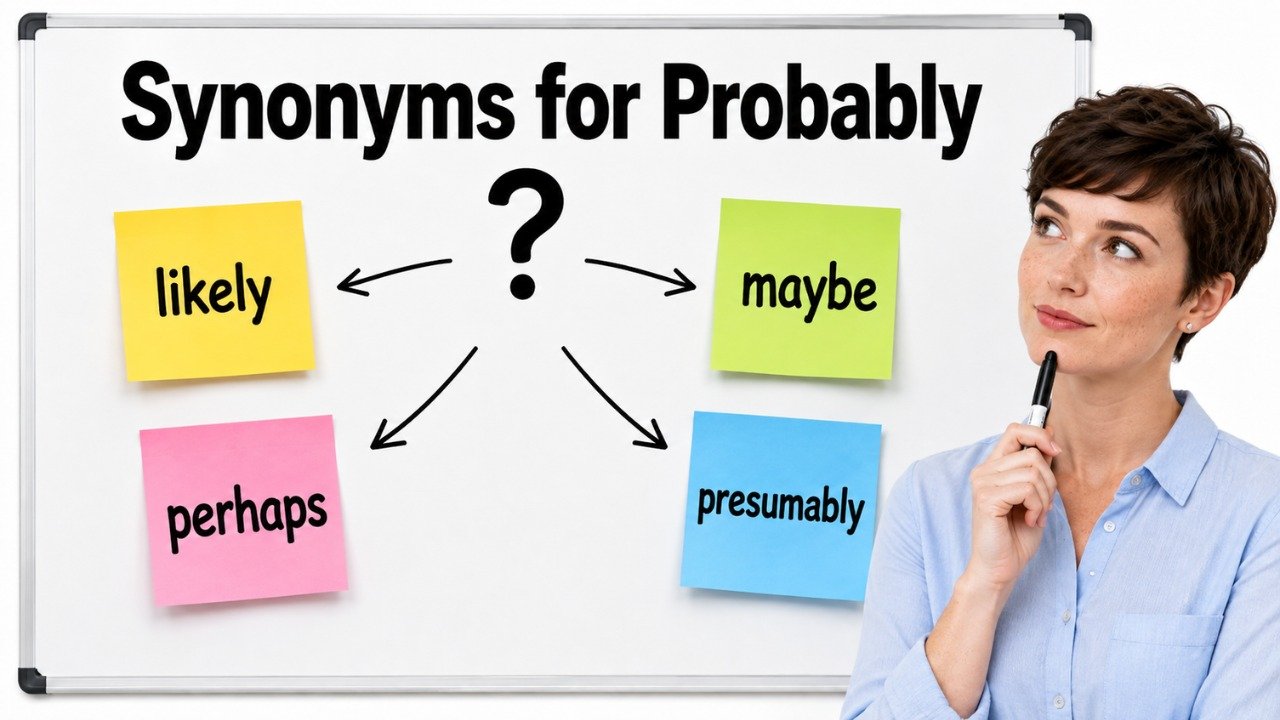
Quick Answer: The best synonyms for probably include likely, presumably, apparently, seemingly, perhaps, possibly, in all likelihood, most likely, presumably so, and chances are. Use likely when something has a strong chance of happening, presumably when making a reasonable assumption, apparently when evidence suggests something is true, and perhaps or possibly when the level of certainty is lower. In formal writing, likely, presumably, and in all likelihood are often strong choices, while chances are works better in casual conversation.
Pronunciation and Word Details
Word: Probably.
Pronunciation: /ˈprɒbəbli/
Part of Speech: Adverb.
Meaning: Probably means that something is likely to happen or be true, although it is not completely certain.
US Pronunciation:
UK Pronunciation:
What Does “Probably” Mean?
Probably means that something is more likely to happen or be true than not, although complete certainty is absent.
It is an adverb commonly used when a speaker or writer believes an event, statement, prediction, or conclusion has a fairly strong chance of being correct.
For example, in the sentence “She will probably arrive before noon,” the speaker expects her to arrive before noon but does not claim complete certainty.
Probably can describe future expectations, conclusions based on evidence, personal assumptions, predictions, and everyday guesses.
It usually expresses more confidence than perhaps or possibly. However, it is weaker than certainly, definitely, or unquestionably.
The word works naturally in casual conversation, professional communication, essays, reports, predictions, and explanatory writing.
Meaning, Tone, and Context of “Probably”
Probably has a neutral and widely usable tone.
It is common in both conversational and formal English because it allows people to express confidence without claiming absolute certainty.
In everyday speech, probably often communicates a practical expectation.
Example: I will probably finish the work this evening.
In formal writing, probably can express a reasonable conclusion when evidence supports an idea but does not prove it completely.
Example: The change probably resulted from several related factors.
In academic or analytical contexts, alternatives such as likely, presumably, apparently, and in all likelihood may sometimes sound more precise.
Probably can also soften a statement. Saying “He probably misunderstood the instructions” sounds less absolute than saying “He misunderstood the instructions.”
This makes the word useful when the available evidence is strong enough for a reasonable conclusion but not strong enough for certainty.
When and How to Use “Probably”
For Strong Possibility
For Strong Possibility: Use probably when something has a good chance of happening but is not guaranteed.
Example: The meeting will probably end before five.
For Predictions
For Predictions: Probably works well when predicting a future event based on current information.
Example: Temperatures will probably rise later in the afternoon.
For Reasonable Assumptions
For Assumptions: Use probably when drawing a sensible conclusion without complete proof.
Example: She probably forgot to check her messages.
For Evidence Based Conclusions
For Evidence: Probably can introduce a conclusion supported by clues or available information.
Example: The delay was probably caused by heavy traffic.
For Personal Expectations
For Expectations: Use probably to describe what you expect will happen.
Example: I will probably stay home this evening.
For Polite Uncertainty
For Polite Uncertainty: Probably can make a statement less forceful or absolute.
Example: We should probably discuss the issue before making a final decision.
For Explaining Causes
For Causes: Probably is useful when suggesting the most reasonable explanation.
Example: The plant probably stopped growing because it received too little sunlight.
Best Synonyms for Probably
Likely
Synonym: Having a strong chance of being true or happening.
Example: She will likely arrive before the presentation begins.
Presumably
Synonym: According to what can reasonably be assumed.
Example: He is presumably aware of the new schedule.
Apparently
Synonym: According to what seems to be true from the available evidence.
Example: Apparently, the problem began earlier in the week.
Seemingly
Synonym: In a way that appears to be true.
Example: The seemingly simple task required considerable attention.
Most Likely
Synonym: More likely than any other possibility.
Example: The most likely explanation is a technical error.
In All Likelihood
Synonym: With a very strong probability.
Example: In all likelihood, the work will be completed tomorrow.
Perhaps
Synonym: Possibly, although with less certainty than probably.
Example: Perhaps she will join us after lunch.
Possibly
Synonym: In a way that may happen or be true.
Example: The package could possibly arrive this afternoon.
Chances Are
Synonym: An informal expression meaning that something is likely.
Example: Chances are, they have already reached their destination.
Conceivably
Synonym: In a way that can reasonably be imagined as possible.
Example: The situation could conceivably improve within a few weeks.
50 Synonyms for Probably with Short Meanings
- Likely: Having a strong chance of being true or happening.
- Presumably: According to a reasonable assumption.
- Apparently: According to what seems to be true.
- Seemingly: In a way that appears to be true.
- Possibly: In a way that may be true or happen.
- Perhaps: Used to express possibility or uncertainty.
- Most Likely: Having the greatest chance of being true.
- In All Likelihood: With a strong probability.
- Very Likely: Having a high chance of occurring.
- Quite Likely: Having a reasonably strong chance.
- More Likely Than Not: More probable than improbable.
- Chances Are: Informally expressing a strong possibility.
- Presumably So: Used when an assumption is considered reasonable.
- As Likely As Not: Having a reasonable or roughly balanced chance.
- Maybe: Informally expressing possibility.
- Perchance: A literary word meaning perhaps.
- Conceivably: In a way that can reasonably be imagined.
- Feasibly: In a way that is practically possible.
- Plausibly: In a way that seems reasonably believable.
- Credibly: In a way that can reasonably be believed.
- Reasonably: According to a sensible expectation or judgment.
- Understandably: In a way that can be logically expected.
- Predictably: In a way that could reasonably be expected.
- Expectedly: In a manner consistent with expectation.
- Naturally: As might normally or reasonably be expected.
- Evidently: According to available signs or evidence.
- Manifestly: In a way that appears clearly evident.
- Ostensibly: According to what appears or is stated to be true.
- Supposedly: According to what is believed or claimed.
- Putatively: According to what is generally supposed or assumed.
- Assumedly: According to an assumption.
- Doubtless: Very probably, with little doubt.
- No Doubt: Used to express strong expectation or probability.
- Almost Certainly: With a very high degree of probability.
- Practically Certain: So likely that little uncertainty remains.
- In All Probability: With a strong likelihood of being true.
- In Probability: According to what is statistically or logically likely.
- By All Appearances: According to what the evidence seems to show.
- By The Look Of It: Based on how the situation appears.
- By The Looks Of Things: Informally, according to present signs.
- As Far As One Can Tell: Based on the information currently available.
- From All Indications: According to the available signs.
- From The Evidence: Based on what the evidence suggests.
- In Expectation: According to what is anticipated.
- With Good Reason: Based on reasonable grounds for belief.
- Reasonably Likely: Having a sensible basis for expectation.
- Highly Likely: Having a very strong chance of being true.
- Strongly Expected: Considered very likely to happen.
- Likely Enough: Having sufficient probability to be expected.
- In The Likely Event: Referring to something expected to happen.
Read Also:
Synonyms for Disturbing
Synonyms for Probably by Context
When Probably Means Likely
When probably expresses a strong chance that something will happen or be true, the best alternatives include likely, most likely, very likely, quite likely, highly likely, and in all likelihood.
Example: She will probably receive the results tomorrow.
Alternative: She will likely receive the results tomorrow.
Likely is one of the closest and most natural replacements for probably.
Example: The road will probably remain busy this evening.
Alternative: In all likelihood, the road will remain busy this evening.
In all likelihood sounds slightly more formal and deliberate.
When Probably Means Presumably
When probably describes a conclusion based on a reasonable assumption, useful alternatives include presumably, assumedly, supposedly, reasonably, and plausibly.
Example: He probably knows about the change.
Alternative: He presumably knows about the change.
Presumably suggests that the speaker has a reasonable basis for the assumption.
When Probably Means Apparently
When probably is based on visible evidence, clues, or reports, apparently, evidently, seemingly, and by all appearances may work better.
Example: The machine probably stopped because of an electrical problem.
Alternative: Apparently, the machine stopped because of an electrical problem.
Apparently emphasizes what the evidence appears to show.
When Probably Means Perhaps
When the speaker wants to communicate weaker certainty, perhaps, maybe, possibly, or conceivably may be better choices.
Example: She will probably attend the event.
Alternative: Perhaps she will attend the event.
Perhaps expresses less confidence than probably.
When Probably Means Almost Certainly
When probability is very strong, alternatives include almost certainly, doubtless, no doubt, practically certain, and highly likely.
Example: They will probably approve the proposal.
Alternative: They will almost certainly approve the proposal.
Almost certainly communicates greater confidence than probably.
When Probably Is Used Casually
In informal conversation, maybe, chances are, by the look of it, and by the looks of things can provide a more natural conversational tone.
Example: He will probably be late.
Alternative: Chances are, he will be late.
Chances are sounds relaxed and conversational.
Another Word for Probably
The best general replacement for probably is likely because it expresses a similar level of confidence and works naturally in many contexts.
However, the best alternative depends on how certain the speaker is and why the conclusion is being made.
Use presumably for reasonable assumptions, apparently for conclusions based on visible evidence, perhaps for weaker possibility, and almost certainly when confidence is especially high.
Original: She will probably finish before noon.
Better Option: She will likely finish before noon.
Original: He probably understands the situation.
Better Option: He presumably understands the situation.
Original: The system probably failed during the night.
Better Option: Apparently, the system failed during the night.
Original: They will probably accept the offer.
Better Option: They will most likely accept the offer.
When Not to Use “Probably”
Probably is useful, but it can sound vague when a more precise level of certainty is available.
When You Are Completely Certain
Do not use probably when the evidence establishes something as certain.
Weak: Water probably freezes under the specified laboratory conditions.
Better: Water freezes under the specified laboratory conditions.
If certainty is justified, probably unnecessarily weakens the statement.
When Probability Is Very Low
Probably suggests that something is more likely than not. If an event has only a small chance, possibly or perhaps may be more accurate.
Weak: He will probably attend, although there is only a slight chance.
Better: He may possibly attend.
When Evidence Is Visible
Apparently or evidently may be more precise when your conclusion comes directly from signs or observations.
Weak: The road is probably closed because several barriers are blocking it.
Better: Apparently, the road is closed because several barriers are blocking it.
When Writing Formal Analysis
Repeated use of probably can make analytical writing sound vague.
Weak: The results probably changed because the conditions probably changed.
Better: The results likely changed because the conditions appear to have shifted.
When Expressing an Assumption
Presumably may clarify that the statement is based on a logical assumption.
Weak: She probably received the invitation.
Better: She presumably received the invitation.
When Repetition Sounds Awkward
Weak: He will probably arrive soon, and he will probably call before he probably enters the building.
Better: He will likely arrive soon and may call before entering the building.
Varied vocabulary improves readability when the meaning remains accurate.
Words Commonly Confused With Probably
Probably vs Possibly: Probably suggests that something is more likely to happen than not. Possibly simply means that something can happen or may be true.
Probably vs Perhaps: Probably communicates stronger confidence. Perhaps introduces a possibility without strongly suggesting that it is likely.
Probably vs Maybe: Both express uncertainty, but maybe is generally more conversational and often indicates weaker certainty.
Probably vs Likely: These words are very close in meaning. Probably is an adverb, while likely can function as an adjective or adverb depending on the sentence.
Probably vs Presumably: Probably focuses on likelihood. Presumably focuses more on what can reasonably be assumed.
Probably vs Apparently: Probably expresses likelihood, while apparently usually suggests that something seems true based on evidence or appearance.
Probably vs Certainly: Probably leaves room for doubt. Certainly expresses strong confidence or complete assurance.
Probably vs Seemingly: Probably evaluates likelihood, while seemingly describes how something appears to be.
Which Synonym Should You Choose?
Choose likely for neutral writing when something has a strong chance of occurring.
Choose most likely when one outcome appears more probable than other possibilities.
Choose presumably in formal writing when making a reasonable assumption.
Choose apparently when evidence or observation suggests that something is true.
Choose seemingly when describing how something appears rather than claiming that it definitely is so.
Choose perhaps when you want to express a moderate or uncertain possibility.
Choose possibly when something may happen but the probability is unclear or relatively low.
Choose almost certainly when the chance is very high and little uncertainty remains.
Choose in all likelihood for formal essays, reports, or analytical writing that requires a polished expression of probability.
Choose chances are in casual speech or informal conversation.
Choose plausibly when discussing an explanation, argument, or possibility that seems believable.
Choose evidently when clues or available information strongly point toward a conclusion.
For formal reports and essays, likely, presumably, apparently, plausibly, and in all likelihood are usually effective choices.
For conversation, probably, maybe, perhaps, and chances are often sound more natural.
Real Life Examples of “Probably” in Sentences
Original: She will probably arrive before dinner.
Better Option: She will likely arrive before dinner.
Original: He probably knows the answer already.
Better Option: He presumably knows the answer already.
Original: The problem probably started yesterday.
Better Option: Apparently, the problem started yesterday.
Original: They will probably choose the cheaper option.
Better Option: They will most likely choose the cheaper option.
Original: It will probably rain later.
Better Option: Rain is quite likely later.
Original: She probably misunderstood the question.
Better Option: She apparently misunderstood the question.
Original: The project will probably succeed.
Better Option: The project is highly likely to succeed.
Original: We should probably leave early.
Better Option: We should perhaps leave early.
Original: He will probably agree with the proposal.
Better Option: Chances are, he will agree with the proposal.
Original: The delay was probably caused by traffic.
Better Option: The delay was presumably caused by traffic.
Synonym Groups and Usage Differences
Strong Probability Group
Likely, most likely, highly likely, very likely, in all likelihood, and almost certainly express a strong chance that something is true or will happen.
Likely is neutral and flexible. Most likely compares one possibility with others, while almost certainly communicates a particularly high level of confidence.
Example: The train will most likely arrive within the next ten minutes.
Moderate Possibility Group
Perhaps, possibly, maybe, conceivably, and feasibly express uncertainty without strongly claiming that an outcome is expected.
These alternatives are usually weaker than probably.
Example: Perhaps the schedule will change before Friday.
Assumption Group
Presumably, assumedly, supposedly, reasonably, and plausibly are useful when a statement is based on an assumption or logical interpretation.
Presumably often suggests that the assumption is sensible unless evidence proves otherwise.
Example: She presumably received the updated instructions.
Evidence Group
Apparently, evidently, seemingly, by all appearances, and from all indications focus on what available evidence seems to suggest.
Apparently is especially common when new information or observations point toward a conclusion.
Example: Apparently, the building will reopen next week.
Very High Confidence Group
Almost certainly, doubtless, no doubt, practically certain, and strongly expected express stronger confidence than probably.
These terms should be used only when the available information supports a high level of certainty.
Example: The changes will almost certainly affect the final result.
Conversational Probability Group
Maybe, chances are, by the look of it, and by the looks of things work naturally in relaxed conversation.
They can make speech sound less formal and more immediate.
Example: Chances are, everyone has already left.
Antonyms of Probably
The opposite of probably depends on whether the contrast involves low probability, impossibility, or certainty in the opposite direction.
Unlikely: Not expected to happen or be true.
Improbably: In a way that is not likely.
Doubtfully: With considerable uncertainty.
Questionably: In a way that creates doubt.
Uncertainly: Without confidence or assurance.
Possibly Not: Expressing a chance that something will not happen.
Probably Not: Indicating that something is more likely not to happen.
Hardly Likely: Very unlikely to happen.
Impossibly: In a way that cannot happen.
Certainly Not: Definitely not true or not going to happen.
Definitely Not: Expressing complete confidence that something will not occur.
Never: At no time, when the context concerns a future event considered impossible.
Comparison: Probably vs Related Words
Probably vs Likely
Probably is an adverb expressing a strong possibility. Likely can serve as an adjective and, in many contexts, an adverb.
Example With Probably: She will probably finish the report today.
Example With Likely: She will likely finish the report today.
The two sentences have nearly the same meaning.
Probably vs Possibly
Probably suggests a stronger chance than possibly.
Example With Probably: The package will probably arrive tomorrow.
Example With Possibly: The package could possibly arrive tomorrow.
The first sentence expresses more confidence.
Probably vs Perhaps
Probably suggests that an outcome is expected. Perhaps simply introduces the possibility.
Example With Probably: He will probably attend the meeting.
Example With Perhaps: Perhaps he will attend the meeting.
Perhaps is less confident.
Probably vs Presumably
Probably describes likelihood, while presumably emphasizes an assumption based on what seems reasonable.
Example With Probably: She probably knows about the change.
Example With Presumably: She presumably knows about the change.
The second sentence highlights logical assumption more clearly.
Probably vs Apparently
Probably expresses a judgment about likelihood. Apparently usually refers to what seems true from available evidence.
Example With Probably: He probably left early.
Example With Apparently: Apparently, he left early.
Apparently suggests that some evidence or information supports the conclusion.
Probably vs Maybe
Probably generally expresses stronger confidence than maybe.
Example With Probably: We will probably finish before sunset.
Example With Maybe: Maybe we will finish before sunset.
Maybe sounds more uncertain and conversational.
Probably vs Certainly
Probably leaves some possibility of error, while certainly expresses much stronger confidence.
Example With Probably: She will probably accept the invitation.
Example With Certainly: She will certainly accept the invitation.
The second sentence sounds much more definite.
Probably vs Seemingly
Probably estimates the chance that something is true. Seemingly describes how something appears.
Example With Probably: The task will probably be easy.
Example With Seemingly: The seemingly easy task became complicated.
The words perform different grammatical and semantic roles.
Common Phrases and Expressions With “Probably”
Probably True: Likely to be accurate or correct.
Probably Not: Likely to be false or unlikely to happen.
Most Probably: Very likely, though often less natural than most likely in many contexts.
Quite Probably: With a reasonably strong likelihood.
Very Probably: With a high degree of likelihood.
Probably Because: Used to introduce a likely explanation or cause.
Probably Means: Used when suggesting the most likely interpretation.
Probably Will: Used when predicting a future action or event.
Probably Would: Used when describing an expected result under certain conditions.
Could Probably: Used to indicate that something is reasonably possible.
Common Mistakes to Avoid
One common mistake is using probably when the speaker actually means possibly.
Probably suggests a relatively strong chance, while possibly only indicates that something could happen.
Incorrect Choice: He will probably win, although his chance is extremely small.
Better Choice: He could possibly win.
Another mistake is combining probably with words that create unnecessary repetition of uncertainty.
Awkward: Maybe she will probably arrive soon.
Better: She will probably arrive soon.
Alternative: Maybe she will arrive soon.
Avoid overusing probably in formal writing.
Repetitive: The increase probably happened because demand probably rose and supply probably fell.
Better: The increase likely occurred because demand appears to have risen while supply declined.
Writers also sometimes confuse probably with presumably.
Use presumably when the main idea is an assumption rather than simply a prediction.
Less Precise: He probably received the notice because it was sent to his registered address.
More Precise: He presumably received the notice because it was sent to his registered address.
Do not replace probably with certainly unless you genuinely mean complete or near complete confidence.
Incorrect: She will certainly attend, although we do not know whether she is available.
Better: She will probably attend if she is available.
Another common issue is unnatural word placement.
Awkward: Probably she will finish before noon.
Natural: She will probably finish before noon.
Beginning a sentence with probably is possible, but the natural position often depends on emphasis and sentence structure.
Finally, avoid choosing a more formal synonym simply because it sounds impressive. The best alternative should clarify the precise degree and basis of uncertainty.
Conclusion
Understanding synonyms for probably helps you express different levels of certainty with greater precision. Likely and most likely are strong general alternatives, while presumably works well for reasonable assumptions and apparently fits conclusions based on evidence. Perhaps, maybe, and possibly communicate weaker possibility, while almost certainly and in all likelihood express stronger confidence. In formal writing, choose the term that accurately reflects the available evidence. In everyday conversation, simpler choices such as likely, maybe, and chances are often sound more natural.
FAQs About Synonyms for Probably
What Is the Best Synonym for Probably?
Likely is one of the closest and most versatile synonyms for probably. It works naturally in predictions, expectations, and statements about strong possibility.
What Is a Formal Synonym for Probably?
Presumably, in all likelihood, apparently, plausibly, and most likely can work well in formal writing depending on the intended meaning.
Is Probably the Same as Possibly?
No. Probably suggests that something has a fairly strong chance of happening, while possibly only means that something may happen.
What Is a Stronger Word Than Probably?
Almost certainly, highly likely, and in all likelihood can express greater confidence than probably.
What Is a Weaker Synonym for Probably?
Perhaps, maybe, possibly, and conceivably usually express less certainty than probably.
What Is the Difference Between Probably and Presumably?
Probably focuses on likelihood. Presumably indicates that something is being reasonably assumed based on available information or circumstances.
Can Likely Replace Probably in a Sentence?
Yes, in many sentences. For example, “She will probably arrive early” can become “She will likely arrive early.” However, sentence structure and tone should always be considered.
