
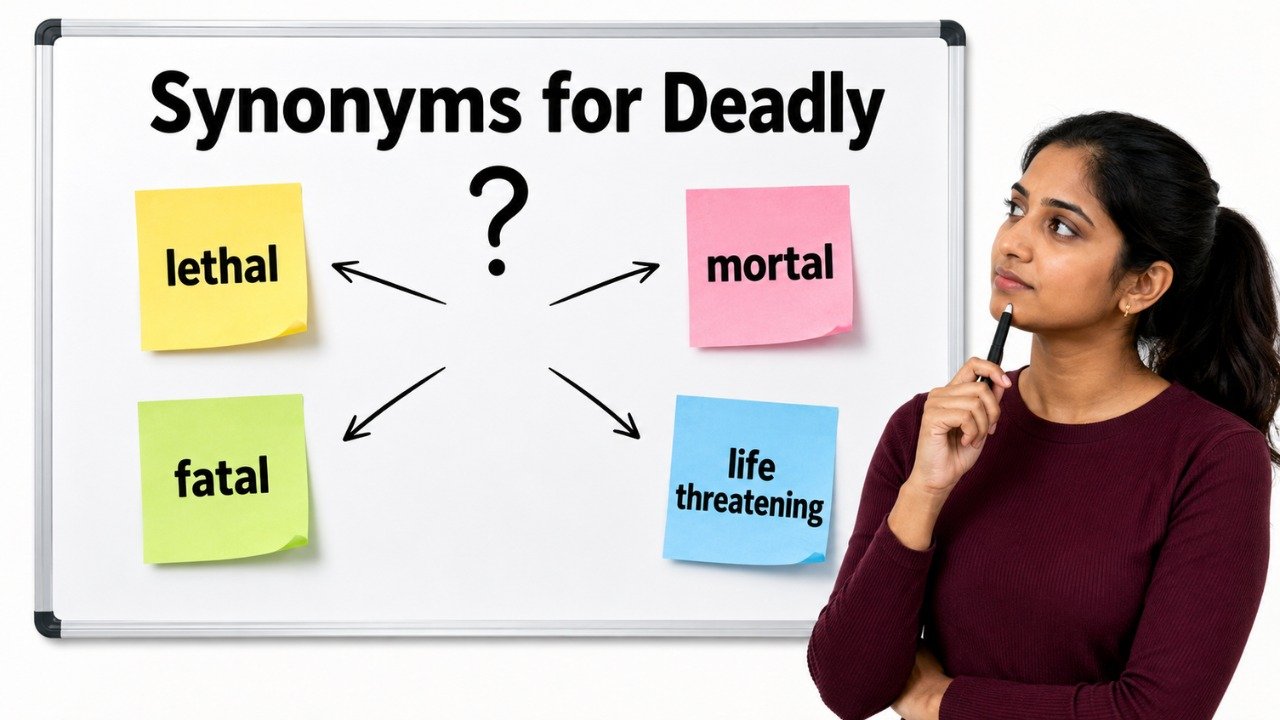
Quick Answer: The best synonyms for deadly include lethal, fatal, mortal, poisonous, toxic, dangerous, life threatening, destructive, devastating, and murderous. Use lethal for something capable of causing death, fatal when death actually results or is expected to result, poisonous or toxic for harmful substances, dangerous for general risk, devastating for severe damage, and mortal when describing a wound, threat, or danger that can cause death.
Pronunciation and Word Details
Word: Deadly
Pronunciation: /ˈdɛdli/
Part of Speech: Adjective and adverb
Meaning: Capable of causing death, extreme harm, serious danger, or severe destruction.
US Pronunciation:
UK Pronunciation:
What Does “Deadly” Mean?
Deadly means capable of causing death, severe injury, extreme danger, or serious destruction. It is most commonly used as an adjective, although it can also function as an adverb in expressions such as deadly serious or deadly accurate.
The word is often used for diseases, weapons, substances, animals, accidents, conditions, forces, and situations that may kill or cause major harm.
Example: The chemical can be deadly if swallowed.
Deadly can also be used more broadly to emphasize severity rather than literal death.
Example: The combination of poor visibility and high speed created a deadly situation.
In expressions such as deadly serious, the word acts as an intensifier and means extremely or completely.
Example: She was deadly serious about the warning.
Understanding the context is important because deadly does not always mean that death has already occurred. It can describe something that has the power or potential to cause death.
Meaning, Tone, and Context of “Deadly”
Deadly is a strong word with a serious and often alarming tone. It usually signals danger, severe consequences, or the possibility of death.
Neutral Tone: Deadly can be neutral when describing an objective danger, such as a deadly disease or deadly toxin.
Strong Tone: The word becomes powerful when used to emphasize immediate risk or serious consequences.
Formal Tone: In reports, essays, and serious informational writing, lethal, fatal, toxic, and life threatening may sometimes be more precise alternatives.
Conversational Tone: Deadly is natural in everyday speech when discussing severe danger.
Medical Context: Deadly may describe diseases, infections, conditions, or substances capable of causing death.
Safety Context: The word can describe hazards, accidents, weather conditions, chemicals, and unsafe environments.
Literary Context: Deadly can create tension when describing weapons, enemies, attacks, threats, or dangerous settings.
Figurative Context: It may intensify another adjective, as in deadly serious, deadly quiet, or deadly accurate.
Because deadly carries significant emotional weight, writers should choose it when the risk or severity genuinely supports such strong language.
When and How to Use “Deadly”
For Life Threatening Danger: Use deadly when something can realistically cause death.
Example: The untreated infection can become deadly.
For Dangerous Substances: Deadly works for poisons, chemicals, gases, and toxins that can cause fatal harm.
Example: The laboratory stored several deadly substances under strict controls.
For Severe Accidents: Use deadly when an accident, collision, or event results in or presents a serious risk of death.
Example: Poor visibility contributed to a deadly crash.
For Dangerous Animals or Organisms: Deadly can describe creatures whose venom, poison, or attacks may kill.
Example: The region contains several deadly species of snake.
For Powerful Weapons: Deadly is suitable when a weapon or attack has the capacity to kill.
Example: The weapon became deadly at close range.
For Extreme Emphasis: Deadly can function as an intensifier in certain expressions.
Example: She remained deadly serious throughout the discussion.
Best Synonyms for Deadly
Lethal: Capable of causing death.
Example: Even a small amount of the substance can be lethal.
Fatal: Causing or resulting in death.
Example: The driver suffered fatal injuries.
Mortal: Capable of causing death, especially when describing wounds or danger.
Example: The soldier received a mortal wound.
Poisonous: Containing poison that can cause illness, injury, or death.
Example: The berries are poisonous if eaten.
Toxic: Harmful or poisonous to living organisms.
Example: Toxic fumes filled the enclosed area.
Dangerous: Likely to cause harm, injury, or serious problems.
Example: Driving in such heavy fog can be dangerous.
Life Threatening: Serious enough to put someone’s life at risk.
Example: The patient developed a life threatening infection.
Destructive: Causing severe damage or ruin.
Example: The storm brought destructive winds to the coast.
Devastating: Causing extremely serious damage, loss, or suffering.
Example: The flooding had a devastating effect on the town.
Murderous: Capable of killing or connected with an intention to kill.
Example: The attack was carried out with murderous force.
50 Synonyms for Deadly with Short Meanings
- Lethal: Capable of causing death.
- Fatal: Causing death or ending in death.
- Mortal: Capable of causing death.
- Poisonous: Containing poison that may cause serious harm.
- Toxic: Harmful or poisonous to living things.
- Dangerous: Likely to cause injury, harm, or death.
- Life Threatening: Serious enough to endanger life.
- Destructive: Causing severe damage or ruin.
- Devastating: Causing extreme destruction or suffering.
- Murderous: Capable of killing or showing an intent to kill.
- Killing: Causing or capable of causing death.
- Deathly: Associated with death or resembling death.
- Pernicious: Causing serious harm, often gradually.
- Noxious: Harmful, poisonous, or unhealthy.
- Venomous: Producing venom capable of causing serious injury.
- Virulent: Extremely harmful or severe, especially of disease.
- Malignant: Dangerous, harmful, or likely to worsen.
- Hazardous: Involving substantial risk or danger.
- Perilous: Full of serious danger.
- Unsafe: Not protected from harm or danger.
- Risky: Involving a significant possibility of harm.
- Treacherous: Dangerous in a hidden or unpredictable way.
- Menacing: Suggesting danger or harm.
- Threatening: Indicating possible harm or danger.
- Dire: Extremely serious or dangerous.
- Grave: Very serious and potentially dangerous.
- Severe: Extremely serious in effect or intensity.
- Critical: Extremely serious and requiring urgent attention.
- Catastrophic: Causing enormous damage or loss.
- Disastrous: Causing severe damage or failure.
- Ruinous: Causing destruction, loss, or serious harm.
- Harmful: Causing damage, injury, or negative effects.
- Injurious: Causing physical or other forms of harm.
- Deadly Serious: Completely serious and not joking.
- Potent: Powerful enough to produce a strong effect.
- Powerful: Having great strength or force.
- Savage: Fierce, violent, or brutally destructive.
- Ferocious: Extremely fierce and dangerous.
- Vicious: Violent, cruel, or likely to cause serious harm.
- Brutal: Extremely violent, harsh, or damaging.
- Violent: Involving strong physical force that can cause injury.
- Doomful: Suggesting destruction or terrible consequences.
- Baleful: Threatening harm or destruction.
- Sinister: Suggesting something harmful or dangerous.
- Ominous: Suggesting that something bad may happen.
- Deadly Effective: Extremely effective, especially in a dangerous way.
- Deadly Accurate: Extremely precise or accurate.
- Extreme: Reaching a very serious or intense degree.
- Grievous: Causing severe harm, suffering, or injury.
- Calamitous: Causing great damage, suffering, or disaster.
Read Also:
Synonyms for Nurture

Synonyms for Deadly by Context
When Deadly Means Capable of Causing Death
Lethal, fatal, mortal, and killing are strong choices when death is the central meaning.
Lethal Example: The gas becomes lethal at high concentrations.
Fatal Example: The injury proved fatal.
Mortal Example: The warrior suffered a mortal wound.
Killing Example: The disease can spread with killing efficiency under severe conditions.
Lethal usually describes the ability to cause death, while fatal often describes an outcome in which death actually occurs.
When Deadly Means Poisonous or Toxic
Poisonous, toxic, noxious, venomous, and virulent fit situations involving substances, organisms, diseases, or biological danger.
Poisonous Example: The plant produces poisonous berries.
Toxic Example: Workers were exposed to toxic chemicals.
Noxious Example: Noxious fumes escaped from the damaged container.
Venomous Example: The snake is venomous and potentially dangerous.
Virulent Example: The infection was caused by a particularly virulent strain.
These terms provide more detail than deadly because they identify the type of danger.
When Deadly Means Generally Dangerous
Dangerous, hazardous, perilous, risky, unsafe, and treacherous describe situations where serious harm is possible.
Dangerous Example: The icy road became dangerous after sunset.
Hazardous Example: Handling the material without protection is hazardous.
Perilous Example: The climbers faced a perilous journey.
Risky Example: Crossing the river during the storm would be risky.
Treacherous Example: Ice made the mountain path treacherous.
These words do not automatically imply death, making them useful when the danger is serious but not necessarily fatal.
When Deadly Means Destructive
Destructive, devastating, catastrophic, disastrous, ruinous, and calamitous emphasize severe damage or consequences.
Destructive Example: The hurricane produced destructive winds.
Devastating Example: The earthquake had devastating consequences.
Catastrophic Example: A structural failure could be catastrophic.
Disastrous Example: The decision had disastrous results.
Calamitous Example: The region faced calamitous flooding.
These alternatives are especially useful when the primary meaning is damage rather than death.
When Deadly Means Extremely Serious
Dire, grave, severe, and critical work well when deadly refers to extreme seriousness.
Dire Example: The community faced a dire shortage of clean water.
Grave Example: Doctors considered his condition grave.
Severe Example: The storm caused severe damage.
Critical Example: The patient remained in critical condition.
These choices are useful in formal writing when the writer wants to avoid suggesting certain death.
When Deadly Is Used for Emphasis
In expressions such as deadly serious or deadly accurate, deadly means extremely, completely, or remarkably.
Deadly Serious Example: She was deadly serious about improving safety.
Deadly Accurate Example: His prediction was deadly accurate.
In these contexts, literal synonyms such as fatal or lethal would usually sound unnatural.
Another Word for Deadly
Lethal is often the best single replacement for deadly when the meaning is capable of causing death. However, the ideal alternative depends on whether you are describing an actual fatal outcome, a dangerous substance, a risky situation, severe destruction, or figurative emphasis.
Original: The chemical can be deadly in large amounts.
Better Option: The chemical can be lethal in large amounts.
Original: The disease became deadly without proper treatment.
Better Option: The disease became life threatening without proper treatment.
Original: The building contained deadly fumes.
Better Option: The building contained toxic fumes.
Original: The storm created deadly conditions on the road.
Better Option: The storm created hazardous conditions on the road.
When Not to Use “Deadly”
Deadly can be too strong when a situation involves only minor or moderate risk.
Weak: The wet floor created a deadly inconvenience.
Better: The wet floor created a safety hazard.
Avoid using deadly when a more specific word explains the danger better.
Weak: The container held deadly liquid.
Better: The container held toxic liquid.
Deadly may also sound exaggerated when describing ordinary problems.
Weak: The delayed meeting created deadly consequences for the schedule.
Better: The delayed meeting created serious consequences for the schedule.
When discussing an event that actually caused death, fatal may be more precise than deadly.
Weak: He suffered a deadly injury and died shortly afterward.
Better: He suffered a fatal injury.
When describing a danger that could cause death but has not done so, lethal or life threatening may communicate the meaning more accurately.
Weak: The untreated condition was fatal, but the patient recovered.
Better: The untreated condition was potentially deadly, but the patient recovered.
Words Commonly Confused With Deadly
Deadly vs Lethal: Deadly and lethal can both mean capable of causing death. Lethal often sounds more technical or precise.
Deadly vs Fatal: Deadly describes something capable of causing death, while fatal often describes something that actually causes death.
Deadly vs Mortal: Mortal commonly describes wounds, dangers, enemies, or conditions related to death. It often sounds more literary than deadly.
Deadly vs Dangerous: Dangerous means likely to cause harm. Deadly is stronger because it specifically suggests the possibility of death.
Deadly vs Toxic: Toxic specifically refers to poisonous or harmful effects, especially involving substances or biological exposure. Deadly has a broader meaning.
Deadly vs Poisonous: Poisonous usually describes something containing poison that causes harm if touched, eaten, inhaled, or absorbed. Deadly can describe many kinds of danger.
Deadly vs Life Threatening: Life threatening directly describes something serious enough to endanger life. Deadly is shorter and often more dramatic.
Deadly vs Devastating: Deadly emphasizes death or extreme danger, while devastating focuses on severe damage, emotional loss, or destruction.
Which Synonym Should You Choose?
Choose lethal when writing about weapons, chemicals, substances, doses, injuries, or forces capable of causing death.
Choose fatal when death is the actual result or expected outcome.
Choose mortal for wounds, threats, dangers, or literary descriptions involving death.
Choose toxic when describing chemicals, fumes, gases, materials, or substances harmful to living things.
Choose poisonous when something contains or produces poison.
Choose dangerous for everyday conversation when the risk is serious but not necessarily deadly.
Choose hazardous in reports, instructions, workplace writing, or formal descriptions of risk.
Choose life threatening when discussing medical conditions, injuries, emergencies, or situations that place life in immediate danger.
Choose devastating when the main idea is severe damage, destruction, or emotional impact rather than death itself.
Choose catastrophic when describing extremely large scale damage or disastrous consequences.
For essays and formal reports, choose the most precise term rather than automatically selecting the strongest one.
Real Life Examples of “Deadly” in Sentences
Original: The infection can become deadly without treatment.
Better Option: The infection can become life threatening without treatment.
Original: The bottle contained a deadly chemical.
Better Option: The bottle contained a toxic chemical.
Original: The snake can deliver a deadly bite.
Better Option: The snake can deliver a lethal bite.
Original: The collision became one of the region’s most deadly accidents.
Better Option: The collision became one of the region’s most fatal accidents.
Original: Heavy snow created deadly driving conditions.
Better Option: Heavy snow created hazardous driving conditions.
Original: The weapon was deadly at close range.
Better Option: The weapon was lethal at close range.
Original: The storm produced deadly winds along the coast.
Better Option: The storm produced destructive winds along the coast.
Original: Doctors recognized the deadly nature of the infection.
Better Option: Doctors recognized the grave danger posed by the infection.
Original: The gas becomes deadly inside enclosed spaces.
Better Option: The gas becomes lethal inside enclosed spaces.
Original: She gave him a deadly serious warning.
Better Option: She gave him an extremely serious warning.
Synonym Groups and Usage Differences
Death Causing Group
Lethal, fatal, mortal, and killing directly relate to death. Lethal focuses on capability, fatal on outcome, and mortal often appears with wounds or serious threats.
Example: The substance becomes lethal above a certain concentration.
Poison and Biological Danger Group
Toxic, poisonous, noxious, venomous, virulent, and malignant relate to biological, chemical, or medical harm.
Example: The damaged container released toxic fumes.
General Danger Group
Dangerous, hazardous, perilous, unsafe, risky, and treacherous describe significant risk without necessarily implying death.
Example: The narrow mountain road becomes treacherous during heavy rain.
Severe Consequences Group
Dire, grave, critical, and severe emphasize seriousness and urgency.
Example: The patient remained in critical condition overnight.
Destruction Group
Destructive, devastating, disastrous, catastrophic, ruinous, and calamitous focus on severe damage.
Example: The flooding had devastating consequences for the region.
Violent Danger Group
Murderous, savage, ferocious, vicious, brutal, and violent emphasize aggression or extreme physical force.
Example: The animal launched a ferocious attack when threatened.
Threatening Tone Group
Menacing, threatening, ominous, sinister, baleful, and doomful suggest approaching danger or harm.
Example: Dark clouds created an ominous atmosphere before the storm.
Antonyms of Deadly
The opposite of deadly changes according to whether the meaning involves danger, harm, toxicity, or severity.
Safe: Free from serious danger or risk.
Harmless: Unable or unlikely to cause harm.
Benign: Not dangerous or harmful, especially in medical contexts.
Nontoxic: Not poisonous or harmful through toxicity.
Nonfatal: Not resulting in death.
Survivable: Capable of being endured without causing death.
Protective: Designed to prevent harm or danger.
Secure: Protected against risk or threat.
Mild: Limited in severity or intensity.
Gentle: Not harsh, violent, or damaging.
Beneficial: Producing a positive or helpful effect.
Healing: Helping restore health rather than causing injury.
Comparison: Deadly vs Related Words
Deadly vs Lethal
Deadly and lethal both describe something capable of causing death. Lethal is often more precise and is common when describing doses, weapons, substances, or force.
Example With Deadly: The fumes can be deadly in an enclosed room.
Example With Lethal: The fumes can reach lethal concentrations in an enclosed room.
Deadly vs Fatal
Deadly describes the potential or ability to cause death. Fatal usually describes an event, condition, injury, or result that causes death.
Example With Deadly: The disease can become deadly if untreated.
Example With Fatal: The untreated disease proved fatal.
Deadly vs Dangerous
Dangerous covers a broader range of risk. Something can be dangerous without being capable of causing death.
Example With Deadly: The substance is deadly if swallowed in sufficient quantities.
Example With Dangerous: The slippery path is dangerous after heavy rain.
Deadly vs Toxic
Deadly describes the seriousness of the danger. Toxic identifies a specific type of danger involving poisonous effects.
Example With Deadly: The fumes may be deadly.
Example With Toxic: The factory released toxic fumes.
Deadly vs Poisonous
Deadly can describe any life threatening danger. Poisonous specifically means containing poison or causing harm through poison.
Example With Deadly: The plant can be deadly if consumed in large amounts.
Example With Poisonous: The plant produces poisonous berries.
Deadly vs Life Threatening
Both can describe severe danger to life. Life threatening is often more precise in medical or safety contexts.
Example With Deadly: The infection became deadly.
Example With Life Threatening: The infection became life threatening.
Deadly vs Devastating
Deadly emphasizes death or severe danger. Devastating emphasizes extreme damage, suffering, loss, or emotional impact.
Example With Deadly: The wildfire created deadly conditions.
Example With Devastating: The wildfire had a devastating effect on nearby communities.
Common Phrases and Expressions With Deadly
Deadly Disease: A disease capable of causing death.
Deadly Weapon: A weapon capable of causing fatal injury.
Deadly Poison: A poisonous substance strong enough to cause death.
Deadly Force: Physical force capable of causing death or extremely serious injury.
Deadly Accident: An accident that causes one or more deaths.
Deadly Combination: Two or more factors that together create extreme danger.
Deadly Threat: A danger that may lead to death or severe harm.
Deadly Serious: Completely serious and not joking.
Deadly Accurate: Extremely accurate or precise.
Deadly Silence: An unusually intense or uncomfortable silence.
Common Mistakes to Avoid
A common mistake is assuming that deadly, lethal, and fatal always mean exactly the same thing. Lethal usually describes the capability to kill, while fatal commonly describes an outcome that results in death.
Avoid using deadly when the danger is relatively minor. Calling every risky situation deadly can make writing sound exaggerated and reduce the impact of genuinely serious warnings.
Another mistake is choosing a vague word when a specific synonym would communicate more information. Toxic may be better than deadly for harmful chemicals. Venomous may be better for an animal that injects venom. Hazardous may be better for a risky working environment.
Do not confuse deadly with deathly. Deadly generally means capable of causing death or extremely dangerous. Deathly usually means resembling death, as in deathly pale or deathly silence.
Writers should also avoid unnecessary repetition. If deadly appears several times in a paragraph, consider whether lethal, fatal, dangerous, toxic, severe, or devastating would communicate the intended meaning more precisely.
Be careful with figurative expressions. In deadly serious, deadly means extremely. Replacing it with fatal serious or lethal serious would be unnatural.
Finally, consider whether death is actually part of the meaning. If the sentence concerns severe damage without a realistic threat to life, destructive, catastrophic, or devastating may be better choices.
Conclusion
Understanding synonyms for deadly makes it easier to describe danger with the right degree of precision. Lethal is ideal for something capable of causing death, while fatal describes an outcome that results in death. Toxic and poisonous fit harmful substances, hazardous and dangerous suit general risk, and life threatening works well in medical contexts. For severe destruction, devastating or catastrophic may be more accurate. Choosing the synonym that matches the exact type and intensity of danger makes writing clearer, stronger, and more natural.
FAQs About Synonyms for Deadly
What Is the Best Synonym for Deadly?
Lethal is the strongest general synonym when deadly means capable of causing death. Dangerous is better when the risk is serious but not necessarily fatal.
What Is a Formal Synonym for Deadly?
Lethal, fatal, hazardous, toxic, and life threatening are useful formal alternatives. The best choice depends on the type of danger being described.
What Is the Difference Between Deadly and Fatal?
Deadly usually means capable of causing death. Fatal commonly means actually resulting in death.
Is Lethal the Same as Deadly?
They are very close in meaning. Lethal often sounds more technical and specifically emphasizes the ability to cause death.
What Is Another Word for Deadly Poison?
Lethal poison, toxic substance, and poisonous substance can work depending on the sentence. Toxic is especially useful when focusing on harmful chemical effects.
What Is a Synonym for Deadly Danger?
Life threatening, perilous, hazardous, grave, and extreme danger are useful alternatives depending on the level and type of risk.
Can Deadly Mean Extremely?
Yes. In expressions such as deadly serious or deadly accurate, deadly functions as an intensifier meaning extremely or completely.
