
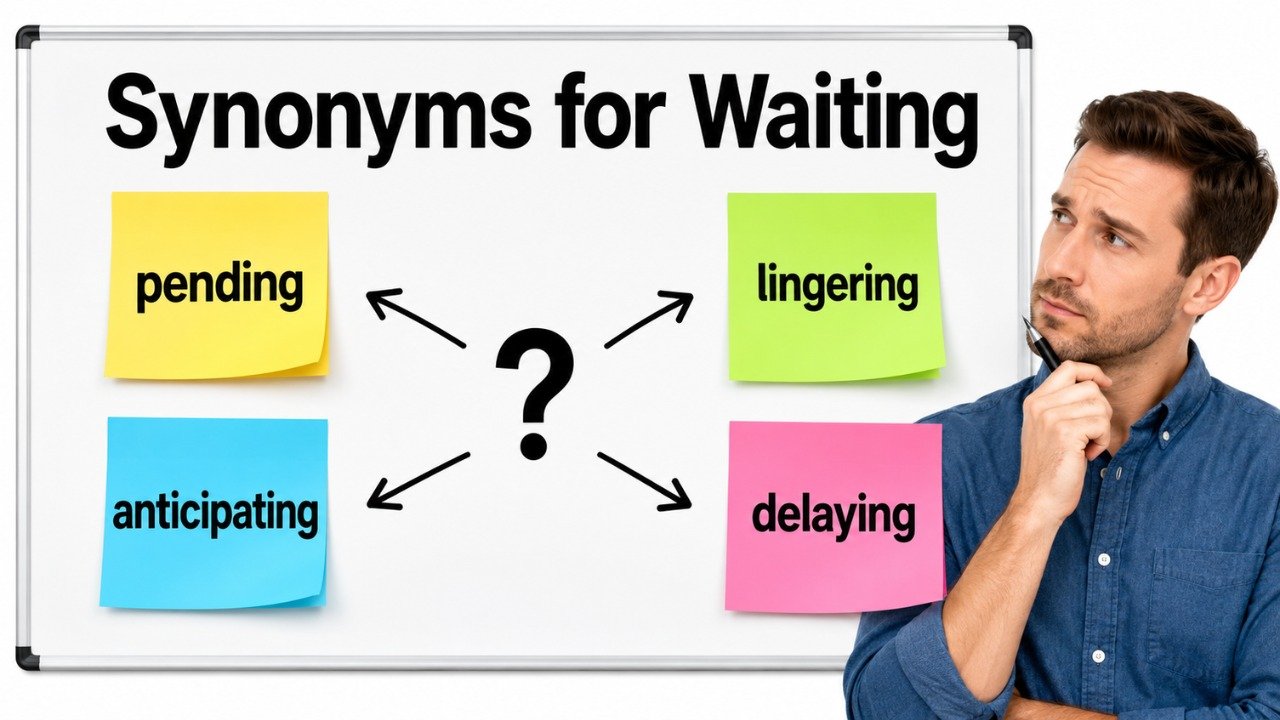
Quick Answer: The best synonyms for waiting include awaiting, lingering, staying, remaining, pausing, delaying, standing by, holding, expecting, and anticipating. Use awaiting when expecting a person, event, or result, lingering when remaining longer than expected, standing by when ready for action, holding when temporarily remaining in place, anticipating when looking forward to something, and delaying when an action is intentionally postponed. Among synonyms for waiting, the best replacement depends on whether the context involves expectation, delay, patience, readiness, or remaining somewhere.
Pronunciation and Word Details
Word: Waiting.
Pronunciation: /ˈweɪtɪŋ/
Part of Speech: Noun, adjective, and present participle of the verb wait.
Meaning: Remaining in place or delaying action until someone arrives, something happens, or the right time comes.
US Pronunciation:
UK Pronunciation:
What Does “Waiting” Mean?
Waiting means staying in a place, delaying an action, or allowing time to pass until something expected happens.
The word waiting is commonly used as the present participle of wait. It can also function as a noun when referring to the act or experience of waiting.
As a Verb Form: She is waiting for the bus.
As a Noun: Waiting can become frustrating when there is no clear timetable.
As an Adjective: The waiting passengers moved toward the entrance.
Waiting can describe physical delay, emotional expectation, readiness, patience, or the period before a decision, event, arrival, or response.
Someone may be waiting for a friend, waiting for news, waiting for permission, waiting for an opportunity, or waiting for the right moment to act.
The meaning changes slightly according to context. Waiting for a person usually means remaining until that person arrives. Waiting for an answer means expecting a response. Waiting to act means deliberately delaying action until conditions are suitable.
Meaning, Tone, and Context of “Waiting”
Waiting is a neutral and widely used word. It appears naturally in casual conversation, formal writing, professional communication, storytelling, academic discussion, and practical instructions.
Neutral Tone: Waiting usually carries no strong emotion by itself.
Casual Context: People commonly use waiting when talking about transportation, appointments, friends, meals, messages, and everyday plans.
Professional Context: Waiting may describe pending approval, delayed decisions, scheduled actions, or unfinished processes.
Emotional Context: Waiting can suggest hope, anxiety, impatience, excitement, uncertainty, or anticipation depending on what a person expects.
Formal Context: In formal writing, awaiting, pending, remaining, or anticipating may sometimes sound more precise.
Conversational Context: In everyday speech, waiting is often simpler and more natural than formal alternatives.
Technical Context: Waiting can describe a process that has paused until a condition, signal, resource, or event becomes available.
The word itself is flexible. The surrounding sentence usually determines whether waiting feels calm, frustrating, hopeful, uncertain, or necessary.
When and How to Use “Waiting”
Use waiting when someone or something remains inactive, stays somewhere, or expects a future event.
For a Person to Arrive: Use waiting when someone remains somewhere until another person comes.
Example: I am waiting for my sister outside the building.
For a Response: Waiting works when someone expects an answer, decision, message, or result.
Example: We are waiting for confirmation before making plans.
For an Event: Use waiting when something is expected to happen in the future.
Example: The children were waiting for the performance to begin.
For the Right Time: Waiting can describe deliberately postponing action until conditions improve.
Example: She is waiting for the right moment to speak.
For Readiness: Waiting can indicate that someone is prepared but has not yet been asked to act.
Example: The team is waiting for further instructions.
For Delay: Waiting can describe time spent before a service, appointment, journey, or activity begins.
Example: We spent twenty minutes waiting for our appointment.
For Expectation: Waiting can carry an emotional sense of hoping or expecting something.
Example: He was waiting eagerly for the final result.
For Patience: Waiting may describe choosing not to act immediately.
Example: She decided that waiting was better than making a rushed decision.
Best Synonyms for Waiting
Awaiting: Expecting someone or something to arrive or happen.
Example: The committee is awaiting the final report.
Lingering: Remaining somewhere longer than expected or necessary.
Example: Several visitors were lingering near the entrance.
Staying: Continuing to remain in a particular place.
Example: She is staying here until the weather improves.
Remaining: Continuing to be in the same place or condition.
Example: The passengers remained inside until the doors opened.
Pausing: Temporarily stopping before continuing.
Example: He paused before giving his answer.
Standing By: Remaining ready to act when needed.
Example: The support team is standing by for further instructions.
Holding: Remaining temporarily in a position or situation.
Example: The callers are holding until an adviser becomes available.
Expecting: Believing that someone or something will arrive or happen.
Example: We are expecting a response later this afternoon.
Anticipating: Expecting something while thinking about its arrival or outcome.
Example: She was anticipating the announcement with excitement.
Delaying: Postponing an action, event, or decision until later.
Example: They are delaying the meeting until everyone can attend.
50 Synonyms for Waiting with Short Meanings
- Awaiting: Expecting something to happen or arrive.
- Lingering: Remaining longer than necessary or expected.
- Staying: Continuing to remain in one place.
- Remaining: Continuing to be present or unchanged.
- Pausing: Stopping temporarily before continuing.
- Delaying: Putting an action or event off until later.
- Holding: Remaining temporarily in a position or state.
- Expecting: Believing that something will happen soon.
- Anticipating: Looking forward to or expecting something.
- Standing By: Remaining ready for action.
- Tarrying: Staying somewhere longer than expected.
- Loitering: Remaining in a place without an obvious purpose.
- Biding: Patiently allowing time to pass before acting.
- Postponing: Moving an action or event to a later time.
- Deferring: Delaying something until a future time.
- Hesitating: Pausing because of uncertainty.
- Resting: Remaining inactive for a period.
- Stopping: Ceasing movement or activity temporarily.
- Sitting: Remaining seated while expecting something.
- Standing: Remaining upright in one place.
- Queuing: Forming or remaining in a line for service.
- Lining Up: Waiting in an ordered line.
- Holding On: Continuing to wait or remain patient.
- Hanging Around: Staying somewhere while waiting informally.
- Remaining Ready: Staying prepared for future action.
- Keeping Watch: Waiting while observing for someone or something.
- Watching: Looking attentively while expecting an event.
- Expecting Arrival: Waiting for someone or something to come.
- Pending: Remaining undecided, unfinished, or unresolved.
- Suspended: Temporarily stopped until something changes.
- On Hold: Temporarily delayed while awaiting further action.
- In Reserve: Kept available until needed.
- At the Ready: Prepared to act immediately when required.
- Patiently Remaining: Staying without acting while time passes.
- Abiding: Remaining or continuing in a place or condition.
- Dwelling: Staying in a place for a period.
- Hovering: Remaining nearby while expecting something.
- Expectant: Showing that something is anticipated.
- Poised: Ready and prepared to act.
- Ready: Prepared for something that is expected.
- Idle: Temporarily inactive while nothing is happening.
- Inactive: Not currently taking action.
- Stationary: Remaining in the same position.
- Delayed: Prevented from happening at the expected time.
- Deferred: Postponed until later.
- Held Back: Temporarily prevented from moving or proceeding.
- Marking Time: Passing time while waiting for something else.
- Biding Time: Waiting patiently for a suitable moment.
- Looking Forward: Expecting something with interest or pleasure.
- Remaining Patient: Continuing to wait calmly.
Read Also:
Synonyms for Deadly
Synonyms for Waiting by Context
When Waiting Means Expecting Something
Awaiting, expecting, anticipating, and looking forward are useful when someone knows or believes that something will happen.
Awaiting: Often sounds more formal than waiting.
Example: The staff are awaiting further instructions.
Expecting: Suggests believing that someone or something will arrive.
Example: We are expecting several visitors this afternoon.
Anticipating: Often adds a sense of thought, interest, excitement, or concern about the future.
Example: She was anticipating the results with nervous excitement.
Looking Forward: Works when the expected event is positive or enjoyable.
Example: They are looking forward to seeing their family.
When Waiting Means Remaining Somewhere
Staying, remaining, lingering, tarrying, and hanging around describe continuing to be in a place.
Staying: Neutral and natural in everyday speech.
Example: I am staying here until the rain stops.
Remaining: Slightly more formal and useful when emphasizing continued presence.
Example: Several passengers remained near the gate.
Lingering: Suggests staying longer than expected or necessary.
Example: The guests lingered after dinner.
Tarrying: A more literary word for delaying or remaining somewhere.
Example: The travelers tarried at the village before continuing.
When Waiting Means Being Ready
Standing by, poised, ready, at the ready, and remaining ready describe someone who is waiting but prepared to act.
Standing By: Common when a person or group is prepared for instructions.
Example: The team is standing by to begin.
Poised: Suggests being prepared to act at the right moment.
Example: She was poised to respond as soon as the signal arrived.
At the Ready: Emphasizes immediate preparedness.
Example: The equipment was kept at the ready.
When Waiting Means Delaying Action
Pausing, postponing, deferring, hesitating, and delaying are useful when an action does not happen immediately.
Pausing: Suggests a short temporary stop.
Example: She paused before answering the difficult question.
Postponing: Means deliberately moving something to a later time.
Example: They are postponing the discussion until tomorrow.
Deferring: A formal alternative for delaying a decision or action.
Example: The board is deferring its decision until more information is available.
Hesitating: Suggests delay caused by uncertainty.
Example: He hesitated before accepting the offer.
When Waiting Means Passing Time Patiently
Biding time, marking time, holding on, and remaining patient are useful when the focus is on allowing time to pass.
Biding Time: Suggests waiting patiently for the right opportunity.
Example: She was biding time until a better opportunity appeared.
Marking Time: Suggests passing time without making much progress.
Example: The workers were marking time until the materials arrived.
Holding On: Common in conversation when someone is asked to continue waiting.
Example: Please hold on while I check the information.
Another Word for Waiting
Awaiting is one of the best single alternatives to waiting when the sentence involves expecting an event, answer, person, or result. However, it cannot replace waiting naturally in every situation.
Use remaining when the focus is on staying somewhere, standing by when readiness matters, anticipating when emotion or expectation is important, and delaying when an action has been postponed.
Original: We are waiting for the final decision.
Better Option: We are awaiting the final decision.
Original: The staff are waiting for instructions.
Better Option: The staff are standing by for instructions.
Original: She was waiting excitedly for the celebration.
Better Option: She was anticipating the celebration with excitement.
Original: They were waiting inside until the storm passed.
Better Option: They were remaining inside until the storm passed.
When Not to Use “Waiting”
Waiting is a useful general word, but a more specific synonym may communicate the situation more clearly.
Avoid repeating waiting several times in the same paragraph when different kinds of delay or expectation are involved.
Weak: We are waiting for the decision, and the manager is waiting for more information.
Better: We are awaiting the decision, while the manager is expecting more information.
The improved version makes the two situations easier to distinguish.
Use another word when waiting sounds vague.
Weak: The equipment is waiting for use.
Better: The equipment is standing by for use.
Standing by communicates readiness more precisely.
Avoid waiting when the action is actually being deliberately postponed.
Weak: They are waiting to hold the meeting until next week.
Better: They are postponing the meeting until next week.
Avoid using formal alternatives unnecessarily in casual conversation.
Weak: I am awaiting my friend outside the café.
Better: I am waiting for my friend outside the café.
Awaiting is grammatically possible, but waiting sounds more natural in ordinary conversation.
Words Commonly Confused With Waiting
Waiting vs Awaiting: Waiting usually requires for before the thing being expected, as in waiting for an answer. Awaiting normally takes a direct object, as in awaiting an answer.
Waiting vs Expecting: Waiting describes remaining until something happens. Expecting focuses more strongly on believing that something will happen.
Waiting vs Anticipating: Waiting refers to allowing time to pass until an event occurs. Anticipating includes mentally looking ahead to that event.
Waiting vs Delaying: Waiting may happen because someone or something has not arrived yet. Delaying usually means causing or choosing postponement.
Waiting vs Lingering: Waiting has a clear expected endpoint. Lingering suggests remaining longer than necessary or expected.
Waiting vs Hesitating: Waiting may be intentional or unavoidable. Hesitating usually happens because someone is uncertain about what to do.
Waiting vs Pending: Waiting usually describes a person or action. Pending commonly describes a decision, case, request, or matter that is not yet complete.
Which Synonym Should You Choose?
Choose awaiting in formal writing when someone expects a decision, response, result, announcement, or arrival.
Choose expecting when you want to emphasize a belief that something is likely to happen.
Choose anticipating when the sentence includes excitement, concern, nervousness, or another emotional response to the future.
Choose remaining when the main idea is continuing to stay somewhere.
Choose lingering when someone stays longer than expected or necessary.
Choose standing by when a person or group is ready to act as soon as instructions arrive.
Choose pausing for a short temporary stop.
Choose postponing when an event or action is deliberately moved to a later time.
Choose deferring in formal reports, essays, or professional writing when a decision or action is intentionally delayed.
Choose holding on in casual conversation when asking someone to continue waiting briefly.
Choose biding time when someone patiently waits for a favorable moment.
Choose pending when describing something unfinished or awaiting a decision.
For essays and reports, awaiting, pending, deferring, remaining, and anticipating often provide useful precision.
For professional emails, waiting, awaiting, expecting, and standing by are usually natural choices.
For ordinary conversation, waiting, staying, holding on, and hanging around often sound the most natural.
Real Life Examples of “Waiting” in Sentences
Original: We are waiting for the final approval.
Better Option: We are awaiting the final approval.
Original: She was waiting for the guests to arrive.
Better Option: She was expecting the guests to arrive.
Original: The team is waiting for instructions.
Better Option: The team is standing by for instructions.
Original: He kept waiting near the entrance after everyone had left.
Better Option: He kept lingering near the entrance after everyone had left.
Original: They are waiting until next month to make the decision.
Better Option: They are deferring the decision until next month.
Original: She was waiting eagerly for the holiday.
Better Option: She was anticipating the holiday eagerly.
Original: Several passengers were waiting in a line.
Better Option: Several passengers were queuing.
Original: He was waiting for the right opportunity to speak.
Better Option: He was biding his time until the right opportunity to speak.
Original: The meeting is waiting until Friday.
Better Option: The meeting is postponed until Friday.
Original: We were waiting inside until the weather improved.
Better Option: We remained inside until the weather improved.
Synonym Groups and Usage Differences
Expectation Group
Awaiting, expecting, anticipating, and looking forward all involve something that has not happened yet.
Awaiting is formal and neutral. Expecting expresses belief about the future. Anticipating suggests active thought or emotion. Looking forward usually expresses positive expectation.
Example: The students were anticipating the announcement with excitement.
Remaining Group
Staying, remaining, lingering, abiding, and tarrying describe continued presence.
Staying and remaining are neutral. Lingering may imply staying longer than expected. Tarrying sounds literary and may suggest unnecessary delay.
Example: Several guests remained after the event ended.
Readiness Group
Standing by, poised, ready, at the ready, and remaining ready describe preparation while waiting.
These expressions are useful when action can begin immediately after a signal, instruction, or event.
Example: The staff remained ready to respond if conditions changed.
Delay Group
Delaying, postponing, deferring, pausing, and hesitating all involve an action that does not happen immediately.
Postponing and deferring generally involve intentional delay. Pausing is usually brief. Hesitating suggests uncertainty.
Example: They deferred the decision until more evidence became available.
Patience Group
Biding time, holding on, marking time, and remaining patient emphasize the passage of time.
Biding time often suggests waiting strategically. Holding on is conversational. Marking time can suggest inactivity or lack of progress.
Example: She was biding her time until the right position became available.
Inactivity Group
Idle, inactive, stationary, and suspended describe something that is not currently moving or operating.
These are not direct replacements for waiting in every sentence, but they can express the state associated with a period of waiting.
Example: The equipment remained inactive while repairs were completed.
Antonyms of Waiting
The opposite of waiting depends on whether the sentence focuses on action, movement, speed, completion, or immediate response.
Proceeding: Continuing with an action instead of waiting.
Acting: Taking action immediately.
Advancing: Moving forward rather than remaining in place.
Leaving: Going away instead of remaining somewhere.
Departing: Moving away from a place.
Beginning: Starting rather than continuing to wait.
Starting: Taking the first step without further delay.
Continuing: Resuming or maintaining progress.
Responding: Giving an answer instead of leaving someone waiting.
Completing: Finishing something that was previously unfinished.
Hurrying: Moving or acting quickly.
Rushing: Acting rapidly rather than patiently waiting.
Proceeding Immediately: Taking action without delay.
Resolving: Bringing a pending matter to a conclusion.
Comparison: Waiting vs Related Words
Waiting vs Awaiting
Waiting is the more common and flexible word. It usually takes for before a noun. Awaiting is somewhat more formal and normally takes the object directly.
Example With Waiting: We are waiting for the results.
Example With Awaiting: We are awaiting the results.
Waiting vs Expecting
Waiting focuses on the period before something happens. Expecting focuses on believing that it will happen.
Example With Waiting: She is waiting for her brother outside.
Example With Expecting: She is expecting her brother to arrive soon.
Waiting vs Anticipating
Waiting describes the act of remaining until something happens. Anticipating involves thinking or feeling ahead of an expected event.
Example With Waiting: They were waiting for the ceremony to begin.
Example With Anticipating: They were anticipating the ceremony with excitement.
Waiting vs Lingering
Waiting generally has a purpose or expected endpoint. Lingering often suggests remaining after the reason for staying has ended.
Example With Waiting: She was waiting outside for a taxi.
Example With Lingering: She lingered outside after the others had left.
Waiting vs Delaying
Waiting may be passive, while delaying often means actively causing something to happen later.
Example With Waiting: We are waiting for more information.
Example With Delaying: We are delaying the decision until more information arrives.
Waiting vs Hesitating
Waiting can be caused by circumstances or choice. Hesitating generally indicates uncertainty, doubt, or reluctance.
Example With Waiting: He was waiting for permission to enter.
Example With Hesitating: He was hesitating because he was unsure whether to enter.
Waiting vs Pending
Waiting commonly describes people and actions. Pending usually describes something that remains unresolved or incomplete.
Example With Waiting: We are waiting for a decision.
Example With Pending: The decision is still pending.
Common Phrases and Expressions With Waiting
Waiting for Someone: Remaining until a particular person arrives.
Waiting for an Answer: Expecting a response or decision.
Waiting for Approval: Expecting permission before proceeding.
Waiting in Line: Remaining in an ordered group until it is your turn.
Waiting Patiently: Remaining calm while allowing time to pass.
Waiting Room: A place where people remain before an appointment or service.
Waiting Period: A required or expected amount of time before something can happen.
Waiting Game: A situation where people delay action and wait to see what happens.
Waiting List: A record of people expecting a place, service, opportunity, or opening.
Waiting for the Right Moment: Delaying action until conditions become more suitable.
Common Mistakes to Avoid
A common mistake is assuming that every synonym for waiting can replace waiting in every sentence. The correct alternative depends on why the delay is happening.
Wrong Synonym Choice: Do not use anticipating when you simply mean remaining somewhere. Anticipating includes expectation and often emotion.
Grammar With Awaiting: Avoid adding for after awaiting.
Incorrect: We are awaiting for the answer.
Correct: We are awaiting the answer.
Correct With Waiting: We are waiting for the answer.
Repetition: Using waiting repeatedly can make writing monotonous. Choose awaiting, remaining, standing by, lingering, or postponing when those words express the meaning more accurately.
Unnatural Formality: Do not replace every everyday use of waiting with awaiting. In casual sentences, waiting often sounds more natural.
Confusing Delay With Expectation: Postponing means actively moving something to a later time. Waiting does not necessarily mean that anyone caused the delay.
Vague Usage: Explain what someone is waiting for when the information is important. A sentence such as “She kept waiting” can feel incomplete unless the surrounding context makes the reason clear.
Confusing Waiting and Pending: A person usually waits, while a decision, request, case, or application may be pending.
Using Lingering Incorrectly: Lingering often suggests remaining longer than expected. Do not use it when someone is simply waiting normally for a scheduled event.
Conclusion
The best synonyms for waiting depend on why someone or something has not yet moved forward. Use awaiting for formal expectation, expecting for a likely arrival, anticipating for emotional expectation, remaining for continued presence, standing by for readiness, postponing for intentional delay, and lingering for staying longer than expected. Understanding these synonyms for waiting helps you describe patience, expectation, delay, readiness, and temporary inactivity with greater accuracy in conversation, essays, reports, and professional writing.
FAQs About Synonyms for Waiting
What Are the Best Synonyms for Waiting?
The best synonyms include awaiting, expecting, anticipating, remaining, staying, lingering, standing by, holding, postponing, and pausing. The strongest choice depends on the situation.
What Is Another Word for Waiting?
Awaiting is a strong alternative when you are expecting an answer, event, result, or arrival. Remaining or standing by may be better in other contexts.
Is Awaiting the Same as Waiting?
The meanings are similar, but their grammar differs. Say waiting for a response, but awaiting a response. Awaiting also tends to sound more formal.
What Is a Formal Synonym for Waiting?
Awaiting, pending, deferring, and remaining are useful formal alternatives. Choose the word that best reflects expectation, unresolved status, delay, or continued presence.
What Is a Synonym for Waiting Patiently?
Biding time, remaining patient, holding on, and patiently remaining can express the idea of waiting calmly.
What Is a Synonym for Waiting for Something to Happen?
Expecting, anticipating, awaiting, and standing by can work. Anticipating is especially useful when emotion or active expectation is involved.
What Is the Opposite of Waiting?
Common opposites include proceeding, acting, advancing, starting, leaving, responding, and completing. The most accurate antonym depends on the context.
