
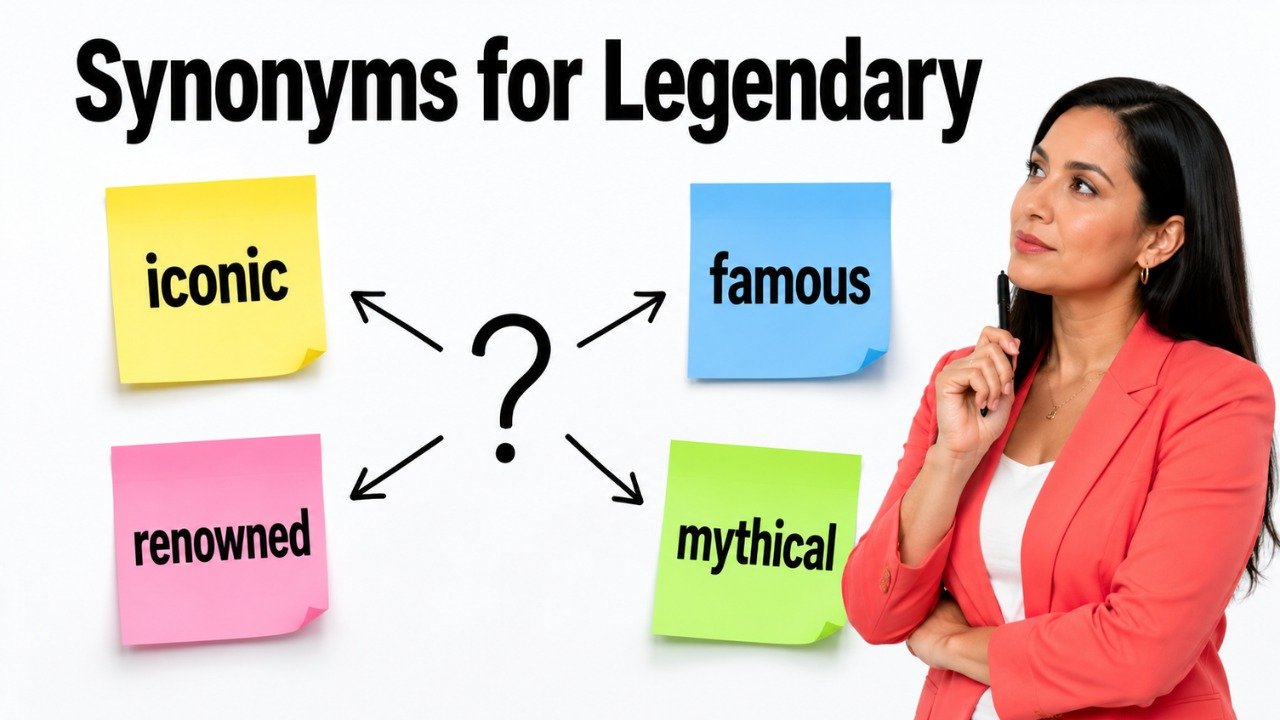
Quick Answer: The best synonyms for legendary include famous, iconic, renowned, celebrated, illustrious, remarkable, extraordinary, mythical, storied, and unforgettable. Use famous for broad recognition, iconic for something strongly associated with a culture or era, renowned for formal writing, celebrated for admired achievement, illustrious for distinguished reputation, mythical for legends and ancient stories, and extraordinary when you want to emphasize exceptional quality rather than fame.
Pronunciation and Word Details
Word: Legendary.
Pronunciation: /ˈledʒənˌderi/
Part of Speech: Adjective.
Meaning: Extremely famous, remarkable, or connected with traditional legends and stories.
US Pronunciation:
UK Pronunciation:
What Does “Legendary” Mean?
Legendary means extremely famous, remarkable, or associated with legends and traditional stories.
As an adjective, legendary can describe a person, achievement, place, event, object, skill, reputation, or story. Its exact meaning depends on the context.
When legendary describes a real person or achievement, it usually means widely admired, unusually memorable, or famous for exceptional qualities.
Example: The athlete became legendary for her determination and skill.
When legendary refers to stories, creatures, heroes, or places, it can mean belonging to legend rather than verified history.
Example: The legendary creature was said to live beyond the mountains.
The word may also be used informally to praise something as exceptionally good, impressive, or memorable.
Example: The chef prepared a legendary meal for the celebration.
Because legendary carries strong praise, it is usually more expressive than ordinary words such as good, successful, or well known.
Meaning, Tone, and Context of “Legendary”
Legendary is a strong and highly positive adjective in most modern contexts. It can also have a neutral literary meaning when it refers to legends, myths, or traditional stories.
Tone: Admiring, expressive, impressive, memorable, and sometimes dramatic.
Formal use: Legendary appears naturally in biographies, historical discussion, cultural writing, essays, profiles, and descriptions of major achievements.
Conversational use: In casual speech, legendary can describe something exceptionally impressive, enjoyable, or memorable.
Literary use: The word frequently describes heroes, creatures, places, battles, journeys, and events connected with traditional stories.
Historical context: Legendary can describe a person whose reputation has become larger than ordinary historical fame.
Praise context: It often signals exceptional respect or admiration.
Mythical context: It can refer to something known mainly through old stories or legends.
Example: The king’s legendary courage became part of local tradition.
Example: Her legendary performances influenced generations of musicians.
The word should be chosen carefully because it suggests a very high level of fame, importance, or excellence. Calling an ordinary achievement legendary can sound exaggerated.
When and How to Use “Legendary”
Use legendary when the subject is exceptionally famous, memorable, remarkable, or connected with legends.
For Exceptional Fame: Use legendary for a person or thing whose reputation is widely recognized and remembered.
Example: The explorer became legendary for completing the dangerous journey.
For Outstanding Achievement: Use legendary when an accomplishment is considered extraordinary or historically memorable.
Example: Her legendary performance changed the course of the competition.
For Remarkable Skill: Legendary can emphasize a level of ability that people greatly admire.
Example: His legendary storytelling ability kept audiences fascinated.
For Cultural Importance: Use legendary for people, objects, or events that have gained lasting cultural significance.
Example: The theater became legendary for its unforgettable productions.
For Traditional Stories: Legendary can describe people, creatures, places, or events that belong to legends.
Example: The villagers told stories about a legendary warrior.
For Strong Praise: In conversation, legendary can describe an experience that was exceptionally impressive.
Example: The celebration was legendary among everyone who attended.
For Reputation: Use legendary when a person’s reputation has become especially strong or memorable.
Example: Her legendary generosity was known throughout the region.
Best Synonyms for Legendary
Famous: Known by many people.
Example: The famous writer attracted readers from around the world.
Iconic: Widely recognized and strongly symbolic of a style, era, or culture.
Example: The building became an iconic part of the city’s identity.
Renowned: Highly respected and widely known for a particular quality or achievement.
Example: The renowned scientist was admired for her groundbreaking research.
Celebrated: Publicly admired and praised for achievement or talent.
Example: The celebrated artist produced many memorable works.
Illustrious: Highly distinguished and respected because of important achievements.
Example: The school has an illustrious history of academic excellence.
Remarkable: Unusually impressive or worthy of attention.
Example: Her remarkable courage inspired the entire team.
Extraordinary: Far beyond what is normal or expected.
Example: The rescue required extraordinary skill and bravery.
Mythical: Existing in or associated with myths and traditional stories.
Example: The travelers searched for the mythical city described in ancient tales.
Storied: Famous because of a long and interesting history.
Example: The storied institution has shaped generations of scholars.
Unforgettable: So impressive or meaningful that it is difficult to forget.
Example: Her unforgettable performance received a standing ovation.
50 Synonyms for Legendary with Short Meanings
- Famous: Known by many people.
- Iconic: Widely recognized as a symbol of something important.
- Renowned: Highly respected and widely known.
- Celebrated: Publicly praised and admired.
- Illustrious: Distinguished by notable achievements.
- Remarkable: Unusually impressive or worthy of attention.
- Extraordinary: Exceptionally unusual or impressive.
- Mythical: Connected with myths or traditional stories.
- Storied: Famous because of a rich or memorable history.
- Unforgettable: Impossible or difficult to forget.
- Famed: Well known for a particular quality or achievement.
- Notable: Important enough to deserve attention.
- Distinguished: Respected because of achievement or excellence.
- Eminent: Highly respected and prominent in a field.
- Acclaimed: Publicly praised for excellence.
- Esteemed: Highly respected and valued.
- Revered: Deeply respected and admired.
- Honored: Treated with great respect or recognition.
- Glorious: Magnificent, impressive, or worthy of admiration.
- Historic: Important enough to be remembered in history.
- Memorable: Worth remembering because of special qualities.
- Monumental: Extremely important, impressive, or significant.
- Epic: Grand, impressive, and memorable in scale or effect.
- Phenomenal: Exceptionally impressive or successful.
- Outstanding: Much better than average.
- Exceptional: Unusually excellent or remarkable.
- Magnificent: Extremely impressive or beautiful.
- Splendid: Very impressive or excellent.
- Magnanimous: Exceptionally generous or noble in character.
- Heroic: Showing exceptional courage or noble qualities.
- Immortal: Remembered for so long that fame seems permanent.
- Timeless: Remaining admired or meaningful across generations.
- Classic: Widely admired and recognized over time.
- Distinguishedly Famous: Known for exceptional achievement or reputation.
- Prominent: Important and well known within a particular area.
- Prestigious: Having high status and widespread respect.
- Venerated: Treated with deep respect and admiration.
- Admired: Regarded with approval and respect.
- Respected: Held in high regard.
- Incomparable: So exceptional that comparison seems difficult.
- Peerless: Having no equal in quality or achievement.
- Unmatched: Not equaled by others.
- Supreme: Highest in quality, importance, or achievement.
- Masterful: Showing exceptional skill or ability.
- Brilliant: Exceptionally clever, talented, or impressive.
- Spectacular: Extremely impressive or dramatic.
- Astonishing: Surprisingly impressive or remarkable.
- Marvelous: Extremely good or impressive.
- Noteworthy: Deserving attention because of importance or quality.
- Mythic: Having the greatness, symbolism, or character of a myth.
Read Also:
Synonyms for Noble
Synonyms for Legendary by Context
When Legendary Means Famous
When legendary describes someone or something widely known, good alternatives include famous, renowned, famed, prominent, notable, and celebrated.
Famous Example: The famous inventor became known throughout the country.
Renowned Example: The renowned professor was respected for decades of research.
Celebrated Example: The celebrated novelist received praise for her latest work.
Famous is the broadest choice. Renowned adds respect, while celebrated emphasizes public admiration and praise.
When Legendary Means Iconic
When legendary describes something that represents an era, culture, style, or movement, iconic, classic, timeless, memorable, and historic may work better.
Iconic Example: The structure became an iconic feature of the skyline.
Timeless Example: The timeless design still feels elegant decades later.
Classic Example: The novel became a classic of modern literature.
Iconic is particularly useful when recognition and symbolism matter more than simple fame.
When Legendary Means Exceptional
When the emphasis is on extraordinary quality, useful alternatives include remarkable, extraordinary, phenomenal, outstanding, exceptional, magnificent, and brilliant.
Remarkable Example: Her remarkable memory impressed everyone in the room.
Extraordinary Example: The team showed extraordinary determination.
Phenomenal Example: His phenomenal performance surprised even experienced judges.
These choices focus more on excellence than reputation.
When Legendary Means Historically Important
Historic, monumental, illustrious, storied, distinguished, and notable work well when describing major historical importance.
Historic Example: The agreement became a historic moment for the region.
Storied Example: The university has a storied tradition of scholarship.
Illustrious Example: She continued her family’s illustrious tradition of public service.
Storied is particularly useful for something with a long and interesting history.
When Legendary Refers to Myths
Mythical and mythic are the most direct alternatives when legendary describes traditional stories, heroes, creatures, or places.
Mythical Example: The explorer searched for a mythical island described in ancient tales.
Mythic Example: The hero achieved almost mythic status in later stories.
Mythical usually means belonging to myth, while mythic can also suggest symbolic greatness.
When Legendary Means Unmatched
Peerless, incomparable, unmatched, supreme, and exceptional emphasize superiority.
Peerless Example: Her peerless skill made her one of the finest performers of her generation.
Unmatched Example: His knowledge of the subject was unmatched.
Incomparable Example: The region is known for scenery of incomparable beauty.
These alternatives are useful when legendary describes exceptional ability rather than fame.
Another Word for Legendary
The best single replacement for legendary is often renowned when the context involves a real person, achievement, institution, or reputation. Renowned sounds precise, polished, and appropriate in formal writing.
However, no single synonym works in every sentence. Iconic is better for cultural significance, extraordinary for exceptional quality, mythical for traditional stories, and storied for something known because of its long history.
Original: She became a legendary scientist because of her discoveries.
Better Option: She became a renowned scientist because of her discoveries.
Original: The city is known for its legendary historic theater.
Better Option: The city is known for its iconic historic theater.
Original: His legendary ability to solve complex problems impressed everyone.
Better Option: His extraordinary ability to solve complex problems impressed everyone.
Original: The story describes a legendary creature that guarded the valley.
Better Option: The story describes a mythical creature that guarded the valley.
When Not to Use “Legendary”
Legendary can sound exaggerated when the subject is ordinary or only mildly impressive.
Weak: She made a legendary cup of tea before work.
Better: She made an excellent cup of tea before work.
It may also be less precise when the writer simply means famous.
Weak: The legendary local manager was known by nearly everyone in the neighborhood.
Better: The well known local manager was recognized by nearly everyone in the neighborhood.
Avoid repeating legendary several times in the same passage.
Weak: The legendary musician played at a legendary venue during a legendary concert.
Better: The renowned musician played at an iconic venue during an unforgettable concert.
Do not use legendary and mythical as if they always mean exactly the same thing.
Weak: The legendary athlete never actually existed.
Better: The mythical hero never actually existed.
Legendary may also be too informal or promotional in factual writing when a more precise adjective is available.
Weak: The researcher produced a legendary study of climate patterns.
Better: The researcher produced an influential study of climate patterns.
Choose a synonym that matches the reason the subject deserves attention.
Words Commonly Confused With Legendary
Legendary vs Famous: Famous simply means widely known. Legendary suggests stronger fame, admiration, exceptional achievement, or a reputation that has become unusually memorable.
Legendary vs Iconic: Legendary emphasizes exceptional reputation or greatness. Iconic emphasizes symbolic recognition and cultural significance.
Legendary vs Mythical: Legendary can describe both real and fictional subjects. Mythical usually refers to something belonging to myth or believed to exist only in traditional stories.
Legendary vs Historic: Legendary describes exceptional fame or reputation. Historic describes something important in history.
Legendary vs Renowned: Legendary is stronger and often more expressive. Renowned is more restrained and formal, emphasizing widespread respect.
Legendary vs Celebrated: Legendary suggests lasting fame or greatness. Celebrated emphasizes being publicly admired or praised.
Legendary vs Illustrious: Legendary can sound dramatic or conversational. Illustrious is more formal and emphasizes distinguished achievement.
Legendary vs Epic: Legendary often refers to reputation or myth. Epic describes something grand, impressive, dramatic, or large in scale.
Which Synonym Should You Choose?
Choose famous when the main idea is simple widespread recognition.
Choose renowned for formal writing about respected people, experts, institutions, or achievements.
Choose iconic when something strongly represents a culture, period, place, design, or style.
Choose celebrated when a person or work receives broad public praise.
Choose illustrious in formal writing when discussing a distinguished history, career, or reputation.
Choose remarkable when the most important idea is that something deserves attention because it is unusual or impressive.
Choose extraordinary when emphasizing exceptional ability, achievement, courage, beauty, or quality.
Choose mythical when discussing a creature, person, place, or object belonging to traditional mythology.
Choose storied for an institution, place, team, family, or tradition with a famous and interesting history.
Choose historic when an event or achievement has major importance in history.
Choose unforgettable in conversational or descriptive writing when something creates a lasting impression.
Choose peerless or unmatched when you want to emphasize superiority.
Choose acclaimed in essays, reviews, reports, and professional writing when the subject has received strong praise.
Real Life Examples of “Legendary” in Sentences
Original: The coach became legendary for his ability to motivate players.
Better Option: The coach became renowned for his ability to motivate players.
Original: Her legendary performance remained unforgettable for decades.
Better Option: Her iconic performance remained unforgettable for decades.
Original: The village was said to contain a legendary treasure.
Better Option: The village was said to contain a mythical treasure.
Original: His legendary courage inspired everyone around him.
Better Option: His extraordinary courage inspired everyone around him.
Original: The university has a legendary history of scientific research.
Better Option: The university has a storied history of scientific research.
Original: The musician’s legendary reputation attracted enormous audiences.
Better Option: The musician’s celebrated reputation attracted enormous audiences.
Original: She delivered a legendary speech at the ceremony.
Better Option: She delivered a memorable speech at the ceremony.
Original: The legendary inventor transformed the field with several discoveries.
Better Option: The renowned inventor transformed the field with several discoveries.
Original: The team completed a legendary comeback during the final match.
Better Option: The team completed an extraordinary comeback during the final match.
Original: People continued telling stories about the legendary warrior.
Better Option: People continued telling stories about the mythical warrior.
Synonym Groups and Usage Differences
Fame Group
Famous, famed, renowned, prominent, notable, and celebrated focus on recognition and reputation.
Famous is the most general word. Renowned suggests respect for achievement, while celebrated emphasizes praise.
Example: The renowned architect became known for innovative public buildings.
Cultural Importance Group
Iconic, classic, timeless, historic, and memorable describe subjects that remain strongly recognized or culturally significant.
Iconic is especially useful when a person, object, image, place, or style represents something larger than itself.
Example: The building became an iconic symbol of the city.
Achievement Group
Illustrious, distinguished, eminent, acclaimed, esteemed, and prestigious suggest high standing based on accomplishment or respect.
These alternatives generally sound more formal than legendary.
Example: She had an illustrious career in public service.
Exceptional Quality Group
Remarkable, extraordinary, outstanding, phenomenal, exceptional, brilliant, and magnificent emphasize unusual excellence.
These words do not require the subject to be famous.
Example: The student showed remarkable skill in solving difficult problems.
Myth and Story Group
Mythical, mythic, and storied relate to traditional stories or reputations shaped by storytelling.
Mythical usually indicates direct connection to myth. Mythic often suggests symbolic greatness.
Example: The mountain was believed to be the home of a mythical creature.
Superiority Group
Peerless, unmatched, incomparable, supreme, and masterful emphasize being exceptionally good or difficult to equal.
Example: Her peerless command of the language impressed every scholar present.
Lasting Reputation Group
Immortal, timeless, classic, unforgettable, and storied emphasize long lasting recognition.
Example: His timeless work continues to influence new generations.
Antonyms of Legendary
The opposite of legendary depends on whether the word means famous, exceptional, respected, or mythical.
Unknown: Not known or recognized by many people.
Obscure: Little known or difficult to recognize.
Ordinary: Normal rather than exceptional.
Average: Typical in quality or ability.
Unremarkable: Not especially interesting or impressive.
Forgettable: Not memorable or distinctive.
Insignificant: Having little importance or influence.
Commonplace: Ordinary and frequently encountered.
Mediocre: Only average in quality.
Uncelebrated: Not publicly praised or widely admired.
Undistinguished: Lacking notable achievement or recognition.
Real: Existing in fact rather than belonging to myth or legend.
Historical: Based on documented history rather than legendary tradition, depending on context.
Comparison: Legendary vs Related Words
Legendary vs Famous
Famous means widely known. Legendary goes further by suggesting exceptional fame, greatness, admiration, or a reputation that has grown over time.
Example With Legendary: Her legendary performances are still discussed decades later.
Example With Famous: She became famous after winning the competition.
Legendary vs Renowned
Renowned means widely known and highly respected. Legendary is stronger and often suggests that the person’s reputation has become exceptionally memorable.
Example With Legendary: The legendary surgeon was remembered for several groundbreaking procedures.
Example With Renowned: The renowned surgeon spoke at the medical conference.
Legendary vs Iconic
Legendary emphasizes fame, achievement, greatness, or storytelling. Iconic emphasizes symbolic importance and instant recognition.
Example With Legendary: His legendary courage became part of local history.
Example With Iconic: The tower became an iconic symbol of the city.
Legendary vs Mythical
Legendary may describe a real person whose reputation has become extraordinary or a figure connected with legend. Mythical more directly refers to myths or imagined traditional beings and places.
Example With Legendary: The legendary commander was remembered for his victories.
Example With Mythical: The mythical creature was said to breathe fire.
Legendary vs Historic
Legendary focuses on exceptional reputation. Historic focuses on historical significance.
Example With Legendary: The player’s legendary career inspired younger athletes.
Example With Historic: The agreement marked a historic change in relations between the two regions.
Legendary vs Celebrated
Legendary suggests lasting and extraordinary fame. Celebrated means widely praised or admired.
Example With Legendary: The legendary poet influenced writers for generations.
Example With Celebrated: The celebrated poet received recognition for her latest collection.
Legendary vs Illustrious
Legendary can be formal or conversational and carries strong admiration. Illustrious is distinctly formal and describes a highly distinguished record or reputation.
Example With Legendary: His legendary leadership changed the organization.
Example With Illustrious: His illustrious career included several major achievements.
Legendary vs Epic
Legendary usually describes fame, reputation, or association with legends. Epic commonly describes something impressive in scale, ambition, difficulty, or excitement.
Example With Legendary: Her legendary skill made her famous across the region.
Example With Epic: Their epic journey lasted several months.
Common Phrases and Expressions With Legendary
Legendary Status: A level of fame or admiration considered extraordinary.
Example: Her achievements eventually gave her legendary status.
Legendary Career: A career remembered for exceptional success or influence.
Example: He completed a legendary career filled with important achievements.
Legendary Performance: An exceptionally memorable display of skill or talent.
Example: Her legendary performance is still discussed by audiences.
Legendary Figure: A person famous for extraordinary achievements or traditional stories.
Example: The warrior became a legendary figure in regional history.
Legendary Hero: A hero remembered through legends or admired for exceptional deeds.
Example: Children grew up hearing stories about the legendary hero.
Legendary Reputation: An exceptionally strong and memorable public image.
Example: The teacher developed a legendary reputation for demanding excellence.
Legendary Skill: Ability considered exceptionally impressive.
Example: His legendary skill with words made him a respected speaker.
Legendary Courage: Exceptional bravery that becomes widely remembered.
Example: Stories of her legendary courage spread throughout the region.
Legendary Story: A famous traditional tale or exceptionally memorable account.
Example: The legendary story has been retold for generations.
Legendary Achievement: An accomplishment considered extraordinary and memorable.
Example: Completing the journey alone was a legendary achievement.
Common Mistakes to Avoid
One common mistake is using legendary simply because something is good. Legendary normally suggests exceptional fame, importance, reputation, or quality.
Unnatural: The sandwich was legendary because it tasted fine.
Better: The sandwich was delicious and satisfying.
Another mistake is treating famous and legendary as exact equivalents.
Less Precise: The local store was legendary because most people on the street knew its name.
Better: The local store was well known throughout the neighborhood.
Legendary may also sound exaggerated in professional or academic writing.
Too Strong: The researcher made a legendary observation about a minor change in the data.
Better: The researcher made a noteworthy observation about a minor change in the data.
Avoid using mythical when the subject is real and you only mean highly respected.
Incorrect: The mythical professor received an award for thirty years of teaching.
Better: The renowned professor received an award for thirty years of teaching.
Do not confuse historic with legendary.
Historic: Something important in history.
Legendary: Something exceptionally famous, memorable, or connected with legends.
Repetition also weakens the word.
Repetitive: The legendary singer performed a legendary song during a legendary concert.
Improved: The renowned singer performed an iconic song during an unforgettable concert.
Avoid vague praise when a more precise synonym communicates the intended idea.
Vague: She had a legendary academic record.
Precise: She had an outstanding academic record.
In strong writing, the best synonym explains why someone or something deserves attention rather than simply making the sentence sound more dramatic.
Conclusion
Understanding synonyms for legendary helps you choose a word that matches fame, excellence, history, cultural importance, or myth. Renowned works well for respected people and achievements, iconic suits cultural symbols, celebrated emphasizes praise, and illustrious fits distinguished reputations. Extraordinary and remarkable highlight exceptional quality, while mythical and mythic belong in stories and legends. By considering tone and context, you can replace legendary with a more precise word without losing the strength of your meaning.
FAQs About Synonyms for Legendary
What Is the Best Synonym for Legendary?
The best general synonym depends on context, but renowned is a strong choice for respected people or achievements. Iconic works better for cultural significance, while mythical suits traditional legends.
What Is Another Word for a Legendary Person?
Useful choices include renowned, iconic, celebrated, illustrious, eminent, distinguished, and famous. Choose the word according to why the person is well known.
Is Iconic a Synonym for Legendary?
Yes, iconic can replace legendary when someone or something is widely recognized and has strong cultural or symbolic importance. The words are not identical in every context.
Is Legendary the Same as Famous?
Not exactly. Famous means widely known, while legendary usually suggests exceptional fame, greatness, admiration, or a reputation that has become unusually memorable.
What Is a Formal Synonym for Legendary?
Renowned, illustrious, distinguished, eminent, and celebrated are good formal alternatives. Renowned is especially versatile in essays, reports, biographies, and professional writing.
What Is the Difference Between Legendary and Mythical?
Legendary can describe a real person with an extraordinary reputation or something connected with legends. Mythical usually refers more directly to myths, imaginary creatures, heroes, or traditional stories.
What Is a Stronger Word Than Legendary?
Words such as iconic, peerless, incomparable, extraordinary, and immortal may sound stronger in certain contexts. The best choice depends on whether you want to emphasize fame, superiority, cultural significance, or lasting reputation.
