
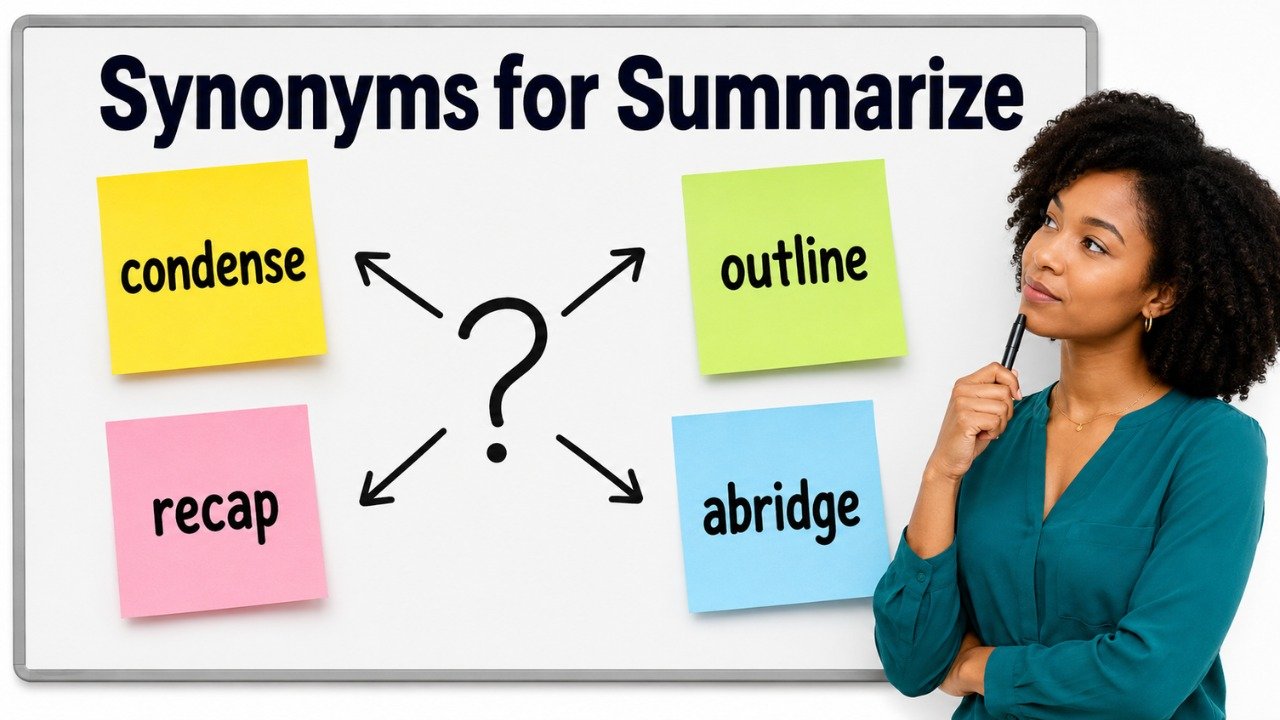
Quick Answer: The best synonyms for summarize include condense, recap, outline, review, abridge, digest, encapsulate, synthesize, restate, and sum up. For formal or academic writing, use condense, synthesize, or encapsulate. Use outline when presenting only the main points, recap for a quick review of something already discussed, abridge for shortening a longer text, digest for reducing complex information into a manageable form, and sum up for natural conversation or an informal conclusion. The best choice among synonyms for summarize depends on how much detail you want to preserve.
Pronunciation and Word Details
Word: Summarize
Pronunciation: /ˈsʌməraɪz/
Part of Speech: Verb
Meaning: To present the main ideas or important details of something in a shorter and clearer form.
US Pronunciation:
UK Pronunciation:
What Does “Summarize” Mean?
Summarize means to give the main points of something without including every detail.
It is a verb commonly used when reducing a longer text, discussion, report, event, argument, lesson, or explanation into a shorter form. The goal is usually to preserve the essential meaning while removing minor details, examples, repetition, and supporting information.
Example: Please summarize the article in three sentences.
Here, summarize means to identify the most important ideas and express them briefly.
The word is common in education because students are often asked to summarize chapters, lectures, stories, and research. It also appears in professional writing when reports, meetings, findings, or proposals need to be presented efficiently.
Example: The manager summarized the main decisions from the meeting.
Summarize can also refer to an oral explanation.
Example: Can you summarize what happened yesterday?
In this context, the speaker wants a brief account rather than a complete description.
The word may therefore involve shortening, reviewing, restating, organizing, or combining information depending on the situation.
Meaning, Tone, and Context of “Summarize”
Summarize has a neutral and practical tone. It works naturally in academic, professional, technical, educational, and conversational settings.
In formal writing, summarize often refers to presenting the essential findings, arguments, evidence, or conclusions of a longer source.
Example: The final paragraph summarizes the results of the study.
In school or academic work, summarize usually means explaining a text in your own words while keeping its central meaning.
Example: Students were asked to summarize the chapter before discussing it.
In professional communication, the word is useful when a long report, meeting, project, or discussion needs to be reduced to key information.
Example: Please summarize the main concerns raised during the meeting.
In everyday conversation, summarize can sound slightly more structured than phrases such as sum up or give me the main points, but it is still completely natural.
Example: Could you summarize the story for me?
The tone is generally objective rather than emotional. It focuses on efficiency, clarity, and relevance.
When and How to Use “Summarize”
For Articles: Use summarize when reducing a long article to its essential ideas.
Example: She summarized the article in a short paragraph.
For Reports: Use it when presenting the main findings, conclusions, or recommendations from a longer document.
Example: The executive summary summarizes the report’s major findings.
For Meetings: Use summarize to provide a brief review of what was discussed or decided.
Example: He summarized the decisions made during the meeting.
For Academic Writing: Use it when explaining the main ideas of a source without discussing every detail.
Example: The student summarized the author’s argument before evaluating it.
For Stories: Use summarize when telling only the central events, characters, and outcome.
Example: Can you summarize the plot of the novel?
For Research: Use it when combining important findings or conclusions into a shorter explanation.
Example: The final section summarizes the evidence collected during the study.
For Conversations: Use summarize when someone needs a quick account of what happened.
Example: She summarized the conversation for her colleague.
For Presentations: Use it near the end when reviewing the most important ideas.
Example: The speaker summarized the three recommendations before answering questions.
Best Synonyms for Summarize
Condense: To make information shorter while preserving its essential meaning.
Example: Condense the report into one clear page.
Recap: To briefly review the important points of something previously discussed or experienced.
Example: She recapped the main events from the previous meeting.
Outline: To present the main points or basic structure without extensive detail.
Example: The introduction outlines the major topics covered in the report.
Review: To go over the important points of something again.
Example: Before the test, the teacher reviewed the key concepts.
Abridge: To shorten a written work while preserving its main content.
Example: The editor abridged the lengthy manuscript for younger readers.
Digest: To reduce complex information into a shorter and easier form.
Example: The analyst digested several reports into one useful briefing.
Encapsulate: To express the essential meaning of something in a concise form.
Example: One sentence encapsulates the central idea of the essay.
Synthesize: To combine information from several sources into one coherent explanation.
Example: The researcher synthesized the findings from multiple studies.
Restate: To express an idea again, often in clearer or simpler words.
Example: The conclusion restates the main argument.
Sum Up: To express the most important points briefly.
Example: She summed up the discussion in two sentences.
50 Synonyms for Summarize with Short Meanings
- Condense: Make information shorter while keeping its main meaning.
- Recap: Review the main points briefly.
- Outline: Present the key points or basic structure.
- Review: Go over important information again.
- Abridge: Shorten a longer written work.
- Digest: Reduce complex information into an easier form.
- Encapsulate: Express the essential meaning concisely.
- Synthesize: Combine key information into one coherent whole.
- Restate: Express the main idea again in different words.
- Sum Up: Present the most important points briefly.
- Abstract: Reduce information to its essential ideas.
- Compress: Reduce the length or amount of information.
- Shorten: Make something briefer.
- Précis: Produce a concise summary of a longer text.
- Paraphrase: Restate information using different wording.
- Recount: Tell the main events of something.
- Report: Give the main facts about an event or subject.
- Describe Briefly: Give only the most important descriptive information.
- Present Briefly: Communicate important information in a short form.
- Highlight: Draw attention to the most important points.
- Extract: Select the most important information from a larger whole.
- Distill: Reduce information to its most essential ideas.
- Boil Down: Reduce something to its basic meaning.
- Generalize: Express broader ideas rather than individual details.
- Conclude: State the main result or final point.
- Recapitulate: Review the principal points again.
- Rephrase: Express information using different wording.
- Retell: Tell a story or event again in a shorter form.
- Survey: Give a broad overview of a subject.
- Overview: Present a general account of the main points.
- Simplify: Make information easier to understand.
- Reduce: Decrease the amount of detail.
- Consolidate: Combine information into a more compact form.
- Compile: Bring important information together.
- Integrate: Combine relevant ideas into a unified explanation.
- Combine: Join important information together.
- Sift: Separate important information from less useful detail.
- Extract the Essentials: Identify only the most important information.
- Give the Gist: State the central meaning briefly.
- Give an Overview: Present the general main points.
- Give a Brief Account: Tell the essential facts in a short form.
- Give a Synopsis: Present the central content concisely.
- Synopsis: Provide a short account of a longer work.
- Characterize Briefly: State the most important qualities concisely.
- Enumerate Key Points: List only the essential ideas.
- State the Essentials: Express only the most necessary information.
- Capture the Main Idea: Express the central meaning clearly.
- Present the Highlights: Focus on the most significant points.
- Reduce to Essentials: Remove secondary details and preserve the core meaning.
- Wrap Up: Bring together the main points at the end.
Read Also:
Synonyms for Waiting
Synonyms for Summarize by Context
When Summarize Means Make Something Shorter
Condense, compress, shorten, abridge, reduce, and distill are useful when the main goal is decreasing length.
Condense: Best when keeping essential meaning while removing unnecessary detail.
Example: Condense the introduction to approximately two paragraphs.
Abridge: Best for shortening a book, document, speech, or other substantial text.
Example: The publisher abridged the original work for a shorter edition.
Distill: Best when reducing complex material to its most important ideas.
Example: The writer distilled the report into five practical lessons.
When Summarize Means Review Main Points
Recap, review, recapitulate, and sum up are useful when revisiting information that has already been presented.
Recap: Natural for meetings, lessons, conversations, events, and presentations.
Example: Let us recap the decisions made this morning.
Review: Useful in academic or professional contexts when returning to important material.
Example: The final section reviews the main findings.
Recapitulate: A more formal choice meaning to restate the main points.
Example: The conclusion recapitulates the central argument.
When Summarize Means Present an Overview
Outline, survey, overview, synopsis, and give an overview work well when presenting the main structure or broad content.
Outline: Best when showing main sections, ideas, or stages.
Example: The opening paragraph outlines the three major concerns.
Survey: Useful for providing a broad account of a subject.
Example: The chapter surveys the major developments in the field.
Synopsis: Useful for a concise account of a book, film, story, or longer document.
Example: The report begins with a synopsis of the proposal.
When Summarize Means Express the Core Meaning
Encapsulate, distill, boil down, capture the main idea, and give the gist focus on essential meaning.
Encapsulate: Suitable for formal writing when one statement captures a larger idea.
Example: Her final sentence encapsulates the entire argument.
Boil Down: More conversational and useful when simplifying a complicated issue.
Example: The problem boils down to insufficient planning.
Give the Gist: Casual and useful when only the central idea matters.
Example: Give me the gist of what happened.
When Summarize Means Combine Information
Synthesize, integrate, consolidate, compile, and combine are useful when information comes from several places.
Synthesize: Particularly strong in academic writing.
Example: The literature review synthesizes findings from several studies.
Integrate: Emphasizes bringing related ideas together naturally.
Example: The conclusion integrates the evidence from all three sections.
Consolidate: Focuses on combining separate information into a more manageable form.
Example: The analyst consolidated the weekly updates into one report.
Another Word for Summarize
A strong general replacement for summarize is condense, especially when the goal is to make longer information shorter while preserving its essential meaning.
However, the best replacement depends on context. Use recap for reviewing previous information, outline for presenting main points, synthesize for combining information from different sources, and encapsulate when expressing an entire idea very concisely.
Original: Please summarize the report before the meeting.
Better Option: Please condense the report before the meeting.
Original: She summarized what happened during yesterday’s discussion.
Better Option: She recapped what happened during yesterday’s discussion.
Original: The introduction summarizes the major sections of the proposal.
Better Option: The introduction outlines the major sections of the proposal.
Original: The final paragraph summarizes evidence from several sources.
Better Option: The final paragraph synthesizes evidence from several sources.
When Not to Use “Summarize”
Summarize is clear and versatile, but another word can sometimes communicate the writer’s purpose more precisely.
If you are presenting only the structure of a document, outline may be more accurate.
Weak: The introduction summarizes the five sections that follow.
Better: The introduction outlines the five sections that follow.
If information from several different sources is being combined, synthesize is usually stronger in academic writing.
Weak: The literature review summarizes research from numerous studies into one argument.
Better: The literature review synthesizes research from numerous studies into one argument.
When discussing a quick reminder of something already covered, recap may sound more natural.
Weak: Let me summarize what we discussed earlier.
Better: Let me recap what we discussed earlier.
When one short statement expresses the essence of a larger idea, encapsulate can be more exact.
Weak: This sentence summarizes the author’s entire philosophy.
Better: This sentence encapsulates the author’s entire philosophy.
Avoid summarize when detailed analysis is required. A summary reduces information, while an analysis examines meaning, relationships, evidence, or significance.
Weak: The essay summarizes why the argument is convincing by examining every piece of evidence.
Better: The essay analyzes why the argument is convincing by examining every piece of evidence.
Words Commonly Confused With Summarize
Summarize vs Paraphrase: Summarize reduces a source to its most important points. Paraphrase restates a particular idea or passage in different words and may remain close to the original length.
Summarize vs Analyze: Summarize explains what the main information is. Analyze examines how, why, or why something matters.
Summarize vs Outline: Summarize presents the main meaning of something, while outline usually presents its main points, sections, or structure.
Summarize vs Synthesize: Summarize usually reduces one source or body of information. Synthesize combines ideas from several sources into a connected interpretation or explanation.
Summarize vs Review: Summarize gives the main information briefly. Review can mean examining something again or evaluating it.
Summarize vs Recap: Both can mean giving key points, but recap often refers to revisiting something previously discussed, watched, experienced, or presented.
Summarize vs Conclude: Summarize reviews important points, while conclude brings a discussion to an ending or states the final result.
Which Synonym Should You Choose?
Choose condense when reducing a long report, article, explanation, or document while preserving its essential meaning.
Choose recap for meetings, lessons, conversations, events, or material that has already been discussed.
Choose outline when presenting major sections, stages, arguments, or ideas without extensive explanation.
Choose abridge when shortening a book, speech, document, or substantial written work.
Choose encapsulate when a short statement expresses the essence of a much larger idea.
Choose synthesize in academic writing when combining information from several sources.
Choose distill when extracting the clearest and most important ideas from complex material.
Choose review when revisiting key information for understanding or preparation.
Choose sum up in everyday conversation or when ending a discussion naturally.
Choose restatement related wording when the goal is to express the same idea again rather than significantly shorten it.
For reports, condense, outline, review, and consolidate are often useful.
For essays, synthesize, encapsulate, distill, and outline can provide greater precision.
For emails, recap or summarize usually sounds clear and professional.
For casual conversation, sum up, recap, or give the gist often sounds natural.
Real Life Examples of “Summarize” in Sentences
Original: Please summarize the report in one paragraph.
Better Option: Please condense the report into one paragraph.
Original: She summarized the main decisions from the meeting.
Better Option: She recapped the main decisions from the meeting.
Original: The introduction summarizes the topics discussed in the article.
Better Option: The introduction outlines the topics discussed in the article.
Original: The student summarized findings from several research papers.
Better Option: The student synthesized findings from several research papers.
Original: One sentence summarizes the message of the entire speech.
Better Option: One sentence encapsulates the message of the entire speech.
Original: He summarized the complicated theory in simple language.
Better Option: He distilled the complicated theory into simple language.
Original: The teacher summarized yesterday’s lesson before starting a new topic.
Better Option: The teacher reviewed yesterday’s lesson before starting a new topic.
Original: She summarized the plot for a friend who had not read the book.
Better Option: She gave a synopsis of the plot for a friend who had not read the book.
Original: Can you summarize what happened during the call?
Better Option: Can you recap what happened during the call?
Original: The speaker summarized the presentation before answering questions.
Better Option: The speaker summed up the presentation before answering questions.
Synonym Groups and Usage Differences
Shortening Group
Condense, compress, abridge, shorten, reduce, and distill belong to this group.
These words focus primarily on reducing the amount of material. Condense preserves key meaning, abridge is especially suitable for written works, and distill emphasizes extracting only the most valuable ideas.
Example: The editor condensed the lengthy explanation into one clear paragraph.
Review Group
Recap, review, recapitulate, and sum up focus on returning to previously presented information.
Recap is natural in both speech and writing. Recapitulate is more formal. Sum up works especially well near the end of a discussion.
Example: Before continuing, the instructor recapped the main points.
Structure Group
Outline, survey, overview, and synopsis focus on giving the reader a broad picture.
Outline emphasizes organization. Survey presents a general account across a wider subject. Synopsis is particularly common for stories, books, and longer documents.
Example: The first section outlines the major stages of the process.
Core Meaning Group
Encapsulate, distill, boil down, give the gist, and capture the main idea focus on essential meaning rather than simply shorter length.
Encapsulate sounds polished and formal. Give the gist is conversational. Boil down is informal but useful when explaining a complicated issue simply.
Example: The final statement encapsulates the author’s main concern.
Combining Information Group
Synthesize, integrate, consolidate, compile, and combine are useful when multiple pieces of information must be brought together.
Synthesize is especially valuable in essays and research because it implies forming a connected understanding rather than simply listing separate summaries.
Example: The discussion synthesizes evidence from several independent studies.
Restatement Group
Restate, paraphrase, rephrase, and retell involve expressing existing information again.
These words are related to summarize, but they do not always involve making information much shorter. Paraphrase and rephrase primarily change wording.
Example: The student restated the main argument in simpler language.
Antonyms of Summarize
The opposite of summarize depends on whether the focus is brevity, detail, explanation, or expansion. Since summarizing reduces information to essential points, its opposites often involve adding detail or developing ideas further.
Expand: Add more information or explanation.
Elaborate: Develop an idea with additional detail.
Detail: Give specific and thorough information.
Explain Fully: Present an idea with extensive clarification.
Amplify: Develop or enlarge an idea.
Extend: Make a discussion or explanation longer.
Develop: Add reasoning, examples, or supporting information.
Analyze: Examine information closely rather than merely reducing it.
Expound: Explain a subject thoroughly.
Describe in Detail: Give complete information rather than only the main points.
Comparison: Summarize vs Related Words
Summarize vs Condense
Summarize focuses on presenting the main ideas. Condense emphasizes reducing the length of material while preserving essential information.
Example With Summarize: Summarize the chapter by explaining its three central ideas.
Example With Condense: Condense the chapter into two pages.
Summarize vs Recap
Summarize can apply to almost any material. Recap usually reviews information that has already been discussed, presented, or experienced.
Example With Summarize: Summarize the article for your classmates.
Example With Recap: Recap what we discussed during yesterday’s lesson.
Summarize vs Outline
A summary communicates the essential meaning of something. An outline shows the main structure, points, or sections.
Example With Summarize: Summarize the argument in one paragraph.
Example With Outline: Outline the three stages of the argument.
Summarize vs Paraphrase
Summarizing reduces information substantially. Paraphrasing changes the wording while usually preserving more of the original detail.
Example With Summarize: Summarize the ten page report in 200 words.
Example With Paraphrase: Paraphrase this paragraph using your own words.
Summarize vs Synthesize
Summarizing generally reduces information from one source or topic. Synthesizing combines information from multiple sources to create a connected explanation.
Example With Summarize: Summarize the author’s argument.
Example With Synthesize: Synthesize the arguments presented by all four authors.
Summarize vs Review
Summarize means present the important points briefly. Review may mean examining something again, discussing it, or evaluating it.
Example With Summarize: Summarize the chapter in five sentences.
Example With Review: Review the chapter before the examination.
Summarize vs Conclude
Summarize brings together important information, while conclude ends a discussion or expresses a final judgment.
Example With Summarize: The final paragraph summarizes the main findings.
Example With Conclude: The final paragraph concludes that further research is necessary.
Common Phrases and Expressions With Summarize
Summarize the Main Points: Present only the most important ideas.
Summarize the Article: Give a shorter account of an article’s central information.
Summarize the Findings: Present the major results of research or investigation.
Summarize the Discussion: Review the essential points from a conversation or debate.
Summarize the Report: Reduce a report to its most important information.
Summarize the Argument: State the central claim and key supporting ideas briefly.
Summarize the Results: Present the major outcomes without extensive detail.
Summarize the Story: Give the main events and outcome of a narrative.
Summarize in Your Own Words: Explain the main ideas using original wording.
Summarize Briefly: Give only the essential information in a concise form.
Common Mistakes to Avoid
A common mistake is treating summarizing as simple copying. A useful summary identifies central ideas and expresses them clearly rather than repeating large portions of the original wording.
Weak: Copy several sentences from the source and call them a summary.
Better: Identify the main points and present them concisely in your own wording.
Another mistake is including too many minor details. A summary should prioritize the information needed to understand the central message.
Weak: Include every example, number, quotation, and supporting point.
Better: Keep only the details that are necessary to understand the main idea.
Do not confuse summarizing with analyzing. A summary tells readers what the source says, while analysis explains significance, reasoning, effectiveness, causes, or relationships.
Weak: The assignment asks for analysis, but the response only summarizes the article.
Better: Briefly summarize the main claim, then analyze the evidence and reasoning.
Avoid using synthesize when information comes from only one source and no combination of ideas is involved.
Unnatural: The student synthesized one short paragraph into two sentences.
Better: The student summarized one short paragraph in two sentences.
Do not use recap where a formal academic term would be more suitable if the context requires precision.
Less Formal: The literature review recaps several major studies.
Better: The literature review summarizes or synthesizes several major studies.
Avoid excessive repetition of summarize in the same paragraph.
Repetitive: The first section summarizes the theory. The second section summarizes the research. The conclusion summarizes the findings.
Better: The first section outlines the theory. The second section reviews the research. The conclusion synthesizes the findings.
Be careful with grammar. Summarize is the base form, summarizes is used with a third person singular subject in the present tense, and summarized is the past tense.
Correct: I summarize each chapter after reading it.
Correct: She summarizes each chapter after reading it.
Correct: They summarized the meeting yesterday.
Finally, do not select a synonym only because it sounds more advanced. The most effective word is the one that expresses the exact task being performed.
Conclusion
Synonyms for summarize allow writers to express different kinds of shortening, reviewing, and combining information more precisely. Use condense when reducing length, recap when reviewing something already discussed, outline for main points, abridge for shortened texts, encapsulate for essential meaning, and synthesize when combining several sources. Distill works well for extracting core ideas, while sum up fits natural conversation. Choosing the right alternative makes essays, reports, presentations, emails, and everyday explanations clearer and more accurate.
FAQs About Synonyms for Summarize
What Is the Best Synonym for Summarize?
Condense is one of the strongest general alternatives because it means making information shorter while preserving its essential meaning. Recap, outline, and sum up are also useful depending on context.
What Is Another Word for Summarize in an Essay?
Good academic alternatives include synthesize, condense, outline, encapsulate, review, and distill. Synthesize is especially useful when combining information from multiple sources.
What Is a Formal Synonym for Summarize?
Encapsulate, synthesize, condense, recapitulate, abstract, and distill are suitable formal alternatives, depending on the intended meaning.
What Is a Casual Synonym for Summarize?
Recap, sum up, give the gist, and boil down are natural choices in casual conversation.
Is Paraphrase the Same as Summarize?
No. A summary reduces information to its main ideas, while a paraphrase restates a particular passage in different words and may keep much of the original detail.
What Is the Difference Between Summarize and Synthesize?
Summarize reduces information to its key points. Synthesize combines ideas or evidence from multiple sources into a unified explanation or conclusion.
What Word Means to Summarize Something Very Briefly?
Encapsulate, condense, distill, or sum up can all express this idea. Encapsulate is especially useful when a very short statement captures the essence of a larger subject.
