
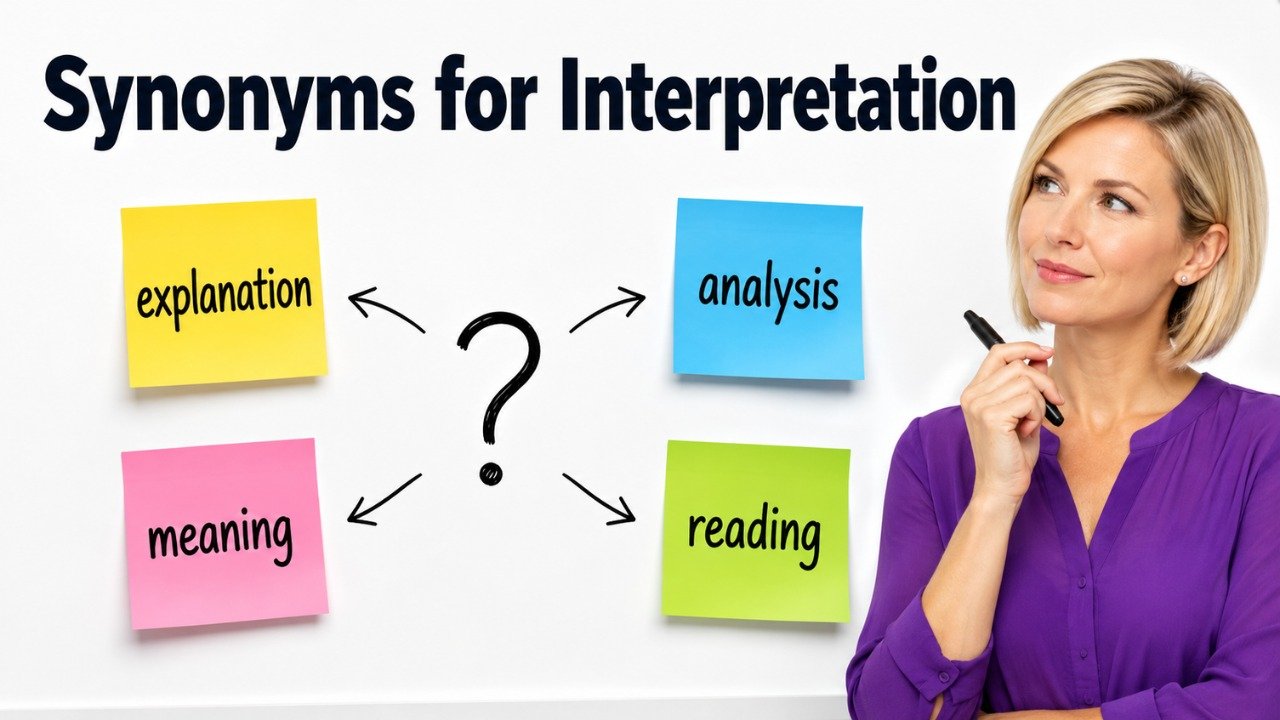
Quick Answer: The best synonyms for interpretation include explanation, understanding, reading, analysis, meaning, view, perspective, construction, account, and rendering. Use explanation when clarifying what something means, understanding for personal comprehension, reading for a particular way of viewing text or events, analysis for careful examination, perspective or view for an opinion, construction for a formal understanding of wording, and rendering for an artistic or creative presentation.
Pronunciation and Word Details
Word: Interpretation
Pronunciation: /ɪnˌtɜːrprɪˈteɪʃən/
Part of Speech: Noun
Meaning: An explanation, understanding, or particular way of expressing the meaning of something.
US Pronunciation:
UK Pronunciation:
What Does “Interpretation” Mean?
Interpretation means an explanation or understanding of what something means, represents, or communicates.
As a noun, interpretation is commonly used when discussing language, literature, art, music, law, data, behavior, events, ideas, and personal opinions. It can refer to the process of deciding what something means or to the explanation produced after considering it.
Someone may offer an interpretation of a poem, a historical event, a statement, a rule, a painting, or a set of results. The word often suggests that meaning is not completely obvious and requires thought, judgment, explanation, or context.
Interpretation can also refer to the way an artist performs or presents an existing work. For example, an actor may give a powerful interpretation of a character, or a musician may create a distinctive interpretation of a composition.
For Meaning: Interpretation can describe an explanation of what words, actions, symbols, or events mean.
Example: Her interpretation of the final paragraph focused on the theme of forgiveness.
For Opinion: Interpretation may describe a person’s individual understanding of a situation.
Example: His interpretation of the conversation was very different from mine.
For Analysis: Interpretation can describe conclusions reached after examining facts, evidence, or data.
Example: The researchers disagreed about the interpretation of the results.
For Creative Expression: Interpretation can describe an artist’s particular presentation of an existing work.
Example: The actor offered a memorable interpretation of the role.
Meaning, Tone, and Context of “Interpretation”
Interpretation is generally neutral to formal in tone. It appears naturally in academic, professional, legal, artistic, scientific, and everyday contexts.
In academic writing, interpretation often refers to explaining the meaning or significance of texts, evidence, research findings, historical events, or theories. It suggests thoughtful evaluation rather than simple repetition of facts.
In everyday conversation, interpretation can describe how someone personally understands a comment, action, event, or situation.
In legal or technical writing, interpretation may involve determining the intended or accepted meaning of a rule, statement, instruction, agreement, or principle. In these situations, precision is especially important.
In creative contexts, interpretation can describe how a performer, artist, writer, or musician presents an existing character, idea, composition, or subject.
Tone: Usually neutral, thoughtful, analytical, or formal.
Academic Context: Common when discussing texts, evidence, research, theories, history, and critical analysis.
Conversational Context: Useful when describing someone’s understanding or opinion about an event or statement.
Professional Context: Appropriate for explaining reports, policies, results, instructions, or decisions.
Creative Context: Used for artistic performances and personal presentations of existing material.
Technical Context: Often refers to carefully determining the meaning or significance of information.
When and How to Use “Interpretation”
For Explaining Meaning
Use: Interpretation works well when someone explains what a text, statement, symbol, action, or idea means.
Example: The teacher encouraged each student to support an interpretation of the poem with evidence.
For Personal Understanding
Use: Interpretation can describe the way an individual understands a situation.
Example: My interpretation of her response was that she wanted more time.
For Literature and Art
Use: Interpretation is useful when discussing the meaning, symbolism, themes, or significance of creative work.
Example: His interpretation of the painting focused on loneliness and isolation.
For Research and Data
Use: Interpretation can describe the process of deciding what findings or evidence suggest.
Example: Accurate interpretation of the data requires careful attention to context.
For Rules and Wording
Use: Interpretation can describe how a rule, instruction, or statement is understood and applied.
Example: The wording allowed more than one interpretation of the requirement.
For Performance
Use: Interpretation can describe a distinctive artistic presentation of a role, composition, or work.
Example: Her interpretation of the character was subtle and emotionally convincing.
For Events and Behavior
Use: Interpretation helps explain what people believe an event or action signifies.
Example: Their interpretation of his silence was that he disagreed.
Best Synonyms for Interpretation
Explanation
Synonym: A statement that makes the meaning of something clear.
Example: Her explanation of the poem helped the class understand its central idea.
Understanding
Synonym: A particular way of comprehending or recognizing meaning.
Example: My understanding of the instructions differs from yours.
Reading
Synonym: A particular way of understanding a text, action, situation, or event.
Example: His reading of the speech emphasized its hopeful message.
Analysis
Synonym: Careful examination used to understand meaning, significance, or relationships.
Example: The analysis revealed several possible reasons for the change.
Meaning
Synonym: The idea, message, or significance communicated by something.
Example: Scholars continue to debate the meaning of the final scene.
View
Synonym: A personal opinion or way of understanding something.
Example: Her view of the situation changed after hearing both sides.
Perspective
Synonym: A particular way of seeing, considering, or understanding something.
Example: The article presents a different perspective on the event.
Construction
Synonym: A particular way of understanding or assigning meaning to words or statements.
Example: That construction of the rule would produce a different result.
Account
Synonym: An explanation or description of an event, idea, or situation.
Example: His account of the incident emphasized the confusion surrounding it.
Rendering
Synonym: A particular artistic presentation or representation of something.
Example: The singer delivered a moving rendering of the composition.
50 Synonyms for Interpretation with Short Meanings
- Explanation: A statement that clarifies meaning.
- Understanding: A person’s comprehension of something.
- Reading: A particular way of understanding something.
- Analysis: Detailed examination of meaning or significance.
- Meaning: The idea or message communicated.
- View: A way of thinking about something.
- Perspective: A particular way of seeing or understanding something.
- Construction: A specific way of understanding wording or meaning.
- Account: An explanation or description of something.
- Rendering: An artistic presentation or representation.
- Explanation of meaning: A clear statement of what something signifies.
- Understanding of meaning: A person’s comprehension of significance.
- Perception: The way something is understood or regarded.
- Comprehension: The ability or act of understanding something.
- Conception: A particular idea or understanding of something.
- Opinion: A personal judgment or belief.
- Impression: An idea or feeling formed about something.
- Judgment: A conclusion reached after consideration.
- Assessment: An evaluation used to determine meaning or importance.
- Evaluation: Careful consideration of value, meaning, or significance.
- Appraisal: An informed judgment or evaluation.
- Explanation of significance: An account of why something matters.
- Sense: A particular meaning conveyed by a word or expression.
- Significance: The meaning or importance of something.
- Implication: A meaning suggested rather than directly stated.
- Inference: A conclusion drawn from evidence or information.
- Deduction: A conclusion reached through reasoning.
- Conclusion: A judgment reached after considering information.
- Opinion of meaning: A personal judgment about what something signifies.
- Point of view: A particular position from which something is understood.
- Standpoint: A position or perspective from which something is considered.
- Outlook: A general way of viewing a situation or subject.
- Approach: A particular way of understanding or dealing with something.
- Take: An informal personal understanding or opinion.
- Version: A particular presentation or account of something.
- Explanation of events: An account of why events occurred or what they mean.
- Representation: A presentation of something in another form.
- Portrayal: A particular way of presenting a person, idea, or subject.
- Depiction: A representation of something through words or images.
- Presentation: A particular way of showing or expressing something.
- Performance: An artistic presentation of a role or composition.
- Expression: A way of communicating or presenting meaning.
- Adaptation: A modified presentation of an existing work.
- Elucidation: A detailed explanation that makes something clearer.
- Clarification: An explanation that removes confusion.
- Exposition: A detailed explanation or presentation of an idea.
- Explication: A careful explanation of meaning, especially in a text.
- Commentary: Explanation or discussion of meaning and significance.
- Exegesis: Detailed critical explanation of a text.
- Paraphrase: A restatement that expresses meaning in different words.
Read Also:
Synonyms for Legendary

Synonyms for Interpretation by Context
When Interpretation Means Explanation
Explanation, clarification, elucidation, exposition, explication, commentary, and account are useful when interpretation means making something understandable.
Example: The professor offered a detailed explanation of the difficult passage.
Explanation is the broadest choice. Clarification is especially useful when removing confusion, while explication suggests careful and detailed explanation.
When Interpretation Means Personal Understanding
Understanding, reading, view, perspective, perception, impression, conception, and take work when describing how someone understands something.
Example: Her reading of his response was more optimistic than mine.
Reading often suggests that more than one reasonable understanding is possible. Take is more conversational and informal.
When Interpretation Means Analytical Judgment
Analysis, assessment, evaluation, appraisal, judgment, inference, deduction, and conclusion are useful when interpretation results from examining evidence.
Example: The researchers offered a cautious analysis of the findings.
Analysis emphasizes examination, while inference and deduction describe conclusions drawn from available information.
When Interpretation Means the Meaning of Words
Meaning, sense, significance, implication, construction, explication, and paraphrase may be useful when focusing on language.
Example: The phrase can carry a different sense in this context.
Construction is more formal and works particularly well when discussing how wording is understood.
When Interpretation Means an Artistic Presentation
Rendering, performance, portrayal, depiction, representation, presentation, expression, and adaptation are useful in creative contexts.
Example: Her rendering of the character was quiet but powerful.
Rendering emphasizes how an existing work is presented, while portrayal works especially well for characters and people.
When Interpretation Means a Point of View
View, perspective, standpoint, outlook, opinion, take, and point of view can replace interpretation when personal judgment is central.
Example: From his perspective, the decision was reasonable.
Perspective often sounds more neutral and polished than opinion because it emphasizes the position from which someone sees the issue.
Another Word for Interpretation
The best general replacement for interpretation is explanation when the purpose is to clarify meaning. However, understanding is often better for personal comprehension, analysis for careful study, perspective for a personal viewpoint, and rendering for artistic performance.
The right synonym depends on what is being interpreted and why.
Original: Her interpretation of the poem focused on memory.
Better Option: Her reading of the poem focused on memory.
Original: We disagreed about the interpretation of the instructions.
Better Option: We disagreed about the meaning of the instructions.
Original: The report provides an interpretation of the results.
Better Option: The report provides an analysis of the results.
Original: His interpretation of the character felt original.
Better Option: His portrayal of the character felt original.
When Not to Use “Interpretation”
Interpretation is useful, but it can sound vague when a more precise word would tell readers exactly what kind of understanding, explanation, judgment, or presentation you mean.
When You Simply Mean Explanation
Weak: She gave an interpretation of how the machine works.
Better: She gave an explanation of how the machine works.
Explanation is clearer when the goal is simply to describe a process.
When You Mean Personal Opinion
Weak: His interpretation is that the plan will fail.
Better: His view is that the plan will fail.
View or opinion sounds more natural when someone is simply expressing a belief.
When You Mean Detailed Examination
Weak: The report contains an interpretation of the figures.
Better: The report contains an analysis of the figures.
Analysis is more precise when the focus is careful examination of information.
When You Mean a Specific Definition
Weak: We need the interpretation of this technical term.
Better: We need the meaning of this technical term.
Meaning is clearer when the reader simply needs to know what a word signifies.
When You Mean Artistic Acting
Weak: Her interpretation of the historical figure was convincing.
Better: Her portrayal of the historical figure was convincing.
Portrayal is often more specific when discussing how a person or character is represented.
When Repetition Makes Writing Heavy
Weak: His interpretation differed from her interpretation because each interpretation focused on different details.
Better: His reading differed from her perspective because each focused on different details.
Using appropriate alternatives prevents unnecessary repetition and improves readability.
Words Commonly Confused With Interpretation
Interpretation vs Explanation: Interpretation involves deciding or expressing what something means, while explanation generally makes a fact, process, idea, or meaning easier to understand.
Interpretation vs Analysis: Interpretation focuses on meaning or significance. Analysis focuses on examining parts, relationships, causes, patterns, or evidence to reach an understanding.
Interpretation vs Opinion: An interpretation is an understanding based on how someone reads evidence, language, behavior, or context. An opinion can be any personal belief or judgment.
Interpretation vs Meaning: Meaning is what something communicates or signifies. Interpretation is the process or result of deciding what that meaning is.
Interpretation vs Perception: Interpretation usually involves conscious explanation or understanding. Perception can refer more broadly to how something is noticed, experienced, or regarded.
Interpretation vs Inference: Interpretation explains what something means. Inference is a conclusion reached from evidence that may not directly state that conclusion.
Interpretation vs Translation: Interpretation can mean explaining meaning, while translation specifically involves changing words or content from one language into another. Interpretation can also refer to conveying spoken language between languages, but the words are not interchangeable in every context.
Interpretation vs Perspective: Interpretation is a particular understanding of something. Perspective is the position, experience, or viewpoint that influences how someone sees it.
Which Synonym Should You Choose?
Choose explanation when your goal is to make an idea, event, statement, or process easier to understand.
Choose understanding when referring to personal comprehension of information, instructions, or ideas.
Choose reading when discussing one possible understanding of a text, statement, action, or event.
Choose analysis when examining research, evidence, data, causes, patterns, or results.
Choose meaning when asking what a word, phrase, symbol, action, or statement signifies.
Choose perspective when describing a viewpoint influenced by someone’s experience, position, or beliefs.
Choose view for a simple and natural way to express someone’s opinion in conversation or general writing.
Choose construction in formal writing when discussing how particular wording can be understood.
Choose explication for detailed academic explanation of a text or passage.
Choose rendering when discussing how a performer or artist presents an existing work.
Choose portrayal when referring to the presentation of a character, person, or subject.
Choose inference when discussing a conclusion drawn from evidence rather than directly stated information.
For essays, analysis, reading, perspective, and explication are often useful. For reports, analysis, assessment, and evaluation may be clearer. In conversation, view, take, understanding, and impression sound natural. In professional communication, explanation, understanding, perspective, and assessment usually work well.
Real Life Examples of “Interpretation” in Sentences
Original: Her interpretation of the poem emphasized loss and memory.
Better Option: Her reading of the poem emphasized loss and memory.
Original: My interpretation of his message was that the meeting had been canceled.
Better Option: My understanding of his message was that the meeting had been canceled.
Original: The scientist challenged the interpretation of the results.
Better Option: The scientist challenged the analysis of the results.
Original: Their interpretation of the rule created confusion.
Better Option: Their understanding of the rule created confusion.
Original: His interpretation of the character impressed the audience.
Better Option: His portrayal of the character impressed the audience.
Original: The book offers an unusual interpretation of the historical event.
Better Option: The book offers an unusual perspective on the historical event.
Original: One interpretation of her silence is that she was uncertain.
Better Option: One reading of her silence is that she was uncertain.
Original: The interpretation of the symbol depends on its cultural context.
Better Option: The meaning of the symbol depends on its cultural context.
Original: The committee disagreed about the interpretation of the evidence.
Better Option: The committee disagreed about the assessment of the evidence.
Original: His interpretation of the song was gentle and reflective.
Better Option: His rendering of the song was gentle and reflective.
Synonym Groups and Usage Differences
Explanation Group
Explanation, clarification, elucidation, exposition, explication, commentary, and paraphrase belong to this group.
These words focus on making meaning clearer. Explanation is the broadest option. Clarification removes uncertainty, while explication and elucidation suggest deeper explanation.
Example: Her clarification removed the confusion surrounding the instructions.
Understanding Group
Understanding, comprehension, reading, perception, conception, and impression describe ways of mentally grasping meaning.
Understanding is general and natural. Reading often suggests that another interpretation could also be possible.
Example: My reading of the situation changed after hearing the full story.
Analysis Group
Analysis, assessment, evaluation, appraisal, judgment, deduction, inference, and conclusion emphasize reasoning and examination.
These words are useful for research, reports, evidence, and decision making.
Example: The assessment identified several possible causes of the problem.
Viewpoint Group
View, perspective, standpoint, outlook, opinion, take, and point of view focus on how an individual sees a subject.
Perspective is especially useful when background or experience influences understanding.
Example: Her perspective helped the group consider the issue differently.
Meaning Group
Meaning, sense, significance, implication, and construction focus on what language, symbols, actions, or ideas communicate.
Meaning is the broadest term, while implication refers to something suggested rather than directly expressed.
Example: The implication of his statement became clearer later.
Creative Presentation Group
Rendering, portrayal, depiction, representation, performance, adaptation, presentation, and expression describe creative ways of presenting material.
Rendering is particularly useful for music and artistic performance. Portrayal is common for characters and people.
Example: The actor’s portrayal made the character feel believable.
Antonyms of Interpretation
Interpretation does not have one exact opposite because it can refer to explanation, understanding, judgment, or creative presentation. Its opposites therefore depend on context.
Antonym: Misinterpretation. An incorrect understanding of meaning.
Antonym: Misunderstanding. A failure to understand something correctly.
Antonym: Confusion. A lack of clear understanding.
Antonym: Uncertainty. A state of not knowing what something means or implies.
Antonym: Ambiguity. The quality of allowing more than one possible meaning.
Antonym: Literalness. Attention to the direct wording rather than a broader interpretive meaning.
Antonym: Fact. Information presented as objectively established rather than personally interpreted.
Antonym: Certainty. Complete confidence about meaning or conclusion.
Antonym: Clarity. A state in which meaning is immediately understandable and requires little interpretation.
Antonym: Objectivity. Consideration based on evidence rather than a personal viewpoint.
Comparison: Interpretation vs Related Words
Interpretation vs Explanation
Interpretation focuses on what something means or signifies. Explanation focuses on making something understandable, including processes, causes, facts, and reasons.
Example With Interpretation: Her interpretation of the final scene emphasizes regret.
Example With Explanation: Her explanation of the process made every step clear.
Interpretation vs Analysis
Interpretation identifies or explains meaning, while analysis examines details and relationships in order to understand a subject.
Example With Interpretation: His interpretation of the findings was optimistic.
Example With Analysis: His analysis examined changes across all five categories.
Interpretation vs Understanding
Interpretation is often an expressed explanation or judgment about meaning. Understanding is the mental comprehension someone has of a subject.
Example With Interpretation: Her interpretation of the statement surprised the group.
Example With Understanding: Her understanding of the instructions was accurate.
Interpretation vs Meaning
Meaning is the message or significance itself. Interpretation is someone’s explanation or understanding of that meaning.
Example With Interpretation: One interpretation of the symbol connects it with freedom.
Example With Meaning: The meaning of the symbol changes across cultures.
Interpretation vs Perspective
Interpretation describes what someone believes something means. Perspective describes the viewpoint or position from which that understanding develops.
Example With Interpretation: His interpretation of the event focused on its economic effects.
Example With Perspective: From his perspective, economic concerns were the most important issue.
Interpretation vs Inference
Interpretation explains meaning, while inference is a conclusion drawn from available evidence.
Example With Interpretation: Her interpretation of the letter focused on its emotional tone.
Example With Inference: Her inference was that the writer intended to leave.
Interpretation vs Opinion
Interpretation normally has a specific object that someone is trying to understand. Opinion is broader and can describe any personal judgment or belief.
Example With Interpretation: Her interpretation of the policy differs from mine.
Example With Opinion: In her opinion, the policy should be changed.
Interpretation vs Rendering
Interpretation is broad and can involve text, events, rules, data, or art. Rendering is more specific and often describes an artistic presentation.
Example With Interpretation: His interpretation of the story focuses on responsibility.
Example With Rendering: Her rendering of the song was delicate and expressive.
Common Phrases and Expressions With “Interpretation”
Different Interpretation: A meaning or understanding that differs from another person’s view.
Example: She offered a different interpretation of the evidence.
Possible Interpretation: One meaning that could reasonably be accepted.
Example: That is one possible interpretation of his statement.
Personal Interpretation: An understanding influenced by an individual’s experience or viewpoint.
Example: The essay presents a personal interpretation of the novel.
Literal Interpretation: An understanding based closely on the direct meaning of the words.
Example: A literal interpretation of the sentence may miss its humor.
Broad Interpretation: An understanding that allows a wide or flexible meaning.
Example: The committee adopted a broad interpretation of the guideline.
Narrow Interpretation: An understanding that limits meaning or application.
Example: A narrow interpretation would apply the rule only in specific situations.
Correct Interpretation: An understanding considered accurate according to the available context or evidence.
Example: Additional information helped them reach the correct interpretation.
Alternative Interpretation: Another reasonable way of understanding something.
Example: The researcher proposed an alternative interpretation of the findings.
Interpretation of Results: An explanation of what research findings, measurements, or data suggest.
Example: Careful interpretation of results is necessary before reaching a conclusion.
Interpretation of Meaning: An explanation of what language, behavior, art, or symbols signify.
Example: Cultural knowledge can affect the interpretation of meaning.
Common Mistakes to Avoid
A common mistake is assuming that every synonym for interpretation can replace it in every sentence. Explanation, reading, analysis, perspective, meaning, and rendering each describe different aspects of interpretation.
Avoid replacing interpretation with opinion when the writer is explaining evidence, wording, or significance. Opinion can sound more subjective and may lose the connection to the material being examined.
Do not use analysis when you only mean meaning. Analysis involves examination, while meaning describes what something signifies.
Avoid using explanation for every academic context. When discussing a literary text, reading, explication, analysis, or interpretation may communicate the intended type of thinking more precisely.
Be careful with inference. An inference is a conclusion drawn from clues or evidence, not simply another name for every interpretation.
Do not confuse interpretation with translation. Translation primarily changes language from one form into another, while interpretation can involve explaining or understanding meaning. The words overlap in some language related contexts but are not general substitutes.
Repetition is another common problem. Writing interpretation several times in one paragraph can make the sentence heavy. Use context appropriate alternatives such as reading, understanding, view, analysis, or meaning where they preserve the intended sense.
Avoid vague phrases when precision matters. Instead of saying an interpretation was made, explain whether someone analyzed evidence, explained a passage, inferred a conclusion, or presented a viewpoint.
Finally, choose the synonym according to the purpose of the sentence. A more precise replacement improves meaning more than simply choosing a different word for variety.
Conclusion
The best synonyms for interpretation depend on whether you mean explanation, personal understanding, detailed analysis, viewpoint, meaning, or creative presentation. Explanation works well for clarification, reading for texts and situations, analysis for evidence and data, perspective for viewpoints, and rendering for artistic performance. Meaning, understanding, inference, and portrayal are useful in more specific contexts. Choosing the right alternative makes writing clearer, more precise, and better suited to academic, professional, creative, and everyday communication.
FAQs About Synonyms for Interpretation
What is the best synonym for interpretation?
The best general synonym is explanation, but understanding, reading, analysis, meaning, and perspective may be better depending on context.
What is another word for interpretation in an essay?
Reading, analysis, explanation, perspective, explication, and understanding are useful choices. Reading often works especially well when discussing literature.
What is a formal synonym for interpretation?
Explication, elucidation, analysis, construction, and exegesis can be formal alternatives. The correct choice depends on whether you are explaining language, evidence, or a text.
Is perspective a synonym for interpretation?
Yes, in some contexts. Perspective describes a viewpoint, while interpretation describes the understanding or meaning someone develops from that viewpoint.
What is the difference between interpretation and analysis?
Interpretation focuses on meaning or significance. Analysis examines details, evidence, patterns, or relationships to understand how something works or what it suggests.
Can explanation replace interpretation?
Yes, when interpretation means clarifying what something means. However, explanation may be less precise when discussing a personal reading, artistic performance, or analytical judgment.
What is another word for personal interpretation?
View, perspective, reading, understanding, perception, impression, and take can all describe a personal interpretation. Take is more conversational, while perspective is more neutral and polished.
