
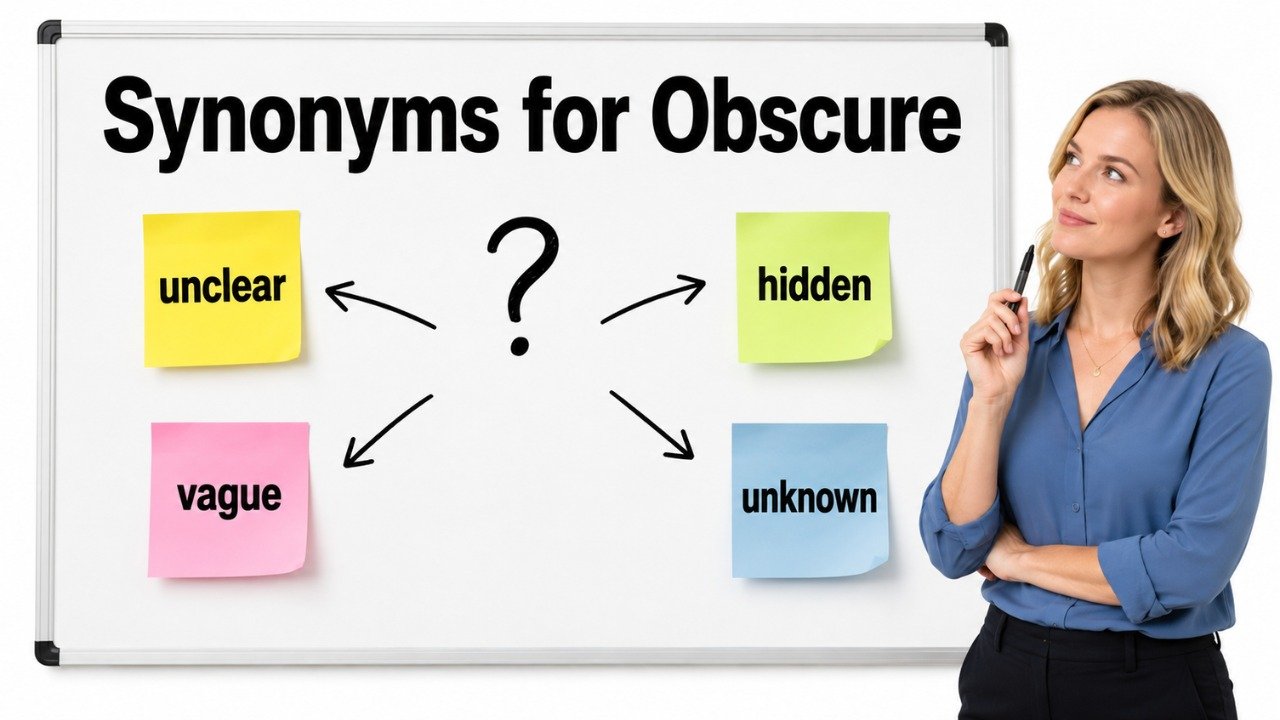
Quick Answer: The best synonyms for obscure include unknown, unclear, vague, cryptic, hidden, concealed, arcane, esoteric, mysterious, and indistinct. The best choice depends on context. Unknown works well for a person, place, or fact that is not widely recognized. Unclear and vague suit information that is difficult to understand. Cryptic suggests deliberately puzzling language, while arcane and esoteric fit specialized knowledge. Hidden and concealed describe something kept from sight, and indistinct works well when something is difficult to see or hear clearly.
Pronunciation and Word Details
Word: Obscure
Pronunciation: /əbˈskjʊr/
Part of Speech: Adjective and verb
Meaning: Not well known, difficult to understand or see clearly, or to hide something from view or understanding.
US Pronunciation:
UK Pronunciation:
What Does “Obscure” Mean?
Obscure means not widely known, difficult to understand, hidden from view, or lacking clarity. It can function as both an adjective and a verb.
As an adjective, obscure can describe a person, place, fact, reference, idea, or object that is unfamiliar, unclear, or difficult to notice. An obscure writer, for example, is a writer who is not widely known. An obscure explanation is difficult to understand.
Obscure can also describe something that is physically difficult to see. A distant object may appear obscure because darkness, fog, or another object blocks a clear view.
As a verb, obscure means to hide, cover, block, or make something less clear. Clouds can obscure the moon, and unnecessary technical language can obscure the meaning of an explanation.
The correct interpretation depends on what obscure describes and how it is used in the sentence.
Meaning, Tone, and Context of “Obscure”
Obscure has a generally neutral to formal tone. It appears naturally in academic writing, literature, professional communication, historical discussion, descriptions, analysis, and everyday conversation.
When obscure means not well known, it is usually neutral. Calling something an obscure fact simply means that few people are familiar with it.
When it describes language or an idea, obscure can carry a mildly negative tone because it suggests that the information is difficult to understand.
In academic or technical contexts, obscure may describe specialized information that is unfamiliar to most readers. However, arcane or esoteric can sometimes express this meaning more precisely.
In descriptions of visibility, obscure suggests that something cannot be seen clearly because of darkness, distance, fog, or another obstruction.
As a verb, obscure often has a stronger sense of blocking, hiding, or reducing clarity.
When and How to Use “Obscure”
For Something That Is Not Well Known
Use obscure for a person, fact, book, place, event, or subject that is unfamiliar to most people.
Example: The researcher discovered an obscure historical document in the collection.
For Ideas That Are Difficult to Understand
Obscure can describe writing, explanations, meanings, or references that are not clear to the reader.
Example: The final paragraph contained several obscure references.
For Something Hidden From View
Use obscure when an object cannot be seen clearly because something blocks or covers it.
Example: Thick clouds obscured the mountains in the distance.
For Specialized Knowledge
Obscure can refer to information that is understood only by a relatively small group of people.
Example: The discussion focused on an obscure point of ancient grammar.
For Concealing Information
As a verb, obscure can describe an action that makes information harder to understand.
Example: Complicated terminology can obscure a simple idea.
For Weak Visibility
Obscure can describe shapes, details, or objects that are difficult to recognize clearly.
Example: The figure remained obscure in the fading light.
Best Synonyms for Obscure
Unknown: Not known or recognized by many people.
Example: The author remained unknown outside a small group of readers.
Unclear: Difficult to understand or interpret.
Example: The instructions were unclear and caused confusion.
Vague: Lacking enough detail or precision.
Example: His explanation was too vague to be useful.
Cryptic: Mysterious or difficult to interpret.
Example: She left a cryptic message on the desk.
Hidden: Kept out of sight or difficult to discover.
Example: The entrance was hidden behind thick vegetation.
Concealed: Deliberately covered or kept from being seen.
Example: The documents were concealed inside a locked cabinet.
Arcane: Known or understood mainly by specialists.
Example: The book examines arcane rules of historical law.
Esoteric: Intended for or understood by a small group with specialized knowledge.
Example: The lecture explored an esoteric philosophical theory.
Mysterious: Difficult to explain, understand, or identify.
Example: The letter contained a mysterious symbol.
Indistinct: Not clear enough to see, hear, or recognize easily.
Example: An indistinct shape appeared beyond the window.
50 Synonyms for Obscure with Short Meanings
- Unknown: Not widely known or recognized.
- Unfamiliar: Not known or easily recognized.
- Little known: Known by only a small number of people.
- Unnoticed: Not observed or given attention.
- Unrecognized: Not identified, acknowledged, or appreciated.
- Forgotten: No longer remembered or commonly discussed.
- Unsung: Not receiving deserved recognition or praise.
- Uncelebrated: Not famous or publicly honored.
- Undistinguished: Not especially well known or prominent.
- Remote: Distant, isolated, or far from common attention.
- Hidden: Kept out of sight.
- Concealed: Deliberately kept from being seen or discovered.
- Veiled: Partly hidden or indirectly expressed.
- Masked: Covered or prevented from being recognized.
- Shrouded: Covered or surrounded so that it is difficult to see or understand.
- Covered: Placed beneath or behind something else.
- Screened: Protected or hidden from direct view.
- Buried: Hidden deeply or placed where discovery is difficult.
- Secret: Kept from general knowledge.
- Unclear: Not easy to understand.
- Vague: Lacking clear detail or precision.
- Ambiguous: Open to more than one interpretation.
- Cryptic: Difficult to understand because the meaning is hidden or puzzling.
- Enigmatic: Mysterious and difficult to interpret.
- Mysterious: Difficult to explain or understand.
- Puzzling: Causing uncertainty or confusion.
- Confusing: Difficult to follow or understand.
- Opaque: Difficult to understand or interpret.
- Abstruse: Difficult to understand because of complexity.
- Arcane: Known mainly by people with specialized knowledge.
- Esoteric: Understood by a limited group of specialists.
- Recondite: Concerned with difficult or little known knowledge.
- Incomprehensible: Impossible or extremely difficult to understand.
- Indistinct: Not clearly defined or recognizable.
- Hazy: Unclear in appearance, thought, or memory.
- Faint: Weak and difficult to see, hear, or notice.
- Dim: Not bright or clearly visible.
- Shadowy: Dark, unclear, or mysterious.
- Blurred: Lacking a sharp or clear form.
- Murky: Dark, unclear, or difficult to understand.
- Conceal: To keep something from being seen or known.
- Hide: To prevent something from being found or seen.
- Veil: To cover or make something less clear.
- Mask: To hide the true appearance, nature, or meaning.
- Blur: To make details or distinctions less clear.
- Cloud: To make something difficult to understand or perceive.
- Darken: To reduce light or make something less visible.
- Overshadow: To make something seem less noticeable or important.
- Disguise: To alter something so its true nature is difficult to recognize.
- Suppress: To prevent information, expression, or evidence from becoming visible or known.
Read Also:
Synonyms for Interpretation
Synonyms for Obscure by Context
When Obscure Means Little Known
When obscure describes something that few people know about, strong alternatives include unknown, unfamiliar, little known, unnoticed, unrecognized, unsung, and uncelebrated.
Example: She researched an obscure poet from the nineteenth century.
Alternative: She researched a little known poet from the nineteenth century.
Unknown is usually the simplest option. Unrecognized suggests that something exists but has not received proper attention. Unsung often suggests that a person deserves more recognition than they have received.
When Obscure Means Unclear
Use unclear, vague, ambiguous, cryptic, confusing, or opaque when obscure refers to difficult language or meaning.
Example: The meaning of the final sentence was obscure.
Alternative: The meaning of the final sentence was unclear.
Vague suggests insufficient detail. Ambiguous means that more than one interpretation is possible. Cryptic suggests hidden or puzzling meaning.
When Obscure Means Difficult to Understand
For complex subjects, abstruse, arcane, esoteric, recondite, and incomprehensible may be stronger choices.
Example: The essay explores an obscure philosophical argument.
Alternative: The essay explores an abstruse philosophical argument.
Abstruse emphasizes intellectual difficulty. Arcane emphasizes specialized or rarely known knowledge. Esoteric often describes ideas understood mainly by a particular group.
When Obscure Means Hidden or Hard to See
Use hidden, concealed, veiled, shrouded, masked, indistinct, hazy, dim, or shadowy when visibility is involved.
Example: Mist made the distant buildings obscure.
Alternative: Mist made the distant buildings indistinct.
Hidden suggests something cannot be seen. Indistinct suggests that it can be seen but not clearly.
When Obscure Means To Hide or Make Less Clear
As a verb, alternatives include conceal, hide, veil, mask, blur, cloud, darken, disguise, and overshadow.
Example: The smoke obscured the road ahead.
Alternative: The smoke concealed the road ahead.
Conceal and hide work well for physical visibility. Blur and cloud are better when clarity rather than complete visibility is reduced.
Another Word for Obscure
Unclear is often the best general replacement for obscure when the word describes meaning, information, instructions, or communication. However, the strongest alternative changes with context.
Use unknown for something that is not widely recognized, hidden for something kept from sight, cryptic for puzzling communication, and arcane for specialized knowledge.
Original: The meaning of the passage was obscure.
Better Option: The meaning of the passage was unclear.
Original: He studied an obscure historical figure.
Better Option: He studied a little known historical figure.
Original: The trees obscured the old building.
Better Option: The trees concealed the old building.
Original: The manuscript discusses an obscure scientific principle.
Better Option: The manuscript discusses an arcane scientific principle.
When Not to Use “Obscure”
Obscure is useful, but it can sometimes be less precise than a more specific alternative.
Avoid using obscure when the reader needs to know exactly why something is difficult to understand. Vague, ambiguous, cryptic, or technical may communicate the problem more accurately.
Weak: The instructions were obscure.
Better: The instructions were unclear and lacked important details.
When discussing popularity, unknown may sound more natural than obscure in simple conversation.
Weak: He is an obscure singer in this region.
Better: He is a little known singer in this region.
Do not use obscure when you specifically mean that something can have two or more interpretations. Ambiguous is more precise.
Weak: The question was obscure because it had two possible meanings.
Better: The question was ambiguous because it had two possible meanings.
Avoid obscure when the main idea is physical darkness rather than difficulty seeing something.
Weak: The room was obscure after the lights went out.
Better: The room was dark after the lights went out.
Words Commonly Confused With Obscure
Obscure vs Vague: Obscure means difficult to understand, see, or recognize. Vague specifically means lacking enough detail or precision.
Obscure vs Ambiguous: Obscure can simply be difficult to understand. Ambiguous specifically means that something allows two or more reasonable interpretations.
Obscure vs Unknown: Unknown means not known or recognized. Obscure can mean little known, but it can also mean unclear, hidden, or difficult to understand.
Obscure vs Esoteric: Obscure may describe anything unfamiliar or unclear. Esoteric usually refers to knowledge understood by a small group of specialists.
Obscure vs Mysterious: Obscure often concerns lack of knowledge or clarity. Mysterious suggests curiosity, uncertainty, or something that cannot easily be explained.
Obscure vs Hidden: Hidden means kept out of sight. Obscure is broader because something can be obscure even when it is physically visible.
Which Synonym Should You Choose?
Choose unknown when describing a person, place, fact, or work that is not widely recognized.
Choose unclear when information, instructions, explanations, or meanings are difficult to understand.
Choose vague when a statement lacks enough specific detail.
Choose ambiguous when a sentence, question, or statement can reasonably have more than one meaning.
Choose cryptic when communication seems deliberately mysterious or puzzling.
Choose hidden when something is physically kept from sight.
Choose concealed when something has been deliberately hidden.
Choose arcane when discussing specialized rules, knowledge, traditions, or information known by few people.
Choose esoteric when writing about specialized ideas understood mainly by a limited group.
Choose indistinct when something can be seen or heard but lacks clear definition.
Choose abstruse in formal or academic writing when a concept is especially difficult to understand because of its complexity.
Choose mysterious when the source, reason, meaning, or identity of something is difficult to explain.
Real Life Examples of “Obscure” in Sentences
Original: The documentary examined an obscure event from local history.
Better Option: The documentary examined a little known event from local history.
Original: Her final comment was obscure.
Better Option: Her final comment was unclear.
Original: A thick curtain obscured the window.
Better Option: A thick curtain concealed the window.
Original: The article contains several obscure references.
Better Option: The article contains several cryptic references.
Original: He enjoys studying obscure areas of ancient philosophy.
Better Option: He enjoys studying esoteric areas of ancient philosophy.
Original: The road became obscure in the heavy mist.
Better Option: The road became indistinct in the heavy mist.
Original: The explanation was so obscure that several readers misunderstood it.
Better Option: The explanation was so confusing that several readers misunderstood it.
Original: The building stood in an obscure corner of the valley.
Better Option: The building stood in a remote corner of the valley.
Original: Technical terminology obscured the central argument.
Better Option: Technical terminology clouded the central argument.
Original: His identity remained obscure for many years.
Better Option: His identity remained unknown for many years.
Synonym Groups and Usage Differences
Recognition Group
Unknown, unfamiliar, unnoticed, unrecognized, unsung, and uncelebrated describe people or things that receive little public attention.
Unknown is the broadest choice, while unsung often suggests that someone deserves greater recognition.
Example: The exhibition highlighted several unsung artists.
Clarity Group
Unclear, vague, ambiguous, confusing, opaque, and puzzling relate to difficulty understanding information.
Unclear is general. Vague refers to missing detail. Ambiguous refers to multiple meanings. Opaque is often used for writing, policies, arguments, or explanations that are especially difficult to understand.
Example: The wording of the rule remained ambiguous.
Mystery Group
Cryptic, enigmatic, mysterious, and puzzling suggest that meaning or explanation is difficult to discover.
Cryptic often describes messages or remarks, while enigmatic commonly describes people, behavior, expressions, or statements.
Example: His enigmatic response raised more questions.
Specialized Knowledge Group
Arcane, esoteric, abstruse, and recondite describe information that is difficult, specialized, or unfamiliar.
Arcane and esoteric often focus on limited knowledge. Abstruse emphasizes intellectual difficulty.
Example: The textbook explores an abstruse mathematical theory.
Visibility Group
Hidden, concealed, veiled, shrouded, indistinct, hazy, dim, and shadowy relate to sight and physical clarity.
Hidden and concealed suggest something cannot readily be seen. Hazy and indistinct suggest partial visibility.
Example: The distant coastline appeared hazy.
Concealment Group
Conceal, hide, veil, mask, cloud, blur, disguise, and darken can replace obscure when it functions as a verb.
The best choice depends on whether something is being completely hidden or merely made less clear.
Example: Dust clouded the view through the glass.
Antonyms of Obscure
The opposite of obscure changes according to whether obscure means unknown, unclear, hidden, or difficult to understand.
Well known: Familiar to many people.
Famous: Widely recognized or celebrated.
Prominent: Important, noticeable, or widely recognized.
Familiar: Easily recognized because of previous knowledge or experience.
Clear: Easy to understand, see, or recognize.
Obvious: Easy to notice or understand.
Explicit: Stated directly and clearly.
Understandable: Easy enough to comprehend.
Visible: Able to be seen.
Distinct: Clearly defined or recognizable.
Transparent: Easy to understand or open to examination.
Reveal: To make something previously hidden known or visible.
Clarify: To make an idea or explanation easier to understand.
Comparison: Obscure vs Related Words
Obscure vs Unclear
Obscure is broader than unclear. Something obscure may be unknown, hidden, difficult to see, or difficult to understand. Unclear mainly refers to a lack of clarity.
Example With Obscure: The poem contains several obscure references.
Example With Unclear: The instructions are unclear about the final step.
Obscure vs Vague
Obscure describes something difficult to understand or recognize. Vague means insufficiently specific or detailed.
Example With Obscure: The origin of the tradition remains obscure.
Example With Vague: She gave only a vague description of the event.
Obscure vs Ambiguous
Obscure describes difficulty in understanding, while ambiguous refers to the presence of multiple possible meanings.
Example With Obscure: The final sentence contains an obscure reference.
Example With Ambiguous: The final sentence can be interpreted in two different ways, so it is ambiguous.
Obscure vs Unknown
Unknown focuses specifically on lack of knowledge or recognition. Obscure has several additional meanings.
Example With Obscure: He collected obscure books on medieval science.
Example With Unknown: The identity of the writer remains unknown.
Obscure vs Esoteric
Obscure can describe anything little known or unclear. Esoteric usually describes specialized knowledge intended for or understood by a limited group.
Example With Obscure: The article mentions an obscure historical custom.
Example With Esoteric: The seminar focused on esoteric philosophical theories.
Obscure vs Hidden
Hidden primarily concerns visibility or discovery. Obscure can also concern reputation, meaning, and understanding.
Example With Obscure: The reason for the change remains obscure.
Example With Hidden: The key was hidden beneath the papers.
Common Phrases and Expressions With Obscure
Obscure Meaning: A meaning that is difficult to understand or identify.
Obscure Reference: A reference that most people may not recognize.
Obscure Fact: A piece of information that is not widely known.
Obscure Writer: A writer who has received little public recognition.
Obscure Origin: A beginning or source that is uncertain or poorly documented.
Obscure Location: A place that is remote, unfamiliar, or difficult to find.
Obscure Detail: A detail that is difficult to notice or understand.
Obscure From View: To prevent something from being clearly visible.
Obscure the Meaning: To make an idea or message harder to understand.
Obscure the Truth: To hide, confuse, or make the truth more difficult to recognize.
Common Mistakes to Avoid
One common mistake is using obscure for every kind of unclear communication. A more precise synonym often gives the reader better information.
If a statement lacks detail, use vague. If it has two possible meanings, use ambiguous. If it is intentionally puzzling, cryptic may be more suitable.
Another mistake is treating obscure and unknown as identical in every sentence. Unknown mainly concerns knowledge or recognition. Obscure has broader meanings involving clarity, visibility, and comprehension.
Avoid repeating obscure several times in the same paragraph when different meanings are involved. Use alternatives that reveal the exact sense.
Repetitive: The obscure author wrote an obscure passage containing an obscure reference.
Better: The little known author wrote a confusing passage containing an unfamiliar reference.
Do not choose an overly formal synonym when a simple word communicates the meaning more clearly. Abstruse and recondite are useful in appropriate contexts, but unclear is often better for ordinary communication.
Be careful when using obscure as a verb. It should refer to hiding, blocking, covering, or reducing clarity.
Unnatural: The difficult vocabulary obscured the reader.
Better: The difficult vocabulary obscured the meaning.
Finally, avoid assuming that arcane, esoteric, vague, and obscure always mean the same thing. Each expresses a different reason something may be unfamiliar or difficult to understand.
Conclusion
The best synonyms for obscure depend on whether you mean unknown, unclear, hidden, specialized, or difficult to see. Unknown and little known work well for limited recognition, while unclear, vague, and cryptic describe problems with meaning. Hidden and concealed fit physical concealment, whereas arcane and esoteric suit specialized knowledge. Indistinct works well for weak visibility. Choosing a synonym according to the exact context makes your writing clearer, more precise, and easier for readers to understand.
FAQs About Synonyms for Obscure
What is the best synonym for obscure?
Unknown is a strong choice when obscure means not widely known. Unclear is better when the meaning is difficult to understand, while hidden works when something cannot easily be seen.
What is a simple synonym for obscure?
A simple synonym is unknown, unclear, or hidden, depending on the sentence.
What is a formal synonym for obscure?
Abstruse, arcane, recondite, and esoteric are useful formal alternatives when obscure refers to difficult or specialized knowledge.
Is vague a synonym for obscure?
Yes, but only in some contexts. Vague means lacking specific detail, while obscure has broader meanings that include unknown, hidden, and difficult to understand.
What is a synonym for an obscure person?
Unknown, little known, unrecognized, unsung, and uncelebrated can describe a person who is not widely recognized.
What is a synonym for obscure information?
Unclear, cryptic, vague, confusing, opaque, or ambiguous may work, depending on why the information is difficult to understand.
What is the opposite of obscure?
Common opposites include clear, well known, familiar, obvious, visible, distinct, and prominent. The correct antonym depends on the meaning of obscure in the sentence.
