
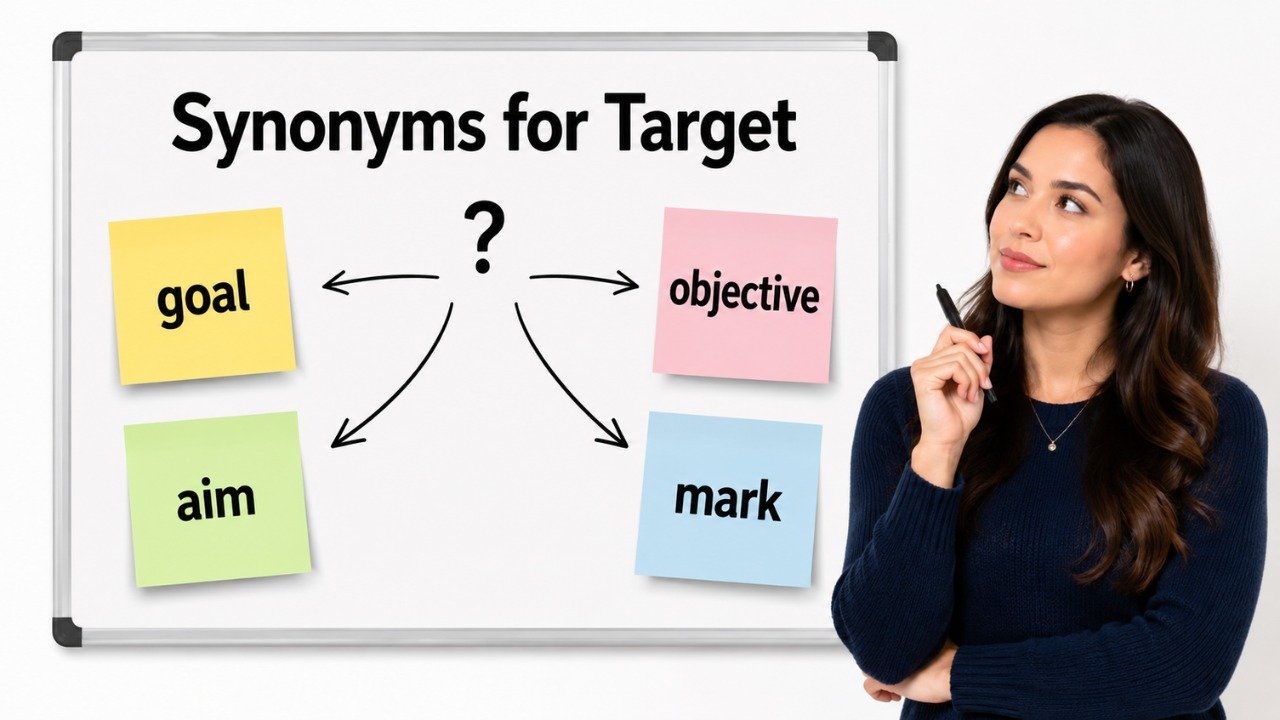
Quick Answer: Common synonyms for target include goal, aim, objective, purpose, focus, mark, destination, intention, result, and recipient. The best synonyms for target depend on context. Use goal or objective for something you want to achieve, aim for a planned result, focus for the main subject of attention, mark for something being aimed at, destination for a place you intend to reach, and recipient for a person or group intended to receive something.
Pronunciation and Word Details
Word: Target.
Pronunciation: /ˈtɑːrɡɪt/
Part of Speech: Noun and verb.
Meaning: A target is a goal, person, place, object, or result that someone aims at, focuses on, or tries to reach.
US Pronunciation:
UK Pronunciation:
What Does “Target” Mean?
Target means something that a person, organization, plan, action, or effort is directed toward.
As a noun, target can describe a goal that someone wants to achieve. For example, a student may have a target of reading twenty books during the year.
Target can also describe a person, object, or place that receives attention or action. A particular group may be the target of a campaign, while an object can be the target of an attempt to hit it.
As a verb, target means to direct attention, effort, communication, or action toward a particular person, group, result, or area.
Noun Example: Our main target is higher customer satisfaction.
Verb Example: The program targets students who need additional support.
The exact meaning of target changes according to context, so choosing the right synonym requires understanding what is being aimed at or focused on.
Meaning, Tone, and Context of “Target”
Target is generally a neutral and flexible word. It appears naturally in everyday conversation, professional communication, academic writing, planning, sports, marketing, education, research, and technical discussions.
When target means something you want to achieve, it often has a practical and measurable tone. Words such as goal, objective, aim, and result may replace it.
When target refers to the main subject of attention, focus, subject, audience, or recipient may be more precise.
When target refers to something being aimed at physically, mark, point, or object may work better.
As a verb, target can sound deliberate because it suggests that attention or action is being intentionally directed toward something.
Formal Context: Objective and intended outcome often sound more precise.
Conversational Context: Goal and aim are usually natural choices.
Technical Context: Target, parameter, objective, and endpoint may be appropriate depending on the subject.
Emotional Context: Target can sometimes suggest unwanted attention, criticism, blame, or attack.
When and How to Use “Target”
For Goals and Achievements
Use target when referring to a result that someone plans or hopes to achieve.
Example: The team reached its monthly sales target.
For Plans and Objectives
Target works well when a goal is specific, measurable, or connected with a larger plan.
Example: Our target is to complete the project before October.
For Physical Aiming
Use target for an object or point that someone is trying to hit.
Example: The arrow landed close to the target.
For a Specific Audience
Target can identify the people for whom information, services, or activities are intended.
Example: Young adults are the target audience for the course.
For Attention or Focus
Target can describe the main subject receiving attention.
Example: Cost reduction became the target of the review.
For Directing an Action
As a verb, target means to direct something toward a particular person, group, place, or result.
Example: The training sessions target beginners.
For Measurable Results
Target is useful when a desired result can be measured clearly.
Example: The company set a target of reducing waste by twenty percent.
Best Synonyms for Target
Goal
Synonym: Goal means a result that someone wants to achieve.
Example: Her goal is to complete the course this year.
Aim
Synonym: Aim means a purpose or intended result.
Example: The main aim of the program is to improve literacy.
Objective
Synonym: Objective means a specific result that a plan or activity is designed to achieve.
Example: Our primary objective is to improve accuracy.
Purpose
Synonym: Purpose means the reason something is done or created.
Example: The purpose of the meeting is to solve the problem.
Focus
Synonym: Focus means the main subject receiving attention.
Example: Customer satisfaction became the focus of the discussion.
Mark
Synonym: Mark means a point or object that someone aims at.
Example: The player successfully hit the mark.
Destination
Synonym: Destination means the place someone intends to reach.
Example: The village was their final destination.
Intention
Synonym: Intention means something a person plans or means to do.
Example: His intention is to finish the work before Friday.
Result
Synonym: Result means an outcome produced by an action or process.
Example: A better result requires careful planning.
Recipient
Synonym: Recipient means the person or group intended to receive something.
Example: Each recipient received a confirmation message.
50 Synonyms for Target with Short Meanings
- Goal: A desired result or achievement.
- Aim: An intended purpose or result.
- Objective: A specific result to be achieved.
- Purpose: The reason for an action or plan.
- Focus: The main subject of attention.
- Mark: Something that is aimed at.
- Destination: A place someone intends to reach.
- Intention: Something a person plans to do.
- Result: An outcome produced by an action.
- Outcome: The final effect of a process or effort.
- End: The final purpose or desired result.
- Purposeful Aim: A clearly intended result.
- Ambition: A strong desire to achieve something.
- Aspiration: Something a person hopes to achieve.
- Plan: An intended course of action.
- Priority: Something considered especially important.
- Focus Point: The main point receiving attention.
- Endpoint: The final point of a process.
- Benchmark: A standard used for comparison or achievement.
- Milestone: An important stage toward a larger goal.
- Quota: A fixed amount expected to be achieved.
- Standard: A required or expected level.
- Expectation: A result believed or hoped to occur.
- Desired Result: An outcome someone wants to achieve.
- Intended Result: The result an action is designed to produce.
- Intended Outcome: The planned final effect.
- Destination Point: The place or position to be reached.
- Finishing Point: The point where an effort ends.
- Endpoint Goal: A final result being pursued.
- Subject: A person or thing receiving attention.
- Object: A thing toward which action is directed.
- Point: A specific place or position being aimed at.
- Bullseye: The central point of a physical target.
- Audience: The people for whom something is intended.
- Recipient: A person or group receiving something.
- Addressee: The person to whom communication is directed.
- Candidate: A person being considered for something.
- Prospect: A person or opportunity being considered for future action.
- Intended Audience: The specific people something is created for.
- Intended Recipient: The person meant to receive something.
- Area of Focus: A subject receiving concentrated attention.
- Main Concern: The issue receiving the most attention.
- Central Goal: The most important desired result.
- Primary Objective: The main result to be achieved.
- Strategic Goal: A result connected with a larger plan.
- Desired Endpoint: The final position or result being sought.
- Achievement: Something successfully completed or reached.
- Mission: An important purpose or goal.
- Intent: A planned purpose or aim.
- Direction: The course toward which effort is guided.
Read Also:
Synonyms for Contradiction
Synonyms for Target by Context
When Target Means a Goal
When target describes something you want to achieve, the strongest alternatives include goal, objective, aim, ambition, aspiration, milestone, and desired result.
Example: Her target is to improve her exam score.
Alternative: Her goal is to improve her exam score.
Goal sounds natural in general conversation, while objective is often better in professional or formal writing.
When Target Means an Aim or Purpose
Target can describe the purpose behind an activity or action.
Useful alternatives include aim, purpose, intention, intent, mission, and objective.
Example: The target of the training is improved workplace safety.
Alternative: The aim of the training is improved workplace safety.
Aim often sounds smoother when discussing the purpose of a program, study, project, or activity.
When Target Means Something Being Aimed At
For physical aiming, useful alternatives include mark, point, object, bullseye, and focus point.
Example: The arrow missed the target.
Alternative: The arrow missed the mark.
Mark is especially useful when the sentence describes accuracy or physical aiming.
When Target Means an Intended Audience
Target can refer to the people for whom a message, service, activity, or product is designed.
Useful alternatives include audience, intended audience, recipient, intended recipient, group, and addressee.
Example: Parents are the target audience for the workshop.
Alternative: Parents are the intended audience for the workshop.
Intended audience is more precise when discussing communication or educational material.
When Target Means a Measurable Result
In planning and performance contexts, target often refers to a measurable level.
Useful alternatives include goal, quota, benchmark, standard, milestone, objective, and desired result.
Example: The department exceeded its annual target.
Alternative: The department exceeded its annual goal.
Quota works best when a specific required amount is involved, while benchmark refers more naturally to a standard used for comparison.
When Target Means a Destination
When target refers to the place or point someone wants to reach, destination, endpoint, finishing point, and destination point may work.
Example: The mountain shelter was our target before sunset.
Alternative: The mountain shelter was our destination before sunset.
Destination is usually the clearest choice for travel or movement.
Another Word for Target
Another word for target is goal when target refers to something someone wants to achieve. However, the best replacement depends on context.
Use objective in formal plans, aim when discussing purpose, mark for physical aiming, focus for attention, and audience or recipient when describing people toward whom something is directed.
Original: Our target is better customer service.
Better Option: Our goal is better customer service.
Original: The main target of the research is understanding the cause.
Better Option: The main objective of the research is understanding the cause.
Original: The arrow struck the target.
Better Option: The arrow struck the mark.
Original: New learners are the target of the program.
Better Option: New learners are the intended audience for the program.
When Not to Use “Target”
Target is useful, but it can sound vague when the sentence does not explain whether it means a goal, person, audience, physical object, or desired result.
Choose a more precise word when clarity matters.
Weak: The target of the study was improvement.
Better: The objective of the study was to identify ways to improve performance.
Target can also sound overly technical when a simpler word such as goal works naturally.
Weak: My target is to read more books this summer.
Better: My goal is to read more books this summer.
When discussing people, target can sometimes suggest unwanted attention or aggressive action.
Weak: Older adults are the target of our educational sessions.
Better: Older adults are the intended audience for our educational sessions.
Avoid repeating target several times in one paragraph when goal, objective, focus, result, or audience can make the writing clearer.
Weak: Our target is to reach the target before the target date.
Better: Our goal is to reach the objective before the planned date.
Words Commonly Confused With Target
Target vs Goal: Target often suggests a specific or measurable result, while goal can describe any desired achievement. Goal usually sounds more natural in everyday conversation.
Target vs Objective: Objective is generally more formal and precise. It is especially common when discussing plans, research, education, projects, and professional activities.
Target vs Aim: Aim describes an intended purpose or direction. Target often suggests the specific point or result toward which that aim is directed.
Target vs Purpose: Purpose explains why something exists or is done. Target describes what someone is trying to reach, influence, or achieve.
Target vs Focus: Focus describes the main subject receiving attention. Target can describe something toward which action is deliberately directed.
Target vs Benchmark: A benchmark is a standard used for comparison. A target is usually the level or result someone wants to reach.
Target vs Quota: A quota is a specific required amount. A target may be desirable without always being a strict requirement.
Target vs Destination: Destination refers mainly to a place being reached, while target can describe a place, result, person, object, or goal.
Which Synonym Should You Choose?
Choose goal when discussing a general result you want to achieve.
Choose objective for formal writing, reports, research, business plans, academic work, and structured projects.
Choose aim when explaining the purpose or intended direction of an activity.
Choose purpose when explaining why something is done.
Choose focus when describing the main subject receiving attention.
Choose mark when talking about something physically being aimed at or when describing accuracy.
Choose destination when referring to a place someone intends to reach.
Choose milestone when discussing an important stage toward a larger goal.
Choose benchmark when referring to a standard used to measure or compare performance.
Choose audience or intended audience when describing the people for whom communication, education, or information is designed.
Choose recipient when referring to the person or group receiving something.
Choose quota when a fixed quantity or required amount must be achieved.
Real Life Examples of “Target” in Sentences
Original: My target is to finish the course by December.
Better Option: My goal is to finish the course by December.
Original: The team reached its weekly target.
Better Option: The team reached its weekly objective.
Original: Children are the target audience for this learning activity.
Better Option: Children are the intended audience for this learning activity.
Original: The arrow hit the target.
Better Option: The arrow hit the mark.
Original: Our main target is reducing unnecessary costs.
Better Option: Our main objective is reducing unnecessary costs.
Original: The village was their target before nightfall.
Better Option: The village was their destination before nightfall.
Original: The project targets several important problems.
Better Option: The project focuses on several important problems.
Original: The campaign targets new learners.
Better Option: The campaign is intended for new learners.
Original: The company exceeded its production target.
Better Option: The company exceeded its production goal.
Original: Improving accuracy became the main target of the training.
Better Option: Improving accuracy became the main focus of the training.
Synonym Groups and Usage Differences
Goal Group
Goal, objective, aim, ambition, aspiration, mission, and desired result belong to the goal group.
These words describe something a person or group wants to achieve.
Goal is broad and natural. Objective is more structured and formal. Ambition and aspiration often describe larger personal hopes.
Example: Her main objective is to qualify for the advanced course.
Achievement Group
Milestone, benchmark, quota, standard, result, achievement, and outcome are useful when target is connected with measurable progress or performance.
A milestone is an important stage. A quota is a fixed required amount. A benchmark is a comparison standard.
Example: Reaching fifty completed projects was an important milestone.
Attention Group
Focus, subject, object, area of focus, main concern, and priority describe something receiving attention.
These alternatives work well when target does not mean a measurable goal.
Example: Safety became the primary focus of the review.
Audience Group
Audience, intended audience, recipient, intended recipient, and addressee refer to people toward whom information or communication is directed.
Example: New employees are the intended audience for the guide.
Physical Aim Group
Mark, point, object, and bullseye work when target refers to something physically aimed at.
Example: The ball landed directly on the mark.
Direction Group
Destination, endpoint, finishing point, direction, and destination point describe movement toward a final place or position.
Example: The harbor was our final destination.
Antonyms of Target
The opposite of target depends on its meaning.
When target means a desired achievement, its opposites may describe failure, avoidance, uncertainty, or lack of direction.
Failure: An unsuccessful result.
Obstacle: Something that prevents progress toward a goal.
Distraction: Something that takes attention away from the main focus.
Detour: A route or action that moves away from the intended direction.
Starting Point: The place where progress begins rather than ends.
Uncertainty: A lack of clear direction or expected result.
Aimlessness: The absence of a clear purpose or goal.
Neglect: Failure to give something proper attention.
Avoidance: The act of deliberately staying away from something.
Departure: Movement away from a planned direction or position.
Comparison: Target vs Related Words
Target vs Goal
Target often suggests something specific, planned, or measurable. Goal is broader and more natural for personal achievements.
Example With Target: The team set a target of completing one hundred applications.
Example With Goal: My goal is to become a stronger writer.
Target vs Objective
Target can be used in formal and informal settings, while objective usually sounds more structured and professional.
Example With Target: The department reached its monthly target.
Example With Objective: The primary objective is to improve response time.
Target vs Aim
Aim emphasizes intention or purpose. Target emphasizes the particular result, point, or subject being pursued.
Example With Target: Our target is a ten percent improvement.
Example With Aim: Our aim is to improve overall performance.
Target vs Focus
Target suggests deliberate action directed toward something. Focus emphasizes attention or concentration.
Example With Target: The program targets beginner writers.
Example With Focus: The program focuses on basic writing skills.
Target vs Benchmark
A target is the result you want to reach. A benchmark is the standard against which progress or performance is measured.
Example With Target: Our target is ninety percent accuracy.
Example With Benchmark: Ninety percent accuracy is the benchmark used for comparison.
Target vs Quota
A target may be a desired goal, while a quota usually describes a required quantity.
Example With Target: The team hopes to reach its sales target.
Example With Quota: Each team must complete its required quota.
Target vs Destination
Target can describe almost any intended result or object. Destination specifically refers to a place or endpoint.
Example With Target: The hill was our target for the afternoon.
Example With Destination: The hilltop cabin was our destination.
Common Phrases and Expressions With “Target”
Target Audience: The specific group for whom something is intended.
Target Market: A particular group that an offering is intended to reach.
Target Date: The planned date for completing or achieving something.
Target Goal: A particular result someone intends to achieve.
Target Number: A specific numerical result someone wants to reach.
Target Range: A preferred or intended range of values.
Target Area: A particular place or subject receiving attention.
Target Group: A specific group toward which an activity or message is directed.
Target Level: A desired level of performance, quantity, or achievement.
On Target: Correct, accurate, or progressing according to the intended plan.
Common Mistakes to Avoid
One common mistake is using target when a more precise word would make the sentence easier to understand.
If you mean a personal achievement, goal may sound more natural. If you mean a formal result in a project, objective is usually clearer.
Another mistake is assuming that every synonym for target can replace it in every sentence. Mark works for physical aiming but usually cannot replace target when discussing a professional objective.
Avoid confusing target with purpose. A purpose explains why something is being done, while a target usually describes what is being reached or achieved.
Be careful when using target for people. The word can sometimes suggest criticism, attack, or unwanted attention. Audience, recipient, participant, or intended group may sound more neutral.
Repetition can also weaken writing. If target appears several times close together, consider using goal, objective, result, focus, audience, or destination where the meaning allows it.
Finally, avoid vague uses of target without explaining what is being measured or pursued. Specific language improves clarity.
Conclusion
Understanding synonyms for target helps you choose a more precise word for goals, plans, people, destinations, and areas of attention. Goal is often the best general replacement, while objective suits formal writing, aim explains purpose, focus describes attention, mark fits physical aiming, and audience or recipient works for people. Benchmark, quota, milestone, and result are useful when measuring performance. Choosing a synonym according to context makes sentences clearer, more natural, and more accurate.
FAQs About Synonyms for Target
What is the best synonym for target?
The best general synonym for target is goal when referring to something you want to achieve. Objective, aim, focus, mark, and destination may be better in specific contexts.
What is another word for target in formal writing?
Objective is often the strongest formal alternative. Intended outcome, goal, and aim can also work depending on the sentence.
What is a synonym for target as a goal?
Goal, objective, aim, ambition, aspiration, milestone, and desired result can all describe a target that someone wants to achieve.
What is another word for a target audience?
Intended audience is the clearest alternative. Audience, recipient, intended recipient, or target group may also fit certain contexts.
What is a synonym for target when aiming at something?
Mark, point, object, and bullseye can replace target when discussing physical aiming.
Are target and objective the same?
They are similar, but objective usually sounds more formal and structured. Target often suggests a specific result, level, number, person, object, or point toward which effort is directed.
Can goal always replace target?
No. Goal works well when target means a desired achievement, but it does not fit every meaning. Use mark for physical aiming, destination for a place, focus for attention, and audience or recipient for people.
