
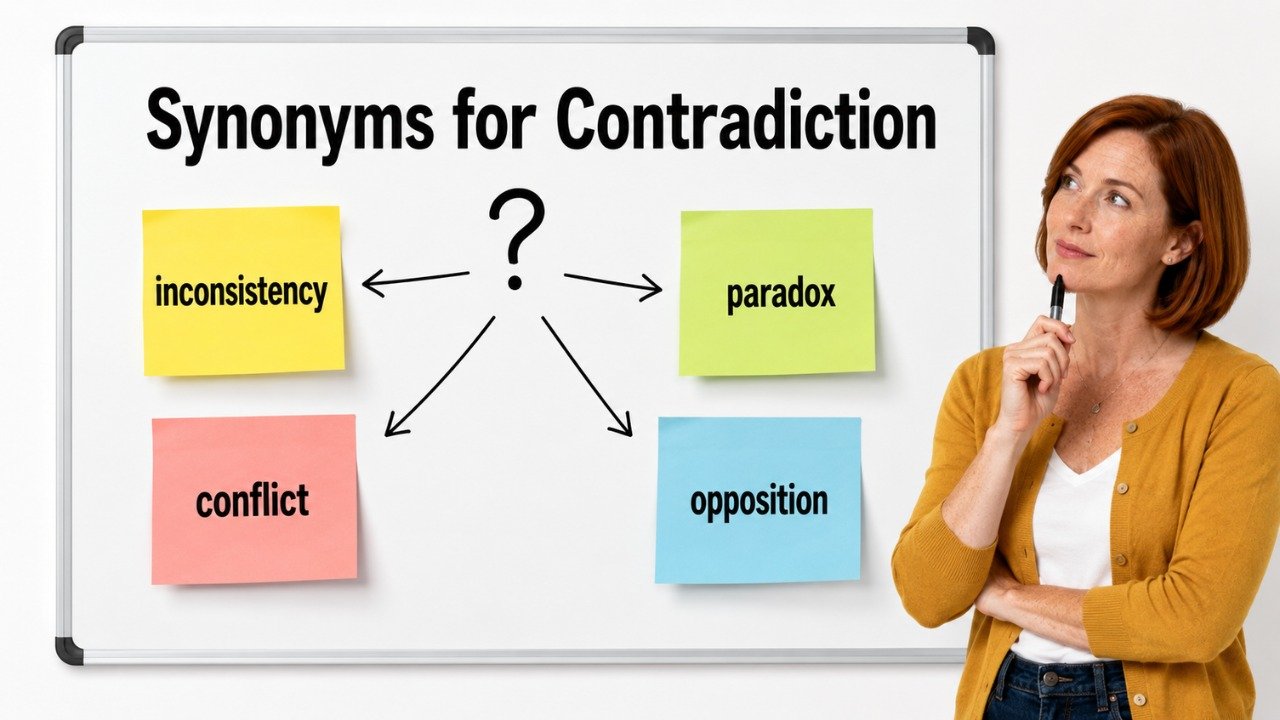
Quick Answer: The best synonyms for contradiction include conflict, inconsistency, discrepancy, incompatibility, opposition, paradox, disagreement, denial, refutation, and clash. Use inconsistency when two statements do not agree, discrepancy when facts or figures differ, conflict when ideas or claims oppose each other, and paradox when something appears logically impossible but may contain truth. Refutation works when an argument is disproved, while disagreement is more natural for differences between people or opinions.
Pronunciation and Word Details
Word: Contradiction.
Pronunciation: /ˌkɒn.trəˈdɪk.ʃən/
Part of Speech: Noun.
Meaning: A statement, fact, idea, or situation that conflicts with another statement, fact, idea, or situation.
US Pronunciation:
UK Pronunciation:
What Does “Contradiction” Mean?
A contradiction is a difference or conflict between two statements, facts, beliefs, actions, or conditions that cannot both appear true or consistent at the same time.
The word is a noun. It commonly describes conflicting information, opposite claims, inconsistent behavior, logical problems, and disagreements between evidence and statements.
In Statements: A contradiction occurs when one statement says something that another statement denies.
In Behavior: Someone may create a contradiction by acting differently from what they previously said or claimed.
In Logic: A contradiction exists when two propositions cannot both be true under the same conditions.
In Evidence: Contradiction can describe a situation in which evidence does not support a previous claim.
In Everyday Conversation: The word often refers to conflicting explanations, opinions, or actions.
For example, saying that a store was both completely empty and crowded at the same moment would create a contradiction unless additional context explained the difference.
Meaning, Tone, and Context of “Contradiction”
Tone: Contradiction is generally neutral to formal, although it can sound strong when used to challenge another person’s statement.
Formal Use: It is common in essays, reports, arguments, analysis, debates, legal discussion, research, and academic writing.
Conversational Use: People also use contradiction in ordinary conversation when someone’s words, actions, or explanations do not match.
Academic Use: In philosophy and logic, contradiction has a precise meaning involving statements that cannot both be true in the same respect.
Critical Use: Calling something a contradiction may suggest that there is a serious problem with an argument, explanation, or account.
Emotional Use: The word itself is not necessarily emotional, but it can become confrontational when one person directly accuses another of contradicting themselves.
The best synonym depends on what is actually conflicting. Discrepancy often fits numbers and records. Inconsistency works well for behavior or statements. Conflict is broader and can describe ideas, interests, or evidence.
When and How to Use “Contradiction”
For Conflicting Statements: Use contradiction when two claims cannot comfortably be accepted together.
Example: Her second explanation created a contradiction with what she had said earlier.
For Inconsistent Evidence: Use contradiction when evidence appears to oppose a claim or another piece of evidence.
Example: The new document revealed a contradiction in the original account.
For Opposing Ideas: Use contradiction when two principles or ideas conflict.
Example: The proposal contains a contradiction between its goals and its methods.
For Inconsistent Behavior: Use contradiction when someone’s actions do not match their stated beliefs.
Example: His behavior seemed to be a contradiction of his promise to remain neutral.
For Logical Problems: Use contradiction when two propositions cannot both be true.
Example: The argument leads to a contradiction if both assumptions are accepted.
For Conflicting Records: Use contradiction when written information does not agree across documents.
Example: Investigators noticed a contradiction between the two reports.
Best Synonyms for Contradiction
Conflict: A situation in which two ideas, facts, interests, or statements oppose each other.
Example: There is a clear conflict between the policy and the new recommendation.
Inconsistency: A lack of agreement or logical connection between statements, actions, or facts.
Example: The editor noticed an inconsistency in the witness’s account.
Discrepancy: A difference between facts, numbers, records, or expected results.
Example: The accountant discovered a discrepancy between the two totals.
Incompatibility: The condition of being unable to exist, work, or agree together successfully.
Example: The researchers identified an incompatibility between the two conclusions.
Opposition: Resistance or a position that goes against another idea, proposal, or belief.
Example: His position was in direct opposition to the committee’s recommendation.
Paradox: A statement or situation that appears contradictory but may reveal an underlying truth.
Example: The idea that greater choice can create greater dissatisfaction is often presented as a paradox.
Disagreement: A difference of opinion, belief, interpretation, or judgment.
Example: Their disagreement concerned the meaning of the final paragraph.
Denial: A statement that rejects or declares something to be untrue.
Example: Her denial directly challenged the accusation.
Refutation: An argument or statement that proves or attempts to prove another claim wrong.
Example: The article offered a detailed refutation of the earlier theory.
Clash: A strong conflict between ideas, opinions, principles, or interests.
Example: The decision created a clash between financial goals and environmental concerns.
50 Synonyms for Contradiction with Short Meanings
- Conflict: A direct opposition between ideas, facts, or positions.
- Inconsistency: A lack of agreement between statements, actions, or facts.
- Discrepancy: A difference between information, records, figures, or results.
- Incompatibility: An inability of two things to agree or exist together successfully.
- Opposition: A position or force acting against something else.
- Paradox: An apparently contradictory statement or situation that may contain truth.
- Disagreement: A difference in opinion, belief, or interpretation.
- Denial: A rejection of a statement, claim, or accusation.
- Refutation: A response that disproves or challenges a claim.
- Clash: A strong conflict between ideas, interests, or opinions.
- Dispute: A disagreement involving opposing claims or views.
- Variance: A difference between two accounts, results, or expectations.
- Divergence: A movement or development in different directions.
- Oppositeness: The state of having contrary qualities or positions.
- Contrariety: A condition of being contrary or opposed.
- Contrariness: A state of being different from or opposed to something.
- Mismatch: A failure of two things to correspond properly.
- Difference: A point at which two things are not the same.
- Disparity: A noticeable difference between related things.
- Conflict of ideas: Opposition between two beliefs or concepts.
- Logical conflict: A situation in which two propositions cannot both be true.
- Logical inconsistency: A failure of statements to form a logically coherent set.
- Self contradiction: A situation in which a statement conflicts with another statement from the same source.
- Counterstatement: A statement made in opposition to another statement.
- Counterclaim: A claim that challenges or opposes another claim.
- Rebuttal: A response that challenges an argument or accusation.
- Rejection: A refusal to accept a claim, idea, or conclusion.
- Negation: The denial or reversal of a statement or proposition.
- Repudiation: A strong rejection of a claim, belief, or connection.
- Objection: An expression of disagreement or opposition.
- Challenge: A questioning of the truth, validity, or authority of a claim.
- Contravention: An action or statement that goes against a rule, principle, or expectation.
- Opposing view: An opinion that differs strongly from another position.
- Conflicting claim: A claim that cannot easily agree with another claim.
- Conflicting evidence: Evidence that points toward different conclusions.
- Conflicting account: An explanation that differs from another account of the same event.
- Contrary statement: A statement expressing the opposite of another statement.
- Contrary position: A viewpoint that directly opposes another position.
- Incongruity: A lack of harmony or consistency between related things.
- Anomaly: Something that does not fit an expected pattern.
- Deviation: A departure from an expected statement, pattern, or standard.
- Irregularity: Something inconsistent with the usual pattern or expectation.
- Discord: A lack of agreement or harmony.
- Dissonance: A lack of consistency or harmony between ideas, beliefs, or actions.
- Contention: A disputed claim or point of disagreement.
- Opposing assertion: A statement that directly challenges another assertion.
- Confutation: The act of proving an argument or statement false.
- Contradictory evidence: Information that conflicts with another piece of evidence.
- Mutual exclusion: A condition in which two possibilities cannot both apply.
- Contradictory position: A stance that conflicts with another position or with itself.
Read Also:
Synonyms for Here
Synonyms for Contradiction by Context
When Contradiction Means Conflicting Statements
Inconsistency: Best when statements from the same person or document do not match.
Example: The reporter found an inconsistency between the two interviews.
Conflict: Useful when two statements directly oppose one another.
Example: There was a conflict between the official statement and the available evidence.
Mismatch: Useful when information does not correspond as expected.
Example: The mismatch between the description and the record required further investigation.
Discrepancy: Best when two records, figures, or factual accounts differ.
Example: A discrepancy appeared between the written report and the final calculation.
When Contradiction Means Opposing Ideas
Opposition: Best for beliefs, policies, principles, and positions.
Example: The new rule stands in opposition to the earlier policy.
Contrariety: A formal term for a state of opposition.
Example: The philosopher examined the apparent contrariety between the two principles.
Clash: Useful for strong differences between values, ideas, or interests.
Example: The debate revealed a clash between tradition and reform.
Incompatibility: Best when two principles cannot work together effectively.
Example: The discussion focused on the incompatibility of the two requirements.
When Contradiction Means Different Facts or Records
Discrepancy: Particularly useful for numbers, records, dates, and measurements.
Example: The audit uncovered a discrepancy in the reported expenses.
Variance: Suitable for differences between expected and actual values.
Example: The report explained the variance between the forecast and the final result.
Disparity: Useful for a noticeable difference between related values or conditions.
Example: Researchers examined the disparity between the two sets of results.
Divergence: Useful when findings or interpretations move in different directions.
Example: The study revealed a divergence between predicted and observed behavior.
When Contradiction Means Challenging a Claim
Refutation: Best when evidence or reasoning demonstrates that a claim is wrong.
Example: The researcher published a refutation of the original argument.
Rebuttal: Useful for a response that answers criticism or opposing reasoning.
Example: Her rebuttal addressed every major objection.
Denial: Best when someone simply rejects a claim or accusation.
Example: His denial conflicted with the testimony of several witnesses.
Counterclaim: Useful when one claim is presented against another.
Example: The defendant offered a counterclaim supported by additional records.
When Contradiction Describes a Logical Problem
Logical inconsistency: Best when several propositions cannot all be true together.
Example: The argument contains a logical inconsistency.
Paradox: Best when an apparent contradiction may contain a meaningful truth.
Example: The statement appears to be a paradox rather than a simple error.
Mutual exclusion: Useful when two conditions or possibilities cannot occur together.
Example: The rules create mutual exclusion between the two available options.
Another Word for Contradiction
The best general replacement for contradiction is often inconsistency, especially when statements, actions, explanations, or facts do not agree. However, the most precise alternative depends on the context. Use discrepancy for factual or numerical differences, conflict for opposing ideas, and paradox for an apparently impossible statement that may still express truth.
Original: The report contains a contradiction in the dates.
Better Option: The report contains a discrepancy in the dates.
Original: There is a contradiction between his words and actions.
Better Option: There is an inconsistency between his words and actions.
Original: The two principles create a contradiction.
Better Option: The two principles create a conflict.
Original: The statement sounds like a contradiction, yet it makes sense after careful thought.
Better Option: The statement sounds like a paradox, yet it makes sense after careful thought.
When Not to Use “Contradiction”
Do not automatically use contradiction whenever two things are merely different. A difference is not always a contradiction. Two statements may describe different circumstances without actually opposing each other.
Weak: There was a contradiction between the red chair and the blue chair.
Better: There was a difference between the red chair and the blue chair.
Use discrepancy instead when comparing records, amounts, measurements, or figures.
Weak: The accountant found a contradiction of twenty dollars between the totals.
Better: The accountant found a discrepancy of twenty dollars between the totals.
Use disagreement when people simply hold different opinions that can coexist.
Weak: Their preferences created a contradiction about which restaurant was better.
Better: Their preferences created a disagreement about which restaurant was better.
Use paradox when something appears contradictory but carries a deeper or unexpected truth.
Weak: The idea that silence can communicate strongly is always a contradiction.
Better: The idea that silence can communicate strongly can be described as a paradox.
Words Commonly Confused With Contradiction
Contradiction vs Inconsistency: A contradiction usually involves direct opposition, while an inconsistency can simply mean that details do not match or follow a stable pattern.
Contradiction vs Discrepancy: Contradiction is broader. Discrepancy usually describes a difference between facts, figures, records, measurements, or accounts.
Contradiction vs Paradox: A contradiction involves incompatible statements or ideas. A paradox appears contradictory but may reveal a valid or meaningful truth.
Contradiction vs Disagreement: A disagreement is a difference of opinion. A contradiction is usually a stronger logical or factual conflict.
Contradiction vs Conflict: Conflict is broader and may involve interests, values, goals, people, or evidence. Contradiction usually focuses more specifically on incompatible statements, facts, or propositions.
Contradiction vs Refutation: A contradiction is the conflict itself. A refutation is an argument or piece of evidence used to prove a claim wrong.
Contradiction vs Denial: A denial simply rejects a statement. It becomes a contradiction only when the denial directly conflicts with another claim or established fact.
Which Synonym Should You Choose?
Choose inconsistency when someone’s statements, actions, or explanations fail to match.
Choose discrepancy when comparing numbers, dates, documents, statistics, records, or measurements.
Choose conflict when ideas, evidence, goals, interests, or principles oppose one another.
Choose opposition when discussing political, philosophical, academic, or formal differences in position.
Choose disagreement when people have different opinions without necessarily creating a logical contradiction.
Choose paradox when a statement seems contradictory but may contain a deeper truth.
Choose refutation when evidence or reasoning is used to disprove an argument.
Choose rebuttal when answering criticism, an accusation, or an opposing argument.
Choose clash when you want a stronger and more vivid word for conflicting beliefs, interests, or values.
Choose incompatibility when two conditions, requirements, systems, or principles cannot work together.
Real Life Examples of “Contradiction” in Sentences
Original: The witness’s second statement contained a contradiction.
Better Option: The witness’s second statement contained an inconsistency.
Original: There is a contradiction between the two financial reports.
Better Option: There is a discrepancy between the two financial reports.
Original: The policy creates a contradiction between safety and convenience.
Better Option: The policy creates a conflict between safety and convenience.
Original: His actions were a contradiction of his stated values.
Better Option: His actions were inconsistent with his stated values.
Original: The two researchers found a contradiction in their conclusions.
Better Option: The two researchers found a divergence in their conclusions.
Original: Her statement was a direct contradiction of the accusation.
Better Option: Her statement was a direct denial of the accusation.
Original: The argument ends in a contradiction.
Better Option: The argument ends in a logical inconsistency.
Original: The idea sounds like a contradiction at first.
Better Option: The idea sounds like a paradox at first.
Original: The documents reveal a contradiction about the date of the event.
Better Option: The documents reveal a discrepancy about the date of the event.
Original: The two positions are in contradiction with each other.
Better Option: The two positions are in direct opposition to each other.
Synonym Groups and Usage Differences
Statement Conflict Group
Words: Contradiction, inconsistency, conflicting claim, contrary statement, counterstatement.
These words are useful when spoken or written statements fail to agree. Inconsistency is often less forceful than contradiction because an inconsistency may involve only a minor mismatch.
Example: The interview contained an inconsistency regarding the time of arrival.
Evidence and Record Group
Words: Discrepancy, variance, disparity, mismatch, divergence.
These alternatives are useful when comparing documents, numbers, observations, measurements, or factual records.
Example: The audit revealed a discrepancy between the expected balance and the recorded balance.
Opposition Group
Words: Conflict, opposition, clash, incompatibility, contrariety.
These words work well when ideas, beliefs, interests, goals, or principles oppose one another.
Example: The proposal exposed a conflict between economic priorities and environmental goals.
Argument Group
Words: Refutation, rebuttal, denial, counterclaim, objection.
These alternatives are useful when one person challenges, rejects, or attempts to disprove another person’s statement.
Example: The author provided a detailed rebuttal to the criticism.
Logic Group
Words: Paradox, logical inconsistency, mutual exclusion, contrariety, negation.
These terms are useful in reasoning, philosophy, mathematics, and analytical writing when propositions cannot logically stand together.
Example: Accepting both assumptions produces a logical inconsistency.
Antonyms of Contradiction
The opposite of contradiction depends on whether you are discussing statements, facts, logic, opinions, or evidence.
Agreement: A state in which opinions or statements are consistent.
Consistency: Agreement between different statements, actions, facts, or principles.
Harmony: A condition in which different elements work together without conflict.
Compatibility: The ability of two things to exist or work together successfully.
Confirmation: Evidence or information that supports a statement or belief.
Support: Information or reasoning that strengthens a claim.
Accord: Formal agreement or harmony between views or positions.
Conformity: Agreement with an expected pattern, rule, or standard.
Coherence: Logical connection and consistency among ideas.
Correspondence: A close agreement between two pieces of information or evidence.
Comparison: Contradiction vs Related Words
Contradiction vs Inconsistency
Contradiction usually describes a direct conflict between two claims or ideas. Inconsistency is broader and may describe behavior, details, or statements that fail to remain uniform.
Example With Contradiction: Saying the door was both locked and unlocked at the same moment creates a contradiction.
Example With Inconsistency: His explanation showed an inconsistency about when he arrived.
Contradiction vs Discrepancy
Contradiction suggests opposing information. Discrepancy usually refers to a difference in records, numbers, measurements, dates, or factual details.
Example With Contradiction: One statement says the meeting happened, while another says it never occurred.
Example With Discrepancy: There is a discrepancy between the invoice total and the payment record.
Contradiction vs Conflict
Conflict is broader and can involve goals, values, interests, evidence, or people. Contradiction focuses more closely on incompatible statements or facts.
Example With Contradiction: The second paragraph contradicts the conclusion.
Example With Conflict: There is a conflict between the project’s budget and its ambitious goals.
Contradiction vs Paradox
A contradiction contains elements that cannot logically both be true in the same sense. A paradox only appears contradictory and may express a deeper truth.
Example With Contradiction: The report says the machine was operating and completely inactive at the same time.
Example With Paradox: Having more choices can sometimes make a decision more difficult.
Contradiction vs Disagreement
A disagreement occurs when people have different opinions. Those opinions do not necessarily contradict each other logically.
Example With Contradiction: His new claim directly conflicts with his earlier statement.
Example With Disagreement: The two teachers disagree about the best method for teaching the lesson.
Contradiction vs Refutation
Contradiction describes an opposing statement or incompatible condition. Refutation describes the act of showing that an argument or claim is incorrect.
Example With Contradiction: The new evidence creates a contradiction in his account.
Example With Refutation: The new evidence provides a strong refutation of his claim.
Common Phrases and Expressions With Contradiction
Direct Contradiction: A clear and immediate conflict between two statements or facts.
Clear Contradiction: An obvious inconsistency between claims, evidence, or actions.
Apparent Contradiction: Something that seems contradictory but may be explained with more context.
Logical Contradiction: A conflict between propositions that cannot both be true.
Internal Contradiction: A conflict within the same statement, argument, document, or system.
Self Contradiction: A situation in which someone makes claims that conflict with their own earlier statements.
Contradiction in Terms: An expression containing ideas that appear logically incompatible.
Contradiction Between Statements: A conflict in what two statements claim to be true.
Contradiction in Evidence: A situation in which pieces of evidence support incompatible conclusions.
Contradiction Between Words and Actions: A mismatch between what someone says and what that person actually does.
Common Mistakes to Avoid
Using Contradiction for Every Difference: Two things can be different without contradicting each other. Use difference, disparity, or variation when direct opposition is absent.
Confusing Contradiction With Disagreement: People can disagree without either person making a logically contradictory statement.
Using Discrepancy for Ideas: Discrepancy is most natural for facts, amounts, dates, measurements, and records. Conflict or inconsistency is usually better for ideas and principles.
Calling Every Surprising Statement a Paradox: A paradox has an apparently contradictory quality that may reveal a deeper truth. An ordinary factual conflict is usually a contradiction instead.
Repeating Contradiction Too Often: In essays and reports, vary the wording when the meaning allows. Inconsistency, discrepancy, conflict, and opposition can make writing more precise.
Choosing a Stronger Word Than Necessary: Contradiction can sound accusatory when describing another person’s words. If the difference is minor or uncertain, inconsistency or discrepancy may be more neutral.
Writing Vaguely: Explain what is in contradiction instead of simply saying, “There is a contradiction.”
Weak: The report has a contradiction.
Better: The report contains a contradiction between the stated date and the recorded date.
Conclusion
Understanding synonyms for contradiction helps you choose a more accurate word for the type of conflict you are describing. Use inconsistency for statements or behavior that do not match, discrepancy for differences in facts or records, conflict for opposing ideas or interests, and paradox for an apparent logical conflict with deeper meaning. Words such as opposition, disagreement, refutation, rebuttal, and incompatibility are also useful in specific contexts. Choosing the right alternative makes writing clearer, more precise, and easier to understand.
FAQs About Synonyms for Contradiction
What is the best synonym for contradiction?
Answer: Inconsistency is one of the best general synonyms. Conflict, discrepancy, opposition, and incompatibility are better in certain contexts.
What is another word for contradiction in a statement?
Answer: Inconsistency, conflict, contrary statement, and conflicting claim are useful alternatives.
What is a formal synonym for contradiction?
Answer: Inconsistency, incompatibility, discrepancy, contrariety, and refutation can work in formal writing depending on the intended meaning.
Is paradox a synonym for contradiction?
Answer: Paradox is a close alternative in some contexts, but it is not always interchangeable. A paradox appears contradictory while potentially expressing a deeper truth.
What is the difference between contradiction and discrepancy?
Answer: Contradiction usually involves opposing statements or facts, while discrepancy usually refers to a difference between figures, records, dates, measurements, or factual details.
What synonym for contradiction works best in academic writing?
Answer: Inconsistency is usually a strong general choice. Logical inconsistency, discrepancy, incompatibility, conflict, and opposition may be more precise depending on the subject.
Can disagreement be used instead of contradiction?
Answer: Sometimes. Disagreement works when people hold different opinions. Contradiction is stronger and usually means that statements, facts, or ideas directly conflict.
