
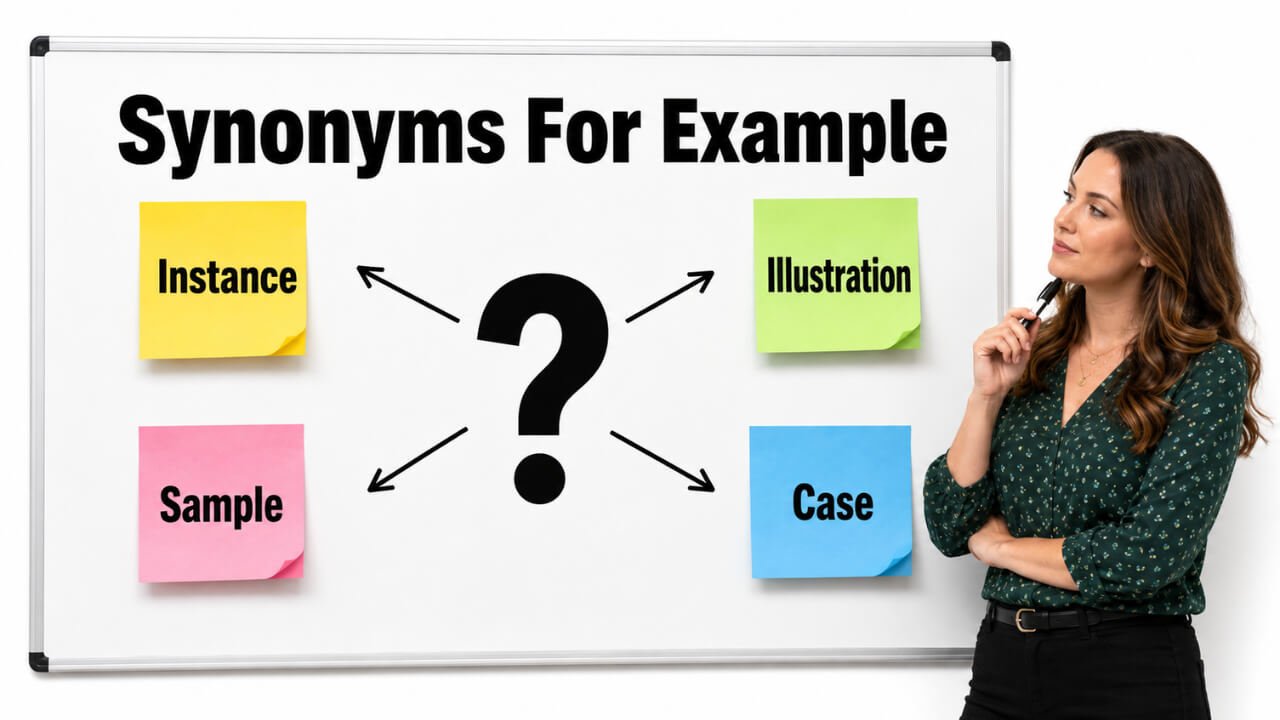
Quick Answer: The best synonyms for example include instance, case, sample, illustration, model, pattern, exemplar, prototype, precedent, and demonstration. The strongest choice depends on context. Use instance or case for a specific situation, sample for a small part of a larger group, illustration for explanation, model or exemplar for something worth following, and precedent when one example guides future action.
Pronunciation and Word Details
Word: Example.
Pronunciation: /ɪɡˈzæmpəl/
Part of Speech: Noun.
Meaning: An example is a person, thing, action, or situation used to explain, prove, represent, or show something.
US Pronunciation:
UK Pronunciation:
What Does “Example” Mean?
Direct Answer: “Example” means a specific person, thing, situation, or action that helps explain or represent a larger idea.
The word example is a noun. It is commonly used when giving evidence, explaining a point, teaching a concept, showing a sample, or presenting something as a model.
In writing and speech, example can refer to a single case, a clear illustration, a sample answer, a behavior to follow, or even a warning. For instance, a teacher may give an example to explain grammar, while a leader may set an example through responsible behavior.
Meaning, Tone, and Context of “Example”
Tone: “Example” is neutral, clear, and widely understood.
Formality: It works in formal writing, academic content, professional communication, and casual conversation.
Context: The word is common in education, grammar, vocabulary, essays, reports, presentations, instructions, and everyday explanations.
Use: It helps readers understand abstract ideas through specific cases. It can also show proof, support a claim, or demonstrate how something works.
Style: “Example” is simple and safe, but using it too often can make writing sound repetitive. Stronger alternatives such as illustration, case, sample, or model can improve clarity when the context is more specific.
When and How to Use “Example”
For Explanation: Use “example” when you want to make an idea easier to understand.
Example: The teacher gave an example of a complete sentence.
For Evidence: Use “example” when one case supports a larger point.
Example: The broken window is an example of poor maintenance.
For a Sample: Use “example” when showing one item from a larger set.
Example: This paragraph is an example of clear writing.
For a Model: Use “example” when someone or something should be followed.
Example: Her honesty is an example for the whole team.
For a Warning: Use “example” when a situation shows what others should avoid.
Example: His mistake became an example of careless planning.
Best Synonyms for Example
Instance: A specific case or occurrence.
Example: This is one instance of strong leadership.
Case: A situation that shows or proves something.
Example: The report includes a case of successful teamwork.
Sample: A small part used to represent a larger group.
Example: The form provides a sample of correct formatting.
Illustration: A clear explanation through a specific example.
Example: Her story is an illustration of courage.
Model: Something that others can follow or copy.
Example: His behavior is a model of patience.
Pattern: A repeated form or guide that can be followed.
Example: This sentence follows the pattern shown in the lesson.
Exemplar: An excellent example of a quality or type.
Example: She is an exemplar of discipline and kindness.
Prototype: An original or early example of a design or idea.
Example: The first version served as a prototype for later designs.
Precedent: An earlier example that guides later decisions.
Example: The ruling created a precedent for similar cases.
Demonstration: A practical example that shows how something works.
Example: The instructor gave a demonstration of the method.
50 Synonyms for Example with Short Meanings
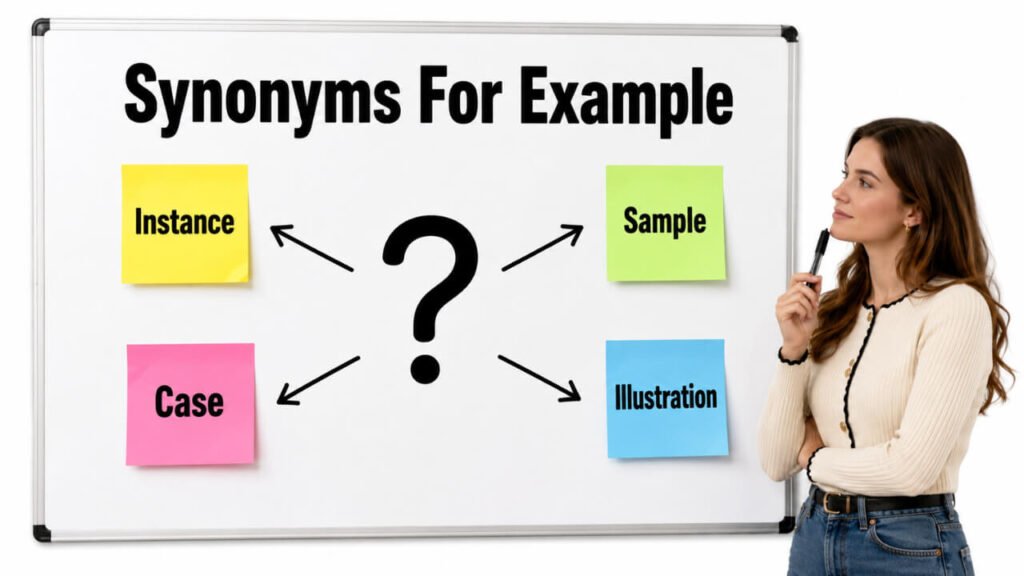
- Instance: A specific case or occurrence.
- Case: A situation that shows a point.
- Sample: One part used to represent a larger group.
- Illustration: A clear example used for explanation.
- Model: Something suitable to follow or copy.
- Pattern: A form or design that guides repetition.
- Exemplar: An excellent example of a kind.
- Prototype: An original example used for development.
- Precedent: An earlier example that influences later actions.
- Demonstration: A practical showing of how something works.
- Specimen: A single item used for study or inspection.
- Representation: Something that stands for a larger idea.
- Case Study: A detailed example used for analysis.
- Scenario: A possible or described situation.
- Situation: A set of conditions that shows a point.
- Occurrence: Something that happens and can be used as a case.
- Event: A happening used to explain or prove something.
- Episode: A particular incident or moment.
- Sample Case: One case used to represent others.
- Illustrative Case: A case that explains an idea clearly.
- Typical Case: A common example of a type.
- Specific Case: A particular example rather than a general idea.
- Representative Case: A case that fairly shows a wider group.
- Notable Case: An important example worth mentioning.
- Test Case: An example used to check or evaluate something.
- Use Case: A practical example of how something is used.
- Sample Item: One item chosen to show a larger set.
- Sample Sentence: A sentence used to show meaning or grammar.
- Sample Answer: An answer used as a guide.
- Model Answer: A strong answer that others can learn from.
- Template: A guiding example used for structure.
- Blueprint: A guiding plan or example for future work.
- Guide: Something that shows how to act or write.
- Standard: An example that sets an expected level.
- Benchmark: An example used for comparison.
- Archetype: A very typical example of a person or thing.
- Paradigm: A clear model or standard example.
- Role Model: A person whose behavior others should follow.
- Ideal: A highly desirable example.
- Reference Point: An example used for comparison.
- Proof: An example that helps show something is true.
- Evidence: Information or examples that support a claim.
- Exhibit: An example shown as proof or explanation.
- Demonstration Case: A case used to show a method.
- Lesson: An example that teaches something.
- Warning: An example that shows what should be avoided.
- Cautionary Case: An example that warns others.
- Object Lesson: A clear example that teaches a moral or practical point.
- Illustrative Point: A point used to clarify an idea.
- Representative Sample: A sample that shows the nature of a larger group.
Read Also:
Synonyms for Wonderful
Synonyms for Example by Context
When Example Means a Specific Case
Use these synonyms when “example” means one situation, event, or occurrence that explains a larger idea.
Best Synonyms: Instance, case, specific case, occurrence, situation.
Example: This case shows how small mistakes can create large problems.
Example: One instance of kindness can change the mood of a whole room.
When Example Means a Sample
Use these synonyms when “example” refers to one item, sentence, answer, or part of a larger group.
Best Synonyms: Sample, specimen, sample item, representative sample, sample answer.
Example: The worksheet includes a sample answer for each question.
Example: This specimen shows the structure of the plant clearly.
When Example Means an Illustration
Use these synonyms when “example” helps explain a rule, idea, meaning, or concept.
Best Synonyms: Illustration, demonstration, illustrative case, representation, scenario.
Example: Her story is an illustration of patience under pressure.
Example: The diagram gives a useful demonstration of the process.
When Example Means a Model to Follow
Use these synonyms when “example” means something admirable or worth copying.
Best Synonyms: Model, exemplar, pattern, standard, role model.
Example: His calm response was a model of mature behavior.
Example: She became an exemplar of honest leadership.
When Example Means a Warning or Precedent
Use these synonyms when “example” shows what happened before or what others should avoid.
Best Synonyms: Precedent, warning, cautionary case, object lesson, lesson.
Example: The failed project became a cautionary case for new planners.
Example: The decision set a precedent for future requests.
Another Word for Example
Direct Answer: Another word for example is instance when you mean a specific case. However, the best replacement depends on meaning. Use sample for one item from a group, illustration for explanation, model for something to follow, and precedent for an earlier guiding case.
Original: Please give an example of this rule.
Better Option: Please give an illustration of this rule.
Original: This is a good example of teamwork.
Better Option: This is a strong model of teamwork.
Original: The report includes an example from the survey.
Better Option: The report includes a representative sample from the survey.
Original: That event is an example of poor planning.
Better Option: That event is a cautionary case of poor planning.
When Not to Use “Example”
Avoid using “example” when a more specific word would make the meaning clearer. The word is useful, but it can sound repetitive if used in every sentence.
Weak: This example is an example of a common example in writing.
Better: This sentence is a common illustration of repeated wording.
Do not use “example” when you mean a physical sample, a legal precedent, a model answer, or proof. In those cases, a sharper synonym is usually better.
Weak: The fabric example feels soft.
Better: The fabric sample feels soft.
Weak: The court used an example from an older case.
Better: The court used a precedent from an older case.
Weak: Her work is a nice example for everyone.
Better: Her work is a strong model for everyone.
Words Commonly Confused With Example
Example vs Instance: An example explains or represents an idea, while an instance is one specific occurrence of something.
Example vs Sample: An example can explain a concept, while a sample is usually one item taken from a larger group.
Example vs Illustration: An example can be any case, while an illustration is usually chosen to make an idea clearer.
Example vs Model: An example may simply show something, while a model is usually something others can follow.
Example vs Precedent: An example shows a point, while a precedent is an earlier case that influences later decisions.
Example vs Evidence: An example may support an idea, while evidence is information used to prove or justify a claim.
Which Synonym Should You Choose?
Choose instance when writing about one specific occurrence.
Choose case when discussing a situation that proves or explains a point.
Choose sample when showing one item from a larger group.
Choose illustration when explaining a meaning, idea, rule, or concept.
Choose model when describing behavior, writing, or work that others should follow.
Choose exemplar when you want a more polished word for an excellent example.
Choose precedent when an earlier example affects future actions or decisions.
Choose demonstration when showing how something works in practice.
Choose specimen when referring to one item used for study, testing, or inspection.
Choose representative case when one example fairly reflects a wider group or trend.
Real Life Examples of “Example” in Sentences
Original: The teacher gave an example of a noun.
Better Option: The teacher gave an illustration of a noun.
Original: This is an example of excellent customer service.
Better Option: This is a model of excellent customer service.
Original: The report gives an example from the data.
Better Option: The report gives a specific case from the data.
Original: I need an example before I start the task.
Better Option: I need a sample before I start the task.
Original: His mistake is an example of poor judgment.
Better Option: His mistake is a cautionary case of poor judgment.
Original: The first design is an example for the next version.
Better Option: The first design is a prototype for the next version.
Original: Her answer is a good example for students.
Better Option: Her answer is a model answer for students.
Original: This event is an example of changing weather patterns.
Better Option: This event is an instance of changing weather patterns.
Original: The paragraph is an example of clear explanation.
Better Option: The paragraph is an illustration of clear explanation.
Original: Their decision became an example for later teams.
Better Option: Their decision became a precedent for later teams.
Synonym Groups and Usage Differences
Case Group
Words in this group refer to a specific situation or occurrence. Use them when explaining one real or possible example.
Synonyms: Instance, case, situation, occurrence, episode.
Example: One case of delayed payment caused the policy to change.
Sample Group
Words in this group refer to one part of a larger whole. Use them for writing, products, data, answers, or test material.
Synonyms: Sample, specimen, representative sample, sample item, sample answer.
Example: The guide includes a sample answer for practice.
Illustration Group
Words in this group make ideas easier to understand. Use them in teaching, grammar, essays, and explanations.
Synonyms: Illustration, demonstration, scenario, representation, illustrative case.
Example: The story is an illustration of courage during difficulty.
Model Group
Words in this group describe something worth following or copying. Use them for behavior, leadership, writing, and standards.
Synonyms: Model, exemplar, pattern, standard, role model.
Example: Her patience is a model for new team members.
Precedent Group
Words in this group refer to earlier examples that guide later actions or decisions.
Synonyms: Precedent, reference point, benchmark, guide, standard.
Example: The earlier agreement became a precedent for future discussions.
Warning Group
Words in this group describe examples that teach what to avoid.
Synonyms: Warning, cautionary case, object lesson, lesson.
Example: The failed launch became an object lesson in poor preparation.
Antonyms of Example
Counterexample: An example that disproves or challenges a statement.
Exception: A case that does not follow the usual rule.
Opposite Case: A situation that shows the reverse idea.
Contrast: Something used to show difference rather than similarity.
Contradiction: Something that goes against a claim or idea.
Irrelevant Case: A case that does not support the point.
Nonexample: Something that does not fit the category being explained.
Deviation: Something that moves away from the expected pattern.
Anomaly: An unusual case that does not match the normal pattern.
Mismatch: Something that does not fit the example or category.
Comparison Between Example and Related Words
Example vs Instance
“Example” is broader and can explain, prove, represent, or model something. “Instance” usually means one specific occurrence.
Example With Example: This is an example of careful planning.
Example With Instance: This is one instance of careful planning.
Example vs Sample
“Example” can explain an idea. “Sample” usually means one item from a larger group.
Example With Example: The sentence is an example of correct grammar.
Example With Sample: The sentence is a sample from the grammar worksheet.
Example vs Illustration
“Example” is general. “Illustration” focuses more on making something clear.
Example With Example: Her answer is an example of honesty.
Example With Illustration: Her answer is an illustration of honesty.
Example vs Model
“Example” may simply show something. “Model” suggests something should be followed.
Example With Example: His speech is an example of confident speaking.
Example With Model: His speech is a model of confident speaking.
Example vs Precedent
“Example” shows a point. “Precedent” is an earlier example that affects later decisions.
Example With Example: The rule includes an example from last year.
Example With Precedent: The rule follows a precedent from last year.
Example vs Evidence
“Example” can support an idea. “Evidence” is stronger because it helps prove a claim.
Example With Example: The survey gives an example of customer concern.
Example With Evidence: The survey gives evidence of customer concern.
Common Phrases and Expressions With Example
For Example: Used before giving a specific case.
A Clear Example: An example that is easy to understand.
A Good Example: A useful or positive example.
A Classic Example: A very typical example of something.
A Prime Example: A very strong or important example.
An Example Of: Used to connect a case with a category.
Set an Example: To behave in a way others should follow.
Follow the Example: To copy or learn from another person or thing.
Lead by Example: To guide others through actions rather than only words.
Make an Example Of: To punish or criticize someone so others learn a lesson.
Common Mistakes to Avoid
Repeating the Same Word: Do not use “example” too many times in one paragraph. Use case, sample, or illustration when they fit better.
Weak: The example gives an example of another example.
Better: The sentence gives an illustration of the main idea.
Choosing the Wrong Synonym: Do not use sample when you mean a situation, and do not use precedent when you only mean a simple example.
Weak: Her kindness is a sample for others.
Better: Her kindness is a model for others.
Using a Vague Example: An example should be clear and specific enough to help the reader understand the point.
Weak: This is an example of something important.
Better: This is an example of how daily practice improves skill.
Confusing Example and Evidence: An example can support an idea, but evidence is stronger when proving a claim.
Weak: One story is enough evidence for the rule.
Better: One story is an example that supports the rule.
Using Formal Words in Casual Sentences: Words like exemplar and paradigm sound polished, but they may feel too formal in simple conversation.
Weak: Your lunch choice is an exemplar of good taste.
Better: Your lunch choice is a good example of good taste.
Conclusion
The keyword synonyms for example includes many useful choices, but the best word depends on meaning and context. Use instance or case for a specific situation, sample for one part of a larger group, illustration for explanation, model or exemplar for something worth following, and precedent for an earlier guiding case. Choosing the right synonym makes your writing clearer, more natural, and more precise.
FAQs About Synonyms for Example
What is the best synonym for example?
The best synonym for example is instance when you mean a specific case. Use illustration for explanation and sample for one item from a larger group.
What is another word for example in writing?
Another word for example in writing is illustration. It works well when you are explaining a point, rule, idea, or meaning.
What is a formal synonym for example?
Formal synonyms for example include instance, case, illustration, exemplar, and precedent. The best choice depends on the sentence.
What is a simple synonym for example?
Simple synonyms for example include case, sample, model, and instance. These words are easy to understand and common in everyday writing.
Is sample the same as example?
A sample is a type of example, but it usually means one part of a larger group. An example can be any case used to explain or show something.
Can example mean model?
Yes, example can mean model when it describes behavior, work, or quality that others should follow.
What is the opposite of example?
The opposite depends on context. Common opposites include counterexample, exception, nonexample, contrast, and opposite case.
