
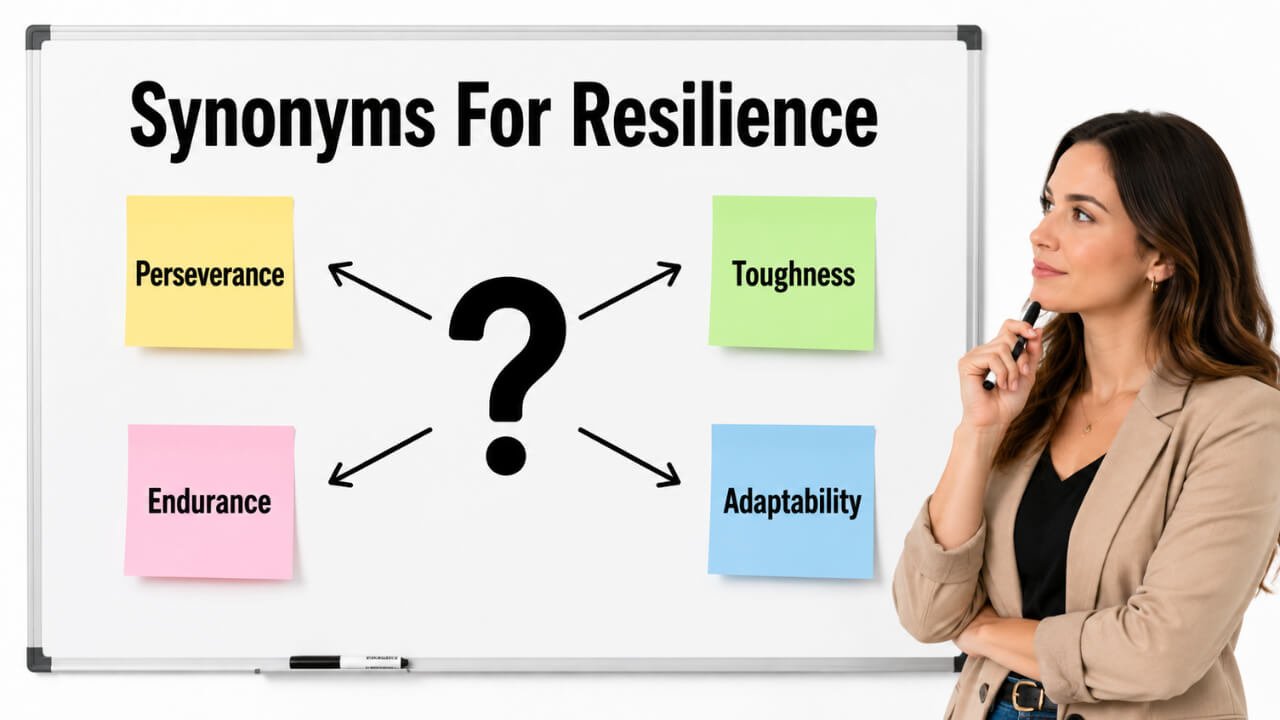
Quick Answer: The best synonyms for resilience include toughness, strength, endurance, fortitude, perseverance, tenacity, grit, adaptability, stamina, and inner strength. Use toughness for general strength, fortitude for formal writing, endurance for lasting through difficulty, perseverance for continued effort, adaptability for adjusting to change, grit for determined courage, and inner strength for emotional recovery.
Pronunciation and Word Details
Word: Resilience.
Pronunciation: /rɪˈzɪliəns/.
Part of Speech: Noun.
Meaning: The ability to recover, stay strong, or adapt after difficulty, stress, pressure, or change.
US Pronunciation:
UK Pronunciation:
What Does “Resilience” Mean?
Direct Answer: Resilience means the ability to recover from difficulty and continue functioning with strength.
Resilience is a noun used to describe mental strength, emotional recovery, physical toughness, social stability, or the ability of a person, group, system, or material to return to a strong condition after stress. It can describe a student facing failure, a worker handling pressure, a family managing loss, a community rebuilding after hardship, or a material bending without breaking.
The word works in personal, academic, professional, emotional, psychological, and technical contexts. It often suggests recovery, courage, flexibility, endurance, and the power to keep going.
Meaning, Tone, and Context of “Resilience”
Meaning: Resilience means strength during difficulty and the ability to recover after pressure, loss, failure, or change.
Tone: The word has a positive, strong, and respectful tone.
Formality: Resilience is suitable for formal writing, academic discussion, professional reports, essays, motivational writing, health topics, and everyday conversation.
Emotional Context: It describes a person who keeps going after sadness, stress, rejection, or failure.
Professional Context: It describes the ability to handle workplace pressure, change, deadlines, and challenges.
Academic Context: It is often used in psychology, education, leadership, health, social studies, and human development.
Technical Context: It can describe systems, materials, networks, or structures that can absorb stress and recover.
When and How to Use “Resilience”
For Emotional Strength: Use resilience when describing the ability to recover from pain, disappointment, stress, or loss.
Example: Her resilience helped her rebuild confidence after a difficult year.
For Mental Strength: Use resilience when someone stays focused and steady during pressure.
Example: Students need resilience when facing exams, feedback, and academic challenges.
For Recovery: Use resilience when someone or something returns to a stable condition after hardship.
Example: The town showed resilience after the storm damaged many homes.
For Adaptability: Use resilience when the focus is adjusting to change without giving up.
Example: Good leaders show resilience when plans change unexpectedly.
For Physical Toughness: Use resilience when describing a body, material, or structure that handles stress well.
Example: The fabric has resilience because it stretches and returns to shape.
For Long Term Endurance: Use resilience when something remains strong over time despite repeated difficulty.
Example: The team’s resilience helped them continue through several setbacks.
Best Synonyms for Resilience
Toughness: The ability to stay strong under pressure or difficulty.
Example: Her toughness helped her handle criticism without losing confidence.
Strength: The power to endure difficulty or remain steady.
Example: His strength became clear during the hardest part of the journey.
Endurance: The ability to continue through pain, stress, or hardship.
Example: The runners showed great endurance during the final miles.
Fortitude: Courage and strength during suffering or difficulty.
Example: She faced the illness with remarkable fortitude.
Perseverance: Continued effort despite problems, delays, or failure.
Example: His perseverance helped him finish the project after many setbacks.
Tenacity: Strong determination to keep going and not give up.
Example: Her tenacity made her keep trying until she succeeded.
Grit: Courage, determination, and strength in difficult situations.
Example: The young athlete showed grit after recovering from injury.
Adaptability: The ability to adjust to new conditions or changes.
Example: His adaptability helped him succeed in a changing workplace.
Stamina: The physical or mental energy to continue for a long time.
Example: The job requires stamina because the workdays are demanding.
Inner Strength: Deep emotional power that helps someone face hardship.
Example: Her inner strength helped her stay calm during the crisis.
50 Synonyms for Resilience with Short Meanings
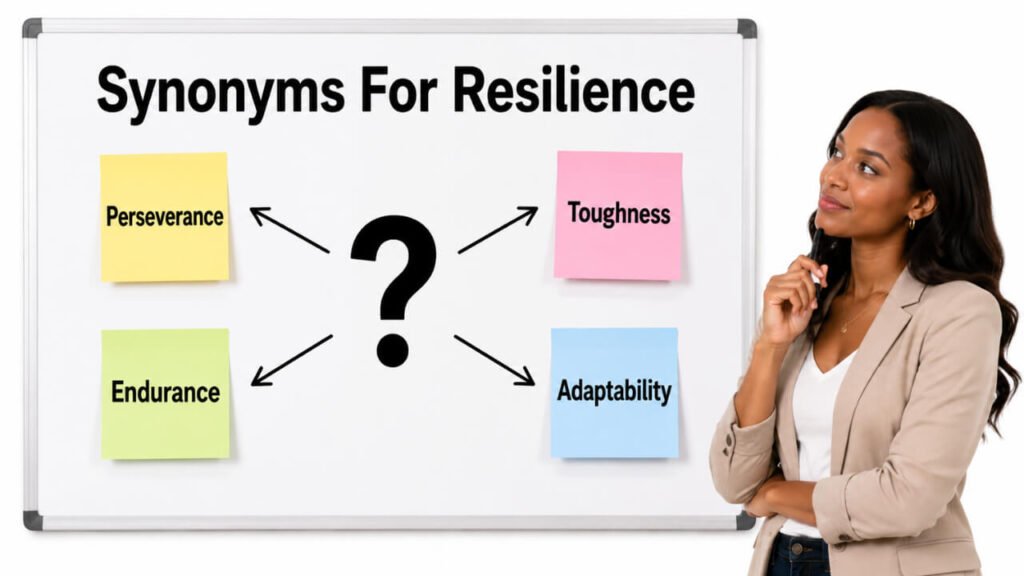
- Toughness: Strength that helps someone withstand difficulty.
- Strength: Power to stay steady during pressure or hardship.
- Endurance: Ability to continue through stress, pain, or challenge.
- Stamina: Energy to keep going for a long time.
- Fortitude: Brave strength during suffering or difficulty.
- Perseverance: Continued effort despite obstacles or failure.
- Persistence: The habit of continuing without giving up.
- Tenacity: Strong determination to hold on or keep trying.
- Grit: Courage and firmness during difficult moments.
- Hardiness: Ability to survive tough conditions.
- Adaptability: Ability to adjust well to change.
- Flexibility: Ability to change approach when needed.
- Recoverability: Ability to return to a stable condition after trouble.
- Buoyancy: Ability to recover quickly and stay hopeful.
- Elasticity: Ability to return to shape or condition after strain.
- Robustness: Strong ability to remain effective under stress.
- Durability: Ability to last despite use, pressure, or damage.
- Resistance: Ability to withstand pressure, harm, or influence.
- Staying Power: Ability to continue for a long time.
- Resolve: Firm decision to continue despite difficulty.
- Determination: Strong will to achieve or continue.
- Courage: Bravery in the face of fear, pain, or risk.
- Bravery: Readiness to face danger or hardship.
- Mental Strength: Ability to stay focused and steady under stress.
- Emotional Strength: Ability to handle painful feelings and recover.
- Inner Strength: Deep personal power during difficulty.
- Coping Ability: Capacity to manage stress or hardship.
- Self Control: Ability to manage emotions and reactions.
- Composure: Calmness during stress, pressure, or danger.
- Steadiness: Calm and reliable strength in difficult situations.
- Stability: Ability to remain balanced and secure.
- Recovery: Return to health, strength, or normal condition.
- Renewal: Process of becoming strong or fresh again.
- Rebound: Quick return after a setback or difficulty.
- Comeback: Return to success or strength after failure.
- Survival: Ability to continue living or existing after danger.
- Survivability: Capacity to survive difficult conditions.
- Invulnerability: Strong protection from harm or weakness.
- Immunity: Protection from harm, pressure, or negative effect.
- Firmness: Strength and steadiness in attitude or action.
- Backbone: Courage, firmness, and moral strength.
- Willpower: Mental force used to continue or resist pressure.
- Patience: Ability to endure delay, difficulty, or frustration calmly.
- Constancy: Steady commitment despite change or difficulty.
- Reliability: Ability to stay dependable under pressure.
- Resourcefulness: Ability to find practical solutions during difficulty.
- Adaptiveness: Quality of adjusting effectively to new conditions.
- Regeneration: Ability to renew, rebuild, or grow again.
- Bounce Back Ability: Capacity to recover after failure or stress.
- Toleration: Ability to bear difficulty, pressure, or discomfort.
Read Also:
Synonyms for Learn

Synonyms for Resilience by Context
When Resilience Means Toughness
Use these synonyms when resilience means being strong enough to withstand pressure, criticism, stress, or difficulty.
Toughness: Her toughness helped her remain calm after the rejection.
Strength: The team showed strength during the final stage of the project.
Hardiness: The plant’s hardiness allowed it to survive cold weather.
Robustness: The system’s robustness made it reliable during heavy use.
Durability: The material’s durability made it useful for outdoor furniture.
When Resilience Means Recovery
Use these synonyms when resilience means returning to strength after hardship, failure, loss, or damage.
Recovery: His recovery after the accident was slow but steady.
Rebound: The business made a strong rebound after a difficult season.
Comeback: Her comeback after failure impressed everyone.
Renewal: The city’s renewal showed the spirit of its people.
Recoverability: The software’s recoverability helped restore lost data.
When Resilience Means Endurance
Use these synonyms when resilience means continuing through stress, pain, pressure, or long effort.
Endurance: The workers showed endurance during the demanding schedule.
Stamina: Her stamina helped her complete the long training session.
Staying Power: The movement had staying power because people believed in it.
Persistence: His persistence helped him finish the task.
Perseverance: Their perseverance carried them through repeated setbacks.
When Resilience Means Adaptability
Use these synonyms when resilience means adjusting to change, uncertainty, or new conditions.
Adaptability: Her adaptability made the transition easier.
Flexibility: The manager’s flexibility helped the team solve the problem.
Adaptiveness: The group’s adaptiveness improved its performance.
Resourcefulness: His resourcefulness helped him find a solution quickly.
Elasticity: The material’s elasticity helped it return to its original shape.
When Resilience Means Emotional Strength
Use these synonyms when resilience means emotional courage, inner power, and the ability to stay balanced.
Inner Strength: Her inner strength helped her face the loss with dignity.
Emotional Strength: He showed emotional strength after receiving bad news.
Composure: She kept her composure during the tense meeting.
Fortitude: They faced the challenge with quiet fortitude.
Courage: His courage helped him begin again after failure.
Another Word for Resilience
Direct Answer: Another word for resilience is toughness, but the best replacement depends on the sentence.
Use fortitude in formal writing about courage. Use endurance when the focus is lasting through difficulty. Use adaptability when the focus is adjusting to change. Use recovery when the focus is returning after a setback.
Original: Her resilience helped her through the crisis.
Better Option: Her fortitude helped her through the crisis.
Original: The team showed resilience during the long season.
Better Option: The team showed endurance during the long season.
Original: His resilience helped him adjust to the new role.
Better Option: His adaptability helped him adjust to the new role.
Original: The company showed resilience after a difficult year.
Better Option: The company showed a strong recovery after a difficult year.
When Not to Use “Resilience”
Do not use resilience when a more exact word gives clearer meaning. The word can sound too broad if the sentence needs a specific idea such as recovery, stamina, adaptability, fortitude, or durability.
Weak: The athlete had resilience during the marathon.
Better: The athlete had stamina during the marathon.
Weak: The rubber has emotional resilience.
Better: The rubber has elasticity.
Weak: She showed resilience by changing her plan quickly.
Better: She showed adaptability by changing her plan quickly.
Weak: His resilience helped him remember the pain.
Better: His emotional strength helped him face the pain.
Weak: The phone case has resilience against scratches.
Better: The phone case has durability against scratches.
Use resilience when the sentence means recovery, strength, or adaptability after difficulty. Choose a sharper synonym when you need to describe physical material, emotional courage, long effort, or technical performance more precisely.
Words Commonly Confused With Resilience
Resilience vs Toughness: Resilience often includes recovery after difficulty, while toughness focuses more on strength during pressure.
Resilience vs Endurance: Resilience means recovering or adapting, while endurance means continuing through hardship for a long time.
Resilience vs Perseverance: Resilience is the ability to recover, while perseverance is the act of continuing effort despite obstacles.
Resilience vs Fortitude: Resilience is broader and can describe people, systems, or materials, while fortitude usually means brave strength during suffering.
Resilience vs Adaptability: Resilience includes recovery and strength, while adaptability focuses on adjusting to change.
Resilience vs Stamina: Resilience can be mental, emotional, physical, or technical, while stamina mainly means lasting energy.
Resilience vs Durability: Resilience can describe recovery or flexibility, while durability means something lasts despite use or damage.
Which Synonym Should You Choose?
Choose toughness when writing about general strength under pressure.
Choose fortitude when writing formally about courage during suffering, loss, or hardship.
Choose endurance when the focus is continuing for a long time despite difficulty.
Choose perseverance when the meaning is continued effort after failure, delay, or challenge.
Choose tenacity when the sentence needs strong determination and refusal to give up.
Choose grit when the tone is stronger, more personal, and focused on courage and determination.
Choose adaptability when writing about change, flexibility, uncertainty, or new situations.
Choose stamina when writing about physical or mental energy over time.
Choose durability when describing objects, materials, tools, or structures.
Choose inner strength when writing about emotional recovery, grief, fear, or personal struggle.
Real Life Examples of “Resilience” in Sentences
Original: Her resilience helped her recover after the loss.
Better Option: Her inner strength helped her recover after the loss.
Original: The team showed resilience after losing the first match.
Better Option: The team showed determination after losing the first match.
Original: His resilience helped him keep working during the crisis.
Better Option: His perseverance helped him keep working during the crisis.
Original: The child’s resilience impressed the teachers.
Better Option: The child’s courage impressed the teachers.
Original: The material has resilience under pressure.
Better Option: The material has elasticity under pressure.
Original: The company showed resilience after the market changed.
Better Option: The company showed adaptability after the market changed.
Original: Her resilience carried her through the long treatment.
Better Option: Her fortitude carried her through the long treatment.
Original: The community’s resilience was visible after the flood.
Better Option: The community’s recovery was visible after the flood.
Original: His resilience helped him finish the difficult course.
Better Option: His endurance helped him finish the difficult course.
Original: Their resilience kept the project alive.
Better Option: Their staying power kept the project alive.
Synonym Groups and Usage Differences
Strength Group
This group includes toughness, strength, hardiness, firmness, and backbone. Use these words when the focus is being strong, steady, or firm during difficulty.
Example: Her toughness helped her face the criticism calmly.
Recovery Group
This group includes recovery, rebound, comeback, renewal, and regeneration. Use these words when the focus is returning to strength after damage, failure, loss, or stress.
Example: The town’s recovery after the storm was impressive.
Endurance Group
This group includes endurance, stamina, persistence, perseverance, and staying power. Use these words when the focus is continuing through long pressure or repeated challenges.
Example: His endurance helped him complete the demanding program.
Adaptability Group
This group includes adaptability, flexibility, adaptiveness, resourcefulness, and elasticity. Use these words when the focus is adjusting to change or returning to shape after pressure.
Example: Her adaptability helped her succeed in a new environment.
Emotional Strength Group
This group includes inner strength, emotional strength, fortitude, composure, and courage. Use these words when the focus is mental balance, emotional recovery, or bravery during hardship.
Example: His composure helped everyone stay calm during the emergency.
Determination Group
This group includes resolve, determination, tenacity, willpower, and grit. Use these words when the focus is refusing to quit.
Example: Her tenacity helped her continue when the work became difficult.
Antonyms of Resilience
Fragility: Weakness that makes something break or fail easily.
Weakness: Lack of strength, power, or firmness.
Vulnerability: Openness to harm, damage, or emotional pain.
Instability: Lack of balance, steadiness, or security.
Helplessness: Inability to act, recover, or manage difficulty.
Hopelessness: Lack of belief that recovery or improvement is possible.
Surrender: Giving up during pressure or difficulty.
Defeat: Loss of strength, confidence, or success after challenge.
Collapse: Sudden failure or breakdown under pressure.
Rigidity: Inability to bend, adapt, or change when needed.
Despair: Deep loss of hope during hardship.
Brittleness: Quality of breaking easily under pressure.
Comparison: Resilience vs Related Words
Resilience vs Toughness
Difference: Resilience includes recovery after hardship, while toughness focuses on strength during hardship.
Example With Resilience: Her resilience helped her recover after the setback.
Example With Toughness: Her toughness helped her face the setback without fear.
Resilience vs Endurance
Difference: Resilience means recovering or adapting after difficulty, while endurance means continuing through difficulty for a long time.
Example With Resilience: The community showed resilience after the disaster.
Example With Endurance: The workers showed endurance during the long project.
Resilience vs Perseverance
Difference: Resilience is the ability to recover, while perseverance is the continued effort to keep going.
Example With Resilience: His resilience helped him recover after failing the test.
Example With Perseverance: His perseverance helped him study again and pass the test.
Resilience vs Fortitude
Difference: Resilience can describe recovery, flexibility, or strength, while fortitude describes brave strength during pain or difficulty.
Example With Resilience: She showed resilience after losing her job.
Example With Fortitude: She showed fortitude while caring for her family during the crisis.
Resilience vs Adaptability
Difference: Resilience means staying strong or recovering after pressure, while adaptability means adjusting well to change.
Example With Resilience: The team’s resilience helped them recover after the failure.
Example With Adaptability: The team’s adaptability helped them adjust to the new plan.
Resilience vs Durability
Difference: Resilience often includes recovery or flexibility, while durability means lasting without breaking or wearing out.
Example With Resilience: The material’s resilience lets it return to shape after pressure.
Example With Durability: The material’s durability helps it last for many years.
Common Phrases and Expressions With Resilience
Emotional Resilience: Ability to recover from emotional stress or pain.
Mental Resilience: Ability to stay focused and strong during pressure.
Physical Resilience: Ability of the body to recover after strain or illness.
Build Resilience: Develop strength to handle future challenges.
Show Resilience: Demonstrate strength during or after hardship.
Develop Resilience: Improve the ability to recover and adapt.
Resilience In Adversity: Strength during difficult or painful conditions.
Community Resilience: Ability of a group or area to recover after hardship.
Resilience Training: Practice or guidance that helps people handle stress better.
Resilience And Adaptability: Strength combined with the ability to adjust to change.
Common Mistakes to Avoid
Repeating Resilience Too Often: Do not use resilience in every sentence when a specific synonym gives better variety and meaning.
Weak: Her resilience showed resilience during a resilient response to hardship.
Better: Her inner strength showed clearly during her recovery from hardship.
Using Resilience For Every Kind Of Strength: Resilience is not always the best word for physical power, muscle strength, or force.
Weak: He lifted the heavy box with resilience.
Better: He lifted the heavy box with strength.
Confusing Resilience With Endurance: Use endurance when the main idea is lasting through time, effort, or pain.
Weak: The runner’s resilience helped him run for four hours.
Better: The runner’s endurance helped him run for four hours.
Confusing Resilience With Adaptability: Use adaptability when the main point is adjusting to change.
Weak: Her resilience helped her accept the new schedule quickly.
Better: Her adaptability helped her accept the new schedule quickly.
Using A Technical Word In Emotional Context: Do not use material terms such as elasticity when describing feelings unless the sentence is clearly figurative.
Weak: His elasticity helped him after grief.
Better: His emotional strength helped him after grief.
Making The Sentence Too Vague: Add the situation or challenge when using resilience.
Weak: She has resilience.
Better: She showed resilience after losing her job and starting again.
Conclusion
The best synonyms for resilience depend on the kind of strength you want to describe. Use toughness for general strength, fortitude for brave emotional power, endurance for lasting through hardship, perseverance for continued effort, adaptability for change, and recovery for returning after setbacks. For personal writing, inner strength often sounds warm and clear. For formal writing, fortitude, robustness, and adaptability can make your meaning more precise and professional.
FAQs About Synonyms for Resilience
What is the best synonym for resilience?
The best synonym for resilience is toughness in general use, but fortitude, endurance, adaptability, or perseverance may fit better depending on the sentence.
What is a formal synonym for resilience?
Formal synonyms for resilience include fortitude, robustness, adaptability, endurance, and recoverability.
What is a simple word for resilience?
A simple word for resilience is strength. It is easy to understand and works in many everyday sentences.
Is perseverance the same as resilience?
Perseverance is close to resilience, but it focuses on continued effort. Resilience focuses more on recovery, strength, and adapting after difficulty.
What is a synonym for emotional resilience?
A good synonym for emotional resilience is inner strength. Other useful options include emotional strength, fortitude, composure, and courage.
What is the opposite of resilience?
The opposite of resilience can be fragility, weakness, vulnerability, instability, or helplessness, depending on the context.
Can resilience describe things, not just people?
Yes, resilience can describe people, communities, systems, materials, and organizations. It means they can handle stress, recover, or remain strong after pressure.
