
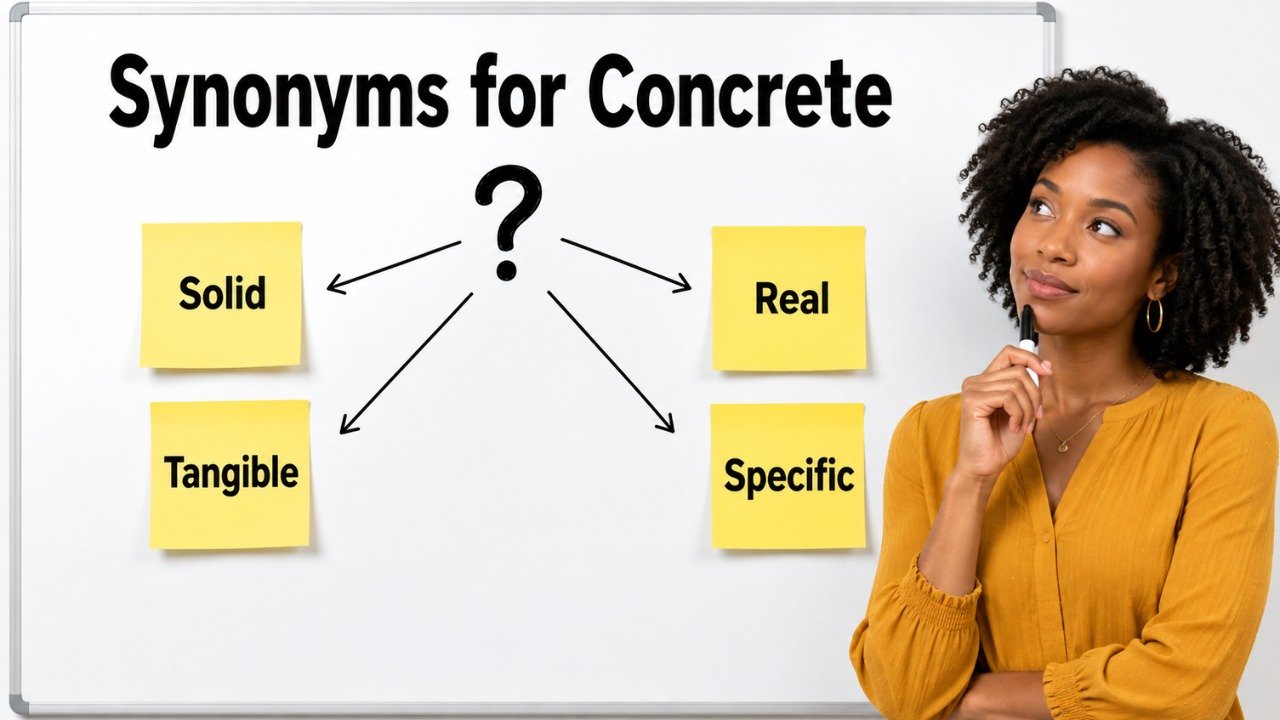
Quick Answer: The best synonyms for concrete are specific, definite, tangible, clear, precise, actual, factual, solid, practical, and measurable. Use specific or precise when describing exact information, tangible when something can be physically experienced, actual or factual when discussing reality, and practical when referring to useful actions or plans. Solid works well for strong evidence or reliable ideas, while measurable is suitable for results, goals, and data. These synonyms for concrete should be chosen according to whether the word describes detail, reality, physical form, certainty, or practical action.
Pronunciation and Word Details
Word: Concrete.
Pronunciation: /ˈkɒŋ.kriːt/.
Part of Speech: Adjective, noun, and verb.
Meaning: Concrete describes something specific, real, physical, clearly defined, or made from a hard construction material.
US Pronunciation:
UK Pronunciation:
What Does “Concrete” Mean?
Concrete means specific, real, clearly defined, or physically existing rather than abstract, uncertain, or imaginary.
As an adjective, concrete often describes facts, evidence, plans, examples, goals, and results that are clear enough to understand, observe, measure, or verify.
Example: The report provided concrete evidence of improvement.
In this sentence, concrete means clear, factual, and convincing.
Concrete can also describe something physical or material.
Example: The sculpture gave concrete form to an abstract idea.
Here, concrete means visible or physically represented.
As a noun, concrete refers to a hard construction material made by combining cement, water, sand, and stone or gravel.
Example: The workers poured concrete into the foundation.
As a verb, concrete can mean covering something with concrete or forming it into a solid mass. This use is less common in everyday conversation.
The intended meaning of concrete depends on the sentence. It may describe specificity, reality, physical existence, certainty, practicality, or construction material.
Meaning, Tone, and Context of “Concrete”
Concrete usually has a neutral, clear, and confident tone. It is common in formal writing, academic discussion, business communication, technical reports, everyday conversation, and construction vocabulary.
In formal writing, concrete often describes evidence, facts, details, findings, proposals, or results that can be examined and verified.
Example: The researcher presented concrete findings from the study.
In professional communication, concrete describes plans, actions, objectives, and solutions that are practical and clearly defined.
Example: We need concrete steps to improve customer satisfaction.
In educational writing, a concrete example helps explain an abstract theory or difficult idea.
Example: The teacher used a concrete example to explain responsibility.
In casual speech, concrete may simply mean real, definite, or certain.
Example: We do not have any concrete plans for the weekend.
In technical and construction contexts, concrete refers to the hard material used for buildings, roads, floors, walls, and foundations.
Because concrete sounds firm and definite, writers should avoid using it when the information is still uncertain, assumed, or unsupported.
When and How to Use “Concrete”
For Specific Information
Use concrete when information is clearly stated and includes exact details rather than general ideas.
Example: Please provide concrete details about the proposed changes.
For Strong Evidence
Use concrete to describe evidence that is factual, observable, or convincing.
Example: The investigation found concrete evidence supporting the claim.
For Practical Plans
Use concrete when a plan includes clear actions, responsibilities, or deadlines.
Example: The committee developed a concrete plan for reducing expenses.
For Measurable Goals
Use concrete for goals that can be tracked, counted, or evaluated.
Example: The manager established concrete goals for the next quarter.
For Real Results
Use concrete when results are actual and noticeable rather than expected or theoretical.
Example: The new process produced concrete improvements in efficiency.
For Physical Objects
Use concrete to describe something that has a material or physical form.
Example: The design turned her vision into a concrete product.
For Clear Examples
Use concrete when an example makes an idea easier to understand.
Example: Give me a concrete example of how this rule works.
For Definite Decisions
Use concrete when a decision, agreement, or arrangement has been firmly established.
Example: No concrete decision has been made about the location.
For Construction Material
Use concrete as a noun when referring to the hard material used in construction.
Example: The path was made from concrete.
Best Synonyms for Concrete
Specific
Synonym: Specific means clearly identified, limited, or focused on an exact subject.
Example: She gave specific instructions for completing the task.
Definite
Synonym: Definite means certain, clearly decided, or free from uncertainty.
Example: We need a definite answer before making the reservation.
Tangible
Synonym: Tangible means physically noticeable or clearly real.
Example: The training produced tangible improvements in performance.
Clear
Synonym: Clear means easy to understand and not confusing.
Example: The speaker provided clear reasons for the decision.
Precise
Synonym: Precise means exact, accurate, and carefully defined.
Example: The document contains precise measurements for the building.
Actual
Synonym: Actual means real or existing in fact.
Example: The actual cost was lower than the original estimate.
Factual
Synonym: Factual means based on facts rather than opinions or assumptions.
Example: The article offered a factual description of the event.
Solid
Synonym: Solid means strong, reliable, convincing, or well supported.
Example: The lawyer presented a solid argument.
Practical
Synonym: Practical means useful, realistic, and suitable for real situations.
Example: They suggested a practical solution to the problem.
Measurable
Synonym: Measurable means capable of being counted, assessed, or evaluated.
Example: The campaign produced measurable growth in sales.
50 Synonyms for Concrete with Short Meanings
- Specific: Clearly focused on an exact subject or detail.
- Definite: Certain, fixed, or clearly decided.
- Precise: Exact and carefully defined.
- Explicit: Expressed clearly and directly.
- Clear: Easy to understand and free from confusion.
- Exact: Fully correct in every detail.
- Detailed: Containing specific and complete information.
- Particular: Referring to one exact person, thing, or situation.
- Distinct: Clearly different, noticeable, or identifiable.
- Unambiguous: Having only one clear meaning.
- Unmistakable: So clear that it cannot be misunderstood.
- Certain: Known or accepted without serious doubt.
- Conclusive: Strong enough to settle a question.
- Decisive: Producing a clear and definite result.
- Established: Accepted, confirmed, or firmly set.
- Confirmed: Shown or proved to be correct.
- Documented: Supported by written or recorded information.
- Proven: Demonstrated to be true or effective.
- Factual: Based on facts and real information.
- Objective: Based on observable facts rather than personal feelings.
- Actual: Existing in reality or fact.
- Real: Truly existing rather than imagined.
- Genuine: Authentic and not false or artificial.
- Authentic: Real, original, and trustworthy.
- Tangible: Physically noticeable or clearly real.
- Physical: Related to material objects or the body.
- Material: Existing as physical matter.
- Solid: Firm, reliable, or strongly supported.
- Substantial: Important, considerable, or firmly existing.
- Palpable: So clear or strong that it seems physically noticeable.
- Perceptible: Capable of being noticed or recognized.
- Observable: Able to be seen, noticed, or examined.
- Visible: Able to be seen or clearly recognized.
- Measurable: Capable of being assessed or calculated.
- Demonstrable: Able to be shown or proved.
- Verifiable: Able to be checked and confirmed.
- Evident: Clear from the available facts.
- Practical: Useful and suitable for real situations.
- Realistic: Sensible and based on actual conditions.
- Grounded: Based on facts, experience, or reality.
- Literal: Following the direct and exact meaning.
- Direct: Clear, straightforward, and without unnecessary detail.
- Plain: Simple, obvious, and easy to understand.
- Quantifiable: Capable of being expressed as a number or amount.
- Testable: Capable of being examined through a test.
- Identifiable: Able to be recognized or named clearly.
- Traceable: Able to be followed back to a source or cause.
- Embodied: Given a visible or physical form.
- Manifest: Clearly visible, obvious, or apparent.
- Particularized: Made specific by adding exact details.
Read Also:
Synonyms for Studio

Synonyms for Concrete by Context
When Concrete Means Specific and Clearly Defined
When concrete describes information, examples, details, or instructions, suitable synonyms include specific, precise, explicit, exact, detailed, particular, and unambiguous.
Specific: Best for information focused on one clearly identified matter.
Example: Please provide specific reasons for your decision.
Precise: Best for measurements, wording, timing, or technical details.
Example: The engineer recorded precise measurements.
Explicit: Best for instructions or statements expressed directly.
Example: The policy contains explicit rules about attendance.
Detailed: Best when information includes many important facts.
Example: She submitted a detailed description of the incident.
When Concrete Means Real or Factual
When concrete describes something that exists in reality, useful synonyms include actual, real, factual, genuine, authentic, established, and proven.
Actual: Refers to what truly happened or exists.
Example: The actual number was higher than expected.
Factual: Describes information based on verified facts.
Example: The report provides a factual account of the meeting.
Established: Describes something already accepted or confirmed.
Example: The procedure follows established safety practices.
Proven: Describes something demonstrated to be true or effective.
Example: This is a proven method for reducing waste.
When Concrete Means Tangible or Physical
When concrete refers to something physically present or directly noticeable, choose tangible, physical, material, solid, palpable, visible, or perceptible.
Tangible: Best for real benefits, results, or objects that can be noticed.
Example: The project delivered tangible benefits to residents.
Physical: Best when contrasting material objects with ideas or emotions.
Example: The archive contains physical copies of the records.
Palpable: Best for feelings, tension, or effects that seem strongly noticeable.
Example: There was a palpable sense of relief in the room.
Visible: Best for changes or results that can easily be seen.
Example: The treatment produced visible improvements.
When Concrete Means Practical and Usable
When concrete describes actions, solutions, proposals, or goals, suitable synonyms include practical, realistic, measurable, workable, grounded, and achievable.
Practical: Best for ideas that can be applied successfully.
Example: We need a practical solution to the storage problem.
Realistic: Best for plans based on available time, money, and resources.
Example: The team created a realistic schedule.
Measurable: Best for goals and results that can be evaluated.
Example: Each department received measurable performance targets.
Grounded: Best for ideas supported by experience or facts.
Example: Her recommendations were grounded in customer feedback.
When Concrete Refers to Construction Material
As a noun, concrete refers to a specific construction mixture. Contextual alternatives include building material, cement based mixture, paving material, structural material, and masonry material.
These expressions may describe concrete, but they are not always exact replacements.
Building Material: A broad term for substances used in construction.
Example: Concrete is a durable building material.
Cement Based Mixture: A descriptive term for a mixture containing cement, water, sand, and aggregate.
Example: The workers prepared a cement based mixture for the foundation.
Paving Material: A broad term used when concrete forms roads, paths, or surfaces.
Example: The contractor selected a durable paving material.
Cement should not normally replace concrete because cement is only one ingredient used to make concrete.
Another Word for Concrete
The best general replacement for concrete is specific when the word describes details, examples, plans, instructions, or information.
However, the best alternative depends on the intended meaning. Tangible is better for noticeable results, factual is better for evidence, practical is better for solutions, and actual is better when contrasting reality with expectation.
Original: The manager asked for concrete information.
Better Option: The manager asked for specific information.
Original: The company achieved concrete results.
Better Option: The company achieved measurable results.
Original: We need a concrete solution.
Better Option: We need a practical solution.
Original: There is no concrete proof of the claim.
Better Option: There is no factual proof of the claim.
When Not to Use “Concrete”
Do not use concrete when the meaning is too broad to show whether you mean specific, real, physical, practical, or definite. A more precise synonym may make the sentence easier to understand.
When Describing Exact Numbers
Precise or exact may be clearer than concrete when discussing measurements, dates, amounts, or calculations.
Weak: We need a concrete measurement of the room.
Better: We need a precise measurement of the room.
When Discussing Verified Facts
Factual, documented, or verified may be stronger when referring to information supported by records.
Weak: The report contains concrete information.
Better: The report contains documented information.
When Referring to Physical Objects
Physical, material, or tangible may communicate the meaning more directly.
Weak: The museum preserves concrete objects from the period.
Better: The museum preserves physical objects from the period.
When Describing Useful Advice
Practical may sound more natural than concrete when referring to advice or solutions.
Weak: She gave me concrete advice about saving money.
Better: She gave me practical advice about saving money.
When Information Is Uncertain
Do not call a claim concrete when it is based only on guesses, rumors, or incomplete evidence.
Weak: We have concrete evidence, although nothing has been verified.
Better: We have preliminary information, although nothing has been verified.
When Repetition Makes Writing Heavy
Repeated use of concrete can make a paragraph sound rigid or monotonous.
Weak: The concrete plan produced concrete results through concrete actions.
Better: The specific plan produced measurable results through practical actions.
Words Commonly Confused With Concrete
Concrete vs Specific: Concrete can mean real, physical, practical, or clearly defined. Specific mainly means exact, limited, or clearly identified.
Concrete vs Tangible: Concrete and tangible can both describe something real. Tangible often emphasizes something physically noticeable or clearly experienced.
Concrete vs Definite: Concrete describes clear details or evidence, while definite emphasizes certainty or a final decision.
Concrete vs Precise: Concrete means clear and specific, while precise emphasizes exactness and accuracy.
Concrete vs Actual: Concrete may describe something real or clearly established. Actual directly contrasts reality with expectation, appearance, or assumption.
Concrete vs Solid: Concrete can mean specific or tangible. Solid often means strong, reliable, convincing, or well supported.
Concrete vs Cement: Concrete is the finished construction mixture. Cement is a powder used as one ingredient in that mixture.
Concrete vs Abstract: Concrete refers to specific, physical, or observable things. Abstract refers to ideas, qualities, theories, or concepts without a physical form.
Which Synonym Should You Choose?
Choose specific when describing exact details, instructions, examples, reasons, or requirements.
Choose precise when writing about time, measurements, wording, numbers, or technical information.
Choose explicit when a rule, instruction, or statement must be communicated directly.
Choose tangible when describing noticeable benefits, physical objects, or real improvements.
Choose factual when discussing reports, evidence, events, records, or information based on facts.
Choose actual when comparing reality with estimates, expectations, plans, or appearances.
Choose definite when describing a firm answer, decision, date, or arrangement.
Choose solid when describing strong arguments, evidence, support, or preparation.
Choose practical when referring to useful advice, realistic solutions, or workable actions.
Choose measurable when describing goals, progress, performance, results, or data.
Choose documented when evidence appears in records, files, reports, or written material.
Choose clear in everyday conversation when you want a simple and natural alternative.
Choose concrete when the sentence benefits from a broad sense of specificity, reality, certainty, or practical value.
Real Life Examples of “Concrete” in Sentences
Original: The teacher asked for a concrete example.
Better Option: The teacher asked for a specific example.
Original: We have no concrete plans for the holiday.
Better Option: We have no definite plans for the holiday.
Original: The police found concrete evidence near the building.
Better Option: The police found solid evidence near the building.
Original: The program produced concrete benefits for students.
Better Option: The program produced tangible benefits for students.
Original: The proposal needs more concrete details.
Better Option: The proposal needs more precise details.
Original: The meeting ended without a concrete decision.
Better Option: The meeting ended without a definite decision.
Original: She suggested concrete steps for improving the process.
Better Option: She suggested practical steps for improving the process.
Original: The research produced concrete results.
Better Option: The research produced measurable results.
Original: There is no concrete proof that the story is true.
Better Option: There is no factual proof that the story is true.
Original: The designer turned the idea into a concrete product.
Better Option: The designer turned the idea into a tangible product.
Synonym Groups and Usage Differences
Specificity Group
Specific, precise, explicit, exact, detailed, particular, and unambiguous belong to the specificity group.
These words describe information that is clearly identified or carefully defined. Specific is the most flexible choice, while precise suggests exact accuracy. Explicit emphasizes direct expression, and detailed emphasizes the amount of information provided.
Example: The instructions included precise details about each step.
Reality Group
Actual, real, factual, authentic, genuine, established, and proven belong to the reality group.
These synonyms describe something that exists, happened, or can be accepted as true. Actual contrasts reality with expectation, while factual emphasizes evidence. Authentic and genuine emphasize originality or truthfulness.
Example: The final report was based on factual information.
Physical Form Group
Tangible, physical, material, solid, visible, perceptible, and palpable belong to the physical form group.
These words describe something that can be seen, touched, experienced, or strongly noticed. Tangible is often used for benefits and results, while physical refers directly to material existence.
Example: The renovation created visible improvements throughout the building.
Evidence Group
Documented, verified, demonstrable, observable, confirmed, conclusive, and proven belong to the evidence group.
These terms describe information that can be checked or supported. Documented refers to written records, verified means checked for accuracy, and conclusive means strong enough to settle a question.
Example: The conclusion was supported by documented evidence.
Practicality Group
Practical, realistic, grounded, measurable, testable, and quantifiable belong to the practicality group.
These words describe plans, goals, or ideas that can be used, examined, or evaluated in real situations. Practical emphasizes usefulness, while measurable and quantifiable emphasize numerical assessment.
Example: The department introduced measurable goals for each employee.
Antonyms of Concrete
The opposite of concrete changes according to whether concrete means specific, real, physical, certain, or practical.
Abstract: Existing as an idea rather than a physical or specific thing.
Vague: Not clearly expressed or defined.
General: Broad and not focused on exact details.
Ambiguous: Open to more than one interpretation.
Unclear: Difficult to understand or identify.
Theoretical: Based mainly on ideas rather than practical experience.
Hypothetical: Based on an imagined possibility.
Imaginary: Existing only in the mind.
Intangible: Not physical or difficult to measure directly.
Uncertain: Not known, fixed, or decided.
Unproven: Not yet demonstrated to be true.
Speculative: Based on guesses rather than established facts.
Imprecise: Not exact or carefully defined.
Indefinite: Not clearly decided or limited.
Unsupported: Lacking sufficient facts or evidence.
Comparison of Concrete and Related Words
Concrete vs Specific
Concrete can describe something specific, real, physical, or practical. Specific focuses mainly on exact details or one clearly identified subject.
Example With Concrete: The proposal needs concrete information about costs.
Example With Specific: The proposal needs specific information about equipment costs.
Specific is often the better choice when the exact subject can be named.
Concrete vs Tangible
Concrete and tangible both suggest reality. Tangible emphasizes something that can be physically experienced or clearly noticed.
Example With Concrete: The policy produced concrete improvements.
Example With Tangible: The policy produced tangible improvements in working conditions.
Tangible is especially natural with benefits, progress, outcomes, and results.
Concrete vs Definite
Concrete emphasizes clarity or real evidence. Definite emphasizes certainty and finality.
Example With Concrete: We need a concrete proposal.
Example With Definite: We need a definite answer.
Use definite for decisions, dates, answers, and arrangements.
Concrete vs Precise
Concrete means clear and specific. Precise means exact in every important detail.
Example With Concrete: Give me a concrete estimate.
Example With Precise: Give me a precise estimate of the total cost.
Use precise for numbers, timing, measurements, wording, and technical details.
Concrete vs Actual
Concrete may describe something real, but it can also describe clear information or practical action. Actual directly refers to what truly exists or happened.
Example With Concrete: We need concrete evidence before acting.
Example With Actual: The actual cause of the problem remains unknown.
Use actual when contrasting reality with an estimate, expectation, or appearance.
Concrete vs Solid
Concrete and solid can both describe reliable evidence or plans. Solid emphasizes strength and dependability.
Example With Concrete: The team presented concrete reasons for the change.
Example With Solid: The team presented solid reasons for the change.
Solid is natural for arguments, preparation, evidence, support, and performance.
Concrete vs Cement
Concrete and cement are not exact synonyms.
Cement is a fine powder that binds other materials together. Concrete is the finished mixture created from cement, water, sand, and aggregate.
Example With Concrete: The builders poured concrete into the foundation.
Example With Cement: The mixture required another bag of cement.
Use concrete for the complete construction material and cement for the binding ingredient.
Common Phrases and Expressions With “Concrete”
Concrete Evidence: Clear facts or proof supporting a conclusion.
Concrete Example: A specific example that makes an idea easier to understand.
Concrete Plan: A clearly defined plan containing practical actions.
Concrete Details: Specific information rather than general statements.
Concrete Steps: Clear actions taken to achieve a goal.
Concrete Action: Practical activity rather than discussion or intention.
Concrete Results: Real, noticeable, or measurable outcomes.
Concrete Proposal: A clearly developed suggestion ready for consideration.
Concrete Proof: Strong evidence that supports a statement or belief.
Concrete Goal: A specific objective that can be understood or measured.
Concrete Foundation: A strong structural base made from concrete.
Reinforced Concrete: Concrete strengthened with steel bars or similar materials.
Common Mistakes to Avoid
Using Concrete for Every Type of Specificity
Concrete is flexible, but it is not always the most accurate word. Use precise for measurements, explicit for direct instructions, and specific for clearly identified details.
Incorrect: The clock provides a concrete time.
Better: The clock provides the exact time.
Treating Cement and Concrete as Identical
Cement is an ingredient in concrete, not the complete material.
Incorrect: The driveway was made from cement.
Better: The driveway was made from concrete.
Using Concrete for Unsupported Claims
Concrete suggests strong reality or clear evidence. Do not use it for information that has not been verified.
Incorrect: We have concrete proof, but the claim has not been investigated.
Better: We have an unverified claim that requires investigation.
Repeating Concrete Too Often
Using the same word repeatedly can make writing sound heavy.
Repetitive: We need concrete goals, concrete actions, and concrete results.
Better: We need specific goals, practical actions, and measurable results.
Choosing Tangible for Purely Exact Information
Tangible usually emphasizes physical existence or noticeable effects. It does not always replace concrete when exact details are involved.
Unnatural: Please give me tangible instructions.
Better: Please give me specific instructions.
Using Concrete With an Abstract Meaning Without Explanation
Concrete and abstract are often contrasted, but readers still need enough context to understand what has become real or visible.
Vague: The concept became concrete.
Better: The concept became concrete when the team developed a working model.
Ignoring the Part of Speech
Concrete may function as an adjective, noun, or verb. Its grammatical role changes its meaning.
Adjective Example: We need concrete evidence.
Noun Example: The wall is made of concrete.
Verb Example: The workers concreted the damaged section.
Using a Broad Synonym in Technical Writing
Technical writing often requires a more exact word than concrete.
Broad: The test produced concrete changes.
Better: The test produced measurable changes in pressure.
Conclusion
The most useful synonyms for concrete include specific, definite, tangible, precise, factual, actual, solid, practical, and measurable. Choose specific for clear details, definite for settled decisions, tangible for noticeable results, factual for verified information, and practical for workable solutions. Precise is best for exact measurements or wording, while solid suits reliable evidence and arguments. Understanding these differences helps you select synonyms for concrete that match the intended meaning, tone, and sentence context without creating confusion or unnecessary repetition.
FAQs About Synonyms for Concrete
What Is the Best Synonym for Concrete?
Specific is the best general synonym when concrete means clearly defined. Tangible is better for noticeable results, while factual is better for evidence.
What Is Another Word for Concrete Evidence?
Solid evidence, factual evidence, documented proof, verified evidence, and conclusive proof are useful alternatives.
What Is a Synonym for Concrete Example?
Specific example, clear example, practical illustration, detailed example, and real example can replace concrete example.
Can Tangible Replace Concrete?
Tangible can replace concrete when describing physical objects, noticeable benefits, or real results. It may not work when concrete means precise or clearly defined.
Is Cement a Synonym for Concrete?
No. Cement is one ingredient used to make concrete. Concrete is the complete construction mixture.
What Is the Opposite of Concrete?
Common opposites include abstract, vague, theoretical, intangible, uncertain, ambiguous, and hypothetical.
What Is a Formal Synonym for Concrete?
Precise, explicit, demonstrable, verifiable, documented, and substantive are suitable formal alternatives, depending on the sentence.
