
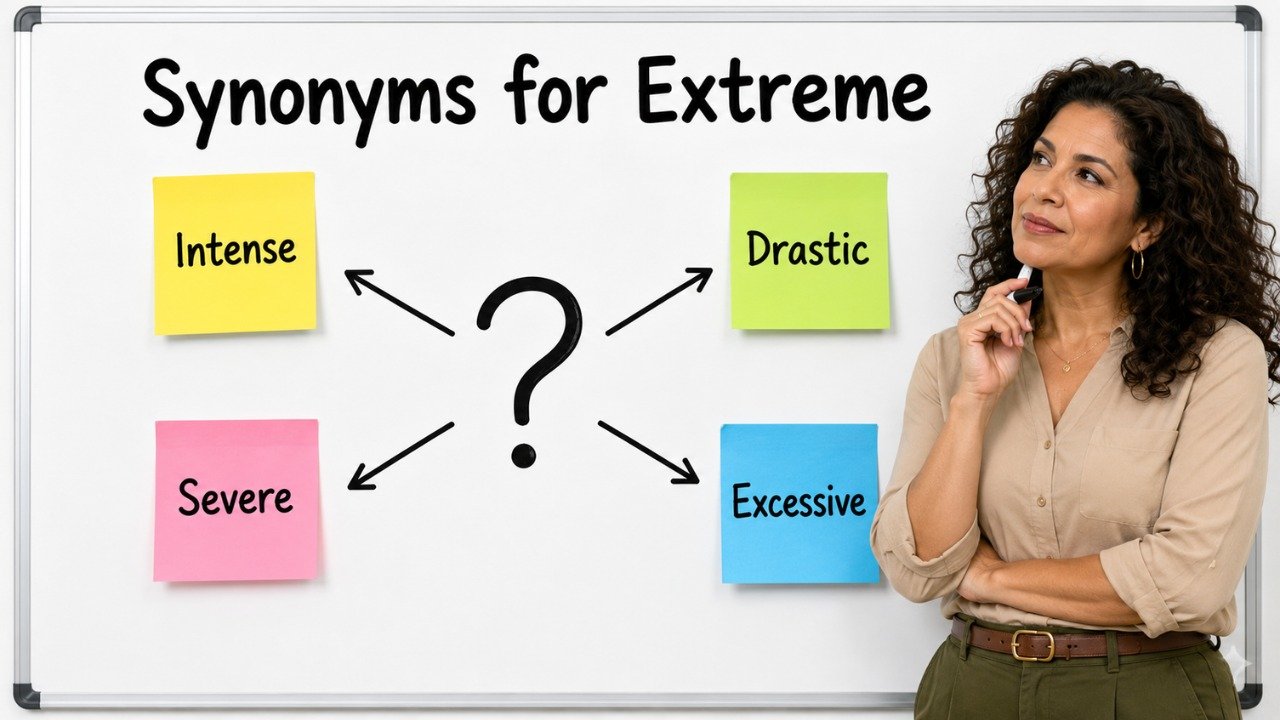
Quick Answer: The best synonyms for extreme include severe, intense, excessive, drastic, radical, utmost, maximum, acute, extraordinary, and outermost. Use severe for serious conditions, intense for strong feelings or activity, excessive for something beyond a reasonable limit, drastic for major actions or changes, and radical for ideas that differ greatly from accepted practice. Utmost and maximum describe the highest possible degree, while outermost refers to the farthest position. The right choice among synonyms for extreme depends on whether you are describing severity, intensity, excess, change, degree, or physical position.
Pronunciation and Word Details
Word: Extreme
Pronunciation: /ɪkˈstriːm/
Part of Speech: Adjective and noun
Meaning: Very great, serious, unusual, or far beyond what is considered normal or moderate.
US Pronunciation:
UK Pronunciation:
What Does “Extreme” Mean?
Extreme means reaching a very high degree, going far beyond normal limits, or being located at the farthest possible point. It is commonly used as an adjective, but it can also function as a noun.
As an adjective, extreme can describe strong weather, serious danger, unusual opinions, major changes, or very difficult conditions.
Example: The hikers faced extreme cold during the night.
As a noun, extreme refers to the highest, lowest, or most distant point of something.
Example: Both extremes of the argument ignore the practical solution.
The meaning changes slightly according to context. Extreme heat means unusually high heat, while an extreme opinion refers to a belief far outside the usual or accepted range.
Meaning, Tone, and Context of “Extreme”
Extreme is a strong and generally neutral word. It becomes emotional or dramatic when it describes pain, fear, danger, or difficult conditions. In reports and academic writing, it can describe values, situations, or positions that are far from average.
The word is common in formal writing, news style writing, technical descriptions, essays, and everyday conversation. However, it should be used carefully because it suggests a very high level. Calling a small inconvenience extreme can sound exaggerated.
In scientific or technical contexts, extreme may refer to the highest or lowest recorded point. In social or political contexts, it can describe beliefs that are far from moderate positions. In daily speech, it often emphasizes seriousness, intensity, or difficulty.
When and How to Use “Extreme”
For Severe Conditions: Use extreme when a condition is unusually serious, dangerous, or difficult.
Example: The region experienced extreme weather throughout the winter.
For Strong Feelings: Use extreme to describe emotions that are far stronger than usual.
Example: She felt extreme anxiety before the final interview.
For Excessive Amounts: Use extreme when an amount goes far beyond a normal or reasonable limit.
Example: Extreme pressure can affect a person’s ability to make decisions.
For Major Changes: Use extreme when an action or change is much stronger than expected.
Example: Closing the entire building seemed like an extreme response.
For Unusual Beliefs: Use extreme for opinions or positions that are far outside moderate thinking.
Example: His extreme views made productive discussion difficult.
For Physical Position: Use extreme to describe the farthest point, edge, or end.
Example: The village stands at the extreme northern edge of the valley.
For Highest Degree: Use extreme when something reaches its greatest possible level.
Example: The rescue team worked with extreme caution.
Best Synonyms for Extreme
Severe
Synonym: Very serious, harsh, or difficult.
Example: The patient experienced severe pain after the accident.
Intense
Synonym: Very strong in degree, force, or feeling.
Example: The athletes trained under intense pressure.
Excessive
Synonym: Greater than what is reasonable, necessary, or acceptable.
Example: Excessive noise made it difficult to concentrate.
Drastic
Synonym: Strong, sudden, and likely to have a major effect.
Example: The organization introduced drastic changes to reduce costs.
Radical
Synonym: Very different from traditional or accepted ideas.
Example: The proposal offered a radical solution to the problem.
Utmost
Synonym: The greatest possible degree or amount.
Example: The documents must be handled with the utmost care.
Maximum
Synonym: The highest amount, level, or degree allowed or possible.
Example: The machine was operating at maximum capacity.
Acute
Synonym: Very serious, sharp, or intense, especially for a problem or condition.
Example: The community faced an acute shortage of clean water.
Extraordinary
Synonym: Far beyond what is normal, expected, or ordinary.
Example: The rescue required extraordinary courage.
Outermost
Synonym: Located farthest from the center.
Example: The outermost wall protected the ancient settlement.
50 Synonyms for Extreme with Short Meanings
- Severe: Very serious, harsh, or difficult.
- Intense: Very strong in force, feeling, or degree.
- Excessive: Beyond a reasonable or acceptable limit.
- Extraordinary: Far beyond what is normal or expected.
- Exceptional: Unusually great, rare, or remarkable.
- Drastic: Strong and likely to create a major change.
- Radical: Very different from accepted ideas or methods.
- Utmost: The greatest possible degree.
- Maximum: The highest possible amount or level.
- Acute: Serious, sharp, or highly intense.
- Tremendous: Extremely great in size, amount, or degree.
- Immense: Extremely large or great.
- Enormous: Very large in size, amount, or importance.
- Overwhelming: So strong or great that it is difficult to manage.
- Fierce: Strong, powerful, or aggressive.
- Profound: Very deep, serious, or powerful.
- Absolute: Complete and without limitation.
- Complete: Having the fullest possible degree.
- Total: Entire, complete, or involving everything.
- Ultimate: The highest, final, or greatest possible.
- Highest: Reaching the greatest level or position.
- Greatest: Larger or stronger than all others.
- Supreme: Highest in degree, authority, or quality.
- Peak: At the highest point or level.
- Maximal: As great or large as possible.
- Outermost: Farthest from the center.
- Farthest: At the greatest physical distance.
- Furthest: At the most distant point or degree.
- Remotest: Most distant or least accessible.
- Outer: Located away from the center or inside.
- Critical: Extremely serious or important.
- Dire: Very serious, urgent, or dangerous.
- Grave: Seriously worrying or important.
- Desperate: Extremely serious or lacking hope.
- Harsh: Unpleasantly severe or difficult.
- Rigorous: Extremely strict, careful, or demanding.
- Intolerable: Too severe or unpleasant to accept.
- Unbearable: Too painful or difficult to endure.
- Immoderate: Greater than reasonable or moderate limits.
- Exorbitant: Unreasonably high in price or amount.
- Outrageous: Shockingly excessive or unreasonable.
- Unreasonable: Beyond what is fair, sensible, or acceptable.
- Unusual: Different from what normally happens.
- Astonishing: Extremely surprising or impressive.
- Staggering: So great that it causes surprise or shock.
- Unprecedented: Never known or experienced before.
- Unrestrained: Not controlled or limited.
- Uncontrolled: Not kept within proper limits.
- Boundless: Having no clear limit.
- Limitless: Without an end, boundary, or restriction.
Read Also:
Synonyms for Sweet Person

Synonyms for Extreme by Context
When Extreme Means Very Serious
Severe, critical, grave, dire, acute, and desperate describe situations that are highly serious or dangerous.
Severe: Best for pain, weather, punishment, illness, damage, or problems.
Example: Severe flooding damaged several roads.
Critical: Best for a situation requiring immediate attention.
Example: The patient remained in critical condition.
Grave: Best for a serious issue that causes concern.
Example: The report raised grave concerns about public safety.
Dire: Best for an urgent and dangerous situation.
Example: Families in the area were in dire need of food.
When Extreme Means Very Strong
Intense, fierce, profound, tremendous, and overwhelming describe strong feelings, pressure, effort, or activity.
Intense: Best for emotions, heat, pressure, competition, or activity.
Example: The team faced intense competition.
Fierce: Best for conflict, determination, storms, or opposition.
Example: Fierce winds damaged the trees.
Profound: Best for deep feelings, effects, or ideas.
Example: The experience had a profound effect on her confidence.
Overwhelming: Best for something too powerful or great to manage easily.
Example: The response from the community was overwhelming.
When Extreme Means Excessive
Excessive, immoderate, exorbitant, outrageous, unreasonable, and uncontrolled describe amounts or behavior beyond acceptable limits.
Excessive: Best for general amounts, behavior, spending, noise, or use.
Example: Excessive screen time affected his sleep.
Exorbitant: Best for prices, fees, or financial demands.
Example: The landlord charged an exorbitant fee.
Outrageous: Best for something shockingly unreasonable.
Example: The customer complained about the outrageous price.
Uncontrolled: Best for growth, emotion, spending, or movement without restraint.
Example: Uncontrolled development damaged the natural landscape.
When Extreme Means the Highest Degree
Utmost, maximum, absolute, total, ultimate, supreme, and peak describe the greatest possible level.
Utmost: Best for care, importance, respect, attention, or urgency.
Example: Please treat this matter with the utmost seriousness.
Maximum: Best for measurable amounts, capacity, speed, or limits.
Example: The hall has a maximum capacity of five hundred people.
Absolute: Best for complete certainty, control, silence, or authority.
Example: The decision requires absolute confidence.
Peak: Best for the highest level of performance, demand, or activity.
Example: Electricity use reaches its peak during the evening.
When Extreme Means Farthest Away
Outermost, farthest, furthest, remotest, and outer describe distance from a center or starting point.
Outermost: Best for layers, edges, walls, or physical positions.
Example: The outermost layer protects the material underneath.
Farthest: Best for measurable physical distance.
Example: Their house is the farthest from the main road.
Remotest: Best for isolated places or distant possibilities.
Example: Medical workers traveled to the remotest villages.
When Extreme Means Unusual or Extraordinary
Extraordinary, exceptional, astonishing, staggering, remarkable, and unprecedented describe something far beyond ordinary experience.
Extraordinary: Best for unusual ability, effort, circumstances, or results.
Example: The volunteers showed extraordinary commitment.
Exceptional: Best for outstanding quality or unusual cases.
Example: Her performance was exceptional.
Staggering: Best for surprisingly large numbers, costs, or effects.
Example: The project required a staggering amount of money.
Unprecedented: Best for something that has never happened before.
Example: The area experienced unprecedented rainfall.
Another Word for Extreme
Severe is often the best single replacement for extreme when describing weather, pain, damage, punishment, or difficult conditions. However, the best alternative depends on the intended meaning. Intense works better for feelings and activity, excessive suits unreasonable amounts, drastic describes major actions, and maximum refers to the highest measurable level.
Original: The city experienced extreme flooding.
Better Option: The city experienced severe flooding.
Original: She was under extreme pressure at work.
Better Option: She was under intense pressure at work.
Original: The company introduced extreme changes.
Better Option: The company introduced drastic changes.
Original: The machine reached an extreme level of output.
Better Option: The machine reached its maximum level of output.
When Not to Use “Extreme”
Do not use extreme when the situation is only slightly unusual, moderately serious, or mildly uncomfortable. The word can make a sentence sound exaggerated when the evidence does not support such a strong description.
Weak: I experienced extreme disappointment when my drink was late.
Better: I felt mild disappointment when my drink was late.
Avoid extreme when a more exact word can explain the problem.
Weak: The report found extreme financial issues.
Better: The report found severe financial losses.
Do not use extreme repeatedly in the same paragraph. Repetition weakens the effect of a strong word.
Weak: Extreme heat caused extreme discomfort during the extreme weather event.
Better: Severe heat caused considerable discomfort during the unusual weather event.
Avoid using extreme when you mean excessive. Extreme describes a very high degree, while excessive clearly shows that an amount is beyond what is acceptable.
Weak: The manager criticized the extreme use of office supplies.
Better: The manager criticized the excessive use of office supplies.
Words Commonly Confused With Extreme
Extreme vs Severe: Extreme describes something far beyond normal limits. Severe focuses on seriousness, harshness, or difficulty. Severe is usually more precise for illness, pain, weather, punishment, and damage.
Extreme vs Intense: Extreme suggests a very high or unusual degree. Intense describes concentrated strength, force, feeling, or activity.
Extreme vs Excessive: Extreme means very great or far from moderate. Excessive means more than is reasonable, necessary, or acceptable.
Extreme vs Drastic: Extreme describes a condition, degree, belief, or position. Drastic usually describes a strong action or change with major consequences.
Extreme vs Radical: Extreme can refer to any unusually high degree. Radical usually refers to a major departure from traditional ideas, systems, or methods.
Extreme vs Maximum: Extreme is a general descriptive word. Maximum refers to the highest measurable, allowed, or possible amount.
Extreme vs Extraordinary: Extreme often emphasizes degree, danger, or distance from moderation. Extraordinary emphasizes how unusual, impressive, or unexpected something is.
Which Synonym Should You Choose?
Choose severe when describing serious weather, pain, damage, illness, punishment, or difficulty.
Choose intense when writing about emotions, pressure, competition, heat, concentration, or activity.
Choose excessive when an amount or behavior goes beyond what is reasonable or acceptable.
Choose drastic when describing a major action, reduction, decision, or change.
Choose radical when discussing ideas, reforms, methods, or beliefs that strongly differ from accepted practice.
Choose acute when describing an urgent problem, a serious shortage, or a sharply painful condition.
Choose extraordinary when something is unusually impressive, rare, or unexpected.
Choose utmost when writing about care, importance, caution, respect, or urgency.
Choose maximum when referring to a measurable limit, amount, capacity, or speed.
Choose critical or grave in formal reports when a situation is serious and requires attention.
Choose harsh in everyday conversation when describing difficult treatment, rules, criticism, or conditions.
Choose outermost or farthest when referring to physical position or distance.
Real Life Examples of “Extreme” in Sentences
Original: The workers continued despite the extreme heat.
Better Option: The workers continued despite the intense heat.
Original: The storm caused extreme damage to several buildings.
Better Option: The storm caused severe damage to several buildings.
Original: Her extreme fear prevented her from entering the room.
Better Option: Her overwhelming fear prevented her from entering the room.
Original: The government introduced extreme measures to control spending.
Better Option: The government introduced drastic measures to control spending.
Original: The shop charged an extreme amount for a basic repair.
Better Option: The shop charged an exorbitant amount for a basic repair.
Original: The patient was experiencing extreme pain.
Better Option: The patient was experiencing acute pain.
Original: The project demanded extreme attention to detail.
Better Option: The project demanded the utmost attention to detail.
Original: The factory was working at an extreme level of production.
Better Option: The factory was working at maximum production capacity.
Original: The researchers traveled to the extreme edge of the region.
Better Option: The researchers traveled to the outermost edge of the region.
Original: Her extreme proposal changed the direction of the discussion.
Better Option: Her radical proposal changed the direction of the discussion.
Synonym Groups and Usage Differences
Severity Group
Severe, critical, grave, dire, and acute describe serious problems or conditions. Severe is the most flexible choice. Critical suggests immediate danger or importance. Grave sounds formal and deeply concerning. Dire emphasizes urgent need, while acute often describes a sharply serious problem.
Example: The town faced an acute shortage of drinking water.
Intensity Group
Intense, fierce, profound, overwhelming, and tremendous describe strength, power, or emotional force. Intense suits concentrated activity or feeling. Fierce suggests force or aggression. Profound describes depth, while overwhelming suggests something difficult to manage.
Example: The speaker’s message had a profound effect on the audience.
Excess Group
Excessive, immoderate, exorbitant, outrageous, and unreasonable describe something beyond acceptable limits. Excessive is the most neutral option. Exorbitant is commonly used for prices or fees. Outrageous adds emotional criticism.
Example: The hotel charged an exorbitant amount for a simple meal.
Change Group
Drastic and radical describe major changes, but they are not identical. Drastic emphasizes the strength and effect of an action. Radical emphasizes a complete departure from traditional methods or ideas.
Example: The school introduced radical changes to its teaching method.
Highest Degree Group
Utmost, maximum, absolute, ultimate, supreme, and peak express the highest possible level. Maximum is best for measurable amounts. Utmost is common with care and importance. Absolute suggests completeness, while peak refers to the highest stage of activity or performance.
Example: Demand reached its peak during the holiday period.
Distance Group
Outermost, farthest, furthest, remotest, and outer describe position or distance. Outermost refers to the layer or point farthest from the center. Farthest generally refers to physical distance. Remotest emphasizes isolation or difficulty of access.
Example: The medical team visited the remotest part of the province.
Unusual Degree Group
Extraordinary, exceptional, astonishing, staggering, and unprecedented describe something far beyond normal experience. Exceptional often has a positive meaning. Staggering emphasizes surprising size or amount. Unprecedented means something has never happened before.
Example: The program achieved exceptional results in its first year.
Antonyms of Extreme
The opposite of extreme depends on whether the word refers to intensity, quantity, position, opinion, or behavior.
Moderate: Kept within reasonable or average limits.
Mild: Not strong, serious, or severe.
Reasonable: Fair, sensible, and within acceptable limits.
Balanced: Showing an appropriate amount of different qualities.
Average: Ordinary or typical in amount or degree.
Normal: Following the usual or expected standard.
Limited: Restricted in size, amount, or degree.
Controlled: Kept within suitable boundaries.
Restrained: Calm and prevented from becoming excessive.
Gentle: Mild, calm, or not harsh.
Central: Located near the middle rather than the edge.
Inner: Positioned closer to the center.
Minimum: The lowest possible or allowed amount.
Ordinary: Common and not unusual or exceptional.
Conventional: Following accepted ideas, methods, or customs.
Comparison: Extreme vs Related Words
Extreme vs Severe
Extreme refers to something far beyond normal limits. Severe focuses more directly on seriousness, harshness, or difficulty.
Example With Extreme: The athletes trained in extreme conditions.
Example With Severe: Severe weather forced the athletes to stop training.
Extreme vs Intense
Extreme describes a very high or unusual degree. Intense describes concentrated power, activity, feeling, or force.
Example With Extreme: The desert is known for extreme temperatures.
Example With Intense: She felt intense pressure before the examination.
Extreme vs Excessive
Extreme means very great or far from moderate. Excessive means greater than what is acceptable or necessary.
Example With Extreme: The rescue team worked in extreme heat.
Example With Excessive: Excessive heat can damage sensitive equipment.
Extreme vs Drastic
Extreme can describe a condition, opinion, action, or degree. Drastic usually describes an action or change that has a powerful effect.
Example With Extreme: The committee considered an extreme solution.
Example With Drastic: The committee made drastic changes to the policy.
Extreme vs Radical
Extreme emphasizes distance from normal or moderate levels. Radical emphasizes fundamental change or a major difference from established ideas.
Example With Extreme: His extreme position discouraged compromise.
Example With Radical: Her radical plan replaced the entire system.
Extreme vs Maximum
Extreme is descriptive and can refer to many kinds of high degree. Maximum refers to a clear upper limit that can often be measured.
Example With Extreme: The engine was tested under extreme pressure.
Example With Maximum: The engine reached its maximum operating pressure.
Extreme vs Extraordinary
Extreme often suggests intensity, severity, excess, or distance from moderation. Extraordinary suggests something unusually impressive, rare, or surprising.
Example With Extreme: The climbers faced extreme danger.
Example With Extraordinary: The climbers showed extraordinary courage.
Common Phrases and Expressions With “Extreme”
Extreme Weather: Weather that is unusually severe or dangerous.
Extreme Heat: Temperatures far above the normal level.
Extreme Cold: Temperatures far below the normal level.
Extreme Pressure: A very high level of physical or emotional pressure.
Extreme Caution: The greatest possible degree of care.
Extreme Difficulty: A very high level of challenge or hardship.
Extreme Measures: Strong actions taken in a serious situation.
Extreme Conditions: Unusually difficult, dangerous, or demanding circumstances.
Extreme Case: An example that is far from ordinary or moderate.
Extreme End: The farthest point of a range, object, or scale.
Common Mistakes to Avoid
One common mistake is using extreme for every strong situation. The word should be reserved for conditions, feelings, amounts, or actions that are genuinely far beyond normal levels.
Avoid repeating extreme several times in one paragraph. Replace it with a more exact synonym such as severe, intense, drastic, excessive, or extraordinary.
Do not confuse extreme with extremely. Extreme is usually an adjective or noun, while extremely is an adverb.
Incorrect: The weather was extreme cold.
Correct: The weather was extremely cold.
Correct: The region experienced extreme cold.
Be careful when choosing between extreme and excessive. Extreme emphasizes a very high degree, while excessive includes the judgment that something is too much.
Unclear: He showed extreme confidence.
Clearer: He showed excessive confidence and ignored every warning.
Avoid combining extreme with another word that already expresses the highest possible degree when the result sounds unnatural.
Awkward: The result was extremely absolute.
Better: The result was absolute.
Do not use extreme when mild, moderate, serious, or unusual would provide a more accurate description. Precise language makes writing more believable and useful.
Conclusion
Understanding synonyms for extreme helps you describe severity, intensity, excess, major change, unusual degree, and physical distance more precisely. Severe works well for serious conditions, intense suits strong feelings or activity, and excessive describes amounts beyond reasonable limits. Drastic and radical are useful for major actions or ideas, while utmost and maximum express the highest degree. Outermost and farthest describe position. Choose the synonym that matches the exact context so your writing sounds clear, natural, and accurate.
FAQs About Synonyms for Extreme
What is the best synonym for extreme?
Severe is often the best general synonym when describing serious weather, pain, damage, or conditions. The best choice still depends on context.
What is a formal synonym for extreme?
Acute, critical, grave, utmost, maximum, and extraordinary are useful formal alternatives. Each expresses a different meaning or degree.
What is another word for extreme weather?
Severe weather is the most natural alternative. Harsh weather and intense weather may also work in particular contexts.
Is intense a synonym for extreme?
Yes. Intense is a good synonym when describing strong feelings, pressure, heat, activity, competition, or concentration.
What is the difference between extreme and excessive?
Extreme means very great or far beyond normal. Excessive means greater than what is reasonable, acceptable, or necessary.
Can radical replace extreme?
Radical can replace extreme when describing ideas, reforms, beliefs, or changes that differ greatly from accepted methods. It does not fit every context.
What is the opposite of extreme?
Common opposites include moderate, mild, reasonable, balanced, controlled, ordinary, central, and minimum. The correct antonym depends on the sentence.
