
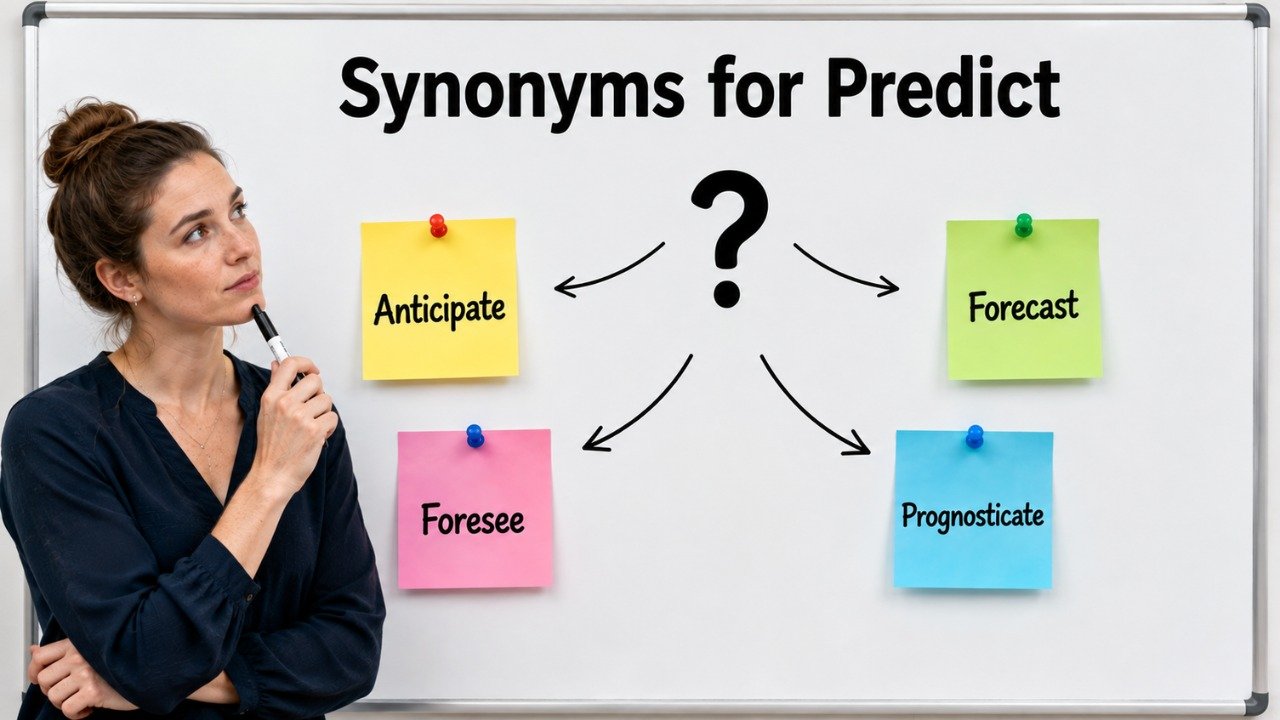
Quick Answer: The best synonyms for predict are forecast, foresee, anticipate, project, estimate, expect, foretell, calculate, speculate, and prognosticate. Use forecast for weather, business, and future conditions, foresee for recognizing an event before it happens, anticipate for expecting and preparing, project for data based estimates, and calculate for measurable outcomes. Speculate suits uncertain opinions, while foretell and prognosticate are more formal ways to describe statements about the future.
Pronunciation and Word Details
Word: Predict
Pronunciation: /prɪˈdɪkt/
Part of Speech: Verb
Meaning: To say or estimate that a particular event or result will happen in the future.
US Pronunciation:
UK Pronunciation:
What Does “Predict” Mean?
Predict means to state, estimate, or believe that something will happen before it actually occurs.
Predict is a verb. It can describe a conclusion based on evidence, a personal expectation, a scientific calculation, or an uncertain guess about the future.
A person may predict an election result, a change in demand, a sports outcome, or someone’s behavior. Researchers may predict future conditions by studying data, patterns, and previous results.
The word can also describe what signs, models, or circumstances indicate.
Example: Rising costs may predict lower consumer demand.
In this sentence, predict means indicate that a future development is likely.
Predict does not always imply complete certainty. A prediction may be highly informed, reasonably likely, or entirely speculative. The strength of the claim depends on the evidence and context.
Meaning, Tone, and Context of “Predict”
Predict has a neutral and widely accepted tone. It appears naturally in formal writing, academic discussion, reports, news, scientific explanations, business communication, and everyday conversation.
The word may sound analytical when it refers to evidence, statistics, or patterns.
Example: The model predicts a gradual increase in demand.
It may sound conversational when someone expresses a personal belief.
Example: I predict that she will arrive early.
Predict can also sound confident or dramatic, depending on the statement.
Example: He predicted that the decision would transform the industry.
In scientific and technical writing, predict usually refers to a conclusion produced by data, observation, calculation, or a model. In casual speech, it may simply mean guess what will happen.
The word itself is not emotional, polite, or impolite. Its tone depends on how confidently the prediction is stated and whether reliable evidence supports it.
When and How to Use “Predict”
For Future Outcomes
Use predict when stating what you believe will happen later.
Example: Analysts predict that prices will remain stable.
For Weather and Natural Conditions
Predict is useful when forecasts are based on measurements, patterns, or scientific information.
Example: Experts predict heavy rainfall during the evening.
For Business and Economic Trends
Use predict for future demand, costs, sales, growth, or market behavior.
Example: The company predicts stronger demand during the final quarter.
For Scientific Results
Predict can describe an expected result based on a theory, experiment, or model.
Example: The theory predicts how the material will react under pressure.
For Human Behavior
Use predict when estimating how a person or group may act.
Example: It is difficult to predict how customers will respond to the change.
For Data Based Projections
Predict is appropriate when past information helps estimate a future result.
Example: Historical patterns can help predict future energy use.
For Casual Opinions
In conversation, predict may introduce a personal expectation without strong evidence.
Example: I predict that this will become her favorite book.
For Warning About Consequences
Use predict when current conditions suggest a likely future problem.
Example: Doctors predict serious consequences if the unhealthy pattern continues.
Best Synonyms for Predict
1. Forecast
Synonym: To estimate a future event or condition by studying available information.
Example: Economists forecast steady growth over the next several months.
2. Foresee
Synonym: To recognize or imagine a future event before it happens.
Example: Nobody foresaw the sudden change in public opinion.
3. Anticipate
Synonym: To expect something and often prepare for it in advance.
Example: The organizers anticipate a large number of visitors.
4. Project
Synonym: To calculate a future amount, result, or trend from current data.
Example: The report projects a rise in operating costs.
5. Estimate
Synonym: To make an approximate judgment about a future amount or result.
Example: Engineers estimate that the repairs will take three weeks.
6. Expect
Synonym: To believe that something is likely to happen.
Example: We expect demand to increase during the holiday period.
7. Foretell
Synonym: To state that a particular event will happen in the future.
Example: The early signs foretold a difficult season.
8. Calculate
Synonym: To determine a likely result through numbers, evidence, or careful reasoning.
Example: The team calculated that production would increase by ten percent.
9. Speculate
Synonym: To suggest a possible future result without having complete evidence.
Example: Commentators speculated that the policy might change.
10. Prognosticate
Synonym: To make a formal or authoritative statement about a future development.
Example: Experts continued to prognosticate about the direction of the economy.
50 Synonyms for Predict with Short Meanings
- Forecast: Estimate future conditions from available information.
- Foresee: Recognize a future possibility before it occurs.
- Anticipate: Expect an event and possibly prepare for it.
- Project: Calculate a future result from present data.
- Estimate: Make an approximate judgment about an outcome.
- Expect: Believe that something is likely to happen.
- Foretell: State what will happen in the future.
- Prophesy: Declare a future event, often with great certainty.
- Prognosticate: Formally predict a future development.
- Divine: Discover or predict something through intuition or special insight.
- Calculate: Work out a likely result through reasoning or numbers.
- Extrapolate: Extend known information to estimate a future result.
- Model: Represent conditions in order to estimate future behavior.
- Infer: Reach a likely conclusion from available evidence.
- Deduce: Form a conclusion through logical reasoning.
- Assess: Judge the likelihood or possible result of something.
- Evaluate: Examine information to determine a likely outcome.
- Judge: Form an opinion about what will probably happen.
- Gauge: Estimate the level, direction, or likely result of something.
- Approximate: Produce a result that is close rather than exact.
- Reckon: Informally think or calculate that something will happen.
- Figure: Informally conclude that a result is likely.
- Suppose: Consider something likely without complete certainty.
- Presume: Accept that something will probably happen.
- Assume: Treat a future possibility as likely for the purpose of reasoning.
- Speculate: Consider a possible result without complete evidence.
- Conjecture: Form an uncertain opinion about what may happen.
- Surmise: Reach a possible conclusion from limited evidence.
- Guess: State a possible outcome without firm knowledge.
- Call: Informally predict the result of an event or contest.
- Envision: Imagine a possible future situation.
- Imagine: Form a mental picture of what may happen.
- See Coming: Recognize that an event is likely to occur.
- Read the Signs: Interpret present clues to understand a future outcome.
- Look Ahead: Think about possible future events or conditions.
- Project Forward: Extend current information into the future.
- Make a Forecast: Produce an informed statement about future conditions.
- Make a Projection: Calculate a likely future amount or trend.
- Estimate the Outcome: Judge approximately how something will end.
- Anticipate the Result: Expect a particular final outcome.
- Expect the Outcome: Believe that a particular result is likely.
- Hazard a Guess: Offer an uncertain prediction.
- Make an Educated Guess: Predict by using limited knowledge or evidence.
- Venture a Prediction: Offer a prediction while acknowledging uncertainty.
- Foreshadow: Suggest or indicate something that will happen later.
- Presage: Serve as a sign that a future event is likely.
- Portend: Indicate that an important event may happen.
- Augur: Suggest that a particular future result is likely.
- Signal: Provide a sign of a possible future development.
- Prefigure: Represent or indicate something before it fully appears.
Read Also:
Synonyms for Dependable
Synonyms for Predict by Context
When Predict Means Make an Evidence Based Forecast
Forecast, project, calculate, estimate, extrapolate, and model are strong choices when a prediction is supported by facts, numbers, patterns, or research.
Forecast is common for weather, economics, business conditions, and demand. Project usually refers to a calculated future amount. Extrapolate describes extending an existing pattern into the future.
Example With Predict: The report predicts a gradual increase in housing demand.
Example With Forecast: The report forecasts a gradual increase in housing demand.
Example With Project: The report projects a gradual increase in housing demand.
Forecast emphasizes the expected trend. Project suggests that the result was calculated from available data.
When Predict Means Recognize a Future Event
Foresee, anticipate, expect, see coming, and envision describe awareness of something before it happens.
Foresee often suggests that a person understands a future possibility. Anticipate may also imply preparation. Expect expresses a more ordinary belief that something is likely.
Example With Predict: She predicted that the meeting would take longer than planned.
Example With Foresee: She foresaw that the meeting would take longer than planned.
Example With Anticipate: She anticipated that the meeting would take longer than planned.
Foresee emphasizes awareness. Anticipate suggests that she may have prepared for the delay.
When Predict Means Make an Uncertain Guess
Guess, speculate, conjecture, surmise, suppose, and hazard a guess work when evidence is incomplete.
Guess is the simplest and most casual choice. Speculate is common in formal discussions when people consider possible explanations or outcomes without firm proof.
Example With Predict: It is too early to predict who will win.
Example With Guess: It is too early to guess who will win.
Example With Speculate: It is too early to speculate about who will win.
Guess sounds conversational. Speculate sounds more cautious and formal.
When Predict Means Announce the Future
Foretell, prophesy, prognosticate, and divine describe statements about future events in formal, literary, historical, or dramatic contexts.
Prophesy often suggests spiritual authority or unusual certainty. Prognosticate is highly formal and may occasionally sound humorous because of its complexity.
Example With Predict: The speaker predicted a period of major change.
Example With Foretell: The speaker foretold a period of major change.
Example With Prophesy: The speaker prophesied a period of major change.
Foretell is literary but neutral. Prophesy sounds more solemn and authoritative.
When Present Signs Predict Something
Foreshadow, presage, portend, augur, signal, and prefigure describe present signs that indicate a future event.
These words differ from ordinary prediction because the subject is often a sign, event, pattern, or condition rather than a person.
Example With Predict: The falling sales figures predict further difficulties.
Example With Signal: The falling sales figures signal further difficulties.
Example With Portend: The falling sales figures portend further difficulties.
Signal is neutral. Portend is stronger and often introduces a serious or negative development.
When Predict Means Judge a Likely Result
Assess, evaluate, judge, gauge, infer, and deduce suit situations where a person examines evidence before reaching a conclusion.
These words do not always refer exclusively to the future. They become alternatives to predict when the judgment concerns a likely outcome.
Example With Predict: The manager tried to predict how the change would affect productivity.
Example With Assess: The manager tried to assess how the change would affect productivity.
Assess focuses on careful examination rather than a firm prediction.
Another Word for Predict
Forecast is often the best single replacement for predict when the statement concerns weather, business, economics, demand, or measurable future conditions. However, the strongest alternative always depends on context.
Use anticipate when preparation is involved. Use foresee when someone recognizes a future possibility. Use project for numerical results and guess when there is little evidence.
Original: Experts predict a colder winter.
Better Option: Experts forecast a colder winter.
Original: We predict that attendance will increase.
Better Option: We anticipate that attendance will increase.
Original: The report predicts higher costs next year.
Better Option: The report projects higher costs next year.
Original: I cannot predict which team will win.
Better Option: I cannot guess which team will win.
When Not to Use “Predict”
When the Result Is Already Known
Predict refers to the future or to an outcome that has not yet been confirmed. Do not use it for an established fact.
Weak: The report predicts that sales increased last month.
Better: The report confirms that sales increased last month.
When You Mean Hope
A hope expresses a desired result. A prediction expresses a belief about what is likely to happen.
Weak: I predict that you have a wonderful birthday.
Better: I hope that you have a wonderful birthday.
When You Mean Plan
Predict does not describe an intended action or schedule.
Weak: We predict to open the new office in June.
Better: We plan to open the new office in June.
When You Have No Evidence
Predict can sound too confident when the statement is based entirely on imagination.
Weak: I predict that the new employee will become the director.
Better: I suppose that the new employee may progress quickly.
When a More Precise Technical Word Is Available
A report may require forecast, project, estimate, calculate, or model instead of the general word predict.
Weak: The budget predicts expenses of fifty thousand dollars.
Better: The budget projects expenses of fifty thousand dollars.
When the Sentence Becomes Repetitive
Repeated use of predict can make analytical writing sound flat.
Weak: Experts predict growth, predict higher demand, and predict rising prices.
Better: Experts forecast growth, anticipate higher demand, and project rising prices.
When Preparation Is the Main Idea
Anticipate is often more accurate when someone expects an event and takes action before it occurs.
Weak: We predicted a large crowd and hired additional staff.
Better: We anticipated a large crowd and hired additional staff.
Words Commonly Confused With Predict
Predict vs Forecast: Predict is a general word for stating what will happen. Forecast usually refers to an informed estimate based on patterns, data, or professional analysis.
Predict vs Anticipate: Predict focuses on the future statement. Anticipate often includes an element of preparation or expectation.
Predict vs Foresee: Predict means state or estimate a future event. Foresee means recognize a future possibility before it happens.
Predict vs Expect: Predict often sounds more deliberate or analytical. Expect expresses a belief that something is likely.
Predict vs Estimate: Predict concerns a future event or result. Estimate concerns an approximate amount, value, time, or probability.
Predict vs Project: Predict is broad. Project normally refers to a calculated future amount, trend, cost, or result.
Predict vs Guess: Predict may be supported by evidence. Guess usually suggests limited knowledge or no reliable evidence.
Predict vs Speculate: Predict states a likely outcome. Speculate considers possibilities without claiming that one outcome will definitely occur.
Predict vs Prophesy: Predict can be ordinary, scientific, or analytical. Prophesy has a solemn, spiritual, or dramatic tone.
Predict vs Presume: Predict concerns what will happen. Presume means accept something as likely or true without full confirmation.
Which Synonym Should You Choose?
Choose Forecast: For weather, economic conditions, business trends, demand, revenue, and other measurable future developments.
Choose Foresee: When someone recognizes a possible event, problem, or consequence before it occurs.
Choose Anticipate: When expecting an event leads to planning or preparation.
Choose Project: For reports, budgets, financial estimates, population figures, sales figures, and numerical trends.
Choose Estimate: When the amount, duration, cost, or outcome is approximate.
Choose Expect: In emails, conversation, and general writing when expressing a straightforward belief about what is likely.
Choose Calculate: When numbers, formulas, or measurable evidence produce the prediction.
Choose Extrapolate: In academic or technical writing when extending an existing pattern beyond the available data.
Choose Speculate: In reports, essays, and discussions when the evidence is incomplete and several outcomes remain possible.
Choose Guess: In casual conversation when there is little certainty.
Choose Foretell: In literary or formal writing when describing a statement about the future.
Choose Prognosticate: In highly formal writing or when emphasizing an expert’s attempt to predict a major development.
Choose Signal: When a fact, trend, or event indicates what may happen next.
Choose Portend: When present signs suggest an important, serious, or negative future event.
Real Life Examples of “Predict” in Sentences
Example One
Original: Experts predict several days of heavy rain.
Better Option: Experts forecast several days of heavy rain.
Example Two
Original: We predict that more customers will use the new service.
Better Option: We anticipate that more customers will use the new service.
Example Three
Original: The report predicts an increase in annual expenses.
Better Option: The report projects an increase in annual expenses.
Example Four
Original: Nobody could predict the sudden shortage.
Better Option: Nobody could foresee the sudden shortage.
Example Five
Original: It is difficult to predict the final score.
Better Option: It is difficult to guess the final score.
Example Six
Original: Researchers predict how the substance will react.
Better Option: Researchers calculate how the substance will react.
Example Seven
Original: Analysts predict that demand may decline.
Better Option: Analysts forecast that demand may decline.
Example Eight
Original: I predict that she will accept the invitation.
Better Option: I expect that she will accept the invitation.
Example Nine
Original: The early warning signs predicted serious difficulties.
Better Option: The early warning signs signaled serious difficulties.
Example Ten
Original: Commentators predicted several possible outcomes.
Better Option: Commentators speculated about several possible outcomes.
Synonym Groups and Usage Differences
Evidence and Data Group
Forecast, project, calculate, extrapolate, estimate, and model belong to the evidence and data group.
These words suit research, business, science, statistics, and planning. Forecast is broad and practical. Project is common for numbers. Extrapolate describes extending a pattern, while model refers to creating a structured representation of possible behavior.
Example: Researchers modeled how the population might change over the next decade.
Expectation Group
Anticipate, expect, foresee, envision, and see coming describe awareness of a likely future event.
Anticipate may include preparation. Expect is simple and neutral. Foresee suggests recognizing a consequence or possibility before others do.
Example: The team anticipated several technical problems and prepared backup equipment.
Uncertainty Group
Guess, speculate, conjecture, surmise, suppose, and venture a prediction communicate limited certainty.
Guess is casual. Speculate is more formal. Conjecture often appears in analytical or academic discussion when proof is unavailable.
Example: Observers speculated about the possible effect of the decision.
Formal Prediction Group
Foretell, prophesy, prognosticate, and divine are formal, literary, dramatic, or historical alternatives.
Foretell is the most flexible word in this group. Prophesy suggests an authoritative declaration, while prognosticate sounds highly formal.
Example: The writer foretold a period of social change.
Judgment Group
Assess, evaluate, judge, gauge, infer, and deduce describe reasoning about a likely outcome.
These words focus more on the process of reaching a conclusion than on announcing the future.
Example: The committee assessed how the proposal might affect local services.
Indicator Group
Foreshadow, presage, portend, augur, signal, and prefigure describe signs of a future event.
Foreshadow is common in stories and historical discussion. Signal is neutral and useful in reports. Portend often suggests an important or unfavorable result.
Example: The sudden decline in orders may signal weaker demand.
Conversational Group
Reckon, figure, suppose, guess, and call are useful in informal speech.
Reckon and figure express personal expectations. Call often refers to predicting a competition, decision, or uncertain outcome.
Example: I figure the journey will take about two hours.
Antonyms of Predict
The opposite of predict depends on whether the sentence concerns future uncertainty, confirmed facts, present observation, or past events.
Confirm: Establish that something is true after evidence becomes available.
Verify: Check and prove the accuracy of information.
Know: Possess certain information rather than estimate what may happen.
Observe: Notice an event while it is happening.
Record: Document an event or result after it occurs.
Report: Communicate known information rather than predict an outcome.
Recount: Describe events that have already happened.
Recall: Remember information or events from the past.
Review: Examine something after it has occurred.
React: Respond after an event instead of anticipating it.
Doubt: Question whether a predicted result will happen.
Disregard: Ignore signs or possibilities concerning the future.
Wait and See: Avoid making a prediction until more information becomes available.
Comparison: Predict vs Related Words
Predict vs Forecast
Predict is a broad word for stating what is likely to happen. Forecast usually suggests that the statement is based on data, trends, patterns, or professional analysis.
Example With Predict: Experts predict that demand will rise.
Example With Forecast: Experts forecast that demand will rise.
Forecast sounds more analytical and is especially common for weather, business, and economics.
Predict vs Anticipate
Predict focuses on stating a future result. Anticipate means expect something and often prepare for it.
Example With Predict: We predicted that many guests would arrive.
Example With Anticipate: We anticipated many guests and prepared extra seating.
The second sentence includes both expectation and preparation.
Predict vs Foresee
Predict means make a statement about the future. Foresee means recognize a future event or consequence before it happens.
Example With Predict: She predicted that the project would face delays.
Example With Foresee: She foresaw that the project would face delays.
Foresee often emphasizes awareness or insight rather than a public statement.
Predict vs Expect
Predict may be formal, analytical, or evidence based. Expect is a common word for believing that something is likely.
Example With Predict: Analysts predict that prices will fall.
Example With Expect: We expect prices to fall.
Expect is often more natural in ordinary conversation and emails.
Predict vs Estimate
Predict concerns what will happen. Estimate gives an approximate amount, cost, time, or measurement.
Example With Predict: The manager predicted that the work would be completed soon.
Example With Estimate: The manager estimated that the work would take five days.
Estimate is more precise when an approximate number is included.
Predict vs Project
Predict is general. Project usually refers to a calculated future figure or trend.
Example With Predict: The report predicts higher sales next year.
Example With Project: The report projects sales of two million units next year.
Project is especially suitable for financial and statistical writing.
Predict vs Guess
Predict may involve evidence, experience, or analysis. Guess suggests greater uncertainty.
Example With Predict: Scientists predicted the movement of the storm.
Example With Guess: I guessed which direction the storm would move.
The scientific prediction is likely based on evidence, while the guess may not be.
Predict vs Speculate
Predict presents an expected result. Speculate explores one or more possibilities without claiming certainty.
Example With Predict: The writer predicted that the law would change.
Example With Speculate: The writer speculated that the law might change.
Speculate is more cautious and less definite.
Common Phrases and Expressions With “Predict”
Predict the Future: State what is expected to happen later.
Predict the Outcome: Estimate the final result of an event or process.
Predict the Weather: Estimate future atmospheric conditions.
Predict a Trend: Identify the likely future direction of a pattern.
Predict Demand: Estimate how much of a product or service people will want.
Predict Behavior: Estimate how a person or group is likely to act.
Predict Success: Judge whether a person, plan, or project is likely to succeed.
Predict Accurately: State a future result that later proves correct.
Difficult to Predict: Not easy to estimate because of uncertainty.
Easy to Predict: Likely to happen in an obvious or expected way.
Common Mistakes to Avoid
Using Predict as a Noun
Predict is a verb. Prediction is the related noun.
Incorrect: My predict was correct.
Correct: My prediction was correct.
Writing Predict About Unnecessarily
Predict usually takes a direct object or a clause beginning with that.
Unnatural: Experts predicted about higher prices.
Natural: Experts predicted higher prices.
Natural: Experts predicted that prices would rise.
Using Predict for a Past Fact
Prediction concerns an unknown outcome. Use confirm, report, observe, or find when the result is already established.
Incorrect: The study predicts that the treatment was effective.
Correct: The study found that the treatment was effective.
Confusing Predict With Expect
Expect is often more natural for personal beliefs and routine developments.
Awkward: I predict your reply by Friday.
Better: I expect your reply by Friday.
Confusing Predict With Estimate
Use estimate for approximate time, cost, size, quantity, or duration.
Vague: We predict the repairs at two thousand dollars.
Better: We estimate the repairs at two thousand dollars.
Overstating Certainty
A prediction is not necessarily a fact. Avoid wording that presents an uncertain outcome as guaranteed.
Overconfident: The model proves that sales will increase.
Better: The model predicts that sales will increase.
Using Predict in Advance
Predict already means state something before it happens. The phrase in advance is often redundant.
Wordy: She predicted the result in advance.
Better: She predicted the result.
Repeating the Same Synonym
Do not replace every occurrence of predict with forecast. Forecast works best for evidence based future conditions, while expect, anticipate, foresee, project, and speculate serve different purposes.
Ignoring the Source of the Prediction
Clear writing should show whether a statement comes from data, expert judgment, intuition, or uncertainty.
Vague: They predicted a decline.
Clearer: Using recent sales data, analysts projected a decline.
Using Prophesy in Neutral Reports
Prophesy can sound spiritual, dramatic, or overly certain. Forecast, project, or anticipate is usually more suitable in objective writing.
Overly Dramatic: The report prophesies lower demand.
Better: The report forecasts lower demand.
Conclusion
The most useful synonyms for predict include forecast, foresee, anticipate, project, estimate, expect, calculate, and speculate. Forecast suits evidence based future conditions, while project works well for numerical results. Anticipate may include preparation, and foresee emphasizes early awareness. Expect is natural in conversation and emails, while speculate expresses uncertainty. Foretell and prognosticate provide more formal alternatives. Choosing the right word helps readers understand the evidence, confidence, and purpose behind every prediction.
FAQs About Synonyms for Predict
What Is the Best Synonym for Predict?
Forecast is a strong general synonym when the prediction is based on evidence or patterns. Expect, anticipate, and foresee may be better in other contexts.
What Is a Simple Word for Predict?
Expect and guess are simple alternatives. Expect suggests reasonable confidence, while guess suggests greater uncertainty.
Is Forecast the Same as Predict?
The words are closely related, but forecast usually suggests analysis of data, trends, or conditions. Predict has a broader meaning.
Can Anticipate Replace Predict?
Anticipate can replace predict when someone expects an event, especially when that expectation leads to preparation.
What Is a Formal Synonym for Predict?
Prognosticate, foretell, project, and forecast are formal alternatives. Project and forecast are usually the most natural choices in professional writing.
What Is the Difference Between Predict and Speculate?
Predict states what is believed likely to happen. Speculate explores possibilities when the available evidence is incomplete.
What Synonym for Predict Is Best in a Report?
Use forecast for future conditions, project for numerical results, estimate for approximate amounts, and anticipate for expected developments.
