
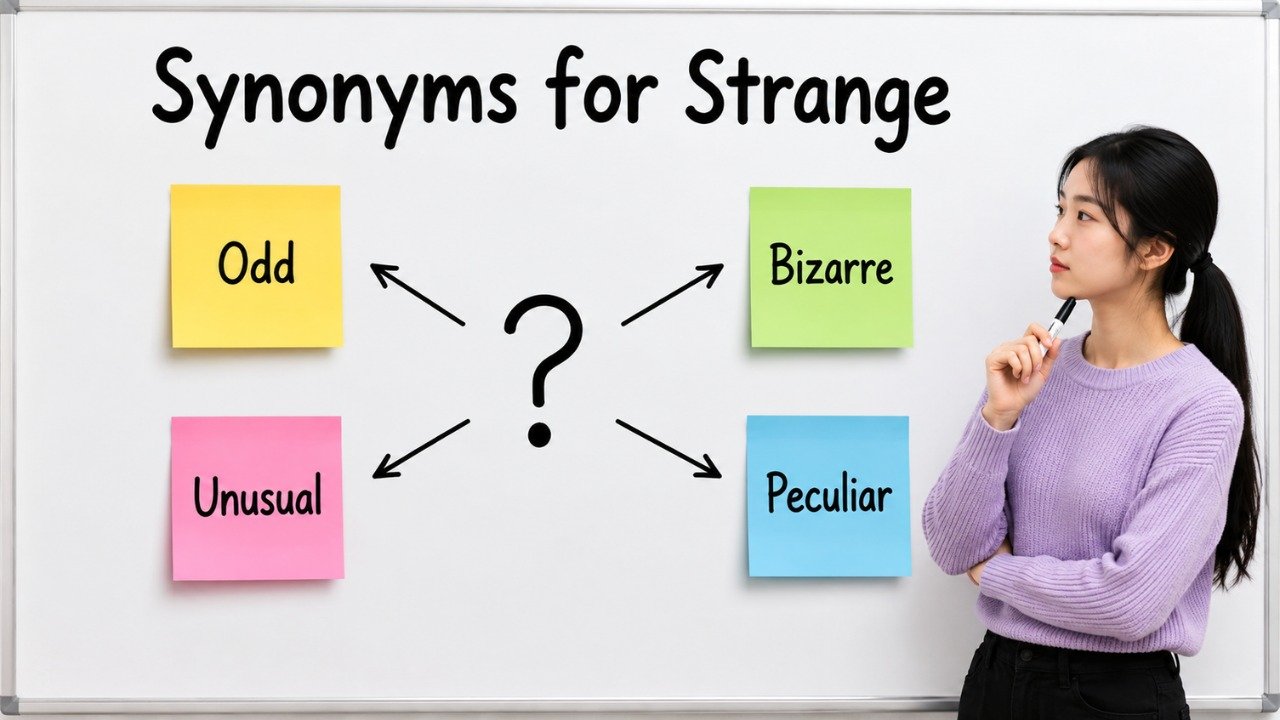
Quick Answer: The best synonyms for strange are unusual, odd, peculiar, weird, bizarre, unfamiliar, mysterious, eccentric, uncanny, and abnormal. Use unusual as a neutral replacement in most writing, odd or weird in casual conversation, peculiar for a noticeable difference, bizarre for something extremely unusual, unfamiliar for something not previously known, mysterious for something difficult to explain, eccentric for unconventional behavior, uncanny for an unsettling experience, and abnormal in technical or analytical contexts. These synonyms for strange help describe unusual appearances, behaviors, situations, feelings, sounds, and experiences more precisely.
Pronunciation and Word Details
Word: Strange
Pronunciation: /streɪndʒ/
Part of Speech: Adjective
Meaning: Unusual, unfamiliar, unexpected, or difficult to understand.
US Pronunciation:
UK Pronunciation:
What Does “Strange” Mean?
Strange means unusual, unfamiliar, unexpected, or difficult to explain. It is an adjective used to describe people, objects, places, events, feelings, sounds, ideas, and behavior.
A strange thing may be different from what is considered normal or expected.
Example: A strange sound came from the empty room.
The word can also describe something unfamiliar.
Example: Everything felt strange during her first day in the new city.
Strange may express mild curiosity, confusion, discomfort, suspicion, or fear. Its exact meaning depends on the sentence.
Example: He gave me a strange look.
Here, strange suggests that the look seemed unusual, confusing, or possibly suspicious.
Strange can appear before a noun or after a linking verb.
Before a Noun: We noticed a strange smell.
After a Linking Verb: The situation seemed strange.
Its comparative form is stranger, and its superlative form is strangest.
Comparative: This explanation sounds stranger than the first one.
Superlative: That was the strangest experience of the entire trip.
Meaning, Tone, and Context of “Strange”
Strange usually has a neutral to slightly negative tone. It may simply describe something uncommon, but it can also suggest discomfort, mystery, suspicion, or fear.
In casual conversation, strange is commonly used for unexpected behavior, unfamiliar feelings, unusual sounds, or confusing situations.
Example: It is strange that he left without saying anything.
In formal writing, unusual, atypical, anomalous, or irregular may sound more precise. These alternatives are useful in reports, essays, research, and analytical explanations.
Example: The study revealed an unusual pattern in the results.
Strange can also carry an emotional meaning. A strange feeling may involve worry, uncertainty, or discomfort.
Example: She had a strange feeling that something was wrong.
When describing a person, strange can sound judgmental if no explanation is provided. Eccentric, unconventional, reserved, unfamiliar, or unusual may communicate the intended meaning more respectfully.
The word is not normally technical. In scientific, medical, or statistical contexts, abnormal, atypical, anomalous, or irregular may offer greater accuracy.
When and How to Use “Strange”
For an Unusual Situation: Use strange when an event differs from what normally happens.
Example: It was strange to see the streets completely empty.
For Unexpected Behavior: Use it when someone acts in a surprising or confusing way.
Example: His strange behavior made everyone concerned.
For an Unfamiliar Experience: Use strange when something feels new or unknown.
Example: The new schedule felt strange at first.
For a Mysterious Event: Use it when the cause or meaning of something is unclear.
Example: A strange light appeared above the field.
For an Uncomfortable Feeling: Use strange when a physical or emotional feeling is difficult to describe.
Example: She felt a strange pressure in her shoulder.
For an Unusual Appearance: Use it when something looks noticeably different from what is expected.
Example: The plant had a strange shape.
For a Suspicious Detail: Use strange when something appears questionable or inconsistent.
Example: There was something strange about his explanation.
For an Unexpected Sound or Smell: Use it to describe a sound or smell that is unfamiliar or difficult to identify.
Example: We heard a strange noise near the back door.
For a Surprising Coincidence: Use strange when two events connect in an unexpected way.
Example: It was strange that both letters arrived on the same day.
Best Synonyms for Strange
Unusual
Synonym: Unusual means different from what normally happens or is commonly seen.
Example: The building had an unusual design.
Unusual is the best neutral synonym for strange. It works well in conversation, essays, reports, descriptions, and professional writing.
Odd
Synonym: Odd means unusual in a noticeable, surprising, or slightly confusing way.
Example: She noticed an odd mark on the wall.
Odd is common in everyday speech. It often describes something mildly strange rather than frightening.
Peculiar
Synonym: Peculiar means noticeably unusual or distinctive.
Example: A peculiar smell filled the hallway.
Peculiar can express curiosity, suspicion, or mild discomfort. It is useful when a detail stands out.
Weird
Synonym: Weird means very unusual, unexpected, or difficult to understand.
Example: I had a weird dream last night.
Weird is common in casual conversation but may sound too informal for reports, essays, or professional messages.
Bizarre
Synonym: Bizarre means extremely strange or difficult to believe.
Example: The witness described a bizarre series of events.
Bizarre is stronger than strange. Use it when something is dramatically unusual.
Unfamiliar
Synonym: Unfamiliar means not known, recognized, or experienced before.
Example: They entered an unfamiliar neighborhood.
Unfamiliar is the best choice when strange means unknown rather than unusual.
Mysterious
Synonym: Mysterious means difficult to explain, understand, or identify.
Example: A mysterious message appeared on the desk.
Mysterious emphasizes missing information or an unknown cause.
Eccentric
Synonym: Eccentric means unconventional in behavior, appearance, or habits.
Example: The artist was known for his eccentric clothing.
Eccentric is most often used for people, personalities, habits, and creative choices.
Uncanny
Synonym: Uncanny means strangely familiar, accurate, or unsettling.
Example: The two paintings had an uncanny similarity.
Uncanny is useful when something creates a surprising and slightly uncomfortable feeling.
Abnormal
Synonym: Abnormal means different from a usual, expected, or healthy standard.
Example: The test revealed an abnormal result.
Abnormal is appropriate in medical, scientific, technical, and analytical contexts. It can sound insensitive when casually applied to a person.
50 Synonyms for Strange with Short Meanings
- Unusual: Different from what is normal or expected.
- Odd: Noticeably unusual or surprising.
- Peculiar: Unusual in a distinctive or curious way.
- Weird: Very unusual or difficult to understand.
- Bizarre: Extremely strange or unbelievable.
- Unfamiliar: Not previously known or recognized.
- Mysterious: Difficult to explain or understand.
- Curious: Unusual enough to attract attention.
- Extraordinary: Far beyond what is ordinary.
- Uncommon: Not often seen, heard, or experienced.
- Abnormal: Different from an expected standard.
- Atypical: Not representing the usual type or pattern.
- Irregular: Not following a normal pattern or rule.
- Unconventional: Different from accepted customs or methods.
- Eccentric: Unconventional in behavior or appearance.
- Outlandish: Extremely unusual in a surprising way.
- Uncanny: Strangely familiar, accurate, or unsettling.
- Eerie: Strange in a frightening or uncomfortable way.
- Unsettling: Causing discomfort, worry, or uncertainty.
- Disturbing: Causing concern, fear, or emotional discomfort.
- Puzzling: Difficult to understand or explain.
- Perplexing: Creating confusion or uncertainty.
- Baffling: Extremely difficult to understand.
- Inexplicable: Impossible or very difficult to explain.
- Unaccountable: Having no clear or reasonable explanation.
- Anomalous: Different from an established pattern.
- Aberrant: Departing from what is normal or expected.
- Exceptional: Unusual because it is rare or remarkable.
- Remarkable: Unusual enough to deserve attention.
- Surprising: Causing an unexpected reaction.
- Unexpected: Not anticipated or predicted.
- Novel: New, original, or unfamiliar.
- Alien: Completely unfamiliar or foreign in nature.
- Foreign: Unfamiliar or coming from another place.
- Unknown: Not identified, understood, or recognized.
- Unrecognized: Not previously identified or noticed.
- Otherworldly: Seeming to belong to another world.
- Surreal: Having an unreal or dreamlike quality.
- Grotesque: Strangely distorted or unpleasant in appearance.
- Absurd: Extremely unreasonable or illogical.
- Preposterous: So unreasonable that it seems unbelievable.
- Singular: Remarkably unusual or distinctive.
- Rare: Not commonly found or experienced.
- Distinctive: Noticeably different from others.
- Offbeat: Unconventional and different from ordinary styles.
- Enigmatic: Mysterious and difficult to interpret.
- Bewildering: Causing strong confusion.
- Cryptic: Mysterious because the meaning is unclear.
- Unusual Looking: Having an appearance that differs from what is expected.
- Out of Place: Unsuitable or noticeably different in a particular setting.
Read Also:
Synonyms for Due to

Synonyms for Strange by Context
When Strange Means Unusual
Use unusual, uncommon, atypical, extraordinary, or exceptional when something differs from what normally happens.
Strange: The region experienced strange weather for the season.
Unusual: The region experienced unusual weather for the season.
Atypical: The region experienced atypical weather for the season.
Unusual is the most neutral choice. Atypical is useful in formal or analytical writing, while extraordinary suggests that the difference is especially noticeable.
When Strange Means Odd or Peculiar
Use odd, peculiar, curious, singular, or offbeat when something attracts attention because it seems different.
Odd: There was an odd mark beside the window.
Peculiar: A peculiar sound came from the machine.
Curious: The document contained a curious detail.
Odd is natural in everyday speech. Peculiar can suggest suspicion, while curious often communicates interest rather than fear.
When Strange Means Unfamiliar
Use unfamiliar, unknown, alien, foreign, or unrecognized when something is strange because it has not been encountered before.
Unfamiliar: The road signs were unfamiliar to the visitors.
Alien: The environment felt completely alien to him.
Unknown: The signal came from an unknown source.
Unfamiliar is usually the safest and clearest option. Alien is much stronger and suggests complete unfamiliarity.
When Strange Means Mysterious
Use mysterious, enigmatic, cryptic, inexplicable, or unaccountable when the cause or meaning is unclear.
Mysterious: A mysterious package appeared outside the door.
Enigmatic: Her enigmatic response raised more questions.
Inexplicable: The sudden change remained inexplicable.
Mysterious is broad and natural. Enigmatic often describes people, expressions, or messages. Inexplicable emphasizes the absence of a clear explanation.
When Strange Means Confusing
Use puzzling, perplexing, baffling, or bewildering when something is difficult to understand.
Puzzling: The report contained several puzzling results.
Perplexing: His decision was perplexing to the entire group.
Baffling: The sudden failure was completely baffling.
Puzzling suggests mild confusion. Baffling and bewildering describe much stronger confusion.
When Strange Means Frightening
Use eerie, uncanny, unsettling, disturbing, or otherworldly when something creates discomfort or fear.
Eerie: An eerie silence filled the building.
Uncanny: She had an uncanny sense that someone was watching.
Unsettling: His unexplained absence was unsettling.
Eerie often describes places, sounds, or atmospheres. Uncanny combines surprise with discomfort. Disturbing is stronger and may suggest emotional harm or serious concern.
When Strange Describes Behavior
Use eccentric, unconventional, unusual, erratic, or outlandish depending on the exact behavior.
Eccentric: The professor had several eccentric habits.
Unconventional: She took an unconventional approach to the problem.
Outlandish: He made an outlandish claim during the discussion.
Eccentric may sound mildly positive or affectionate. Outlandish is stronger and often critical.
When Strange Describes a Technical Difference
Use abnormal, atypical, irregular, anomalous, or aberrant in scientific, medical, statistical, and analytical contexts.
Abnormal: The scan showed an abnormal growth.
Anomalous: Researchers investigated the anomalous reading.
Irregular: The device produced an irregular signal.
These terms are more precise than strange when comparing a result with an accepted standard or pattern.
Another Word for Strange
Unusual is usually the best single replacement for strange because it is clear, neutral, and suitable for most contexts. However, the strongest alternative depends on whether something is unfamiliar, mysterious, frightening, confusing, or simply different from normal.
Original: We heard a strange sound outside.
Better Option: We heard an unusual sound outside.
Original: She received a strange message with no name attached.
Better Option: She received a mysterious message with no name attached.
Original: The room gave him a strange and uncomfortable feeling.
Better Option: The room gave him an eerie feeling.
Original: His strange habits surprised the new employees.
Better Option: His eccentric habits surprised the new employees.
When Not to Use “Strange”
Do not use strange when a more precise word would help readers understand what is unusual.
Weak: The results were strange.
Better: The results were inconsistent with the earlier findings.
Avoid strange when the intended meaning is simply unfamiliar.
Weak: The language sounded strange to her.
Better: The language sounded unfamiliar to her.
Do not use strange to describe a person when the wording could sound insulting or judgmental.
Weak: The new student is strange.
Better: The new student seems quiet and unfamiliar with the routine.
Avoid strange in technical writing when abnormal, irregular, atypical, or anomalous provides a measurable meaning.
Weak: The patient had a strange heart rhythm.
Better: The patient had an irregular heart rhythm.
Do not use bizarre unless the situation is extremely unusual. It may sound exaggerated when the difference is minor.
Weak: He wore a bizarre blue shirt.
Better: He wore an unusual blue shirt.
Avoid weird in formal reports, professional messages, and academic explanations.
Weak: The data showed a weird pattern.
Better: The data showed an anomalous pattern.
Do not use mysterious when the cause is already known.
Weak: The mysterious sound came from a loose window.
Better: The unusual sound came from a loose window.
Words Commonly Confused With Strange
Strange vs Unusual: Strange may suggest discomfort, mystery, or unfamiliarity. Unusual simply means different from what is normal and is usually more neutral.
Strange vs Odd: Both describe something unexpected. Odd often sounds milder and more conversational.
Strange vs Weird: Weird is a casual and sometimes stronger alternative. Strange is more suitable across formal and informal contexts.
Strange vs Peculiar: Strange is broad, while peculiar often points to a specific detail, feature, smell, sound, or behavior that stands out.
Strange vs Mysterious: Strange describes something unusual. Mysterious emphasizes that its cause, identity, or meaning is unknown.
Strange vs Unfamiliar: Strange can mean unusual or uncomfortable. Unfamiliar only means that something is not known or recognized.
Strange vs Abnormal: Strange is general and subjective. Abnormal compares something with a defined standard, pattern, or expected condition.
Strange vs Eccentric: Strange can describe almost anything. Eccentric mainly describes unconventional people, habits, behavior, and styles.
Strange vs Uncanny: Strange is broad, while uncanny describes something unexpectedly accurate, familiar, or unsettling.
Strange vs Foreign: Strange may describe anything unusual. Foreign usually means coming from another country, place, culture, or outside source.
Which Synonym Should You Choose?
Choose unusual for a neutral replacement in essays, reports, messages, descriptions, and everyday writing.
Choose odd for mild surprise, unexpected details, or casual conversation.
Choose peculiar when a sound, smell, habit, feature, or situation stands out in a noticeable way.
Choose weird for informal speech, personal stories, dreams, feelings, and casual reactions.
Choose bizarre when something is extremely unusual, unbelievable, or difficult to accept.
Choose unfamiliar when a place, person, object, sound, or experience has not been encountered before.
Choose mysterious when the cause, meaning, identity, or origin is unknown.
Choose puzzling when something creates questions or mild confusion.
Choose baffling when something is extremely difficult to understand.
Choose eerie when a place, sound, silence, or experience feels strange and frightening.
Choose uncanny when something is surprisingly familiar, accurate, or unsettling.
Choose eccentric when describing unconventional habits, personalities, clothing, or behavior.
Choose abnormal for medical, scientific, technical, or measurable differences from a standard.
Choose anomalous for reports, data, research, and patterns that do not match expected results.
Choose unconventional when a method, lifestyle, choice, or idea differs from accepted practice without necessarily being negative.
Choose extraordinary when the unusual quality is impressive, rare, or remarkable.
Real Life Examples of “Strange” in Sentences
Original: I heard a strange sound in the kitchen.
Better Option: I heard an unusual sound in the kitchen.
Original: She had a strange feeling before the meeting.
Better Option: She had an unsettling feeling before the meeting.
Original: His strange habits surprised his coworkers.
Better Option: His eccentric habits surprised his coworkers.
Original: The machine produced a strange result.
Better Option: The machine produced an abnormal result.
Original: A strange message appeared on the screen.
Better Option: A mysterious message appeared on the screen.
Original: The empty house had a strange atmosphere.
Better Option: The empty house had an eerie atmosphere.
Original: Her explanation sounded strange.
Better Option: Her explanation sounded peculiar.
Original: The new environment felt strange to him.
Better Option: The new environment felt unfamiliar to him.
Original: Researchers discovered a strange pattern in the data.
Better Option: Researchers discovered an anomalous pattern in the data.
Original: It was strange that both clocks stopped at the same time.
Better Option: It was an uncanny coincidence that both clocks stopped at the same time.
Synonym Groups and Usage Differences
General Difference Group
Unusual, uncommon, atypical, rare, and extraordinary describe something that differs from what normally occurs.
Example: The town experienced unusually warm weather during winter.
Unusual is neutral, while extraordinary suggests a stronger or more impressive difference.
Oddity Group
Odd, peculiar, curious, singular, and offbeat describe something noticeable because it does not fit ordinary expectations.
Example: A peculiar mark appeared on the door.
These words often express curiosity or mild confusion rather than fear.
Mystery Group
Mysterious, enigmatic, cryptic, inexplicable, and unaccountable describe something that cannot be easily understood or explained.
Example: The source of the mysterious signal remained unknown.
Mysterious is broad, while cryptic usually describes unclear language, symbols, or messages.
Confusion Group
Puzzling, perplexing, baffling, and bewildering focus on the difficulty of understanding something.
Example: The sudden change in direction was baffling.
Puzzling is mild, while bewildering suggests intense confusion.
Unfamiliarity Group
Unfamiliar, foreign, alien, unknown, and unrecognized describe something outside a person’s knowledge or experience.
Example: The customs felt unfamiliar to the visitors.
Alien is the strongest word in this group and suggests complete difference or separation.
Fear and Discomfort Group
Eerie, uncanny, unsettling, disturbing, and otherworldly describe experiences that create worry, fear, or discomfort.
Example: An eerie light moved across the empty field.
Eerie often creates fear, while unsettling may express general discomfort without direct danger.
Unconventional Behavior Group
Eccentric, unconventional, outlandish, offbeat, and bizarre describe behavior, ideas, clothing, or choices outside accepted norms.
Example: His eccentric decorating style attracted attention.
Eccentric may sound harmless or creative. Bizarre and outlandish are stronger and more critical.
Technical Difference Group
Abnormal, atypical, irregular, anomalous, and aberrant describe departures from an expected standard or pattern.
Example: The report identified an anomalous increase in temperature.
These terms are useful in science, medicine, research, statistics, and formal analysis.
Antonyms of Strange
The opposites of strange describe things that are normal, familiar, expected, understandable, or commonly experienced.
Normal: Matching an accepted or expected standard.
Ordinary: Common and not unusual.
Usual: Happening or appearing regularly.
Familiar: Known through previous experience.
Common: Frequently seen, found, or experienced.
Typical: Showing the expected qualities of a group or situation.
Conventional: Following accepted customs or methods.
Expected: Anticipated based on available knowledge.
Recognizable: Easy to identify from previous knowledge.
Natural: Seeming normal, comfortable, or unsurprising.
Regular: Following a consistent pattern.
Standard: Matching an established level or form.
Understandable: Easy to explain or comprehend.
Predictable: Happening in a way that can be anticipated.
Reassuring: Creating comfort rather than uncertainty.
Comparison: Strange vs Related Words
Strange vs Unusual
Strange may suggest mystery, discomfort, or unfamiliarity. Unusual is more neutral and simply shows that something differs from the normal pattern.
Example With Strange: A strange shadow moved across the wall.
Example With Unusual: The region received an unusual amount of rain.
Strange vs Odd
Strange is broader and can sound more serious. Odd usually describes a mild or noticeable difference.
Example With Strange: His sudden disappearance seemed strange.
Example With Odd: There was an odd stain on the carpet.
Strange vs Weird
Strange works in both formal and casual contexts. Weird is more informal and often expresses a stronger personal reaction.
Example With Strange: The results revealed a strange pattern.
Example With Weird: I had a weird dream last night.
Strange vs Peculiar
Strange describes a general sense of difference. Peculiar often identifies a specific quality, detail, smell, sound, habit, or feature.
Example With Strange: Something about the room felt strange.
Example With Peculiar: The room had a peculiar smell.
Strange vs Mysterious
Strange means unusual or unfamiliar. Mysterious means that the cause, identity, or meaning is unknown.
Example With Strange: A strange car stopped outside the house.
Example With Mysterious: A mysterious caller left a message without giving a name.
Strange vs Unfamiliar
Strange may suggest that something is unusual or uncomfortable. Unfamiliar simply means it is not known from previous experience.
Example With Strange: The town seemed strangely quiet.
Example With Unfamiliar: The town was unfamiliar to the new residents.
Strange vs Eerie
Strange is neutral or mildly uncomfortable. Eerie specifically creates fear, tension, or an unnatural feeling.
Example With Strange: We noticed a strange silence.
Example With Eerie: An eerie silence filled the abandoned building.
Strange vs Uncanny
Strange describes anything unusual. Uncanny describes a surprising similarity, accuracy, or feeling that is also unsettling.
Example With Strange: The child made a strange prediction.
Example With Uncanny: The child’s prediction was uncannily accurate.
Strange vs Eccentric
Strange can describe people, objects, events, and feelings. Eccentric mainly describes unconventional people, habits, behavior, or style.
Example With Strange: His response to the question was strange.
Example With Eccentric: His eccentric clothing made him easy to recognize.
Strange vs Abnormal
Strange is subjective and general. Abnormal refers to a measurable difference from an accepted standard.
Example With Strange: The device made a strange sound.
Example With Abnormal: The test detected an abnormal reading.
Common Phrases and Expressions With “Strange”
Strange Feeling: An unusual emotional or physical sensation.
Example: She had a strange feeling that she had forgotten something.
Strange Behavior: Actions that appear unusual, confusing, or suspicious.
Example: His strange behavior concerned the other employees.
Strange Sound: A noise that is unfamiliar or difficult to identify.
Example: A strange sound came from the engine.
Strange Smell: An unusual odor with an unknown source.
Example: We noticed a strange smell near the storage area.
Strange Look: An unusual facial expression or appearance.
Example: She gave him a strange look after hearing the question.
Strange Place: A location that feels unfamiliar, unusual, or uncomfortable.
Example: He woke up in a strange place.
Strange Situation: An event or condition that seems unusual or confusing.
Example: It was a strange situation with no simple explanation.
Strange Coincidence: An unexpected connection between separate events.
Example: Their meeting on the same train was a strange coincidence.
Strange Idea: A thought or suggestion that seems unusual or unrealistic.
Example: At first, the proposal sounded like a strange idea.
Something Strange: An unidentified event, feeling, object, or detail that seems unusual.
Example: She noticed something strange beside the window.
Common Mistakes to Avoid
One common mistake is using strange without explaining what makes something unusual. More specific wording often gives readers a clearer picture.
Vague: The meeting was strange.
Clear: The meeting was unusually quiet, and no one asked questions.
Avoid repeating strange several times in the same paragraph.
Repetitive: We saw a strange house with a strange roof and strange windows.
Improved: We saw an unusual house with a sharply curved roof and narrow windows.
Do not replace strange with a stronger synonym unless the context supports it. Bizarre, grotesque, disturbing, and absurd can greatly change the tone.
Too Strong: The chair had a bizarre design.
Neutral: The chair had an unusual design.
Avoid using weird in formal reports or academic writing when unusual, atypical, or anomalous would be more precise.
Use unfamiliar when something seems strange only because it is new to the observer.
Be careful when describing people. Calling someone strange may sound insulting. Describe the specific behavior, habit, or quality instead.
Judgmental: He is a strange person.
Specific: He has several unconventional habits.
Do not confuse strange with foreign. Foreign often refers to another country, culture, or outside source, while strange has a broader meaning.
Remember that strange is an adjective. Use strangely when modifying a verb, adjective, or complete statement.
Adjective: The room seemed strange.
Adverb: The room was strangely quiet.
Use the correct comparative and superlative forms.
Comparative: This situation is stranger than the previous one.
Superlative: It was the strangest event of the week.
Conclusion
The most useful synonyms for strange include unusual, odd, peculiar, bizarre, unfamiliar, mysterious, eccentric, uncanny, and abnormal. Choose unusual for a neutral difference, unfamiliar for something unknown, mysterious for an unexplained event, eerie for a frightening atmosphere, and anomalous for formal analysis. Eccentric works well for unconventional behavior, while bizarre describes something extremely unusual. Selecting synonyms for strange by meaning and tone makes descriptions more specific, natural, respectful, and easier for readers to understand.
FAQs About Synonyms for Strange
What Is the Best Synonym for Strange?
Unusual is the best general synonym for strange. It is neutral, clear, and suitable for formal and casual writing.
What Is a Formal Synonym for Strange?
Unusual, atypical, anomalous, irregular, and unconventional are useful formal alternatives. The best choice depends on the exact context.
What Is a Casual Synonym for Strange?
Odd and weird are common casual synonyms. Odd is usually milder, while weird can express a stronger personal reaction.
What Is a Stronger Word Than Strange?
Bizarre, uncanny, eerie, and disturbing can be stronger than strange. Each word adds a different meaning, such as extreme unusualness, discomfort, fear, or concern.
What Is a Positive Synonym for Strange?
Extraordinary, distinctive, novel, remarkable, and unconventional can describe unusual qualities positively.
What Is the Difference Between Strange and Mysterious?
Strange means unusual or unfamiliar. Mysterious means difficult to explain because important facts, causes, or identities are unknown.
Can Strange Describe a Person?
Yes, but it can sound judgmental. Eccentric, unconventional, unfamiliar, reserved, or unusual may be more respectful when they express the intended meaning accurately.
