
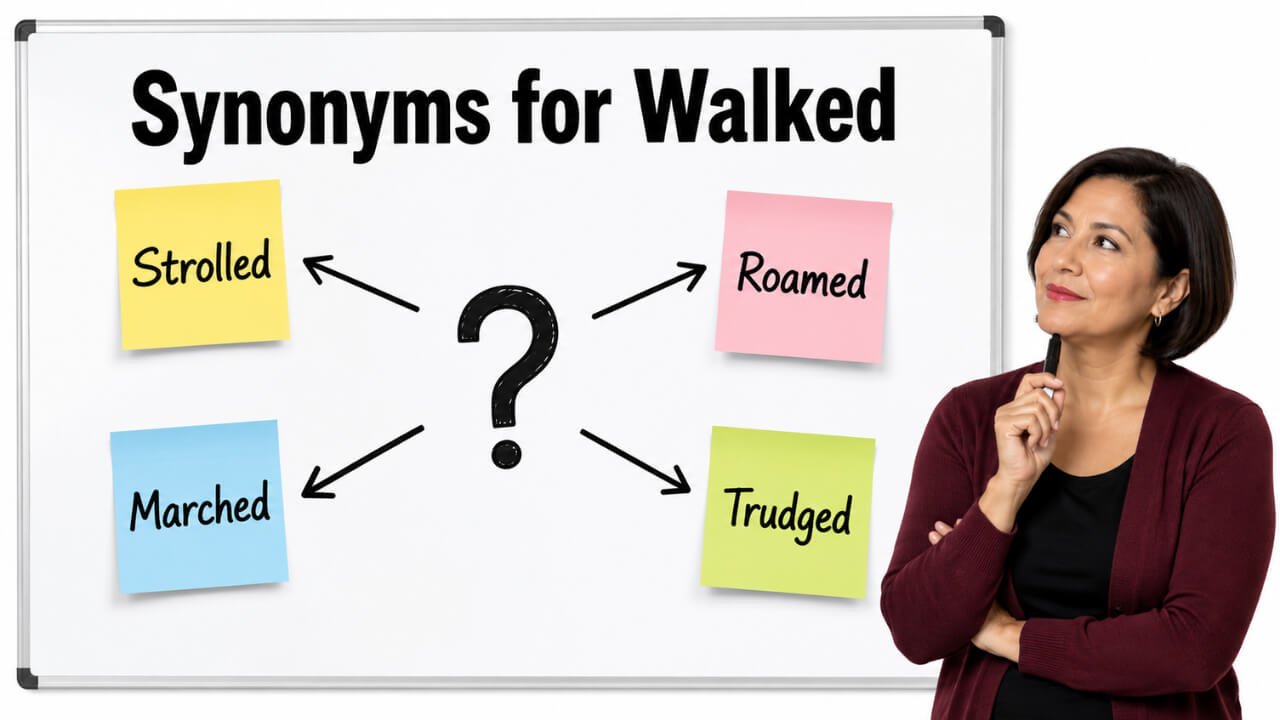
Quick Answer: The best synonyms for walked include strode, strolled, marched, wandered, paced, trudged, hiked, sauntered, tiptoed, and proceeded. Use strode for confident movement, strolled for relaxed movement, marched for firm or organized movement, wandered for movement without a clear direction, and trudged for tired or difficult movement. Proceeded works well in formal writing, while went on foot sounds natural in casual speech. The best choice depends on the person’s speed, mood, purpose, direction, and surroundings.
Pronunciation and Word Details
Word: Walked.
Pronunciation: /wɔːkt/
Part of Speech: Verb, simple past tense and past participle of walk.
Meaning: Walked means moved from one place to another on foot.
US Pronunciation:
UK Pronunciation:
What Does “Walked” Mean?
Walked means traveled or moved somewhere by placing one foot in front of the other.
It is the simple past tense and past participle of the verb walk. The word normally describes movement on foot at a regular pace, but its exact meaning can change according to the sentence.
In a basic sentence, walked simply explains how someone moved.
Example: Mia walked to the library.
Walked can also describe the manner, direction, purpose, or emotional quality of someone’s movement.
Example: He walked confidently into the meeting.
The word may appear with prepositions and adverbs that provide additional details.
Example: They walked across the bridge slowly.
Walked can also mean accompanying, guiding, or escorting someone.
Example: She walked her children to school.
In some expressions, walked describes leaving a place, abandoning a situation, or separating from something.
Example: He walked away from the argument.
Because walked is a general verb, writers often replace it with a more descriptive synonym that shows speed, mood, effort, or intention.
Meaning, Tone, and Context of “Walked”
Walked is a neutral and common word. It is appropriate in casual conversation, stories, reports, instructions, essays, and formal writing.
The word does not automatically reveal how quickly, confidently, quietly, or comfortably someone moved. That information usually comes from the surrounding words.
Neutral Context: She walked toward the door.
Relaxed Context: She walked slowly through the garden.
Urgent Context: She walked quickly toward the exit.
Emotional Context: She walked away in disappointment.
Formal Context: The visitors walked through the designated entrance.
Conversational Context: We walked home after dinner.
Walked is clear and natural, but it can sound repetitive in descriptive writing. More specific verbs such as strolled, strode, trudged, marched, or tiptoed create a stronger picture.
The tone of a synonym should match the situation. Strolled sounds peaceful, marched sounds controlled or forceful, wandered sounds uncertain or relaxed, and trudged suggests difficulty.
When and How to Use “Walked”
For Ordinary Movement
Use walked when the manner of movement is not especially important.
Example: Daniel walked from the office to the parking area.
For Movement in a Particular Direction
Add a direction word to explain where someone moved.
Example: The students walked toward the main entrance.
For Relaxed Movement
Use walked with words such as slowly, calmly, or peacefully when the movement is comfortable.
Example: We walked peacefully beside the river.
A stronger synonym such as strolled or ambled can create a clearer image.
For Confident Movement
Use walked with confidently or replace it with strode when the person moves with purpose.
Example: The speaker walked confidently onto the stage.
For Difficult Movement
Use walked with difficulty when someone is tired, injured, or moving through challenging conditions.
Example: The travelers walked with difficulty through the deep mud.
Trudged, plodded, or slogged may express the difficulty more effectively.
For Quiet Movement
Use walked quietly when someone is trying not to make noise.
Example: She walked quietly past the sleeping child.
Tiptoed or crept provides a more precise description.
For Long Distance Travel
Use walked when someone covers a distance on foot.
Example: They walked several miles before reaching the village.
Hiked or trekked may be more suitable when the journey is long or physically demanding.
For Accompanying Someone
Walked can describe going somewhere with another person.
Example: Marcus walked his grandmother to the car.
For Leaving a Situation
Walked away means left a place, argument, responsibility, or opportunity.
Example: She walked away before the discussion became hostile.
For Repeated Movement
Walked back and forth describes repeated movement across the same space.
Example: He walked back and forth while waiting for the results.
Paced is a shorter and more expressive alternative.
Best Synonyms for Walked
Strode
Synonym: Walked with long, confident, and purposeful steps.
Example: The manager strode into the room and began the presentation.
Strolled
Synonym: Walked slowly and comfortably for pleasure.
Example: We strolled through the park after lunch.
Marched
Synonym: Walked with firm, regular, or organized steps.
Example: The musicians marched along the street.
Wandered
Synonym: Walked without a fixed route or clear destination.
Example: She wandered through the market looking at the displays.
Paced
Synonym: Walked repeatedly in a small area, often because of worry or impatience.
Example: He paced outside the office while waiting for the interview.
Trudged
Synonym: Walked slowly and heavily because of tiredness or difficulty.
Example: The hikers trudged through the wet field.
Hiked
Synonym: Walked a long distance, especially through the countryside or mountains.
Example: They hiked along the forest trail.
Sauntered
Synonym: Walked in a slow, relaxed, and confident manner.
Example: He sauntered into the cafe as though he had plenty of time.
Tiptoed
Synonym: Walked quietly on the toes to avoid making noise.
Example: She tiptoed out of the room without waking anyone.
Proceeded
Synonym: Moved forward or continued toward a destination in a formal or orderly way.
Example: The visitors proceeded toward the reception area.
50 Synonyms for Walked with Short Meanings
- Strode: Walked with long and confident steps.
- Strolled: Walked slowly and pleasantly.
- Marched: Walked with firm and regular steps.
- Wandered: Walked without a fixed direction.
- Paced: Walked repeatedly within a limited area.
- Trudged: Walked slowly with heavy effort.
- Hiked: Walked a long distance outdoors.
- Trekked: Walked on a long and difficult journey.
- Sauntered: Walked slowly in a relaxed manner.
- Ambled: Walked at an easy and comfortable pace.
- Meandered: Walked along an indirect or winding route.
- Roamed: Walked freely over a wide area.
- Tiptoed: Walked quietly on the toes.
- Crept: Moved slowly and quietly on foot.
- Sneaked: Walked secretly to avoid being noticed.
- Stepped: Moved by taking one or more steps.
- Trod: Walked or stepped on a surface.
- Proceeded: Walked forward in an orderly way.
- Advanced: Walked forward toward a position or goal.
- Moved: Changed position or location.
- Traveled: Went from one place to another.
- Went: Moved toward another place.
- Crossed: Walked from one side to another.
- Traversed: Walked across or through an area.
- Passed: Walked by a person, place, or object.
- Approached: Walked closer to someone or something.
- Entered: Walked into a place.
- Exited: Walked out of a place.
- Departed: Walked away or left a location.
- Left: Moved away from a person or place.
- Returned: Walked back to an earlier location.
- Followed: Walked behind a person or along a route.
- Accompanied: Walked somewhere with another person.
- Escorted: Walked with someone for guidance or protection.
- Promenaded: Walked leisurely in a public place.
- Paraded: Walked publicly as part of a display or celebration.
- Patrolled: Walked around an area to observe or protect it.
- Rambled: Walked for pleasure, often through the countryside.
- Traipsed: Walked a long way, often with inconvenience.
- Plodded: Walked slowly with heavy steps.
- Slogged: Walked with great effort through difficult conditions.
- Stomped: Walked with loud, heavy, or angry steps.
- Shuffled: Walked without lifting the feet fully.
- Limped: Walked unevenly because of pain or injury.
- Hobbled: Walked slowly and unsteadily.
- Skulked: Walked secretly while trying to avoid attention.
- Prowled: Walked quietly while searching or watching.
- Footed It: Traveled somewhere by walking.
- Went on Foot: Reached a place by walking rather than using transport.
- Made One’s Way: Walked or moved gradually toward a destination.
Read Also:
Synonyms for Symbolizes
Synonyms for Walked by Context
When Walked Means Ordinary Movement
Went, moved, stepped, traveled, and made one’s way can describe ordinary movement from one location to another.
Example: She went on foot to the nearby store.
Example: He made his way toward the entrance.
Went is common and conversational, but it does not always show that the person traveled on foot. Went on foot is more precise.
When Walked Means Relaxed Movement
Strolled, sauntered, ambled, promenaded, and meandered describe slow or pleasant movement.
Example: The couple strolled beside the lake.
Example: We ambled through the quiet village.
Strolled is the most natural choice for peaceful movement. Sauntered may also suggest relaxed confidence.
When Walked Means Confident Movement
Strode, advanced, proceeded, and marched describe movement with confidence, purpose, or control.
Example: The captain strode toward the waiting group.
Example: The guests proceeded into the hall.
Strode is vivid and confident. Proceeded is more formal and neutral.
When Walked Means Tired Movement
Trudged, plodded, slogged, shuffled, and traipsed suggest effort, exhaustion, or discomfort.
Example: The workers trudged home after the long shift.
Example: We slogged through the thick mud.
Trudged is suitable for tired movement, while slogged emphasizes difficult conditions.
When Walked Means Quiet Movement
Tiptoed, crept, sneaked, skulked, and prowled describe movement intended to avoid attention.
Example: The child tiptoed past the bedroom.
Example: He crept quietly along the hallway.
Tiptoed often suggests careful silence. Crept may create a more secretive or tense feeling.
When Walked Means Long Distance Travel
Hiked, trekked, rambled, roamed, and traversed describe walking over a considerable distance or through a large area.
Example: They trekked across the rocky landscape.
Example: We hiked through the hills until sunset.
Hiked usually describes outdoor recreation. Trekked suggests a longer or more demanding journey.
When Walked Means Repeated Movement
Paced and patrolled describe repeated walking within an area.
Example: She paced the room while waiting for an answer.
Example: The guard patrolled the building throughout the night.
Paced often reflects anxiety or impatience. Patrolled suggests observation, security, or responsibility.
When Walked Means Leaving
Departed, exited, left, and walked away describe movement out of a place or situation.
Example: He exited the building through the rear door.
Example: She departed before the event ended.
Exited works well for physical locations. Walked away can also express rejection, independence, or emotional separation.
Another Word for Walked
The best general replacement for walked is went on foot because it clearly communicates movement by walking. However, the strongest alternative depends on the person’s pace, mood, intention, and environment.
Use a more descriptive verb when those details matter.
Original: She walked through the garden.
Better Option: She strolled through the garden.
Original: He walked into the office confidently.
Better Option: He strode into the office confidently.
Original: They walked through the snow with difficulty.
Better Option: They trudged through the snow.
Original: The child walked quietly into the room.
Better Option: The child tiptoed into the room.
When Not to Use “Walked”
Walked may be too general when the reader needs to understand how or why someone moved.
When the Pace Matters
Avoid walked when speed or effort is important.
Weak: She walked slowly up the steep hill.
Better: She trudged up the steep hill.
When the Mood Matters
A descriptive synonym can reveal confidence, anger, relaxation, fear, or exhaustion.
Weak: He walked angrily out of the office.
Better: He stomped out of the office.
When the Movement Is Repeated
Use paced when someone repeatedly moves back and forth.
Weak: She walked back and forth near the door.
Better: She paced near the door.
When Silence Matters
Use tiptoed or crept when the movement is intentionally quiet.
Weak: He walked quietly past the sleeping baby.
Better: He tiptoed past the sleeping baby.
When the Journey Is Long
Use hiked or trekked when someone walks a considerable distance outdoors.
Weak: They walked across the mountain trail.
Better: They hiked along the mountain trail.
When the Writing Becomes Repetitive
Avoid using walked in several nearby sentences.
Weak: She walked into the room. She walked toward the desk. She walked around the chair.
Better: She entered the room, approached the desk, and stepped around the chair.
When the Method of Travel Is Unclear
Went does not always mean walked because a person may go somewhere by vehicle.
Unclear: He went to the station.
Clearer: He walked to the station.
Words Commonly Confused With Walked
Walked vs Went: Walked specifically means traveled on foot. Went only means moved to another place and does not explain the method of travel.
Walked vs Stepped: Walked usually describes continuous movement. Stepped often describes one movement, a short distance, or placing a foot somewhere.
Walked vs Strolled: Walked is neutral. Strolled suggests slow, relaxed, and enjoyable movement.
Walked vs Hiked: Walked can happen anywhere. Hiked usually describes a longer outdoor walk on a trail or through natural surroundings.
Walked vs Marched: Walked has no special rhythm or purpose. Marched suggests firm, controlled, organized, or forceful steps.
Walked vs Wandered: Walked may follow a clear route. Wandered suggests movement without a definite direction or destination.
Walked vs Paced: Walked can describe movement toward a destination. Paced describes repeated movement within a small area.
Walked vs Trudged: Walked is emotionally neutral. Trudged suggests tiredness, heaviness, difficulty, or reluctance.
Walked vs Strode: Walked does not reveal confidence. Strode describes long, confident, and purposeful steps.
Walked vs Escorted: Walked describes personal movement. Escorted means accompanied or guided another person while moving.
Which Synonym Should You Choose?
Choose walked when you need a neutral description of movement on foot.
Choose went on foot when you want to clarify the method of travel in casual or informative writing.
Choose proceeded in formal reports, instructions, announcements, or descriptions of orderly movement.
Choose strode when someone moves confidently, quickly, or with a strong sense of purpose.
Choose strolled when the movement is relaxed, slow, and enjoyable.
Choose sauntered when someone moves slowly with relaxed confidence.
Choose marched when the steps are organized, forceful, rhythmic, or determined.
Choose wandered when the person has no clear route or destination.
Choose paced when someone repeatedly walks because of worry, impatience, or deep thought.
Choose trudged when movement is slow and difficult because of exhaustion, weather, or challenging ground.
Choose plodded when someone takes slow, heavy, and unenthusiastic steps.
Choose slogged when the journey requires considerable physical effort.
Choose tiptoed when the person is trying to remain quiet.
Choose crept when the movement is slow, careful, secretive, or fearful.
Choose hiked when someone walks outdoors for recreation or exercise.
Choose trekked when describing a long, demanding journey on foot.
Choose escorted when someone accompanies another person for safety, support, or guidance.
Choose traversed in formal or descriptive writing about crossing an area.
Choose approached when the important detail is movement toward a person, object, or location.
Choose exited when the important detail is leaving a building or enclosed space.
Real Life Examples of “Walked” in Sentences
Original: Emma walked slowly through the flower garden.
Better Option: Emma strolled through the flower garden.
Original: The director walked confidently into the conference room.
Better Option: The director strode into the conference room.
Original: We walked for six hours through the hills.
Better Option: We trekked for six hours through the hills.
Original: The tired student walked home after the examination.
Better Option: The tired student trudged home after the examination.
Original: The child walked quietly past the bedroom.
Better Option: The child tiptoed past the bedroom.
Original: He walked back and forth while waiting for the call.
Better Option: He paced while waiting for the call.
Original: The group walked in organized lines toward the field.
Better Option: The group marched in organized lines toward the field.
Original: She walked around the old neighborhood without a plan.
Better Option: She wandered around the old neighborhood without a plan.
Original: The visitors walked into the exhibition hall.
Better Option: The visitors proceeded into the exhibition hall.
Original: The guard walked around the property throughout the night.
Better Option: The guard patrolled the property throughout the night.
Synonym Groups and Usage Differences
Ordinary Movement Group
Walked, went on foot, moved, stepped, and made one’s way describe general movement without adding a strong emotional meaning.
Use these choices when the destination matters more than the person’s mood or manner.
Example: She made her way toward the front desk.
Relaxed Movement Group
Strolled, ambled, sauntered, promenaded, and meandered describe comfortable or unhurried movement.
Strolled is pleasant and neutral. Sauntered suggests relaxed confidence. Meandered emphasizes an indirect route.
Example: The visitors meandered through the outdoor market.
Confident Movement Group
Strode, marched, advanced, and proceeded describe focused or purposeful movement.
Strode emphasizes confidence. Marched suggests force or order. Proceeded sounds formal and controlled.
Example: The athlete strode toward the starting area.
Difficult Movement Group
Trudged, plodded, slogged, traipsed, and shuffled describe movement that requires effort.
Trudged often suggests exhaustion. Slogged emphasizes difficult conditions. Shuffled describes short steps without lifting the feet fully.
Example: The travelers plodded along the muddy road.
Quiet Movement Group
Tiptoed, crept, sneaked, skulked, and prowled describe careful or secretive movement.
Tiptoed is often innocent or practical. Skulked and prowled may suggest suspicious intentions.
Example: She crept into the dark room.
Long Distance Group
Hiked, trekked, traversed, roamed, and rambled describe movement through larger areas.
Hiked often relates to outdoor exercise. Trekked suggests difficulty and distance. Roamed emphasizes freedom.
Example: They traversed the valley before nightfall.
Direction Group
Approached, entered, exited, crossed, departed, and returned explain the direction or result of the movement.
These words are helpful when the location matters more than the person’s walking style.
Example: The passengers approached the terminal entrance.
Accompanying Group
Accompanied, escorted, followed, and guided describe walking with or behind another person.
Escorted may suggest protection or official assistance. Accompanied is more general.
Example: A staff member escorted the guest to her seat.
Antonyms of Walked
The opposite of walked depends on whether the contrast involves movement, position, speed, or method of travel.
Stayed: Remained in the same place.
Remained: Continued to be in one location.
Stopped: Ended the act of walking.
Halted: Came to a complete stop.
Stood: Remained upright without moving forward.
Sat: Rested in a seated position instead of walking.
Rested: Stopped moving to recover energy.
Waited: Stayed in one place until something happened.
Ran: Moved on foot at a faster pace than walking.
Drove: Traveled using a motor vehicle instead of walking.
Rode: Traveled on a bicycle, animal, or vehicle.
Flew: Traveled through the air rather than on foot.
Comparison Walked vs Related Words
Walked vs Strolled
Walked is a general description of movement on foot. Strolled describes slow and pleasant movement, usually without urgency.
Example With Walked: We walked through the park to reach the museum.
Example With Strolled: We strolled through the park and enjoyed the flowers.
Walked vs Strode
Walked does not reveal confidence or step length. Strode describes long, firm, and purposeful steps.
Example With Walked: The lawyer walked into the courtroom.
Example With Strode: The lawyer strode into the courtroom with confidence.
Walked vs Marched
Walked describes normal movement. Marched suggests regular steps, organization, discipline, anger, or determination.
Example With Walked: The students walked toward the field.
Example With Marched: The students marched toward the field in two straight lines.
Walked vs Wandered
Walked may follow a planned route. Wandered suggests a lack of direction or a desire to explore freely.
Example With Walked: She walked directly to the information desk.
Example With Wandered: She wandered through the building looking for the information desk.
Walked vs Hiked
Walked is suitable for short or ordinary journeys. Hiked usually describes outdoor walking over trails or natural land.
Example With Walked: We walked from the hotel to the cafe.
Example With Hiked: We hiked along a mountain trail for three hours.
Walked vs Trudged
Walked is neutral. Trudged adds the feeling of tiredness, difficulty, or reluctance.
Example With Walked: He walked across the wet field.
Example With Trudged: He trudged across the wet field in heavy boots.
Walked vs Tiptoed
Walked does not explain how much noise a person made. Tiptoed shows that the person moved carefully and quietly.
Example With Walked: She walked into the bedroom.
Example With Tiptoed: She tiptoed into the bedroom to avoid waking the baby.
Walked vs Paced
Walked may describe progress toward a destination. Paced means repeatedly walking within a small space.
Example With Walked: He walked to the reception desk.
Example With Paced: He paced beside the reception desk while waiting.
Walked vs Proceeded
Walked is common and neutral. Proceeded sounds more formal and often describes orderly forward movement.
Example With Walked: The guests walked into the dining room.
Example With Proceeded: The guests proceeded into the dining room after the announcement.
Common Phrases and Expressions With Walked
Walked Away: Left a place, conversation, relationship, or opportunity.
Walked Home: Traveled home on foot.
Walked Alone: Moved without another person.
Walked Past: Passed a person, object, or location on foot.
Walked Into: Entered a place by walking.
Walked Out: Left a place, often suddenly or deliberately.
Walked Across: Moved from one side of an area to another.
Walked Through: Moved inside, across, or along something.
Walked Toward: Moved in the direction of someone or something.
Walked Beside: Moved next to another person.
Walked Around: Moved through different parts of an area.
Walked Back: Returned to an earlier position on foot.
Walked Slowly: Moved at a low walking speed.
Walked Confidently: Moved with certainty and self assurance.
Walked Someone Home: Accompanied someone to their home on foot.
Common Mistakes to Avoid
Repeating Walked Too Often
Using walked in every sentence can make descriptive writing sound flat.
Repetitive: He walked into the building, walked through the hallway, and walked toward the office.
Improved: He entered the building, passed through the hallway, and approached the office.
Choosing a Synonym With the Wrong Mood
Every walking verb creates a different impression.
Strolled sounds relaxed, so it is unsuitable for an emergency unless the contrast is intentional.
Unnatural: She strolled toward the emergency exit as smoke filled the room.
Better: She hurried toward the emergency exit as smoke filled the room.
Using Marched for Ordinary Movement
Marched suggests discipline, rhythm, anger, or determination. It should not replace walked in every sentence.
Unnatural: He marched casually through the peaceful garden.
Better: He strolled casually through the peaceful garden.
Confusing Went With Walked
Went does not identify the method of travel.
Vague: She went to the office.
Precise: She walked to the office.
Ignoring Direction
Sometimes a directional verb is clearer than walked.
Weak: He walked near the door.
Better: He approached the door.
Using Hiked for Short Indoor Movement
Hiked normally refers to longer outdoor walking.
Unnatural: She hiked from the kitchen to the living room.
Better: She walked from the kitchen to the living room.
Using Tiptoed Without a Reason for Silence
Tiptoed implies an effort to remain quiet or careful.
Unclear: He tiptoed across the busy outdoor field.
Clearer: He walked across the busy outdoor field.
Confusing Trudged and Strolled
Trudged expresses effort or exhaustion. Strolled expresses comfort and ease.
Incorrect Mood: After resting all morning, they trudged pleasantly through the garden.
Better: After resting all morning, they strolled pleasantly through the garden.
Forgetting Tense Consistency
Walked is a past tense form. Do not combine it incorrectly with present tense verbs when describing the same completed event.
Incorrect: She walked into the room and sits beside the window.
Correct: She walked into the room and sat beside the window.
Adding Unnecessary Adverbs
A strong synonym can often replace walked plus an adverb.
Wordy: He walked slowly and heavily through the snow.
Better: He trudged through the snow.
Conclusion
The best synonyms for walked depend on how, where, and why a person moved. Use strolled for relaxed movement, strode for confidence, marched for firm steps, wandered for movement without direction, and trudged for difficult progress. Tiptoed describes quiet movement, while hiked and trekked suit longer outdoor journeys. In neutral sentences, walked or went on foot remains clear and natural. Choosing a precise walking verb makes descriptions more vivid, reduces repetition, and helps readers understand the person’s mood, pace, effort, and purpose.
FAQs About Synonyms for Walked
What Is the Best Synonym for Walked?
Went on foot is the best neutral alternative. Strolled, strode, marched, and trudged are better when the manner of movement matters.
What Is a Formal Synonym for Walked?
Proceeded is a useful formal synonym. Traversed is suitable when describing movement across an area.
What Word Means Walked Slowly?
Strolled, ambled, sauntered, plodded, and meandered can mean walked slowly. The correct choice depends on whether the movement was relaxed or difficult.
What Word Means Walked Confidently?
Strode is the strongest choice for confident and purposeful walking.
What Word Means Walked With Difficulty?
Trudged, plodded, and slogged describe walking with effort. Limped or hobbled may be appropriate when pain or injury affects the movement.
Can Went Replace Walked?
Went can replace walked when the method of travel is not important. Use went on foot when you need to make the walking action clear.
Is Walked a Regular Verb?
Yes. Walked is the simple past tense and past participle of walk, formed by adding ed to the base verb.
What Is the Difference Between Walked and Strolled?
Walked is neutral, while strolled describes slow, relaxed, and enjoyable movement.
What Is a Stronger Word Than Walked?
The strongest word depends on context. Strode adds confidence, marched adds determination, trudged adds difficulty, and tiptoed adds quietness.
