
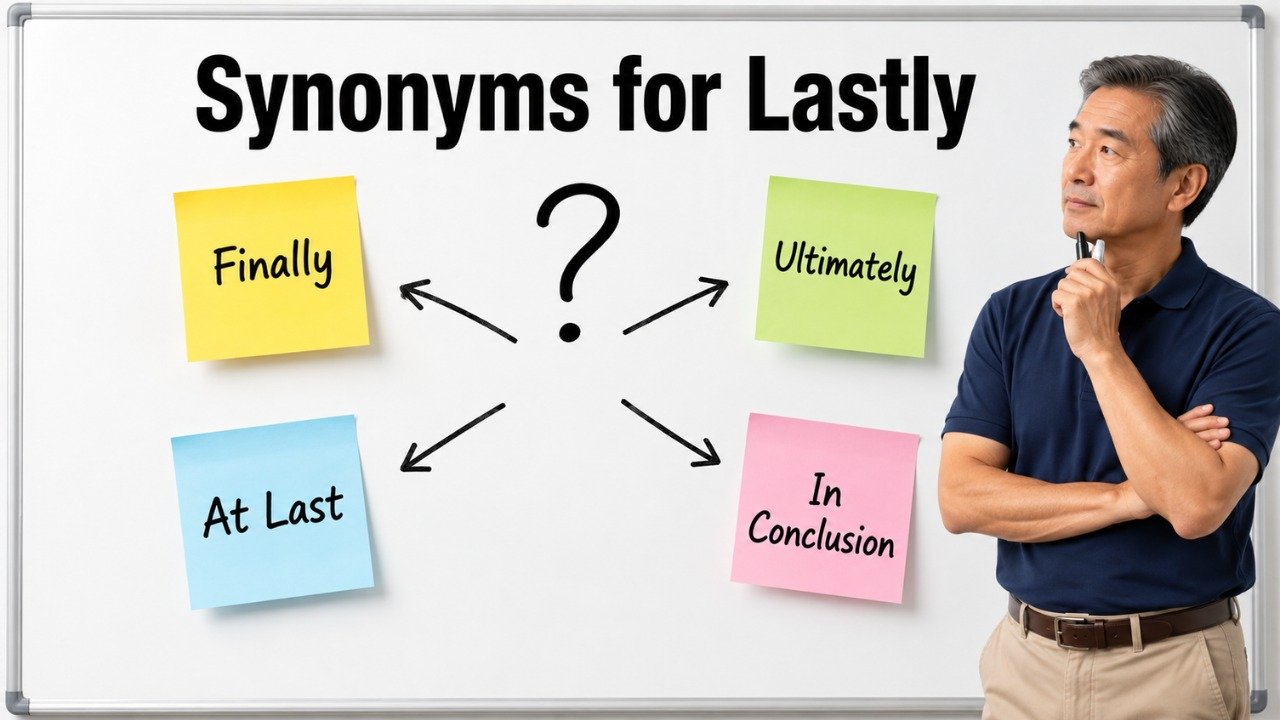
Quick Answer: The best synonyms for lastly are finally, in conclusion, to conclude, last of all, in closing, to finish, ultimately, to sum up, in summary, and on a final note. Use finally when introducing the last item in a sequence, in conclusion for formal essays, in closing for speeches or messages, to sum up when reviewing key points, and ultimately when describing a final result rather than the last point in a list. The keyword synonyms for lastly helps writers choose a transition that fits the purpose, tone, and structure of a sentence.
Pronunciation and Word Details
Word: Lastly
Pronunciation: /ˈlæstli/
Part of Speech: Adverb
Meaning: Used to introduce the final point, action, item, or idea in a sequence.
US Pronunciation:
UK Pronunciation:
What Does “Lastly” Mean?
Lastly means as the final point, action, or item in an ordered series. It is an adverb commonly placed at the beginning of a sentence to show that the writer or speaker has reached the last part of a list or explanation.
For example, someone might say, “Lastly, check the document for errors before submitting it.” Here, lastly introduces the final instruction.
The word can organize ideas in essays, reports, instructions, presentations, discussions, and everyday conversations. It usually follows earlier transitions such as firstly, secondly, or next. It does not normally describe something that happened after a long delay. In that context, finally or at last may be more accurate.
Meaning, Tone, and Context of “Lastly”
Lastly has a neutral and organized tone. It is clear enough for everyday communication but structured enough for essays, reports, instructions, and professional writing.
In formal writing, lastly introduces the final argument, reason, recommendation, or consideration. In educational writing, it helps readers follow an ordered explanation. In instructions, it marks the final step of a process.
In conversation, lastly can sound slightly planned or formal. Phrases such as one last thing or before I finish may sound more natural in relaxed speech.
Lastly usually points to the final item rather than summarizing everything that came before it. In conclusion, to sum up, and in summary are better when the purpose is to review or combine earlier ideas.
When and How to Use “Lastly”
For the Final Point: Use lastly to introduce the final idea in a list, discussion, or argument.
Example: Lastly, the proposal must explain how the plan will be funded.
For the Final Instruction: Use it before the last action in a set of directions.
Example: Lastly, save the file and close the program.
For an Additional Reminder: Use lastly when adding one final reminder before ending a message.
Example: Lastly, remember to bring your identification document.
For an Essay Argument: Use it to introduce the final supporting point in an organized essay.
Example: Lastly, regular practice improves both confidence and accuracy.
For a Presentation: Use lastly to signal that the speaker is moving to the final topic.
Example: Lastly, let us consider the long term effects of the decision.
For a Recommendation: Use it to present the final suggestion in a group of recommendations.
Example: Lastly, review the results before making a final decision.
For a Final Consideration: Use lastly when one more factor must be examined.
Example: Lastly, consider whether the solution will remain effective over time.
Best Synonyms for Lastly
Finally
Finally: Introduces the last point, action, or event.
Example: Finally, check that every answer is complete.
Finally is the most flexible replacement for lastly. It works in formal writing, instructions, and casual speech. However, it can also mean after a delay, so the surrounding context must be clear.
In Conclusion
In Conclusion: Introduces a final summary or judgment.
Example: In conclusion, the evidence supports a change in policy.
This phrase is useful at the end of essays, reports, and formal discussions. Unlike lastly, it usually summarizes earlier ideas instead of introducing one more separate point.
To Conclude
To Conclude: Signals that a discussion is reaching its ending.
Example: To conclude, careful planning can reduce unnecessary costs.
This expression is direct and formal. It works well before a final observation, judgment, or recommendation.
Last of All
Last of All: Introduces the final item in an ordered list.
Example: Last of all, attach the required supporting documents.
This alternative has almost the same function as lastly, although it may sound slightly more conversational.
In Closing
In Closing: Introduces a final statement before ending a speech, message, or discussion.
Example: In closing, I would like to thank everyone for their support.
It is especially useful for speeches, letters, formal messages, and spoken remarks.
To Finish
To Finish: Introduces the final point or action.
Example: To finish, compare your results with the original goal.
This alternative is simple and natural. It works particularly well in spoken explanations, lessons, and instructions.
Ultimately
Ultimately: Refers to the final result, decision, or outcome.
Example: Ultimately, the final decision belongs to the committee.
Ultimately is appropriate when discussing what happens after all factors have been considered. It does not always introduce the last item in a list.
To Sum Up
To Sum Up: Introduces a brief summary of the main points.
Example: To sum up, the new process is faster, clearer, and less expensive.
This phrase is best when reviewing information rather than adding another argument.
In Summary
In Summary: Introduces a concise review of earlier information.
Example: In summary, the research identified three major causes.
It has a formal and organized tone that suits reports, essays, and academic explanations.
On a Final Note
On a Final Note: Introduces one last thought, reminder, or observation.
Example: On a final note, please keep your contact information updated.
This expression sounds polite and natural when ending a message with one additional point.
50 Synonyms for Lastly with Short Meanings
- Finally: As the final point or action.
- In Conclusion: As a closing summary or judgment.
- To Conclude: To bring a discussion toward its ending.
- Last of All: As the final item in a sequence.
- As a Final Point: To introduce the last main idea.
- In Closing: Before ending a speech or message.
- To Finish: To present the last action or point.
- To End: To introduce the final part.
- To End With: To present something as the final item.
- To Finish With: To introduce the last detail or action.
- As a Last Point: As the final subject for consideration.
- As a Final Thought: To present one concluding idea.
- For the Final Point: To mark the last part of a discussion.
- At the End: In the final part of a sequence.
- In the End: When considering the final situation or result.
- Ultimately: In the final result or decision.
- To Sum Up: To briefly review the main ideas.
- In Summary: As a short review of earlier information.
- To Summarize: To state the central points briefly.
- All in All: Considering everything together.
- Overall: After considering the complete situation.
- On a Final Note: To add one last observation or reminder.
- As a Concluding Point: To introduce a final supporting idea.
- To Wrap Up: To bring a discussion toward its close.
- In the Final Analysis: After considering all evidence or factors.
- When All Is Said and Done: After everything has been considered.
- As the Last Step: To introduce the final action in a process.
- At the Final Stage: During the last part of a process.
- For the Last Item: To identify the final entry in a list.
- The Final Consideration Is: To introduce the last factor to examine.
- The Last Point Is: To identify the final subject in a discussion.
- One Final Point: One more important idea before ending.
- One Last Thing: One additional detail before finishing.
- Before Concluding: Prior to ending a discussion or explanation.
- Before Closing: Prior to ending a message, speech, or meeting.
- To Bring This to a Close: To move a discussion toward its ending.
- To Close: To introduce a final statement.
- To Close With: To present the final remark or example.
- To Complete the List: To introduce the last listed item.
- To Complete the Discussion: To add the final necessary point.
- As the Final Matter: To introduce the last issue for attention.
- As a Final Step: To identify the last required action.
- In the Last Place: In the final position of an ordered discussion.
- Last but Not Least: To introduce a final item that remains important.
- At Last: After waiting, difficulty, or delay.
- Eventually: At the final stage after a period of time.
- As a Final Remark: To present one closing comment.
- As a Final Observation: To add one last noticed point.
- To Conclude the Discussion: To introduce the closing part of a discussion.
- To End the Discussion: To present the final idea before stopping.
Read Also:
Synonyms for Evaluate
Synonyms for Lastly by Context
When Lastly Introduces the Final Point
Use these alternatives when moving to the last item in a list, argument, or explanation.
Finally: Lastly, we must examine the cost of the proposed changes.
Last of All: Last of all, we must examine the cost of the proposed changes.
As a Final Point: As a final point, we must examine the cost of the proposed changes.
The Last Point Is: The last point is the cost of the proposed changes.
One Final Point: One final point concerns the cost of the proposed changes.
These choices preserve the main function of lastly. Finally is the most versatile, while as a final point sounds more deliberate and formal.
When Lastly Ends a Formal Discussion
Use these expressions when closing a report, essay, speech, or structured discussion.
In Conclusion: In conclusion, the proposed changes offer more benefits than risks.
To Conclude: To conclude, the proposed changes deserve further consideration.
In Closing: In closing, the evidence supports gradual implementation.
To Bring This to a Close: To bring this to a close, the plan should be reviewed again next month.
In conclusion is best for a summary. In closing is more suitable for speeches, messages, and formal remarks.
When Lastly Introduces a Summary
Use these alternatives when the final section reviews ideas already discussed.
To Sum Up: To sum up, the process is affordable, practical, and easy to manage.
In Summary: In summary, three factors influenced the final outcome.
To Summarize: To summarize, the results were positive in every major category.
Overall: Overall, the changes improved both speed and accuracy.
These expressions should not introduce a completely new argument. Their purpose is to collect and restate the main points.
When Lastly Introduces the Final Step
Use these alternatives for procedures, instructions, recipes, plans, and ordered tasks.
As the Last Step: As the last step, review the form for missing information.
As a Final Step: As a final step, sign and date the document.
To Finish: To finish, place the completed form in the correct folder.
At the Final Stage: At the final stage, the results are checked for accuracy.
These phrases are clearer than lastly when the writer wants to emphasize the last action in a process.
When Lastly Refers to a Final Outcome
Use these alternatives when discussing a final result rather than a list position.
Ultimately: Ultimately, the decision depends on the available budget.
In the End: In the end, the simpler solution proved more effective.
Eventually: Eventually, the group reached an agreement.
In the Final Analysis: In the final analysis, the advantages were greater than the disadvantages.
Lastly is usually not the best choice in these sentences because the focus is the final outcome, not the final listed point.
When Lastly Adds a Final Reminder
Use these alternatives when ending with one more useful thought.
On a Final Note: On a final note, please keep a copy of the completed form.
One Last Thing: One last thing, remember to confirm the meeting time.
As a Final Thought: As a final thought, consider how the decision may affect others.
Before Closing: Before closing, I would like to clarify one important detail.
These options are useful in messages, conversations, instructions, and presentations.
Another Word for Lastly
Finally is usually the best single word replacement for lastly because it can introduce the final point, action, or stage in many sentence types. However, the strongest alternative depends on whether the sentence introduces another item, summarizes earlier information, describes a final step, or explains an eventual outcome.
Original: Lastly, check your answers before submitting the test.
Better Option: Finally, check your answers before submitting the test.
Original: Lastly, the evidence shows that the policy should be revised.
Better Option: In conclusion, the evidence shows that the policy should be revised.
Original: Lastly, sign your name at the bottom of the form.
Better Option: As a final step, sign your name at the bottom of the form.
Original: Lastly, the group decided to delay the project.
Better Option: Ultimately, the group decided to delay the project.
When Not to Use “Lastly”
Do not use lastly when the sentence describes something that happened after a long wait. At last or finally is more accurate in that context.
Weak: Lastly, the missing package arrived after three weeks.
Better: At last, the missing package arrived after three weeks.
Do not use lastly when the purpose is to summarize an entire argument. In conclusion or to sum up provides a clearer signal.
Weak: Lastly, the evidence confirms that regular practice improves performance.
Better: In conclusion, the evidence confirms that regular practice improves performance.
Avoid lastly when no earlier points have been presented. Calling something the final item may confuse readers if there was no visible sequence.
Weak: Lastly, the office will close at five today.
Better: One final reminder, the office will close at five today.
Do not use lastly when discussing the eventual result of several events or decisions.
Weak: Lastly, the committee approved the revised plan.
Better: Ultimately, the committee approved the revised plan.
In relaxed conversation, lastly may sound more structured than necessary.
Weak: Lastly, can you bring some water?
Better: One last thing, can you bring some water?
Avoid using lastly and finally together because they perform nearly the same transitional function.
Weak: Lastly, finally, review the completed document.
Better: Finally, review the completed document.
Words Commonly Confused With Lastly
Lastly vs Finally: Both can introduce the final point in a sequence. Finally can also describe something that happens after waiting or difficulty, while lastly normally refers only to the last listed point or action.
Lastly vs Ultimately: Lastly introduces the final item in an ordered discussion. Ultimately explains the final outcome after all factors, events, or choices have been considered.
Lastly vs At Last: Lastly means as the final point. At last expresses relief or completion after a delay, struggle, or long period of waiting.
Lastly vs In Conclusion: Lastly often introduces one more separate idea. In conclusion introduces a summary, judgment, or final interpretation of ideas already discussed.
Lastly vs Eventually: Lastly organizes information in a sequence. Eventually describes what happens after time has passed or a process has developed.
Lastly vs Last but Not Least: Lastly simply introduces the final item. Last but not least emphasizes that the final item remains important despite being mentioned last.
Lastly vs Overall: Lastly introduces the final point. Overall presents a general judgment based on the complete situation.
Which Synonym Should You Choose?
Choose finally when introducing the last point, action, or instruction in most forms of writing.
Choose in conclusion when ending an essay, report, or argument with a final judgment.
Choose to conclude when introducing a brief formal closing statement.
Choose in closing when ending a speech, letter, meeting, or professional message.
Choose to sum up when reviewing the main ideas in a simple and direct way.
Choose in summary when presenting a concise review in reports, essays, or academic writing.
Choose as a final step when explaining the last action in a process or set of instructions.
Choose ultimately when discussing the final decision, result, or outcome.
Choose at last when something happens after waiting, effort, or difficulty.
Choose one last thing for natural and casual conversation.
Choose on a final note when adding a polite reminder, observation, or thought before ending.
Choose last but not least when the final item deserves special emphasis.
Real Life Examples of “Lastly” in Sentences
Original: Lastly, wash your hands before serving the food.
Better Option: Finally, wash your hands before serving the food.
Original: Lastly, the report recommends improving staff training.
Better Option: As a final recommendation, the report suggests improving staff training.
Original: Lastly, we can see that the new method produced better results.
Better Option: In conclusion, the new method produced better results.
Original: Lastly, attach the receipt to the completed form.
Better Option: As a final step, attach the receipt to the completed form.
Original: Lastly, I would like to thank everyone who contributed.
Better Option: In closing, I would like to thank everyone who contributed.
Original: Lastly, remember to update your contact details.
Better Option: On a final note, remember to update your contact details.
Original: Lastly, the committee chose the less expensive option.
Better Option: Ultimately, the committee chose the less expensive option.
Original: Lastly, the main causes were poor planning and limited communication.
Better Option: To sum up, the main causes were poor planning and limited communication.
Original: Lastly, consider how the change will affect future costs.
Better Option: As a final point, consider how the change will affect future costs.
Original: Lastly, can you send me the revised document?
Better Option: One last thing, can you send me the revised document?
Synonym Groups and Usage Differences
Sequence and Ordering Group
Finally, last of all, as a final point, and the last point is introduce the final item in an organized sequence. They are useful when earlier points have already appeared.
Example: Finally, compare the completed results with the original target.
Finally is the most flexible choice. As a final point sounds more formal and deliberate.
Conclusion and Summary Group
In conclusion, to conclude, to sum up, in summary, and to summarize close a discussion by reviewing or interpreting earlier information.
Example: In summary, the changes reduced costs and improved efficiency.
These expressions are not exact replacements when lastly introduces a completely new point.
Final Step Group
As a final step, as the last step, to finish, and at the final stage identify the final action in a procedure.
Example: As a final step, check that every required field is complete.
These alternatives are especially useful in instructions because they describe the function of the last action clearly.
Final Outcome Group
Ultimately, in the end, eventually, and in the final analysis describe a result reached after time, thought, or a series of events.
Example: Ultimately, the team selected the safest option.
These words focus on what happened at the end, not which point was mentioned last.
Conversational Closing Group
One last thing, before I finish, on a final note, and as a final thought introduce an additional remark before a conversation or message ends.
Example: One last thing, please confirm that you received the document.
These choices often sound more natural than lastly in everyday speech.
Formal Closing Group
In closing, to conclude, as a concluding point, and to bring this to a close suit speeches, reports, meetings, and formal discussions.
Example: In closing, the proposal offers a practical solution to the current problem.
The best expression depends on whether the speaker is summarizing, thanking the audience, or adding one final observation.
Antonyms of Lastly
The opposite of lastly depends on whether the word refers to order, sequence, timing, or position.
Firstly: Used to introduce the first point in a sequence.
First: Coming before every other item or action.
Initially: At the beginning of a process or period.
Originally: At the earliest stage or in the first form.
At First: During the beginning of a situation.
To Begin With: Used to introduce the opening point or reason.
In the Beginning: During the earliest part of an event or process.
First of All: Used to introduce the first and often most immediate point.
At the Start: During the opening stage.
Beforehand: Earlier than a particular action or event.
Comparison of Lastly and Related Words
Lastly vs Finally
Lastly and finally can both introduce the last item in a sequence. Lastly focuses clearly on list order. Finally can also show that something happened after waiting or difficulty.
Example With Lastly: Lastly, check the form for missing information.
Example With Finally: Finally, the delayed results were announced.
Lastly vs Ultimately
Lastly organizes ideas by placing one point at the end of a list. Ultimately introduces the final result, decision, or truth after everything has been considered.
Example With Lastly: Lastly, the report examines the environmental impact.
Example With Ultimately: Ultimately, the environmental impact determined the final decision.
Lastly vs In Conclusion
Lastly can introduce one more supporting idea. In conclusion normally reviews the discussion and gives a final judgment.
Example With Lastly: Lastly, regular maintenance can reduce repair costs.
Example With In Conclusion: In conclusion, regular maintenance provides both financial and practical benefits.
Lastly vs At Last
Lastly is an ordering transition. At last describes something that happens after waiting, effort, or delay.
Example With Lastly: Lastly, place the signed form in the envelope.
Example With At Last: At last, the signed form arrived in the mail.
Lastly vs Eventually
Lastly identifies the final item in a list. Eventually describes a later result that develops over time.
Example With Lastly: Lastly, the team reviewed the final budget.
Example With Eventually: Eventually, the team agreed on a final budget.
Lastly vs Last but Not Least
Lastly introduces the final item without adding special emphasis. Last but not least highlights that the final item is still important.
Example With Lastly: Lastly, we should consider customer feedback.
Example With Last but Not Least: Last but not least, we should recognize the staff members who supported the project.
Common Phrases and Expressions With “Lastly”
Lastly, Consider: Introduces the final factor that should be examined.
Example: Lastly, consider whether the plan can be maintained over time.
Lastly, Remember: Adds a final reminder.
Example: Lastly, remember to keep a copy of the document.
Lastly, Note: Draws attention to one final detail.
Example: Lastly, note that the schedule may change without notice.
Lastly, Ensure: Introduces a final requirement or safety check.
Example: Lastly, ensure that every section has been completed.
Lastly, Add: Introduces the final addition to a document, list, or process.
Example: Lastly, add your signature at the bottom of the page.
Lastly, Mention: Introduces the final subject that needs to be discussed.
Example: Lastly, mention any relevant experience in your application.
Lastly, Examine: Directs attention to the final issue for analysis.
Example: Lastly, examine how the results compare with the original prediction.
Lastly, Discuss: Introduces the last topic in a structured discussion.
Example: Lastly, discuss the possible limitations of the research.
Lastly, Check: Introduces the final inspection or review.
Example: Lastly, check the document for spelling and grammar errors.
Lastly, Decide: Introduces the final decision in a process.
Example: Lastly, decide which solution best meets the stated requirements.
Common Mistakes to Avoid
One common mistake is using lastly when no earlier points have been given. Readers expect it to introduce the final item in a visible or understood sequence.
Writers also confuse lastly with finally. Both can introduce the final point, but only finally commonly expresses completion after delay or difficulty.
Avoid using lastly repeatedly within the same section. If several paragraphs all introduce final ideas, the structure may need to be reorganized. Use one clear final transition at the appropriate point.
Do not combine lastly with another transition that performs the same job.
Incorrect: Lastly, in conclusion, the plan should be approved.
Correct: In conclusion, the plan should be approved.
Another mistake is using lastly before a summary when in conclusion, in summary, or to sum up would express the purpose more accurately.
Use a comma after lastly when it appears as an introductory transition at the beginning of a sentence.
Incorrect: Lastly check every answer carefully.
Correct: Lastly, check every answer carefully.
Choose synonyms by meaning rather than replacing lastly mechanically. Ultimately refers to outcomes, at last refers to delayed completion, and in conclusion introduces a closing judgment.
Conclusion
The most useful synonyms for lastly include finally, in conclusion, to conclude, last of all, in closing, to sum up, ultimately, and on a final note. Finally is the strongest general replacement for a final point or instruction. Use in conclusion for formal summaries, as a final step for procedures, ultimately for final outcomes, and one last thing for casual conversation. Choosing synonyms for lastly by context makes transitions clearer, prevents repetition, and helps readers understand whether you are adding a final point, summarizing ideas, or describing an outcome.
FAQs About Synonyms for Lastly
What Is the Best Synonym for Lastly?
Finally is the best general synonym for lastly. It naturally introduces the final point, item, or action in most contexts.
Can I Use Finally Instead of Lastly?
Yes, finally can replace lastly when introducing the last point in a sequence. Remember that finally can also mean after a delay.
Is Lastly Formal or Informal?
Lastly has a neutral to slightly formal tone. It is common in essays, reports, instructions, presentations, and organized discussions.
What Is a Formal Alternative to Lastly?
In conclusion, to conclude, as a final point, and in closing are useful formal alternatives. The best choice depends on whether you are adding a point or summarizing.
What Can I Use Instead of Lastly in an Essay?
Use finally for the last argument, as a final point for a final supporting idea, or in conclusion when summarizing the whole essay.
Is Ultimately a Synonym for Lastly?
Ultimately is a synonym only when the sentence describes a final result or decision. It does not usually introduce the last item in a list.
What Is the Difference Between Lastly and Last but Not Least?
Lastly simply introduces the final item. Last but not least emphasizes that the final item is important even though it appears at the end.
