
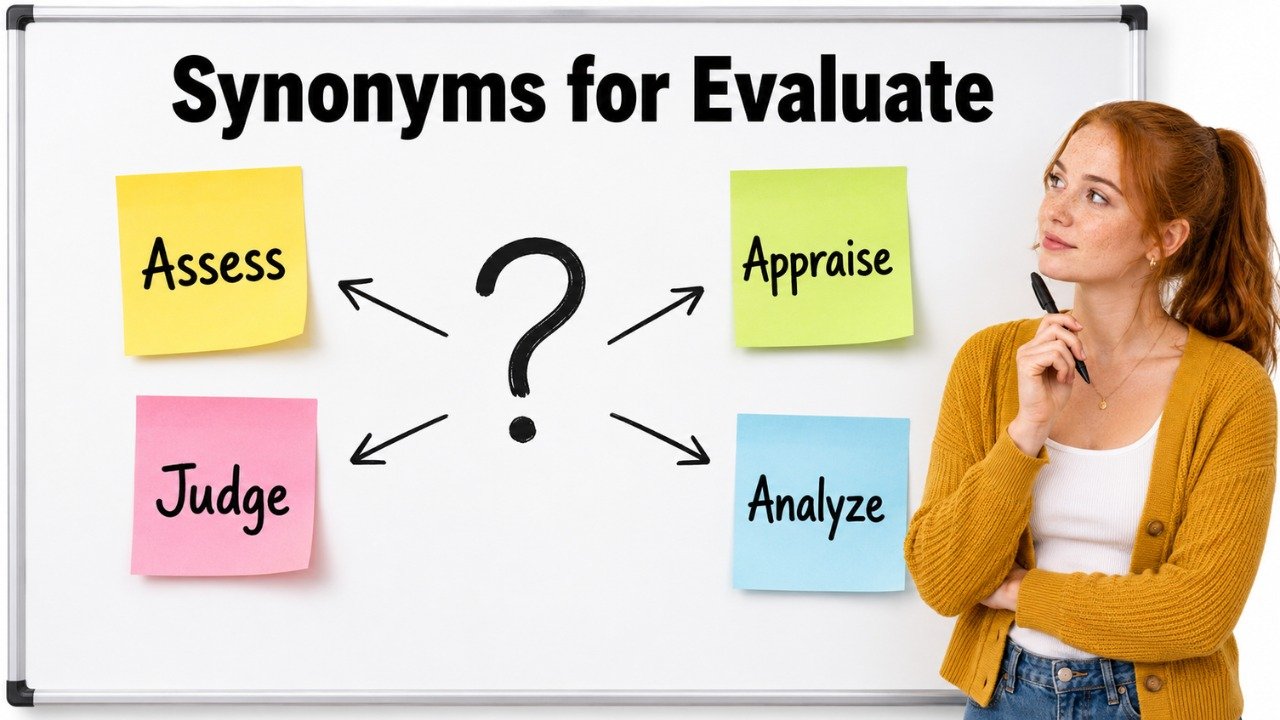
Quick Answer: The best synonyms for evaluate include assess, analyze, appraise, examine, review, judge, measure, estimate, rate, and test. Use assess as the strongest general alternative when determining quality, value, or performance. Choose analyze for detailed examination, appraise for value or professional performance, review for checking information, measure for results or progress, estimate for an approximate value, rate for assigning a level or score, and test for determining effectiveness or ability. The correct choice among synonyms for evaluate depends on the subject, purpose, criteria, and level of formality.
Pronunciation and Word Details
Word: Evaluate
Pronunciation: /ɪˈvæl.ju.eɪt/
Part of Speech: Verb
Meaning: To examine something carefully and determine its quality, value, importance, effectiveness, or condition.
US Pronunciation:
UK Pronunciation:
What Does “Evaluate” Mean?
Evaluate means to examine something carefully before forming a judgment about its quality, value, effectiveness, importance, or suitability.
Evaluate is a verb. It describes a process that usually involves gathering information, applying standards, comparing results, and reaching a conclusion. A teacher may evaluate a student’s work, a manager may evaluate employee performance, and a buyer may evaluate several products before making a decision.
The word can also refer to measuring results. A research team may evaluate whether a method worked, while a doctor may evaluate a person’s symptoms before deciding what further examination is needed.
In mathematics, evaluate can mean finding the value of an expression. In everyday decision making, it often means considering the strengths, weaknesses, risks, and benefits of an option.
The sentence context determines whether evaluate is best replaced by assess, analyze, review, appraise, estimate, measure, test, or another related word.
Meaning, Tone, and Context of “Evaluate”
Evaluate has a neutral to formal tone. It is commonly used in academic writing, professional reports, research, education, finance, health discussions, hiring, quality control, project management, and technical communication.
In academic and research contexts, evaluate often means examining evidence and forming a reasoned judgment. Students may be asked to evaluate an argument rather than simply describe it. This requires them to consider its strengths, weaknesses, accuracy, and significance.
In professional settings, evaluate may refer to performance, risk, progress, efficiency, cost, or suitability. Managers evaluate results, hiring teams evaluate applicants, and organizations evaluate proposed plans.
In technical contexts, evaluate can mean testing whether a system, process, or method performs as expected. Here, words such as test, validate, measure, and benchmark may be more precise.
In casual conversation, evaluate can sound slightly formal. People are more likely to say check, look over, think about, or size up when discussing simple everyday choices.
Evaluate is not usually emotional. It suggests careful, objective, and evidence based judgment, although personal opinions may sometimes affect the final conclusion.
When and How to Use “Evaluate”
For Performance: Use evaluate when examining how well a person, team, system, or process has performed.
Example: The supervisor will evaluate each employee’s performance at the end of the month.
For Quality: Use evaluate when deciding whether something meets a required standard.
Example: The inspector evaluated the quality of the finished materials.
For Evidence: Use evaluate when studying information before accepting or rejecting a claim.
Example: Readers should evaluate the evidence before reaching a conclusion.
For Options: Use evaluate when comparing several choices before making a decision.
Example: We need to evaluate all available options before selecting a supplier.
For Risk: Use evaluate when considering possible danger, loss, or uncertainty.
Example: The committee evaluated the financial risks of the proposal.
For Effectiveness: Use evaluate when determining whether a method, plan, or treatment achieved its purpose.
Example: The researchers evaluated the effectiveness of the training program.
For Value: Use evaluate when determining the financial, practical, or overall worth of something.
Example: An expert was hired to evaluate the property.
For Progress: Use evaluate when measuring improvement over a period of time.
Example: The teacher evaluated the student’s progress throughout the term.
For Suitability: Use evaluate when deciding whether a person, product, or plan is appropriate for a particular purpose.
Example: The hiring panel will evaluate each applicant’s suitability for the role.
For Mathematical Value: Use evaluate when calculating the result of a mathematical expression.
Example: Evaluate the expression after replacing the variable with the given number.
Best Synonyms for Evaluate
Assess
Meaning: To determine the quality, condition, value, ability, or importance of something.
Example: The team will assess the damage before beginning repairs.
Analyze
Meaning: To examine information or a subject in detail by studying its parts.
Example: Researchers analyzed the data to identify important patterns.
Appraise
Meaning: To judge the quality, value, or performance of someone or something.
Example: A specialist appraised the painting before the sale.
Examine
Meaning: To inspect or study something carefully to understand its condition or features.
Example: The technician examined the equipment for signs of damage.
Review
Meaning: To look at something again in order to check, improve, or judge it.
Example: The manager reviewed the proposal before approving it.
Judge
Meaning: To form an opinion or decision after considering available information.
Example: It is difficult to judge the plan without seeing the full cost estimate.
Measure
Meaning: To determine the amount, degree, level, or effectiveness of something.
Example: The survey was designed to measure customer satisfaction.
Estimate
Meaning: To form an approximate judgment about cost, size, value, or quantity.
Example: The builder estimated the total cost of the repairs.
Rate
Meaning: To assign a level, score, or position according to quality or performance.
Example: Participants rated the service on a scale from one to ten.
Test
Meaning: To examine ability, quality, performance, or effectiveness through practical use.
Example: Engineers tested the system under difficult conditions.
50 Synonyms for Evaluate with Short Meanings
- Assess: Determine quality, condition, value, or importance.
- Appraise: Judge value, quality, or performance professionally.
- Analyze: Examine something closely by studying its parts.
- Examine: Inspect carefully to understand condition or meaning.
- Review: Look over something to check or judge it.
- Judge: Form an opinion after considering information.
- Measure: Determine the amount, degree, or effectiveness.
- Estimate: Form an approximate judgment of value or quantity.
- Rate: Assign a score, level, or position.
- Test: Check ability, quality, or effectiveness through use.
- Inspect: Examine closely for quality, condition, or problems.
- Audit: Conduct a formal examination of records or processes.
- Study: Examine a subject carefully to gain understanding.
- Consider: Think carefully about relevant facts or options.
- Weigh: Compare advantages, disadvantages, risks, or evidence.
- Gauge: Estimate the amount, level, feeling, or effect.
- Determine: Reach a conclusion after examination.
- Calculate: Find a numerical value or result.
- Value: Decide the financial or practical worth of something.
- Rank: Place items in order according to quality or importance.
- Score: Assign points according to established criteria.
- Grade: Judge work or performance by assigning a level.
- Check: Examine something to confirm quality or correctness.
- Verify: Confirm that information or results are accurate.
- Investigate: Examine facts carefully to discover the truth.
- Scrutinize: Examine something with close and critical attention.
- Compare: Examine similarities and differences between options.
- Monitor: Observe something regularly to track change or progress.
- Observe: Watch or study something carefully.
- Diagnose: Identify a condition or problem through examination.
- Interpret: Explain the meaning or significance of information.
- Validate: Confirm that something is accurate, useful, or effective.
- Benchmark: Compare performance against a standard.
- Critique: Analyze strengths and weaknesses carefully.
- Survey: Examine the general condition or features of something.
- Explore: Investigate a subject, idea, or possibility in detail.
- Probe: Investigate deeply to discover important information.
- Screen: Examine people or items to determine suitability.
- Classify: Place something into a category after examination.
- Quantify: Express or measure something in numerical terms.
- Ascertain: Discover or determine something with certainty.
- Vet: Examine someone or something carefully before approval.
- Assay: Test or analyze the quality or composition of a substance.
- Size Up: Form a quick judgment about someone or something.
- Look Over: Examine something briefly or informally.
- Go Over: Review information, work, or details carefully.
- Take Stock Of: Examine a situation before deciding what to do.
- Deliberate On: Consider a question or option carefully.
- Review Critically: Examine strengths, weaknesses, and accuracy.
- Form a Judgment About: Reach an opinion after considering evidence.
Read Also:
Synonyms for Present
Synonyms for Evaluate by Context
When Evaluate Means Assess Quality or Performance
When evaluate refers to determining quality, ability, condition, or performance, useful synonyms include assess, appraise, rate, grade, score, rank, and judge.
Assess is the strongest general choice. It works well for performance, risk, needs, ability, and condition. Appraise often refers to professional judgments about value or workplace performance. Rate and score involve applying a scale or point system.
Evaluate: The manager will evaluate the employee’s performance.
Assess: The manager will assess the employee’s performance.
Evaluate: Judges evaluated each entry according to five criteria.
Scored: Judges scored each entry according to five criteria.
When Evaluate Means Analyze Information
When evaluate involves detailed examination of facts, evidence, arguments, or data, choose analyze, examine, study, investigate, interpret, scrutinize, or critique.
Analyze focuses on breaking a subject into parts. Examine is broader and means looking closely. Scrutinize suggests especially careful attention. Critique requires identifying strengths and weaknesses rather than only explaining information.
Evaluate: Students must evaluate the author’s argument.
Critique: Students must critique the author’s argument.
Evaluate: The researchers evaluated the survey results.
Analyzed: The researchers analyzed the survey results.
When Evaluate Means Estimate Value
When evaluate involves determining monetary or practical value, the most useful alternatives are appraise, value, estimate, calculate, assess, and gauge.
Appraise is common for property, artwork, jewelry, and other valuable items. Estimate provides an approximate value rather than a final professional judgment. Calculate is suitable when the value is based on numbers.
Evaluate: An expert evaluated the antique table.
Appraised: An expert appraised the antique table.
Evaluate: We need to evaluate the likely cost of the repairs.
Estimate: We need to estimate the likely cost of the repairs.
When Evaluate Means Test Effectiveness
When evaluate refers to discovering whether something works, use test, validate, measure, benchmark, monitor, verify, or audit.
Test involves practical examination. Validate confirms that a method or result is accurate or suitable. Benchmark compares performance with an established standard. Monitor involves regular observation over time.
Evaluate: Engineers evaluated the new safety system.
Tested: Engineers tested the new safety system.
Evaluate: The organization evaluated progress each month.
Monitored: The organization monitored progress each month.
When Evaluate Means Consider Options
When evaluate means thinking carefully before making a choice, use consider, weigh, compare, review, deliberate on, take stock of, or judge.
Consider is a natural general choice. Weigh emphasizes advantages and disadvantages. Compare focuses on similarities and differences. Deliberate on suggests careful thought before an important decision.
Evaluate: We should evaluate each option before deciding.
Consider: We should consider each option before deciding.
Evaluate: The committee evaluated the benefits and risks.
Weighed: The committee weighed the benefits and risks.
When Evaluate Means Check Suitability
When evaluating whether a person, product, or proposal is appropriate, use assess, screen, vet, review, test, or inspect.
Screen often describes an early selection process. Vet suggests detailed checking before approval. Assess is suitable for both people and plans.
Evaluate: The team will evaluate all applicants.
Screen: The team will screen all applicants.
Evaluate: Experts evaluated the proposal before approving it.
Vetted: Experts vetted the proposal before approving it.
Another Word for Evaluate
The best single replacement for evaluate is assess. Both words mean examining something carefully before reaching a conclusion about its quality, value, condition, effectiveness, or importance.
However, the best alternative depends on what is being evaluated. Analyze is better for detailed information, appraise for financial value, review for documents or plans, test for effectiveness, and rate for assigning a score.
Original: The manager will evaluate the team’s performance.
Better Option: The manager will assess the team’s performance.
Original: Scientists evaluated the collected data.
Better Option: Scientists analyzed the collected data.
Original: A specialist evaluated the value of the property.
Better Option: A specialist appraised the property.
Original: Engineers evaluated whether the device could operate safely.
Better Option: Engineers tested whether the device could operate safely.
When Not to Use “Evaluate”
Avoid evaluate when the sentence requires a more precise description of the action. The word can refer to assessing quality, analyzing evidence, estimating value, testing effectiveness, or considering options. A specific verb often tells readers exactly what happened.
Weak: The technician evaluated the machine.
Better: The technician inspected the machine for electrical faults.
The weak sentence does not explain whether the technician inspected, tested, measured, or repaired the machine.
Evaluate can also sound too formal in casual conversation.
Weak: I need to evaluate these shoes before buying them.
Better: I need to look over these shoes before buying them.
Do not repeat evaluate several times in one paragraph when different actions are involved.
Weak: The team evaluated the data, evaluated the risks, and evaluated the final proposal.
Better: The team analyzed the data, assessed the risks, and reviewed the final proposal.
Avoid evaluate when you only mean describe or summarize. Evaluation requires judgment based on evidence, standards, or criteria.
Weak: The report evaluates what happened during the event.
Better: The report describes what happened during the event.
Use estimate rather than evaluate when the result is only an approximate number.
Weak: We evaluated that the repairs would cost five thousand dollars.
Better: We estimated that the repairs would cost five thousand dollars.
Words Commonly Confused With Evaluate
Evaluate vs Assess: Both words involve forming a judgment. Evaluate often suggests a detailed process based on criteria, while assess can refer to a quicker or broader judgment of quality, condition, risk, or ability.
Evaluate vs Analyze: Evaluate involves deciding how good, effective, valuable, or important something is. Analyze involves studying its parts, causes, patterns, or structure. Analysis may provide the information needed for evaluation.
Evaluate vs Review: Evaluate emphasizes judgment. Review means examining something again to check, understand, improve, or approve it. A person may review a report before evaluating its quality.
Evaluate vs Appraise: Evaluate is broad and can apply to results, performance, plans, and evidence. Appraise often refers to determining financial value or formally judging employee performance.
Evaluate vs Estimate: Evaluate involves careful judgment using evidence or criteria. Estimate provides an approximate number, cost, amount, or value when exact information is unavailable.
Evaluate vs Examine: Examine means looking at something carefully. Evaluate goes further by forming a judgment based on what was discovered during the examination.
Evaluate vs Judge: Judge focuses on reaching an opinion or decision. Evaluate usually suggests a more systematic process involving evidence, standards, measurement, or comparison.
Evaluate vs Measure: Measure determines amount, size, degree, or progress. Evaluate interprets measurements and other information to reach a broader conclusion.
Evaluate vs Test: Test means checking performance, ability, or effectiveness under particular conditions. Evaluate may include testing, but it also considers the meaning and quality of the results.
Which Synonym Should You Choose?
Choose assess as a strong general alternative in formal writing, reports, emails, and professional discussions.
Choose analyze when studying data, arguments, causes, patterns, evidence, or detailed information.
Choose examine when carefully inspecting a document, object, condition, issue, or subject.
Choose appraise when determining the financial value of property, artwork, jewelry, or another valuable item.
Choose review when checking a plan, report, application, document, or previous decision.
Choose measure when focusing on progress, quantity, effectiveness, growth, ability, or results.
Choose estimate when calculating an approximate cost, value, duration, size, or amount.
Choose rate when assigning a quality level, score, or position on a scale.
Choose score when points are given according to established rules or criteria.
Choose grade when judging academic work, assignments, tests, or performance levels.
Choose test when checking whether a method, device, system, or person performs as expected.
Choose validate when confirming that a process, result, model, or method is reliable and suitable.
Choose benchmark when comparing results against an accepted standard or competitor.
Choose audit for formal checks of financial records, systems, procedures, or compliance.
Choose inspect when looking for faults, damage, defects, or safety problems.
Choose screen when conducting an early check of candidates, applications, or health concerns.
Choose vet when conducting detailed checks before approving a person, proposal, or provider.
Choose consider in natural conversation when thinking carefully about a choice.
Choose weigh when comparing advantages, disadvantages, risks, and benefits.
Choose size up in casual speech when forming a quick judgment about a person or situation.
Real Life Examples of “Evaluate” in Sentences
Original: The teacher will evaluate each student’s written work.
Better Option: The teacher will grade each student’s written work.
Original: The manager evaluated the team’s performance.
Better Option: The manager assessed the team’s performance.
Original: Researchers evaluated the results of the experiment.
Better Option: Researchers analyzed the results of the experiment.
Original: A professional evaluated the value of the house.
Better Option: A professional appraised the house.
Original: The committee evaluated every available proposal.
Better Option: The committee reviewed every available proposal.
Original: Engineers evaluated the strength of the material.
Better Option: Engineers tested the strength of the material.
Original: We evaluated the advantages and disadvantages of moving.
Better Option: We weighed the advantages and disadvantages of moving.
Original: The organization evaluated its progress every month.
Better Option: The organization measured its progress every month.
Original: The hiring team evaluated more than one hundred applications.
Better Option: The hiring team screened more than one hundred applications.
Original: Inspectors evaluated whether the building met safety requirements.
Better Option: Inspectors verified whether the building met safety requirements.
Synonym Groups and Usage Differences
Assessment Group
This group includes assess, judge, rate, score, grade, rank, and appraise. These words involve forming a judgment about quality, ability, value, or performance.
Assess is broad and formal. Rate and score use a scale or point system. Grade is common in education. Appraise often involves value or professional performance.
Example: The supervisor assessed each employee according to the same criteria.
Analysis Group
This group includes analyze, examine, study, investigate, scrutinize, interpret, critique, probe, and explore.
These words focus on careful examination. Analyze studies parts and relationships. Scrutinize means examining something with intense attention. Critique identifies both strengths and weaknesses.
Example: The researcher analyzed the responses before drawing a conclusion.
Measurement Group
This group includes measure, quantify, calculate, estimate, gauge, benchmark, and determine.
These alternatives are useful when evaluation involves numbers, levels, standards, or approximate values. Quantify expresses something numerically, while benchmark compares results with a standard.
Example: The study measured how quickly participants completed the task.
Inspection Group
This group includes inspect, check, verify, audit, monitor, observe, test, and validate.
These words describe checking condition, accuracy, compliance, or effectiveness. Inspect is often physical, audit is formal, and monitor involves observation over time.
Example: A technician inspected the equipment before it was used.
Decision Group
This group includes consider, weigh, compare, deliberate on, review, take stock of, and form a judgment about.
These alternatives are useful when evaluation supports a choice or decision. Weigh focuses on benefits and risks, while compare examines differences between available options.
Example: The family weighed every option before making its decision.
Value Group
This group includes appraise, value, estimate, calculate, gauge, and assess.
These words are useful when determining financial, practical, emotional, or general worth. Appraise usually suggests professional expertise, while estimate gives an approximate amount.
Example: An independent expert appraised the artwork.
Selection Group
This group includes screen, vet, classify, rank, score, and review.
These alternatives help describe the examination of candidates, applications, proposals, or products before selection. Screen is often an initial step, while vet suggests deeper checking.
Example: The panel screened the applications before selecting interview candidates.
Antonyms of Evaluate
The opposite of evaluate depends on whether the word refers to examining, measuring, checking, or forming a judgment.
Ignore: Refuse to consider or examine something.
Overlook: Fail to notice or consider an important detail.
Disregard: Pay no attention to available facts or evidence.
Neglect: Fail to give something the attention it requires.
Assume: Accept something as true without proper examination.
Guess: Reach an answer without enough evidence or calculation.
Accept: Approve something without further investigation or judgment.
Dismiss: Reject something without fully considering its value.
Avoid: Stay away from examining or dealing with something.
Misjudge: Form an incorrect opinion about quality, value, or ability.
Misinterpret: Understand information or evidence incorrectly.
Approve Automatically: Accept something without checking it against standards.
Comparison: Evaluate vs Related Words
Evaluate vs Assess
Evaluate and assess both involve forming a judgment. Evaluate often suggests a complete process using criteria, evidence, and conclusions. Assess may describe a broader or quicker judgment about condition, ability, risk, or need.
Example With Evaluate: The committee evaluated the program’s long term effectiveness.
Example With Assess: The committee assessed the immediate risks.
Evaluate vs Analyze
Evaluate determines quality, value, effectiveness, or importance. Analyze examines structure, causes, patterns, evidence, or individual parts.
Example With Evaluate: The panel evaluated whether the plan was practical.
Example With Analyze: The panel analyzed the financial data within the plan.
Evaluate vs Appraise
Evaluate applies to many subjects, including performance, evidence, systems, and plans. Appraise is especially common when determining monetary value or formally reviewing employee performance.
Example With Evaluate: The director evaluated the success of the project.
Example With Appraise: The expert appraised the property at a high value.
Evaluate vs Review
Evaluate emphasizes making a judgment. Review focuses on examining something to check it, understand it, improve it, or consider it again.
Example With Evaluate: The board evaluated the proposal’s overall value.
Example With Review: The board reviewed the proposal before the meeting.
Evaluate vs Measure
Evaluate forms a broad conclusion using evidence and criteria. Measure determines the amount, degree, level, size, or progress of something.
Example With Evaluate: The researchers evaluated the success of the campaign.
Example With Measure: The researchers measured the increase in participation.
Evaluate vs Estimate
Evaluate involves a reasoned judgment about quality or effectiveness. Estimate gives an approximate number, value, cost, size, or duration.
Example With Evaluate: The manager evaluated whether the plan was affordable.
Example With Estimate: The manager estimated the total cost of the plan.
Evaluate vs Judge
Evaluate usually suggests an organized and objective process. Judge can describe any decision or opinion, including one based on personal impressions.
Example With Evaluate: The panel evaluated every entry using written criteria.
Example With Judge: It was difficult to judge his reaction from his expression.
Evaluate vs Test
Evaluate involves interpreting the overall quality or effectiveness of something. Test places something under specific conditions to discover how well it works.
Example With Evaluate: The team evaluated the new system’s overall performance.
Example With Test: The team tested the system during a power failure.
Common Phrases and Expressions With “Evaluate”
Evaluate Performance: Judge how well a person, team, or system has worked.
Evaluate Results: Examine outcomes and decide what they mean.
Evaluate Evidence: Consider whether information is reliable and convincing.
Evaluate Options: Compare available choices before making a decision.
Evaluate Effectiveness: Determine whether something achieved its intended purpose.
Evaluate Risk: Examine the likelihood and seriousness of possible problems.
Evaluate Quality: Determine whether something meets expected standards.
Evaluate Progress: Measure improvement or development over time.
Evaluate Suitability: Decide whether someone or something is appropriate for a purpose.
Evaluate Impact: Determine the effect or influence of an action or event.
Evaluate a Proposal: Examine the strengths, costs, risks, and benefits of a suggested plan.
Evaluate Critically: Examine a subject carefully and form a reasoned judgment.
Common Mistakes to Avoid
A common mistake is treating evaluate as a synonym for describe. Description explains what something is, while evaluation judges its quality, value, effectiveness, or importance.
Another mistake is confusing evaluate with analyze. Analysis examines parts, causes, patterns, and evidence. Evaluation uses that information to reach a conclusion.
Avoid using evaluate without explaining the criteria when the standard matters. A clear sentence should show what is being judged.
Vague: The panel evaluated the project.
Clear: The panel evaluated the project according to cost, safety, and environmental impact.
Do not add about immediately after evaluate when the verb already takes a direct object.
Incorrect: We evaluated about the possible risks.
Correct: We evaluated the possible risks.
Use the noun evaluation when referring to the process or final judgment.
Incorrect: The manager completed an evaluate of the employee.
Correct: The manager completed an evaluation of the employee.
Avoid choosing appraise when the sentence is about detailed data analysis. Appraise is more suitable for value, quality, or formal performance judgments.
Do not use estimate when an exact assessment has been completed. Estimate suggests that the result is approximate.
Avoid unnecessary repetition by choosing more precise verbs for different actions.
Repetitive: We evaluated the records, evaluated the costs, and evaluated the equipment.
Improved: We audited the records, calculated the costs, and inspected the equipment.
Remember that a person evaluates something. The object being examined usually appears directly after the verb.
Correct: The teacher evaluated the essays.
Correct: The committee evaluated whether the plan was practical.
Conclusion
Choosing accurate synonyms for evaluate makes writing clearer and more specific. Assess is the strongest general replacement, while analyze suits detailed information, appraise fits financial value, review works for documents and plans, and test describes practical checks. Use measure for progress, estimate for approximate amounts, rate for scores, and weigh when comparing choices. Before replacing evaluate, identify whether the sentence concerns quality, evidence, performance, value, risk, suitability, or effectiveness. That context will lead you to the most natural word.
FAQs About Synonyms for Evaluate
What Is the Best Synonym for Evaluate?
Assess is the best general synonym because it can describe judging quality, performance, condition, risk, value, or suitability.
What Is a Formal Synonym for Evaluate?
Assess, appraise, analyze, examine, review, scrutinize, and validate are suitable formal alternatives. The best choice depends on what is being examined.
What Is a Casual Synonym for Evaluate?
Check, look over, go over, think about, and size up are natural choices in casual conversation.
Are Evaluate and Assess the Same?
They are very similar. Evaluate often suggests a complete judgment based on criteria, while assess may describe a broader judgment of condition, ability, need, or risk.
Can Analyze Replace Evaluate?
Analyze can replace evaluate when the focus is detailed examination. It is less suitable when the sentence focuses on rating quality, value, effectiveness, or suitability.
What Is the Noun Form of Evaluate?
The noun form is evaluation. It refers to the process of examining something or the judgment produced by that process.
What Is the Opposite of Evaluate?
Possible opposites include ignore, overlook, disregard, neglect, assume, and guess. The best antonym depends on whether evaluate means examine, measure, or judge.
