
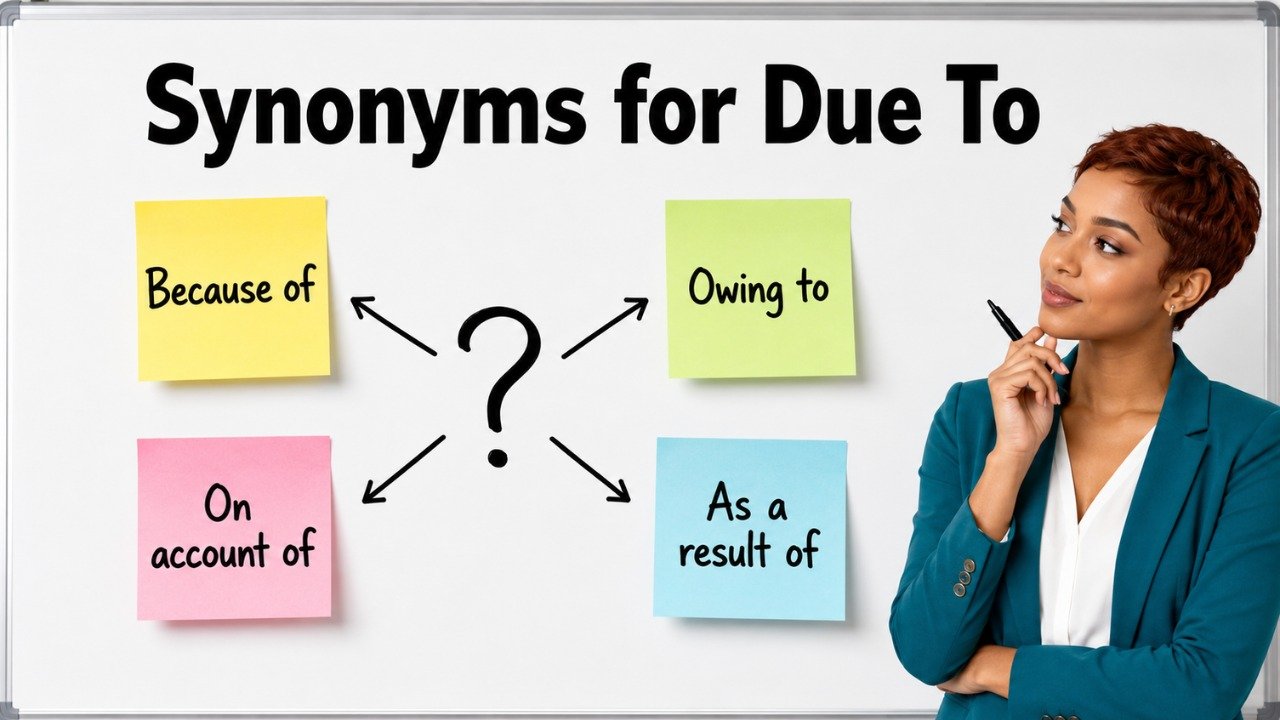
Quick Answer: The best synonyms for due to are because of, owing to, as a result of, on account of, caused by, resulting from, attributable to, thanks to, stemming from, and in light of. Use because of in everyday writing, owing to in formal explanations, as a result of when showing a clear consequence, attributable to in reports and analysis, thanks to for positive causes, and caused by when the direct source of a problem or event is known. These synonyms for due to help express reasons, causes, conditions, and results more clearly.
Pronunciation and Word Details
Word: Due to
Pronunciation: /ˈduː tuː/
Part of Speech: Prepositional phrase
Meaning: Because of a particular reason, cause, condition, or situation.
US Pronunciation:
UK Pronunciation:
What Does “Due To” Mean?
Due to means because of or caused by a particular reason, event, condition, or situation. It is commonly used as a prepositional phrase before a noun or noun phrase.
Example: The match was canceled due to heavy rain.
In this sentence, heavy rain is the reason the match was canceled.
Due to can explain negative causes, neutral conditions, and positive results. It frequently appears in formal writing, reports, announcements, academic discussions, instructions, and everyday communication.
The phrase often answers the question why something happened.
Example: The road was closed due to flooding.
It can also connect a result to its source.
Example: The improvement was due to regular practice.
In some sentences, due to follows a form of the verb be and means caused by.
Example: The delay was due to a technical problem.
In modern usage, due to is also widely used at the beginning or middle of a sentence to mean because of.
Example: Due to strong demand, more sessions were added.
Meaning, Tone, and Context of “Due To”
Due to usually has a neutral or slightly formal tone. It is common in professional messages, essays, reports, announcements, academic writing, news style writing, and official explanations.
In everyday conversation, because of often sounds more natural.
Formal: The event was postponed due to severe weather.
Conversational: The event was postponed because of the bad weather.
Due to can introduce both positive and negative reasons. However, thanks to is often a warmer choice when the result is clearly positive.
Neutral: The project succeeded due to careful planning.
Positive: The project succeeded thanks to careful planning.
In analytical writing, attributable to, resulting from, and stemming from may provide greater precision. These phrases show whether the writer is describing a direct cause, an observed relationship, or the origin of a continuing issue.
Due to is not emotional by itself. Its tone depends on the surrounding sentence. It can sound factual, polite, serious, technical, or administrative.
When and How to Use “Due To”
For a Direct Cause: Use due to when one event or condition directly causes another.
Example: The flight was delayed due to thick fog.
For a Changed Plan: Use it to explain why an event, schedule, or decision changed.
Example: The meeting was moved due to a scheduling conflict.
For a Problem: Use due to when identifying the source of an error, failure, delay, or difficulty.
Example: The system stopped working due to an electrical fault.
For a Positive Result: Use it when explaining what created a successful outcome.
Example: Sales increased due to better customer service.
For a Medical or Physical Cause: Use it to connect a condition or symptom with a possible cause.
Example: The discomfort may be due to muscle strain.
For an Academic Explanation: Use due to when describing the reason behind an event, pattern, result, or observation.
Example: Population growth slowed due to changing economic conditions.
For an Official Announcement: Use it to give a clear and concise reason for a closure, delay, or cancellation.
Example: The office will remain closed due to maintenance work.
For a Result Linked to Several Factors: Use it when the exact cause is broad or includes several related conditions.
Example: The decline was due to a combination of rising costs and lower demand.
Best Synonyms for Due To
Because Of
Synonym: Because of means as a result of a particular reason or cause.
Example: The picnic was canceled because of the rain.
Because of is the most natural and flexible replacement for due to. It works well in formal and casual communication.
Owing To
Synonym: Owing to means because of a particular situation or condition.
Example: The road is closed owing to construction work.
Owing to is slightly more formal than because of. It is useful in notices, reports, and professional explanations.
As a Result Of
Synonym: As a result of introduces the cause of a clear consequence.
Example: Several trees fell as a result of the storm.
This phrase emphasizes the connection between an earlier cause and a later result.
On Account Of
Synonym: On account of means because of a particular reason.
Example: The ceremony was moved indoors on account of the weather.
This expression is natural but slightly less common in highly formal writing.
Caused By
Synonym: Caused by identifies the direct source of an event, condition, or problem.
Example: The damage was caused by strong winds.
Caused by is best when the sentence focuses on direct causation rather than a general reason.
Resulting From
Synonym: Resulting from means developing or happening because of something else.
Example: The injury resulted from repeated strain.
This alternative is useful in analytical, medical, legal, and technical explanations.
Attributable To
Synonym: Attributable to means reasonably explained as being caused by a particular factor.
Example: The improvement was attributable to better training.
This phrase is formal and cautious. It is useful when evidence suggests a cause without claiming absolute certainty.
Thanks To
Synonym: Thanks to means because of something that produced a positive or welcome result.
Example: The work was completed early thanks to careful planning.
Thanks to is usually positive, although it can occasionally be used sarcastically.
Stemming From
Synonym: Stemming from means originating from a particular source, cause, or problem.
Example: The disagreement stemmed from a misunderstanding.
This expression is useful when describing the deeper origin of an issue.
In Light Of
Synonym: In light of means considering a fact, event, or situation when making a decision.
Example: The schedule was revised in light of the new information.
In light of is most appropriate when a condition influences a judgment, response, or decision.
50 Synonyms for Due To with Short Meanings
- Because Of: For the reason of something.
- Owing To: Because of a particular condition or event.
- As a Result Of: Happening as the consequence of something.
- On Account Of: Because of a stated reason.
- Caused By: Produced directly by something.
- Resulting From: Developing as a consequence of something.
- Attributable To: Reasonably explained as caused by something.
- Thanks To: Because of a positive or helpful cause.
- Stemming From: Originating from a particular source.
- Arising From: Beginning or developing from something.
- Originating From: Starting from a particular cause or source.
- Brought About By: Made to happen by something.
- Produced By: Created as the result of something.
- Triggered By: Started suddenly by a particular cause.
- Prompted By: Encouraged or caused by a situation.
- Driven By: Strongly influenced or caused by something.
- Created By: Made or produced through a particular cause.
- Generated By: Produced through an action, process, or condition.
- Induced By: Brought about or stimulated by something.
- Provoked By: Caused as a reaction to something.
- Sparked By: Started by a particular event or action.
- Connected With: Having a relationship with a cause or condition.
- Linked To: Associated with a particular reason or factor.
- Related To: Connected with a relevant condition or situation.
- Associated With: Regularly connected with a factor or outcome.
- Dependent On: Determined or controlled by something else.
- Based On: Resting on a particular reason, fact, or condition.
- In View Of: Considering a particular situation or fact.
- In Light Of: Considering information that affects a decision.
- Considering: Taking a condition or fact into account.
- Given: Considering a known fact or situation.
- By Reason Of: Because of a stated cause.
- By Virtue Of: Because of a quality, position, or condition.
- In Consequence Of: As a result of something.
- As a Consequence Of: Happening because of an earlier cause.
- For Reasons Of: Because of concerns or purposes involving something.
- On the Grounds Of: Because of an accepted reason or justification.
- In Response To: Happening as a reaction to something.
- Following: Happening after and often because of an event.
- After: Occurring later than an event that may have caused it.
- Through: Because of the action or influence of something.
- From: Showing the source or cause of a condition.
- Because: Introducing a clause that explains a reason.
- Since: Introducing a known or accepted reason.
- As: Introducing a reason in a clause.
- For: Giving a reason in formal or literary wording.
- Given That: Considering that a stated fact is true.
- Considering That: Taking a fact or situation into account.
- Due to the Fact That: Because a particular statement is true.
- In Recognition Of: Because a fact, contribution, or condition is acknowledged.
Read Also:
Synonyms for Lastly

Synonyms for Due To by Context
When Due To Means Because Of
Because of is the strongest general replacement when a sentence simply explains why something happened.
Due To: The class was canceled due to bad weather.
Because Of: The class was canceled because of bad weather.
Owing to and on account of can perform the same function.
Owing To: The delivery was delayed owing to traffic.
On Account Of: The event was moved indoors on account of rain.
Because of sounds natural in almost every context, while owing to sounds more formal.
When Due To Shows a Direct Cause
Use caused by, resulting from, produced by, or triggered by when the relationship between cause and result is direct.
Caused By: The power failure was caused by damaged equipment.
Resulting From: The pain resulted from repeated pressure on the joint.
Produced By: The sound was produced by moving air.
Triggered By: The alarm was triggered by smoke.
These alternatives are often more precise than due to in scientific, medical, technical, and analytical writing.
When Due To Describes the Origin of a Problem
Use stemming from, arising from, or originating from when explaining where a problem, disagreement, or condition began.
Stemming From: The confusion stemmed from unclear instructions.
Arising From: The dispute arose from a misunderstanding.
Originating From: The unusual smell originated from a damaged pipe.
These expressions emphasize the source or beginning of the issue rather than only its immediate cause.
When Due To Explains a Positive Result
Thanks to is usually the clearest alternative when the cause created a helpful or welcome outcome.
Thanks To: The team met its goal thanks to careful preparation.
Due To: The team met its goal due to careful preparation.
Both sentences are correct, but thanks to adds a positive and appreciative tone.
Other useful choices include supported by and made possible by.
Made Possible By: The improvement was made possible by additional training.
Supported By: The progress was supported by regular feedback.
When Due To Supports a Formal Explanation
Use owing to, attributable to, by reason of, or in consequence of in formal reports, notices, and analytical writing.
Owing To: Production slowed owing to equipment failure.
Attributable To: The increase was attributable to stronger demand.
By Reason Of: Access was restricted by reason of safety concerns.
In Consequence Of: Several changes were introduced in consequence of the review.
Attributable to is useful when the writer wants to avoid claiming that one factor was certainly the only cause.
When Due To Influences a Decision
Use in light of, in view of, considering, or given when a fact or condition affects a decision.
In Light Of: The policy was revised in light of recent findings.
In View Of: The event was postponed in view of the weather warning.
Considering: Considering the limited time, the shorter option is more practical.
Given: Given the current conditions, travel should be avoided.
These phrases express consideration rather than direct physical causation.
When Due To Introduces a Clause
Due to normally comes before a noun or noun phrase. When the reason is expressed as a complete clause, use because, since, as, given that, or considering that.
Because: The meeting ended early because several members were absent.
Since: Since the room is unavailable, the session will take place outside.
As: As the deadline is close, the team must act quickly.
Given That: Given that demand is increasing, more staff may be required.
These choices are grammatically natural before a subject and verb.
Another Word for Due To
Because of is the best general replacement for due to. It is clear, natural, and suitable for formal and casual writing. However, the strongest alternative depends on whether the sentence describes a cause, result, decision, positive outcome, or developing problem.
Original: The game was canceled due to heavy rain.
Better Option: The game was canceled because of heavy rain.
Original: The error occurred due to a damaged cable.
Better Option: The error was caused by a damaged cable.
Original: The project succeeded due to strong teamwork.
Better Option: The project succeeded thanks to strong teamwork.
Original: The schedule changed due to new safety information.
Better Option: The schedule changed in light of new safety information.
When Not to Use “Due To”
Do not use due to before a full clause containing both a subject and a verb unless the sentence is carefully restructured. Because is usually more natural.
Weak: The event was canceled due to the weather was dangerous.
Better: The event was canceled because the weather was dangerous.
Avoid due to when a more precise phrase can clearly show the type of relationship.
Weak: The machine stopped due to a broken wire.
Better: The machine stopped because of a broken wire.
More Precise: The failure was caused by a broken wire.
Do not use due to repeatedly in the same paragraph. Repetition can make formal writing sound mechanical.
Weak: The delay was due to rain. The closure was due to flooding. The cancellation was due to unsafe roads.
Better: The delay occurred because of rain. Flooding forced the building to close, while unsafe roads led to the cancellation.
Avoid thanks to when the cause is negative unless the sentence is intentionally sarcastic.
Weak: The road closed thanks to a serious accident.
Better: The road closed because of a serious accident.
Do not use owing to as a forced replacement in relaxed conversation when because of sounds more natural.
Weak: We stayed home owing to the rain.
Better: We stayed home because of the rain.
Avoid attributable to when the evidence does not support a reasonable connection.
Weak: The sales decline was attributable to the new design, although no evidence was available.
Better: The reason for the sales decline remains unclear.
Do not use due to when the intended meaning is expected or scheduled.
Weak: The train is due to bad weather.
Better: The train is delayed because of bad weather.
Different Meaning: The train is due to arrive at noon.
Words Commonly Confused With Due To
Due To vs Because Of: Both introduce a reason. Because of is flexible and natural in most sentences. Due to often sounds more formal and traditionally follows a form of the verb be.
Due To vs Because: Due to comes before a noun or noun phrase, while because introduces a clause with a subject and verb.
Example With Due To: The match was canceled due to rain.
Example With Because: The match was canceled because it was raining.
Due To vs Owing To: Both mean because of. Owing to is slightly more formal and often appears in notices, reports, and announcements.
Due To vs Caused By: Due to gives a reason, while caused by more directly identifies the source that produced an event or condition.
Due To vs Thanks To: Due to is neutral. Thanks to usually suggests that the cause had a positive or welcome effect.
Due To vs Attributable To: Due to may present a cause directly. Attributable to sounds more analytical and may suggest that available evidence supports the connection.
Due To vs Resulting From: Due to introduces the reason for something. Resulting from emphasizes that one condition developed as a consequence of another.
Due To vs In Light Of: Due to shows causation. In light of shows that information or circumstances influenced a decision or judgment.
Due To vs Since: Due to is followed by a noun phrase. Since can introduce a clause explaining a reason, but it may also refer to time.
Which Synonym Should You Choose?
Choose because of for clear everyday writing, conversation, general explanations, and most routine messages.
Choose owing to for formal notices, official statements, reports, and professional explanations.
Choose as a result of when you want to emphasize a clear consequence.
Choose caused by when identifying the direct source of damage, failure, illness, error, or change.
Choose resulting from when describing a condition that developed from an earlier event or process.
Choose attributable to in research, reports, analysis, and cautious formal writing when evidence supports a likely cause.
Choose thanks to for positive outcomes, successful results, helpful actions, and expressions of appreciation.
Choose stemming from when explaining the deeper origin of a problem, conflict, or misunderstanding.
Choose triggered by when an event, reaction, symptom, or process begins suddenly because of a specific cause.
Choose in light of when new information influences a decision, policy, schedule, or judgment.
Choose because when the reason contains a subject and a verb.
Choose given that or considering that when a known fact must be considered before reaching a conclusion.
Choose on account of for a natural alternative that works well in general writing and speech.
Choose by virtue of when a result exists because of a legal position, personal quality, official status, or special condition.
Real Life Examples of “Due To” in Sentences
Original: The outdoor event was canceled due to rain.
Better Option: The outdoor event was canceled because of rain.
Original: The computer stopped working due to damaged wiring.
Better Option: The computer failure was caused by damaged wiring.
Original: The team improved due to regular practice.
Better Option: The team improved thanks to regular practice.
Original: The policy was changed due to new information.
Better Option: The policy was changed in light of new information.
Original: The decline was due to weaker demand.
Better Option: The decline was attributable to weaker demand.
Original: The disagreement occurred due to unclear instructions.
Better Option: The disagreement stemmed from unclear instructions.
Original: The roads became unsafe due to heavy snowfall.
Better Option: The roads became unsafe as a result of heavy snowfall.
Original: The alarm sounded due to smoke in the hallway.
Better Option: The alarm was triggered by smoke in the hallway.
Original: The meeting ended early due to several members being absent.
Better Option: The meeting ended early because several members were absent.
Original: The building was closed due to safety concerns.
Better Option: The building was closed on account of safety concerns.
Synonym Groups and Usage Differences
General Cause Group
Because of, owing to, on account of, and by reason of explain why something happened.
Example: The journey was delayed because of heavy traffic.
Because of is the most natural choice. Owing to and by reason of have a more formal tone.
Direct Cause Group
Caused by, produced by, induced by, and triggered by identify a more direct causal relationship.
Example: The reaction was triggered by sudden exposure to heat.
These alternatives are useful when the writer knows what directly produced the event or condition.
Result and Consequence Group
As a result of, as a consequence of, in consequence of, and resulting from connect an outcome to an earlier cause.
Example: Several changes were made as a result of the investigation.
These phrases emphasize the consequence more strongly than due to.
Origin Group
Stemming from, arising from, and originating from describe the source or beginning of a problem, idea, conflict, or condition.
Example: The confusion stemmed from incomplete instructions.
These expressions are especially useful when explaining deeper or continuing causes.
Positive Cause Group
Thanks to and made possible by connect a successful result with a helpful action, person, resource, or condition.
Example: The project finished early thanks to careful planning.
These alternatives add a positive meaning that due to does not always provide.
Evidence and Analysis Group
Attributable to, associated with, linked to, and related to describe relationships found through observation or analysis.
Example: The change may be attributable to improved training.
Attributable to suggests a likely cause. Associated with and linked to may describe a relationship without proving direct causation.
Decision and Consideration Group
In light of, in view of, considering, and given introduce facts that influence a decision or response.
Example: In light of the warning, the trip was postponed.
These phrases show that information was considered rather than acting as a direct physical cause.
Clause Based Reason Group
Because, since, as, given that, and considering that introduce complete clauses.
Example: The session was delayed because the speaker arrived late.
Use these alternatives when the reason contains a subject and a verb.
Antonyms of Due To
Due to expresses cause, connection, or influence. Its opposites depend on the intended meaning because there is no single direct antonym for every sentence.
Despite: Shows that something happened without being prevented by a condition.
In Spite Of: Indicates that a result occurred even though a difficulty existed.
Regardless Of: Shows that a factor did not influence the result.
Without: Indicates the absence of a cause, condition, or influence.
Unrelated To: Having no meaningful connection with something.
Independent Of: Not controlled or determined by another factor.
Unaffected By: Not changed or influenced by something.
In the Absence Of: Occurring when a factor or condition is missing.
Contrary To: Happening in opposition to an expectation, fact, or condition.
Notwithstanding: Despite a particular condition or difficulty.
Example With Due To: The event was canceled due to the storm.
Example With Despite: The event continued despite the storm.
Comparison: Due To vs Related Words
Due To vs Because Of
Due to and because of both explain reasons. Because of is generally more conversational and flexible. Due to is slightly more formal and often follows a form of the verb be.
Example With Due To: The closure was due to a safety concern.
Example With Because Of: The building closed because of a safety concern.
Due To vs Because
Due to comes before a noun phrase. Because comes before a complete clause.
Example With Due To: The game ended early due to rain.
Example With Because: The game ended early because it began to rain.
Due To vs Owing To
Both phrases mean because of. Owing to often sounds more formal and administrative.
Example With Due To: The service was interrupted due to maintenance.
Example With Owing To: The service was interrupted owing to maintenance.
Due To vs Caused By
Due to gives a reason, while caused by directly identifies what produced the result.
Example With Due To: The damage was due to high winds.
Example With Caused By: The damage was caused by high winds.
Due To vs Thanks To
Due to is neutral and can introduce positive or negative causes. Thanks to usually introduces a positive cause.
Example With Due To: Attendance improved due to better planning.
Example With Thanks To: Attendance improved thanks to better planning.
Due To vs Attributable To
Due to can state a cause directly. Attributable to is more cautious and analytical.
Example With Due To: The growth was due to increased demand.
Example With Attributable To: The growth was largely attributable to increased demand.
Due To vs Resulting From
Due to introduces a reason. Resulting from emphasizes that the subject developed from an earlier cause.
Example With Due To: The pain was due to repeated strain.
Example With Resulting From: The pain resulted from repeated strain.
Due To vs Stemming From
Due to provides a general cause. Stemming from focuses on the deeper origin of an issue.
Example With Due To: The conflict occurred due to poor communication.
Example With Stemming From: The conflict stemmed from poor communication.
Due To vs In Light Of
Due to shows why something happened. In light of shows why a decision was made after considering certain information.
Example With Due To: The event was canceled due to severe weather.
Example With In Light Of: The event was canceled in light of the severe weather warning.
Common Phrases and Expressions With Due To
Due To Weather: Because of rain, snow, wind, heat, or another weather condition.
Example: The match was postponed due to weather.
Due To Illness: Because someone is unwell.
Example: She was absent due to illness.
Due To Technical Difficulties: Because equipment, software, or a system failed to work correctly.
Example: The presentation ended early due to technical difficulties.
Due To Circumstances: Because of a situation that affects a plan or action.
Example: The schedule changed due to unforeseen circumstances.
Due To Demand: Because many people want or need something.
Example: More sessions were added due to high demand.
Due To Safety Concerns: Because a possible danger requires caution.
Example: The area was closed due to safety concerns.
Due To Maintenance: Because repairs, checks, or improvement work must be completed.
Example: The facility is unavailable due to maintenance.
Due To an Error: Because a mistake occurred.
Example: The total was incorrect due to an error.
Due To a Lack Of: Because something necessary is missing or insufficient.
Example: The plan failed due to a lack of preparation.
Due To the Fact That: Because a particular statement or condition is true.
Example: The meeting was delayed due to the fact that several members arrived late.
Common Mistakes to Avoid
A common mistake is placing due to directly before a complete clause.
Incorrect: The match was canceled due to it was raining.
Correct: The match was canceled because it was raining.
Correct: The match was canceled due to the rain.
Writers sometimes overuse due to in formal content. Repeating the phrase can make paragraphs sound dull and mechanical. Use because of, resulting from, caused by, or owing to when they express the meaning accurately.
Another mistake is replacing due to with thanks to in negative situations.
Unnatural: The office closed thanks to a serious electrical fault.
Natural: The office closed because of a serious electrical fault.
Do not assume that linked to and associated with prove direct causation. They may only describe a relationship.
Unclear: The condition was caused by the new routine.
Cautious: The condition was associated with the new routine.
Avoid the longer phrase due to the fact that when because gives the same meaning more clearly.
Wordy: The event was canceled due to the fact that the weather was unsafe.
Clear: The event was canceled because the weather was unsafe.
Make sure the replacement fits the grammar of the sentence. Because of is followed by a noun phrase, while because is followed by a clause.
Noun Phrase: The trip was delayed because of traffic.
Clause: The trip was delayed because traffic was heavy.
Use attributable to carefully. It should describe a reasonable causal explanation rather than an unsupported guess.
Conclusion
The most useful synonyms for due to include because of, owing to, as a result of, caused by, attributable to, thanks to, stemming from, and in light of. Choose because of for everyday reasons, caused by for direct causes, thanks to for positive outcomes, and attributable to for formal analysis. Use in light of when circumstances influence a decision and because when the reason is a complete clause. Selecting synonyms for due to by context makes explanations clearer, more natural, and more precise.
FAQs About Synonyms for Due To
What Is the Best Synonym for Due To?
Because of is the best general synonym for due to. It is natural, clear, and suitable for most formal and casual sentences.
Can Because Of Replace Due To?
Yes. Because of can replace due to in many sentences when it appears before a noun or noun phrase.
Example: The event was canceled because of rain.
Is Owing To the Same as Due To?
Owing to has nearly the same meaning as due to. It usually sounds slightly more formal and is common in notices and reports.
What Is a Formal Alternative to Due To?
Owing to, attributable to, as a result of, and by reason of are formal alternatives. The best choice depends on the type of cause being described.
What Is a Positive Synonym for Due To?
Thanks to is the best positive alternative. It shows that a helpful person, action, or condition produced a welcome result.
What Is the Difference Between Due To and Because?
Due to is followed by a noun phrase, while because introduces a complete clause.
Due To: The delay occurred due to traffic.
Because: The delay occurred because traffic was heavy.
Can Due To Begin a Sentence?
Yes. Due to can begin a sentence when it introduces the reason for the main statement.
Example: Due to severe weather, the event was postponed.
