
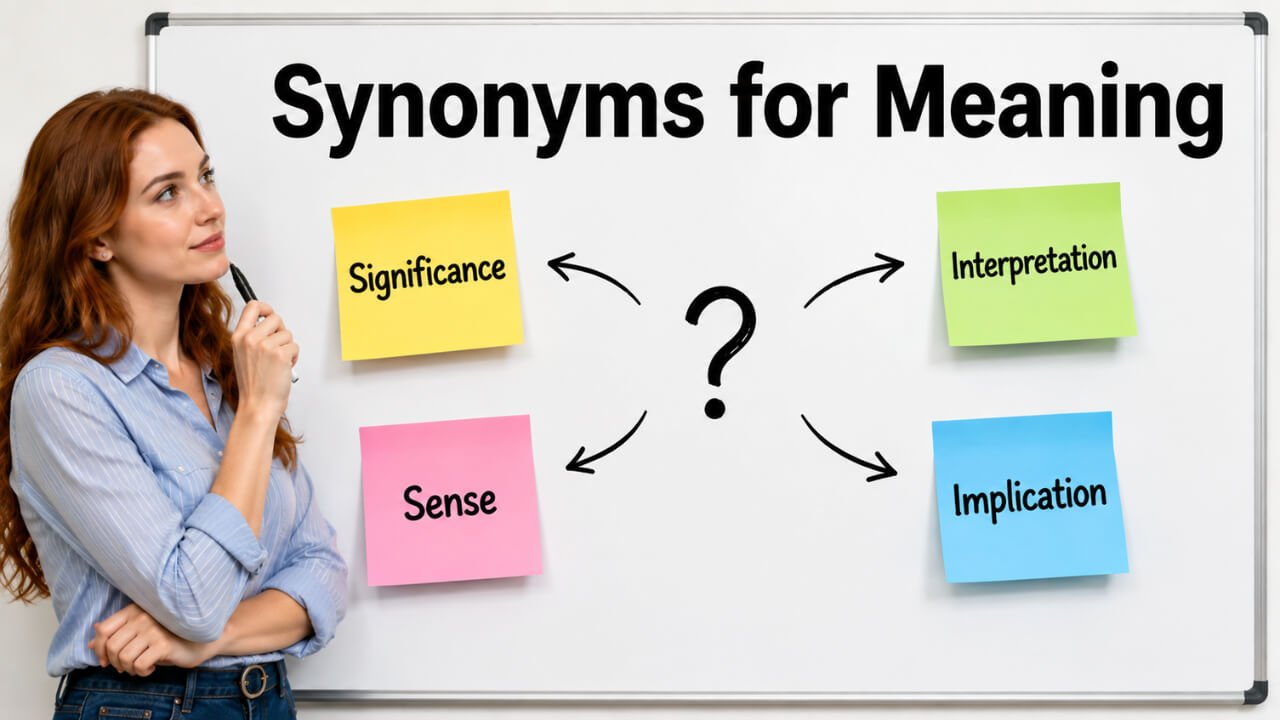
Quick Answer: The best synonyms for meaning include sense, definition, significance, purpose, intent, implication, interpretation, message, importance, and substance. Use definition when explaining what a word means, sense when discussing one particular use of a word, and significance when describing importance. Purpose is best for the reason something exists, while intent explains what a person wanted to communicate or achieve. Implication and connotation describe ideas that are suggested rather than stated directly. The best choice among synonyms for meaning depends on whether you are discussing language, purpose, importance, interpretation, or an implied message.
Pronunciation and Word Details
Word: Meaning
Pronunciation: /ˈmiːnɪŋ/
Part of Speech: Noun
Meaning: The idea, definition, purpose, importance, or message expressed by a word, action, event, or situation.
US Pronunciation:
UK Pronunciation:
What Does “Meaning” Mean?
Meaning is the idea, definition, message, purpose, or importance connected with a word, statement, action, event, or object. It is mainly used as a noun.
In vocabulary and grammar, meaning explains what a word or sentence communicates.
Example: The meaning of the word became clear from the sentence.
Meaning can also refer to the purpose behind an action.
Example: She questioned the meaning of his unexpected visit.
In another context, meaning describes importance or value.
Example: The family tradition has special meaning for them.
Meaning may also refer to an idea that is implied rather than directly expressed.
Example: His silence carried a deeper meaning.
The exact sense of meaning depends on context. It may refer to a dictionary definition, personal importance, intended purpose, hidden implication, or general message.
Meaning, Tone, and Context of “Meaning”
Meaning is a neutral and widely used word. It appears naturally in formal writing, academic discussion, everyday conversation, literature, language study, philosophy, and professional communication.
In vocabulary lessons, meaning usually refers to the definition or sense of a word. In essays and literary analysis, it may refer to a theme, message, interpretation, or symbolism. In personal conversation, it often describes emotional importance or purpose.
The word can sound thoughtful when used to discuss life, relationships, beliefs, or important experiences.
Example: Her work gave her life a stronger sense of meaning.
It can also be practical and direct.
Example: Please explain the meaning of this instruction.
Meaning is broad, so a more specific synonym may improve accuracy. Definition, purpose, significance, implication, and interpretation each express a narrower idea.
When and How to Use “Meaning”
For Word Definitions: Use meaning when asking what a word, phrase, or sentence communicates.
Example: Do you know the meaning of this expression?
For Intended Messages: Use meaning when discussing what a speaker or writer wanted to communicate.
Example: The meaning of her statement was easy to understand.
For Personal Importance: Use meaning when something has emotional, cultural, or personal value.
Example: This photograph has great meaning for my family.
For Purpose: Use meaning when discussing the reason behind an action, object, or experience.
Example: He searched for meaning in his daily work.
For Hidden Ideas: Use meaning when a message is suggested but not directly stated.
Example: Readers debated the hidden meaning of the final scene.
For Interpretation: Use meaning when different people may understand the same words or event differently.
Example: The poem may have a different meaning for each reader.
For Symbolism: Use meaning when an object, color, image, or action represents a larger idea.
Example: The candle has a symbolic meaning in the ceremony.
Best Synonyms for Meaning
Sense
Synonym: A particular idea expressed by a word, phrase, or statement.
Example: The word has a different sense in legal writing.
Definition
Synonym: A clear explanation of what a word, phrase, or concept means.
Example: The definition appears at the beginning of the lesson.
Significance
Synonym: The importance or deeper value of something.
Example: The discovery had great significance for the community.
Purpose
Synonym: The reason something exists, happens, or is done.
Example: The purpose of the meeting was to review the plan.
Intent
Synonym: The idea, aim, or message a person means to express.
Example: Her intent was to offer helpful advice.
Implication
Synonym: An idea suggested without being directly stated.
Example: The implication of his comment was clear.
Interpretation
Synonym: A particular way of understanding or explaining something.
Example: Her interpretation of the story was convincing.
Message
Synonym: The main idea communicated through words, actions, or creative work.
Example: The message of the speech was one of cooperation.
Importance
Synonym: The quality of being valuable, serious, or worthy of attention.
Example: The teacher explained the importance of careful research.
Substance
Synonym: The main idea or essential content of something.
Example: The substance of the proposal remained unchanged.
50 Synonyms for Meaning with Short Meanings
- Sense: A particular idea expressed by a word or statement.
- Definition: A clear explanation of a word or concept.
- Significance: The importance or deeper value of something.
- Purpose: The reason something exists or is done.
- Intent: The aim or message someone wants to express.
- Implication: An idea suggested without being directly stated.
- Interpretation: A particular way of understanding something.
- Message: The main idea being communicated.
- Import: The important or intended sense of a statement.
- Substance: The main content or essential idea.
- Point: The main idea or purpose of a statement.
- Idea: A thought or concept communicated by something.
- Concept: A general idea or mental understanding.
- Explanation: Information that makes an idea easier to understand.
- Understanding: The way someone recognizes or interprets an idea.
- Connotation: An associated idea or feeling suggested by a word.
- Denotation: The direct and literal definition of a word.
- Essence: The central or most important quality of something.
- Value: The importance or usefulness of something.
- Relevance: The connection or importance something has to a subject.
- Consequence: The importance or result connected with an action.
- Indication: A sign that communicates or suggests something.
- Suggestion: An idea communicated indirectly.
- Reference: The person, object, or idea being mentioned.
- Symbolism: The use of something to represent a larger idea.
- Theme: The central subject or idea of a work.
- Lesson: An idea or principle learned from an experience.
- Moral: A lesson about right conduct or behavior.
- Content: The information or ideas contained in something.
- Information: Facts or ideas communicated to another person.
- Communication: The act or result of sharing an idea.
- Expression: A word, action, or form that communicates an idea.
- Purport: The apparent or intended meaning of something.
- Gist: The main or general meaning.
- Tenor: The general character, direction, or meaning of a message.
- Drift: The general idea or direction of a statement.
- Bearing: The connection or importance something has to a matter.
- Inference: A conclusion formed from available information.
- Aim: The result or purpose someone wants to achieve.
- Objective: A specific purpose or intended result.
- Reason: The cause or purpose behind something.
- Function: The purpose or role performed by something.
- Role: The purpose or position something has in a situation.
- Importance: The quality of being valuable or significant.
- Weight: The seriousness or importance of an idea.
- Force: The strength or intended effect of words.
- Effect: The result or influence produced by something.
- Intention: What a person plans or means to do.
- Signification: The formal meaning or importance of something.
- Nuance: A small and subtle difference in meaning.
Read Also:
Synonyms for Extreme
Synonyms for Meaning by Context
When Meaning Refers to a Definition
Definition, sense, denotation, signification, and explanation are useful when discussing vocabulary, grammar, or concepts.
Definition: Use this for a clear and direct explanation of a term.
Example: The definition of the word includes two common uses.
Sense: Use this when a word has several possible meanings.
Example: In this sense, light means not heavy.
Denotation: Use this for the literal or direct meaning of a word.
Example: The denotation of snake refers to a type of animal.
Explanation: Use this when additional detail is needed to make an idea clear.
Example: Her explanation helped the students understand the term.
When Meaning Refers to Significance
Significance, importance, value, weight, relevance, import, and bearing describe how important something is.
Significance: Use this for formal discussion of importance or deeper value.
Example: Researchers examined the significance of the results.
Importance: Use this as a clear and general alternative.
Example: The report explains the importance of clean water.
Value: Use this when discussing usefulness, worth, or emotional importance.
Example: The old letter has great personal value.
Weight: Use this when an idea, argument, or statement deserves serious attention.
Example: Her opinion carried considerable weight in the discussion.
Bearing: Use this when something is relevant to a question or decision.
Example: The new evidence has a direct bearing on the case.
When Meaning Refers to Purpose
Purpose, intent, intention, aim, objective, reason, function, and role describe why something exists or is done.
Purpose: Use this for the main reason behind an action, object, or plan.
Example: The purpose of the guide is to improve vocabulary.
Intent: Use this for what someone wants to communicate or accomplish.
Example: His intent was not to cause offence.
Aim: Use this for a desired result.
Example: The aim of the lesson is to improve clarity.
Function: Use this for the practical job performed by an object, word, or system.
Example: The function of this button is to open the menu.
Reason: Use this when explaining why something happened.
Example: She understood the reason for the delay.
When Meaning Refers to an Implied Idea
Implication, suggestion, inference, indication, connotation, and nuance describe ideas that are not always stated directly.
Implication: Use this for a conclusion suggested by words or actions.
Example: The implication was that further changes were coming.
Connotation: Use this for feelings or associations connected with a word.
Example: The word home often has a warm connotation.
Inference: Use this for a conclusion reached through evidence or reasoning.
Example: His inference was based on several clear details.
Indication: Use this for a sign that points toward a possible conclusion.
Example: The sudden silence was an indication of concern.
Nuance: Use this for a small or subtle difference in meaning.
Example: The translator preserved every nuance of the original statement.
When Meaning Refers to a Main Message
Message, point, gist, theme, lesson, moral, substance, purport, tenor, and drift describe the main idea communicated by something.
Message: Use this for the central idea of a speech, story, action, or statement.
Example: The message of the story is easy to understand.
Point: Use this in everyday conversation for the main idea or purpose.
Example: I understand the point of your argument.
Gist: Use this for a short summary of the general meaning.
Example: She understood the gist of the conversation.
Theme: Use this when discussing literature, art, speeches, or repeated ideas.
Example: Responsibility is a central theme of the novel.
Moral: Use this for a lesson about behavior or values.
Example: The moral of the story is to remain honest.
Another Word for Meaning
Sense is often the best single replacement for meaning when discussing the idea expressed by a word, phrase, or sentence. However, the best alternative depends on context. Definition is better for vocabulary, significance is better for importance, purpose is better for reason, and implication is better for an indirect message.
Original: I do not understand the meaning of this word.
Better Option: I do not understand the sense of this word.
Original: The meaning of the ceremony is important to the community.
Better Option: The significance of the ceremony is important to the community.
Original: What is the meaning of this exercise?
Better Option: What is the purpose of this exercise?
Original: The meaning of his silence worried everyone.
Better Option: The implication of his silence worried everyone.
When Not to Use “Meaning”
Do not use meaning when a more specific word would make the sentence clearer. Because meaning can refer to definition, purpose, significance, implication, or interpretation, it may sound vague in formal writing.
Weak: The report explains the meaning of the new rule.
Better: The report explains the purpose of the new rule.
Avoid using meaning when you are discussing the exact dictionary explanation of a word. Definition is usually more precise.
Weak: Write the meaning of each vocabulary word.
Better: Write the definition of each vocabulary word.
Do not use meaning when you specifically want to discuss importance.
Weak: The discovery had great meaning for the researchers.
Better: The discovery had great significance for the researchers.
Avoid repeating meaning several times in one paragraph.
Weak: The meaning of the poem depends on the meaning of its symbols and the meaning readers give them.
Better: The interpretation of the poem depends on its symbolism and the significance readers attach to it.
Do not replace meaning with purpose when discussing language. Purpose explains why something exists or is done, while meaning explains what something communicates.
Weak: What is the purpose of this word?
Better: What is the meaning of this word?
Words Commonly Confused With Meaning
Meaning vs Definition: Meaning is broad and may include purpose, importance, implication, or message. Definition is a clear explanation of a word or concept.
Meaning vs Significance: Meaning may refer to what something communicates. Significance refers specifically to its importance or deeper value.
Meaning vs Purpose: Meaning explains what something represents or communicates. Purpose explains why it exists or is done.
Meaning vs Implication: Meaning may be directly stated or indirectly understood. Implication is an idea that is suggested without being expressed openly.
Meaning vs Connotation: Meaning may include the direct definition of a word. Connotation refers to the feelings or associations connected with that word.
Meaning vs Interpretation: Meaning can be the idea contained in something. Interpretation is the way a person explains or understands that idea.
Meaning vs Message: Meaning can refer to any definition, purpose, or significance. Message usually refers to the main idea someone wants to communicate.
Which Synonym Should You Choose?
Choose definition when explaining a vocabulary word, technical term, or formal concept.
Choose sense when a word or phrase has several possible uses.
Choose significance when discussing importance, value, history, culture, or research findings.
Choose purpose when explaining why something exists, happens, or is done.
Choose intent when discussing what a speaker, writer, or decision maker wanted to communicate or achieve.
Choose implication when describing an idea that is suggested but not directly stated.
Choose interpretation when discussing how a reader, listener, researcher, or observer understands something.
Choose connotation when describing the emotional or cultural associations of a word.
Choose denotation when discussing the literal dictionary meaning of a word.
Choose message when identifying the main idea of a speech, story, action, or conversation.
Choose gist in casual conversation when you need only the general idea.
Choose theme in essays and literary analysis when discussing a repeated central idea.
Choose significance or importance in reports and professional writing when explaining why a fact or result matters.
Choose point in everyday conversation when referring to the main idea of a statement.
Real Life Examples of “Meaning” in Sentences
Original: The meaning of the word changes in this sentence.
Better Option: The sense of the word changes in this sentence.
Original: The teacher asked us to write the meaning of each term.
Better Option: The teacher asked us to write the definition of each term.
Original: Few people understood the meaning of the discovery.
Better Option: Few people understood the significance of the discovery.
Original: She explained the meaning of the new procedure.
Better Option: She explained the purpose of the new procedure.
Original: The meaning of his comment was difficult to ignore.
Better Option: The implication of his comment was difficult to ignore.
Original: Every reader may find a different meaning in the poem.
Better Option: Every reader may develop a different interpretation of the poem.
Original: The meaning of the speech focused on shared responsibility.
Better Option: The message of the speech focused on shared responsibility.
Original: I understood the general meaning of the instructions.
Better Option: I understood the gist of the instructions.
Original: The color has a special meaning in the painting.
Better Option: The color has special symbolism in the painting.
Original: Her words had more meaning than she realized.
Better Option: Her words carried more weight than she realized.
Synonym Groups and Usage Differences
Definition Group
Sense, definition, denotation, signification, and explanation describe what a word, phrase, or concept communicates. Definition is the clearest choice for vocabulary. Sense is useful when a word has several uses, while denotation refers to literal meaning.
Example: The word sharp has a different sense when it describes intelligence.
Significance Group
Significance, importance, value, weight, relevance, import, and bearing describe why something matters. Significance sounds formal, while importance is more general. Weight suggests seriousness or influence.
Example: The findings have considerable significance for future research.
Purpose Group
Purpose, intent, intention, aim, objective, reason, function, and role explain why something exists or what someone wants to achieve. Purpose is broad, while objective usually refers to a specific planned result.
Example: The main objective of the meeting is to reach an agreement.
Implied Idea Group
Implication, connotation, suggestion, indication, inference, and nuance describe indirect or subtle ideas. Implication is suggested by words or actions. Connotation is an association connected with a word, while inference is a conclusion made by the reader or listener.
Example: The statement carried a clear implication that the policy would change.
Main Message Group
Message, point, gist, theme, lesson, moral, substance, purport, tenor, and drift describe the central idea of communication. Message is flexible, gist is informal, and theme is common in literary analysis.
Example: The central theme of the story is personal responsibility.
Antonyms of Meaning
The opposite of meaning depends on whether meaning refers to definition, purpose, importance, or clarity.
Meaninglessness: The condition of having no purpose, value, or clear idea.
Nonsense: Words or ideas that have no understandable sense.
Insignificance: A lack of importance or influence.
Irrelevance: A lack of connection to the subject being discussed.
Ambiguity: The quality of having more than one possible interpretation.
Obscurity: A lack of clarity or easy understanding.
Confusion: A state in which an idea is not understood clearly.
Purposelessness: The condition of having no clear aim or reason.
Triviality: A lack of seriousness or importance.
Emptiness: A lack of substance, value, or purpose.
Pointlessness: The condition of having no useful purpose.
Uncertainty: A lack of confidence about what something means.
Comparison: Meaning vs Related Words
Meaning vs Definition
Meaning is broader than definition. It may refer to purpose, significance, implication, or message. Definition specifically explains a word, term, or concept.
Example With Meaning: The gesture had a special meaning for the family.
Example With Definition: The dictionary provides a clear definition of the term.
Meaning vs Significance
Meaning describes what something communicates or represents. Significance describes why it is important.
Example With Meaning: We discussed the meaning of the symbol.
Example With Significance: We discussed the historical significance of the symbol.
Meaning vs Purpose
Meaning can refer to an idea, message, or importance. Purpose refers to the reason something exists or is done.
Example With Meaning: The meaning of her words was clear.
Example With Purpose: The purpose of her speech was to encourage cooperation.
Meaning vs Implication
Meaning may be directly expressed. Implication is an indirect idea suggested by words, actions, or circumstances.
Example With Meaning: The meaning of the notice was easy to understand.
Example With Implication: The implication of the notice was that further restrictions might follow.
Meaning vs Connotation
Meaning may include the literal definition of a word. Connotation refers to the feelings, ideas, or cultural associations connected with it.
Example With Meaning: The meaning of inexpensive is low in cost.
Example With Connotation: Inexpensive often has a more positive connotation than cheap.
Meaning vs Interpretation
Meaning is the idea contained in a word, event, or work. Interpretation is a person’s explanation or understanding of that idea.
Example With Meaning: The meaning of the final paragraph is unclear.
Example With Interpretation: Her interpretation of the final paragraph was thoughtful.
Meaning vs Message
Meaning is a broad term that can include definition, purpose, or significance. Message refers more directly to the central idea being communicated.
Example With Meaning: The meaning of the phrase depends on its context.
Example With Message: The message of the speech was clear and encouraging.
Common Phrases and Expressions With “Meaning”
Meaning of Life: The purpose, value, or reason for human existence.
Literal Meaning: The direct and exact definition of a word or statement.
Hidden Meaning: An idea that is suggested but not openly expressed.
Deeper Meaning: A more thoughtful or important idea beneath the obvious one.
Intended Meaning: The idea a speaker or writer wanted to communicate.
Clear Meaning: An idea that is easy to understand.
Exact Meaning: The precise definition or sense of a word.
Real Meaning: The true idea, purpose, or importance behind something.
Symbolic Meaning: An idea represented through an object, image, color, or action.
Double Meaning: A word or statement that can be understood in two different ways.
Common Mistakes to Avoid
A common mistake is using meaning when a more exact noun would improve clarity. Choose definition for vocabulary, purpose for reason, significance for importance, and implication for an indirect idea.
Avoid confusing meaning with means. Meaning is a noun, while means may refer to a method, resource, or way of doing something.
Incorrect: What is the means of this word?
Correct: What is the meaning of this word?
Do not confuse meaning with mean in grammar.
Incorrect: What does this sentence meaning?
Correct: What does this sentence mean?
Avoid repeating meaning too often in essays or explanations. Use sense, interpretation, message, significance, or purpose when they accurately fit the context.
Be careful with connotation and denotation. Denotation is the direct definition of a word, while connotation is the feeling or association connected with it.
Do not use significance when you only mean definition.
Incorrect: What is the significance of this basic vocabulary word?
Better: What is the definition of this basic vocabulary word?
Avoid vague phrases such as something has meaning without explaining whether you mean importance, purpose, symbolism, or a message.
Vague: The event had a lot of meaning.
Clearer: The event had great cultural significance for the community.
Conclusion
Understanding synonyms for meaning helps you choose a more accurate word for every context. Use definition or sense for vocabulary, significance or importance for value, and purpose or intent for reasons and goals. Implication, connotation, and inference work well for indirect ideas, while message, gist, and theme describe central thoughts. Because meaning has several uses, the strongest replacement depends on what you want to express. A precise synonym makes sentences clearer, more natural, and easier for readers to understand.
FAQs About Synonyms for Meaning
What is the best synonym for meaning?
Sense is one of the most flexible synonyms. Definition, purpose, significance, and implication may be better in more specific contexts.
What is another word for the meaning of a word?
Definition, sense, and denotation are useful choices. Definition is the most common option for vocabulary explanations.
Is significance a synonym for meaning?
Yes. Significance is a synonym when meaning refers to importance, value, or a deeper reason something matters.
What is the difference between meaning and purpose?
Meaning explains what something communicates or represents. Purpose explains why something exists, happens, or is done.
Can implication replace meaning?
Implication can replace meaning when the idea is suggested indirectly rather than stated clearly.
What is a formal synonym for meaning?
Significance, interpretation, implication, import, substance, and signification are useful formal alternatives.
What is the opposite of meaning?
Possible opposites include meaninglessness, nonsense, insignificance, irrelevance, ambiguity, and purposelessness. The correct antonym depends on context.
