
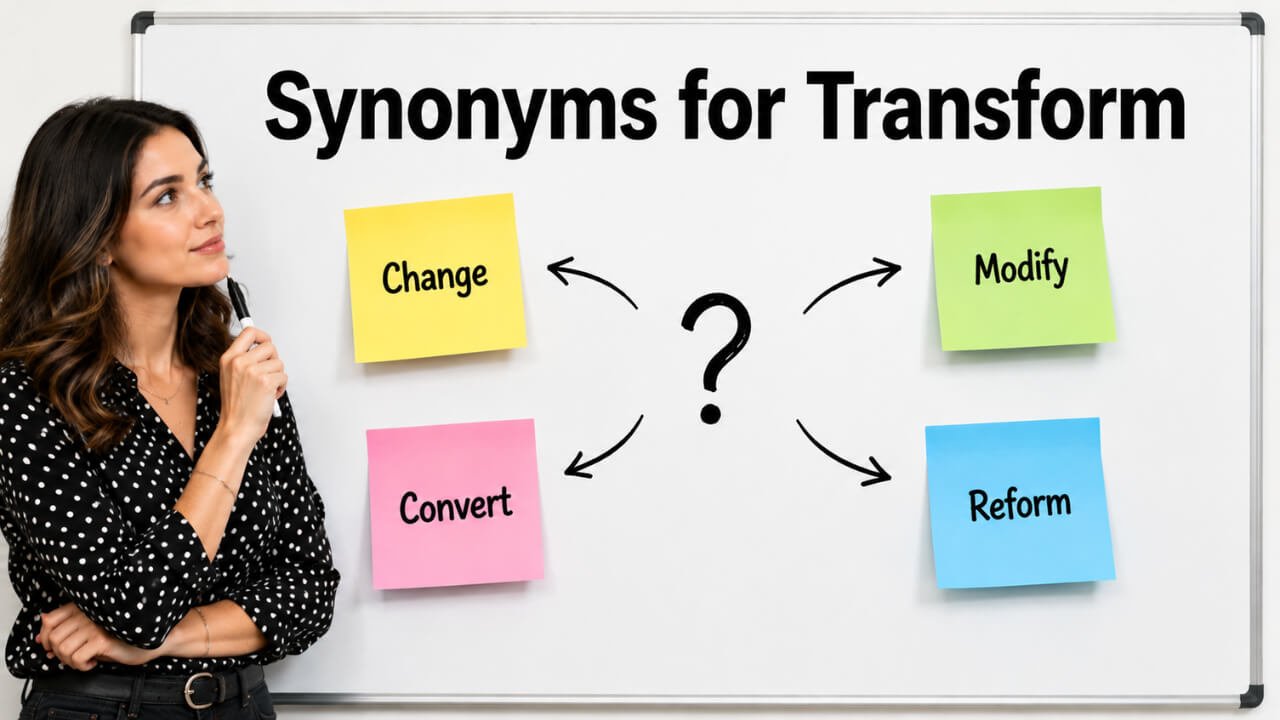
Quick Answer: The best synonyms for transform include change, alter, convert, reshape, reform, remodel, revamp, reinvent, overhaul, and transfigure. Use change as the most flexible everyday replacement. Choose convert when something moves from one form, purpose, or system to another. Use reshape for structure or appearance, reform for systems and behavior, revamp for modern improvements, and reinvent for a completely new identity or approach. The most suitable choice depends on whether the transformation involves appearance, purpose, organization, technology, personality, or development.
Pronunciation and Word Details
Word: Transform.
Pronunciation: /trænsˈfɔːrm/
Part of Speech: Verb.
Meaning: To change someone or something greatly in form, appearance, character, purpose, or condition.
US Pronunciation:
UK Pronunciation:
What Does “Transform” Mean?
Transform means to change someone or something significantly so that it becomes different in form, appearance, function, character, or condition.
Transform is mainly used as a verb. It can describe physical changes, personal development, organizational improvements, technological changes, and major shifts in ideas or behavior.
In a physical context, transform may describe changing the appearance or structure of a room, building, object, or landscape.
Example: New lighting can transform a dark room into a welcoming space.
In a personal context, it can describe a major improvement in someone’s habits, confidence, attitude, or lifestyle.
Example: Regular practice transformed her into a confident speaker.
In a business or technical context, transform often refers to changing processes, services, systems, or strategies.
Example: The new system transformed the way the team handled customer requests.
Transform usually suggests a noticeable or important change. It is stronger than simple words such as adjust or modify, which often describe smaller changes.
Meaning, Tone, and Context of “Transform”
Transform has a neutral but powerful tone. It communicates a meaningful change rather than a minor adjustment.
The word is common in formal writing, everyday conversation, academic discussion, business communication, personal development, design, science, technology, and creative writing.
In casual speech, transform can describe an impressive improvement.
Example: That new haircut completely transformed his appearance.
In formal writing, transform may describe significant social, economic, educational, or organizational change.
Example: Improved access to education can transform communities.
In technical contexts, transform may refer to changing information, energy, materials, or systems from one form into another.
Example: The device transforms electrical energy into heat.
In emotional or motivational writing, transform often suggests positive personal growth.
Example: The experience transformed her understanding of success.
Although transform is frequently positive, it can also describe neutral or negative changes.
Example: Years of neglect transformed the building into an unsafe structure.
When and How to Use “Transform”
For Major Physical Change
Use transform when the appearance, structure, or condition of something changes noticeably.
Example: Fresh paint and natural light transformed the small apartment.
For Personal Growth
Use transform when someone experiences a significant change in confidence, behavior, beliefs, skills, or lifestyle.
Example: The leadership program transformed him into a more thoughtful manager.
For Changing Purpose
Use transform when an object, space, or resource is given a completely different use.
Example: The old warehouse was transformed into a community center.
For Organizational Improvement
Use transform when a company, department, institution, or process changes in an important way.
Example: Clear communication transformed the department’s working culture.
For Technology and Systems
Use transform when technology changes how people complete tasks, share information, or provide services.
Example: The updated platform transformed how employees managed their daily work.
For Creative Changes
Use transform when an idea, story, design, or ordinary object becomes something new or more developed.
Example: The artist transformed discarded materials into a striking sculpture.
For Scientific Change
Use transform when matter, energy, information, or living organisms change form or condition.
Example: The process transforms raw materials into usable products.
For Social Change
Use transform when policies, education, innovation, or collective action create major changes in society.
Example: Better public services can transform the quality of life in growing communities.
Best Synonyms for Transform
Change
Synonym: To make or become different.
Example: The experience changed her view of the world.
Change is the broadest and most natural synonym for transform. It works in formal and casual contexts, but it does not always express the same degree of major change.
Alter
Synonym: To make something different without replacing it completely.
Example: The designer altered the layout to create more space.
Alter is useful when the basic identity of something remains the same while certain details are changed.
Convert
Synonym: To change something into another form, purpose, system, or belief.
Example: They converted the unused office into a reading room.
Convert is especially useful when something moves from one clear state or function to another.
Reshape
Synonym: To change the form, structure, direction, or character of something.
Example: New technology reshaped the entire industry.
Reshape works well for physical forms, organizations, industries, ideas, and future plans.
Reform
Synonym: To improve a system, organization, practice, or behavior by making important changes.
Example: The institution reformed its outdated admission process.
Reform is common in political, educational, legal, social, and organizational contexts.
Remodel
Synonym: To change the structure or appearance of a room, building, or object.
Example: They remodeled the kitchen to make it brighter and more practical.
Remodel is most appropriate for physical spaces and structural design.
Revamp
Synonym: To improve the appearance, organization, or effectiveness of something.
Example: The team revamped the website to make the information easier to find.
Revamp has a modern and slightly informal tone. It often suggests refreshing something that has become outdated.
Reinvent
Synonym: To create a completely new version, identity, method, or purpose.
Example: The writer reinvented her style for a younger audience.
Reinvent suggests creativity and a major departure from an earlier version.
Overhaul
Synonym: To examine and change something completely in order to improve it.
Example: The organization overhauled its training program.
Overhaul is a strong choice for systems, policies, equipment, structures, and processes.
Transfigure
Synonym: To change the appearance or character of someone or something in a striking way.
Example: The morning light transfigured the ordinary landscape.
Transfigure has a literary and expressive tone. It is suitable when a transformation appears beautiful, dramatic, or almost magical.
50 Synonyms for Transform with Short Meanings
- Change: To make or become different.
- Alter: To change part of something without replacing it completely.
- Convert: To change something into another form or purpose.
- Modify: To make limited changes for improvement or suitability.
- Reshape: To change the structure, form, or direction of something.
- Reform: To improve something by correcting problems or weaknesses.
- Remodel: To change the structure or appearance of a space.
- Revamp: To give something a fresher or more effective form.
- Remake: To create a new version of something.
- Rebuild: To construct or develop something again in a better form.
- Reconstruct: To build, organize, or form something again.
- Reorganize: To arrange people, tasks, or resources differently.
- Restructure: To change the basic organization of a system or group.
- Redesign: To create a new design, structure, or arrangement.
- Rework: To change or improve something that has already been created.
- Recast: To present an idea, role, or situation in a different form.
- Adapt: To change something so it suits new conditions.
- Adjust: To make a small change for accuracy or effectiveness.
- Revise: To change written material, plans, or ideas for improvement.
- Renovate: To repair and improve an old building or space.
- Modernize: To update something with current methods or features.
- Revolutionize: To change something completely through a new method or idea.
- Transfigure: To change appearance or character in a striking way.
- Metamorphose: To change completely in form or nature.
- Mutate: To undergo a change in form, structure, or genetic character.
- Evolve: To develop gradually into a more advanced or different form.
- Develop: To grow or change over time.
- Shift: To move from one position, direction, condition, or opinion to another.
- Turn: To become or make something different.
- Translate: To change information, ideas, or energy into another form.
- Transmute: To change something into a completely different substance or form.
- Regenerate: To restore, renew, or produce something again.
- Reinvent: To create a new identity, method, or version.
- Overhaul: To change or repair something completely.
- Reconfigure: To arrange parts or systems in a new way.
- Repurpose: To give something a new function or use.
- Recondition: To repair or restore something to a better condition.
- Restore: To return something to an earlier or improved condition.
- Upgrade: To improve something by adding better features or qualities.
- Improve: To make something better in quality or effectiveness.
- Refine: To improve something through careful changes.
- Redefine: To give something a new meaning, role, or identity.
- Reimagine: To think about or create something in a new way.
- Reframe: To present an idea or situation from a different perspective.
- Renew: To make something active, effective, or fresh again.
- Refresh: To improve the appearance, energy, or condition of something.
- Reformulate: To express, prepare, or organize something in a different way.
- Reorient: To change direction, focus, or priorities.
- Reconstitute: To form, organize, or restore something in a new way.
- Recreate: To create something again in a different or improved form.
Read Also:
Synonyms for Meaning

Synonyms for Transform by Context
When Transform Means to Change Form or Appearance
Useful synonyms include alter, reshape, remodel, redesign, transfigure, renovate, and remake.
Use these words when describing visual, physical, or structural changes.
Example: The designer transformed the plain room with warmer lighting.
Alternative: The designer remodeled the plain room with warmer lighting.
Remodel is more specific because it suggests changing the physical design or structure of a space.
When Transform Means to Change Purpose
Useful synonyms include convert, repurpose, adapt, reconfigure, and recreate.
These words work when something receives a new function or is prepared for a different use.
Example: The council transformed the empty building into a public library.
Alternative: The council converted the empty building into a public library.
Convert is more precise because the building moved from one clear purpose to another.
When Transform Means to Improve Greatly
Useful synonyms include revamp, overhaul, upgrade, reform, modernize, refine, and revolutionize.
These words suggest that something becomes more effective, useful, attractive, or suitable.
Example: The manager transformed the outdated training system.
Alternative: The manager overhauled the outdated training system.
Overhauled emphasizes that the entire system received careful and extensive changes.
When Transform Means Personal Growth
Useful synonyms include change, evolve, develop, reinvent, reform, renew, and reshape.
These words are appropriate when describing improvements in character, habits, beliefs, abilities, or identity.
Example: Her experiences transformed her into a patient leader.
Alternative: Her experiences shaped her into a patient leader.
Shaped suggests gradual influence, while transformed suggests a more noticeable personal change.
When Transform Means Organizational Change
Useful synonyms include restructure, reorganize, reform, redesign, reconfigure, and overhaul.
These alternatives work well for companies, institutions, departments, policies, and processes.
Example: The new director transformed the organization.
Alternative: The new director restructured the organization.
Restructured is more specific because it focuses on changing roles, departments, responsibilities, or systems.
When Transform Means Gradual Development
Useful synonyms include evolve, develop, shift, adapt, and mature.
These words describe change that happens over a period rather than immediately.
Example: The small project transformed into a national program.
Alternative: The small project evolved into a national program.
Evolved is better when the change happened gradually through several stages.
Another Word for Transform
The best general replacement for transform is change. It is simple, natural, and suitable for most everyday sentences. However, change is broader and sometimes weaker than transform.
The best alternative depends on what is changing. Use convert for a new purpose, reshape for structure or influence, reform for correction, remodel for a physical space, and reinvent for a completely new identity.
Original: The new furniture transformed the living room.
Better Option: The new furniture remodeled the appearance of the living room.
Original: The organization transformed its internal structure.
Better Option: The organization restructured its internal operations.
Original: She transformed her professional image.
Better Option: She reinvented her professional image.
Original: They transformed the old factory into apartments.
Better Option: They converted the old factory into apartments.
When Not to Use “Transform”
Do not use transform when the change is very small. Words such as adjust, edit, modify, or revise may be more accurate.
Weak: I transformed the font size from twelve to thirteen.
Better: I adjusted the font size from twelve to thirteen.
Avoid transform when you need to describe one specific type of change. A precise verb often gives the reader more information.
Weak: They transformed the kitchen.
Better: They remodeled the kitchen.
Do not use transform repeatedly in nearby sentences. Repetition can make writing sound promotional or exaggerated.
Weak: The program transformed the team, transformed its methods, and transformed its results.
Better: The program strengthened the team, improved its methods, and reshaped its results.
Avoid transform when a gradual development is more accurately described by evolve.
Weak: The local club suddenly transformed into a national organization over twenty years.
Better: The local club gradually evolved into a national organization over twenty years.
Do not use transform when something is simply moved, replaced, or repaired without undergoing a major change.
Weak: The technician transformed the broken cable.
Better: The technician replaced the broken cable.
Transform can also sound exaggerated when the result is ordinary or limited.
Weak: A new folder transformed my filing system.
Better: A new folder improved my filing system.
Words Commonly Confused With Transform
Transform vs Change: Change is a general word for making or becoming different. Transform usually suggests a major, noticeable, or complete change.
Transform vs Convert: Transform emphasizes the overall result of a major change. Convert focuses on moving something from one form, use, system, or belief to another.
Transform vs Alter: Alter means changing particular details while keeping the basic identity of something. Transform suggests a deeper change in appearance, function, or character.
Transform vs Modify: Modify usually describes a limited or controlled adjustment. Transform suggests a broader and more significant result.
Transform vs Evolve: Transform may happen quickly or dramatically. Evolve usually describes gradual development over time.
Transform vs Reform: Transform can describe any major change. Reform specifically involves correcting weaknesses, improving conduct, or changing an ineffective system.
Transform vs Remodel: Transform is broad and can apply to people, ideas, systems, and spaces. Remodel mainly refers to changing the design or structure of a building or room.
Transform vs Transition: Transform describes the change itself. Transition describes the process or period of moving from one state to another.
Transform vs Transfigure: Transform is neutral and widely used. Transfigure is literary and often describes a striking, beautiful, or spiritual change.
Transform vs Revolutionize: Transform means to change greatly. Revolutionize means to introduce a new idea or method that changes an entire activity, industry, or system.
Which Synonym Should You Choose?
Choose change for general everyday writing when no specialized meaning is required.
Choose alter when only certain details are being changed while the main form remains recognizable.
Choose modify when making a controlled, practical, or technical adjustment.
Choose convert when something changes from one form, purpose, system, or use to another.
Choose reshape when a person, idea, industry, structure, or future direction is strongly influenced.
Choose reform when correcting problems in laws, institutions, behavior, education, or public systems.
Choose remodel when discussing structural or design changes to rooms and buildings.
Choose renovate when an older building or space is repaired and improved.
Choose revamp when something outdated receives a fresher appearance or more effective organization.
Choose reinvent when someone or something develops a completely new identity, style, purpose, or approach.
Choose overhaul when an entire process, policy, machine, or system requires extensive improvement.
Choose revolutionize when a new method or invention creates an unusually powerful change.
Choose transfigure in literary writing when the change appears striking, beautiful, emotional, or spiritual.
Choose evolve when the change happens gradually over a long period.
Choose restructure in reports, essays, and professional communication when an organization changes its internal arrangement.
Choose reimagine in creative discussions when an existing concept is considered in a fresh and original way.
Real Life Examples of “Transform” in Sentences
Original: Natural light transformed the narrow room.
Better Option: Natural light brightened and reshaped the narrow room.
Original: The course transformed her communication skills.
Better Option: The course greatly improved her communication skills.
Original: The team transformed the outdated process.
Better Option: The team overhauled the outdated process.
Original: They transformed the garage into a home office.
Better Option: They converted the garage into a home office.
Original: The new director transformed the department.
Better Option: The new director restructured the department.
Original: Daily exercise transformed his lifestyle.
Better Option: Daily exercise reshaped his lifestyle.
Original: The editor transformed the rough draft.
Better Option: The editor reworked and refined the rough draft.
Original: Technology transformed the way the service operated.
Better Option: Technology revolutionized the way the service operated.
Original: The artist transformed an ordinary object into a meaningful artwork.
Better Option: The artist reimagined an ordinary object as a meaningful artwork.
Original: Years of experience transformed her approach to leadership.
Better Option: Years of experience refined her approach to leadership.
Synonym Groups and Usage Differences
General Change Group
This group includes change, alter, modify, adjust, and revise.
These words describe different levels of change. Change is broad, alter and modify suggest limited differences, adjust suggests a small correction, and revise often applies to writing or plans.
Example: The writer revised the conclusion to make the argument clearer.
Structural Change Group
This group includes reshape, restructure, reorganize, rebuild, reconstruct, and reconfigure.
These words focus on changing how something is formed, arranged, or organized. They are common in design, construction, management, and technical writing.
Example: The company restructured its departments to reduce delays.
Improvement Group
This group includes improve, refine, upgrade, revamp, overhaul, modernize, and reform.
These synonyms suggest making something more useful, effective, accurate, attractive, or current.
Example: The school modernized its classrooms and improved its learning materials.
New Purpose Group
This group includes convert, adapt, repurpose, recreate, and reconstitute.
These words describe changing how something is used or forming it again for a different purpose.
Example: The owners repurposed the unused room as a quiet study area.
Creative Change Group
This group includes reinvent, reimagine, redesign, recast, redefine, and reframe.
These words are useful when ideas, identities, stories, products, roles, or perspectives receive a new interpretation.
Example: The author recast the traditional story from another character’s perspective.
Gradual Development Group
This group includes evolve, develop, shift, adapt, and mature.
These words describe changes that occur through experience, time, pressure, or changing conditions.
Example: Her teaching style evolved as she gained more classroom experience.
Dramatic Change Group
This group includes revolutionize, transfigure, metamorphose, transmute, and mutate.
These words communicate an unusually deep, complete, scientific, or dramatic transformation.
Example: The discovery revolutionized the treatment process.
Antonyms of Transform
The opposite of transform depends on whether transform means changing appearance, purpose, structure, condition, or behavior.
Preserve: To keep something in its existing condition.
Maintain: To continue something without major change.
Retain: To keep a quality, feature, possession, or form.
Conserve: To protect something from damage, loss, or unnecessary change.
Keep: To allow something to remain in the same state.
Stabilize: To make something steady and prevent further change.
Remain: To continue in the same condition or position.
Resist: To oppose or prevent change.
Freeze: To stop a process, system, or condition from changing.
Stagnate: To remain inactive without developing or improving.
Preserve vs Transform: Preserve means keeping the original form, while transform means creating a significantly different form.
Maintain vs Transform: Maintain focuses on continuity, while transform focuses on major change.
Stagnate vs Transform: Stagnate means failing to develop, while transform means becoming noticeably different.
Comparison: Transform vs Related Words
Transform vs Change
Change is general and can describe any difference, whether small or large. Transform usually suggests a major or meaningful change.
Example With Transform: The training transformed her approach to customer service.
Example With Change: The training changed her daily schedule.
Transform vs Convert
Transform focuses on the overall degree of change. Convert focuses on movement from one specific form, system, function, or belief to another.
Example With Transform: The project transformed the neglected neighborhood.
Example With Convert: The builders converted the warehouse into apartments.
Transform vs Alter
Transform suggests a deep change in form, identity, function, or character. Alter usually means changing only part of something.
Example With Transform: The experience transformed his personality.
Example With Alter: The tailor altered the sleeves of his jacket.
Transform vs Modify
Transform communicates extensive change. Modify communicates a smaller adjustment made for a particular reason.
Example With Transform: The new policy transformed the entire process.
Example With Modify: The manager modified one step in the process.
Transform vs Evolve
Transform may describe a sudden, planned, or dramatic change. Evolve describes gradual development.
Example With Transform: The renovation transformed the building within six months.
Example With Evolve: The small business evolved over several decades.
Transform vs Reform
Transform is broad and does not always involve correcting a problem. Reform specifically means improving something by removing faults or changing ineffective practices.
Example With Transform: Digital tools transformed the learning experience.
Example With Reform: The institution reformed its assessment policy.
Transform vs Revolutionize
Transform means to change greatly. Revolutionize is stronger and suggests an innovation that changes an entire field or activity.
Example With Transform: The new equipment transformed production.
Example With Revolutionize: The invention revolutionized modern production.
Transform vs Transfigure
Transform is neutral and suitable for most contexts. Transfigure is more literary and suggests a striking change in appearance or character.
Example With Transform: The decorations transformed the garden.
Example With Transfigure: Golden sunlight transfigured the quiet garden.
Common Phrases and Expressions With “Transform”
Transform Into: To change from one form, state, purpose, or identity to another.
Example: The empty space was transformed into a peaceful reading area.
Transform From: To move away from an earlier condition or form.
Example: The organization transformed from a small local group into a national service.
Completely Transform: To change something in a major or total way.
Example: A clearer strategy could completely transform the project.
Help Transform: To contribute to a major change or improvement.
Example: Better training can help transform workplace communication.
Transform the Way: To change how an activity is performed or understood.
Example: The new process transformed the way the team shared information.
Transform Your Life: To make significant changes to habits, goals, health, work, or personal direction.
Example: Consistent learning can transform your life over time.
Transform a Space: To change the appearance, atmosphere, or purpose of a room or area.
Example: Soft lighting can transform a space without expensive renovations.
Transform an Idea Into Reality: To develop a thought or plan into something real.
Example: Careful planning helped them transform the idea into reality.
Transform for the Better: To change into a more positive, effective, or desirable condition.
Example: Honest feedback helped the team transform for the better.
Transform Over Time: To change gradually through development, experience, or changing conditions.
Example: The neighborhood transformed over time as new services became available.
Common Mistakes to Avoid
One common mistake is using transform for every type of change. Transform usually suggests an important or noticeable difference. Use adjust, edit, revise, or modify for smaller changes.
Another mistake is choosing a synonym that does not match the context. Convert is best for a change in purpose or form, while remodel is more suitable for rooms and buildings. Reform is appropriate for correcting systems, laws, or behavior.
Avoid repeating transform several times in one paragraph. Use precise alternatives such as reshape, improve, restructure, or reinvent where appropriate.
Writers sometimes use transform in exaggerated claims without explaining what changed. Add a clear result so the sentence provides useful information.
Vague: The program transformed the organization.
Clearer: The program restructured the organization, improved communication, and reduced delays.
Do not confuse transform with transition. Transform describes a significant change, while transition usually describes the process of moving between two conditions.
Avoid using evolve when the change is sudden. Evolve normally suggests gradual development over time.
Do not use transfigure in ordinary professional writing unless a literary tone is intended. Change, transform, reshape, or improve will usually sound more natural.
Conclusion
Understanding synonyms for transform helps you describe different kinds of change with greater accuracy. Change is the most flexible general alternative, while convert works for a new form or purpose. Choose reshape for structural influence, reform for correcting systems, remodel for physical spaces, reinvent for a new identity, and overhaul for complete improvement. Words such as evolve and develop are better for gradual progress. Selecting the right synonym allows readers to understand exactly how deeply, quickly, or purposefully someone or something has changed.
FAQs About Synonyms for Transform
What Is the Best Synonym for Transform?
Change is the best general synonym for transform. More precise choices include convert, reshape, reform, reinvent, remodel, and overhaul.
What Is a Stronger Word Than Transform?
Revolutionize can be stronger than transform when a new idea or method completely changes an industry, system, or activity.
Is Change the Same as Transform?
Not exactly. Change can describe any difference, including a small one. Transform usually suggests a major or noticeable change.
What Is Another Word for Transforming a Space?
Remodel, renovate, redesign, revamp, and convert are useful choices. The best word depends on whether the space changes in appearance, structure, or purpose.
What Is Another Word for Personal Transformation?
Useful alternatives include growth, development, evolution, reinvention, renewal, and reform. As verbs, change, evolve, develop, and reinvent are common choices.
Should I Use Convert or Transform?
Use convert when something moves from one clear form, function, system, or purpose to another. Use transform when emphasizing the overall importance or extent of the change.
What Is the Difference Between Transform and Evolve?
Transform can describe a sudden, planned, or dramatic change. Evolve usually describes gradual development that happens over time.
