
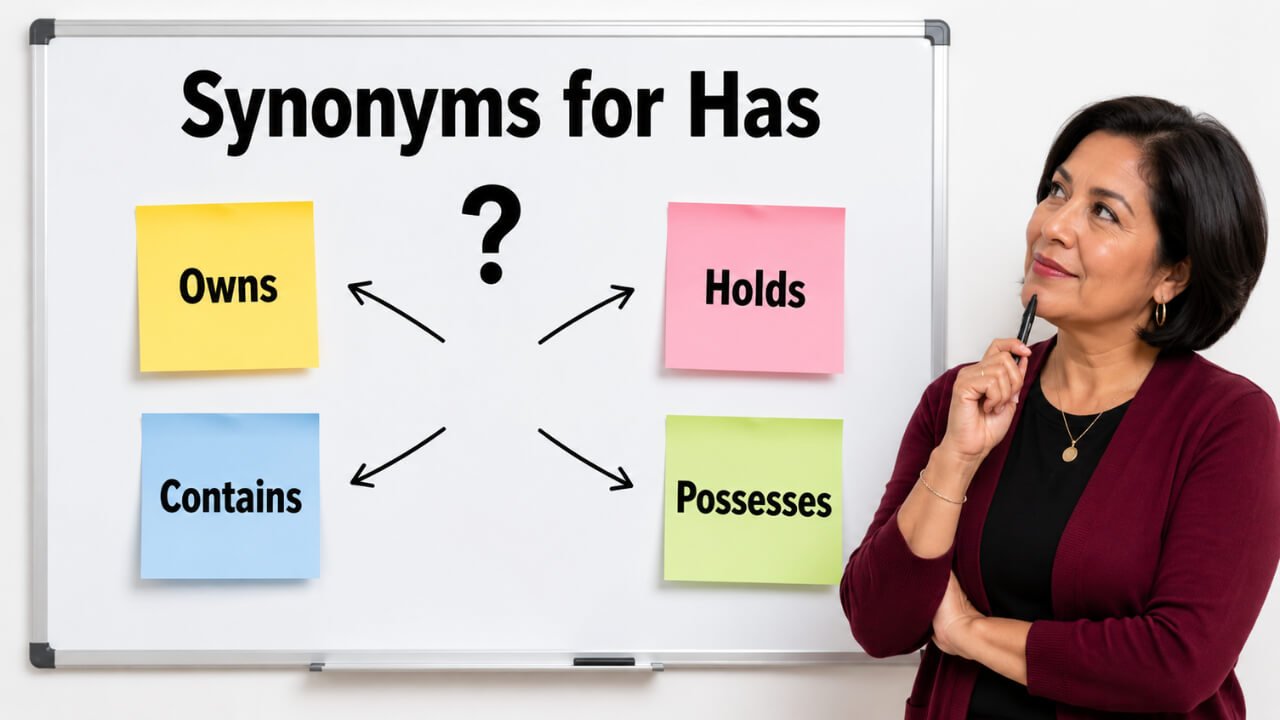
Quick Answer: The best synonyms for has include owns, possesses, holds, contains, includes, features, keeps, experiences, receives, and enjoys. Use owns or possesses for property, contains for something held inside, includes for parts of a group, features for notable qualities, experiences for events or feelings, and receives for something given. Because has can also function as an auxiliary verb or appear in has to, the correct replacement always depends on its grammatical role and sentence context.
Pronunciation and Word Details
Word: Has.
Pronunciation: /hæz/, with the weaker form /həz/ sometimes heard in natural speech.
Part of Speech: Main verb and auxiliary verb.
Meaning: Has is the third person singular form of have and can express possession, inclusion, experience, obligation, or a completed action.
US Pronunciation:
UK Pronunciation:
What Does “Has” Mean?
Has is the third person singular form of the verb have. It is used with singular subjects such as he, she, it, the company, the house, or the machine.
As a main verb, has commonly shows possession.
Example: She has a new bicycle.
It can also describe a quality, feature, relationship, illness, experience, opportunity, meal, or responsibility.
Example: The building has three entrances.
Example: He has a headache.
Example: The team has an important opportunity.
Has also works as an auxiliary verb in the present perfect tense.
Example: She has completed the assignment.
In this structure, has supports the main verb rather than expressing possession. It cannot usually be replaced with owns, possesses, or contains.
Has can also appear in the expression has to, which communicates necessity or obligation.
Example: He has to arrive before noon.
In this context, must or needs to may be suitable alternatives.
Meaning, Tone, and Context of “Has”
Has is a neutral and extremely common word. It appears naturally in formal writing, casual conversation, academic explanations, reports, descriptions, instructions, and storytelling.
When has expresses possession, it usually sounds simpler and more conversational than possesses.
Neutral: The school has a large library.
Formal: The school possesses an extensive collection of reference materials.
When has describes something included within an object or system, contains or includes may provide greater precision.
General: The report has several useful charts.
More Precise: The report includes several useful charts.
When has refers to an experience, feeling, or condition, words such as experiences, feels, suffers from, or faces may communicate the intended meaning more clearly.
General: She has difficulty sleeping.
More Specific: She experiences difficulty sleeping.
Has is usually polite and emotionally neutral. Its strength and tone come from the surrounding words rather than from the verb itself.
When and How to Use “Has”
For Possession
Use has when a person, organization, animal, or object owns or possesses something.
Example: Maria has a small apartment near her workplace.
For Physical Features
Use has to describe a visible feature, design element, or physical quality.
Example: The garden has a stone path and a wooden gate.
For Included Parts
Use has when something contains or includes particular sections, objects, or elements.
Example: The guide has five practical chapters.
For Personal Qualities
Use has to describe a skill, characteristic, personality trait, or ability.
Example: The candidate has excellent communication skills.
For Experiences
Use has when someone experiences an event, feeling, condition, or problem.
Example: He has frequent headaches during the summer.
For Meals and Activities
Use has for eating, drinking, attending, conducting, or participating in something.
Example: She has breakfast at seven each morning.
For Relationships
Use has to describe family members, friends, colleagues, or other personal connections.
Example: Daniel has two younger sisters.
For Obligation
Use has to when a singular subject must perform an action.
Example: The driver has to renew the permit this month.
For Completed Actions
Use has with a past participle to form the present perfect tense.
Example: The manager has approved the final proposal.
Best Synonyms for Has
Owns
Synonym: Owns means legally possessing something as property.
Example: She owns a small house in the countryside.
Possesses
Synonym: Possesses means having or controlling something and often sounds more formal than has.
Example: The applicant possesses the necessary qualifications.
Holds
Synonym: Holds means keeping, carrying, containing, or occupying something.
Example: The container holds ten liters of water.
Contains
Synonym: Contains means having something inside.
Example: The package contains three separate items.
Includes
Synonym: Includes means having something as part of a larger group or whole.
Example: The course includes weekly writing exercises.
Features
Synonym: Features means presenting an important, noticeable, or attractive quality.
Example: The hotel features a spacious dining area.
Keeps
Synonym: Keeps means continuing to have, store, or retain something.
Example: She keeps important documents in a secure drawer.
Experiences
Synonym: Experiences means going through an event, feeling, situation, or condition.
Example: The region experiences heavy rainfall during winter.
Receives
Synonym: Receives means getting something that is sent, offered, awarded, or given.
Example: Each participant receives a certificate.
Enjoys
Synonym: Enjoys can mean benefiting from or possessing a positive condition, privilege, or advantage.
Example: The neighborhood enjoys convenient access to public transportation.
50 Synonyms for Has with Short Meanings
- Owns: Legally possesses something.
- Possesses: Has ownership or control of something.
- Holds: Keeps, carries, contains, or controls something.
- Keeps: Continues to have or store something.
- Retains: Continues possessing something over time.
- Maintains: Keeps something in existence or good condition.
- Controls: Has authority or power over something.
- Commands: Has control, respect, or authority.
- Carries: Has something on, within, or with it.
- Bears: Carries, displays, or supports something.
- Contains: Has something inside.
- Includes: Has something as part of a whole.
- Features: Presents a notable quality or element.
- Comprises: Is made up of particular parts.
- Consists of: Is formed from specified elements.
- Houses: Contains or provides space for something.
- Stores: Keeps something for future use.
- Provides: Makes something available.
- Offers: Presents something for use or acceptance.
- Supplies: Provides what is required.
- Presents: Shows, introduces, or makes available.
- Displays: Shows something visibly.
- Shows: Makes a quality, condition, or feature noticeable.
- Exhibits: Displays a quality, behavior, or characteristic.
- Wears: Has clothing or an accessory on the body.
- Uses: Employs something for a purpose.
- Employs: Uses a method, tool, or person.
- Receives: Gets something that is given or sent.
- Gets: Obtains, receives, or experiences something.
- Obtains: Gains something through effort or action.
- Acquires: Comes to possess something.
- Gains: Receives or develops something valuable.
- Earns: Gains something through work or achievement.
- Enjoys: Possesses or benefits from something positive.
- Experiences: Goes through an event, feeling, or condition.
- Undergoes: Experiences a process, treatment, or change.
- Suffers from: Experiences an illness, difficulty, or problem.
- Feels: Experiences an emotion or physical sensation.
- Faces: Encounters a challenge, decision, or situation.
- Encounters: Comes into contact with a situation or problem.
- Hosts: Provides a place or setting for an event.
- Conducts: Organizes and carries out an activity.
- Organizes: Arranges or manages an event or activity.
- Takes: Consumes, accepts, or participates in something.
- Consumes: Eats, drinks, or uses something.
- Knows: Has knowledge or awareness of something.
- Is given: Receives something from another source.
- Is equipped with: Has a tool, feature, or useful component.
- Is accompanied by: Has something or someone present alongside it.
- Is required to: Has an obligation to perform an action.
Read Also:
Synonyms for Variety
Synonyms for Has by Context
When Has Means Owns
Use owns, possesses, holds, keeps, or retains when has expresses possession.
Has: She has a valuable collection of old books.
Owns: She owns a valuable collection of old books.
Possesses: She possesses a valuable collection of old books.
Owns is best for legal property. Possesses is more formal and may describe objects, skills, qualities, or information. Keeps suggests continued possession rather than legal ownership.
When Has Means Contains
Use contains, holds, houses, stores, or carries when something has objects or substances inside it.
Has: The bottle has clean drinking water.
Contains: The bottle contains clean drinking water.
Holds: The bottle holds one liter of clean drinking water.
Contains emphasizes what is inside. Holds often emphasizes capacity. Houses is commonly used for buildings, systems, or large containers.
When Has Means Includes
Use includes, features, comprises, or consists of when discussing parts, sections, qualities, or components.
Has: The package has a printed guide and three worksheets.
Includes: The package includes a printed guide and three worksheets.
Features: The package features three practical worksheets.
Includes identifies parts of a whole. Features highlights something important or attractive. Comprises describes all the main parts that form the whole.
When Has Means Experiences
Use experiences, undergoes, feels, faces, encounters, or suffers from when discussing events, emotions, conditions, or difficulties.
Has: The patient has severe back pain.
Experiences: The patient experiences severe back pain.
Suffers From: The patient suffers from severe back pain.
Experiences is neutral and precise. Suffers from emphasizes discomfort or hardship. Faces is best for challenges, risks, choices, and difficult situations.
When Has Means Receives
Use receives, gets, obtains, acquires, gains, or earns when something comes into a person’s possession.
Has: Every student has a copy of the workbook.
Receives: Every student receives a copy of the workbook.
Gets: Every student gets a copy of the workbook.
Receives is suitable for formal or neutral writing. Gets is more conversational. Earns suggests that effort or achievement was required.
When Has Means Displays
Use shows, displays, exhibits, bears, or presents when has refers to a visible quality, sign, label, or characteristic.
Has: The fabric has a floral pattern.
Displays: The fabric displays a floral pattern.
Features: The fabric features a floral pattern.
Displays emphasizes visibility. Features presents the quality as notable. Bears is often used for names, marks, labels, signs, or symbols.
When Has Means Must
Use must, needs to, is required to, or is expected to when has appears in the expression has to.
Has To: She has to submit the form today.
Must: She must submit the form today.
Is Required To: She is required to submit the form today.
Must is direct and strong. Needs to is slightly softer. Is required to is suitable for official rules and formal instructions.
When Has Is an Auxiliary Verb
Has is used with a past participle to form the present perfect tense.
Example: He has completed the training.
In this sentence, has does not mean owns, contains, or experiences. It supports the verb completed. There is normally no direct synonym without changing the grammatical structure or meaning.
Possible Rewrite: He completed the training.
The rewritten sentence uses the simple past and may communicate a different time relationship.
Another Word for Has
The best single replacement for has is often possesses when the sentence expresses ownership or a personal quality. However, possesses is more formal and does not work naturally in every sentence.
The correct alternative depends on whether has means owns, contains, includes, experiences, receives, displays, or must.
Original: The organization has several useful resources.
Better Option: The organization provides several useful resources.
Original: The room has two large windows.
Better Option: The room features two large windows.
Original: She has excellent leadership skills.
Better Option: She possesses excellent leadership skills.
Original: The guide has ten practical exercises.
Better Option: The guide includes ten practical exercises.
When Not to Use “Has”
Has is useful, but repeated use can make writing sound plain, vague, or monotonous. A more specific verb often communicates the relationship more clearly.
When Describing Included Content
Use contains or includes when readers need to understand what is inside something.
Weak: The report has four sections about workplace safety.
Better: The report includes four sections about workplace safety.
When Highlighting an Important Feature
Use features when describing a notable quality, design element, or benefit.
Weak: The apartment has a modern kitchen.
Better: The apartment features a modern kitchen.
When Describing a Medical Condition
Use experiences or suffers from when the condition needs greater emphasis or precision.
Weak: He has severe pain in his shoulder.
Better: He experiences severe pain in his shoulder.
When Discussing Formal Qualifications
Use possesses when describing abilities, knowledge, experience, or qualities in formal writing.
Weak: The applicant has strong analytical skills.
Better: The applicant possesses strong analytical skills.
When Describing an Event
Use hosts, conducts, or organizes when the subject is responsible for an event.
Weak: The community center has a workshop every month.
Better: The community center hosts a workshop every month.
When Has Is Too Vague
Choose a verb that explains how the subject obtained, used, or experienced something.
Weak: She has an award for her research.
Better: She received an award for her research.
Words Commonly Confused With Has
Has vs Have: Has is used with third person singular subjects such as he, she, it, Maria, or the building. Have is used with I, you, we, they, and plural nouns.
Example With Has: The building has three floors.
Example With Have: The buildings have three floors.
Has vs Had: Has describes a present situation or helps form the present perfect tense. Had describes past possession or helps form the past perfect tense.
Example With Has: She has a new position.
Example With Had: She had a different position last year.
Has vs Owns: Has can describe possession, experiences, features, relationships, illnesses, or completed actions. Owns mainly describes legal or personal ownership.
Example With Has: He has a headache.
Incorrect Replacement: He owns a headache.
Has vs Contains: Has is general, while contains specifically means that something is inside an object, document, mixture, or space.
Example With Has: The box has several tools.
More Precise: The box contains several tools.
Has vs Includes: Has can describe many relationships. Includes specifically identifies something as part of a larger whole.
Example With Has: The price has delivery costs.
More Natural: The price includes delivery costs.
Has vs There Is: Has connects an object or feature to a subject. There is introduces the existence or location of something.
With Has: The house has a garden.
With There Is: There is a garden behind the house.
Has vs Has Got: Both forms can express possession in informal conversation, but has is usually simpler and more suitable for formal or concise writing.
Standard: She has a new appointment.
Conversational: She has got a new appointment.
Which Synonym Should You Choose?
Choose owns when describing legal ownership of property, businesses, vehicles, or valuable objects.
Choose possesses when writing formally about qualities, knowledge, abilities, documents, or objects.
Choose contains when explaining what is physically inside a container, document, mixture, room, or system.
Choose includes when identifying parts of a list, package, plan, price, course, or group.
Choose features when highlighting an attractive, important, or noticeable quality.
Choose holds when describing capacity, storage, a position, a record, or something being carried.
Choose keeps when the subject stores or continues to possess something.
Choose experiences when discussing emotions, symptoms, events, changes, or conditions.
Choose receives when the subject is given a message, payment, object, reward, or opportunity.
Choose faces when describing a problem, risk, challenge, decision, or difficult situation.
Choose hosts when a place or organization arranges an event.
Choose displays when describing visible signs, qualities, patterns, or information.
Choose must when has to expresses a strong obligation.
Choose needs to when the obligation is necessary but less forceful.
Keep has when it functions as an auxiliary verb in the present perfect tense.
Real Life Examples of “Has” in Sentences
Original: The house has a large garden.
Better Option: The house features a large garden.
Original: The folder has several important documents.
Better Option: The folder contains several important documents.
Original: The course has twelve detailed lessons.
Better Option: The course includes twelve detailed lessons.
Original: She has excellent writing skills.
Better Option: She possesses excellent writing skills.
Original: The child has a high fever.
Better Option: The child is experiencing a high fever.
Original: The organization has a public meeting every month.
Better Option: The organization hosts a public meeting every month.
Original: Each employee has a printed handbook.
Better Option: Each employee receives a printed handbook.
Original: The museum has thousands of historical objects.
Better Option: The museum houses thousands of historical objects.
Original: The company has serious financial challenges.
Better Option: The company faces serious financial challenges.
Original: He has to complete the application today.
Better Option: He must complete the application today.
Synonym Groups and Usage Differences
Possession Group
Owns, possesses, holds, keeps, retains, and controls belong to the possession group. They describe ownership, authority, custody, or continued possession.
Owns is the clearest word for legal property. Possesses is more formal. Retains emphasizes keeping something over time.
Example: The researcher retains complete control of the original records.
Content Group
Contains, includes, houses, stores, carries, comprises, and consists of describe what is inside or forms part of something.
Contains focuses on internal content. Includes identifies selected parts. Consists of normally identifies all the parts that form something.
Example: The final section contains practical advice for new writers.
Feature Group
Features, displays, shows, exhibits, bears, and presents describe noticeable qualities, signs, characteristics, or design elements.
Features often suggests that the quality is important or attractive. Exhibits is suitable for behavior, symptoms, and formal observations.
Example: The new design features larger buttons and clearer instructions.
Experience Group
Experiences, undergoes, suffers from, feels, faces, and encounters describe events, emotions, physical conditions, and challenges.
Experiences is neutral. Undergoes is often used for processes or treatments. Suffers from communicates discomfort or hardship.
Example: The region experiences strong winds during the colder months.
Acquisition Group
Receives, gets, obtains, acquires, gains, and earns describe coming into possession of something.
Gets is conversational. Obtains suggests effort or a process. Earns means that work, skill, or achievement produced the result.
Example: Each successful applicant receives written confirmation.
Provision Group
Provides, offers, supplies, and presents can replace has when the intended meaning is that something makes a resource, service, or opportunity available.
Example: The program offers practical support to new learners.
Obligation Group
Must, needs to, is required to, and is expected to replace the full expression has to rather than the word has by itself.
Must is strong and direct. Is required to sounds official. Needs to expresses practical necessity.
Example: Every visitor is required to follow the safety instructions.
Antonyms of Has
The opposite of has changes according to its meaning. When has means possesses, the opposite may be lacks or is without. When it means receives, the opposite may be gives, refuses, or loses.
Lacks: Does not have something necessary or desirable.
Is Without: Does not possess or contain something.
Needs: Requires something that is not currently available.
Loses: Stops having something.
Releases: Gives up possession or control.
Gives Away: Transfers something to another person.
Excludes: Leaves something out of a group or whole.
Omits: Fails to include something.
Refuses: Does not accept something offered.
Avoids: Does not experience, face, or become involved with something.
Rejects: Declines to receive or accept something.
Surrenders: Gives up possession, control, or authority.
Comparison: Has vs Related Words
Has vs Owns
Has is broader than owns. Has can describe possession, physical features, emotions, health conditions, relationships, obligations, and completed actions. Owns mainly refers to possession or legal ownership.
Example With Has: She has two brothers.
Example With Owns: She owns two rental properties.
Has vs Possesses
Has is neutral and common. Possesses is more formal and often emphasizes ownership, ability, knowledge, power, or a personal quality.
Example With Has: He has a natural talent for teaching.
Example With Possesses: He possesses a natural talent for teaching.
Has vs Contains
Has is a general verb. Contains specifically means that something is located inside another thing.
Example With Has: The jar has several coins.
Example With Contains: The jar contains several coins.
Has vs Includes
Has can show many kinds of relationships. Includes shows that something forms part of a larger set, package, plan, cost, or document.
Example With Has: The course has a final assessment.
Example With Includes: The course includes a final assessment.
Has vs Features
Has neutrally states that a quality or element exists. Features highlights the element as noticeable, important, useful, or appealing.
Example With Has: The phone has a large screen.
Example With Features: The device features a large, easy to read screen.
Has vs Holds
Has is broad, while holds commonly describes capacity, possession, storage, records, positions, beliefs, or events.
Example With Has: The hall has five hundred seats.
Example With Holds: The hall holds five hundred people.
Has vs Experiences
Has is common in everyday descriptions of feelings and conditions. Experiences is more precise when describing symptoms, emotions, events, or changes.
Example With Has: She has occasional anxiety before presentations.
Example With Experiences: She experiences occasional anxiety before presentations.
Has vs Receives
Has describes a current state of possession. Receives explains how something was given, delivered, awarded, or obtained.
Example With Has: Every member has an identification card.
Example With Receives: Every new member receives an identification card.
Has vs Must
Has alone is not a synonym for must. The complete expression has to can often be replaced by must.
Example With Has To: He has to attend the meeting.
Example With Must: He must attend the meeting.
Common Phrases and Expressions With “Has”
Has Access To: Is able or permitted to use something.
Has a Chance: Possesses an opportunity or possibility.
Has an Effect: Produces an influence or result.
Has a Point: Expresses a reasonable or valid idea.
Has in Mind: Is thinking about a particular person, idea, or plan.
Has Trouble: Experiences difficulty with something.
Has No Idea: Does not know or understand something.
Has Something in Common: Shares a quality, interest, or experience.
Has to Do With: Is connected or related to something.
Has What It Takes: Possesses the qualities needed to succeed.
Has Been: Forms the present perfect tense with a singular subject.
Has Gone: Indicates that someone or something went somewhere and has not yet returned.
Has Become: Indicates a change that occurred before the present time.
Has Yet To: Indicates that an expected action has not happened.
Common Mistakes to Avoid
Using Has With the Wrong Subject
Has should normally be used with he, she, it, singular names, and singular nouns. Use have with I, you, we, they, and plural nouns.
Incorrect: They has enough time.
Correct: They have enough time.
Replacing Auxiliary Has With a Possession Verb
Do not replace has with owns or possesses when it helps form the present perfect tense.
Incorrect: She possesses completed the report.
Correct: She has completed the report.
Using the Wrong Past Participle
Has must be followed by a past participle in the present perfect tense.
Incorrect: He has went home.
Correct: He has gone home.
Incorrect: She has ate breakfast.
Correct: She has eaten breakfast.
Using Has Repeatedly
Too many sentences beginning with has can make a paragraph sound repetitive.
Repetitive: The house has a large kitchen. It has three bedrooms. It has a small garden.
Improved: The house features a large kitchen, includes three bedrooms, and offers a small garden.
Choosing a Synonym That Is Too Formal
Possesses may sound unnatural in simple everyday statements.
Unnatural: She possesses a cup of coffee every morning.
Natural: She has a cup of coffee every morning.
Confusing Owns With Experiences
Owns cannot replace has when discussing illnesses, feelings, family relationships, or completed actions.
Incorrect: He owns a cold.
Correct: He has a cold.
Using Contains for Every Type of Inclusion
Contains is best for internal content. Includes is often better for services, prices, lists, plans, and packages.
Less Natural: The ticket contains admission and lunch.
Better: The ticket includes admission and lunch.
Using Has When a More Precise Verb Is Needed
Has may hide the true action in formal, technical, or descriptive writing.
Vague: The machine has several safety checks each day.
Precise: The machine undergoes several safety checks each day.
Conclusion
Synonyms for has depend on the meaning and grammatical structure of the sentence. Use owns or possesses for ownership, contains for internal content, includes for parts, features for notable qualities, experiences for feelings or conditions, and receives for something given. Must can replace the full expression has to when describing obligation. However, when has forms the present perfect tense, it usually cannot be replaced without restructuring the sentence. Choosing a specific alternative makes writing clearer, more natural, and more informative.
FAQs About Synonyms for Has
What Is the Best Synonym for Has?
Possesses is a strong general alternative when has expresses ownership, ability, or a personal quality. The most accurate choice still depends on the context.
Can Owns Always Replace Has?
No. Owns only works for possession or ownership. It cannot naturally replace has in sentences about feelings, illnesses, relationships, obligations, or completed actions.
What Can Replace Has in Formal Writing?
Possesses, contains, includes, features, experiences, receives, and maintains are useful formal alternatives. Choose the verb that clearly expresses the intended relationship.
What Is Another Word for Has When Describing Features?
Features is often the best choice when highlighting a notable design element or quality. Includes and contains may also work in certain contexts.
What Is Another Word for Has When Describing an Illness?
Experiences or suffers from may replace has when discussing symptoms or illnesses. Suffers from carries a stronger negative tone.
Can Must Replace Has?
Must can replace the full expression has to when it communicates necessity. It cannot replace has when the word expresses possession or forms the present perfect tense.
Is Has a Main Verb or an Auxiliary Verb?
Has can be both. It is a main verb in “She has a car” and an auxiliary verb in “She has finished her work.”
