
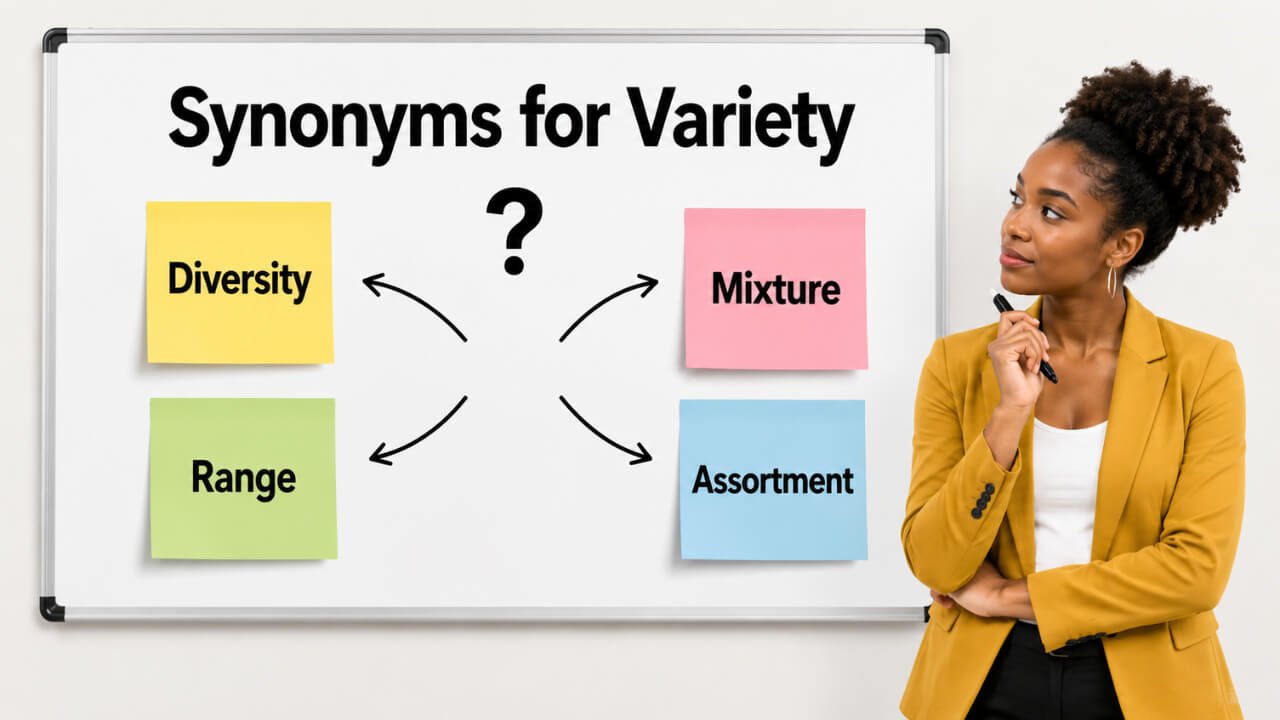
Quick Answer: The best synonyms for variety include diversity, range, assortment, selection, array, mixture, variation, collection, spectrum, and choice. Use diversity when emphasizing meaningful differences among people, ideas, or elements. Range works well for products, prices, skills, or possibilities. Assortment and selection are useful for available items, while mixture describes different things combined together. Variation refers to differences or changes within a group. In formal writing, diversity, multiplicity, and spectrum are strong choices. In casual speech, mix, choice, and spread often sound more natural.
Pronunciation and Word Details
Word: Variety
Pronunciation: /vəˈraɪəti/
Part of Speech: Noun
Meaning: A number of different types, choices, forms, or examples within a group.
US Pronunciation:
UK Pronunciation:
What Does “Variety” Mean?
Variety means the presence of several different types, choices, forms, or qualities within one group or situation.
Variety is a noun. It is commonly used when talking about products, food, people, activities, ideas, designs, experiences, plants, animals, or available options. The word suggests that things are not all the same.
In the phrase “a variety of,” the word means several different kinds. For example, “a variety of books” means books from different genres, subjects, styles, or authors.
Variety can also refer to change that prevents an experience from becoming repetitive. Someone may add variety to a daily routine by trying different activities.
In science, farming, and gardening, variety can describe a particular form of a plant or organism that has distinct features. In most everyday sentences, however, it simply refers to diversity, range, or different available choices.
Meaning, Tone, and Context of “Variety”
Variety is a neutral and widely used word. It works naturally in formal writing, academic explanations, business communication, descriptions, reports, and everyday conversation.
The word usually has a positive tone because it suggests choice, interest, flexibility, or diversity. A wide variety of products gives customers more options. Variety in a routine can make life feel less repetitive.
In academic or professional writing, variety may refer to differences in methods, sources, perspectives, skills, or results. Diversity, range, variation, and multiplicity may sometimes express these meanings more precisely.
In casual conversation, variety often refers to available choices. Someone might say that a restaurant offers plenty of variety or that a weekly schedule needs more variety.
The word can also be technical in biology, agriculture, and horticulture, where it may describe a distinct form of a plant within a species. Context determines whether variety means diversity in general or one particular kind.
When and How to Use “Variety”
For Different Choices: Use variety when several options are available.
Example: The store offers a variety of sizes and styles.
For Different Types: Use variety to describe several kinds within one larger category.
Example: The garden contains a variety of flowering plants.
For Diversity: Use variety when emphasizing differences among ideas, experiences, people, or features.
Example: The discussion included a variety of opinions.
For Products and Services: Use variety when describing a broad selection of available items or services.
Example: Customers can choose from a variety of payment methods.
For Food and Meals: Use variety when several flavors, ingredients, dishes, or food groups are included.
Example: A balanced meal plan should contain a variety of foods.
For Change and Interest: Use variety when something prevents boredom or repetition.
Example: Adding variety to your routine can make exercise more enjoyable.
For Research and Writing: Use variety when referring to different sources, examples, methods, or sentence patterns.
Example: The report uses a variety of reliable evidence.
For Natural Groups: Use variety when describing different plants, animals, landscapes, or natural features.
Example: The region supports a remarkable variety of wildlife.
Best Synonyms for Variety
Diversity
Synonym: Diversity means the presence of noticeable differences within a group.
Example: The course encourages diversity of thought and experience.
Range
Synonym: Range means a number of different options, levels, types, or possibilities.
Example: The program covers a broad range of practical skills.
Assortment
Synonym: Assortment means a group of different items collected or offered together.
Example: The gift basket contained an assortment of snacks.
Selection
Synonym: Selection means a group of available items from which someone can choose.
Example: The library has an excellent selection of history books.
Array
Synonym: Array means an impressive or organized collection of different things.
Example: Visitors could choose from an array of activities.
Mixture
Synonym: Mixture means different substances, ideas, qualities, or elements combined together.
Example: The design uses a mixture of traditional and modern features.
Variation
Synonym: Variation means a difference or change within a group, pattern, or standard form.
Example: There was considerable variation in the survey results.
Collection
Synonym: Collection means a group of objects, works, ideas, or examples gathered together.
Example: The museum displays a collection of regional artwork.
Spectrum
Synonym: Spectrum means a broad range of related qualities, positions, or possibilities.
Example: The participants represented a wide spectrum of opinions.
Choice
Synonym: Choice means a number of available options or the ability to select among them.
Example: Customers appreciate having more choice.
50 Synonyms for Variety with Short Meanings
- Diversity: The presence of different types or qualities.
- Range: A number of available types, levels, or possibilities.
- Assortment: A collection of different items.
- Selection: A group of options available for choosing.
- Array: An impressive or organized display of different things.
- Collection: A group of items gathered together.
- Mixture: Different elements combined in one whole.
- Mix: An informal word for different things combined together.
- Combination: Two or more different things joined together.
- Variation: A difference or change within a group or pattern.
- Multiplicity: The state of having many different elements or forms.
- Spectrum: A broad range of related possibilities or qualities.
- Choice: A number of options available for selection.
- Breadth: The wide extent or range of something.
- Abundance: A large amount or rich supply of different things.
- Profusion: A generous quantity or extensive display.
- Miscellany: A group of different and unrelated items.
- Medley: A varied mixture of elements presented together.
- Blend: A combination of different qualities or components.
- Lineup: A set of people, products, or activities presented together.
- Spread: A broad or varied display of available items.
- Cross Section: A representative group showing different types.
- Sampling: A small selection representing a larger variety.
- Set: A group of related or collected items.
- Group: A number of things considered together.
- Series: A number of related items, events, or forms.
- Category: A class containing things with shared qualities.
- Kind: A particular type within a larger group.
- Type: A class or form with shared features.
- Form: A particular version, shape, or expression of something.
- Class: A group of things sharing common qualities.
- Sort: A particular kind or category.
- Option: One possible choice among several.
- Alternative: A different available possibility.
- Difference: A quality that makes one thing unlike another.
- Distinction: A clear difference between types or examples.
- Change: A movement from one condition, style, or form to another.
- Variability: The ability or tendency to differ or change.
- Diversification: The process of adding different types or activities.
- Heterogeneity: The state of containing different kinds or qualities.
- Plurality: The condition of existing in several forms or types.
- Richness: An impressive amount of detail, diversity, or quality.
- Versatility: The ability to offer several uses, forms, or functions.
- Scope: The extent of available subjects, activities, or possibilities.
- Extent: The amount, degree, or range covered.
- Gamut: The complete range of possible types or experiences.
- Kaleidoscope: A vivid and changing collection of different elements.
- Patchwork: A combination of different pieces, styles, or ideas.
- Potpourri: A varied mixture of different things.
- Mixed Bag: An informal expression for a group containing different types or qualities.
Read Also:
Synonyms for Express
Synonyms for Variety by Context
When Variety Means Diversity
Diversity is the strongest synonym when variety refers to meaningful differences among people, ideas, experiences, cultures, skills, or perspectives.
Multiplicity and heterogeneity are more formal. Multiplicity emphasizes a large number of different elements. Heterogeneity emphasizes that the parts of a group are not alike.
Plurality can describe the existence of several viewpoints, identities, or forms. Richness often presents diversity positively by suggesting depth and value.
Example: The team benefits from diversity of experience.
Example: The research revealed a multiplicity of possible causes.
Example: The region is known for the richness of its traditions.
When Variety Means Range
Range is often the best replacement when describing available products, services, prices, subjects, abilities, or possibilities.
Spectrum works well when the options belong to a continuous scale, such as beliefs, emotions, colors, or abilities. Breadth emphasizes how widely a subject or selection extends. Gamut refers to the complete range of possible experiences or qualities.
Example: The course covers a wide range of topics.
Example: The survey included people from across the political spectrum.
Example: Her work demonstrates impressive breadth and depth.
When Variety Means Selection
Selection, assortment, array, lineup, and spread are useful when variety refers to a group of available items.
Selection focuses on choice. Assortment highlights differences among the items. Array can suggest an impressive or attractive presentation. Lineup is common for events, performers, products, or planned activities. Spread often refers to food or a visually broad display.
Example: The shop offers a large selection of notebooks.
Example: The box contained an assortment of handmade items.
Example: The festival presented an impressive lineup of performers.
When Variety Means Mixture
Mixture, mix, blend, combination, medley, potpourri, and patchwork describe different elements brought together.
Mixture is neutral and flexible. Mix is more conversational. Blend suggests that the elements work smoothly together. Combination simply means that different parts have been joined. Medley often refers to music, food, colors, or creative elements.
Patchwork may suggest that separate pieces remain noticeable. Potpourri is a colorful or informal term for an unusual mixture.
Example: The neighborhood contains a mixture of old and new buildings.
Example: Her style is a blend of comfort and elegance.
Example: The show offered a medley of songs from different periods.
When Variety Means Different Kinds
Kind, type, sort, form, class, and category work when variety means one particular kind within a larger group.
These words do not always replace variety in sentences about diversity. They are most useful when variety refers to a specific type.
Example: This variety of tomato grows well in warm weather.
Example: This type of tomato grows well in warm weather.
Example: The store sells every kind of kitchen tool.
When Variety Means Change
Variation, variability, change, diversification, and versatility are useful when variety refers to difference, flexibility, or freedom from repetition.
Variation describes a difference within a pattern or group. Variability refers to the tendency to change. Diversification means adding new types, products, investments, or activities. Versatility describes the ability to serve several purposes.
Example: There is noticeable variation in the quality of the samples.
Example: The business reduced risk through diversification.
Example: The tool is valued for its versatility.
When Variety Means Plenty of Options
Choice, option, alternative, abundance, and profusion work when variety emphasizes availability.
Choice can mean both the available options and the freedom to select. Option refers to one possibility. Alternative is a different possibility that can replace the first. Abundance and profusion suggest that many choices or examples are present.
Example: The new menu gives customers greater choice.
Example: Several alternatives are available.
Example: The garden displayed a profusion of colors.
Another Word for Variety
Diversity is often the best single replacement for variety when the sentence emphasizes meaningful differences. However, the most accurate alternative depends on the context.
Use range for available possibilities, selection for products or choices, assortment for different items, mixture for combined elements, and variation for differences within a group.
Original: The class included a variety of viewpoints.
Better Option: The class included a diversity of viewpoints.
Original: The shop offers a variety of affordable products.
Better Option: The shop offers a range of affordable products.
Original: The table held a variety of desserts.
Better Option: The table held an assortment of desserts.
Original: The results showed a variety of responses.
Better Option: The results showed considerable variation in responses.
When Not to Use “Variety”
Variety is useful, but it can become vague or repetitive when a more specific word would communicate the meaning more clearly.
Avoid using variety several times in the same paragraph. Replace it with range, selection, diversity, mixture, variation, or assortment according to the intended meaning.
Do not use variety when you are referring to only one option unless the word means a particular type. “A variety of solutions” means several solutions, while “a plant variety” means one specific type of plant.
In formal reports, clarify whether variety refers to differences, available choices, broad coverage, or inconsistent results.
Weak: The report contains a variety of information.
Better: The report contains information from a broad range of subjects.
Weak: The store has a variety of variety in its products.
Better: The store offers a diverse selection of products.
Weak: There was a variety in the test scores.
Better: There was considerable variation in the test scores.
Weak: We need variety in our possible choices.
Better: We need a wider range of choices.
Weak: The box contains a variety of mixed objects.
Better: The box contains an assortment of objects.
Words Commonly Confused With Variety
Variety vs Diversity: Variety means the presence of different types or choices. Diversity often emphasizes meaningful differences within a group, especially among people, ideas, cultures, or experiences.
Variety vs Range: Variety focuses on differences among items. Range focuses on the extent from one type, level, or possibility to another.
Variety vs Variation: Variety means several different kinds. Variation means a particular difference or the process of changing within a group.
Variety vs Assortment: Variety is a broad concept. Assortment usually refers to a collection of different physical items offered or gathered together.
Variety vs Selection: Variety emphasizes difference. Selection emphasizes the items available for someone to choose from.
Variety vs Mixture: Variety means that different things are present. Mixture means those different things have been combined.
Variety vs Choice: Variety refers to differences among options. Choice refers to the available options or the act of selecting one.
Variety vs Type: Variety may mean several different kinds, but it can also mean one specific form of a plant or product. Type refers to one category with shared features.
Which Synonym Should You Choose?
Choose diversity when writing about different people, perspectives, experiences, skills, cultures, or ideas.
Choose range when describing products, prices, abilities, services, topics, possibilities, or levels.
Choose selection when the sentence focuses on items available for someone to choose.
Choose assortment when describing a collection of different objects, foods, gifts, or products.
Choose array when the collection is impressive, organized, or visually noticeable.
Choose mixture when different elements, ingredients, ideas, or qualities are combined.
Choose blend when the different elements combine smoothly and create a unified result.
Choose variation when describing differences in data, performance, appearance, pronunciation, quality, or behavior.
Choose spectrum when discussing a broad scale of opinions, emotions, abilities, or positions.
Choose multiplicity in formal or academic writing when emphasizing many possible forms, causes, or interpretations.
Choose heterogeneity in scientific, technical, or academic writing when a group contains unlike elements.
Choose choice in casual or customer focused writing when emphasizing available options.
Choose diversification when discussing the addition of new products, investments, activities, or strategies.
Choose versatility when describing a person or object that can perform several functions.
Choose kind, type, sort, or form when variety means one particular category.
Real Life Examples of “Variety” in Sentences
Original: The website provides a variety of learning materials.
Better Option: The website provides a wide range of learning materials.
Original: The market sells a variety of fresh fruits.
Better Option: The market sells an assortment of fresh fruits.
Original: The committee included a variety of opinions.
Better Option: The committee included a diversity of opinions.
Original: The survey produced a variety of answers.
Better Option: The survey produced considerable variation in the answers.
Original: The menu offers a variety of vegetarian dishes.
Better Option: The menu offers a broad selection of vegetarian dishes.
Original: Her artwork uses a variety of colors and textures.
Better Option: Her artwork uses a rich spectrum of colors and textures.
Original: The workshop includes a variety of practical activities.
Better Option: The workshop includes an array of practical activities.
Original: The neighborhood contains a variety of architectural styles.
Better Option: The neighborhood contains a mixture of architectural styles.
Original: The job requires a variety of technical skills.
Better Option: The job requires a broad range of technical skills.
Original: The program adds variety to the weekly routine.
Better Option: The program brings welcome change to the weekly routine.
Synonym Groups and Usage Differences
Diversity Group
Diversity, multiplicity, heterogeneity, plurality, and richness emphasize the presence of meaningful differences.
Diversity is the most common and flexible word in this group. Multiplicity emphasizes number. Heterogeneity is more technical and focuses on unlike elements. Plurality highlights the existence of several forms or perspectives. Richness presents diversity as valuable or impressive.
Example: The diversity of perspectives improved the discussion.
Range Group
Range, spectrum, breadth, scope, extent, and gamut describe how widely something reaches.
Range is suitable for most formal and casual contexts. Spectrum often describes positions along a scale. Breadth focuses on wide coverage. Scope refers to the boundaries of a subject or activity. Gamut suggests the complete range.
Example: The book covers a broad range of historical periods.
Selection Group
Selection, assortment, array, collection, lineup, spread, and set describe groups of available or gathered items.
Selection highlights choice. Assortment emphasizes differences among items. Array suggests an impressive display. Collection focuses on items brought together. Lineup often refers to scheduled people, products, or events.
Example: The exhibition presents an impressive array of paintings.
Mixture Group
Mixture, mix, combination, blend, medley, patchwork, potpourri, and mixed bag describe different elements placed together.
Mixture and combination are neutral. Mix is informal. Blend suggests harmony. Medley often has a creative or enjoyable tone. Patchwork suggests separate pieces joined together. Mixed bag can indicate uneven quality.
Example: The final design is a blend of traditional and modern elements.
Difference Group
Variation, difference, distinction, variability, and change focus on how things are not the same.
Variation is useful for measurable or observable differences. Difference is the broadest term. Distinction refers to a clear dividing feature. Variability describes a tendency to change.
Example: Researchers observed significant variation between the samples.
Choice Group
Choice, option, and alternative refer to possibilities available for selection.
Choice can refer to all available possibilities or the act of choosing. Option means one possible course. Alternative is usually a replacement for another option.
Example: Flexible hours give employees more choice.
Type Group
Kind, type, form, class, category, and sort identify one group or version within a larger whole.
Kind and type are common in everyday language. Form often refers to the way something appears or exists. Class and category are useful for organized systems. Sort is conversational.
Example: This type of fabric is suitable for warm weather.
Abundance Group
Abundance, profusion, and richness describe a generous amount or impressive supply.
Abundance focuses on quantity. Profusion suggests something displayed or produced in large amounts. Richness combines quantity, depth, and value.
Example: The forest supports an abundance of plant life.
Antonyms of Variety
The opposite of variety depends on whether the word refers to differences, choices, change, or several types.
Sameness: The condition of being identical or very similar.
Uniformity: Consistency without noticeable differences.
Monotony: Repetition that creates boredom or lack of interest.
Similarity: The quality of being alike.
Repetition: The act of doing or presenting the same thing again.
Consistency: The condition of remaining steady or unchanged.
Homogeneity: The state of containing elements that are all alike.
Singularity: The condition of being one rather than many.
Limitation: A restriction on available choices or possibilities.
Scarcity: A shortage or insufficient supply.
Narrowness: A limited range, scope, or variety.
Standardization: The process of making things follow one common form.
Uniformness: A lack of differences in appearance or character.
Predictability: The quality of following an expected pattern.
Conformity: Agreement with one standard, pattern, or accepted practice.
Comparison: Variety vs Related Words
Variety vs Diversity
Variety refers broadly to different types or choices. Diversity places greater emphasis on meaningful differences within a group.
Example With Variety: The event included a variety of activities.
Example With Diversity: The team valued diversity of experience and perspective.
Variety vs Range
Variety focuses on different kinds. Range focuses on the full extent of available types, levels, or possibilities.
Example With Variety: The shop sells a variety of jackets.
Example With Range: The shop sells jackets across a wide range of prices.
Variety vs Assortment
Variety can describe an abstract quality or several types. Assortment usually refers to a group of different items presented together.
Example With Variety: The course offers variety in its weekly activities.
Example With Assortment: The basket contained an assortment of fruit.
Variety vs Selection
Variety emphasizes differences among available things. Selection emphasizes the group from which someone can choose.
Example With Variety: The menu provides plenty of variety.
Example With Selection: The menu provides a large selection of soups.
Variety vs Variation
Variety means several different types. Variation means a difference from a standard, pattern, or other example.
Example With Variety: The garden contains a variety of roses.
Example With Variation: There is noticeable variation in the color of the roses.
Variety vs Mixture
Variety means that different things exist or are available. Mixture means that different things have been combined.
Example With Variety: The course includes a variety of subjects.
Example With Mixture: The course is a mixture of theory and practical work.
Variety vs Spectrum
Variety describes different kinds in general. Spectrum suggests a broad range extending between two ends or across many related positions.
Example With Variety: The group expressed a variety of opinions.
Example With Spectrum: The group represented a broad spectrum of political opinions.
Variety vs Choice
Variety describes differences among options. Choice refers to the available options or the decision between them.
Example With Variety: The store offers variety in color and design.
Example With Choice: Customers have a choice between five colors.
Common Phrases and Expressions With “Variety”
Wide Variety: A large range of different types or choices.
Great Variety: An impressive amount of difference or selection.
Large Variety: Many different available options or examples.
Rich Variety: A diverse and valuable collection of types or qualities.
Endless Variety: A seemingly unlimited number of choices or forms.
Variety of Options: Several different possibilities from which to choose.
Variety of Styles: Several different designs, appearances, or methods.
Variety of Reasons: Several different explanations or causes.
Variety of Sources: Information gathered from different places or materials.
Variety Is the Spice of Life: Differences and changes make life more interesting.
Common Mistakes to Avoid
Repeating Variety Too Often: Using variety several times in one paragraph can make the writing sound limited. Replace it with range, diversity, assortment, selection, or mixture when appropriate.
Using Variety With an Incorrect Verb: The phrase “a variety of” is usually followed by a plural noun. The verb often agrees with the plural noun when the sentence emphasizes the individual items.
Example: A variety of activities are available.
Using Variety When You Mean Variation: Variety refers to different types. Variation refers to measurable differences or changes among examples.
Incorrect: The study found a variety in temperature.
Better: The study found variation in temperature.
Confusing Variety With Amount: Variety describes different kinds, not simply a large quantity. A store can have many products but little variety if all products are almost identical.
Choosing Assortment for Abstract Ideas: Assortment sounds most natural for physical items. Diversity or range is usually better for opinions, skills, experiences, and perspectives.
Unnatural: The team has an assortment of experiences.
Better: The team has a diversity of experiences.
Using Diversity When Only Choice Is Intended: Diversity can carry a deeper meaning than simple product availability. Use selection or range when discussing items for sale.
Vague: The company provides a variety of solutions.
Better: The company provides solutions for planning, storage, reporting, and communication.
Using “Varieties” Incorrectly: Varieties refers to several distinct types, often within one category. Use it when the individual types matter.
Example: The farm grows several varieties of apples.
Adding Unnecessary Words: Phrases such as “many different varieties of options” are repetitive.
Wordy: Customers can choose from many different varieties of options.
Better: Customers can choose from many options.
Conclusion
Synonyms for variety help writers express differences, choices, mixtures, and ranges more precisely. Diversity works well for people, ideas, and experiences, while range suits products, prices, skills, and possibilities. Selection and assortment describe available items, and mixture or blend explains combined elements. Variation is best for measurable differences, while spectrum suggests broad coverage. Choosing the right alternative makes a sentence clearer by showing whether variety refers to different kinds, available choices, change, abundance, or a specific type.
FAQs About Synonyms for Variety
What is the best synonym for variety?
Diversity is a strong general synonym when emphasizing differences. Range is often better for available products, services, skills, prices, or possibilities.
What is another word for a variety of?
Useful alternatives include a range of, a selection of, an assortment of, an array of, several kinds of, and many types of.
What is a formal synonym for variety?
Diversity, multiplicity, heterogeneity, variation, spectrum, and breadth are suitable formal alternatives, depending on context.
What is a synonym for a wide variety?
A broad range, extensive selection, diverse array, large assortment, and rich spectrum can replace a wide variety.
Are variety and diversity the same?
They are related but not identical. Variety refers broadly to different types, while diversity often emphasizes meaningful differences within a group.
What is the difference between variety and variation?
Variety means several different types or choices. Variation means a difference or change among examples, measurements, or forms.
Can variety refer to one type?
Yes. In biology, gardening, and farming, a variety can mean one specific form within a species or larger category.
