
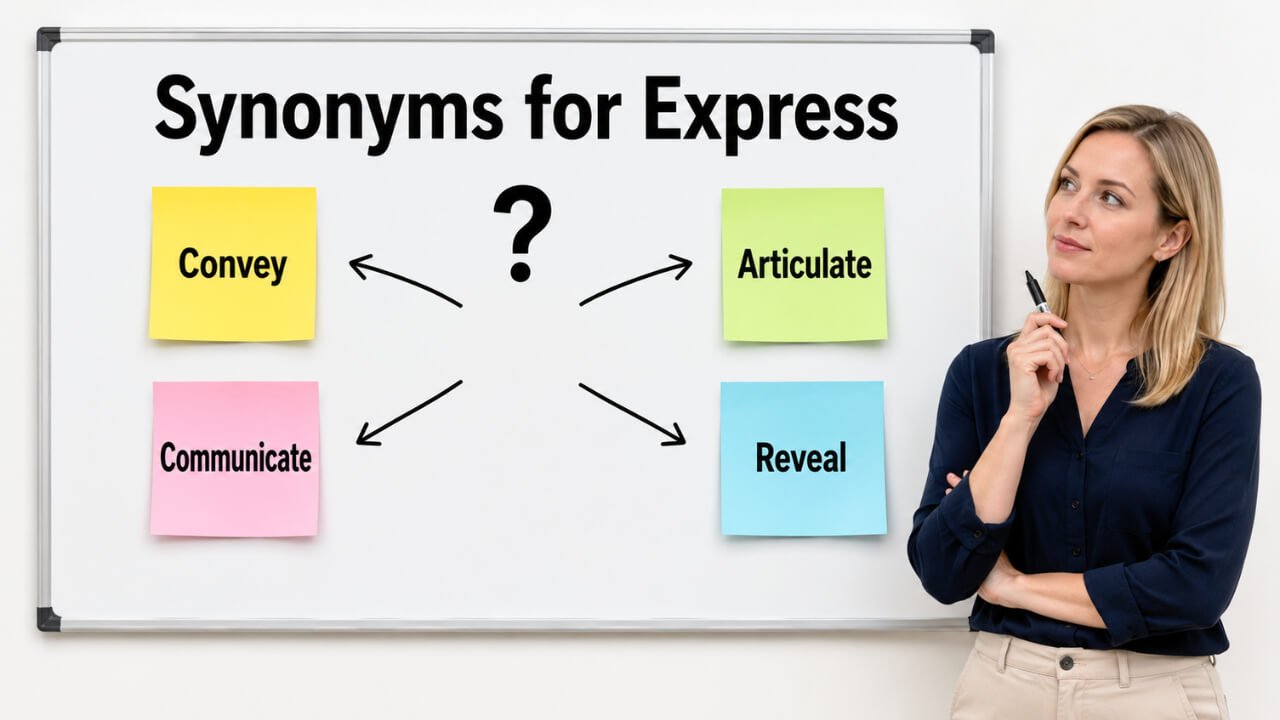
Quick Answer: The best synonyms for express include convey, communicate, articulate, state, voice, reveal, demonstrate, represent, indicate, and declare. Use convey or communicate for sharing information, articulate for presenting an idea clearly, state for giving a direct opinion, and voice for sharing a feeling or concern. Demonstrate works when actions provide evidence, while represent is suitable for symbols and ideas. As an adjective, express can also mean fast, direct, clearly stated, or specifically intended.
Pronunciation and Word Details
Word: Express.
Pronunciation: /ɪkˈspres/.
Part of Speech: Verb, adjective, and noun.
Meaning: To communicate or show a thought, feeling, quality, or message, or to describe something fast and direct.
US Pronunciation:
UK Pronunciation:
What Does “Express” Mean?
Express means to communicate, show, or make a thought, feeling, opinion, or quality known. It is most commonly used as a verb.
A person can express an opinion through speech, express an emotion through facial movements, or express an idea through writing. Actions, art, symbols, and gestures can also express meaning without spoken words.
Express can also function as an adjective. In this use, it may describe something fast, direct, clearly stated, or created for a particular purpose. An express service is faster than a regular service, while an express instruction is clearly and directly stated.
As a noun, express can refer to a fast transportation or delivery service.
Meaning, Tone, and Context of “Express”
Express is generally a neutral and flexible word. It can appear naturally in formal writing, academic discussions, professional communication, personal conversations, and emotional statements.
In formal contexts, people commonly express concern, gratitude, interest, support, or disagreement. In casual speech, someone might express how they feel or express an opinion about an everyday situation.
The tone depends on what is being communicated. Express gratitude sounds polite and positive, while express anger may sound emotional and strong. Express concern often sounds serious but respectful.
In academic or technical writing, express may describe how a formula, symbol, graph, or statement presents information. In creative writing, it can describe how a person communicates emotions, personality, or imagination.
When and How to Use “Express”
For Communicating Ideas: Use express when someone communicates a thought, belief, or message.
Example: The writer expressed her main idea clearly in the opening paragraph.
For Sharing Feelings: Use express when someone reveals an emotion or personal reaction.
Example: He found it difficult to express his sadness in words.
For Giving an Opinion: Use express when someone states a personal view or judgment.
Example: Every participant was invited to express an opinion.
For Showing Gratitude: Use express when offering thanks in a sincere or formal way.
Example: We would like to express our gratitude for your assistance.
For Showing Concern: Use express when politely communicating worry or doubt.
Example: Several residents expressed concern about the proposed changes.
For Demonstrating a Quality: Use express when an action, appearance, or work shows a particular quality.
Example: The design expresses simplicity and balance.
For Symbolic Meaning: Use express when a symbol, image, or action represents an idea.
Example: The white flower expresses peace and remembrance.
For Speed or Directness: Use express as an adjective when describing something fast or direct.
Example: They selected the express service because the package was urgent.
Best Synonyms for Express
Convey
Synonym: To communicate an idea, feeling, or message successfully.
Example: Her calm voice conveyed confidence and experience.
Communicate
Synonym: To share information, thoughts, or feelings with another person.
Example: The manager communicated the new instructions clearly.
Articulate
Synonym: To express an idea clearly and effectively in words.
Example: She articulated her concerns during the discussion.
State
Synonym: To express something directly, clearly, and formally.
Example: The report states the main findings in simple language.
Voice
Synonym: To express an opinion, concern, feeling, or objection openly.
Example: Several employees voiced their concerns about the schedule.
Reveal
Synonym: To make a hidden thought, feeling, or fact known.
Example: His expression revealed a sense of disappointment.
Demonstrate
Synonym: To express or prove something through actions, evidence, or examples.
Example: Her consistent work demonstrated strong commitment.
Represent
Synonym: To express or stand for an idea, group, quality, or meaning.
Example: The symbol represents unity and cooperation.
Indicate
Synonym: To express or suggest information through a sign, result, or signal.
Example: The results indicate a noticeable improvement.
Declare
Synonym: To express something publicly, firmly, or officially.
Example: The speaker declared his support for the proposal.
50 Synonyms for Express with Short Meanings
- Convey: To communicate a message or feeling.
- Communicate: To share information or ideas.
- Articulate: To present thoughts clearly in words.
- State: To express something clearly and directly.
- Voice: To make an opinion or feeling known.
- Reveal: To show something previously hidden.
- Show: To make a feeling or quality visible.
- Demonstrate: To show through evidence or actions.
- Indicate: To point out or suggest meaning.
- Represent: To stand for or communicate something.
- Declare: To express something firmly or officially.
- Announce: To make information publicly known.
- Mention: To refer to something briefly.
- Describe: To express details about something.
- Explain: To make an idea easier to understand.
- Share: To communicate thoughts or feelings with others.
- Tell: To give information through words.
- Say: To express something verbally.
- Utter: To produce spoken words or sounds.
- Verbalize: To put a thought or feeling into words.
- Phrase: To express an idea using particular words.
- Formulate: To organize and express an idea carefully.
- Present: To communicate information for consideration.
- Report: To give an account of information or events.
- Proclaim: To express something publicly and confidently.
- Assert: To express a belief firmly.
- Affirm: To express agreement, support, or certainty.
- Pronounce: To state something formally or authoritatively.
- Disclose: To reveal information that was private.
- Display: To show a feeling, quality, or feature.
- Manifest: To make a feeling or quality clearly visible.
- Exhibit: To show a particular behavior or characteristic.
- Portray: To express someone or something through description.
- Depict: To represent something in words or images.
- Reflect: To show a feeling, condition, or quality.
- Symbolize: To express an idea through a symbol.
- Embody: To represent a quality in a clear form.
- Signify: To communicate or indicate a particular meaning.
- Imply: To express something indirectly.
- Signal: To communicate through an action or sign.
- Transmit: To send information, sound, or meaning.
- Relay: To pass information from one person to another.
- Impart: To communicate knowledge or information.
- Emote: To express emotion openly.
- Vent: To express strong or frustrated feelings.
- Confess: To express a private truth or admission.
- Confide: To share personal thoughts privately.
- Put Into Words: To communicate a thought through language.
- Make Known: To reveal or communicate information.
- Get Across: To communicate an idea successfully.
Read Also:
Synonyms for Wild

Synonyms for Express by Context
When Express Means Communicate an Idea
Convey, communicate, articulate, explain, phrase, and formulate are useful when express refers to sharing an idea or message.
Convey focuses on successfully transferring meaning. Communicate is broad and practical. Articulate emphasizes clarity and skill. Formulate suggests careful organization before speaking or writing.
Example: She articulated the proposal in a clear and convincing way.
When Express Means State an Opinion
State, voice, declare, assert, affirm, and announce work when someone makes an opinion or position known.
State is neutral and direct. Voice is often used for concerns, objections, or opinions. Assert suggests confidence, while declare sounds stronger and more public.
Example: The committee voiced its support for the revised plan.
When Express Means Show Emotion
Reveal, display, manifest, emote, vent, confide, and share are suitable for feelings and emotional reactions.
Reveal may refer to emotions shown unintentionally. Display suggests that an emotion is visible. Vent is used for strong frustration, while confide describes sharing private feelings with someone trusted.
Example: His face revealed how worried he felt.
When Express Means Demonstrate Through Actions
Demonstrate, show, exhibit, manifest, reflect, and display are useful when actions or behavior communicate a quality.
Demonstrate often involves clear evidence. Exhibit is commonly used for behavior or characteristics. Reflect shows that one thing communicates the nature or condition of another.
Example: Her patience demonstrated excellent leadership.
When Express Means Represent or Symbolize
Represent, symbolize, embody, signify, portray, and depict are useful when an object, image, action, or person communicates a larger idea.
Represent is broad and neutral. Symbolize focuses on symbolic meaning. Embody suggests that a person or object is a strong example of a quality.
Example: The open door symbolizes opportunity and welcome.
When Express Means Fast or Direct
Fast, rapid, direct, immediate, expedited, and clearly stated may replace express when it functions as an adjective.
Fast and rapid focus on speed. Direct describes a route or service without unnecessary stops. Clearly stated works when express means openly or specifically communicated.
Example: The company arranged expedited delivery for the urgent documents.
Another Word for Express
Convey is often the best single replacement for express when discussing ideas, feelings, messages, or meaning. It works well in formal, academic, professional, and creative writing.
However, the best alternative depends on context. Articulate is better for clear speech, voice is better for opinions or concerns, and demonstrate is better when actions provide evidence.
Original: The paragraph expresses the writer’s main argument.
Better Option: The paragraph conveys the writer’s main argument.
Original: She expressed her concerns clearly.
Better Option: She articulated her concerns clearly.
Original: Several members expressed disagreement.
Better Option: Several members voiced disagreement.
Original: His actions expressed genuine loyalty.
Better Option: His actions demonstrated genuine loyalty.
When Not to Use “Express”
Do not use express repeatedly when a more precise word can identify how something is communicated. State, reveal, demonstrate, describe, and symbolize often provide clearer meaning.
Express may also sound too formal in a very casual sentence. In simple conversation, say, tell, or show may sound more natural.
Avoid using express when you actually mean explain. Express means to communicate an idea, while explain means to make that idea understandable by giving details.
Weak: The report expresses the results of the experiment.
Better: The report presents the results of the experiment.
Weak: He expressed me the reason for leaving.
Better: He told me the reason for leaving.
Weak: The teacher expressed how the formula works.
Better: The teacher explained how the formula works.
Weak: Her actions expressed that she was dependable.
Better: Her actions demonstrated that she was dependable.
Words Commonly Confused With Express
Express vs Explain: Express means to communicate a thought or feeling. Explain means to make something understandable by giving reasons, details, or examples.
Express vs Convey: Both words involve communication. Express focuses on making something known, while convey emphasizes successfully transferring meaning to another person.
Express vs State: Express can involve words, actions, emotions, or symbols. State usually means to communicate something directly and clearly in words.
Express vs Demonstrate: Express can refer to any form of communication. Demonstrate usually involves showing something through evidence, behavior, or practical action.
Express vs Reveal: Express often suggests intentional communication. Reveal may describe information or feelings that become known intentionally or unintentionally.
Express vs Represent: Express means to communicate meaning. Represent means to stand for, symbolize, or act on behalf of something.
Express vs Explicit: Express is commonly a verb meaning to communicate. Explicit is an adjective meaning clear, direct, and leaving no uncertainty.
Which Synonym Should You Choose?
Choose convey when writing about the communication of meaning, emotion, tone, or information.
Choose communicate for general sharing between people, groups, or systems.
Choose articulate when someone presents a complex idea clearly and effectively.
Choose state for direct statements in reports, essays, instructions, and formal documents.
Choose voice for opinions, concerns, objections, support, and personal views.
Choose reveal when a feeling, fact, or intention becomes visible or known.
Choose demonstrate when actions, evidence, or results show a quality or conclusion.
Choose indicate when data, signs, or results suggest particular information.
Choose represent when discussing symbols, groups, ideas, or abstract qualities.
Choose say or tell in casual conversation when express sounds unnecessarily formal.
Choose declare or proclaim for strong, public, or official statements.
Choose expedited, rapid, or direct when express describes speed or a service.
Real Life Examples of “Express” in Sentences
Original: She expressed her opinion during the meeting.
Better Option: She voiced her opinion during the meeting.
Original: The painting expresses a feeling of loneliness.
Better Option: The painting conveys a feeling of loneliness.
Original: He expressed the idea in simple language.
Better Option: He articulated the idea in simple language.
Original: The results express a clear improvement in performance.
Better Option: The results indicate a clear improvement in performance.
Original: Her actions expressed genuine kindness.
Better Option: Her actions demonstrated genuine kindness.
Original: The symbol expresses hope and renewal.
Better Option: The symbol represents hope and renewal.
Original: They expressed their decision in a written statement.
Better Option: They declared their decision in a written statement.
Original: His face expressed disappointment.
Better Option: His face revealed disappointment.
Original: The speaker expressed the problem in great detail.
Better Option: The speaker described the problem in great detail.
Original: Please express the instructions to the new employees.
Better Option: Please communicate the instructions to the new employees.
Synonym Groups and Usage Differences
Communication Group
Convey, communicate, relay, transmit, impart, and get across all involve transferring information or meaning.
Convey emphasizes meaning, while relay often involves passing information received from another source.
Example: The chart conveys the information more clearly than the paragraph.
Clear Statement Group
State, articulate, formulate, phrase, assert, and declare involve presenting something in words.
Articulate emphasizes clarity. Formulate suggests careful preparation. Assert and declare communicate confidence or firmness.
Example: She formulated a clear response before the interview.
Emotion Group
Voice, reveal, share, emote, vent, confide, and confess relate to feelings and personal thoughts.
Voice is useful for opinions and concerns. Confide suggests privacy and trust. Vent usually refers to releasing frustration or anger.
Example: He confided his concerns to a close friend.
Evidence Group
Show, demonstrate, indicate, display, exhibit, manifest, and reflect communicate meaning through evidence or visible qualities.
Demonstrate is strong when evidence supports a claim. Indicate is more cautious because it may suggest rather than prove.
Example: The test results indicate steady progress.
Representation Group
Represent, symbolize, portray, depict, signify, and embody relate to symbolic or descriptive meaning.
Portray and depict are common in writing and visual art. Symbolize and signify focus on what something means.
Example: The character embodies courage and determination.
Public Statement Group
Announce, proclaim, declare, pronounce, report, and disclose involve making information known.
Announce is suitable for general news. Proclaim is forceful and public. Disclose often involves information that was previously private.
Example: The organization announced the final decision.
Antonyms of Express
The opposite of express depends on whether the word refers to communication, emotion, meaning, speed, or directness.
Conceal: To keep information, thoughts, or feelings hidden.
Hide: To prevent something from being seen or known.
Suppress: To prevent a feeling or thought from being expressed.
Withhold: To choose not to share information.
Silence: To stop someone from communicating.
Restrain: To control or limit an emotional reaction.
Obscure: To make meaning difficult to understand.
Disguise: To hide the true nature of something.
Misrepresent: To communicate something inaccurately.
Confuse: To make an idea unclear rather than understandable.
Delay: To make something slower or later.
Slow: To move or operate without speed.
Indirect: Not following a direct route or method.
Unstated: Not communicated clearly or openly.
Comparison: Express vs Related Words
Express vs Convey
Express focuses on making a thought, feeling, or idea known. Convey emphasizes whether the meaning successfully reaches another person.
Example With Express: She expressed her gratitude in a handwritten message.
Example With Convey: Her message conveyed sincere gratitude.
Express vs Communicate
Express often describes a particular thought, feeling, or opinion. Communicate is broader and may include the exchange of information between several people.
Example With Express: He expressed concern about the deadline.
Example With Communicate: He communicated the new deadline to the entire team.
Express vs Articulate
Express can describe any method of sharing meaning. Articulate specifically suggests clear, effective, and organized verbal communication.
Example With Express: She expressed her thoughts about the issue.
Example With Articulate: She articulated a detailed solution to the issue.
Express vs State
Express may involve words, actions, symbols, or emotions. State normally refers to direct communication through spoken or written words.
Example With Express: The music expresses a sense of hope.
Example With State: The author states the main argument in the introduction.
Express vs Demonstrate
Express means to communicate or show something. Demonstrate suggests stronger evidence through actions, examples, or results.
Example With Express: He expressed his commitment to the project.
Example With Demonstrate: He demonstrated his commitment by completing every task early.
Express vs Reveal
Express often describes deliberate communication. Reveal means to make something known and may involve an accidental sign or discovery.
Example With Express: She expressed her disappointment politely.
Example With Reveal: Her expression revealed her disappointment.
Express vs Represent
Express focuses on communication. Represent focuses on standing for a person, group, idea, or quality.
Example With Express: The poem expresses the writer’s sadness.
Example With Represent: The dark clouds represent sadness and uncertainty.
Common Phrases and Expressions With “Express”
Express an Opinion: To communicate a personal view or judgment.
Express Concern: To communicate worry about a situation.
Express Gratitude: To communicate sincere thanks.
Express Interest: To show curiosity or a desire to participate.
Express Feelings: To communicate emotions through words or actions.
Express Yourself: To communicate your personality, thoughts, or emotions freely.
Express Support: To communicate approval or encouragement.
Express Sympathy: To show care for someone experiencing sadness or difficulty.
Express Disagreement: To communicate that you do not share an opinion.
Express Consent: To give clear and direct permission.
Express Purpose: A specific and clearly stated intention.
Express Delivery: A faster delivery service.
Common Mistakes to Avoid
One common mistake is using express with an indirect object incorrectly. Express is not normally used in the same pattern as tell.
Incorrect: She expressed me her concerns.
Correct: She expressed her concerns to me.
Another mistake is confusing express with explain. You express an idea when you communicate it. You explain an idea when you provide enough detail to make it understandable.
Avoid repeating express several times in one paragraph. Use more precise alternatives such as state, convey, reveal, demonstrate, or indicate when they match the intended meaning.
Do not choose a synonym only because it has a similar definition. Consider tone and context. Proclaim may sound too dramatic for a simple opinion, while say may sound too casual for an official report.
Be careful when express functions as an adjective. An express service is a fast or direct service. It does not mean a service that communicates emotions.
Avoid vague sentences in which the reader cannot identify what was expressed or how it was communicated. Add the specific opinion, emotion, message, or quality whenever it improves clarity.
Conclusion
The best synonyms for express depend on what is being communicated and how it is shown. Convey and communicate work well for general meaning, while articulate and state are stronger for clear formal writing. Voice suits opinions and concerns, reveal suits hidden feelings, and demonstrate suits evidence shown through actions. Represent and symbolize are useful for abstract or visual meaning. By choosing synonyms for express according to tone, purpose, and sentence context, you can make your writing clearer, more precise, and more natural.
FAQs About Synonyms for Express
What Is the Best Synonym for Express?
Convey is often the best general synonym because it can describe the communication of ideas, feelings, messages, and meaning.
What Is a Formal Synonym for Express?
Articulate, convey, state, communicate, and declare are useful formal alternatives. The right choice depends on the intended meaning.
What Is Another Word for Expressing Feelings?
Voice, reveal, share, display, communicate, and verbalize can describe expressing feelings.
Can Express Mean Fast?
Yes. As an adjective, express can describe a fast or direct service, route, train, or delivery method.
What Is the Difference Between Express and Explain?
Express means to communicate a thought or feeling. Explain means to make something understandable by providing details or reasons.
Which Synonym Is Best for Academic Writing?
Convey, articulate, state, indicate, demonstrate, and represent are especially useful in essays, reports, and academic discussions.
Is Articulate a Synonym for Express?
Yes. Articulate means to express an idea clearly, effectively, and in a well organized way.
