
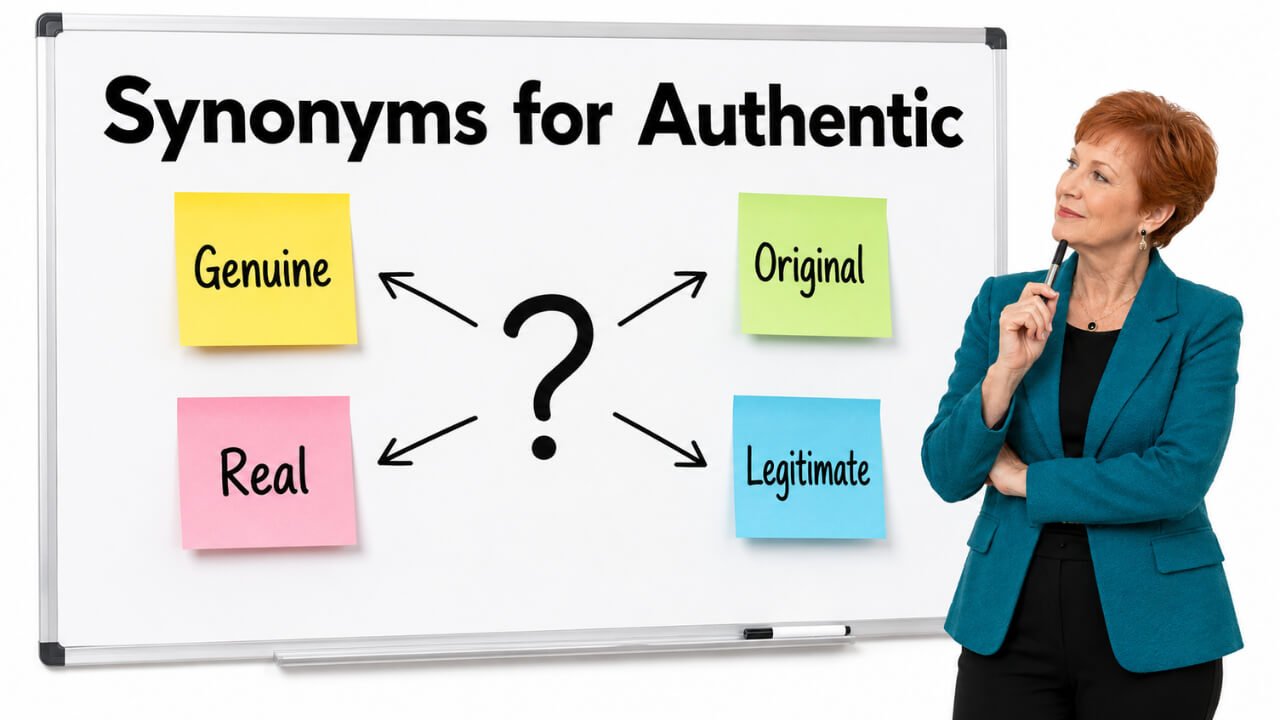
Quick Answer: The best synonyms for authentic include genuine, real, original, true, legitimate, sincere, credible, trustworthy, valid, and verified. Use genuine for something that is not fake, original for something that comes from its true source, and legitimate for something officially accepted. Sincere works best for honest feelings, while credible and trustworthy describe information or people that deserve belief. In formal writing, genuine, legitimate, verified, and credible are strong choices. In casual speech, real, honest, natural, and true often sound more comfortable.
Pronunciation and Word Details
Word: Authentic.
Pronunciation: /ɔːˈθen.tɪk/
Part of Speech: Adjective.
Meaning: Authentic means genuine, real, accurate, or true to its original source, identity, character, or purpose.
US Pronunciation:
UK Pronunciation:
What Does “Authentic” Mean?
Authentic means real, genuine, and not false or copied. It is an adjective used to describe objects, information, experiences, emotions, people, traditions, and creative work.
When authentic describes an object, it means the object is original rather than an imitation. An authentic painting, for example, was created by the claimed artist rather than copied by someone else.
When it describes information, authentic means reliable, accurate, or properly verified. An authentic document contains valid information and comes from a recognized source.
When authentic describes a person, emotion, or action, it suggests honesty and natural self expression. An authentic person behaves according to genuine beliefs rather than pretending to impress others.
The exact meaning depends on the sentence. Authentic can refer to origin, truth, emotional sincerity, cultural accuracy, legal validity, or personal character.
Meaning, Tone, and Context of “Authentic”
Authentic usually has a positive and approving tone. It suggests that something deserves trust because it is real, honest, original, or faithful to its source.
The word is neutral to formal. It appears naturally in academic writing, reports, reviews, cultural discussions, personal development writing, historical descriptions, and everyday conversation.
In formal contexts, authentic may describe evidence, documents, records, artifacts, or accounts. In conversational language, people often use it to describe honest personalities, natural experiences, traditional food, or genuine emotions.
Authentic can also carry emotional meaning. Describing someone as authentic suggests that the person is sincere, confident, and comfortable showing a true personality. However, the word should not automatically be treated as a synonym for good. Something can be authentic and still be unpleasant, outdated, or unsuitable.
When and How to Use “Authentic”
For Genuine Objects: Use authentic when confirming that an item is original rather than copied or falsely presented.
Example: The collector confirmed that the signature was authentic.
For Honest Personality: Use authentic to describe someone who expresses genuine beliefs and emotions.
Example: Her authentic personality made people feel comfortable around her.
For Traditional Experiences: Use authentic when something closely reflects its cultural, historical, or regional origins.
Example: The festival offered an authentic experience of local traditions.
For Reliable Information: Use authentic when information comes from a valid and trustworthy source.
Example: The researcher examined authentic records from the period.
For Original Creative Work: Use authentic when art, writing, music, or design reflects an individual voice rather than imitation.
Example: His writing feels authentic because it comes from personal experience.
For Sincere Emotions: Use authentic when feelings or reactions are honest and naturally expressed.
Example: Her gratitude was authentic and deeply moving.
For Verified Identity: Use authentic when a person, record, or digital item has been confirmed as genuine.
Example: The certificate proved that the document was authentic.
Best Synonyms for Authentic
Genuine: Truly what something claims to be and not fake.
Example: The expert confirmed that the gemstone was genuine.
Real: Existing in fact rather than being imaginary, artificial, or copied.
Example: Her concern for the injured animal was real.
Original: Coming from the first creator, source, or period.
Example: The museum displayed the original manuscript.
True: Correct, faithful, or consistent with reality.
Example: The film is based on a true account.
Legitimate: Lawful, valid, or officially acceptable.
Example: The organization received a legitimate request for information.
Sincere: Honest in feelings, intentions, or expression.
Example: He offered a sincere apology for his mistake.
Credible: Believable because it is supported by reliable information.
Example: The witness provided a credible explanation.
Trustworthy: Deserving confidence because of honesty or reliability.
Example: Choose a trustworthy person to manage the records.
Valid: Logically, legally, or officially acceptable.
Example: She presented a valid identification document.
Verified: Checked and confirmed as accurate or genuine.
Example: The report contains verified information from official records.
50 Synonyms for Authentic with Short Meanings
- Genuine: Truly what it claims to be.
- Real: Existing in fact and not artificial.
- Original: Coming from the first source or creator.
- True: Consistent with fact, reality, or identity.
- Legitimate: Lawful, valid, or officially recognized.
- Sincere: Honest in feelings or intentions.
- Credible: Reasonable and worthy of belief.
- Trustworthy: Deserving confidence and reliance.
- Valid: Acceptable, sound, or officially effective.
- Verified: Confirmed through careful checking.
- Actual: Existing as a fact rather than an idea.
- Honest: Truthful and free from deception.
- Faithful: Accurate and loyal to an original.
- Accurate: Correct in every important detail.
- Reliable: Consistently correct or dependable.
- Natural: Unforced, normal, and free from artificial behavior.
- Truthful: Expressing or representing the truth.
- Unfeigned: Sincere and not pretended.
- Unaffected: Natural and free from artificial behavior.
- Heartfelt: Deeply and sincerely felt.
- Candid: Honest, direct, and open.
- Frank: Open and truthful in expression.
- Forthright: Direct and honest without hiding intentions.
- Earnest: Serious and sincere in purpose.
- Bona fide: Genuine and made in good faith.
- Authoritative: Recognized as reliable and accurate.
- Certified: Officially confirmed as genuine or acceptable.
- Confirmed: Established as true through evidence.
- Proven: Demonstrated to be true or genuine.
- Established: Accepted as true through strong evidence.
- Factual: Based on real events or information.
- Exact: Fully accurate and correct in detail.
- Precise: Clearly and accurately expressed.
- Sound: Reliable, reasonable, and well supported.
- Dependable: Able to be trusted consistently.
- Recognized: Officially accepted or acknowledged.
- Authorized: Approved by a person or institution with authority.
- Traditional: Following established customs or practices.
- Classic: Representing a recognized original style.
- Representative: Accurately showing the qualities of a group or type.
- Characteristic: Typical of the real nature of something.
- Faithful to the Source: Closely matching the original material.
- Undisguised: Shown openly without concealment.
- Unpretended: Real and not performed falsely.
- Unfabricated: Not invented, altered, or falsely created.
- Undoctored: Not improperly changed or manipulated.
- Unaltered: Remaining in the original condition.
- Firsthand: Coming directly from personal experience.
- Veritable: Used to emphasize that something is truly what it appears to be.
- Recognizable: Clearly showing the expected identity or qualities.
Read Also:
Synonyms for Anxiety

Synonyms for Authentic by Context
When Authentic Means Genuine or Real
When authentic means that something is not fake, the strongest alternatives are genuine, real, actual, bona fide, proven, and verified.
Genuine Example: The jeweler confirmed that the necklace was genuine.
Real Example: The document appears to be real rather than a modern copy.
Verified Example: Only verified records were included in the investigation.
Genuine is usually the closest general replacement. Real sounds more conversational, while verified emphasizes that evidence or checking has confirmed authenticity.
When Authentic Means Original or From the Source
When authentic refers to origin, use original, unaltered, traditional, firsthand, classic, or faithful to the source.
Original Example: The library protects the original letters in a secure case.
Unaltered Example: The recording contains the unaltered interview.
Firsthand Example: Her firsthand account provided valuable historical detail.
Original emphasizes the first version. Unaltered means no changes were made. Firsthand describes information received directly from a person who experienced an event.
When Authentic Means Honest or Sincere
When authentic describes emotions, behavior, or personality, use sincere, honest, natural, heartfelt, candid, earnest, or unfeigned.
Sincere Example: His sincere concern was clear from his expression.
Natural Example: Her natural speaking style made the presentation engaging.
Heartfelt Example: They shared a heartfelt message of support.
Sincere is suitable for feelings and intentions. Natural describes relaxed and unforced behavior. Heartfelt suggests strong and deeply felt emotion.
When Authentic Means Culturally or Historically Accurate
When authentic describes a tradition, style, setting, or historical representation, use traditional, faithful, accurate, representative, characteristic, or classic.
Traditional Example: The dancers wore traditional clothing during the ceremony.
Faithful Example: The production offered a faithful representation of the historical period.
Representative Example: The collection is representative of regional craftsmanship.
Traditional emphasizes established customs. Faithful shows close similarity to an original. Representative means that something accurately displays the main qualities of a culture, period, or group.
When Authentic Means Valid or Trustworthy
When authentic refers to documents, evidence, claims, or information, use valid, legitimate, credible, reliable, authoritative, certified, or confirmed.
Valid Example: The traveler presented a valid passport.
Credible Example: Investigators found the explanation credible.
Certified Example: The buyer requested a certified copy of the record.
Valid is useful for documents and arguments. Credible describes information that deserves belief. Certified indicates that an authorized person or institution has formally confirmed something.
Another Word for Authentic
Genuine is usually the best single replacement for authentic because it can describe objects, experiences, emotions, intentions, and identities. However, the most accurate alternative depends on what makes something authentic.
Original: The expert examined the authentic painting.
Better Option: The expert examined the genuine painting.
Original: She gave an authentic apology.
Better Option: She gave a sincere apology.
Original: The article provides an authentic account of the event.
Better Option: The article provides a firsthand account of the event.
Original: The office accepted the authentic document.
Better Option: The office accepted the verified document.
When Not to Use “Authentic”
Avoid authentic when a more precise word can explain exactly why something is real, trustworthy, or honest. Authentic can become vague when the reader does not know whether it refers to origin, accuracy, sincerity, tradition, or legal validity.
Do not use authentic automatically for anything connected to a culture. A cultural practice may be traditional, representative, regional, historical, or personally meaningful. Choose the word that accurately describes the connection.
Avoid repeating authentic several times in one paragraph. Use genuine, original, sincere, verified, or traditional when those words express the intended meaning more clearly.
Weak: The report includes authentic facts from authentic documents.
Better: The report includes verified facts from original documents.
Weak: She gave an authentic and authentic sounding response.
Better: She gave a sincere and natural response.
Weak: This is an authentic legal permit.
Better: This is a valid legal permit.
Weak: The actor gave an authentic copy of the speech.
Better: The actor gave a faithful performance of the speech.
Words Commonly Confused With Authentic
Authentic vs Genuine: Both words mean real and not fake. Genuine is often the closest direct synonym, while authentic can also suggest faithfulness to an origin, identity, culture, or personal character.
Authentic vs Original: Original means the first version or the work produced by its creator. Authentic means that something has been confirmed as genuine. An object may be an authentic reproduction without being the original item.
Authentic vs Real: Real is a broad and conversational word meaning that something exists or is not imaginary. Authentic focuses more strongly on identity, origin, accuracy, or honesty.
Authentic vs Sincere: Sincere describes honest feelings and intentions. Authentic has a wider meaning and can describe objects, documents, traditions, experiences, personalities, and emotions.
Authentic vs Accurate: Accurate means correct in detail. Authentic means genuine or faithful to a source. A fictional story may contain accurate historical details without being an authentic historical account.
Authentic vs Legitimate: Legitimate emphasizes legal, official, or reasonable acceptance. Authentic emphasizes genuineness. A legitimate business may sell reproductions that are clearly identified and therefore not presented as original items.
Authentic vs Traditional: Traditional describes customs or methods passed through generations. Authentic may describe something that faithfully represents those traditions, but not every traditional practice has one fixed authentic form.
Which Synonym Should You Choose?
Choose genuine when you need a broad synonym meaning real and not fake.
Choose real in casual speech or when contrasting fact with imagination or artificial appearance.
Choose original when referring to the first version, creator, design, document, or work.
Choose sincere when describing honest feelings, apologies, gratitude, intentions, or concern.
Choose natural when describing relaxed behavior that does not appear forced or performed.
Choose legitimate when discussing official claims, legal activities, acceptable reasons, or recognized authority.
Choose valid when referring to documents, arguments, identification, permissions, or logical points.
Choose verified when information, evidence, identity, or records have been checked.
Choose credible when a statement, witness, explanation, or report deserves belief.
Choose trustworthy when describing a person, source, organization, or system that can be relied upon.
Choose faithful when a copy, translation, performance, or description closely follows the original.
Choose traditional when discussing customs, methods, clothing, celebrations, or practices passed through generations.
Choose firsthand when information comes directly from someone who experienced an event.
Choose authoritative for expert guidance, established records, or information recognized as highly reliable.
Real Life Examples of “Authentic” in Sentences
Original: The shop displayed an authentic historical clock.
Better Option: The shop displayed a genuine historical clock.
Original: Her authentic reaction surprised everyone in the room.
Better Option: Her natural reaction surprised everyone in the room.
Original: He shared an authentic account of the accident.
Better Option: He shared a firsthand account of the accident.
Original: The lawyer requested authentic copies of the records.
Better Option: The lawyer requested certified copies of the records.
Original: The building preserves its authentic design.
Better Option: The building preserves its original design.
Original: She offered an authentic expression of sympathy.
Better Option: She offered a heartfelt expression of sympathy.
Original: The committee needed authentic evidence before deciding.
Better Option: The committee needed verified evidence before deciding.
Original: His authentic leadership style earned respect.
Better Option: His sincere leadership style earned respect.
Original: The performance remained authentic to the original story.
Better Option: The performance remained faithful to the original story.
Original: They wanted an authentic experience of the region.
Better Option: They wanted a traditional experience of the region.
Synonym Groups and Usage Differences
Genuineness Group
Genuine, real, actual, bona fide, veritable, and proven describe something that truly exists or is what it claims to be. Genuine is the most flexible option, while bona fide and veritable sound more formal.
Example: Experts confirmed that the artifact was genuine.
Originality Group
Original, unaltered, undoctored, unfabricated, classic, and faithful to the source focus on origin or preservation. Original identifies the first version, while unaltered and undoctored emphasize that no improper changes were made.
Example: The archive contains the unaltered recording.
Honesty Group
Sincere, honest, heartfelt, candid, frank, earnest, unfeigned, and unpretended describe truthful feelings or behavior. Heartfelt adds emotional depth, while candid and frank emphasize direct communication.
Example: Her candid response helped resolve the misunderstanding.
Credibility Group
Credible, trustworthy, reliable, dependable, authoritative, sound, and factual describe information or people that deserve confidence. Credible often applies to claims, while trustworthy and dependable commonly describe people or systems.
Example: The researcher relied on credible evidence.
Validity Group
Legitimate, valid, verified, certified, confirmed, authorized, and recognized emphasize approval, evidence, or official acceptance. Verified focuses on checking, while authorized focuses on permission.
Example: Only authorized personnel may enter the records room.
Cultural and Historical Group
Traditional, representative, characteristic, faithful, accurate, and classic describe something that reflects a culture, period, style, or established practice. These words should be chosen carefully because cultural traditions often contain regional and personal variation.
Example: The design is representative of early regional architecture.
Antonyms of Authentic
The opposite of authentic depends on whether the word refers to an object, emotion, identity, document, experience, or claim.
Fake: Made to appear genuine when it is not.
False: Not true or correct.
Counterfeit: Illegally copied to deceive others.
Imitation: Made to resemble an original item.
Artificial: Produced rather than naturally occurring.
Fabricated: Invented or created dishonestly.
Fraudulent: Intended to deceive for personal benefit.
Bogus: False and not deserving serious acceptance.
Insincere: Not expressing genuine feelings.
Pretended: Presented as real when it is not.
Affected: Unnatural and designed to impress others.
Invalid: Not legally, logically, or officially acceptable.
Unreliable: Unable to be trusted consistently.
Inaccurate: Containing mistakes or incorrect details.
Altered: Changed from the original condition.
Misleading: Likely to create a false belief or impression.
Comparison: Authentic vs Related Words
Authentic vs Genuine
Authentic and genuine both describe something real and not fake. Genuine is usually more direct. Authentic often adds the idea of confirmed origin, true character, or faithfulness to a tradition.
Example With Authentic: The museum confirmed that the vase was authentic.
Example With Genuine: Her concern for the family was genuine.
Authentic vs Real
Real is broader and more conversational. It can describe anything that exists in fact. Authentic is more specific and often refers to identity, origin, honesty, or cultural accuracy.
Example With Authentic: The historian examined authentic letters from the period.
Example With Real: The story is based on real events.
Authentic vs Original
Original refers to the first version or the work created by a particular person. Authentic means that something is genuine, but it may not always be the first version.
Example With Authentic: The dealer provided proof that the signature was authentic.
Example With Original: The original letter remains in the family archive.
Authentic vs Sincere
Sincere relates mainly to feelings, intentions, communication, and behavior. Authentic is broader and may also describe objects, documents, traditions, and experiences.
Example With Authentic: She remained authentic even under pressure.
Example With Sincere: She gave a sincere explanation of her decision.
Authentic vs Legitimate
Legitimate means lawful, officially accepted, or reasonable. Authentic means genuine or true to an original source.
Example With Authentic: Experts identified the authentic manuscript.
Example With Legitimate: The applicant provided a legitimate reason for the delay.
Authentic vs Accurate
Accurate means correct in facts or details. Authentic means genuine or faithful to an identity or source. A description may be accurate without being based on direct experience.
Example With Authentic: The memoir offers an authentic account of village life.
Example With Accurate: The map provides accurate distances between the towns.
Authentic vs Traditional
Traditional refers to established customs, practices, or styles. Authentic suggests faithfulness to a real origin or cultural context. Something may be traditional while still changing across families, regions, or generations.
Example With Authentic: The exhibit presents an authentic view of regional craftsmanship.
Example With Traditional: The family prepared a traditional meal for the celebration.
Common Phrases and Expressions With Authentic
Authentic Experience: An experience that feels genuine and closely connected to its real setting or origin.
Authentic Voice: A natural and honest way of speaking or writing.
Authentic Self: A person’s true identity, values, and personality.
Authentic Style: A distinctive style that reflects genuine character or origin.
Authentic Document: A document confirmed as genuine and valid.
Authentic Signature: A signature confirmed to have been written by the named person.
Authentic Account: A truthful, reliable, or firsthand description of events.
Authentic Reaction: A natural response that is not planned or performed.
Authentic Leadership: Leadership based on honesty, clear values, and consistent behavior.
Authentic Connection: A sincere relationship based on openness and mutual understanding.
Common Mistakes to Avoid
One common mistake is using authentic as a general word of praise. Authentic does not automatically mean excellent, attractive, ethical, or enjoyable. It only indicates that something is genuine, sincere, original, or faithful to a source.
Another mistake is using authentic when verified, original, valid, or sincere would be more precise. Clear vocabulary helps the reader understand exactly what quality is being described.
Writers may also repeat authentic too frequently. Replace repeated uses with context appropriate alternatives such as genuine, natural, credible, traditional, or firsthand.
Avoid assuming that one version of a cultural practice is the only authentic version. Customs can differ across regions, communities, families, and historical periods.
Do not confuse authentic with accurate. Authentic describes genuineness or origin, while accurate describes correctness.
Avoid unnatural combinations such as very authentic truth or completely authentic sincerity. Use simpler expressions such as verified truth, sincere emotion, or genuine concern.
Conclusion
The best synonyms for authentic depend on what makes a person, object, document, or experience genuine. Use genuine or real for something that is not fake, original for the first version, sincere for honest feelings, and verified for checked information. Legitimate and valid suit official contexts, while traditional and faithful describe cultural or historical accuracy. Understanding these differences helps you choose clearer vocabulary and use synonyms for authentic naturally in essays, reports, descriptions, and everyday conversations.
FAQs About Synonyms for Authentic
What Is the Best Synonym for Authentic?
Genuine is the best general synonym for authentic. It describes something that is truly what it claims to be and is not fake.
Is Real a Synonym for Authentic?
Yes, real can replace authentic in casual contexts. However, authentic often provides more information about origin, identity, sincerity, or accuracy.
What Is a Formal Synonym for Authentic?
Legitimate, verified, bona fide, authoritative, and certified are formal alternatives. The correct choice depends on whether you are discussing evidence, documents, identity, or official approval.
What Is a Synonym for an Authentic Person?
Sincere, genuine, honest, natural, candid, and unpretended can describe an authentic person. These words suggest truthful behavior and natural self expression.
What Is a Synonym for an Authentic Experience?
Genuine, real, traditional, firsthand, and true to life may describe an authentic experience. Traditional works well for cultural practices, while firsthand describes direct personal experience.
Are Authentic and Original the Same?
Not always. Original means the first version or source. Authentic means genuine and correctly identified, even when the item is not the first version.
What Is the Opposite of Authentic?
Common opposites include fake, false, counterfeit, artificial, fabricated, fraudulent, insincere, and imitation. The best antonym depends on the sentence.
