
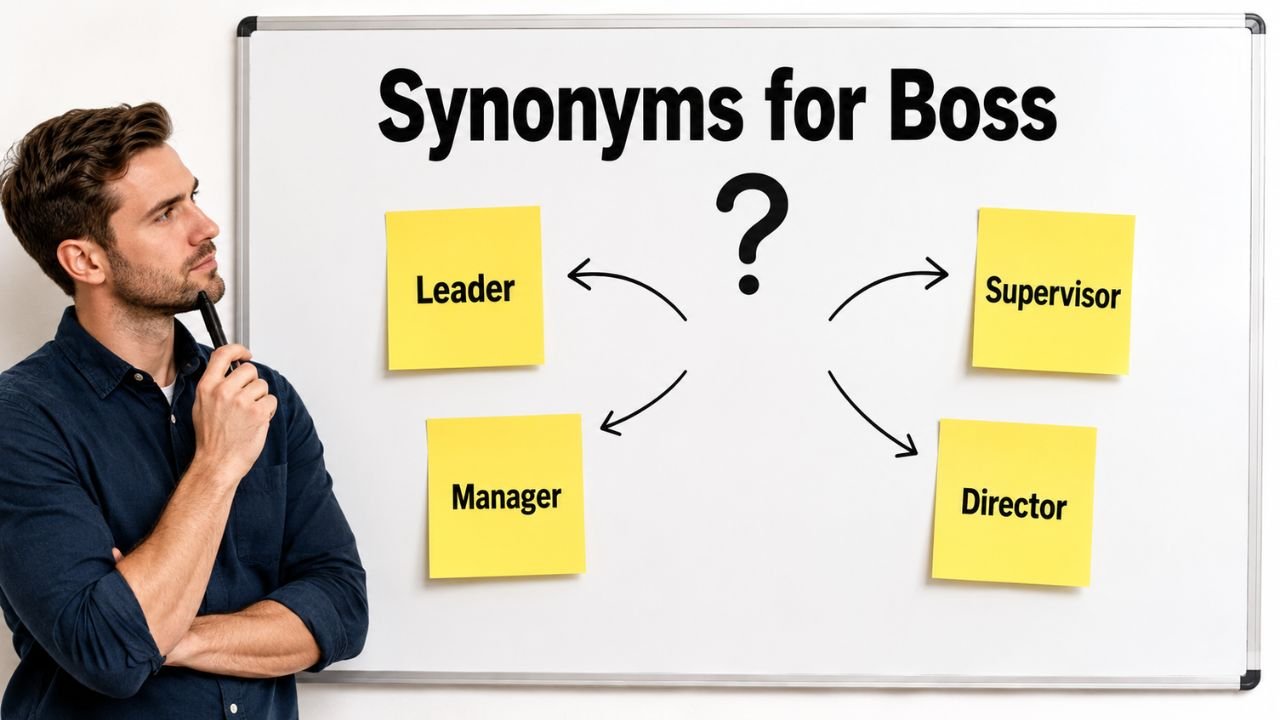
Quick Answer: The best synonyms for boss include manager, supervisor, leader, director, chief, employer, executive, owner, administrator, and person in charge. Use manager for a professional workplace role, supervisor for someone who directly monitors employees, leader for someone who guides and motivates others, and director for a senior decision maker. Employer is best when referring to the person or organization providing work, while owner describes someone who possesses a business. In casual speech, person in charge sounds natural. In formal reports, manager, director, executive, and administrator are usually more precise.
Pronunciation and Word Details
Word: Boss.
Pronunciation: /bɔːs/ or /bɒs/
Part of Speech: Noun and verb, with occasional informal adjective use.
Meaning: A boss is a person who directs, manages, supervises, or has authority over other people.
US Pronunciation:
UK Pronunciation:
What Does “Boss” Mean?
Boss means a person who has authority over employees, workers, or members of a group.
As a noun, boss usually refers to someone who gives instructions, assigns responsibilities, evaluates performance, and makes workplace decisions.
Example: My boss approved the new project plan.
The word can describe a direct supervisor, senior manager, business owner, department head, or another person with organizational authority. Its exact meaning depends on the workplace structure.
Example: The department boss met with the team to discuss its goals.
Boss can also refer to someone who controls an activity or takes charge of a situation outside a traditional workplace.
Example: Everyone treated Maya as the boss of the volunteer group.
As a verb, boss means to give someone frequent or forceful orders.
Example: He constantly bosses his younger brother around.
In informal speech, boss may occasionally describe something impressive, excellent, or powerful.
Example: That was a boss performance.
However, this informal adjective use is less common than the noun meaning. In professional writing, manager, supervisor, director, or leader often provides a clearer description.
Meaning, Tone, and Context of “Boss”
Boss is a common and conversational word. It is widely understood, but its tone can change according to the speaker, relationship, and situation.
In everyday conversation, boss usually sounds neutral.
Example: I need to ask my boss for approval.
In professional documents, boss may sound less precise than an official position title such as manager, director, supervisor, or department head.
Example: The operations manager approved the revised schedule.
The word can also sound slightly hierarchical because it emphasizes authority and control. Some workplaces prefer leader, manager, or team lead because these terms suggest guidance and cooperation rather than command.
Boss may sound respectful when an employee uses it to describe a person with legitimate authority.
Example: My boss supported my professional development.
It may sound negative when it describes someone who gives excessive orders or treats others unfairly.
Example: He acts like a boss even though he has no authority.
In academic writing, reports, formal emails, and official policies, use the person’s actual role whenever possible. Words such as supervisor, director, administrator, and executive communicate responsibility more accurately.
In casual speech, boss remains natural, direct, and easy to understand.
When and How to Use “Boss”
For a Direct Workplace Supervisor
Use boss when referring generally to the person who directly manages your work.
Example: I informed my boss that the report was ready.
For a Managerial Role
Use boss when the exact job title is unknown or unnecessary.
Example: The new boss introduced several workplace improvements.
Manager is usually more professional when the official role is known.
For a Business Owner
Boss can describe the person who owns and controls a business, although owner or proprietor may be more precise.
Example: The boss opened the store early that morning.
For Someone With Authority
Use boss for a person who has the power to make decisions or give instructions.
Example: Ask the boss before changing the schedule.
For Team Leadership
Boss can describe the person leading a group, but leader or team lead may sound more cooperative.
Example: Everyone looked to Carlos as the boss of the project.
For Casual Conversation
Boss works naturally in relaxed discussions about employment and workplace experiences.
Example: My boss gave me helpful feedback today.
For Formal Workplace Writing
In formal writing, replace boss with the person’s official title.
Example: The department director reviewed the proposal.
For Describing Controlling Behavior
As a verb, boss means to order someone around in a forceful or unnecessary way.
Example: Stop trying to boss everyone around.
For Showing Respectful Authority
Boss can communicate recognition of another person’s responsibility.
Example: She is a fair boss who listens to her employees.
For Describing Informal Excellence
Boss may occasionally mean impressive or excellent in highly casual speech.
Example: His final presentation was boss.
This use should be avoided in formal or academic writing.
Best Synonyms for Boss
Manager
Synonym: A person who organizes employees, tasks, resources, or business operations.
Example: The manager assigned responsibilities to each team member.
Supervisor
Synonym: A person who directly monitors and guides the work of others.
Example: The supervisor reviewed the employee’s completed tasks.
Leader
Synonym: A person who guides, influences, or motivates a group.
Example: A strong leader helps the team remain focused during challenges.
Director
Synonym: A senior person responsible for an organization, department, or major activity.
Example: The director approved the annual operating plan.
Chief
Synonym: The highest ranking person within a group, department, or organization.
Example: The chief addressed the staff during the morning meeting.
Employer
Synonym: A person or organization that hires and pays workers.
Example: Her employer provided additional training opportunities.
Executive
Synonym: A senior professional who makes important organizational decisions.
Example: The executive presented the new strategy to department leaders.
Owner
Synonym: A person who legally possesses and controls a business.
Example: The restaurant owner greeted the employees personally.
Administrator
Synonym: A person who manages organizational procedures, policies, or daily operations.
Example: The administrator updated the workplace guidelines.
Person in Charge
Synonym: The individual who has authority or responsibility in a particular situation.
Example: Speak to the person in charge if you need further assistance.
50 Synonyms for Boss with Short Meanings
- Manager: A person who organizes employees and workplace activities.
- Supervisor: Someone who directly monitors the work of others.
- Leader: A person who guides and influences a group.
- Director: A senior person responsible for a department or organization.
- Chief: The highest ranking person in a group or department.
- Head: The person with primary authority over a team or organization.
- Employer: A person or organization that hires workers.
- Executive: A senior professional with decision making authority.
- Administrator: Someone who manages procedures and organizational operations.
- Overseer: A person responsible for watching and directing work.
- Foreperson: Someone who supervises workers, especially at a worksite.
- Team Leader: A person responsible for guiding a particular team.
- Team Lead: A professional who coordinates the work of team members.
- Department Head: The person responsible for a department.
- Division Head: A senior person managing an organizational division.
- Section Head: Someone who manages a particular section.
- Unit Head: The person responsible for a specific organizational unit.
- Office Manager: Someone who manages office activities and administrative staff.
- Operations Manager: A person who directs daily operational activities.
- General Manager: A senior manager responsible for broad business operations.
- Project Manager: A person who plans and directs a project.
- Line Manager: A manager who directly supervises employees.
- Senior Manager: An experienced manager with greater organizational authority.
- Managing Director: A senior leader responsible for major business decisions.
- Chief Executive: The highest executive responsible for organizational direction.
- Owner: A person who possesses and controls a business.
- Proprietor: The legal owner of a business or property.
- Principal: A leading person with authority in an organization.
- Authority: A person who has official power or control.
- Commander: A person who directs a group, especially in a disciplined setting.
- Captain: A person who leads a team, crew, or organized group.
- Superintendent: A person who manages an institution, site, or department.
- Controller: Someone who directs, regulates, or manages operations.
- Coordinator: A person who organizes people, tasks, and schedules.
- Chairperson: The person who leads a committee, board, or formal meeting.
- President: A senior leader responsible for an organization or group.
- Governor: A person with authority over an institution, territory, or organization.
- Master: A person with control, authority, or advanced responsibility.
- Superior: A person holding a higher position in a hierarchy.
- Decision Maker: Someone authorized to make important choices.
- Person in Charge: The individual responsible for directing a situation.
- Head of Staff: The person responsible for managing staff members.
- Crew Leader: Someone who directs a group of workers.
- Shift Leader: The person responsible for workers during a particular shift.
- Site Manager: Someone who manages activities at a specific location.
- Branch Manager: The person responsible for a local business branch.
- Area Manager: A manager responsible for several locations within an area.
- Department Manager: Someone who manages employees within a department.
- Foreman: A traditional term for a man who supervises manual workers.
- Forewoman: A woman who supervises workers at a worksite.
Read Also:
Synonyms for Authentic

Synonyms for Boss by Context
When Boss Means a Direct Supervisor
Manager, supervisor, line manager, team lead, and foreperson describe someone who directly oversees an employee’s work.
Example: My supervisor reviewed my weekly progress.
Supervisor is often the most accurate term when the person monitors attendance, performance, schedules, and daily tasks.
Manager may have broader responsibility for planning, budgets, staffing, and results.
Example: The manager created a new training schedule for the department.
When Boss Means a Senior Organizational Leader
Director, executive, chief, president, and managing director describe people with senior decision making authority.
Example: The director approved the department’s annual budget.
Director often refers to the leader of a particular department or major function.
Executive usually describes someone who makes important decisions affecting the entire organization.
Example: The executive discussed the organization’s long term priorities.
When Boss Means a Business Owner
Owner, proprietor, principal, and employer can describe the person who owns or controls a business.
Example: The owner decided to expand the business.
Owner emphasizes legal possession. Employer emphasizes the working relationship between the organization and its employees.
Example: The employer introduced a new workplace policy.
Proprietor is more formal and is often used for the owner of a smaller business.
When Boss Means a Team Leader
Leader, team leader, team lead, coordinator, and project manager describe someone who guides a group toward a shared goal.
Example: The team leader explained the next stage of the project.
Leader emphasizes influence and direction rather than strict authority.
Coordinator focuses on organizing tasks, communication, resources, and schedules.
Example: The coordinator arranged meetings between all participating teams.
When Boss Means the Person With Final Authority
Chief, head, person in charge, authority, and decision maker describe someone with the power to make a final choice.
Example: The person in charge approved the requested changes.
Person in charge is useful when the official title is unknown.
Decision maker emphasizes the ability to approve, reject, or change a plan.
When Boss Means a Military or Organized Commander
Commander, captain, chief, and superior are suitable when authority exists within a disciplined structure.
Example: The commander gave instructions to the entire unit.
Commander emphasizes formal control. Captain commonly refers to the leader of a team, crew, or unit.
When Boss Means an Administrative Leader
Administrator, superintendent, office manager, and department head describe people responsible for organized systems and procedures.
Example: The administrator reviewed the updated safety procedures.
Administrator often manages policies and services, while superintendent usually oversees an institution, district, property, or operation.
When Boss Is Used Casually
Manager, head, person in charge, and leader are natural alternatives in everyday conversation.
Example: I need to speak with the person in charge.
Manager sounds more professional, while person in charge works well when the official role is unknown.
Another Word for Boss
The best general replacement for boss is manager. Manager is professional, neutral, and suitable for most workplace situations. However, the best alternative depends on the person’s actual responsibilities.
Use supervisor when the person directly monitors employees. Use leader when guidance and influence matter more than formal power. Use owner when the person possesses the business, and use director for a senior departmental role.
Original: My boss approved my leave request.
Better Option: My manager approved my leave request.
Original: The boss checked every employee’s daily work.
Better Option: The supervisor checked every employee’s daily work.
Original: The boss inspired the group during a difficult project.
Better Option: The leader inspired the group during a difficult project.
Original: The boss decided to sell the business.
Better Option: The owner decided to sell the business.
When Not to Use “Boss”
Boss should not be used when a more precise title would communicate the person’s responsibilities more clearly.
In Formal Documents
Boss can sound too conversational in policies, reports, contracts, and official correspondence.
Weak: The boss must approve all expense requests.
Better: The department manager must approve all expense requests.
When Referring to a Business Owner
A boss may manage employees without owning the business.
Weak: The boss plans to sell the business next year.
Better: The owner plans to sell the business next year.
When Referring to an Employer
An employer may be an organization rather than one individual.
Weak: My boss provides health benefits to all workers.
Better: My employer provides health benefits to all workers.
When Describing Inspirational Leadership
Boss emphasizes position and authority, while leader emphasizes influence, trust, and motivation.
Weak: She became a respected boss during the crisis.
Better: She became a respected leader during the crisis.
When the Official Title Is Known
Use the actual role in professional writing whenever possible.
Weak: The boss of the marketing department attended the meeting.
Better: The marketing director attended the meeting.
In Cooperative Team Environments
Boss may create an unnecessarily strict or controlling tone.
Weak: Ava is the boss of our design group.
Better: Ava is the team lead for our design group.
When Describing Military Authority
Commander or superior is usually more accurate.
Weak: The soldiers waited for their boss to give the order.
Better: The soldiers waited for their commander to give the order.
When Boss Could Sound Disrespectful
Calling a senior professional boss directly may sound overly casual in some situations.
Weak: Hey, boss, can you sign this report?
Better: Could you please review and sign this report?
When Discussing Controlling Behavior
Use bossy, controlling, domineering, or demanding when describing behavior rather than a legitimate workplace role.
Weak: He is very boss with the other employees.
Better: He is very controlling with the other employees.
Words Commonly Confused With Boss
Boss vs Manager: A boss is any person who has authority over others. A manager is someone with an official responsibility to organize employees, tasks, and resources.
Boss vs Supervisor: Boss is a general term. Supervisor specifically refers to someone who directly observes, guides, and evaluates workers.
Boss vs Leader: Boss emphasizes authority and position. Leader emphasizes guidance, influence, motivation, and trust.
Boss vs Employer: A boss directs an employee’s work. An employer hires, pays, and maintains a formal employment relationship with workers.
Boss vs Owner: A boss may manage the workplace without owning it. An owner legally possesses the business.
Boss vs Director: Boss is conversational and broad. Director is a formal title for a senior person responsible for a department or organizational function.
Boss vs Chief: Boss can refer to any workplace superior. Chief usually refers to the highest ranking person in a group or department.
Boss vs Executive: Boss may describe a direct supervisor. Executive normally refers to a senior professional who makes organization wide decisions.
Boss vs Administrator: Boss emphasizes authority over people. Administrator emphasizes responsibility for policies, procedures, services, and operations.
Boss vs Coordinator: Boss has authority to direct others. Coordinator mainly organizes communication, schedules, and activities and may not have formal authority.
Which Synonym Should You Choose?
Choose manager for professional workplace writing about someone who organizes employees, projects, or resources.
Choose supervisor when describing a person who directly monitors an employee’s daily performance.
Choose leader when the person guides, supports, influences, or motivates a group.
Choose director when referring to a senior person responsible for a department or major function.
Choose executive when writing about high level organizational decisions, strategy, or leadership.
Choose chief when the person holds the highest position within a department or group.
Choose employer when discussing hiring, salaries, benefits, contracts, or workplace obligations.
Choose owner when legal possession and control of a business matter.
Choose proprietor in formal writing about the owner of a smaller business.
Choose administrator when writing about procedures, institutional services, or organized operations.
Choose project manager when the person plans, coordinates, and controls a particular project.
Choose team lead for a professional who directs a team without necessarily holding broad management authority.
Choose department head when identifying the person responsible for a particular organizational department.
Choose person in charge in casual conversation when the official title is unknown.
Choose decision maker when emphasizing someone’s power to approve or reject a proposal.
Choose commander for formal authority within a military or highly disciplined group.
Choose captain when referring to the leader of a crew, team, or organized unit.
Choose superintendent when discussing the management of an institution, property, site, or district.
Choose chairperson when referring to someone who leads a committee or formal meeting.
Choose boss in casual speech when precision is unnecessary and the workplace relationship is already clear.
Real Life Examples of “Boss” in Sentences
Original: My boss asked me to complete the report by Friday.
Better Option: My manager asked me to complete the report by Friday.
Original: The boss watched the employees while they completed their tasks.
Better Option: The supervisor watched the employees while they completed their tasks.
Original: Our boss encouraged everyone during the difficult project.
Better Option: Our leader encouraged everyone during the difficult project.
Original: The boss of the department approved the new policy.
Better Option: The department director approved the new policy.
Original: The boss announced a major change in organizational strategy.
Better Option: The executive announced a major change in organizational strategy.
Original: The boss owns three local stores.
Better Option: The proprietor owns three local stores.
Original: Ask the boss whether we can change the schedule.
Better Option: Ask the person in charge whether we can change the schedule.
Original: The boss assigned tasks to every member of the project group.
Better Option: The project manager assigned tasks to every member of the project group.
Original: The boss decided to hire two new workers.
Better Option: The employer decided to hire two new workers.
Original: The boss guided the crew through the emergency.
Better Option: The captain guided the crew through the emergency.
Synonym Groups and Usage Differences
Direct Supervision Group
Supervisor, line manager, foreperson, shift leader, and crew leader describe people who directly oversee employees.
These terms are useful when discussing schedules, daily responsibilities, attendance, safety, and performance.
Example: The shift leader checked that every station was properly prepared.
General Management Group
Manager, general manager, office manager, operations manager, and department manager describe people who organize employees and resources.
These roles usually involve planning, decision making, problem solving, and performance management.
Example: The operations manager improved the delivery process.
Executive Leadership Group
Executive, chief executive, director, managing director, president, and chief describe senior organizational leaders.
These synonyms are best for decisions involving strategy, budgets, policies, and long term direction.
Example: The chief executive presented the organization’s future priorities.
Team Guidance Group
Leader, team leader, team lead, coordinator, and project manager describe people who guide groups toward a shared result.
Leader focuses on influence. Coordinator focuses on organization. Project manager focuses on completing a defined project.
Example: The team lead helped each member understand the new process.
Ownership Group
Owner, proprietor, principal, and employer may describe someone who controls or possesses a business.
Owner emphasizes possession. Employer emphasizes the employment relationship. Proprietor has a more formal tone.
Example: The proprietor personally welcomed the new employees.
Authority Group
Head, authority, superior, person in charge, and decision maker describe people with official or practical control.
These words are useful when the exact position title is unavailable or less important than decision making power.
Example: The final decision must be approved by the person in charge.
Command Group
Commander, captain, chief, master, and governor describe strong or formal authority.
These words are usually connected to military groups, crews, institutions, territories, or highly structured organizations.
Example: The commander explained the operation to the unit.
Administrative Group
Administrator, superintendent, controller, chairperson, and office manager describe people responsible for systems, procedures, and organized activities.
These words often appear in education, property management, public institutions, offices, and formal committees.
Example: The superintendent introduced new operating procedures.
Antonyms of Boss
The opposite of boss depends on whether boss refers to authority, management, ownership, or leadership.
Employee: A person who works for an employer or organization.
Worker: Someone who performs assigned labor or duties.
Subordinate: A person holding a lower position in an organizational hierarchy.
Follower: Someone who accepts the guidance or direction of a leader.
Assistant: A person who supports someone in a more senior role.
Trainee: Someone learning the duties required for a position.
Apprentice: A learner receiving practical instruction from an experienced professional.
Junior: A person with less authority, experience, or seniority.
Staff Member: A person working as part of an organization rather than directing it.
Team Member: A participant in a group who may not hold leadership authority.
Report: An employee who works under a particular manager.
Volunteer: A person who offers services without necessarily holding authority.
Intern: A person gaining temporary workplace experience.
Associate: A professional who may hold a supporting rather than managerial role.
Representative: Someone who acts for a group without necessarily controlling it.
Comparison: Boss vs Related Words
Boss vs Manager
Boss is a general and conversational word for someone with authority. Manager is a professional role involving the organization of employees, tasks, budgets, or resources.
Example With Boss: I asked my boss for permission to leave early.
Example With Manager: I asked my manager to approve the revised work schedule.
Boss vs Supervisor
Boss can refer to any superior. Supervisor usually describes the person who directly monitors an employee’s work.
Example With Boss: My boss attended the department meeting.
Example With Supervisor: My supervisor reviewed my daily performance.
Boss vs Leader
Boss emphasizes formal power. Leader emphasizes guidance, trust, influence, and motivation.
Example With Boss: The boss assigned each employee a task.
Example With Leader: The leader encouraged the group to solve the problem together.
Boss vs Employer
Boss is usually an individual who directs your work. Employer is the person or organization that officially hires and pays you.
Example With Boss: My boss explained what I needed to complete.
Example With Employer: My employer provides paid training to new workers.
Boss vs Owner
Boss describes authority over employees. Owner describes legal possession of the business.
Example With Boss: The boss prepared the weekly staff schedule.
Example With Owner: The owner decided to open a second location.
Boss vs Director
Boss is broad and informal. Director is a formal title for a senior person responsible for a department, program, or organizational function.
Example With Boss: The boss approved the advertising plan.
Example With Director: The marketing director approved the advertising plan.
Boss vs Chief
Boss may refer to a person at any management level. Chief normally describes the highest ranking person within a group or department.
Example With Boss: The boss spoke with the new employees.
Example With Chief: The department chief announced the updated policy.
Boss vs Executive
Boss may refer to a direct manager. Executive usually describes a senior leader responsible for major organizational decisions.
Example With Boss: My boss changed our weekly meeting time.
Example With Executive: The executive approved the organization’s expansion strategy.
Boss vs Administrator
Boss emphasizes authority over workers. Administrator emphasizes the management of systems, policies, records, or services.
Example With Boss: The boss gave the employee a new assignment.
Example With Administrator: The administrator updated the institution’s procedures.
Boss vs Team Lead
Boss can suggest a strong hierarchy. Team lead often describes a professional who coordinates and supports a smaller group.
Example With Boss: The boss told the group what to do.
Example With Team Lead: The team lead helped the group organize its responsibilities.
Common Phrases and Expressions With Boss
My Boss: The person who directly manages or supervises me.
The Boss: The person with the greatest authority in a particular situation.
Be Your Own Boss: Work independently or control your own business.
Boss Someone Around: Give someone frequent or unnecessary orders.
Big Boss: An informal expression for the most powerful or senior person.
Former Boss: A person who managed someone in the past.
New Boss: A recently appointed manager or supervisor.
Direct Boss: The person who immediately supervises an employee.
Act Like the Boss: Behave as though one has authority over others.
Ask the Boss: Request approval or information from the person in charge.
Boss of the Team: The person who controls or leads a team.
Work for a Boss: Be employed under another person’s authority.
Speak to the Boss: Discuss an issue with the person responsible.
Supportive Boss: A manager who helps and encourages employees.
Demanding Boss: A manager who expects a high level of effort or performance.
Common Mistakes to Avoid
Using Boss for Every Leadership Role
Boss is broad and may not explain the person’s actual responsibilities.
Weak: The boss of the finance department reviewed the budget.
Better: The finance director reviewed the budget.
Assuming the Boss Owns the Business
A manager or supervisor can be a boss without owning any part of the business.
Incorrect: Our boss owns the organization.
Correct: Our manager leads the department, but the organization has a different owner.
Confusing Boss With Employer
An employer establishes the employment relationship. A boss directs the employee’s work.
Incorrect: My boss provides employment contracts to thousands of workers.
Better: My employer provides employment contracts to thousands of workers.
Using Boss in Very Formal Writing
Boss may sound too casual in reports, policies, academic essays, and official correspondence.
Weak: Every expense must be approved by the boss.
Better: Every expense must be approved by the department manager.
Choosing a Synonym Based Only on Rank
Consider the person’s duties, not only seniority. A leader may inspire others without officially managing them.
Weak: She is the boss because everyone trusts her.
Better: She is a respected leader because everyone trusts her.
Using Manager and Supervisor as Exact Matches
A supervisor usually focuses on direct employee oversight. A manager may handle broader planning, budgets, staffing, and results.
Unclear: The manager watched each employee complete every daily task.
Clearer: The supervisor watched each employee complete every daily task.
Overusing Gendered Job Titles
Foreman and forewoman are established words, but foreperson is more inclusive when gender is unknown or irrelevant.
Limited: Ask the foreman to inspect the site.
Inclusive: Ask the foreperson to inspect the site.
Confusing Bosses and Boss’s
Bosses is the plural form of boss. Boss’s usually shows that something belongs to one boss.
Plural: The department bosses attended the meeting.
Singular Possessive: The boss’s office is on the second floor.
Using Boss’s for Multiple Bosses
When something belongs to several bosses, the plural possessive form is bosses’.
Incorrect: The boss’s meeting included all four department leaders.
Correct: The bosses’ meeting included all four department leaders.
Using Boss as an Adjective in Formal Writing
The informal adjective meaning excellent may confuse readers.
Too Casual: She delivered a boss presentation.
Better: She delivered an excellent presentation.
Adding Unnecessary Words
A precise title is often shorter and clearer than a long description.
Wordy: The person who is the boss of the office approved the request.
Better: The office manager approved the request.
Conclusion
The best synonyms for boss depend on the person’s authority, duties, and relationship with others. Use manager for general workplace responsibility, supervisor for direct oversight, leader for guidance, and director for senior departmental authority. Employer is best for the hiring relationship, while owner identifies the person who possesses a business. Team lead suits cooperative group settings, and person in charge works when the official title is unknown. Choosing the right alternative makes workplace communication clearer, more respectful, and more professionally accurate.
FAQs About Synonyms for Boss
What Is the Best Synonym for Boss?
Manager is the best general synonym for boss in professional workplace communication. Supervisor is better for someone who directly monitors employees.
What Is a Formal Word for Boss?
Director, manager, executive, administrator, and department head are useful formal alternatives. The best choice depends on the person’s official role.
What Is Another Word for a Good Boss?
A good boss may be described as a leader, mentor, supportive manager, or effective supervisor. Leader is best when emphasizing guidance and motivation.
Is a Manager the Same as a Boss?
A manager is usually a boss, but boss is a broader term. A boss may be a supervisor, director, owner, or another person with authority.
What Is the Difference Between a Boss and an Employer?
A boss directs an employee’s work. An employer is the person or organization that hires and pays the employee.
What Is an Informal Synonym for Boss?
Head, chief, big boss, and person in charge are common informal alternatives. Person in charge is the clearest neutral choice.
What Is the Opposite of Boss?
Common opposites include employee, subordinate, worker, follower, assistant, and team member. The correct antonym depends on the workplace context.
