
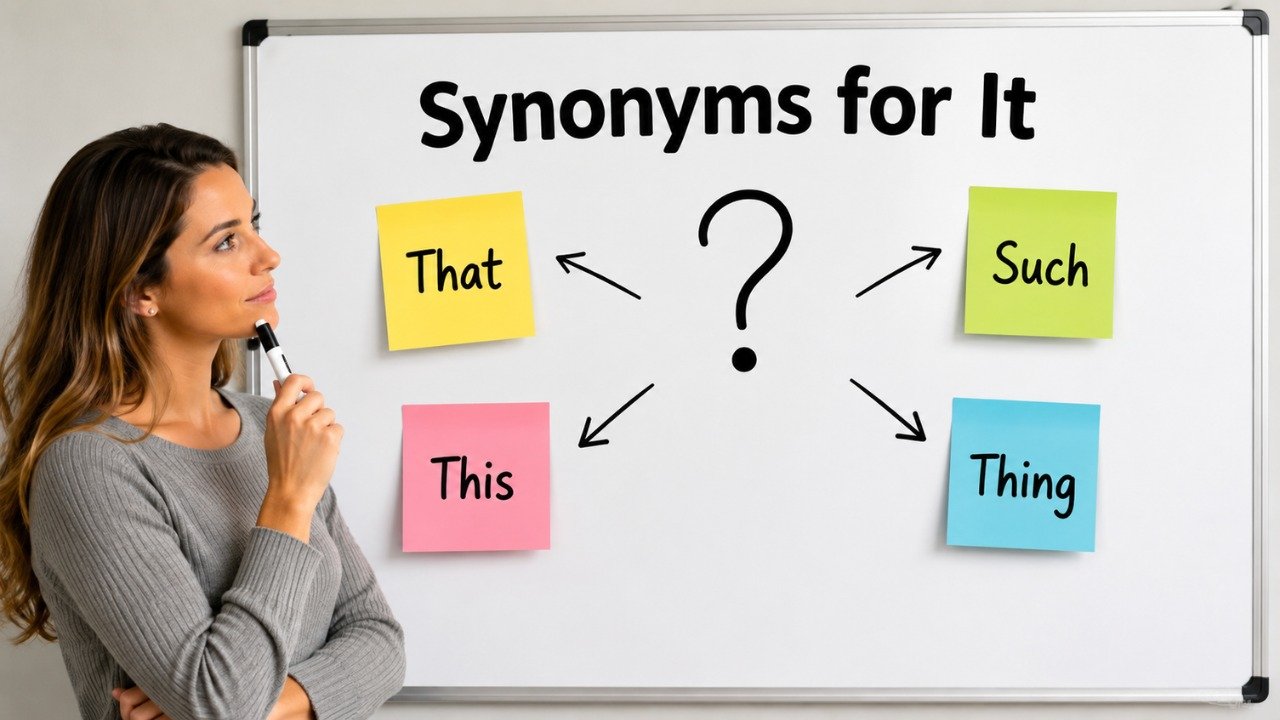
Quick Answer: Common synonyms for it include this, that, the thing, the object, the item, the matter, the issue, the situation, they, and one. The best replacement depends on what the pronoun represents. Use this for something nearby, that for something previously mentioned or farther away, the object or item for a physical thing, and the matter or issue for a subject or problem. Use they for a person or animal when gender is unknown or unimportant. Because it is a pronoun, many alternatives are contextual replacements rather than exact synonyms.
Pronunciation and Word Details
Word: It.
Pronunciation: /ɪt/.
Part of Speech: Personal pronoun and impersonal pronoun.
Meaning: A pronoun used to refer to a thing, animal, idea, situation, action, fact, or previously mentioned subject.
US Pronunciation:
UK Pronunciation:
What Does “It” Mean?
It is a pronoun used in place of a noun that has already been mentioned, identified, or understood from context.
The word usually refers to a thing, animal, idea, event, action, or situation. It prevents unnecessary repetition and makes sentences shorter and more natural.
Referring to a Thing: The phone is new, but it is already damaged.
In this sentence, it replaces the noun phone.
Referring to an Animal: I saw a bird, but it flew away.
Here, it refers to the bird.
Referring to an Idea: She suggested a new plan, and everyone supported it.
The pronoun refers to the plan.
Referring to a Situation: The meeting was delayed, but it was not a serious problem.
In this example, it refers to the delay or the overall situation.
It can also function as an impersonal subject when a sentence describes weather, time, distance, temperature, or general conditions.
Weather: It is raining.
Time: It is almost noon.
Distance: It is five miles from here.
In these sentences, it does not replace a particular noun. It simply fills the subject position required by English grammar.
Meaning, Tone, and Context of “It”
It is a neutral and extremely common English pronoun. It appears naturally in formal writing, casual conversation, academic explanations, technical instructions, reports, stories, and everyday communication.
The tone of it usually depends on the surrounding sentence. The word itself is neither emotional nor strongly formal.
Neutral Use: I found the key and placed it on the table.
Conversational Use: It looks great.
Formal Use: The committee reviewed the proposal and approved it.
Technical Use: Connect the device before turning it on.
It is appropriate for objects, concepts, events, actions, and many animals. However, calling a known person it can sound disrespectful or dehumanizing. A personal pronoun such as he, she, or they is normally more appropriate for a person.
When used repeatedly without a clear noun, it can make writing vague. Replacing it with a specific noun often improves precision and readability.
When and How to Use “It”
For a Previously Mentioned Object
Use it when the reader already knows which object you mean.
Example: I bought a lamp, but it does not work.
The pronoun it replaces lamp and prevents repetition.
For an Animal
Use it for an animal when its sex is unknown, unimportant, or not being emphasized.
Example: A rabbit entered the garden, but it quickly disappeared.
For a named pet or an animal with a known identity, he, she, or they may sound more personal.
For an Idea or Plan
Use it to refer to a suggestion, thought, decision, proposal, or concept.
Example: Your idea is practical, and I think we should use it.
For an Event or Situation
Use it when discussing an experience, condition, event, or situation already understood from context.
Example: The journey was exhausting, but it was worthwhile.
For Weather
Use impersonal it when describing rain, snow, wind, heat, cold, or another weather condition.
Example: It is becoming colder outside.
For Time
Use it before expressions that state or describe time.
Example: It is nearly seven o’clock.
For Distance
Use it to introduce a statement about distance.
Example: It is only two miles to the station.
For Emphasis
Use it in an emphasis structure to focus attention on a person, object, time, or detail.
Example: It was Daniel who discovered the mistake.
Before a Longer Subject
Use it as a temporary subject when the real subject appears later in the sentence.
Example: It is important to check your work.
The real idea being discussed is checking your work.
Best Synonyms for It
The following words and phrases are among the strongest alternatives to it. Each replacement works only in certain contexts.
This: A nearby object, current idea, or present situation.
Example: This is the document you requested.
That: A distant object, earlier statement, or previously mentioned idea.
Example: That was the reason for the delay.
The Thing: An object, action, or idea whose exact name is unknown or unimportant.
Example: The thing on the shelf belongs to me.
The Object: A physical item being discussed or examined.
Example: The object was found near the entrance.
The Item: One particular article, product, or entry in a group.
Example: The item needs to be returned.
The Matter: A subject, concern, or situation under discussion.
Example: The matter requires immediate attention.
The Issue: A question, difficulty, or problem that needs consideration.
Example: The issue has not yet been resolved.
The Situation: A particular set of circumstances or conditions.
Example: The situation became more difficult overnight.
They: A gender neutral pronoun for a person or a more personal reference to an animal.
Example: Someone left a message, but they did not provide a name.
One: A single object or person selected from a group.
Example: This cup is cracked, so choose another one.
50 Synonyms for It with Short Meanings
Because it is a pronoun, it has few exact synonyms. The following words are useful contextual alternatives that can replace it when the intended noun, person, object, idea, or situation is clear.
- This: A nearby thing, idea, or situation.
- That: A distant or previously mentioned thing.
- This Thing: A nearby object or matter.
- That Thing: A particular object or matter already identified.
- The Thing: An object, action, or idea.
- The Object: A physical thing being discussed.
- The Item: One article within a group.
- The Device: A machine or electronic object.
- The Product: Something created, produced, or sold.
- The Tool: An object used to complete a task.
- The Machine: A mechanical or electronic object.
- The Material: A substance used to make something.
- The Substance: A particular type of physical matter.
- The Animal: A living creature being discussed.
- The Creature: An animal or living being.
- The Pet: A domesticated animal kept for companionship.
- They: A gender neutral personal pronoun.
- Them: The object form of the pronoun they.
- He: A pronoun for a male person or animal.
- She: A pronoun for a female person or animal.
- The Person: A specific human being.
- The Child: A young person being discussed.
- The Baby: A very young child or animal.
- The Matter: A subject requiring discussion.
- The Issue: A topic, concern, or problem.
- The Problem: A difficulty requiring a solution.
- The Situation: A particular set of circumstances.
- The Case: A specific example or situation.
- The Event: Something that happened or will happen.
- The Action: Something that someone does.
- The Idea: A thought, suggestion, or concept.
- The Concept: A general or abstract idea.
- The Point: The main idea or purpose.
- The Fact: A detail accepted as true.
- The Subject: The person or thing being discussed.
- The Topic: The main area of discussion.
- The Plan: A proposed course of action.
- The Proposal: A formal suggestion for consideration.
- The Request: Something someone has asked for.
- The Task: A piece of work that must be completed.
- The Result: What happens because of an action.
- The Outcome: The final consequence or conclusion.
- The Answer: A response or solution to a question.
- The Statement: Something expressed in speech or writing.
- Something: An unspecified object, idea, or matter.
- Anything: An object or matter without a specific identity.
- Everything: All things within a particular situation.
- One: A single item or person from a group.
- What: The thing or information being identified.
- Which: A particular choice from a known group.
Read Also:
Synonyms for Interaction
Synonyms for It by Context
When It Refers to a Nearby Thing
This is often the best alternative when pointing to something nearby or introducing an immediate idea.
This: Refers to something physically or mentally close.
Example: This belongs on the top shelf.
This Thing: Refers to a nearby object whose name is unknown.
Example: This thing keeps making a strange sound.
The Item: Identifies one particular object.
Example: The item has already been inspected.
The Object: Refers to a visible or physical thing.
Example: The object appears to be made of glass.
When It Refers to a Distant or Previously Mentioned Thing
That is useful when the object, event, or idea is farther away or was mentioned earlier.
That: Points to something distant or previously discussed.
Example: That caused the entire system to stop.
That Thing: Identifies a particular object or matter.
Example: That thing near the door is blocking the entrance.
The Device: Names a specific piece of equipment.
Example: The device needs a new battery.
The Product: Refers to something made or offered for use.
Example: The product performed better than expected.
When It Refers to an Idea or Situation
Specific nouns usually communicate more clearly than it when discussing abstract subjects.
The Idea: Refers to a thought or suggestion.
Example: The idea received strong support.
The Matter: Refers to a subject being considered.
Example: The matter will be discussed tomorrow.
The Issue: Refers to a concern or problem.
Example: The issue affects every department.
The Situation: Refers to a set of conditions or circumstances.
Example: The situation remains uncertain.
The Fact: Refers to a true piece of information.
Example: The fact cannot be ignored.
The Point: Refers to the main message or argument.
Example: The point was clearly explained.
When It Refers to a Person or Animal
Personal pronouns are usually more respectful and natural for people and familiar animals.
They: Refers to a person whose gender is unknown or unimportant.
Example: A visitor arrived, but they did not stay long.
He: Refers to a male person or animal.
Example: The dog was hungry, so he waited beside his bowl.
She: Refers to a female person or animal.
Example: The cat heard a noise, and she ran upstairs.
The Animal: Identifies a creature more specifically.
Example: The animal was returned safely to its habitat.
The Pet: Refers to an animal kept for companionship.
Example: The pet needs regular exercise.
When It Is an Impersonal Subject
Impersonal it often has no direct synonym. It is required by normal English sentence structure.
Weather Example: It is raining heavily.
A natural direct synonym cannot replace it in this sentence.
Time Example: It is ten o’clock.
The pronoun fills the subject position but does not represent a noun.
Distance Example: It is a short walk from here.
This sentence may be rewritten as follows.
Alternative: The destination is a short walk from here.
Evaluation Example: It is useful to review your notes.
This may be rewritten more directly.
Alternative: Reviewing your notes is useful.
Another Word for It
That is often the best single alternative to it when referring to a previously mentioned object, idea, statement, or event. However, the clearest replacement depends on the noun represented by the pronoun.
A specific noun such as device, issue, plan, animal, or situation is usually better when it improves clarity.
Original: It is the book I ordered.
Better Option: That is the book I ordered.
Original: It needs to be repaired.
Better Option: The device needs to be repaired.
Original: I do not fully understand it.
Better Option: I do not fully understand the issue.
Original: We discussed it during the meeting.
Better Option: We discussed the proposal during the meeting.
When Not to Use “It”
Avoid it when the reader cannot easily identify the noun it represents. An unclear pronoun can make a sentence vague or confusing.
When the Reference Is Unclear
Weak: When the box was placed beside the table, it broke.
The reader may not know whether the box or the table broke.
Better: The box broke when it was placed beside the table.
When a Specific Noun Is More Informative
Weak: It produced an unexpected result.
Better: The experiment produced an unexpected result.
The specific noun gives the reader immediate context.
When Referring to a Person
Calling a person it can sound disrespectful unless the word appears in a special grammatical construction.
Weak: Someone is at the door, but it will not answer.
Better: Someone is at the door, but they will not answer.
When It Appears Too Often
Repeated use can make writing dull and difficult to follow.
Weak: It was approved because it was useful, and it was implemented immediately.
Better: The proposal was approved because it was useful, and the new system was implemented immediately.
When the Sentence Can Be More Direct
Some sentences beginning with it can be rewritten more clearly.
Weak: It is important that every applicant checks the form.
Better: Every applicant should check the form carefully.
When It Creates an Empty Opening
Phrases such as it is clear that or it is important to may add unnecessary words.
Weak: It is clear that the figures have changed.
Better: The figures have clearly changed.
Words Commonly Confused With It
It vs This: It refers to something already known, while this often introduces or points to something nearby or immediate. “I found the file, and it was complete” refers back to the file. “This is the complete file” directly presents it.
It vs That: It replaces a known noun, while that can point to something distant or emphasize a previous statement. “I read the report, and it was useful” differs slightly from “That was a useful report.”
It vs They: It normally refers to a thing, idea, situation, or animal. They refers to multiple people or things and can also refer to one person whose gender is unknown or unimportant.
It vs One: It refers to a particular noun already identified. One often means a single member of a group. “I found the pen and used it” refers to a specific pen. “I needed a pen, so I bought one” introduces one pen from the general category.
It vs Its: It is a pronoun, while its shows possession. “It is moving” uses the pronoun. “Its wheels are moving” uses the possessive form.
It vs It’s: It’s is a shortened form of it is or it has. “It’s raining” means “It is raining.” The apostrophe is never used to show possession.
It vs The Thing: It is more natural when the noun is already clear. The thing is useful when the object has not been named or when the speaker cannot remember its name.
Which Synonym Should You Choose?
Choose this when pointing to a nearby object, introducing a current idea, or drawing attention to the present situation.
Choose that when referring to something farther away, recalling an earlier statement, or emphasizing a previously mentioned event.
Choose the object when writing about a physical thing in a formal, scientific, or descriptive context.
Choose the item when referring to one product, entry, article, or object within a larger group.
Choose the device when discussing a phone, machine, tool, or piece of electronic equipment.
Choose the matter when referring to a formal subject, concern, or situation under discussion.
Choose the issue when discussing a question, disagreement, concern, or problem requiring attention.
Choose the situation when describing circumstances, conditions, or an experience involving several connected details.
Choose they when referring respectfully to a person whose gender is unknown or unimportant.
Choose one when replacing a countable noun after introducing a general category.
Choose a specific noun in reports, essays, instructions, and professional communication whenever it makes the sentence clearer.
Keep it when describing time, weather, distance, temperature, or another impersonal condition where no direct replacement is necessary.
Real Life Examples of “It” in Sentences
Original: I bought a new computer, but it stopped working.
Better Option: I bought a new computer, but the device stopped working.
Original: We discussed it for nearly an hour.
Better Option: We discussed the proposal for nearly an hour.
Original: It was more difficult than expected.
Better Option: The task was more difficult than expected.
Original: I placed it beside the window.
Better Option: I placed the plant beside the window.
Original: She explained it clearly.
Better Option: She explained the process clearly.
Original: It caused several delays.
Better Option: The technical problem caused several delays.
Original: We should improve it before publication.
Better Option: We should improve the article before publication.
Original: I saw an injured bird and carried it to a safe place.
Better Option: I saw an injured bird and carried the animal to a safe place.
Original: It is important to confirm every detail.
Better Option: Confirming every detail is important.
Original: The plan looked promising, but it required more research.
Better Option: The plan looked promising, but the proposal required more research.
Synonym Groups and Usage Differences
Demonstrative Group
This and that identify or point toward a particular object, idea, or situation. This usually suggests closeness, while that suggests distance or earlier mention.
Example: This is useful, but that needs revision.
Physical Object Group
The thing, object, item, device, product, tool, and machine replace it when the writer wants to identify a physical noun more clearly.
Example: The device must remain connected during the update.
Subject and Idea Group
The matter, issue, idea, concept, point, fact, subject, and topic are useful when it refers to something abstract.
Example: The matter deserves further consideration.
Situation Group
The situation, case, event, action, result, and outcome refer to circumstances, experiences, or consequences.
Example: The outcome surprised everyone involved.
Living Being Group
They, he, she, the person, the child, the animal, and the pet can replace it when discussing a living being more personally or specifically.
Example: The dog heard the gate open, and she ran outside.
Unspecified Reference Group
Something, anything, everything, what, and which can refer to objects, ideas, or information that has not been clearly identified.
Example: Something is making a noise upstairs.
Selection Group
One identifies a single object or person from a category or group.
Example: The first chair was damaged, so we selected another one.
Antonyms of It
It has no true antonym because it is a pronoun rather than a descriptive word. However, several words can create an opposite or contrasting meaning in particular contexts.
Nothing: The absence of any object, matter, or thing.
Nobody: The absence of any person.
None: Not one person or thing from a group.
Neither: Not either of two people or things.
Absence: The state of not being present.
Other: A different person or thing.
Opposite: Something completely different in position, meaning, or nature.
Elsewhere: In another place rather than the place being discussed.
Unknown: Not identified or recognized.
Unspecified: Not clearly named or described.
Comparison It vs Related Words
It vs This
It refers back to a noun that is already known. This points directly to something nearby or introduces an immediate subject.
Example With It: I found the document, and it contains the correct figures.
Example With This: This contains the correct figures.
It vs That
It provides a neutral reference to an identified noun. That often points to something more distant or emphasizes an earlier idea.
Example With It: The decision was unexpected, but it was final.
Example With That: That was the final decision.
It vs They
It usually refers to a nonhuman singular noun, concept, event, or situation. They refers to more than one person or thing and can also refer to one person without specifying gender.
Example With It: The package arrived, and it was undamaged.
Example With They: A customer called, but they did not leave a message.
It vs One
It refers to a specific noun already identified. One replaces a singular countable noun when the exact item has not been identified.
Example With It: I found my old notebook and opened it.
Example With One: I needed a notebook, so I bought one.
It vs The Thing
It is smoother when the intended noun is clear. The thing is used when the object has not been named or its name is unknown.
Example With It: I repaired the radio and tested it.
Example With The Thing: What is the thing beside the radio?
It vs The Issue
It can refer to any known noun, while the issue specifically names a subject, concern, or problem.
Example With It: We discussed it during the meeting.
Example With The Issue: We discussed the issue during the meeting.
It vs The Situation
It is a general pronoun. The situation provides more detail by showing that the writer means a set of circumstances.
Example With It: It became difficult to manage.
Example With The Situation: The situation became difficult to manage.
Common Phrases and Expressions With It
It Is: Used to identify something or describe a condition.
Example: It is the correct answer.
It Was: Used to identify or describe something in the past.
Example: It was an enjoyable experience.
It Seems: Used when something appears to be true.
Example: It seems reasonable to continue.
It Appears: Used to express an observation or cautious conclusion.
Example: It appears that the door is locked.
It Depends: Used when an answer changes according to circumstances.
Example: It depends on the available time.
It Matters: Used to say that something is important.
Example: It matters how you communicate the result.
It Works: Used when something functions correctly or produces a desired result.
Example: The solution is simple, but it works.
It Happens: Used to accept that an event sometimes occurs.
Example: Mistakes occur, and it happens to everyone.
Get It: Used to mean understand, obtain, or receive something.
Example: I understand the explanation now. I get it.
Take It: Used when accepting, carrying, or receiving something.
Example: Take it with you when you leave.
Common Mistakes to Avoid
Using an Unclear Reference
Make sure the reader can identify what it represents.
Unclear: The cup was placed beside the plate, but it was dirty.
The sentence does not show whether the cup or plate was dirty.
Clear: The dirty cup was placed beside the plate.
Using It for a Person
Avoid using it for a known person because the word can sound impersonal or disrespectful.
Incorrect: The caller said it would contact us later.
Correct: The caller said they would contact us later.
Confusing Its and It’s
Its is possessive. It’s means it is or it has.
Incorrect: The machine lost it’s power.
Correct: The machine lost its power.
Correct: It’s losing power.
Repeating It Too Often
Repeated pronouns can make a paragraph confusing, especially when several nouns are present.
Weak: It was reviewed, and it was changed because it was unclear.
Better: The document was reviewed and revised because the final section was unclear.
Choosing an Unnatural Synonym
Do not replace it with this, that, one, or the thing unless the alternative matches the sentence.
Unnatural: The weather is cold, and this is snowing.
Natural: The weather is cold, and it is snowing.
Replacing Impersonal It Unnecessarily
It is required in many sentences about weather, time, distance, and temperature.
Incorrect: Is raining outside.
Correct: It is raining outside.
Changing the Reference Midway
The same pronoun should not appear to represent different nouns without clear explanation.
Confusing: The report mentioned the proposal, but it was incomplete.
Clear: The report mentioned the proposal, but the report was incomplete.
Using a Vague Opening
Openings such as it is believed or it is clear may weaken a sentence when the source or evidence is not identified.
Vague: It is believed that the method is effective.
Clear: Many researchers consider the method effective.
Conclusion
Understanding synonyms for it requires attention to grammar and context because the pronoun has few exact replacements. Use this or that when pointing to a particular thing, object or item for physical nouns, and matter, issue, or situation for abstract subjects. They is more appropriate for a person whose gender is unknown, while one can replace a singular countable noun. In formal writing, replacing vague uses of it with specific nouns usually makes sentences clearer, stronger, and easier to understand.
FAQs About Synonyms for It
What Is the Best Synonym for It?
That is often the closest general alternative, but a specific noun such as object, issue, device, or situation may be clearer.
Can This Replace It?
Yes, this can replace it when referring to something nearby, current, or being introduced directly. The two words are not interchangeable in every sentence.
Can That Be Used Instead of It?
That can replace it when pointing to a distant object or referring strongly to a previous idea, event, or statement.
Is They a Synonym for It?
They can be a contextual alternative when referring to a person whose gender is unknown or to an animal being treated personally. It is not a direct replacement in every context.
Can One Replace It?
One can replace it when referring to an unspecified member of a countable group. It cannot replace a specific known object in every sentence.
Does It Have an Antonym?
No. It has no true antonym because it is a pronoun. Words such as nothing, nobody, none, or other may create contextual contrasts.
When Should I Avoid Using It?
Avoid it when the noun is unclear, when it refers disrespectfully to a person, or when repeated use makes the writing vague. A specific noun is often the strongest alternative.
