
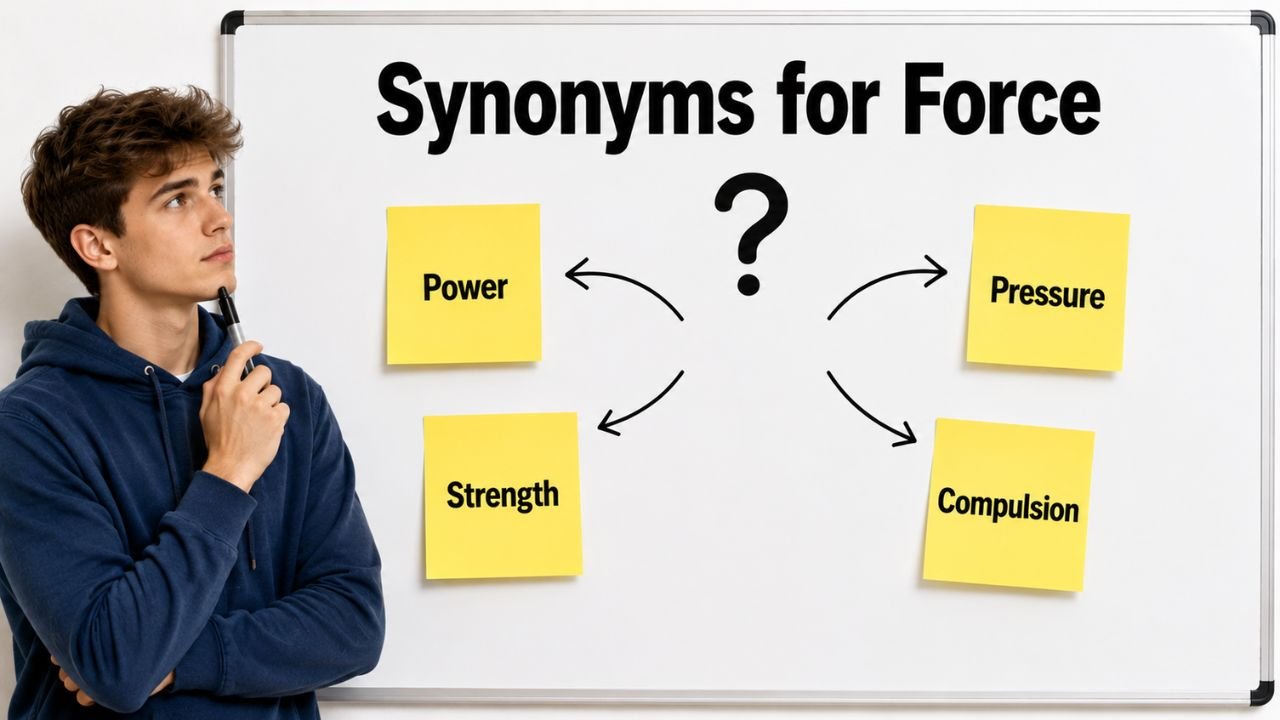
Quick Answer: The best synonyms for force include power, strength, pressure, coercion, influence, impact, authority, compel, require, and oblige. Power is the strongest general replacement when force means physical or controlling ability. Strength fits physical capacity, while pressure and coercion describe attempts to make someone act. Use influence for indirect control, impact for a strong effect, and authority for official power. As a verb, compel is suitable for formal writing, require fits rules and duties, and oblige works when circumstances make an action necessary.
Pronunciation and Word Details
Word: Force.
Pronunciation: /fɔːrs/ or /fɔːs/.
Part of Speech: Noun and verb.
Meaning: Force means physical power, strong influence, pressure, or the act of making someone do something.
US Pronunciation:
UK Pronunciation:
What Does “Force” Mean?
Force means power, strength, influence, or pressure that causes a person, object, or situation to move, change, or act in a particular way. The word functions as both a noun and a verb.
As a noun, force can describe physical power.
Example: The force of the wind damaged several trees.
It can also mean a push or pull that affects movement.
Example: She used enough force to open the heavy door.
Force may describe influence, authority, or the ability to produce change.
Example: Public opinion became a powerful force for reform.
The noun can also refer to an organized group of people working for a shared purpose.
Example: A rescue force arrived before sunrise.
As a verb, force means to make someone do something against their preference or to make an event happen through pressure.
Example: The emergency forced the family to leave their home.
It can also mean pushing, moving, or placing something with physical effort.
Example: He forced the drawer open.
The correct meaning depends on whether force refers to physical power, emotional pressure, legal authority, influence, organized personnel, or compulsory action.
Meaning, Tone, and Context of “Force”
Force is a strong word that can sound neutral, technical, formal, threatening, or emotional depending on its context.
In physical descriptions, force is usually neutral. It describes strength, motion, pressure, or impact.
Example: The force of the water moved the rocks.
In scientific and technical writing, force refers to a push or pull that can affect the movement of an object. This use is precise and neutral.
Example: The object moved when an external force was applied.
When force describes making someone act against their will, the tone becomes stronger and often negative.
Example: They tried to force her to accept the decision.
In legal, political, or professional contexts, force can describe authority, compulsory action, or organized personnel. The word may sound formal in these settings.
Example: The rule remained in force throughout the year.
Force can also carry an emotional tone when it suggests aggression, violence, control, or a lack of choice.
Example: No one should be forced to make an immediate decision.
In everyday conversation, people commonly use force when circumstances leave no practical alternative.
Example: Heavy rain forced us to cancel the trip.
This use does not always suggest direct pressure from another person. It can simply mean that a situation made an action necessary.
When and How to Use “Force”
Force is useful when describing physical power, compulsory action, strong influence, official authority, or an organized group.
For Physical Strength: Use force when an object, person, or natural event produces strong physical pressure or movement.
Example: The force of the collision damaged the front of the vehicle.
For a Push or Pull: Use force when describing physical movement or pressure applied to an object.
Example: Apply gentle force to move the handle.
For Compulsory Action: Use force when someone is made to act without freely choosing.
Example: The manager cannot force employees to attend an optional event.
For Necessary Action: Use force when circumstances make a decision unavoidable.
Example: The rising costs forced the business to change its plans.
For Strong Influence: Use force when a person, idea, or movement causes meaningful change.
Example: Education can be a powerful force in a community.
For Emotional Pressure: Use force when someone uses fear, guilt, threats, or control to influence another person.
Example: She felt that the group was trying to force her into agreeing.
For Authority: Use force when describing power supported by rules, law, or official control.
Example: The policy has the force of an official requirement.
For an Organized Group: Use force when referring to personnel working together for a particular duty.
Example: A special force was formed to handle the emergency.
For Strong Expression: Use force when describing the intensity or effectiveness of words, arguments, or emotions.
Example: He spoke with enough force to capture everyone’s attention.
Best Synonyms for Force
The best synonym depends on whether force means physical strength, authority, pressure, influence, impact, or compulsory action.
- Power: The ability to control, act, or produce change.
Example: The storm had enough power to damage the coastline. - Strength: Physical, emotional, or structural capacity.
Example: She used her strength to lift the box. - Pressure: Influence or demands intended to make someone act.
Example: He faced pressure to complete the work early. - Coercion: The use of threats or control to make someone act.
Example: The agreement must be made freely and without coercion. - Influence: The ability to affect decisions, behavior, or events.
Example: Her advice had a strong influence on the final decision. - Impact: A powerful effect or physical collision.
Example: The new policy had an immediate impact on attendance. - Authority: Official power to make decisions or give instructions.
Example: The director has the authority to approve the request. - Compel: To make someone act because of pressure, duty, or necessity.
Example: The evidence may compel the committee to reconsider. - Require: To make something necessary under a rule or condition.
Example: The position will require applicants to complete additional training. - Oblige: To make someone act because of duty, circumstances, or expectation.
Example: The delay obliged us to change the schedule.
50 Synonyms for Force with Short Meanings
- Power: The ability to act, control, or create change.
- Strength: Physical, mental, or structural capacity.
- Might: Great or impressive power.
- Energy: The capacity to perform work or activity.
- Vigor: Active physical or mental strength.
- Intensity: A high degree of strength or power.
- Potency: The ability to produce a strong result.
- Impact: A forceful effect or collision.
- Momentum: Strength gained through continued movement or progress.
- Thrust: A strong forward push.
- Pressure: Physical or emotional force applied to something.
- Push: An act of moving something away through pressure.
- Pull: An act of drawing something closer.
- Effort: Physical or mental energy used to achieve something.
- Exertion: The use of physical or mental strength.
- Drive: Strong energy, motivation, or movement.
- Forcefulness: The quality of being powerful or convincing.
- Impetus: A force that causes action or progress.
- Influence: The power to affect people or events.
- Leverage: Power gained from a useful position or advantage.
- Clout: Informal power or influence.
- Authority: Official power to command or decide.
- Control: The power to direct actions or events.
- Command: Authority to give orders.
- Coercion: Pressure or threats used to make someone act.
- Compulsion: A strong pressure or need to act.
- Duress: Threats or pressure that remove free choice.
- Constraint: A limit or pressure that restricts action.
- Domination: Control over another person or group.
- Violence: Physical force intended to cause harm.
- Army: An organized military force.
- Military: Armed personnel serving a country or authority.
- Troops: Groups of trained military personnel.
- Corps: An organized body of people with a particular function.
- Personnel: People employed or assigned to a service.
- Unit: An organized group working as one body.
- Brigade: A large organized group, often with a specific duty.
- Squad: A small organized team or unit.
- Crew: A group working together on a shared task.
- Workforce: The people available or employed for work.
- Compel: To make someone act through pressure or necessity.
- Coerce: To make someone act through threats or control.
- Oblige: To make an action necessary because of duty or circumstances.
- Require: To make something necessary.
- Make: To cause or order someone to do something.
- Impel: To drive someone toward an action.
- Constrain: To restrict or pressure someone into acting.
- Press: To urge someone strongly.
- Strong Arm: To make someone act through intimidation or pressure.
- Enforce: To make sure a rule, decision, or requirement is obeyed.
Read Also:
Synonyms for Basically
Synonyms for Force by Context
Force has several meanings, so the correct alternative changes with the sentence.
When Force Means Physical Power
Use these synonyms when describing strength, movement, pressure, or physical impact.
Power: The ability to produce movement, damage, or change.
Example: The power of the waves damaged the sea wall.
Strength: The capacity of a person or object to resist or apply pressure.
Example: The bridge has enough strength to support heavy traffic.
Might: Great and impressive power.
Example: The army demonstrated its might during the exercise.
Intensity: The degree of strength behind an action or natural event.
Example: The intensity of the storm surprised the residents.
Impact: The force created when objects meet or when an event produces a strong effect.
Example: The impact cracked the protective covering.
Thrust: A strong push in a forward direction.
Example: The engine produced enough thrust to move the aircraft.
When Force Means Pressure or Coercion
Use these alternatives when someone is made to act through demands, threats, fear, or control.
Pressure: Strong influence intended to produce a particular decision.
Example: She refused to change her answer despite the pressure.
Coercion: Threats or control used to remove a person’s free choice.
Example: Any agreement obtained through coercion should be questioned.
Compulsion: Strong pressure that makes an action feel necessary.
Example: He acted under compulsion rather than personal choice.
Duress: Serious pressure or threats that force someone to act.
Example: She signed the document while under duress.
Constraint: A restriction that limits available choices.
Example: Financial constraints forced the team to reduce its spending.
When Force Means Compel
Use these verbs when force means making an action happen.
Compel: To make someone act because of pressure, duty, or evidence.
Example: The new information compelled the committee to investigate.
Coerce: To make someone act through threats or intimidation.
Example: No employer should coerce a worker into accepting unsafe conditions.
Oblige: To make an action necessary because of circumstances or duty.
Example: The sudden closure obliged us to find another route.
Require: To state that an action is necessary.
Example: The rules require every visitor to sign the register.
Impel: To drive or encourage someone strongly toward an action.
Example: Concern for the community impelled her to volunteer.
Constrain: To limit someone’s choices or actions.
Example: Limited resources constrained the team to select one solution.
When Force Means Influence or Effect
Use these synonyms when something strongly affects decisions, behavior, or results.
Influence: The ability to shape opinions, choices, or events.
Example: Her experience had a major influence on the decision.
Impact: A strong and noticeable effect.
Example: The new schedule had a positive impact on productivity.
Leverage: Influence gained through an advantage or useful position.
Example: The organization used its experience as leverage during the discussion.
Clout: Strong influence, especially in decisions or public matters.
Example: The committee has enough clout to change the policy.
Impetus: A force or reason that starts action or progress.
Example: The report provided the impetus for further research.
Drive: Energy or motivation that causes continued action.
Example: Curiosity was the main drive behind the project.
When Force Means Authority or Control
Use these words when force describes official power or the ability to direct others.
Authority: Recognized or official power.
Example: Only the supervisor has the authority to approve the change.
Control: The ability to direct actions, resources, or events.
Example: The owner maintained control of the company.
Command: The power to give orders.
Example: She took command of the team during the emergency.
Domination: Powerful control over another person, group, or area.
Example: The smaller businesses struggled against the company’s market domination.
Power: The ability to make decisions or control outcomes.
Example: The board has the power to reject the proposal.
When Force Means an Organized Group
Use these alternatives when force refers to people organized for work, protection, military service, or a special purpose.
Unit: A group organized to perform one function.
Example: A medical unit was sent to the affected area.
Personnel: The people employed or assigned to an organization.
Example: Additional personnel were called to manage the situation.
Corps: An organized body with a specialized role.
Example: The engineering corps helped rebuild the road.
Squad: A small team assigned to a specific task.
Example: A rescue squad searched the building.
Crew: A group working together.
Example: The repair crew arrived early in the morning.
Workforce: The complete group of available employees.
Example: The company expanded its workforce to meet demand.
Another Word for Force
Power is usually the best general noun replacement for force, while compel is often the strongest verb replacement. However, the correct choice depends on whether the sentence describes strength, pressure, authority, influence, or necessity.
Use strength for physical ability, coercion for threatening pressure, influence for indirect control, and require for rules or duties.
Original: The force of the storm damaged several buildings.
Better Option: The power of the storm damaged several buildings.
Original: They tried to force her to change her statement.
Better Option: They tried to coerce her into changing her statement.
Original: The evidence forced the committee to reconsider.
Better Option: The evidence compelled the committee to reconsider.
Original: The policy forces all visitors to show identification.
Better Option: The policy requires all visitors to show identification.
When Not to Use “Force”
Force may sound too strong, vague, aggressive, or inaccurate when a softer or more specific word would communicate the meaning better.
When the Action Is Voluntary
Do not use force when someone freely agrees or chooses to act.
Weak: Her friends forced her to join the celebration, and she happily accepted.
Better: Her friends encouraged her to join the celebration, and she happily accepted.
When You Mean Gentle Persuasion
Force suggests strong pressure or a lack of choice. Use encourage, persuade, or urge when the person can still decide freely.
Weak: The teacher forced the students to consider another viewpoint.
Better: The teacher encouraged the students to consider another viewpoint.
When a Rule Simply Requires Something
Force may sound emotional or aggressive when require communicates the rule more accurately.
Weak: The application process forces candidates to provide identification.
Better: The application process requires candidates to provide identification.
When Describing Physical Ability
Use strength rather than force when referring to a person’s ability to lift, carry, or resist weight.
Weak: She has enough force to lift the box.
Better: She has enough strength to lift the box.
When Discussing Indirect Influence
Force may suggest direct pressure. Influence is better when ideas, experience, or relationships affect a decision indirectly.
Weak: His experience was a major force on the decision.
Better: His experience was a major influence on the decision.
When the Meaning Is Too Broad
Force can refer to physical power, organized personnel, authority, coercion, or influence. Choose a more exact synonym when readers might misunderstand the sentence.
Weak: The force changed the outcome.
Better: Public pressure changed the outcome.
When the Tone Should Remain Polite
Force may sound confrontational in professional messages or conversations.
Weak: We will force the department to provide an answer.
Better: We will request a clear answer from the department.
Words Commonly Confused With Force
Force vs Power: Force often describes pressure, movement, or compulsory action. Power is the broader ability to act, control, or produce change.
Force vs Strength: Force is power being applied, while strength is the ability to apply or resist that power.
Force vs Pressure: Force can be physical or emotional. Pressure often describes continuous demands or influence intended to change a decision.
Force vs Coercion: Force is a broad word with neutral and negative meanings. Coercion specifically refers to threats, intimidation, or control that removes free choice.
Force vs Compel: Force is both a noun and verb. Compel is a verb meaning to make someone act because of strong pressure, evidence, duty, or necessity.
Force vs Require: Force suggests pressure or unwilling action. Require means that a rule, condition, or need makes something necessary.
Force vs Influence: Force usually suggests direct power or pressure. Influence works more indirectly by affecting opinions, behavior, or decisions.
Force vs Violence: Force can be harmless, necessary, or technical. Violence specifically involves physical harm or destructive action.
Force vs Authority: Force is power being applied. Authority is the recognized right to make decisions or give instructions.
Force vs Momentum: Force causes or changes movement, while momentum describes the strength gained by an object, action, or process already moving.
Which Synonym Should You Choose?
Choose power when describing the ability to control, act, or produce change.
Choose strength when referring to physical ability, emotional resilience, or structural capacity.
Choose pressure when someone faces demands, expectations, or persistent influence.
Choose coercion when threats or intimidation remove a person’s ability to choose freely.
Choose compel in formal writing when evidence, duty, or necessity makes action unavoidable.
Choose coerce when someone uses fear, threats, or control to make another person act.
Choose require when a rule, process, job, or situation makes something necessary.
Choose oblige when circumstances, responsibility, or social duty make someone act.
Choose influence when a person, idea, or experience affects a decision indirectly.
Choose impact when describing a strong effect on a person, situation, or result.
Choose authority when discussing official power in reports, policies, essays, or workplace communication.
Choose drive when describing motivation, energy, or an internal desire to achieve something.
Choose impetus when writing formally about something that begins or accelerates progress.
Choose clout in casual conversation when describing strong influence or importance.
Choose personnel, unit, crew, or workforce when force refers to an organized group of people.
Choose push, pull, thrust, or pressure when describing physical movement or mechanics.
Real Life Examples of “Force” in Sentences
Original: The force of the wind knocked over the fence.
Better Option: The power of the wind knocked over the fence.
Original: She used force to lift the heavy lid.
Better Option: She used strength to lift the heavy lid.
Original: His manager tried to force him to work additional hours.
Better Option: His manager tried to pressure him into working additional hours.
Original: The emergency forced the residents to leave.
Better Option: The emergency compelled the residents to leave.
Original: The rules force every applicant to provide identification.
Better Option: The rules require every applicant to provide identification.
Original: Her words were a positive force in his life.
Better Option: Her words were a positive influence in his life.
Original: The decision had a powerful force on the final result.
Better Option: The decision had a powerful impact on the final result.
Original: They used force to obtain his agreement.
Better Option: They used coercion to obtain his agreement.
Original: A rescue force arrived after the storm.
Better Option: A rescue unit arrived after the storm.
Original: Curiosity was the force behind her research.
Better Option: Curiosity was the driving influence behind her research.
Synonym Groups and Usage Differences
Synonyms for force belong to different meaning groups. These differences matter because a word for physical power cannot always replace a word for coercion, authority, or influence.
Physical Power Group
Power, strength, might, vigor, intensity, potency, impact, and forcefulness belong to the physical power group.
Power is broad and can describe physical or controlling ability. Strength refers to capacity, while might emphasizes impressive power. Impact describes a collision or strong effect.
Example: The strength of the structure allowed it to withstand the impact.
Motion Group
Push, pull, thrust, pressure, momentum, drive, and impetus describe movement or the energy behind movement.
Push and pull describe directions. Thrust suggests a strong forward motion. Momentum refers to power gained through continued movement, while impetus can describe the beginning of progress.
Example: The new funding gave the project fresh impetus.
Coercion Group
Pressure, coercion, compulsion, duress, constraint, domination, and violence describe actions that limit choice or impose control.
Pressure can be mild or strong. Coercion and duress suggest serious threats or intimidation. Violence involves harmful physical force.
Example: The decision must be made without pressure or coercion.
Compulsory Action Group
Compel, coerce, oblige, require, make, impel, constrain, press, and enforce describe making an action happen.
Compel is formal and can result from duty or evidence. Coerce implies threats. Require refers to necessity, while enforce means making sure a rule is obeyed.
Example: The policy requires identification, and staff members enforce that requirement.
Influence Group
Influence, leverage, clout, drive, impetus, and impact describe the power to affect people, choices, or events.
Influence is usually indirect. Leverage comes from an advantage, while clout is an informal word for strong influence. Impact describes the result produced.
Example: Her professional experience gave her considerable influence during the discussion.
Authority Group
Power, authority, control, command, and domination describe the ability to direct people or determine outcomes.
Authority is recognized or official. Command is the power to give orders. Domination suggests extensive control and often has a negative tone.
Example: The director has the authority to make the final decision.
Organized Group
Army, military, troops, corps, personnel, unit, brigade, squad, crew, and workforce refer to groups organized for service or work.
Army and troops are connected with military service. Personnel and workforce are broader workplace terms. Unit, squad, and crew describe groups assigned to specific duties.
Example: A trained rescue crew entered the damaged building.
Antonyms of Force
The opposite of force changes according to whether the word means strength, pressure, compulsory action, authority, or movement.
Weakness: A lack of physical or emotional strength.
Frailty: Physical weakness or delicacy.
Powerlessness: The inability to control or influence events.
Gentleness: The use of mild and careful action instead of strong pressure.
Calm: A state without violent movement, intensity, or disturbance.
Freedom: The ability to act without control or compulsory pressure.
Choice: The ability to select an action freely.
Consent: Voluntary agreement or permission.
Permission: Approval that allows an action without compulsion.
Release: The act of freeing someone or something from control.
Restraint: Controlled action that avoids excessive physical power.
Persuasion: The use of reasoning rather than compulsory pressure.
Encouragement: Support that motivates action without removing choice.
Passivity: A lack of active effort, resistance, or influence.
Surrender: The act of giving up control or resistance.
Comparison: Force vs Related Words
Force vs Power
Force refers to power being applied to produce movement, pressure, or compulsory action. Power is the broader ability to act, control, or cause change.
Example With Force: The force of the water moved the damaged boat.
Example With Power: The engine has enough power to move the boat.
Force vs Strength
Force describes applied power. Strength describes the capacity to apply, resist, or endure that power.
Example With Force: He applied force to open the door.
Example With Strength: He had enough strength to open the door.
Force vs Pressure
Force can be a single physical action or a broad form of control. Pressure often refers to repeated demands, expectations, or influence.
Example With Force: They used force to remove the object.
Example With Pressure: She faced pressure to change her opinion.
Force vs Coercion
Force has several neutral and negative meanings. Coercion specifically describes threats or intimidation used to make someone act.
Example With Force: The storm forced everyone indoors.
Example With Coercion: The signature was obtained through coercion.
Force vs Compel
Force can sound direct and strong. Compel often sounds more formal and may result from evidence, duty, emotion, or necessity.
Example With Force: The delay forced us to change our plans.
Example With Compel: The new evidence compelled the panel to review the case.
Force vs Require
Force suggests that someone may be unwilling or that circumstances leave no choice. Require simply states that something is necessary.
Example With Force: The emergency forced everyone to leave.
Example With Require: The application requires two forms of identification.
Force vs Influence
Force is direct and often visible. Influence is usually indirect and works by shaping thoughts, feelings, or decisions.
Example With Force: They used force to control the crowd.
Example With Influence: Her opinion influenced the final decision.
Force vs Violence
Force can be controlled, harmless, technical, or necessary. Violence involves physical harm or destructive behavior.
Example With Force: Gentle force was used to move the handle.
Example With Violence: The conflict ended in violence.
Force vs Authority
Force is the application of power. Authority is the recognized right to use power or make decisions.
Example With Force: The guards used force to move the barrier.
Example With Authority: The guards had the authority to restrict access.
Common Phrases and Expressions With “Force”
By Force: Through physical power, threats, or compulsory action.
Example: The door could not be opened by force.
Use Force: To apply physical strength or compulsory power.
Example: Staff members were instructed not to use force.
Full Force: With complete strength, intensity, or effect.
Example: The storm reached the coast with full force.
Brute Force: Raw physical strength without skill or careful planning.
Example: The lock could not be opened through brute force.
Force of Nature: A powerful natural event or an unusually energetic person.
Example: Her energy made her seem like a force of nature.
Driving Force: The main person, reason, or motivation behind progress.
Example: Curiosity was the driving force behind the discovery.
Force Someone To: To make a person perform an action.
Example: The circumstances forced them to change their plans.
Force Into: To make someone enter a situation, role, or decision unwillingly.
Example: He felt forced into accepting the responsibility.
Force Out: To make a person leave a position, place, or organization.
Example: Financial difficulties forced the business out of the market.
Force Through: To make a proposal, decision, or action succeed despite opposition.
Example: The committee tried to force the proposal through without discussion.
Common Mistakes to Avoid
Using Force When You Mean Encourage
Encouragement allows choice, while force suggests pressure or a lack of freedom.
Incorrect: The teacher forced the students to explore new ideas.
Better: The teacher encouraged the students to explore new ideas.
Confusing Force With Strength
Strength is the ability to apply physical power. Force is the power being applied.
Incorrect: She has enough force to carry the equipment.
Better: She has enough strength to carry the equipment.
Using Force for Every Requirement
Rules usually require actions rather than force people to act.
Weak: The form forces applicants to include a telephone number.
Better: The form requires applicants to include a telephone number.
Confusing Force With Coercion
Coercion is more specific and usually involves threats or intimidation.
Vague: The agreement was obtained through force.
Clear: The agreement was obtained through coercion.
Choosing an Unnatural Preposition
The verb force is commonly followed by a person or object and an infinitive beginning with to.
Incorrect: They forced him for leave the room.
Correct: They forced him to leave the room.
Force can also be followed by into and a noun or verb ending in ing.
Correct: They forced him into leaving the room.
Repeating the Same Word
Using force several times close together makes writing sound repetitive.
Repetitive: The force used by the force was considered excessive force.
Improved: The physical power used by the unit was considered excessive.
Using Force Without Naming Its Type
Force can mean physical power, influence, personnel, or compulsory pressure. Add detail when the meaning is unclear.
Vague: A force changed the decision.
Clear: Public pressure changed the decision.
Using Force When the Tone Should Be Polite
In professional communication, force may sound aggressive or confrontational.
Too Strong: We must force the team to respond.
Better: We should ask the team to respond by Friday.
Confusing Force With Impact
Impact is the result produced, while force is the power that produces it.
Incorrect: The new rule had a strong force on attendance.
Correct: The new rule had a strong impact on attendance.
Adding Unnecessary Words
Avoid expressions that repeat the meaning already contained in force.
Wordy: They forcibly forced the door open.
Better: They forced the door open.
Conclusion
The most accurate synonyms for force depend on its meaning in the sentence. Use power or strength for physical ability, pressure or coercion for compulsory influence, and authority or control for official power. Compel is a strong formal verb, while require works better for rules and duties. Influence and impact describe effects without suggesting direct control. By understanding these distinctions, readers can use synonyms for force more precisely and choose wording that matches the intended meaning, tone, and level of intensity.
FAQs About Synonyms for Force
What Is the Best Synonym for Force?
Power is the best general noun synonym, while compel is often the best verb alternative. The correct choice depends on the sentence.
What Is a Formal Synonym for Force?
Compel is a formal verb synonym. Coercion, authority, impetus, and exertion are useful formal noun alternatives in specific contexts.
Is Pressure a Synonym for Force?
Yes. Pressure can replace force when describing physical contact, demands, expectations, or influence intended to produce action.
What Is Another Word for Physical Force?
Strength, power, might, pressure, impact, thrust, and exertion can describe different kinds of physical force.
What Is Another Word for Forcing Someone?
Compelling, coercing, pressuring, obliging, constraining, and strong arming are possible alternatives. Coercing is best when threats are involved.
What Is the Difference Between Force and Coercion?
Force has broad physical, technical, and social meanings. Coercion specifically means using threats, intimidation, or control to remove free choice.
Can Force Have a Positive Meaning?
Yes. Force can describe positive power or influence, as in a force for progress, a creative force, or the driving force behind a successful project.
