
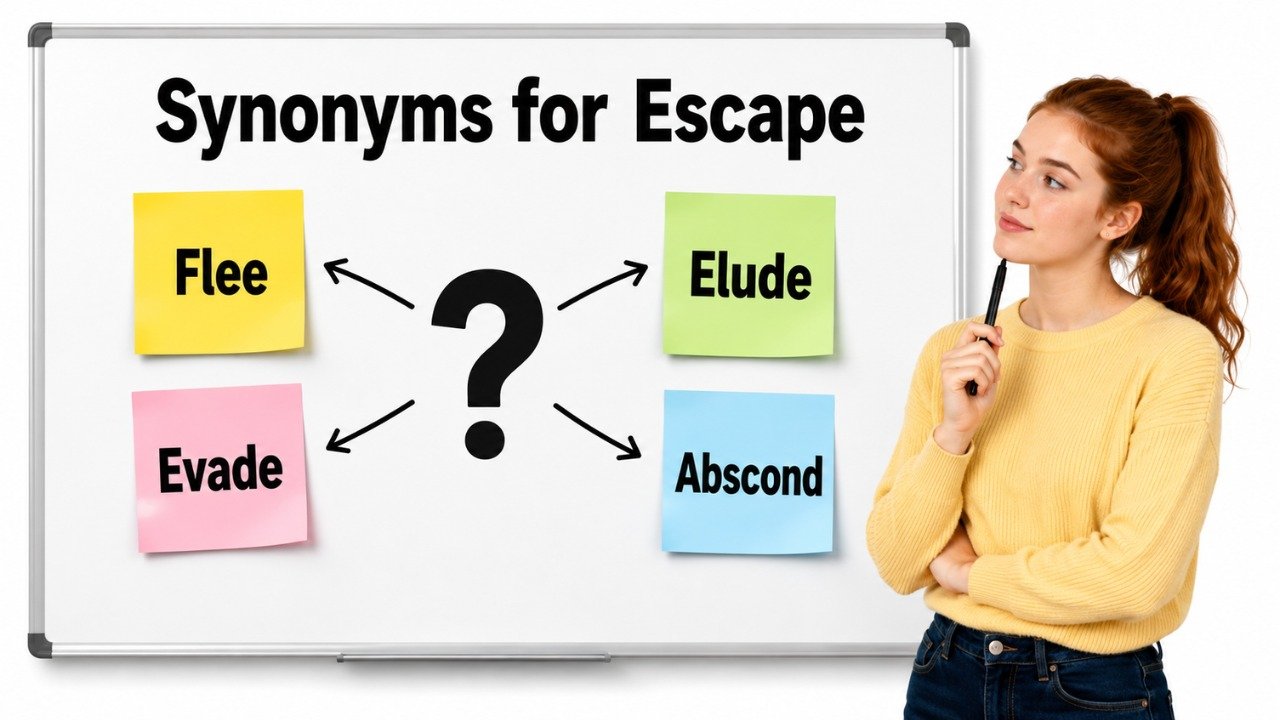
Quick Answer: The best synonyms for escape include flee, get away, break free, evade, avoid, elude, slip away, run away, retreat, and liberation. Use flee when someone leaves danger quickly, evade when avoiding capture or responsibility, and elude when someone remains difficult to catch. Break free emphasizes release from control, while get away is the most natural choice in casual speech. Retreat suits military or strategic situations, and liberation works best when escape means gaining freedom from oppression or restriction.
Pronunciation and Word Details
Word: Escape.
Pronunciation: /ɪˈskeɪp/.
Part of Speech: Verb and noun.
Meaning: To get away from danger, control, capture, responsibility, or an unpleasant situation.
US Pronunciation:
UK Pronunciation:
What Does “Escape” Mean?
Escape means to get away from a dangerous, controlled, unpleasant, or limiting situation. It can describe physically leaving a place, avoiding capture, preventing harm, or finding temporary relief from everyday pressure.
As a verb, escape describes the action of getting free.
Example: The prisoner escaped through an open window.
As a noun, escape describes the act, opportunity, or method of getting away.
Example: The hikers searched for an escape from the approaching fire.
Escape can also describe avoiding an unwanted result.
Example: The driver escaped serious injury.
In emotional or recreational contexts, escape can mean taking a temporary break from stress, responsibility, or reality.
Example: Reading gives her an escape from daily worries.
The exact meaning depends on the sentence. A person can escape from danger, escape punishment, escape attention, or enjoy a peaceful escape.
Meaning, Tone, and Context of “Escape”
Escape is a common and generally neutral word. Its tone changes according to the situation in which it appears.
In dangerous situations, escape can sound urgent, dramatic, or emotional.
Example: The family escaped before the building collapsed.
In legal or criminal contexts, it has a serious and formal tone.
Example: The suspect attempted to escape from custody.
In casual conversation, escape often means getting away from work, stress, noise, or routine.
Example: We planned a quiet weekend escape in the countryside.
In literature and entertainment, escape may describe imagination, emotional relief, or separation from reality.
Example: Music became his escape during a difficult period.
In technical contexts, escape can describe gas, liquid, heat, or information leaving a contained area.
Example: Steam escaped through a small opening.
The word is suitable for conversation, news writing, essays, stories, reports, and formal explanations. However, a more specific synonym can make the meaning clearer.
When and How to Use “Escape”
For Leaving Danger: Use escape when someone gets away from a threatening place or situation.
Example: The passengers escaped from the damaged vehicle.
For Avoiding Capture: Use escape when a person or animal avoids being caught or controlled.
Example: The thief escaped before the officers arrived.
For Gaining Freedom: Use escape when someone breaks away from confinement, restriction, or control.
Example: The bird escaped from its cage.
For Avoiding Harm: Use escape when someone avoids injury, loss, or another negative result.
Example: The village escaped the worst effects of the storm.
For Avoiding Responsibility: Use escape when someone avoids a duty, punishment, or difficult consequence.
Example: He could not escape responsibility for the mistake.
For Emotional Relief: Use escape when an activity provides a break from stress or unpleasant thoughts.
Example: Gardening offers a peaceful escape from work pressure.
For Leaving a Routine: Use escape when describing a short journey or break from ordinary life.
Example: They enjoyed a weekend escape near the lake.
For Substances Leaving a Container: Use escape when air, gas, heat, water, or another substance moves out through an opening.
Example: Gas escaped from the damaged pipe.
Best Synonyms for Escape
Flee: To leave a dangerous place quickly because of fear or urgency.
Example: Residents fled the area when the fire spread.
Get Away: To leave or avoid being caught, harmed, or delayed.
Example: The robber got away before anyone could stop him.
Break Free: To escape from physical, emotional, or social control.
Example: She worked hard to break free from the restrictive arrangement.
Evade: To avoid capture, responsibility, questioning, or an unwanted situation.
Example: The driver tried to evade the police.
Avoid: To stay away from danger, difficulty, responsibility, or an unpleasant result.
Example: He changed his route to avoid the traffic.
Elude: To escape from or remain beyond someone’s ability to catch, understand, or achieve.
Example: The fox eluded the hunters.
Slip Away: To leave quietly, secretly, or without being noticed.
Example: She slipped away before the meeting ended.
Run Away: To leave a place, person, or difficult situation, often suddenly.
Example: The frightened child ran away from the loud noise.
Retreat: To move away from danger, conflict, or an unfavorable position.
Example: The soldiers retreated to a safer location.
Liberation: The act of being freed from control, oppression, or restriction.
Example: The people celebrated their liberation from foreign rule.
50 Synonyms for Escape with Short Meanings
- Flee: To leave danger quickly.
- Get Away: To leave or avoid capture.
- Break Free: To release oneself from control.
- Evade: To avoid capture, duty, or questioning.
- Avoid: To keep away from something unwanted.
- Elude: To escape someone trying to catch or understand you.
- Slip Away: To leave quietly and unnoticed.
- Run Away: To leave suddenly, often because of fear.
- Retreat: To move back from danger or conflict.
- Withdraw: To remove oneself from a place or situation.
- Depart: To leave a particular place.
- Exit: To go out of a place.
- Leave: To go away from a location or situation.
- Bolt: To run away suddenly and quickly.
- Dash Away: To leave at great speed.
- Make Off: To leave quickly, especially after wrongdoing.
- Take Flight: To run or fly away from danger.
- Abscond: To leave secretly to avoid arrest or responsibility.
- Decamp: To leave a place suddenly or secretly.
- Disappear: To leave sight or become impossible to find.
- Vanish: To disappear quickly or unexpectedly.
- Sneak Away: To leave secretly without attracting attention.
- Steal Away: To leave quietly and unnoticed.
- Slip Out: To leave quietly through an exit.
- Break Out: To escape from confinement.
- Bust Out: To forcefully escape from a confined place.
- Get Free: To become released from control or restraint.
- Gain Freedom: To become free from restriction.
- Free Oneself: To remove control or restraint from oneself.
- Liberate Oneself: To gain freedom from oppression or limitation.
- Extricate Oneself: To free oneself from a difficult situation.
- Disengage: To separate oneself from involvement or contact.
- Wriggle Free: To escape by twisting or persistent effort.
- Shake Off: To escape from someone following or controlling you.
- Lose: To escape from a person who is following you.
- Outrun: To escape by moving faster than a pursuer.
- Outwit: To escape or succeed by using greater intelligence.
- Dodge: To avoid a person, object, duty, or question.
- Sidestep: To avoid dealing directly with a problem.
- Circumvent: To find a way around a rule or obstacle.
- Bypass: To avoid or go around something.
- Duck: To avoid a person, duty, or unwanted situation.
- Escape Notice: To remain unseen or unnoticed.
- Escape Detection: To avoid being discovered.
- Escape Injury: To avoid being physically harmed.
- Escape Punishment: To avoid a penalty or consequence.
- Find Refuge: To reach a safe and protected place.
- Seek Shelter: To move to safety from danger or bad conditions.
- Find Relief: To gain freedom from pain, stress, or pressure.
- Get Clear: To move away from danger or obstruction.
Read Also:
Synonyms for Smile
Synonyms for Escape by Context
When Escape Means Leaving Danger
Flee, run away, retreat, take flight, bolt, and dash away are useful when someone leaves because of danger, fear, or urgency.
Flee is the strongest general alternative when danger is present.
Example: Hundreds of residents fled the flooded area.
Run away is more conversational and may describe fear, emotional pressure, or a sudden decision.
Example: The horse ran away when it heard the explosion.
Retreat suggests moving back to a safer or more favorable position.
Example: The rescue team retreated when conditions became unsafe.
Bolt emphasizes a sudden and extremely fast departure.
Example: The dog bolted through the open gate.
When Escape Means Avoiding Capture
Evade, elude, get away, outrun, shake off, abscond, and make off describe avoiding arrest, capture, or pursuit.
Evade often suggests deliberate action.
Example: The suspect used narrow streets to evade capture.
Elude suggests that someone is difficult to catch.
Example: The missing animal eluded search teams for several days.
Get away is the most natural casual choice.
Example: The thief got away in a waiting car.
Outrun specifically means escaping by moving faster.
Example: The deer outran the pursuing dogs.
When Escape Means Gaining Freedom
Break free, get free, gain freedom, free oneself, liberate oneself, extricate oneself, and break out describe release from physical or emotional control.
Break free is useful for both literal and figurative situations.
Example: She wanted to break free from other people’s expectations.
Get free is simple and conversational.
Example: The trapped animal struggled to get free.
Extricate oneself is formal and describes leaving a complicated or difficult situation.
Example: The company tried to extricate itself from the costly agreement.
Break out usually refers to escaping from a locked or guarded place.
Example: Two prisoners attempted to break out during the night.
When Escape Means Avoiding Harm or Consequences
Avoid, dodge, sidestep, circumvent, bypass, duck, and escape punishment describe avoiding an unpleasant result, responsibility, or difficulty.
Avoid is the broadest and most neutral choice.
Example: Careful planning helped the team avoid unnecessary delays.
Dodge is more informal and may suggest avoiding something through quick action or cleverness.
Example: The speaker dodged the difficult question.
Sidestep means avoiding direct discussion or involvement.
Example: The manager sidestepped the issue during the meeting.
Circumvent suggests finding an indirect way around a rule, restriction, or obstacle.
Example: They tried to circumvent the new regulations.
When Escape Means Leaving Quietly
Slip away, sneak away, steal away, slip out, disappear, and vanish describe leaving without attracting attention.
Slip away is neutral and natural.
Example: He slipped away while everyone was distracted.
Sneak away suggests secrecy and possible disapproval.
Example: The children sneaked away from the group.
Steal away has a softer and more literary tone.
Example: She stole away before the celebration ended.
Vanish emphasizes sudden disappearance.
Example: The stranger vanished into the crowd.
When Escape Means Relief from Stress
Relief, refuge, retreat, diversion, release, and getaway can describe a break from stress, routine, worry, or responsibility.
Relief focuses on the removal of discomfort.
Example: The quiet room provided relief from the noise.
Refuge describes a safe or comforting place.
Example: The library became a refuge from the pressures of daily life.
Retreat can refer to a peaceful place or period of rest.
Example: The cottage served as a private retreat.
Getaway describes a short recreational trip.
Example: They planned a relaxing weekend getaway.
Another Word for Escape
The best single replacement for escape is often get away because it works naturally in everyday speech and can describe leaving danger, avoiding capture, or taking a break. However, the strongest alternative depends on the intended meaning.
Choose flee for urgent danger, evade for avoiding capture or responsibility, break free for gaining freedom, and avoid for preventing an unwanted result.
Original: The family escaped from the fire.
Better Option: The family fled from the fire.
Original: The suspect escaped from the officers.
Better Option: The suspect evaded the officers.
Original: She escaped from the controlling situation.
Better Option: She broke free from the controlling situation.
Original: He escaped a serious penalty.
Better Option: He avoided a serious penalty.
When Not to Use “Escape”
Escape is broad, so it may sound unclear when the sentence needs a more precise description of how or why someone left.
Do not use escape repeatedly in the same paragraph when flee, avoid, elude, leave, or break free would add variety and precision.
Weak: The family escaped the house, escaped the smoke, and escaped serious injury.
Better: The family fled the house, avoided the thickest smoke, and survived without serious injury.
Escape may also sound too dramatic when someone simply leaves an ordinary place.
Weak: She escaped the office at five o’clock.
Better: She left the office at five o’clock.
Avoid escape when the intended meaning is only temporary relief and the sentence could sound as though real danger was involved.
Weak: The café was an escape from her lunch break.
Better: The café offered a relaxing break during her lunch hour.
Do not use escape when a technical term is more accurate.
Weak: Water escaped from the broken container.
Better: Water leaked from the broken container.
Escape can also be unclear when discussing responsibility.
Weak: He escaped the project.
Better: He withdrew from the project.
Words Commonly Confused With Escape
Escape vs Flee: Escape focuses on successfully getting away, while flee focuses on leaving quickly because of fear or danger. A person may flee without successfully escaping.
Escape vs Evade: Escape means getting away from danger or control. Evade means deliberately avoiding capture, responsibility, questioning, or an unwanted situation.
Escape vs Elude: Escape describes getting free. Elude emphasizes remaining difficult to catch, find, understand, or achieve.
Escape vs Avoid: Escape often suggests that danger or difficulty was already present. Avoid means preventing contact with the problem before it happens.
Escape vs Leave: Leave simply means going away from a place. Escape suggests danger, restriction, urgency, or an unwanted condition.
Escape vs Retreat: Escape emphasizes getting away. Retreat means moving back strategically from conflict, danger, or an unfavorable position.
Escape vs Release: Escape is usually an action performed by the person or thing getting free. Release is the act of allowing or causing someone or something to become free.
Escape vs Getaway: Escape can be a verb or noun connected to danger, control, or relief. Getaway is usually a noun describing a short trip or a method of leaving after wrongdoing.
Which Synonym Should You Choose?
Choose flee when someone leaves immediate danger quickly.
Choose get away for natural and casual speech about leaving or avoiding capture.
Choose break free when describing freedom from control, restriction, habits, or expectations.
Choose evade when someone deliberately avoids capture, responsibility, questioning, or a rule.
Choose elude when a person, animal, answer, or goal remains difficult to catch, find, understand, or achieve.
Choose avoid when the unwanted event has not happened and someone prevents it.
Choose retreat in military, strategic, competitive, or carefully planned situations.
Choose withdraw in formal writing about leaving an agreement, activity, organization, or conflict.
Choose abscond in formal legal writing when someone secretly leaves to avoid arrest or responsibility.
Choose slip away when someone leaves quietly without attracting attention.
Choose liberation when discussing freedom from oppression, occupation, or long term restriction.
Choose getaway when describing a short recreational trip or the vehicle used to leave after a crime.
Real Life Examples of “Escape” in Sentences
Original: The residents escaped when the wildfire reached the road.
Better Option: The residents fled when the wildfire reached the road.
Original: The suspect escaped from the security officers.
Better Option: The suspect evaded the security officers.
Original: The rabbit escaped from the garden.
Better Option: The rabbit slipped out of the garden.
Original: She escaped from an unhealthy working environment.
Better Option: She broke free from an unhealthy working environment.
Original: The driver escaped serious injury in the crash.
Better Option: The driver avoided serious injury in the crash.
Original: The fox escaped the hunters throughout the night.
Better Option: The fox eluded the hunters throughout the night.
Original: The soldiers escaped to a safer position.
Better Option: The soldiers retreated to a safer position.
Original: He escaped from the meeting before the final discussion.
Better Option: He slipped away from the meeting before the final discussion.
Original: The company escaped its financial obligations.
Better Option: The company evaded its financial obligations.
Original: The cabin provided an escape from the noise of the city.
Better Option: The cabin provided a peaceful retreat from the noise of the city.
Synonym Groups and Usage Differences
Danger Group
Flee, run away, bolt, dash away, and take flight describe rapid movement away from danger.
Flee is neutral and widely suitable. Bolt emphasizes sudden speed, while take flight can sound literary.
Example: The animals fled when the flames approached.
Capture Group
Evade, elude, get away, outrun, and shake off describe avoiding a pursuer or remaining uncaught.
Evade emphasizes deliberate avoidance. Elude suggests that the pursuer repeatedly fails.
Example: The driver evaded the patrol and disappeared into traffic.
Freedom Group
Break free, get free, gain freedom, liberate oneself, and extricate oneself describe release from control or restriction.
Break free is emotional and flexible. Extricate oneself is more formal and usually involves a complicated situation.
Example: She finally broke free from the unfair arrangement.
Quiet Departure Group
Slip away, sneak away, steal away, slip out, and disappear describe leaving without attention.
Slip away is neutral, while sneak away can imply secrecy or disobedience.
Example: He slipped away before anyone noticed.
Avoidance Group
Avoid, dodge, sidestep, circumvent, bypass, and duck describe preventing contact with a problem or responsibility.
Avoid is neutral. Dodge and duck are conversational, while circumvent is formal.
Example: The spokesperson sidestepped the question.
Relief Group
Refuge, retreat, getaway, diversion, release, and relief describe emotional or temporary escape.
Refuge emphasizes safety. Retreat and getaway usually describe a place or short break.
Example: Painting became a welcome escape from daily stress.
Formal Departure Group
Withdraw, depart, exit, disengage, and decamp describe leaving in more specific ways.
Withdraw suggests ending involvement. Depart and exit simply describe leaving, while disengage means ending contact or participation.
Example: The organization withdrew from the negotiations.
Antonyms of Escape
The opposite of escape depends on whether escape means leaving, avoiding capture, gaining freedom, or preventing harm.
Remain: To stay in the same place or situation.
Stay: To continue being present.
Enter: To go into a place rather than leave it.
Approach: To move toward something instead of away from it.
Face: To confront a problem, danger, or responsibility.
Confront: To deal directly with a difficult situation.
Submit: To accept another person’s control or authority.
Surrender: To stop resisting and accept defeat or capture.
Yield: To give way to pressure, force, or authority.
Return: To come back to a place or situation.
Engage: To become involved rather than withdraw.
Accept: To receive or acknowledge a duty, result, or condition.
Endure: To continue experiencing something difficult.
Capture: To catch and prevent someone from leaving.
Confine: To keep someone or something within limits.
Imprison: To place or keep someone in confinement.
Detain: To prevent someone from leaving temporarily.
Trap: To prevent escape from a place or situation.
Seize: To take hold of someone or something forcefully.
Meet: To experience a result rather than avoid it.
Comparison: Escape vs Related Words
Escape vs Flee
Escape emphasizes successfully getting away from danger, confinement, or control. Flee emphasizes leaving quickly because of fear or immediate danger.
Example With Escape: The passengers escaped through the emergency exit.
Example With Flee: The passengers fled when smoke filled the cabin.
Escape vs Evade
Escape means getting away from a situation that has already become threatening or restrictive. Evade means deliberately avoiding capture, responsibility, questions, or rules.
Example With Escape: The prisoner escaped from the guarded building.
Example With Evade: The prisoner evaded the guards by changing his appearance.
Escape vs Elude
Escape usually describes a completed act of getting free. Elude describes remaining beyond someone’s ability to catch, find, understand, or achieve.
Example With Escape: The deer escaped through a gap in the fence.
Example With Elude: The deer eluded the search party for hours.
Escape vs Avoid
Escape suggests getting away from something that is already happening or close to happening. Avoid suggests preventing contact with it.
Example With Escape: She escaped the falling debris.
Example With Avoid: She took another path to avoid the construction area.
Escape vs Leave
Leave is a neutral word for going away. Escape adds the idea of danger, pressure, control, secrecy, or urgency.
Example With Escape: The workers escaped from the burning warehouse.
Example With Leave: The workers left the warehouse after their shift.
Escape vs Retreat
Escape focuses on reaching safety or freedom. Retreat describes a planned or strategic movement away from conflict or difficulty.
Example With Escape: The hikers escaped the approaching storm.
Example With Retreat: The hikers retreated to their previous campsite.
Escape vs Break Free
Escape often describes leaving a physical place or avoiding danger. Break free emphasizes overcoming control, restriction, dependence, or limitation.
Example With Escape: The animal escaped from the enclosure.
Example With Break Free: She broke free from years of self doubt.
Escape vs Slip Away
Escape can be dramatic, urgent, or physical. Slip away means leaving quietly and without being noticed.
Example With Escape: The suspect escaped during the confusion.
Example With Slip Away: The guest slipped away before the speeches began.
Common Phrases and Expressions With “Escape”
Escape from Reality: A temporary break from ordinary concerns or difficult circumstances.
Narrow Escape: A situation in which someone barely avoids danger or harm.
Escape Route: A planned or available path leading away from danger.
Escape Plan: A strategy for leaving a dangerous or restrictive situation.
Escape Attempt: An effort to get away from confinement or capture.
Escape Notice: To remain unseen or unnoticed.
Escape Detection: To avoid being discovered by people or equipment.
Escape Capture: To avoid being caught.
Escape Punishment: To avoid a penalty or negative consequence.
Escape Responsibility: To avoid accepting a duty or blame.
Escape Injury: To avoid being physically harmed.
Escape Unharmed: To leave a dangerous situation without injury.
Make an Escape: To successfully leave or get away.
Means of Escape: A method, route, or opportunity for getting out.
Great Escape: A dramatic, difficult, or impressive act of getting away.
Common Mistakes to Avoid
One common mistake is using escape when the sentence only means leave.
Incorrect: She escaped the shop after buying groceries.
Better: She left the shop after buying groceries.
Another mistake is using flee without a source of danger, fear, or urgency.
Unnatural: He fled the office at the end of his normal shift.
Better: He left the office at the end of his normal shift.
Writers also confuse escape with avoid. Escape usually happens when the danger or difficulty is already present, while avoid often means preventing contact with it.
Incorrect: He escaped the meeting by declining the invitation.
Better: He avoided the meeting by declining the invitation.
Do not overuse escape in a paragraph. Repetition makes writing sound flat and may hide important differences in meaning.
Repetitive: The thief escaped the store, escaped the guard, and escaped arrest.
Improved: The thief fled the store, evaded the guard, and avoided arrest.
Be careful with evade because it can suggest intentional dishonesty or avoidance of responsibility.
Unclear: She evaded the busy road.
Better: She avoided the busy road.
Do not use elude as a direct replacement for every form of escape. Elude usually requires someone or something that cannot catch, find, understand, or achieve the subject.
Incorrect: She eluded from the room.
Better: She slipped out of the room.
Use the correct noun form when describing a short holiday. Getaway is often more natural than escape when no danger or restriction is involved.
Less Natural: They booked a romantic escape for the weekend.
More Natural: They booked a romantic getaway for the weekend.
Conclusion
The most useful synonyms for escape include flee, get away, evade, elude, avoid, break free, slip away, retreat, and withdraw. Flee is best for immediate danger, while evade and elude suit situations involving pursuit or capture. Break free emphasizes gaining independence, and avoid describes preventing an unwanted result. Get away works naturally in casual conversation, while retreat and withdraw fit more strategic or formal contexts. Choosing among synonyms for escape makes each sentence clearer, more accurate, and better matched to the intended meaning.
FAQs About Synonyms for Escape
What Is the Best Synonym for Escape?
Get away is the broadest everyday synonym. Flee is better for danger, evade for capture or responsibility, and break free for gaining freedom.
What Is a Formal Synonym for Escape?
Evade, abscond, withdraw, extricate, and elude are formal alternatives. The correct choice depends on whether the sentence concerns capture, responsibility, or a difficult situation.
What Is Another Word for Escaping Danger?
Flee is the strongest choice for escaping danger. Retreat, run away, take flight, and seek shelter may also fit.
What Is a Synonym for Escaping Capture?
Evade, elude, get away, outrun, shake off, and abscond can describe escaping capture.
What Is a Synonym for Emotional Escape?
Relief, refuge, retreat, diversion, release, and getaway can describe a temporary emotional escape from stress or routine.
What Is the Difference Between Escape and Avoid?
Escape means getting away from danger or difficulty that is present or approaching. Avoid means preventing contact with the problem before it occurs.
Can Escape Be Both a Noun and a Verb?
Yes. As a verb, escape describes getting away. As a noun, it describes the act, method, or opportunity of getting away.
