
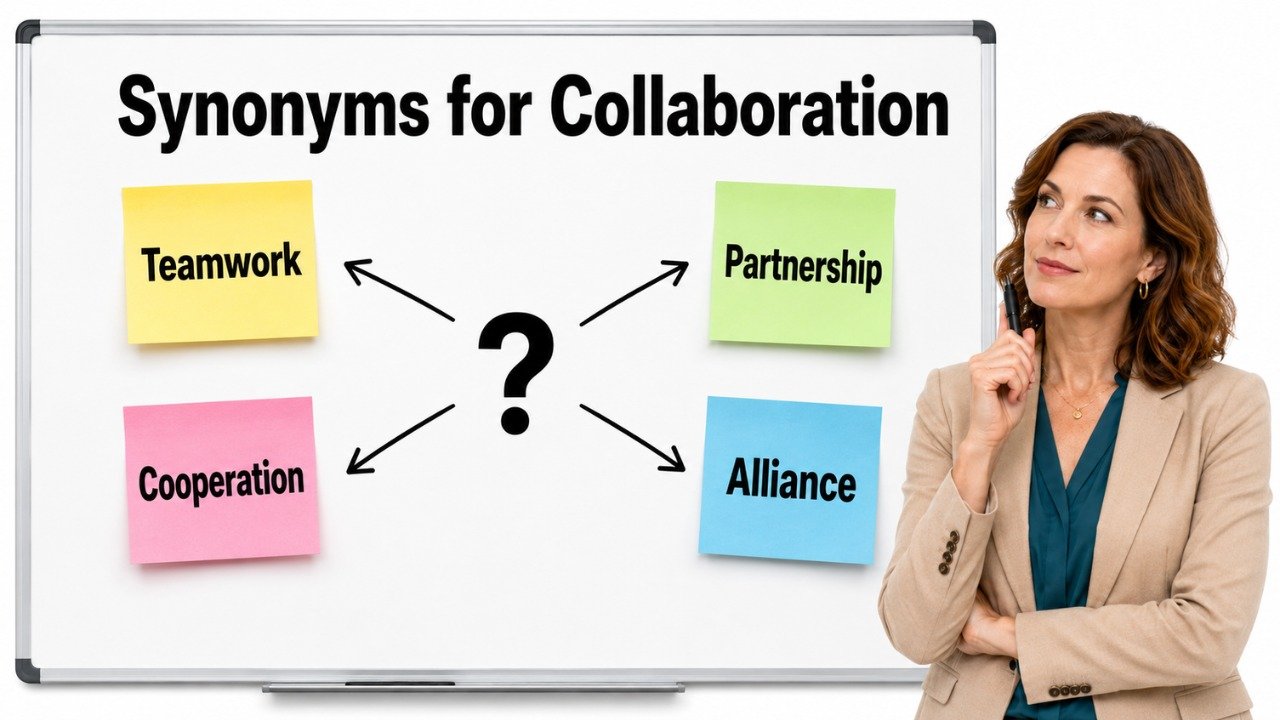
Quick Answer: The best synonyms for collaboration are cooperation, teamwork, partnership, coordination, alliance, joint effort, collective effort, consultation, cocreation, and synergy. Use cooperation for general shared work, teamwork for people working as one group, partnership for a formal relationship, coordination for organized activities, alliance for strategic support, and cocreation for producing something together. The best replacement depends on whether you are describing shared effort, formal agreements, creative work, planning, or community action.
Pronunciation and Word Details
Word: Collaboration.
Pronunciation: /kəˌlæbəˈreɪʃən/.
Part of Speech: Noun.
Meaning: The act of working with other people or groups to achieve a shared goal or create something together.
US Pronunciation:
UK Pronunciation:
What Does “Collaboration” Mean?
Collaboration means working together with one or more people to achieve a common goal, solve a problem, or produce something.
Collaboration is a noun. It describes a process in which people share ideas, responsibilities, knowledge, skills, or resources. It often involves active communication and meaningful participation from everyone involved.
The word can describe informal teamwork between friends, organized cooperation between departments, creative work between artists, academic research between specialists, or formal partnerships between organizations.
In a workplace sentence, collaboration may refer to employees combining their skills. In education, it can describe students completing a project together. In creative settings, it may involve writers, designers, and performers producing one piece of work.
Workplace Use: The project succeeded because of close collaboration between the two departments.
Academic Use: The study was completed through collaboration among several researchers.
Creative Use: Their collaboration produced an original and memorable design.
Community Use: Collaboration between residents helped improve the neighborhood.
Meaning, Tone, and Context of “Collaboration”
Collaboration has a positive, professional, and generally neutral tone. It suggests shared responsibility, open communication, and a willingness to contribute toward the same result.
The word is common in professional writing, education, research, business communication, creative industries, community projects, and technical discussions. It can also appear in everyday conversation, although teamwork and working together often sound more natural in casual speech.
Formal Tone: Collaboration is suitable for reports, proposals, essays, presentations, and professional emails.
Positive Tone: The word usually suggests trust, cooperation, shared ideas, and productive relationships.
Academic Tone: Researchers often use collaboration when discussing shared studies, knowledge exchange, or work across different fields.
Professional Tone: Employers may use the word when discussing communication, leadership, team performance, or project management.
Creative Tone: Collaboration can describe two or more people combining their creative abilities to produce something new.
Technical Tone: In technical settings, collaboration may involve specialists sharing information, systems, responsibilities, and problem solving tasks.
Collaboration is stronger than simple participation because it usually requires people to contribute actively. Someone may participate in a meeting without collaborating, but true collaboration involves sharing ideas, decisions, or responsibilities.
When and How to Use “Collaboration”
For Shared Work
Use collaboration when people actively work together toward the same objective.
Example: Collaboration among the team members helped them complete the assignment early.
For Team Projects
Use collaboration when several people combine their abilities, experience, or knowledge.
Example: The project required collaboration between writers, editors, and designers.
For Formal Relationships
Use collaboration when departments, institutions, or professional groups work together.
Example: The program was developed through collaboration between two educational institutions.
For Creative Work
Use collaboration when people jointly produce art, writing, music, designs, or other creative material.
Example: The exhibition was the result of a creative collaboration between several local artists.
For Research
Use collaboration when researchers, specialists, or academic departments conduct work together.
Example: International collaboration allowed the scientists to share data and expertise.
For Problem Solving
Use collaboration when people exchange ideas and develop a solution together.
Example: Close collaboration helped the managers resolve the scheduling problem.
For Planning
Use collaboration when individuals or groups share decisions and organize activities together.
Example: The event was planned through collaboration among volunteers and community leaders.
For Communication
Use collaboration when productive communication supports shared work.
Example: Clear communication is essential for successful collaboration.
For Community Action
Use collaboration when residents, volunteers, or organizations work toward a community goal.
Example: Community collaboration helped create a safer public space.
Best Synonyms for Collaboration
Cooperation
Synonym: Cooperation means working willingly with others to achieve a shared result.
Example: Cooperation between the employees made the transition much easier.
Teamwork
Synonym: Teamwork means a group combining its abilities and effort to complete a task.
Example: Strong teamwork helped the players respond to every challenge.
Partnership
Synonym: Partnership means a formal or continuing relationship in which people or groups work together.
Example: The two organizations formed a partnership to support local education.
Coordination
Synonym: Coordination means organizing people, activities, or resources so they work effectively together.
Example: Better coordination between the departments reduced delays.
Alliance
Synonym: Alliance means an agreement between people or groups to support shared interests.
Example: The organizations created an alliance to promote environmental protection.
Joint Effort
Synonym: Joint effort means work completed through the combined actions of two or more people.
Example: The successful event was a joint effort by staff members and volunteers.
Collective Effort
Synonym: Collective effort means combined work performed by an entire group.
Example: Protecting the local park required a collective effort.
Consultation
Synonym: Consultation means discussing an issue with others before making a decision.
Example: The policy was revised after consultation with employees and advisers.
Cocreation
Synonym: Cocreation means developing or producing something through shared creative input.
Example: The workshop encouraged cocreation between teachers and students.
Synergy
Synonym: Synergy means the improved result created when people or groups combine their strengths.
Example: The synergy between the two teams produced excellent results.
50 Synonyms for Collaboration with Short Meanings
- Cooperation: Willing action with others toward a shared goal.
- Teamwork: Combined effort by members of a group.
- Partnership: A continuing relationship based on shared work or interests.
- Coordination: Organized management of people, actions, or resources.
- Alliance: An agreement to support shared goals or interests.
- Joint Effort: Work completed through the actions of multiple people.
- Collective Effort: Combined work performed by a group.
- Combined Effort: Effort created by bringing individual contributions together.
- Shared Effort: Work and responsibility divided among participants.
- Concerted Effort: Carefully organized action toward one purpose.
- Team Effort: Work completed through the contribution of a team.
- Group Work: Tasks performed jointly by several people.
- Joint Work: Work produced or completed by two or more participants.
- Cooperative Effort: Shared work based on willingness and mutual assistance.
- Mutual Support: Help exchanged between people or groups.
- Mutual Aid: Practical assistance provided to one another.
- Joint Action: Action taken together toward the same objective.
- Collective Action: Coordinated action performed by a group.
- Coordinated Action: Organized activity involving several participants.
- Combined Action: Action created by joining separate efforts.
- Association: A connection formed for a shared purpose.
- Coalition: A group formed by different parties to pursue a common goal.
- Union: The joining of people or groups for shared action.
- Affiliation: A formal or informal connection with another group.
- Liaison: Communication and cooperation between separate people or groups.
- Working Relationship: A professional connection based on shared responsibilities.
- Strategic Partnership: A planned relationship created to achieve important goals.
- Joint Venture: A project or activity undertaken by multiple parties.
- Shared Enterprise: A common project involving shared effort and responsibility.
- Common Endeavor: An activity pursued together for the same purpose.
- Participation: Active involvement in an activity or project.
- Engagement: Meaningful involvement in shared work or discussion.
- Consultation: Discussion with others before making plans or decisions.
- Interaction: Communication or activity between people or groups.
- Communication: The exchange of information needed for shared work.
- Idea Sharing: The exchange of thoughts, suggestions, and creative concepts.
- Knowledge Sharing: The exchange of information, experience, or expertise.
- Resource Sharing: The joint use of materials, money, tools, or information.
- Joint Planning: Developing plans through shared discussion and decisions.
- Consensus Building: Creating agreement among people with different views.
- Cocreation: Producing something through shared creative participation.
- Coproduction: Producing a result, service, or work together.
- Integration: Combining separate contributions into one effective whole.
- Networking: Building connections that support communication and shared opportunities.
- Synergy: A stronger result created by combining different abilities.
- Solidarity: Unity and mutual support among people with shared interests.
- Reciprocity: A relationship based on exchanging help or benefits.
- Team Participation: Active involvement in a group task or decision.
- Collaborative Work: Work completed through shared ideas and responsibilities.
- Community Effort: Combined action by people working for a local goal.
Read Also:
Synonyms for Fostering

Synonyms for Collaboration by Context
When Collaboration Means Working Together
Cooperation, teamwork, joint effort, group work, and collective effort are useful when people actively contribute to the same task.
Cooperation emphasizes willingness to help. Teamwork emphasizes group performance. Joint effort emphasizes the combined work that produces a result.
Example With Cooperation: Cooperation among the employees helped the office remain productive.
Example With Teamwork: Teamwork allowed the group to finish the project successfully.
Example With Joint Effort: The community garden was created through a joint effort.
When Collaboration Means a Formal Relationship
Partnership, alliance, association, strategic partnership, and joint venture work well for formal or continuing relationships.
Partnership is suitable when people or organizations share responsibility. Alliance emphasizes shared interests or strategic support. Joint venture usually refers to a specific project or business activity.
Example With Partnership: The two institutions established a partnership for student training.
Example With Alliance: Several organizations formed an alliance to support the campaign.
Example With Joint Venture: The new service was developed as a joint venture.
When Collaboration Means Organized Activity
Coordination, joint planning, integration, liaison, and coordinated action are useful when the focus is organization.
Coordination emphasizes arranging activities efficiently. Joint planning focuses on shared decisions. Liaison emphasizes communication between separate groups.
Example With Coordination: Careful coordination prevented scheduling conflicts.
Example With Joint Planning: Joint planning helped the departments use their resources wisely.
Example With Liaison: A liaison between the teams improved communication.
When Collaboration Means Creative Production
Cocreation, coproduction, idea sharing, creative partnership, and knowledge sharing are suitable for creative or intellectual projects.
Cocreation emphasizes equal involvement in developing something. Idea sharing focuses on exchanging suggestions. Coproduction emphasizes producing a finished result together.
Example With Cocreation: The workshop supported cocreation between designers and customers.
Example With Idea Sharing: Regular idea sharing encouraged original solutions.
Example With Coproduction: The program was a coproduction involving several creative teams.
When Collaboration Means Community Support
Collective action, community effort, solidarity, mutual aid, and mutual support are appropriate when people work together for social or local goals.
Solidarity emphasizes unity. Mutual aid emphasizes practical help. Collective action emphasizes organized group activity.
Example With Solidarity: The residents showed solidarity during the difficult period.
Example With Mutual Aid: Mutual aid helped families obtain essential supplies.
Example With Collective Action: Collective action brought meaningful improvements to the neighborhood.
Another Word for Collaboration
Cooperation is often the best single replacement for collaboration because it has a broad meaning and works in many professional, academic, and everyday contexts. However, the strongest alternative depends on the type of shared activity being described.
Use teamwork for group performance, partnership for a formal relationship, coordination for organized activity, and cocreation for creative development.
Original: Successful collaboration helped the group complete the assignment.
Better Option: Successful teamwork helped the group complete the assignment.
Original: The project was developed through collaboration between two institutions.
Better Option: The project was developed through a partnership between two institutions.
Original: Collaboration between the departments reduced delays.
Better Option: Coordination between the departments reduced delays.
Original: The design resulted from collaboration with local residents.
Better Option: The design resulted from cocreation with local residents.
When Not to Use “Collaboration”
Do not use collaboration when a more precise word explains the relationship or activity more clearly.
When You Mean Simple Help
Collaboration may sound too formal when one person only provides minor assistance.
Weak: Thank you for your collaboration with carrying the boxes.
Better: Thank you for your help with carrying the boxes.
When You Mean Group Performance
Teamwork is often more natural when discussing people functioning as one team.
Weak: The players demonstrated excellent collaboration during the match.
Better: The players demonstrated excellent teamwork during the match.
When You Mean Formal Commercial Work
Partnership may be clearer when organizations have an established professional relationship.
Weak: The two businesses announced a long term collaboration.
Better: The two businesses announced a long term partnership.
When You Mean Organization
Coordination is more accurate when separate groups arrange schedules, resources, or responsibilities.
Weak: Better collaboration is needed to prevent scheduling conflicts.
Better: Better coordination is needed to prevent scheduling conflicts.
When You Mean Advice
Consultation is more accurate when one person gives information or guidance but does not share responsibility for the final result.
Weak: The policy was created in collaboration with an adviser who reviewed it once.
Better: The policy was created after consultation with an adviser.
When Repetition Weakens the Sentence
Repeating collaboration several times can make professional writing sound mechanical.
Weak: Collaboration improves collaboration because collaborative teams value collaboration.
Better: Cooperation improves team performance because participants value shared responsibility.
Words Commonly Confused With Collaboration
Collaboration vs Cooperation: Collaboration usually involves active shared work and joint responsibility. Cooperation can simply mean being helpful, supportive, or willing to follow a shared plan.
Collaboration vs Teamwork: Collaboration can occur between separate individuals, departments, or organizations. Teamwork usually happens among members of the same group.
Collaboration vs Coordination: Collaboration emphasizes creating or solving something together. Coordination emphasizes arranging separate tasks so they operate smoothly.
Collaboration vs Partnership: Collaboration may describe one project or temporary activity. Partnership often suggests a formal, structured, or continuing relationship.
Collaboration vs Consultation: Collaboration involves shared contribution and responsibility. Consultation involves asking someone for advice, feedback, or specialist knowledge.
Collaboration vs Participation: Participation means taking part. Collaboration requires participants to interact and contribute toward a shared result.
Collaboration vs Communication: Communication is the exchange of information. Collaboration includes communication but also requires shared action, decisions, or production.
Collaboration vs Contribution: A contribution is one person’s individual input. Collaboration is the broader process through which several contributions are combined.
Which Synonym Should You Choose?
Choose cooperation when you need a broad and neutral word for people working willingly together.
Choose teamwork when members of one group combine their abilities to complete a task.
Choose partnership when two people, institutions, or organizations have a formal or continuing relationship.
Choose coordination when the main focus is arranging schedules, tasks, resources, or responsibilities.
Choose alliance when different groups unite because they share an interest, purpose, or strategy.
Choose joint effort when you want to emphasize that several people contributed to one result.
Choose collective effort when an entire group or community worked toward a shared objective.
Choose consultation when people discuss an issue or seek advice before making a decision.
Choose cocreation when participants jointly design, develop, or produce something.
Choose synergy when the combined abilities of participants create a stronger result than separate efforts would produce.
Choose cooperation in general essays, professional emails, and neutral explanations.
Choose teamwork in casual conversation, workplace discussions, and descriptions of group performance.
Choose partnership in reports, proposals, agreements, and formal announcements.
Choose coordination in project plans, schedules, operational reports, and administrative communication.
Choose collaboration when shared ideas, shared decisions, and shared responsibility are all important.
Real Life Examples of “Collaboration” in Sentences
Original: Collaboration among the teachers improved the lesson plans.
Better Option: Cooperation among the teachers improved the lesson plans.
Original: The team completed the difficult task through collaboration.
Better Option: The team completed the difficult task through teamwork.
Original: The two organizations began a collaboration to support local families.
Better Option: The two organizations began a partnership to support local families.
Original: Better collaboration between the offices reduced scheduling problems.
Better Option: Better coordination between the offices reduced scheduling problems.
Original: The community project required collaboration from residents and volunteers.
Better Option: The community project required a collective effort from residents and volunteers.
Original: The design was developed through collaboration between the artist and the architect.
Better Option: The design was developed through cocreation between the artist and the architect.
Original: International collaboration strengthened the research project.
Better Option: International cooperation strengthened the research project.
Original: The event succeeded because of collaboration among several departments.
Better Option: The event succeeded because of a joint effort among several departments.
Original: Collaboration with experienced advisers improved the final proposal.
Better Option: Consultation with experienced advisers improved the final proposal.
Original: The collaboration between the two groups produced better results.
Better Option: The synergy between the two groups produced better results.
Synonym Groups and Usage Differences
Teamwork Group
Teamwork, team effort, group work, joint work, and team participation describe people working as members of a group.
Teamwork is the strongest general choice when group members depend on one another. Group work is common in educational settings. Team effort emphasizes everyone’s contribution.
Example: Excellent teamwork helped the group meet its deadline.
Cooperation Group
Cooperation, cooperative effort, mutual support, mutual aid, and reciprocity emphasize willingness to help and support others.
Cooperation is broad and neutral. Mutual aid refers to practical help exchanged between people. Reciprocity emphasizes a two way exchange of support.
Example: Cooperation between the neighbors made the cleanup easier.
Formal Relationship Group
Partnership, alliance, coalition, association, affiliation, and joint venture describe organized relationships.
Partnership usually suggests shared responsibility. Alliance and coalition often describe groups joining for strategic reasons. Affiliation indicates a connection without necessarily suggesting shared control.
Example: The institutions formed a partnership to provide professional training.
Planning and Organization Group
Coordination, joint planning, integration, liaison, and coordinated action relate to organized work.
Coordination focuses on arranging activities. Integration means combining separate elements into a unified process. Liaison focuses on maintaining communication between groups.
Example: Careful coordination allowed every department to complete its responsibilities.
Creative Exchange Group
Cocreation, coproduction, idea sharing, knowledge sharing, and creative partnership relate to developing something through shared input.
Cocreation emphasizes equal creative involvement. Idea sharing may happen before production begins. Coproduction focuses on making the final work together.
Example: Cocreation gave every participant a voice in the design process.
Community Action Group
Collective action, community effort, solidarity, common endeavor, and collective effort describe people uniting around a shared cause.
Collective action is organized and purposeful. Solidarity expresses unity and support. Community effort emphasizes local participation.
Example: The new public garden was created through a community effort.
Combined Strength Group
Synergy, combined effort, concerted effort, shared effort, and joint action emphasize the power created by bringing contributions together.
Synergy suggests that the combined result is stronger than individual results. Concerted effort suggests deliberate and organized action.
Example: The synergy between the specialists led to an innovative solution.
Antonyms of Collaboration
The opposite of collaboration depends on whether the word refers to shared work, unity, communication, or coordinated action.
Competition: An attempt to perform better than another person or group.
Conflict: Serious disagreement or opposition between participants.
Opposition: Resistance to another person’s plans or actions.
Isolation: Separation from other people or groups.
Separation: The state of remaining apart rather than working together.
Division: Disagreement or separation within a group.
Rivalry: Continuing competition between individuals or groups.
Obstruction: Action that prevents progress or cooperation.
Noncooperation: Refusal to assist or work with others.
Disagreement: A difference of opinion that may prevent shared action.
Independence: Working or acting without relying on others.
Individualism: Emphasis on personal action rather than collective effort.
Disconnection: A lack of communication or connection between participants.
Fragmentation: The division of a unified group or process into separate parts.
Withdrawal: The act of ending involvement in a shared activity.
Comparison: Collaboration vs Related Words
Collaboration vs Cooperation
Collaboration usually involves people actively creating, planning, or solving something together. Cooperation may only require people to be helpful or follow the same plan.
Example With Collaboration: The writers worked in collaboration to produce the final guide.
Example With Cooperation: The employees showed cooperation by following the new procedure.
Collaboration vs Teamwork
Collaboration can take place between separate individuals or organizations. Teamwork usually describes members of the same group working as one unit.
Example With Collaboration: The two departments began a collaboration on the new project.
Example With Teamwork: Strong teamwork helped the department complete the project.
Collaboration vs Coordination
Collaboration involves shared ideas, decisions, and responsibilities. Coordination involves organizing separate actions so they do not conflict.
Example With Collaboration: The specialists developed the solution through collaboration.
Example With Coordination: The manager improved coordination between the morning and evening teams.
Collaboration vs Partnership
Collaboration can be temporary and focused on one task. Partnership often describes a formal, structured, or continuing relationship.
Example With Collaboration: Their collaboration lasted until the report was completed.
Example With Partnership: Their partnership continued for several years.
Collaboration vs Consultation
Collaboration involves active participation in creating the outcome. Consultation involves providing advice, information, or feedback.
Example With Collaboration: The adviser joined the team in collaboration on the full proposal.
Example With Consultation: The team prepared the proposal after consultation with the adviser.
Collaboration vs Participation
Participation means taking part in an activity. Collaboration requires participants to work with one another toward a shared outcome.
Example With Collaboration: Collaboration among the students produced a detailed presentation.
Example With Participation: Every student received credit for participation in the discussion.
Collaboration vs Contribution
Collaboration describes the complete shared process. Contribution describes the specific input provided by one participant.
Example With Collaboration: The article was completed through collaboration among three editors.
Example With Contribution: Her contribution included checking the facts and correcting the grammar.
Common Phrases and Expressions With “Collaboration”
In Collaboration With: Working jointly with another person or group.
Close Collaboration: Frequent and active shared work between participants.
Effective Collaboration: Shared work that produces the intended result.
Successful Collaboration: Cooperation that achieves a positive outcome.
Creative Collaboration: Shared work focused on producing an original idea or creation.
Team Collaboration: Joint work involving members of the same team.
Research Collaboration: Shared investigation or study involving multiple researchers.
Professional Collaboration: Joint work conducted in a professional setting.
Ongoing Collaboration: Shared work that continues over a period of time.
Future Collaboration: Shared work that participants may undertake later.
Cross Functional Collaboration: Cooperation between people from different professional departments or specialties.
International Collaboration: Shared work involving people or institutions from different countries.
Collaboration Skills: Abilities that help someone communicate and work effectively with others.
Collaborative Environment: A setting that encourages shared ideas, decisions, and responsibilities.
Common Mistakes to Avoid
Repeating the Word Too Often: Using collaboration in every sentence makes writing sound mechanical. Replace some instances with teamwork, cooperation, partnership, or joint effort.
Choosing an Overly Formal Word: Collaboration may sound unnatural in simple everyday situations. Use help, teamwork, or working together when the context is casual.
Confusing Collaboration With Coordination: Use collaboration for shared creation or problem solving. Use coordination for arranging schedules, duties, and resources.
Confusing Collaboration With Consultation: A person who only gives advice is usually consulted. A person who actively helps develop the result is collaborating.
Using Partnership Too Broadly: Partnership can imply a formal or continuing relationship. Do not use it when people only work together briefly.
Using Participation as an Exact Synonym: Participation only means taking part. It does not always involve shared responsibility or meaningful interaction.
Ignoring the Context: Choose a synonym based on the actual relationship. Teamwork suits a team, alliance suits strategic unity, and cocreation suits shared creative work.
Using Unnatural Phrasing: Collaboration is commonly followed by between, among, or with.
Natural: Collaboration between the departments improved communication.
Natural: The project was completed in collaboration with local experts.
Unnatural: The department did collaboration for the project.
Better: The department collaborated on the project.
Forgetting the Verb Form: Collaboration is a noun. Collaborate is the related verb.
Noun: Their collaboration produced excellent results.
Verb: They collaborated to produce excellent results.
Conclusion
The best synonyms for collaboration include cooperation, teamwork, partnership, coordination, alliance, joint effort, and cocreation. Cooperation is the strongest general replacement, while teamwork suits group performance and partnership suits formal relationships. Use coordination for organized activities, consultation for advice, and synergy for combined strength. Choosing the right alternative depends on whether you are describing shared work, creative production, planning, community action, or a professional relationship. Understanding these differences makes your language clearer, more accurate, and more natural.
FAQs About Synonyms for Collaboration
What Is the Best Synonym for Collaboration?
Cooperation is the best general synonym because it describes people or groups working willingly toward a shared result.
Is Teamwork the Same as Collaboration?
They are closely related, but not identical. Teamwork usually occurs within one group, while collaboration can involve separate people, teams, departments, or organizations.
What Is a Formal Synonym for Collaboration?
Partnership, coordination, alliance, association, and joint venture are useful formal alternatives. The best choice depends on the type of relationship.
Can Cooperation Replace Collaboration?
Cooperation can replace collaboration in many sentences. However, collaboration often suggests deeper involvement, shared decisions, and joint responsibility.
What Is Another Word for Creative Collaboration?
Cocreation, creative partnership, idea sharing, joint production, and coproduction are suitable alternatives for creative collaboration.
What Is the Difference Between Collaboration and Coordination?
Collaboration involves working together to create or solve something. Coordination involves organizing separate tasks, schedules, or responsibilities efficiently.
What Is the Verb Form of Collaboration?
The verb form is collaborate. For example, “The departments collaborated on the new project.”
