
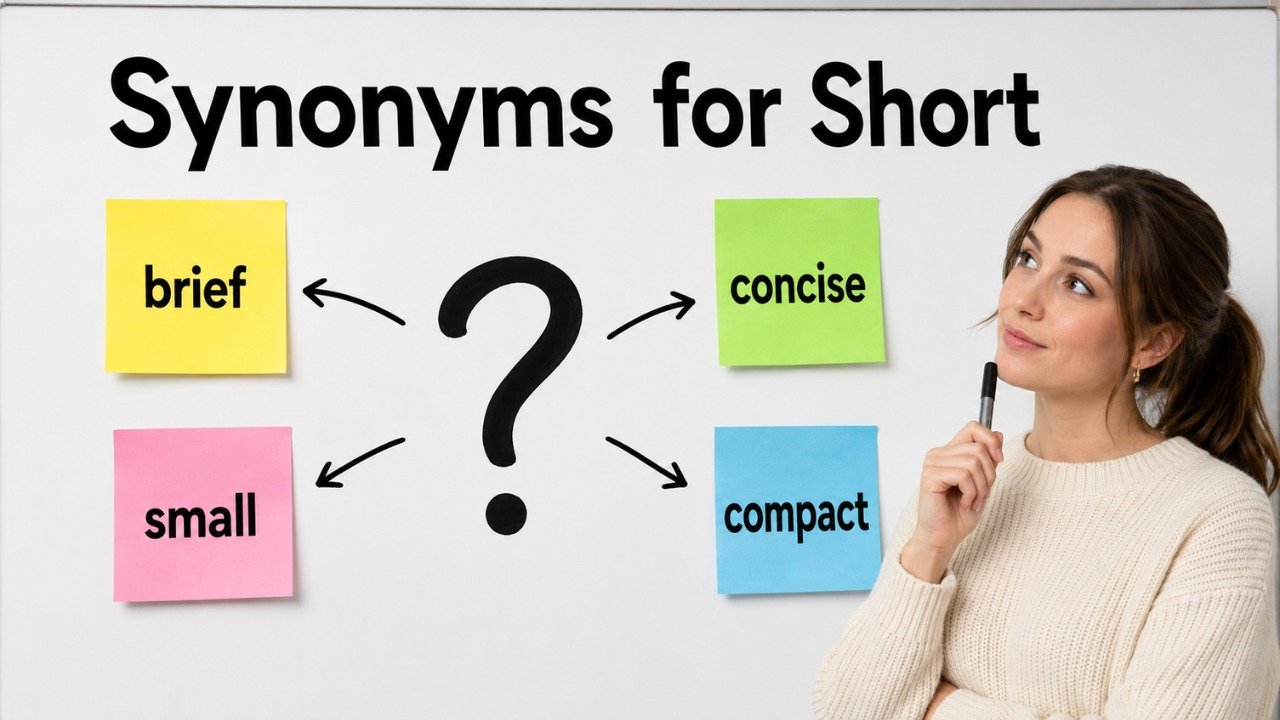
Quick Answer: The best synonyms for short include brief, concise, succinct, compact, abbreviated, small, low, limited, insufficient, and curt. Use brief for something that lasts little time, concise or succinct for clear writing with few words, small or compact for limited size, low for limited height, abbreviated for a shortened form, insufficient for an inadequate amount, and curt for speech that sounds abrupt or unfriendly.
Pronunciation and Word Details
Word: Short.
Pronunciation: /ʃɔːrt/
Part of Speech: Adjective, adverb, noun, and verb.
Meaning: Having little length, height, duration, detail, or quantity.
US Pronunciation:
UK Pronunciation:
What Does “Short” Mean?
Short describes something that has little length, height, duration, detail, or quantity. It is most commonly used as an adjective, although it can also function as an adverb, noun, or verb.
The word has several common meanings. A short road has little physical length. A short person has limited height. A short meeting lasts for little time. A short answer contains few words. A business that is short of supplies does not have enough of them.
Short can also describe communication. A short response may simply be brief, but it can sometimes sound curt, abrupt, or unfriendly.
In financial language, short can describe selling an asset with the expectation that its value will decrease. In everyday language, however, the word usually relates to length, time, size, quantity, or detail.
Meaning, Tone, and Context of “Short”
Short is a common, neutral, and highly flexible word. It appears naturally in casual conversation, professional communication, academic writing, instructions, descriptions, and reports.
When short refers to physical length or height, its tone is usually neutral.
Example: The cable is too short to reach the outlet.
When it refers to writing or speech, it may suggest clarity and efficiency.
Example: Please provide a short summary of the report.
However, when short describes someone’s manner of speaking, it can carry a negative emotional tone. A short reply may sound impatient, annoyed, or impolite.
Example: Her short response suggested that she was upset.
In formal writing, words such as concise, succinct, abbreviated, limited, or insufficient may communicate a more precise meaning than short.
When and How to Use “Short”
For Physical Length
Use short when something does not extend very far from one end to the other.
Example: We followed a short path through the garden.
For Height
Use short to describe a person, object, plant, or structure with limited height.
Example: The short cabinet fits beneath the window.
For Time
Use short when an event, activity, or experience lasts for a limited period.
Example: We had a short meeting before lunch.
For Writing and Speech
Use short when a message, answer, story, or explanation contains few words.
Example: She gave a short explanation of the problem.
For Limited Quantity
Use short when an amount is smaller than what is required or expected.
Example: The team is short of essential supplies.
For Distance
Use short when two places or points are close together.
Example: The office is a short walk from the station.
For Communication Style
Use short when a response sounds abrupt, impatient, or lacking in warmth.
Example: His short reply made the conversation uncomfortable.
For Incomplete Results
Use short when someone or something fails to reach a target, standard, or goal.
Example: The final total fell short of our expectations.
Best Synonyms for Short
Brief: Lasting for little time or containing few words.
Example: The manager gave a brief introduction.
Concise: Expressing information clearly in few words.
Example: Her concise explanation was easy to understand.
Succinct: Clearly expressed without unnecessary detail.
Example: He provided a succinct summary of the proposal.
Compact: Small and arranged efficiently.
Example: They selected a compact table for the apartment.
Abbreviated: Reduced from a longer or complete form.
Example: The guide contains an abbreviated version of the instructions.
Small: Limited in size, amount, or extent.
Example: A small fence surrounded the garden.
Low: Not extending far upward.
Example: The room has a low ceiling.
Limited: Restricted in amount, range, time, or availability.
Example: Only a limited number of seats remained.
Insufficient: Not enough for a particular purpose.
Example: The evidence was insufficient to support the claim.
Curt: Unusually brief and possibly impolite.
Example: His curt answer made her feel unwelcome.
50 Synonyms for Short with Short Meanings
- Brief: Lasting little time or using few words.
- Concise: Clear and complete without unnecessary words.
- Succinct: Expressed clearly in a compact form.
- Compact: Small and efficiently arranged.
- Abbreviated: Made shorter than the complete form.
- Abridged: Reduced while keeping the main meaning.
- Condensed: Made shorter by removing extra detail.
- Summarized: Presented through the most important points.
- Compressed: Reduced into a smaller space or form.
- Truncated: Cut off before the complete ending.
- Clipped: Brief, shortened, or sharply expressed.
- Curtailed: Reduced in length, duration, or activity.
- Reduced: Made smaller in size, amount, or extent.
- Miniature: Much smaller than the usual size.
- Cut: Reduced in length, amount, or duration.
- Cropped: Cut shorter by removing an outer part.
- Limited: Restricted in amount, time, or range.
- Narrow: Limited in width, range, or scope.
- Small: Having little size, extent, or amount.
- Little: Small in size, quantity, or importance.
- Low: Having limited height or level.
- Diminutive: Very small in size or height.
- Petite: Small and attractively proportioned.
- Undersized: Smaller than the expected size.
- Stunted: Prevented from reaching normal height or growth.
- Shallow: Having little depth.
- Slight: Small in degree, size, or amount.
- Scant: Barely sufficient in amount or quantity.
- Scarce: Available only in a limited quantity.
- Insufficient: Not enough for the required purpose.
- Inadequate: Not sufficient in quality or quantity.
- Deficient: Lacking something necessary.
- Lacking: Missing an important amount or quality.
- Meager: Unusually small or inadequate in amount.
- Sparse: Thinly distributed or limited in number.
- Fleeting: Lasting for a very short time.
- Momentary: Continuing for only a moment.
- Temporary: Existing for a limited period.
- Quick: Taking little time to complete.
- Rapid: Happening within a short period.
- Abrupt: Sudden, brief, or unexpectedly sharp.
- Curt: Brief in a way that may sound rude.
- Terse: Using very few words.
- Brusque: Brief and direct in an unfriendly manner.
- Blunt: Direct and lacking softness or detail.
- Laconic: Using very few words in speech or writing.
- Pithy: Brief but meaningful and effective.
- Incomplete: Not fully developed or finished.
- Unfinished: Not brought to completion.
- Nearby: Located only a short distance away.
Read Also:
Synonyms for Vintage

Synonyms for Short by Context
When Short Means Brief
Brief, concise, succinct, pithy, and compact describe communication that uses relatively few words.
Brief is the most general alternative. Concise suggests that unnecessary words have been removed. Succinct sounds slightly more formal and emphasizes clarity. Pithy describes language that is both brief and meaningful.
Example: She gave a concise explanation of the new procedure.
When Short Means Small in Length or Height
Small, little, low, diminutive, petite, undersized, and stunted can replace short when discussing physical dimensions.
Use low for limited height, especially with objects and structures. Petite is generally used for a small and proportionate person. Stunted suggests that normal growth has been prevented.
Example: A low wall separated the two gardens.
When Short Means Limited in Time
Brief, fleeting, momentary, temporary, quick, and rapid describe something that lasts or happens within a limited period.
Fleeting emphasizes that something disappears quickly. Momentary means lasting only for a moment. Temporary suggests that something will eventually change or end.
Example: The delay caused a momentary interruption.
When Short Means Insufficient
Insufficient, inadequate, deficient, lacking, scarce, scant, and meager describe an amount that does not meet a need or expectation.
Insufficient is appropriate for formal reports and evaluations. Scarce describes something that is difficult to find. Meager often suggests a disappointingly small amount.
Example: The available information was insufficient for a final decision.
When Short Means Abrupt in Tone
Curt, terse, clipped, brusque, blunt, and laconic describe communication that contains few words.
Curt and brusque often imply impatience or impoliteness. Terse may be neutral or negative depending on context. Laconic can describe a naturally reserved communication style.
Example: His curt response ended the discussion.
When Short Means Reduced or Cut
Abbreviated, abridged, condensed, compressed, truncated, cropped, and curtailed describe something reduced from its complete form.
Use abbreviated for shortened words, names, or versions. Abridged is common for books and documents. Truncated suggests that the ending has been removed.
Example: We read an abridged version of the novel.
Another Word for Short
Brief is often the best general replacement for short when discussing time, writing, speech, meetings, or events. However, the most accurate alternative depends on the intended meaning.
Use concise for clear writing, small for physical size, low for height, insufficient for quantity, and curt for an unfriendly communication style.
Original: We had a short discussion about the schedule.
Better Option: We had a brief discussion about the schedule.
Original: Please write a short explanation.
Better Option: Please write a concise explanation.
Original: The building has a short entrance wall.
Better Option: The building has a low entrance wall.
Original: The department is short of qualified workers.
Better Option: The department has insufficient qualified workers.
When Not to Use “Short”
Avoid using short when a more precise word would communicate your intended meaning more clearly.
When Describing Clear Writing
Short only refers to length. It does not necessarily mean that the writing is clear, complete, or effective.
Weak: The report was short and easy to understand.
Better: The report was concise and easy to understand.
When Describing an Inadequate Amount
In formal writing, insufficient or inadequate is usually clearer than short.
Weak: The evidence was short for a final conclusion.
Better: The evidence was insufficient for a final conclusion.
When Describing Height
Low is often more natural for ceilings, walls, shelves, and similar objects.
Weak: The room has a short ceiling.
Better: The room has a low ceiling.
When Describing an Impolite Reply
Curt or brusque explains the tone more accurately than short.
Weak: His answer was short and unfriendly.
Better: His answer was curt and unfriendly.
When Describing an Edited Text
Use abridged, condensed, or abbreviated when a longer work has been deliberately reduced.
Weak: This is a short version of the original guide.
Better: This is an abridged version of the original guide.
When Repetition Weakens the Sentence
Repeating short can make a sentence sound basic or monotonous.
Weak: We took a short trip after a short meeting and had a short conversation.
Better: We took a brief trip after a quick meeting and had a concise conversation.
Words Commonly Confused With Short
Short vs Brief: Short has many meanings, including limited length, height, time, or quantity. Brief mainly relates to limited time or few words.
Short vs Concise: Short describes length. Concise describes communication that expresses the necessary information without unnecessary words.
Short vs Small: Short usually refers to length or height. Small can refer to overall size, amount, importance, or degree.
Short vs Low: Short may describe a person or object with limited height. Low usually describes the position or vertical level of an object.
Short vs Curt: A short answer contains few words. A curt answer is brief and may sound impatient or rude.
Short vs Terse: Terse means using few words. It may sound efficient, restrained, impatient, or unfriendly depending on the context.
Short vs Abbreviated: Short is a general description. Abbreviated means deliberately reduced from a longer form.
Short vs Scarce: Short can describe an inadequate supply. Scarce means something is limited and difficult to obtain.
Which Synonym Should You Choose?
Choose brief when describing a meeting, visit, conversation, event, or explanation that does not last long.
Choose concise when writing an essay, report, email, summary, or answer that should be clear and economical.
Choose succinct when formal or academic writing requires a compact but complete statement.
Choose compact when describing an object, design, room, or arrangement that uses little space efficiently.
Choose small when referring to limited overall size.
Choose low when describing limited height, level, or position.
Choose abbreviated when discussing a shortened name, title, document, or version.
Choose insufficient when an amount does not meet a requirement.
Choose limited when access, time, quantity, range, or availability is restricted.
Choose curt when a reply sounds unusually brief, impatient, or impolite.
Choose fleeting when an emotion, opportunity, or experience lasts for very little time.
Choose truncated when something has been cut off before its natural or complete ending.
Real Life Examples of “Short” in Sentences
Original: We had a short meeting before the presentation.
Better Option: We had a brief meeting before the presentation.
Original: She wrote a short summary of the article.
Better Option: She wrote a concise summary of the article.
Original: He lives a short distance from the office.
Better Option: He lives nearby.
Original: The short wall surrounds the front garden.
Better Option: The low wall surrounds the front garden.
Original: The team is short of essential equipment.
Better Option: The team has insufficient essential equipment.
Original: His short reply sounded unfriendly.
Better Option: His curt reply sounded unfriendly.
Original: We watched a short version of the documentary.
Better Option: We watched an abridged version of the documentary.
Original: She experienced a short feeling of doubt.
Better Option: She experienced a fleeting feeling of doubt.
Original: The shop has a short supply of fresh fruit.
Better Option: The shop has a limited supply of fresh fruit.
Original: The speech was short but memorable.
Better Option: The speech was succinct but memorable.
Synonym Groups and Usage Differences
Brevity Group
Brief, concise, succinct, pithy, terse, and laconic all relate to the use of few words.
Brief focuses mainly on length. Concise emphasizes clarity and efficiency. Succinct is more formal. Pithy suggests memorable meaning. Terse and laconic may describe a restrained speaking style.
Example: Her succinct response answered the question completely.
Physical Size Group
Small, little, compact, diminutive, petite, undersized, and miniature describe limited physical dimensions.
Small is the broadest word. Compact suggests efficient use of space. Diminutive emphasizes very small size. Petite is often positive when describing a person’s build.
Example: The compact desk fits perfectly into the corner.
Height and Depth Group
Low, shallow, stunted, and undersized relate to limited vertical measurement or development.
Low describes height or level. Shallow refers to depth. Stunted describes restricted or abnormal growth.
Example: The shallow drawer is suitable for small tools.
Duration Group
Brief, fleeting, momentary, temporary, quick, and rapid relate to limited time.
Brief is general. Fleeting emphasizes how quickly something passes. Temporary means that a condition will not be permanent.
Example: A momentary silence followed the announcement.
Insufficient Quantity Group
Insufficient, inadequate, deficient, scarce, scant, meager, and lacking describe an amount below what is needed.
Insufficient and inadequate suit formal writing. Scarce emphasizes limited availability. Meager suggests a disappointingly small amount.
Example: The project failed because its funding was inadequate.
Abrupt Tone Group
Curt, brusque, terse, clipped, and blunt describe speech that may sound sharp or unfriendly.
Curt suggests impatience. Brusque suggests a rough social manner. Blunt emphasizes directness without softening the message.
Example: His brusque manner made the new employees uncomfortable.
Reduced Form Group
Abbreviated, abridged, condensed, compressed, truncated, cropped, and curtailed describe something made shorter.
Abridged is useful for written works. Condensed describes information reduced to its main points. Cropped usually refers to visual material or physical edges.
Example: The condensed report presents only the central findings.
Antonyms of Short
The opposite of short changes according to the intended meaning.
Long: Extending a great distance or lasting considerable time.
Lengthy: Continuing for a long time or containing many words.
Tall: Having considerable height.
High: Extending far upward or positioned above the usual level.
Extended: Made longer in time, size, or scope.
Detailed: Containing a large amount of information.
Elaborate: Developed with many details or features.
Complete: Containing every necessary part.
Sufficient: Enough for a particular purpose.
Adequate: Acceptable in quantity or quality.
Abundant: Available in a large quantity.
Plentiful: Existing in more than enough quantity.
Lasting: Continuing for a considerable period.
Permanent: Intended to remain for a long or unlimited time.
Polite: Showing respect and consideration in communication.
Comparison: Short vs Related Words
Short vs Brief
Short can describe length, height, time, quantity, writing, or tone. Brief mainly describes limited time or limited wording.
Example With Short: The rope is too short for the task.
Example With Brief: We had a brief conversation after the meeting.
Short vs Concise
Short describes something with few words, but those words may still be unclear. Concise means brief, clear, and free from unnecessary detail.
Example With Short: He submitted a short answer.
Example With Concise: He submitted a concise answer that covered every key point.
Short vs Succinct
Short is common in everyday communication. Succinct is more formal and suggests that an idea has been expressed clearly in very few words.
Example With Short: She wrote a short conclusion.
Example With Succinct: She wrote a succinct conclusion that summarized the argument.
Short vs Small
Short normally refers to length, height, duration, or supply. Small refers more generally to overall size, quantity, importance, or degree.
Example With Short: The table is too short for the tall chairs.
Example With Small: The table is too small for eight guests.
Short vs Low
Short can describe limited height, especially for people or objects. Low describes vertical level, position, or elevation.
Example With Short: He is shorter than his brother.
Example With Low: The shelf is too low for the large container.
Short vs Curt
Short describes the number of words in a response. Curt describes a brief response that sounds unfriendly, impatient, or dismissive.
Example With Short: She gave a short answer.
Example With Curt: She gave a curt answer and ended the conversation.
Short vs Terse
Short is neutral unless context gives it a negative tone. Terse suggests very few words and may imply impatience or restraint.
Example With Short: The message was short.
Example With Terse: The message was terse and showed no warmth.
Short vs Abbreviated
Short describes the final length. Abbreviated indicates that something has been deliberately reduced from a longer form.
Example With Short: We used a short title.
Example With Abbreviated: We used an abbreviated form of the official title.
Short vs Insufficient
Short can informally indicate that something is lacking. Insufficient is more precise in formal, professional, and academic contexts.
Example With Short: The department is short of funds.
Example With Insufficient: The department has insufficient funds to complete the project.
Common Phrases and Expressions With “Short”
Short Answer: A brief and direct response.
Short Time: A limited period.
Short Notice: Very little time given before an event or request.
Short Distance: A place or point that is not far away.
Short Story: A work of fiction that is shorter than a novel.
Short List: A reduced selection of the strongest options.
Short Supply: An amount that is smaller than the demand.
Short of Something: Lacking the required amount of something.
Fall Short: Fail to reach a goal, expectation, or standard.
Cut Short: End something earlier than expected.
Common Mistakes to Avoid
Using Short When Concise Is More Accurate
A short piece of writing is not always clear or effective. Use concise when the writing communicates its message efficiently.
Incorrect: Make the report short and informative.
Better: Make the report concise and informative.
Using Short for Every Physical Dimension
Short usually refers to length or height. Use narrow for width and shallow for depth.
Incorrect: The box is too short from side to side.
Better: The box is too narrow from side to side.
Confusing Short and Small
A person may be short because of limited height, but a small person may have limited overall size or build.
Incorrect: The container is short for all these items.
Better: The container is too small for all these items.
Ignoring Negative Tone
Calling a reply short may imply that it was unfriendly. Use brief when you want a neutral description.
Unclear: Her response was short.
Clearer: Her response was brief but polite.
Choosing Curt for Neutral Brevity
Curt usually carries a negative meaning. Do not use it when the speaker was simply efficient.
Incorrect: He gave a curt but friendly explanation.
Better: He gave a brief and friendly explanation.
Repeating Short Too Often
Repeated use can make writing sound plain and imprecise. Select synonyms according to the intended meaning.
Repetitive: We had a short meeting about a short report during a short visit.
Improved: We had a brief meeting about a concise report during a quick visit.
Using Abbreviated for Physical Size
Abbreviated normally describes language, names, texts, schedules, or versions that have been reduced.
Incorrect: She bought an abbreviated table.
Better: She bought a compact table.
Using Insufficient Without Naming the Requirement
Insufficient becomes clearer when the sentence explains what the amount cannot achieve.
Vague: The information was insufficient.
Better: The information was insufficient to confirm the final result.
Conclusion
The best synonyms for short depend on whether you are describing length, height, time, writing, quantity, or tone. Brief works well for time and general communication, while concise and succinct suit clear writing. Small and compact describe size, low describes height, and insufficient describes an inadequate amount. Curt, terse, and brusque communicate an abrupt tone. Understanding these differences makes synonyms for short easier to use accurately in conversations, essays, reports, descriptions, and professional messages.
FAQs About Synonyms for Short
What Is the Best Synonym for Short?
Brief is the best general synonym when short refers to time, speech, writing, meetings, or events. Other meanings may require small, low, insufficient, or curt.
Is Concise a Synonym for Short?
Yes, concise is a synonym for short when describing writing or speech. It also suggests that the information is clear and contains no unnecessary words.
What Is a Formal Synonym for Short?
Succinct, concise, abbreviated, limited, and insufficient are useful formal alternatives. The correct choice depends on whether short refers to wording, time, availability, or quantity.
What Is Another Word for a Short Period?
Brief period, moment, interval, fleeting moment, and limited time are natural alternatives for a short period.
What Is a Synonym for a Short Person?
Low in height, petite, diminutive, and small are possible alternatives. Petite is usually positive, while diminutive emphasizes unusually small size.
What Is a Synonym for a Short Reply?
Brief is neutral, concise suggests clarity, terse suggests very few words, and curt suggests that the reply sounded impatient or impolite.
What Is the Difference Between Brief and Short?
Short has many meanings related to length, height, time, quantity, and tone. Brief mainly refers to limited duration or communication containing few words.
