
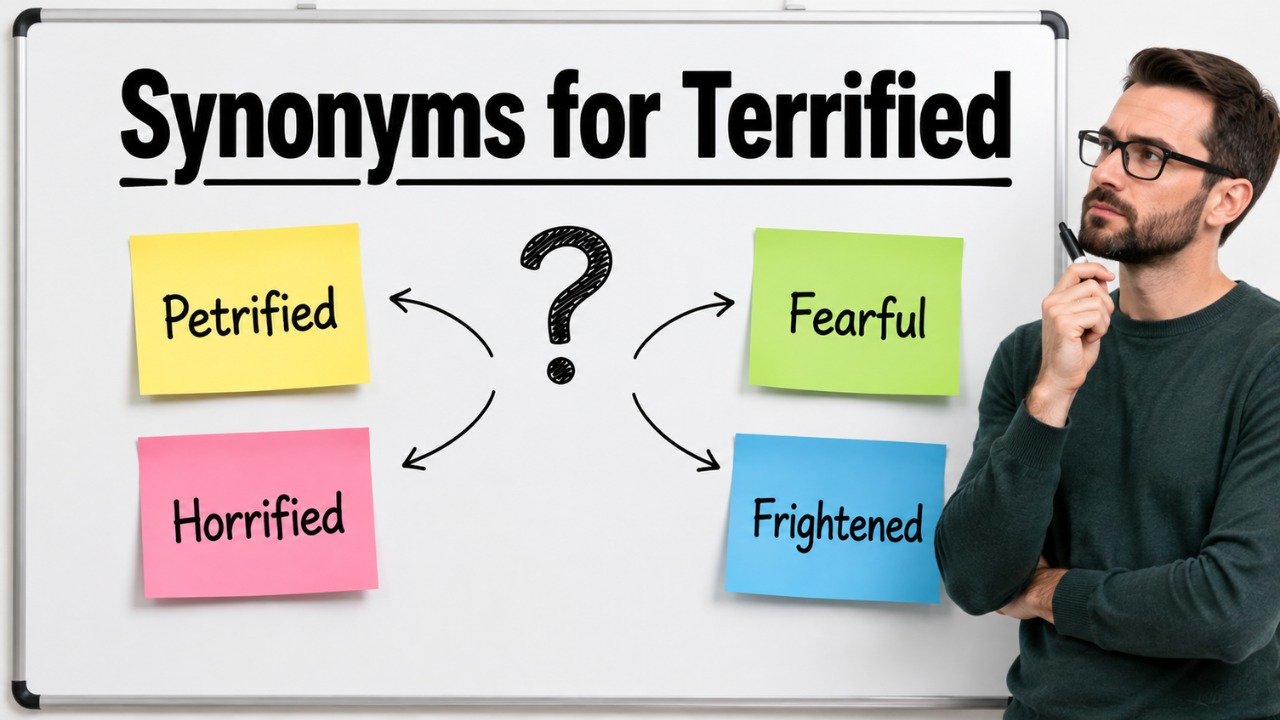
Quick Answer: The best synonyms for terrified are petrified, horrified, frightened, panic stricken, fear stricken, alarmed, aghast, scared stiff, frozen with fear, and overwhelmed by fear. Use petrified for extreme fear that makes someone feel unable to act, horrified for fear mixed with shock or disgust, frightened for a clear and neutral description, alarmed for sudden concern, and panic stricken for uncontrolled fear. In casual speech, scared stiff sounds natural, while formal or descriptive writing often favors petrified, horrified, or gripped by terror.
Pronunciation and Word Details
Word: Terrified.
Pronunciation: /ˈterəfaɪd/.
Part of Speech: Adjective and past participle of the verb terrify.
Meaning: Feeling extremely frightened or filled with intense fear.
US Pronunciation:
UK Pronunciation:
What Does “Terrified” Mean?
Terrified means feeling extremely afraid, often so strongly that clear thought, speech, or movement becomes difficult.
Terrified is commonly used as an adjective. It describes a person or animal experiencing intense fear. It is also the past participle of terrify, as in “The sudden crash terrified everyone in the room.”
The word is much stronger than nervous, worried, or uneasy. A nervous person may feel uncertain, but a terrified person feels severe fear. The cause may be an immediate danger, a frightening thought, a threatening situation, or the possibility of harm.
Terrified can appear before a noun in limited expressions, but it is most often used after a linking verb.
Example: The terrified child held tightly to her mother.
Example: She was terrified when she heard footsteps outside.
It can also be followed by of, by, that, or an infinitive.
Terrified Of: He is terrified of deep water.
Terrified By: The hikers were terrified by the sudden roar.
Terrified That: She was terrified that the door would not open.
Terrified To: He was terrified to look behind him.
Meaning, Tone, and Context of “Terrified”
Terrified is a strong and highly emotional word. It communicates much more fear than afraid, nervous, or concerned. The tone can be serious, dramatic, personal, or descriptive depending on the sentence.
In everyday conversation, terrified is common when someone wants to emphasize a powerful fear.
Example: I was terrified during the storm.
In stories and descriptive writing, terrified helps readers understand the intensity of a character’s emotional state. It is especially useful when the fear affects the body, thoughts, or behavior.
Example: Terrified, she stood motionless beside the locked door.
In formal reports, terrified may be appropriate when a witness, victim, or participant directly describes extreme fear. However, writers should avoid using it when a more neutral term such as frightened, alarmed, or distressed would be more accurate.
Terrified is not usually technical or academic. It is a direct emotional word. In psychological or medical discussion, more precise terms may be needed to describe anxiety, panic, trauma, or a specific fear response.
The word can also be used figuratively for situations that are not physically dangerous.
Example: He was terrified of failing the final examination.
When and How to Use “Terrified”
For Immediate Danger: Use terrified when a person believes that serious harm may happen at once.
Example: The passengers were terrified when smoke entered the cabin.
For a Powerful Phobia: Use terrified when fear of an object, place, animal, or activity is extremely strong.
Example: She is terrified of snakes.
For Sudden Panic: Use terrified when fear appears quickly and becomes difficult to control.
Example: He became terrified when he realized that he was lost.
For Frozen Reactions: Use terrified when fear prevents someone from moving, speaking, or deciding what to do.
Example: The child was too terrified to call for help.
For Emotional Storytelling: Use terrified to create a strong emotional picture in fiction, personal writing, or narrative description.
Example: The terrified traveler listened as the footsteps moved closer.
For Fear About Another Person: Use terrified when someone fears that a loved one may be in danger.
Example: She was terrified for her brother when he did not return.
For Fear of an Outcome: Use terrified when someone expects a deeply upsetting result.
Example: He was terrified that the test results would bring bad news.
Best Synonyms for Terrified
Petrified: So frightened that movement or clear thought feels impossible.
Example: She was petrified when the lights suddenly went out.
Horrified: Filled with fear, shock, or disgust because of something deeply disturbing.
Example: The neighbors were horrified by what they discovered.
Frightened: Feeling afraid, often because of danger or uncertainty.
Example: The frightened dog hid beneath the table.
Panic Stricken: Overcome by sudden and uncontrolled fear.
Example: The panic stricken crowd rushed toward the exit.
Fear Stricken: Strongly affected by fear and unable to respond calmly.
Example: The fear stricken witness struggled to speak.
Alarmed: Suddenly worried or frightened by a warning, sound, or unexpected event.
Example: She became alarmed when the smoke detector sounded.
Aghast: Shocked and frightened by something terrible or unexpected.
Example: The audience stood aghast as the structure began to collapse.
Scared Stiff: Extremely frightened and almost unable to move.
Example: The strange noise left him scared stiff.
Frozen With Fear: Unable to move or react because of intense fear.
Example: She remained frozen with fear at the top of the stairs.
Gripped By Terror: Completely controlled by overwhelming fear.
Example: He was gripped by terror when the door slowly opened.
50 Synonyms for Terrified with Short Meanings
- Petrified: Extremely frightened and unable to react normally.
- Horrified: Filled with fear, shock, or disgust.
- Frightened: Feeling afraid because of danger or uncertainty.
- Scared: Afraid or worried about possible harm.
- Panicked: Overcome by sudden and uncontrolled fear.
- Alarmed: Suddenly frightened or deeply concerned.
- Aghast: Shocked and frightened by something terrible.
- Fearful: Feeling or showing fear.
- Afraid: Feeling fear or anxiety about danger.
- Panic Stricken: Completely overcome by panic.
- Fear Stricken: Strongly affected by intense fear.
- Terror Stricken: Filled with extreme and overwhelming terror.
- Horror Struck: Suddenly filled with horror and fear.
- Scared Stiff: So frightened that movement feels difficult.
- Scared Witless: Extremely frightened and unable to think clearly.
- Scared Senseless: Frightened to an overwhelming degree.
- Frozen With Fear: Unable to move because of fear.
- Paralyzed With Fear: Unable to act because terror is overwhelming.
- Gripped By Terror: Completely controlled by extreme fear.
- Consumed By Fear: Mentally and emotionally overwhelmed by fear.
- Full Of Dread: Filled with fear about what may happen.
- Dread Filled: Dominated by a strong sense of coming danger.
- In A Panic: Experiencing sudden and uncontrolled fear.
- Frantic: Wildly anxious and unable to remain calm.
- Distraught: Deeply upset and unable to think calmly.
- Distressed: Experiencing strong emotional pain or fear.
- Shaken: Emotionally disturbed by a frightening experience.
- Unnerved: Made less confident or calm by fear.
- Spooked: Suddenly frightened, often in casual speech.
- Startled: Suddenly surprised and briefly frightened.
- Intimidated: Frightened or made less confident by power or threat.
- Cowed: Frightened into submission or silence.
- Cowering: Bending or shrinking away because of fear.
- Cringing: Drawing back in fear, embarrassment, or discomfort.
- Recoiling: Moving away suddenly because of fear or shock.
- Trembling: Shaking because of fear or nervousness.
- Shaking: Physically trembling as a result of fear.
- Quaking: Shaking strongly because of extreme fear.
- White With Fear: Appearing pale because of intense fright.
- Pale With Fear: Losing facial color because of terror.
- Overwhelmed By Fear: Unable to cope because fear is too strong.
- Haunted By Fear: Repeatedly troubled by a frightening thought or memory.
- Racked With Fear: Suffering intensely because of fear.
- Beside Oneself With Fear: So frightened that calm behavior becomes difficult.
- Frightened Out Of One’s Wits: Extremely scared and unable to think clearly.
- Terrified Beyond Words: Too frightened to describe the feeling easily.
- Filled With Terror: Experiencing a powerful sense of extreme fear.
- Struck With Fear: Suddenly affected by intense fear.
- Overcome With Dread: Controlled by fear of what is about to happen.
- Deeply Frightened: Experiencing serious and powerful fear.
Read Also:
Synonyms for Plant

Synonyms for Terrified by Context
When Terrified Means Extremely Frightened
Petrified, fear stricken, terror stricken, and gripped by terror describe the strongest level of fear. These choices are useful when fear overwhelms normal thought or action.
Petrified Example: The child was petrified by the sound of breaking glass.
Fear Stricken Example: The fear stricken driver could barely hold the steering wheel.
Terror Stricken Example: The residents fled the building with terror stricken expressions.
Gripped By Terror Example: She was gripped by terror as the shadow moved toward her.
When Terrified Means Shocked and Horrified
Horrified, aghast, horror struck, and appalled can describe fear mixed with shock, disbelief, or disgust. Appalled is less focused on fear and more focused on strong disapproval or shock, so it should be used carefully.
Horrified Example: The family was horrified by the damage after the storm.
Aghast Example: He stared aghast at the ruined bridge.
Horror Struck Example: The horror struck crowd fell silent.
Appalled Example: She was appalled by the cruel treatment of the animal.
When Terrified Means Unable to Move
Frozen with fear, paralyzed with fear, scared stiff, and cowed emphasize the effect of fear on action. They suggest silence, stillness, or submission.
Frozen With Fear Example: He stood frozen with fear beside the window.
Paralyzed With Fear Example: She felt paralyzed with fear when the alarm sounded.
Scared Stiff Example: The sudden scream left everyone scared stiff.
Cowed Example: The workers were cowed by the manager’s threats.
When Terrified Means Panicking
Panicked, panic stricken, frantic, and in a panic describe fear that leads to hurried, uncontrolled, or confused behavior.
Panicked Example: The panicked swimmer called for help.
Panic Stricken Example: A panic stricken parent searched the crowded station.
Frantic Example: He made a frantic attempt to unlock the door.
In A Panic Example: She left the building in a panic.
When Terrified Means Frightened in Casual Speech
Scared, spooked, scared witless, and scared senseless are natural in conversation. Scared is common and direct, while the longer expressions add stronger emphasis.
Scared Example: I was scared when I heard the noise.
Spooked Example: The empty hallway really spooked me.
Scared Witless Example: That sudden crash scared me witless.
Scared Senseless Example: The thunder scared the children senseless.
When Terrified Means Nervous About the Future
Full of dread, overcome with dread, fearful, and unnerved work well when the danger has not happened yet. They focus on expectation, uncertainty, or a growing sense that something bad may occur.
Full Of Dread Example: She was full of dread before entering the courtroom.
Overcome With Dread Example: He was overcome with dread when the phone rang.
Fearful Example: Residents were fearful of another flood.
Unnerved Example: The repeated warnings left everyone unnerved.
Another Word for Terrified
Petrified is often the best single replacement for terrified because both words express extreme fear. However, the strongest alternative depends on the type of fear. Horrified is better for fear mixed with shock, panic stricken suits uncontrolled panic, and frozen with fear emphasizes an inability to move.
Original: She was terrified when the stranger followed her.
Better Option: She was petrified when the stranger followed her.
Original: The witnesses were terrified by the violent scene.
Better Option: The witnesses were horrified by the violent scene.
Original: He was terrified and ran in every direction.
Better Option: He was panic stricken and ran in every direction.
Original: The child was terrified and could not move.
Better Option: The child was frozen with fear and could not move.
When Not to Use “Terrified”
Do not use terrified for mild nervousness, ordinary concern, or small discomfort. The word may sound exaggerated when the emotion is not severe.
Weak: I was terrified that the meeting might start five minutes late.
Better: I was worried that the meeting might start five minutes late.
Avoid terrified when you need to describe shock or disgust more than fear.
Weak: She was terrified by the unfair decision.
Better: She was appalled by the unfair decision.
Do not use terrified repeatedly in the same paragraph. Choose a synonym that reflects the specific reaction.
Weak: He was terrified by the noise, terrified by the darkness, and terrified to move.
Better: He was alarmed by the noise, unnerved by the darkness, and too frightened to move.
Avoid terrified when discussing a general tendency toward concern rather than an immediate emotional state.
Weak: The committee is terrified about rising costs.
Better: The committee is deeply concerned about rising costs.
Do not use terrified when anxious is the more accurate word. Anxiety can continue for a long period without the extreme fear suggested by terrified.
Weak: She felt terrified for several weeks before the interview.
Better: She felt anxious for several weeks before the interview.
Words Commonly Confused With Terrified
Terrified vs Afraid: Afraid covers many levels of fear, from mild concern to serious fear. Terrified always suggests a very high level of fear.
Terrified vs Frightened: Frightened is strong but usually less intense than terrified. It is useful when the exact level of fear is not extreme.
Terrified vs Petrified: Both express extreme fear. Petrified often suggests that fear has made someone unable to move or think clearly.
Terrified vs Horrified: Terrified focuses on fear. Horrified often combines fear with shock, disgust, or disbelief.
Terrified vs Panicked: Terrified describes an emotional state. Panicked emphasizes confused, rushed, or uncontrolled behavior caused by fear.
Terrified vs Anxious: Terrified describes immediate and intense fear. Anxious usually describes worry, tension, or uncertainty that may last longer.
Terrified vs Alarmed: Terrified is much stronger. Alarmed describes sudden fear or concern after noticing a possible danger.
Terrified vs Intimidated: Terrified refers to extreme fear in general. Intimidated means feeling frightened or less confident because of another person’s power, behavior, or threat.
Which Synonym Should You Choose?
Choose petrified when the fear is extreme and makes movement or clear thought difficult.
Choose horrified when fear is mixed with shock, disgust, or disbelief.
Choose frightened for a clear, neutral description that is strong but less dramatic.
Choose panic stricken when fear causes uncontrolled actions or confusion.
Choose alarmed when someone suddenly notices a warning, threat, or possible danger.
Choose aghast in formal or descriptive writing when a person reacts with intense shock and fear.
Choose scared in casual speech and ordinary conversation.
Choose spooked for a sudden fear caused by something strange, unexpected, or eerie.
Choose frozen with fear when a person cannot move or respond.
Choose full of dread when someone fears a future event rather than an immediate danger.
Choose intimidated when fear is caused by authority, strength, pressure, or threatening behavior.
Choose distressed in reports, professional writing, or careful descriptions when emotional suffering matters more than dramatic intensity.
Choose deeply concerned instead of terrified in formal emails when the situation is serious but not truly frightening.
Real Life Examples of “Terrified” in Sentences
Original: The child was terrified by the barking dog.
Better Option: The child was frightened by the barking dog.
Original: She was terrified when the elevator stopped between floors.
Better Option: She was petrified when the elevator stopped between floors.
Original: The residents were terrified by the explosion.
Better Option: The residents were panic stricken after the explosion.
Original: He was terrified of speaking in front of the audience.
Better Option: He was deeply afraid of speaking in front of the audience.
Original: The hikers were terrified when they heard an animal nearby.
Better Option: The hikers were alarmed when they heard an animal nearby.
Original: She looked terrified after reading the message.
Better Option: She looked horror struck after reading the message.
Original: The witness was terrified and could not answer.
Better Option: The witness was frozen with fear and could not answer.
Original: I was terrified by the sudden figure in the doorway.
Better Option: I was scared stiff by the sudden figure in the doorway.
Original: He felt terrified as the court date approached.
Better Option: He felt full of dread as the court date approached.
Original: The employee was terrified of the aggressive supervisor.
Better Option: The employee felt intimidated by the aggressive supervisor.
Synonym Groups and Usage Differences
Extreme Fear Group
Petrified, terror stricken, fear stricken, gripped by terror, and consumed by fear describe severe fear that controls a person’s thoughts or actions. These terms work well in dramatic, personal, and descriptive contexts.
Example: She was gripped by terror when she heard someone trying to open the door.
Sudden Shock Group
Horrified, aghast, horror struck, alarmed, and startled describe reactions to unexpected events. Horrified and aghast are stronger than alarmed or startled.
Example: The audience was aghast when the platform began to shake.
Panic and Confusion Group
Panicked, panic stricken, frantic, in a panic, and beside oneself with fear focus on uncontrolled behavior. These words suggest that fear affects judgment and decision making.
Example: The frantic father searched every room for his child.
Frozen Reaction Group
Scared stiff, frozen with fear, paralyzed with fear, cowed, and cowering describe fear that stops action or causes submission.
Example: The rabbit remained frozen with fear beneath the bush.
Physical Reaction Group
Trembling, shaking, quaking, pale with fear, and white with fear describe visible bodily signs of intense fear.
Example: He was trembling as he reached for the door handle.
Future Fear Group
Full of dread, overcome with dread, fearful, anxious, and unnerved describe fear connected to an expected event or uncertain outcome. Anxious is normally weaker than terrified.
Example: She was full of dread before hearing the final decision.
Casual Speech Group
Scared, spooked, scared witless, scared senseless, and frightened out of one’s wits are natural in conversation. Some are more expressive than formal.
Example: That strange sound scared me witless.
Antonyms of Terrified
The opposite of terrified may describe calmness, courage, confidence, safety, or emotional control.
Calm: Free from fear, panic, or strong emotional disturbance.
Composed: In control of thoughts, emotions, and behavior.
Relaxed: Free from tension, worry, or fear.
Fearless: Showing no fear in a difficult situation.
Brave: Willing to face danger or fear with courage.
Courageous: Able to act despite danger or fear.
Confident: Feeling sure of one’s ability or safety.
Reassured: Made less worried or afraid by helpful information.
Unafraid: Not frightened by a person, event, or possibility.
Secure: Feeling protected, stable, and safe.
Untroubled: Not worried, disturbed, or frightened.
Undisturbed: Remaining calm and unaffected by fear.
Comparison: Terrified vs Related Words
Terrified vs Petrified
Terrified and petrified both describe extreme fear. Petrified more strongly suggests that a person feels frozen or unable to respond.
Example With Terrified: She was terrified when the lights failed.
Example With Petrified: She was petrified and could not move when the lights failed.
Terrified vs Frightened
Terrified is more intense than frightened. Frightened can describe moderate or strong fear, while terrified clearly communicates an extreme reaction.
Example With Terrified: The trapped climber was terrified.
Example With Frightened: The loud noise frightened the children.
Terrified vs Horrified
Terrified focuses on fear of danger. Horrified often includes shock, disgust, or disbelief after seeing or learning something disturbing.
Example With Terrified: He was terrified that the animal would attack.
Example With Horrified: He was horrified by the injuries he saw.
Terrified vs Panicked
Terrified describes how someone feels. Panicked describes fear that often causes rushed, confused, or uncontrolled behavior.
Example With Terrified: She felt terrified inside the locked room.
Example With Panicked: She panicked and began pulling at the door.
Terrified vs Alarmed
Terrified expresses overwhelming fear. Alarmed expresses sudden concern or fear that may still be controlled.
Example With Terrified: The family was terrified when the fire reached the stairs.
Example With Alarmed: The family became alarmed when they smelled smoke.
Terrified vs Anxious
Terrified is intense and often connected to immediate danger. Anxious refers to worry, tension, or uncertainty and may continue for a longer time.
Example With Terrified: He was terrified when the car began to slide.
Example With Anxious: He felt anxious before the driving test.
Terrified vs Intimidated
Terrified can come from any source of fear. Intimidated usually describes fear or reduced confidence caused by another person’s strength, status, behavior, or threat.
Example With Terrified: The witness was terrified by the attack.
Example With Intimidated: The witness felt intimidated by the lawyer’s aggressive questions.
Common Phrases and Expressions With Terrified
Absolutely Terrified: Experiencing complete and overwhelming fear.
Deeply Terrified: Feeling fear at a powerful emotional level.
Visibly Terrified: Showing obvious signs of intense fear.
Terrified Of Something: Extremely afraid of a particular object, person, activity, or situation.
Terrified By Something: Made extremely afraid by an event, sight, sound, or experience.
Terrified At The Thought: Extremely frightened by imagining a possible event.
Terrified To Move: Too frightened to change position or take action.
Terrified Into Silence: Made unable or unwilling to speak because of fear.
Terrified For Someone: Extremely afraid that another person may be harmed.
Terrified Beyond Words: So frightened that the feeling is difficult to describe.
Common Mistakes to Avoid
Mistake One: Using terrified for mild worry.
Choose worried, nervous, uneasy, or concerned when the emotional level is not extreme.
Mistake Two: Treating all fear words as equal.
Petrified, alarmed, anxious, and horrified describe different reactions. Select the word that matches the intensity and cause of fear.
Mistake Three: Confusing terrified with horrifying.
Terrified describes the person who feels fear. Horrifying describes the thing that causes horror.
Correct Example: The passengers were terrified.
Correct Example: The crash was horrifying.
Mistake Four: Using terrified when intimidated is more precise.
Use intimidated when fear comes from another person’s authority, pressure, strength, or threatening manner.
Mistake Five: Repeating terrified too often.
Vary the wording with frightened, petrified, alarmed, horrified, or frozen with fear when each alternative fits the sentence.
Mistake Six: Choosing a dramatic synonym in formal communication.
In professional emails or reports, deeply concerned, distressed, or alarmed may sound more accurate unless the person truly experienced extreme fear.
Mistake Seven: Writing an unnatural preposition.
Use terrified of for a general fear, terrified by for a cause, terrified that before a clause, and terrified to before a verb.
Correct Example: She is terrified of heights.
Correct Example: She was terrified by the sudden movement.
Correct Example: She was terrified that she might fall.
Correct Example: She was terrified to look down.
Conclusion
Learning the best synonyms for terrified makes it easier to describe fear with accuracy and emotional depth. Petrified suits fear that causes stillness, horrified adds shock or disgust, and panic stricken describes uncontrolled fear. Frightened is a more neutral option, while alarmed works for sudden concern. In casual speech, scared stiff and spooked can sound natural. The right choice depends on the intensity, cause, physical reaction, and context of the fear being described.
FAQs About Synonyms for Terrified
What Is the Best Synonym for Terrified?
Petrified is often the strongest direct synonym because it expresses extreme fear and may suggest an inability to move or think clearly.
Is Terrified Stronger Than Frightened?
Yes. Frightened can describe many levels of fear, while terrified clearly means extremely afraid.
What Is a Formal Synonym for Terrified?
Horrified, petrified, terror stricken, deeply alarmed, and gripped by terror can work in formal or descriptive writing.
What Is a Casual Synonym for Terrified?
Scared, spooked, scared stiff, and scared witless are common casual alternatives.
What Word Describes Being Unable to Move From Fear?
Frozen with fear, paralyzed with fear, petrified, and scared stiff all describe fear that prevents movement.
Can Horrified Replace Terrified?
Sometimes. Horrified is best when fear is mixed with shock, disgust, or disbelief. It is not always a direct replacement for fear of danger.
What Is the Opposite of Terrified?
Calm, composed, fearless, brave, reassured, secure, and unafraid are useful antonyms, depending on the context.
