
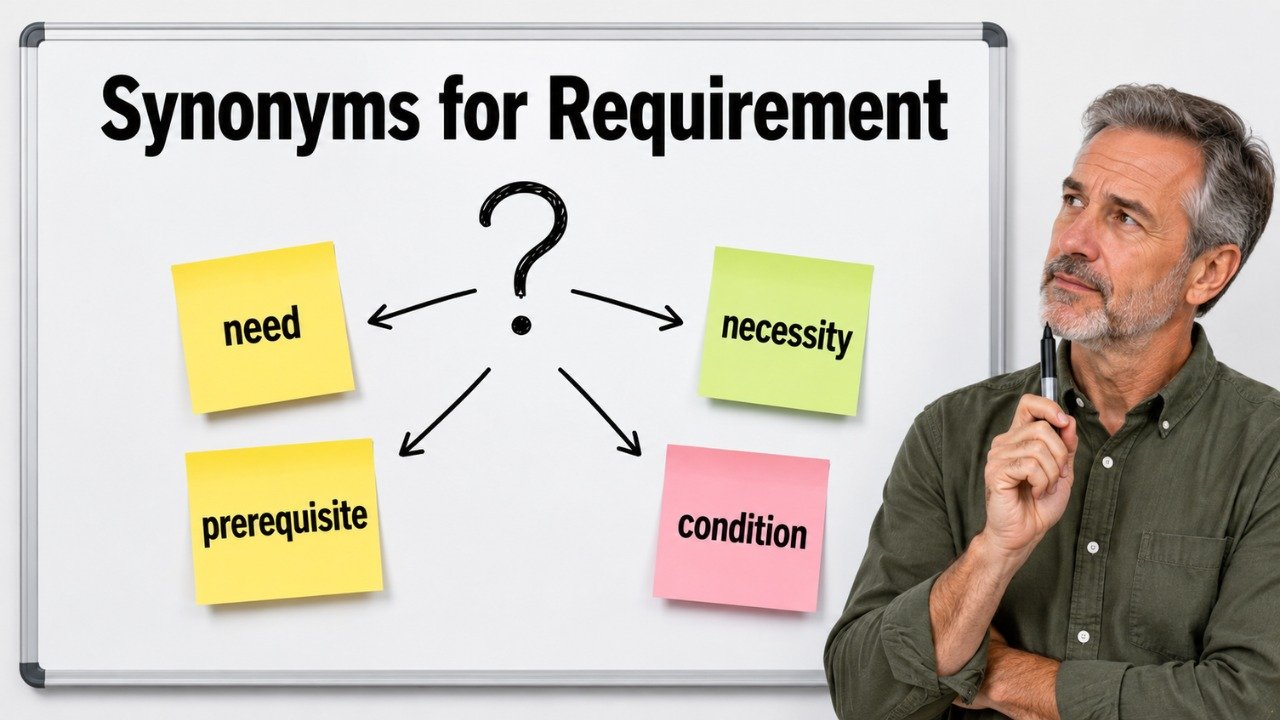
Quick Answer: The best synonyms for requirement include necessity, need, condition, prerequisite, obligation, demand, specification, criterion, qualification, and stipulation. Use necessity for something essential, prerequisite for something needed before another action, condition for an agreement or approval, obligation for a duty, specification for technical details, and criterion for a standard used to judge something. The most accurate choice depends on whether you are discussing rules, eligibility, agreements, employment, education, or practical needs.
Pronunciation and Word Details
Word: Requirement.
Pronunciation: /rɪˈkwaɪərmənt/.
Part of Speech: Noun.
Meaning: Something that is needed, expected, demanded, or officially necessary.
US Pronunciation:
UK Pronunciation:
What Does “Requirement” Mean?
Requirement means something that must be provided, completed, followed, or achieved. It is a noun commonly used for rules, needs, qualifications, standards, and official conditions.
A requirement can describe something essential for survival or success. It can also refer to a rule established by an organization, agreement, system, course, or process.
For example, experience may be a requirement for a job. Identification may be a requirement for entering a secure location. Reliable internet access may be a requirement for completing an online course.
Requirement is usually countable. The singular form refers to one necessary condition, while the plural form, requirements, refers to several conditions.
Singular Example: A valid passport is a requirement for international travel.
Plural Example: Applicants must satisfy all admission requirements.
The word can appear in formal documents, everyday conversations, technical instructions, contracts, academic policies, and workplace discussions.
Meaning, Tone, and Context of “Requirement”
Requirement has a neutral to formal tone. It usually communicates that something is necessary rather than optional.
In ordinary conversation, it can describe a practical need.
Example: A quiet room is an important requirement for my work.
In professional writing, requirement often refers to qualifications, duties, or expected results.
Example: Strong communication skills are a key requirement for the position.
In academic contexts, it may describe courses, grades, assignments, attendance, or documents that students must complete or submit.
Example: Passing the final examination is a graduation requirement.
In technical writing, requirement describes a feature, function, capacity, or performance standard that a product or system must have.
Example: Data encryption is a central security requirement.
In legal or official contexts, requirement can sound firm and authoritative because it refers to something established by a rule, agreement, or regulation.
Example: Written consent is a legal requirement in this situation.
The emotional strength of requirement depends on context. A personal requirement may sound flexible, while a legal requirement normally sounds strict and binding.
When and How to Use “Requirement”
For Rules and Policies
Use requirement when referring to something that a person must follow under a rule or policy.
Example: Wearing protective equipment is a workplace requirement.
For Eligibility
Use requirement when describing something a person must have before being considered for a position, course, benefit, or opportunity.
Example: Two years of experience is a requirement for the role.
For Education
Use requirement when discussing courses, assignments, grades, attendance, or other academic conditions.
Example: Completing the research project is a course requirement.
For Agreements
Use requirement when an agreement states that a particular action or condition is necessary.
Example: Monthly reporting is a requirement of the agreement.
For Technical Details
Use requirement when defining the necessary features, capacity, performance, or behavior of a system.
Example: Fast response time is an important software requirement.
For Personal Needs
Use requirement when discussing something that is personally necessary for comfort, health, productivity, or success.
Example: Natural light is one of her main requirements for a new apartment.
For Applications
Use requirement when explaining which documents, qualifications, payments, or details must be submitted.
Example: Proof of identity is an application requirement.
For Quality Standards
Use requirement when a product, service, or result must reach a particular standard.
Example: Every item must meet the quality requirement before shipment.
Best Synonyms for Requirement
Necessity
Synonym: Something that is essential or cannot reasonably be avoided.
Example: Clean drinking water is a basic necessity.
Need
Synonym: Something required for a particular purpose or situation.
Example: Reliable transportation is a practical need for this job.
Condition
Synonym: A rule or circumstance that must exist before something can happen.
Example: Regular attendance is a condition of membership.
Prerequisite
Synonym: Something that must be completed or obtained before another action is possible.
Example: Basic mathematics is a prerequisite for the advanced course.
Obligation
Synonym: A duty that a person is expected or required to perform.
Example: Employees have an obligation to protect private information.
Demand
Synonym: A firm request or need that must be satisfied.
Example: The new schedule was introduced in response to customer demand.
Specification
Synonym: A detailed statement describing what something must contain or achieve.
Example: The device meets every technical specification.
Criterion
Synonym: A standard used to judge, select, or evaluate something.
Example: Accuracy is the most important selection criterion.
Qualification
Synonym: A skill, achievement, or condition needed for a position or opportunity.
Example: Professional certification is a preferred qualification.
Stipulation
Synonym: A specific condition included in an agreement or arrangement.
Example: The contract contains a stipulation about payment dates.
50 Synonyms for Requirement with Short Meanings
- Necessity: Something that is essential.
- Need: Something required for a purpose.
- Condition: Something that must be true or completed.
- Prerequisite: Something needed before another step.
- Obligation: A duty that must be performed.
- Demand: A firm or necessary request.
- Specification: A detailed statement of what is required.
- Criterion: A standard used for judgment.
- Qualification: A skill or condition needed for eligibility.
- Stipulation: A specific condition in an agreement.
- Provision: A condition included in a document or arrangement.
- Requisite: Something necessary for a particular purpose.
- Rule: An instruction that must be followed.
- Standard: An expected level of quality or performance.
- Expectation: Something reasonably required or anticipated.
- Mandate: An official command or instruction.
- Duty: A responsibility that must be completed.
- Essential: Something completely necessary.
- Imperative: Something urgent and necessary.
- Precondition: A condition that must exist beforehand.
- Constraint: A limit or restriction that must be considered.
- Guideline: A recommended rule or direction.
- Term: A condition included in an agreement.
- Clause: A particular condition in a legal document.
- Regulation: An official rule established by authority.
- Compulsion: Strong pressure or necessity to act.
- Minimum: The lowest acceptable amount or standard.
- Benchmark: A standard used to measure performance.
- Threshold: The minimum level needed for acceptance.
- Parameter: A limit or condition defining what is acceptable.
- Eligibility Rule: A rule determining who can qualify.
- Entry Condition: Something needed before entry is allowed.
- Admission Condition: Something required for acceptance into a program.
- Selection Criterion: A standard used to choose someone or something.
- Acceptance Criterion: A condition used to approve a result.
- Compliance Condition: A condition that must be met to follow rules.
- Technical Specification: A detailed technical need or standard.
- Contractual Term: A condition written into a contract.
- Legal Obligation: A duty established by law.
- Required Qualification: A necessary skill or achievement.
- Required Document: A document that must be submitted.
- Required Step: An action that must be completed.
- Required Action: Something a person must do.
- Required Feature: A function that a product or system must include.
- Required Component: A necessary part of a larger system.
- Core Necessity: Something central and essential.
- Formal Demand: An officially expressed requirement.
- Mandatory Condition: A condition that cannot be ignored.
- Binding Term: A condition that parties must legally follow.
- Essential Condition: A condition necessary for success or approval.
Read Also:
Synonyms for Cheating

Synonyms for Requirement by Context
When Requirement Means Something Essential
Use words such as necessity, need, essential, imperative, and requisite when discussing something that cannot be removed without causing difficulty or failure.
Example With Requirement: Reliable electricity is a requirement for the laboratory.
Example With Necessity: Reliable electricity is a necessity for the laboratory.
Example With Need: The laboratory has a constant need for reliable electricity.
Necessity sounds stronger and more serious than need. Need is natural in both casual and formal language. Requisite is more formal and less common in everyday speech.
When Requirement Means a Rule or Condition
Use condition, rule, stipulation, provision, term, or regulation when the requirement is established by an agreement, policy, or authority.
Example With Requirement: Payment within thirty days is a requirement of the agreement.
Example With Condition: Payment within thirty days is a condition of the agreement.
Example With Stipulation: The agreement includes a stipulation requiring payment within thirty days.
Condition is the most flexible alternative. Stipulation is especially useful for a specific condition in an agreement. Regulation is best for an official rule.
When Requirement Means Something Needed Beforehand
Use prerequisite or precondition when something must happen before another action can begin.
Example With Requirement: Completing the introductory course is a requirement for enrollment.
Example With Prerequisite: Completing the introductory course is a prerequisite for enrollment.
Example With Precondition: Successful completion of the introductory course is a precondition for enrollment.
Prerequisite is common in education, employment, and professional training. Precondition is slightly more formal and emphasizes that the condition must already exist.
When Requirement Means a Duty
Use obligation, duty, mandate, or responsibility when referring to something a person must do.
Example With Requirement: Protecting confidential information is a requirement for all employees.
Example With Obligation: All employees have an obligation to protect confidential information.
Example With Duty: It is every employee’s duty to protect confidential information.
Obligation suggests a formal, moral, or legal responsibility. Duty often emphasizes a person’s role. Mandate refers to an official instruction.
When Requirement Means a Standard
Use criterion, standard, benchmark, threshold, or qualification when something is used to evaluate quality, eligibility, or performance.
Example With Requirement: Accuracy is a basic requirement for the report.
Example With Criterion: Accuracy is a basic criterion for evaluating the report.
Example With Standard: The report must meet a high standard of accuracy.
Criterion is used for judgment or selection. Standard describes the expected level of quality. Threshold describes the minimum acceptable level.
When Requirement Means a Technical Detail
Use specification, parameter, constraint, required feature, or required component when describing a system, product, process, or design.
Example With Requirement: The application must support secure user access.
Example With Specification: Secure user access is an important system specification.
Example With Constraint: Limited storage capacity is a major design constraint.
Specification explains what must be included. Parameter defines an acceptable limit or value. Constraint describes a restriction that affects the design or process.
Another Word for Requirement
The best broad replacement for requirement is necessity when the sentence describes something essential. However, the strongest alternative depends on the context.
Use condition for an agreement, prerequisite for something needed beforehand, obligation for a duty, specification for a technical detail, and criterion for a standard used in evaluation.
Original: Experience is a requirement for the position.
Better Option: Experience is a qualification for the position.
Original: Approval is a requirement before work can begin.
Better Option: Approval is a prerequisite before work can begin.
Original: Regular payment is a requirement of the agreement.
Better Option: Regular payment is a condition of the agreement.
Original: Protecting customer information is a requirement for employees.
Better Option: Protecting customer information is an obligation for employees.
When Not to Use “Requirement”
Requirement is useful, but it can sound repetitive or overly formal when a simpler word would communicate the meaning more clearly.
Avoid using requirement repeatedly in the same paragraph. Choose a more specific synonym that explains whether you mean a need, rule, duty, qualification, or technical detail.
Weak: The first requirement is experience, and the second requirement is certification.
Better: The first qualification is experience, and the second is professional certification.
Do not use requirement when the sentence refers only to a personal preference.
Weak: A balcony is a requirement for my ideal apartment, but I could live without one.
Better: A balcony is a preference for my ideal apartment, but I could live without one.
Avoid requirement when prerequisite explains that something must happen before another step.
Weak: Completing level one is a requirement before entering level two.
Better: Completing level one is a prerequisite for entering level two.
Do not use requirement when specification is more accurate for a technical feature.
Weak: Battery life is one of the product requirements.
Better: Battery life is one of the product specifications.
Avoid vague use when the reader needs to know what is actually necessary.
Weak: There are several requirements for approval.
Better: Approval requires identification, payment, and a completed form.
Words Commonly Confused With Requirement
Requirement vs Need: A requirement is often stated by a rule, process, person, or organization. A need may be personal, practical, or essential without being officially established.
Requirement vs Prerequisite: A requirement can apply at any stage. A prerequisite must be completed or obtained before another action can happen.
Requirement vs Condition: A requirement is something necessary. A condition often describes a specific term that controls whether an agreement, approval, or result remains valid.
Requirement vs Qualification: A qualification is a skill, achievement, or characteristic that makes someone suitable or eligible. A requirement can include qualifications, documents, actions, or rules.
Requirement vs Criterion: A requirement must usually be satisfied. A criterion is a standard used to evaluate or compare options.
Requirement vs Specification: A requirement states what is needed. A specification explains the required feature, measurement, design, or performance in greater detail.
Requirement vs Obligation: A requirement describes what must exist or happen. An obligation emphasizes the duty of a person or organization to act.
Requirement vs Preference: A requirement is necessary. A preference is desirable but optional.
Which Synonym Should You Choose?
Choose necessity when discussing something essential for safety, health, success, or basic operation.
Choose need in everyday speech when describing something practical or important.
Choose condition when discussing approval, membership, agreements, payments, or access.
Choose prerequisite when something must be completed before another step can begin.
Choose obligation when describing a legal, professional, financial, or moral duty.
Choose specification when writing about technical features, measurements, system behavior, or product design.
Choose criterion when discussing evaluation, selection, judgment, or assessment.
Choose qualification when discussing education, experience, skills, licenses, or job eligibility.
Choose stipulation when referring to a specific condition in a formal agreement.
Choose standard when describing an expected level of quality, performance, conduct, or safety.
Choose mandate when an official authority has ordered that something must happen.
Choose expectation when the condition is strongly anticipated but may not be formally compulsory.
Real Life Examples of “Requirement” in Sentences
Original: A valid license is a requirement for this position.
Better Option: A valid license is a qualification for this position.
Original: Completing the orientation is a requirement before starting work.
Better Option: Completing the orientation is a prerequisite for starting work.
Original: Weekly attendance is a requirement of the program.
Better Option: Weekly attendance is a condition of the program.
Original: Accurate reporting is an important requirement for every employee.
Better Option: Accurate reporting is an important obligation for every employee.
Original: Secure access is a requirement for the new system.
Better Option: Secure access is a technical specification for the new system.
Original: Clear communication is a requirement for effective teamwork.
Better Option: Clear communication is a necessity for effective teamwork.
Original: A strong writing sample is a requirement for selection.
Better Option: A strong writing sample is a selection criterion.
Original: Identification is a requirement for entering the building.
Better Option: Identification is an entry condition for the building.
Original: Regular maintenance is a requirement for safe operation.
Better Option: Regular maintenance is essential for safe operation.
Original: Payment by the due date is a requirement of the contract.
Better Option: Payment by the due date is a contractual term.
Synonym Groups and Usage Differences
Essential Need Group
This group includes necessity, need, essential, imperative, and requisite. These words describe something important or unavoidable.
Necessity is stronger than need. Imperative suggests urgency. Requisite is formal and commonly used in official or academic language.
Example: Clear instructions are a necessity when safety is involved.
Rule and Condition Group
This group includes condition, rule, stipulation, provision, term, clause, and regulation. These words describe requirements established through policies, agreements, or official authority.
Condition is broad and flexible. Stipulation is a clearly stated condition. Clause refers to a section of a written agreement.
Example: The agreement contains a clause about early cancellation.
Duty Group
This group includes obligation, duty, mandate, and compulsory condition. These terms emphasize responsibility or required action.
Obligation can be legal, professional, financial, or moral. Duty often relates to a person’s role. Mandate usually comes from an authority.
Example: Managers have an obligation to provide a safe working environment.
Eligibility Group
This group includes qualification, prerequisite, precondition, eligibility rule, admission condition, and entry condition.
Qualification refers to skills or achievements. Prerequisite refers to something needed before participation. Admission condition is common in educational contexts.
Example: Previous study is a prerequisite for the advanced class.
Evaluation Group
This group includes criterion, standard, benchmark, threshold, and minimum. These words describe how something is judged or measured.
Criterion is a basis for judgment. Benchmark provides a point of comparison. Threshold is the lowest level that must be reached.
Example: Reliability is a central criterion in the evaluation process.
Technical Group
This group includes specification, parameter, constraint, required feature, and required component.
Specification describes what a system must do. Parameter defines acceptable limits. Constraint describes a restriction that affects possible solutions.
Example: Low energy use is a key design specification.
Antonyms of Requirement
The opposite of requirement depends on whether the word means a necessity, rule, duty, or condition.
Option: Something that may be chosen but is not necessary.
Choice: The freedom to select between possibilities.
Preference: Something desired rather than required.
Luxury: Something enjoyable or valuable but not essential.
Extra: Something additional that is not necessary.
Convenience: Something that makes a task easier but is not essential.
Freedom: The ability to act without a particular restriction.
Exemption: Official permission not to follow a requirement.
Exception: A case that is not controlled by the general rule.
Permission: Approval to act rather than an obligation to act.
Voluntary Action: An action performed by choice.
Optional Feature: A feature that may be included but is not required.
Comparison of Requirement and Related Words
Requirement vs Necessity
Requirement often comes from a rule, person, process, or system. Necessity emphasizes that something is naturally or practically essential.
Example With Requirement: Identification is a requirement for entry.
Example With Necessity: Clean water is a necessity for every community.
Requirement vs Prerequisite
Requirement is a general word for something necessary. Prerequisite specifically refers to something needed before another stage can begin.
Example With Requirement: Students must meet every course requirement.
Example With Prerequisite: Basic science is a prerequisite for the advanced class.
Requirement vs Condition
Requirement emphasizes necessity. Condition emphasizes the circumstances or terms under which something will happen.
Example With Requirement: Insurance is a requirement for participation.
Example With Condition: Maintaining insurance is a condition of participation.
Requirement vs Obligation
Requirement describes something that must be done or provided. Obligation emphasizes responsibility placed on a person or organization.
Example With Requirement: Timely reporting is a workplace requirement.
Example With Obligation: Supervisors have an obligation to report serious incidents.
Requirement vs Criterion
Requirement must usually be satisfied. Criterion is used to judge, rank, or evaluate something.
Example With Requirement: Applicants must submit a writing sample.
Example With Criterion: Writing quality is an important selection criterion.
Requirement vs Specification
Requirement may state a broad need. Specification gives precise technical or practical details about that need.
Example With Requirement: The device must have a durable screen.
Example With Specification: The screen specification requires resistance to scratches and impact.
Requirement vs Qualification
Requirement can refer to any necessary condition. Qualification usually refers to a skill, degree, license, achievement, or personal quality.
Example With Requirement: Applicants must meet several requirements.
Example With Qualification: A relevant degree is the main qualification.
Common Phrases and Expressions With “Requirement”
Basic Requirement: A simple or fundamental condition that must be met.
Minimum Requirement: The lowest acceptable condition or standard.
Legal Requirement: Something that must be done under the law.
Job Requirement: A skill, qualification, or duty connected with a position.
Entry Requirement: Something needed before entering a place, course, or program.
Admission Requirement: A condition that must be met before acceptance.
Technical Requirement: A necessary feature or performance condition for a system.
Safety Requirement: A rule or condition intended to prevent harm.
Meet a Requirement: To reach or satisfy a necessary condition.
Fulfill a Requirement: To complete everything a rule or process demands.
Satisfy a Requirement: To provide enough evidence, performance, or action for acceptance.
Additional Requirement: An extra condition added to existing conditions.
Common Mistakes to Avoid
Repeating Requirement Too Often
Using requirement several times in one paragraph can make writing sound mechanical.
Weak: The first requirement is training, while the second requirement is experience.
Better: The first requirement is training, while the second qualification is experience.
Using Requirement for a Preference
A preference is something a person wants. A requirement is something that is necessary.
Incorrect: A garden is a requirement, although I would also accept an apartment without one.
Correct: A garden is a preference, although I would also accept an apartment without one.
Confusing Requirement and Prerequisite
Use prerequisite when the necessary condition must be completed before another stage.
Less Precise: The introductory class is a requirement before the advanced course.
More Precise: The introductory class is a prerequisite for the advanced course.
Using Mandatory Requirement Unnecessarily
Requirement often already suggests necessity. Adding mandatory may be repetitive unless you need to contrast compulsory and optional requirements.
Wordy: Completing the form is a mandatory requirement.
Better: Completing the form is required.
Confusing Require and Requirement
Require is a verb. Requirement is a noun.
Incorrect: Identification is require for entry.
Correct: Identification is required for entry.
Correct: Identification is an entry requirement.
Using the Wrong Preposition
Requirement for usually identifies the purpose, position, person, or situation. Requirement of often identifies the source or owner of the condition.
Example With For: Experience is a requirement for the position.
Example With Of: Regular reporting is a requirement of the agreement.
Writing Vague Requirements
A requirement should be specific enough for readers to understand what they must do.
Vague: Applicants must meet the necessary requirements.
Clear: Applicants must submit identification, proof of experience, and a completed form.
Ignoring Singular and Plural Agreement
Use is with a singular requirement and are with plural requirements.
Incorrect: The main requirement are two years of experience.
Correct: The main requirement is two years of experience.
Correct: The main requirements are experience and certification.
Conclusion
Synonyms for requirement help you express different kinds of necessity with greater accuracy. Use necessity or need for something essential, condition or stipulation for agreements, prerequisite for something needed beforehand, obligation for a duty, qualification for eligibility, specification for technical details, and criterion for evaluation. Requirement remains a useful neutral word, but a more specific synonym often makes the sentence clearer. Choose the alternative that shows exactly why something is needed, who established it, and when it must be satisfied.
FAQs About Synonyms for Requirement
What Is the Best Synonym for Requirement?
Necessity is the best broad synonym when something is essential. Condition, prerequisite, obligation, and specification may be better in specific contexts.
Is Need a Synonym for Requirement?
Yes. Need is a common synonym, especially in everyday speech. Requirement usually sounds more formal or official.
What Is a Formal Word for Requirement?
Requisite, stipulation, provision, prerequisite, and obligation are formal alternatives. The right choice depends on the sentence.
What Is Another Word for a Job Requirement?
Qualification is often the best alternative for skills, education, licenses, or experience needed for a job.
What Is Another Word for a Legal Requirement?
Legal obligation, regulation, mandate, binding term, and statutory condition are useful alternatives depending on the legal context.
What Is the Difference Between a Requirement and a Prerequisite?
A requirement is anything that must be satisfied. A prerequisite must be satisfied before another action, course, or stage can begin.
Can Requirement Mean a Personal Need?
Yes. Requirement can describe a personal necessity, but need or preference may sound more natural depending on how essential the item is.
