
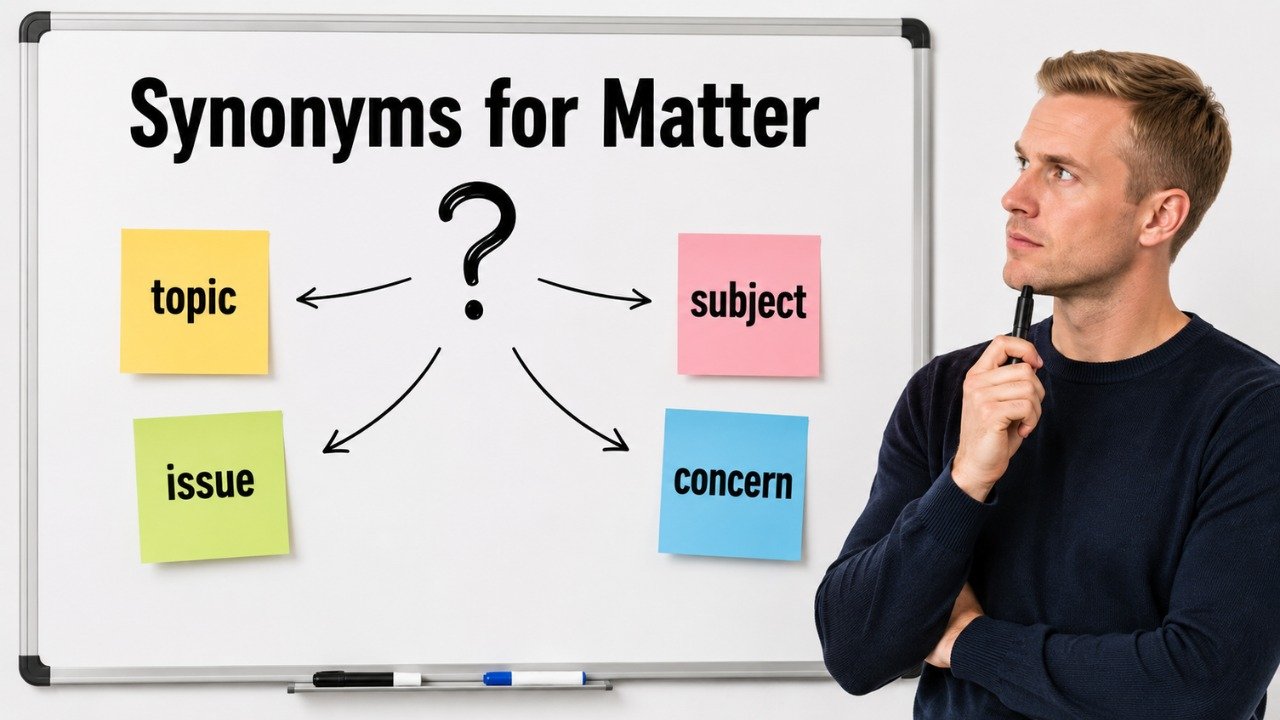
Quick Answer: The best synonyms for matter include issue, subject, topic, concern, affair, situation, substance, material, importance, and significance. Use issue for a problem that needs attention, subject or topic for something being discussed, concern for a worry or responsibility, and affair for a situation or area of activity. Substance and material describe physical matter, while importance and significance express the idea of something having value or consequence. The best choice among synonyms for matter depends on whether matter functions as a noun meaning a subject, problem, substance, or situation, or as a verb meaning to be important.
Pronunciation and Word Details
Word: Matter.
Pronunciation: /ˈmætər/.
Part of Speech: Noun and verb.
Meaning: A subject, situation, physical substance, or something that has importance.
US Pronunciation:
UK Pronunciation:
What Does “Matter” Mean?
Matter means a subject, issue, situation, substance, or concern, and as a verb it means to be important.
As a noun, matter has several common meanings. It can refer to something being discussed, considered, or handled.
Example: We need to discuss an important matter.
In this sentence, matter means subject, issue, or concern.
Matter can also describe a problem or situation that requires attention.
Example: The financial matter was resolved quickly.
Here, matter refers to a particular situation or affair.
In science, matter means any physical substance that has mass and occupies space. Solids, liquids, gases, and plasma are forms of matter.
Example: Water is a form of matter.
Matter may also refer to written, printed, or spoken material.
Example: The book contains useful educational matter.
As a verb, matter means to have importance, value, or influence.
Example: Your opinion matters to us.
The word changes meaning according to its sentence context. A personal matter is a private concern. A serious matter is an important issue. Printed matter is written material. When something matters, it has significance.
Meaning, Tone, and Context of “Matter”
Matter is a neutral and highly flexible word. It appears naturally in formal writing, casual conversation, professional communication, science, education, law, business, and everyday speech.
When matter means subject or issue, it can sound formal and professional.
Example: The committee will consider the matter tomorrow.
In casual conversation, matter often appears in questions and common expressions.
Example: What is the matter?
This question usually asks what is wrong or what problem exists.
When matter refers to a private concern, it may have a polite and reserved tone.
Example: That is a personal matter.
In academic and scientific contexts, matter is a technical noun describing physical substances.
Example: Matter can change from one state to another.
As a verb, matter often expresses emotional importance, practical value, or meaningful consequences.
Example: Small acts of kindness matter.
This use may sound personal, encouraging, or emphatic.
Because matter has several meanings, writers should consider the sentence carefully before replacing it. Issue may work for a problem, topic may work for a discussion, substance may work in science, and importance may work when expressing value.
When and How to Use “Matter”
For a Subject: Use matter when referring to something being discussed, considered, or investigated.
Example: The board discussed the matter in detail.
For a Problem: Use matter for a difficulty or issue that needs attention.
Example: The customer service team handled the matter professionally.
For a Situation: Use matter when referring generally to a set of circumstances.
Example: The matter became more complicated after the meeting.
For a Private Concern: Use matter for personal, family, financial, or professional concerns.
Example: She left early because of a family matter.
For an Area of Responsibility: Use matter for something that belongs to a person’s role or authority.
Example: Hiring decisions are a matter for the director.
For Physical Substance: Use matter in scientific contexts for material that has mass and occupies space.
Example: All physical objects are made of matter.
For Written Material: Use matter for printed, written, or spoken content.
Example: The booklet contains useful introductory matter.
For Importance: Use matter as a verb when something has value, consequence, or meaning.
Example: Accurate details matter in a formal report.
For Emotional Value: Use matter when showing that someone or something is personally important.
Example: Your happiness matters to your family.
For Comparison: Use matter to identify the quality that affects a decision or result.
Example: Experience matters more than age in this role.
Best Synonyms for Matter
Issue: A subject or problem that requires discussion or attention.
Example: The council discussed the issue during the meeting.
Subject: A person, idea, or area being discussed, studied, or written about.
Example: The subject of the lecture was human memory.
Topic: A particular idea or theme being discussed.
Example: Environmental protection was the main topic of conversation.
Concern: A worry, responsibility, or matter of interest.
Example: Safety remains our greatest concern.
Affair: A situation, event, or area of activity.
Example: The family preferred to keep the affair private.
Situation: A set of circumstances existing at a particular time.
Example: The manager explained the situation clearly.
Substance: A physical material with particular qualities.
Example: The scientist examined the unknown substance.
Material: A physical substance or information used for a purpose.
Example: The building material must be strong and durable.
Importance: The quality of being valuable, serious, or worthy of attention.
Example: The teacher emphasized the importance of careful reading.
Significance: The meaning, value, or consequence of something.
Example: The researchers understood the significance of the discovery.
50 Synonyms for Matter With Short Meanings
- Issue: A subject or problem requiring attention.
- Subject: Something being discussed, studied, or considered.
- Topic: A particular theme or point of discussion.
- Concern: A worry, interest, or responsibility.
- Affair: A situation, activity, or private concern.
- Situation: A particular set of circumstances.
- Question: A point that needs discussion or resolution.
- Problem: A difficulty requiring a solution.
- Case: A particular situation being examined.
- Business: An activity, concern, or responsibility.
- Circumstance: A condition connected with an event or situation.
- Event: Something that happens or takes place.
- Occurrence: An incident or event that happens.
- Incident: A particular event, often unusual or important.
- Consideration: A fact or issue that must be thought about.
- Point: A particular idea or detail.
- Theme: A central subject or idea.
- Area: A field, subject, or range of activity.
- Field: A particular area of knowledge or work.
- Department: A specific area of responsibility or activity.
- Responsibility: A duty or concern belonging to someone.
- Priority: Something considered especially important.
- Interest: A subject or activity that attracts attention.
- Preoccupation: A matter that occupies someone’s thoughts.
- Difficulty: A problem or challenging situation.
- Complication: A condition that makes a situation harder.
- Dispute: A disagreement about a particular matter.
- Controversy: A subject that causes public disagreement.
- Debate: A formal or informal discussion involving different views.
- Argument: A disagreement or a set of reasons supporting a view.
- Substance: A particular type of physical material.
- Material: Physical substance used to create something.
- Element: A basic part or substance.
- Stuff: An informal word for material or things.
- Content: Information or material contained in something.
- Text: Written words or printed material.
- Information: Facts or details about a subject.
- Data: Collected facts used for analysis.
- Materiality: The quality of having physical or practical importance.
- Importance: The quality of being valuable or serious.
- Significance: Meaning, value, or consequence.
- Relevance: Connection or importance to the subject.
- Consequence: An important effect or result.
- Weight: Seriousness, influence, or importance.
- Value: Worth, usefulness, or importance.
- Meaning: The idea or significance expressed.
- Count: To have importance or value.
- Concern: To affect or be important to someone.
- Influence: To affect an outcome or decision.
- Mean Something: To possess emotional or practical importance.
Read Also:
Synonyms for Charismatic

Synonyms for Matter by Context
When Matter Means an Issue
Issue, problem, question, concern, difficulty, complication, dispute, and controversy can replace matter when something requires attention or resolution.
Issue is the most flexible alternative for a subject that needs discussion.
Example: The team resolved the issue before the deadline.
Problem is more negative because it clearly suggests a difficulty.
Example: The technical problem prevented the system from operating.
Question is useful when an uncertainty or decision needs to be examined.
Example: The question of responsibility remains unresolved.
Concern can describe either a worry or an important area of attention.
Example: Customer privacy is a serious concern.
When Matter Means a Subject
Subject, topic, theme, point, area, field, and question work when matter refers to something being discussed or studied.
Subject is broader than topic and may refer to an entire field of study.
Example: Language development is the subject of her research.
Topic usually refers to a more specific point within a conversation, essay, lesson, or presentation.
Example: The next topic is workplace communication.
Theme describes a central or repeated idea, especially in literature, art, or discussion.
Example: Courage is a major theme in the story.
Point refers to one particular idea or detail.
Example: She raised an important point during the discussion.
When Matter Means a Situation
Situation, affair, case, circumstance, event, occurrence, incident, and business can replace matter when referring to a set of events or circumstances.
Situation is the strongest general alternative.
Example: We need more information before judging the situation.
Affair can refer to a private, official, or complicated situation.
Example: The affair was handled quietly.
Case is useful when a situation is being investigated, reviewed, or used as an example.
Example: The doctor reviewed the case carefully.
Incident usually describes a specific event, especially one that caused concern.
Example: The school investigated the incident.
When Matter Means a Personal Concern
Concern, affair, business, responsibility, interest, and preoccupation describe something personal or connected to someone’s duties.
Concern works for a worry, responsibility, or area of interest.
Example: The health of the children was her main concern.
Business can mean something that belongs to a person and should not involve others.
Example: Their disagreement is private business.
Responsibility is best when the matter belongs to someone’s duties.
Example: Employee training is the manager’s responsibility.
When Matter Means Physical Substance
Substance, material, element, and stuff describe physical matter.
Substance is common in science and formal writing.
Example: The laboratory identified the substance as harmless.
Material refers to matter used for a particular purpose.
Example: Cotton is a soft and flexible material.
Element may describe a basic substance or a component of something larger.
Example: Oxygen is an essential element for human life.
Stuff is informal and vague. It is suitable for casual conversation but not usually for scientific or professional writing.
Example: What is this sticky stuff on the table?
When Matter Means Written Content
Content, text, information, data, and material can replace matter when referring to written, printed, or spoken information.
Content describes everything included in a document, lesson, book, or presentation.
Example: The course content is clear and practical.
Text refers specifically to written words.
Example: The text contains several unfamiliar expressions.
Information means facts or knowledge communicated to someone.
Example: The guide provides useful information for beginners.
Material can describe educational, written, or recorded content.
Example: The teacher prepared additional reading material.
When Matter Means Importance
Importance, significance, relevance, consequence, weight, value, and meaning work when matter refers to worth or impact.
Importance is the clearest general noun.
Example: The report explains the importance of accurate records.
Significance suggests deeper meaning or serious consequences.
Example: Few people understood the significance of the decision.
Relevance describes how closely something connects to a subject or situation.
Example: The lawyer questioned the relevance of the evidence.
Weight refers figuratively to seriousness or influence.
Example: Her professional experience gave weight to her opinion.
When Matter Is a Verb
Count, concern, influence, mean something, have importance, make a difference, and be significant can replace matter as a verb.
Count means to possess value or importance.
Example: Every vote counts.
Mean something emphasizes personal or emotional value.
Example: Your support means something to the entire team.
Make a difference emphasizes an effect on a situation or result.
Example: A small improvement can make a difference.
Be significant is more formal and works well in reports or academic writing.
Example: The difference may be significant in larger samples.
Another Word for Matter
Issue is the best general replacement for matter when referring to a subject or problem that requires attention. However, matter has several meanings, so one synonym cannot replace it in every sentence.
Use topic for a subject of discussion, situation for a set of circumstances, substance for physical matter, significance for importance, and count when matter functions as a verb.
Original: We discussed the matter yesterday.
Better Option: We discussed the issue yesterday.
Original: This is a private matter.
Better Option: This is a private concern.
Original: The scientist studied the matter in the container.
Better Option: The scientist studied the substance in the container.
Original: Your contribution matters.
Better Option: Your contribution is important.
When Not to Use “Matter”
Do not use matter when it creates uncertainty about the intended meaning. Since the word can mean issue, substance, situation, or importance, a more precise synonym may improve clarity.
Weak: The matter changed during the experiment.
Better: The substance changed during the experiment.
Avoid matter when you need to identify a specific type of problem.
Weak: We experienced a matter with the payment system.
Better: We experienced a problem with the payment system.
Do not use matter repeatedly in formal writing when more specific words are available.
Weak: The first matter concerns safety, while the second matter is a financial matter.
Better: The first issue concerns safety, while the second concern involves finances.
Avoid using matter for every discussion subject.
Weak: The main matter of the essay is education.
Better: The main topic of the essay is education.
Do not use matter as a verb when the sentence needs a clearer explanation of how something is important.
Weak: The result matters for the project.
Better: The result will influence the project’s final direction.
Avoid the phrase no matter when regardless or despite would make formal writing more direct.
Weak: No matter the weather, the inspection will continue.
Better: Regardless of the weather, the inspection will continue.
Do not confuse physical matter with material used for a specific purpose. Matter is a scientific category, while material often refers to a substance selected for construction, production, or design.
Weak: Wood is useful matter for furniture.
Better: Wood is a useful material for furniture.
Words Commonly Confused With Matter
Matter vs Issue: Matter is broader and can refer to a subject, situation, substance, or importance. Issue usually means a subject or problem requiring attention.
Matter vs Subject: Matter can mean something under discussion, while subject is the specific person, idea, or field being discussed or studied.
Matter vs Topic: Matter may describe a general concern or situation. Topic usually means a focused subject within a discussion, lesson, or piece of writing.
Matter vs Problem: Matter is neutral and does not always suggest difficulty. Problem clearly refers to something undesirable that needs a solution.
Matter vs Concern: Matter may be any subject or situation. Concern usually involves worry, responsibility, or personal interest.
Matter vs Affair: Matter is more neutral and flexible. Affair often refers to a private, official, complicated, or public situation.
Matter vs Substance: Matter is the broad scientific term for physical material. Substance is a particular type of matter with specific qualities.
Matter vs Material: Matter refers generally to physical substance. Material often means matter selected or used for a purpose.
Matter vs Importance: Matter as a verb means to be important. Importance is the noun describing value or seriousness.
Matter vs Significance: Matter can mean to have importance. Significance suggests deeper meaning, wider consequences, or notable value.
Which Synonym Should You Choose?
Choose issue when writing about a problem, disagreement, policy concern, or subject requiring attention.
Choose subject when discussing a broad area of study, writing, research, or conversation.
Choose topic for a focused theme in an essay, lesson, meeting, email, or discussion.
Choose concern when the matter involves worry, responsibility, safety, or personal interest.
Choose situation when describing a set of circumstances without judging whether they are positive or negative.
Choose affair when referring to a private, official, political, or complicated situation.
Choose problem when something clearly needs to be corrected or solved.
Choose case for a situation being investigated, reviewed, treated, or examined.
Choose circumstance when emphasizing a condition that affects an event or decision.
Choose business in casual speech when something belongs to a person and should remain private.
Choose substance in scientific writing when identifying a particular physical material.
Choose material when referring to a substance used for building, making, teaching, or writing.
Choose content when discussing information within a document, lesson, website, book, or presentation.
Choose importance when expressing general value or seriousness.
Choose significance for formal writing about meaning, consequences, research findings, or historical value.
Choose relevance when explaining how closely information connects to the subject.
Choose consequence when emphasizing the result or effect of a decision.
Choose count in casual or motivational language when matter means to have value.
Choose influence when explaining how something affects an outcome.
Choose make a difference when describing a practical or meaningful effect.
Real Life Examples of “Matter” in Sentences
Original: We will discuss the matter after lunch.
Better Option: We will discuss the issue after lunch.
Original: The matter of employee safety requires attention.
Better Option: The subject of employee safety requires attention.
Original: She called because of a personal matter.
Better Option: She called because of a personal concern.
Original: The legal matter continued for several months.
Better Option: The legal case continued for several months.
Original: The teacher introduced a new matter for discussion.
Better Option: The teacher introduced a new topic for discussion.
Original: Scientists examined the matter under a microscope.
Better Option: Scientists examined the substance under a microscope.
Original: The booklet contains useful matter for new students.
Better Option: The booklet contains useful information for new students.
Original: Your ideas matter during this process.
Better Option: Your ideas are important during this process.
Original: Small details matter in professional writing.
Better Option: Small details make a difference in professional writing.
Original: The final score does not matter to her.
Better Option: The final score has little significance to her.
Synonym Groups and Usage Differences
Discussion Group
Issue, subject, topic, question, point, theme, area, and field describe matters being discussed, studied, or considered.
Subject is broad, while topic is more focused. Point refers to one particular idea. Theme describes a repeated or central message.
Example: The main topic of the meeting was staff development.
Problem Group
Problem, issue, difficulty, complication, dispute, and controversy describe matters that involve challenges or disagreement.
Problem clearly requires a solution. Complication makes an existing situation more difficult. Dispute and controversy involve opposing views.
Example: A scheduling complication delayed the final interview.
Situation Group
Situation, affair, case, circumstance, event, occurrence, and incident refer to events or conditions.
Situation is general. Case is often examined formally. Incident usually describes one specific event.
Example: The unusual incident was reported to the manager.
Responsibility Group
Concern, business, responsibility, priority, interest, and preoccupation describe matters connected to attention or duty.
Responsibility identifies an obligation. Priority identifies something that should receive attention first. Preoccupation describes something that occupies the mind.
Example: Improving customer safety remains our highest priority.
Physical Substance Group
Matter, substance, material, element, and stuff describe physical things.
Matter is the broad scientific term. Substance refers to a particular kind of matter. Material usually has a practical use. Stuff is informal.
Example: The material becomes flexible when heated.
Information Group
Content, text, information, data, and material describe written, spoken, or recorded matter.
Content is broad. Text means written words. Data consists of collected facts, often used in analysis.
Example: The report contains enough data to support the conclusion.
Importance Group
Importance, significance, relevance, consequence, weight, value, and meaning describe why something matters.
Importance is general. Significance is more formal. Relevance focuses on connection. Consequence focuses on results.
Example: The evidence has direct relevance to the investigation.
Influence Group
Count, concern, influence, mean something, make a difference, and be significant describe the verb meaning of matter.
Count is concise and conversational. Make a difference emphasizes practical effect. Be significant is suitable for formal or academic writing.
Example: Every accurate detail counts in a legal document.
Antonyms of Matter
The opposite of matter depends on whether the word refers to importance, substance, relevance, or a serious concern.
Triviality: Something with little importance or seriousness.
Insignificance: A lack of importance, meaning, or influence.
Irrelevance: A lack of connection to the subject.
Unimportance: The state of having little or no value.
Nothingness: The absence of anything physical or meaningful.
Emptiness: A state of containing nothing.
Void: A completely empty space or absence.
Vacuum: A space containing little or no matter.
Immateriality: The quality of not having physical form or practical relevance.
Spirit: A nonphysical aspect of a person or existence.
Idea: A mental concept rather than a physical substance.
Minor Detail: A point with little effect on the main issue.
Nonissue: Something that does not require concern or attention.
Distraction: Something that draws attention away from the important subject.
Meaninglessness: A lack of purpose, value, or significance.
Worthlessness: A complete lack of value or usefulness.
Negligibility: The quality of being too small or unimportant to consider.
Indifference: A lack of interest or concern.
Disregard: A lack of attention or consideration.
Ignore: To treat something as unimportant or unworthy of attention.
Comparison: Matter vs Related Words
Matter vs Issue
Matter is a broad word for a subject, situation, substance, or concern. Issue usually refers to a subject or problem requiring discussion.
Example With Matter: The manager will review the matter tomorrow.
Example With Issue: The manager will investigate the payment issue tomorrow.
Matter vs Subject
Matter can refer to anything being considered. Subject identifies the central person, idea, or area being discussed or studied.
Example With Matter: This matter requires further research.
Example With Subject: This subject requires further research.
Matter vs Topic
Matter may describe a concern, problem, or situation. Topic refers more specifically to the focus of a discussion, lesson, essay, or presentation.
Example With Matter: They discussed several important matters.
Example With Topic: The first topic was workplace safety.
Matter vs Problem
Matter is neutral, while problem clearly communicates difficulty.
Example With Matter: We need to examine the matter carefully.
Example With Problem: We need to solve the problem quickly.
Matter vs Concern
Matter may be any subject or situation. Concern often includes worry, interest, responsibility, or emotional involvement.
Example With Matter: The financial matter was discussed privately.
Example With Concern: Rising costs are a serious concern.
Matter vs Affair
Matter is a general and neutral term. Affair often suggests a private, official, public, or complicated situation.
Example With Matter: The matter was resolved without delay.
Example With Affair: The entire affair attracted public attention.
Matter vs Situation
Matter focuses on a subject being handled or considered. Situation emphasizes the surrounding circumstances.
Example With Matter: The lawyer is handling the matter.
Example With Situation: The lawyer explained the situation to the family.
Matter vs Substance
Matter is the broad scientific category for physical things. Substance is a particular kind of matter.
Example With Matter: Matter exists in several physical states.
Example With Substance: The substance changed color when heated.
Matter vs Material
Matter is any physical substance. Material is a substance used for a particular purpose.
Example With Matter: All objects contain matter.
Example With Material: Steel is a strong construction material.
Matter vs Significance
Matter as a verb means to be important. Significance is a noun describing importance, meaning, or consequence.
Example With Matter: The final decision matters to everyone.
Example With Significance: Everyone understood the significance of the final decision.
Common Phrases and Expressions With Matter
What Is the Matter: A question asking what is wrong or what problem exists.
No Matter: Regardless of a condition, situation, or difficulty.
A Matter of Time: Something expected to happen eventually.
A Matter of Opinion: Something determined by personal belief rather than fact.
A Matter of Fact: Something based on reality or presented in a direct manner.
For That Matter: An expression adding another relevant person, thing, or point.
The Heart of the Matter: The central or most important part of an issue.
A Serious Matter: An issue requiring careful attention.
A Private Matter: A concern that should not be discussed publicly.
It Does Not Matter: An expression meaning something is unimportant or will not affect the result.
Common Mistakes to Avoid
One common mistake is using matter without making its meaning clear. Since it can refer to a topic, problem, physical substance, or importance, vague sentences may confuse readers.
Vague: The matter affected the result.
Clear: The measurement error affected the result.
Another mistake is using matter and issue as exact synonyms in every context. Issue cannot replace matter when matter refers to physical substance.
Incorrect: Scientists study the properties of issue.
Correct: Scientists study the properties of matter.
Do not confuse matter and material. Matter is a general scientific term, while material often describes a substance chosen for a practical purpose.
Incorrect: The chair is made from strong matter.
Correct: The chair is made from strong material.
Avoid using matter when problem would be more direct.
Weak: There is a matter with the printer.
Better: There is a problem with the printer.
Do not overuse the phrase the fact of the matter in formal writing. It may sound wordy when the fact is enough.
Wordy: The fact of the matter is that the deadline has passed.
Direct: The deadline has passed.
Remember that matter can be both countable and uncountable. When it means an issue, it can have a plural form.
Singular: We discussed one matter.
Plural: We discussed several matters.
When matter means physical substance, it is usually uncountable.
Correct: Matter occupies space.
Incorrect: A matter occupies a space when discussing physical substance generally.
Do not confuse what is the matter with what does it matter. The first asks what is wrong. The second asks why something is important.
Question About a Problem: What is the matter?
Question About Importance: What does it matter?
Avoid unnatural replacements. Topic cannot replace matter when the sentence refers to responsibility or physical substance.
Incorrect: This is a private topic between the two families.
Better: This is a private matter between the two families.
Finally, choose precise synonyms rather than repeating matter throughout a paragraph. Issue, topic, concern, situation, substance, material, importance, and significance help readers understand the exact meaning.
Conclusion
Learning synonyms for matter helps you communicate its different meanings clearly. Use issue for a problem, subject or topic for discussion, concern for worry or responsibility, and situation for a set of circumstances. Substance and material work for physical matter, while importance and significance describe value or consequence. When matter functions as a verb, count, influence, mean something, and make a difference may be better choices. Always select the synonym that matches the sentence’s exact context and intended tone.
FAQs About Synonyms for Matter
What Is the Best Synonym for Matter?
Issue is the best general synonym when matter means a subject or problem. Topic, concern, situation, substance, and importance work in other contexts.
What Is Another Word for an Important Matter?
Serious issue, major concern, priority, significant question, and important affair are useful alternatives.
Can Topic Replace Matter?
Topic can replace matter when referring to something being discussed, taught, or written about. It cannot replace matter when referring to physical substance or importance.
What Is a Formal Synonym for Matter?
Issue, subject, concern, affair, substance, significance, and consideration are suitable formal alternatives, depending on the meaning.
What Is a Synonym for Matter as a Verb?
Count, be important, have significance, make a difference, influence, and mean something can replace matter as a verb.
What Is the Difference Between Matter and Issue?
Matter has several meanings, including subject, situation, substance, and importance. Issue usually refers to a topic, concern, or problem requiring attention.
What Is the Opposite of Matter?
When matter means importance, its opposites include insignificance, triviality, and irrelevance. In physical contexts, emptiness, void, or vacuum may express an opposite idea.
