
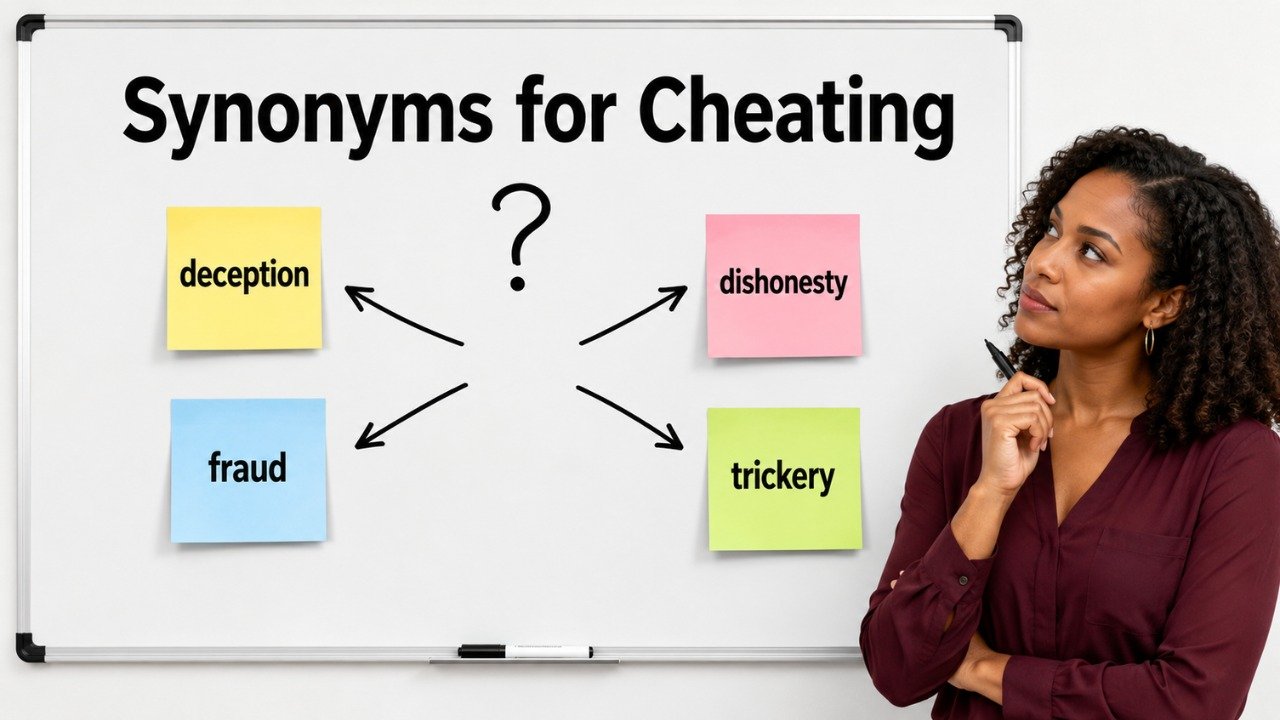
Quick Answer: The best synonyms for cheating include dishonesty, deception, deceit, fraud, trickery, misconduct, rule breaking, plagiarism, infidelity, and betrayal. Dishonesty is the broadest replacement for general unethical behavior. Fraud works best for deliberate financial or business deception. Plagiarism and academic misconduct describe cheating in education. Infidelity and unfaithfulness refer to cheating in a romantic relationship. Rule breaking, foul play, and misconduct fit games, sports, competitions, and professional situations.
Pronunciation and Word Details
Word: Cheating.
Pronunciation: /ˈtʃiːtɪŋ/
Part of Speech: Verb form, gerund, noun, and adjective.
Meaning: Acting dishonestly to gain an unfair advantage or breaking trust in a relationship.
US Pronunciation:
UK Pronunciation:
What Does “Cheating” Mean?
Cheating means behaving dishonestly to gain an advantage, avoid a rule, mislead someone, or break a promise of loyalty.
The word comes from the verb “cheat.” It can function as a verb form, gerund, noun, or adjective depending on the sentence.
As a verb form, it describes an action happening at a particular time.
Example: The student was cheating during the examination.
As a gerund or noun, it names the dishonest behavior itself.
Example: Cheating can damage a person’s reputation.
As an adjective, it describes a person who acts dishonestly or breaks relationship commitments.
Example: She confronted her cheating partner.
The exact meaning changes according to context. In education, cheating may involve copying answers or using unauthorized information. In games and sports, it means breaking rules to gain an unfair advantage. In business, it may involve misleading customers or manipulating records. In relationships, it usually means being romantically or sexually unfaithful.
Meaning, Tone, and Context of “Cheating”
Cheating has a strongly negative tone. It normally suggests dishonesty, unfairness, betrayal, or deliberate rule breaking.
In everyday conversation, cheating is a common and direct word. People use it when discussing examinations, games, relationships, business dealings, contests, and personal trust.
In formal writing, a more specific term is often better. Academic misconduct is more precise in educational policies. Fraud is stronger in financial or business contexts. Infidelity is more formal when discussing romantic relationships. Misconduct works well in professional reports.
Cheating can also carry an emotional tone. In relationships, it may suggest betrayal, broken trust, anger, or emotional pain. In academic and professional settings, it may suggest a lack of integrity or fairness.
The word is usually accusatory, so it should not be used carelessly. Calling someone a cheat or accusing someone of cheating can seriously affect that person’s reputation. Use precise and neutral language when the facts are uncertain.
When and How to Use “Cheating”
For General Dishonesty
Use cheating when someone acts dishonestly to obtain an advantage that would not otherwise be available.
Example: Cheating gave him an unfair advantage over the other participants.
For Academic Misconduct
Use cheating when a student copies answers, receives unauthorized help, uses prohibited materials, or submits another person’s work.
Example: The school has clear rules against cheating during examinations.
For Romantic Betrayal
Use cheating when a person breaks an agreed commitment of romantic or sexual faithfulness.
Example: She ended the relationship after discovering that her partner was cheating.
For Games and Competitions
Use cheating when a participant secretly breaks rules or manipulates a contest to improve the chance of winning.
Example: The player was removed from the competition for cheating.
For Financial Deception
Use cheating when someone misleads another person about money, prices, services, or agreements.
Example: The dishonest seller was accused of cheating customers.
For Unfair Advantage
Use cheating when a person avoids the normal process and gains benefits that others must earn fairly.
Example: Using hidden information would be cheating.
For Breaking a System
Use cheating when someone exploits a system, procedure, or set of rules for personal benefit.
Example: The investigation examined whether applicants were cheating the system.
For Emotional Emphasis
Use cheating when you want to emphasize that an action violated both rules and trust.
Example: Her teammates saw the secret arrangement as cheating and betrayal.
Best Synonyms for Cheating
Dishonesty: Behavior that is untruthful, unfair, or lacking in integrity.
Example: The manager would not tolerate dishonesty in financial reports.
Deception: The act of making someone believe something that is not true.
Example: The entire scheme depended on deception.
Deceit: Deliberate behavior intended to hide the truth or mislead someone.
Example: Their trust was destroyed by years of deceit.
Fraud: Intentional deception used to obtain money, property, services, or another benefit.
Example: The false payment records led to an investigation for fraud.
Trickery: The use of clever but dishonest methods to fool someone.
Example: He gained access through trickery rather than permission.
Misconduct: Unacceptable or improper behavior, especially in a professional or official setting.
Example: The employee faced disciplinary action for misconduct.
Rule Breaking: Acting against established instructions, standards, or regulations.
Example: Repeated rule breaking resulted in removal from the tournament.
Plagiarism: Presenting another person’s words or ideas as your own.
Example: Copying the entire paragraph without acknowledgment was plagiarism.
Infidelity: Unfaithfulness within a romantic or marital relationship.
Example: The couple sought counseling after the infidelity was revealed.
Betrayal: The act of breaking someone’s trust, confidence, or loyalty.
Example: She regarded his secret relationship as a serious betrayal.
50 Synonyms for Cheating with Short Meanings
- Dishonesty: Untruthful or unfair behavior.
- Deception: Making someone believe something false.
- Deceit: Deliberate concealment or distortion of the truth.
- Fraud: Intentional deception for personal or financial gain.
- Trickery: Dishonest methods used to fool someone.
- Duplicity: Deliberately presenting two different intentions or stories.
- Swindling: Obtaining money through lies or deception.
- Scamming: Informally deceiving someone to gain money or benefits.
- Conning: Persuading someone through dishonest claims.
- Misrepresentation: Giving a false or misleading description.
- Falsification: Changing or inventing information to make it false.
- Fabrication: Creating false information, evidence, or stories.
- Forgery: Producing or altering something to make it appear genuine.
- Plagiarism: Using another person’s work as your own.
- Copying: Reproducing another person’s answers or work dishonestly.
- Cribbing: Informally copying answers or material without permission.
- Collusion: Secret cooperation intended to deceive or gain an unfair advantage.
- Answer Sharing: Giving or receiving answers when it is not permitted.
- Academic Misconduct: Behavior that violates educational integrity rules.
- Test Fraud: Deliberate deception during an assessment.
- Rule Breaking: Violating an established rule or instruction.
- Foul Play: Dishonest, unfair, or suspicious conduct.
- Gamesmanship: Using questionable tactics to gain an advantage.
- Misconduct: Improper behavior that violates expected standards.
- Violation: An act that breaks a rule, agreement, or law.
- Infringement: Failure to respect a rule, right, or restriction.
- Tampering: Secretly changing something to influence an outcome.
- Rigging: Dishonestly arranging a result in advance.
- Fixing: Secretly controlling the result of a competition or event.
- Manipulation: Unfairly controlling information, people, or results.
- Exploitation: Taking unfair advantage of a person or situation.
- Betrayal: Breaking another person’s trust or loyalty.
- Unfaithfulness: Failure to remain loyal in a relationship.
- Infidelity: Romantic or sexual disloyalty to a partner.
- Adultery: Sexual unfaithfulness involving a married person.
- Disloyalty: Failure to remain faithful to a person or commitment.
- Two Timing: Secretly having romantic relationships with two people.
- Secret Affair: A hidden romantic or sexual relationship.
- Double Dealing: Dishonest behavior involving conflicting promises.
- Sharp Practice: Clever but unfair or dishonest conduct.
- Underhandedness: Secretive and morally dishonest behavior.
- Chicanery: Complicated or clever deception used for advantage.
- Guile: Cunning intelligence used to deceive someone.
- Subterfuge: A secret method used to hide the truth.
- Bad Faith: Dishonest intention when making an agreement or promise.
- Breach of Trust: A serious failure to honor another person’s confidence.
- Unfair Play: Behavior that violates fairness in a contest or situation.
- Evasion: Avoiding a duty, rule, question, or responsibility dishonestly.
- Circumvention: Finding an improper way around a rule or restriction.
- Dishonorable Conduct: Behavior that lacks honesty, fairness, or integrity.
Read Also:
Synonyms for Matter
Synonyms for Cheating by Context
When Cheating Means General Dishonesty
Dishonesty is the broadest alternative. It can describe lying, hiding information, breaking rules, or acting unfairly.
Deceit emphasizes a deliberate attempt to hide the truth. Deception focuses on making another person believe something false. Duplicity suggests that someone presents different stories or intentions to different people.
Example With Dishonesty: His dishonesty made it difficult for others to trust him.
Example With Deceit: The agreement was obtained through deceit.
Example With Deception: The deception continued until the records were examined.
When Cheating Means Academic Misconduct
Academic misconduct is the most suitable formal term for dishonest behavior in education. Plagiarism specifically means using another person’s words or ideas as your own. Copying refers to reproducing another student’s answers. Collusion involves students secretly working together when independent work is required.
Example With Academic Misconduct: The student received a penalty for academic misconduct.
Example With Plagiarism: The copied sections were treated as plagiarism.
Example With Collusion: The identical responses raised concerns about collusion.
When Cheating Means Breaking Competition Rules
Rule breaking is a clear general alternative. Foul play suggests suspicious or deliberately unfair conduct. Rigging means secretly arranging a result. Tampering involves changing equipment, records, or evidence to influence an outcome.
Example With Rule Breaking: The official reported several cases of rule breaking.
Example With Foul Play: The unusual result created suspicion of foul play.
Example With Rigging: The committee investigated allegations of vote rigging.
When Cheating Means Financial Deception
Fraud is the strongest formal synonym when deliberate deception is used to obtain money or another benefit. Swindling and conning describe persuading someone to give up money through lies. Scamming is a more informal term.
Example With Fraud: The false invoices were evidence of possible fraud.
Example With Swindling: He was accused of swindling vulnerable customers.
Example With Conning: The dishonest agent was conning people with false promises.
When Cheating Means Romantic Unfaithfulness
Infidelity is the most common formal alternative. Unfaithfulness is clear and less technical. Betrayal emphasizes the emotional damage caused by broken trust. Adultery is more specific and normally refers to sexual unfaithfulness involving a married person.
Example With Infidelity: Their relationship struggled after the infidelity.
Example With Unfaithfulness: She confronted him about his unfaithfulness.
Example With Betrayal: The secret relationship felt like a painful betrayal.
When Cheating Means Manipulating a Process
Manipulation describes unfair control of information or events. Circumvention means improperly finding a way around a restriction. Exploitation refers to using a weakness or situation unfairly for personal benefit.
Example With Manipulation: The data manipulation changed the apparent result.
Example With Circumvention: The arrangement was designed to allow circumvention of the rules.
Example With Exploitation: The policy was introduced to prevent exploitation of the system.
Another Word for Cheating
Dishonesty is usually the best single general replacement for cheating because it covers untruthful, unfair, and unethical behavior. However, the strongest alternative depends on the situation.
Use fraud for deliberate financial deception, plagiarism for copied work, academic misconduct for dishonest educational behavior, infidelity for romantic unfaithfulness, and rule breaking for violations in games or competitions.
Original: The report found several examples of cheating.
Better Option: The report found several examples of misconduct.
Original: He was punished for cheating on his assignment.
Better Option: He was punished for plagiarism in his assignment.
Original: The seller was cheating customers with false prices.
Better Option: The seller was deceiving customers with false prices.
Original: Their marriage ended because of cheating.
Better Option: Their marriage ended because of infidelity.
When Not to Use “Cheating”
Do not use cheating when a more specific word would explain the behavior more accurately. The term can sound vague because it covers many different actions.
When Discussing Formal Academic Rules
Academic misconduct is often clearer in educational policies, reports, and disciplinary notices.
Weak: The student was reported for cheating.
Better: The student was reported for academic misconduct after copying another person’s work.
When Describing Financial Crime
Fraud or falsification may be more precise when money, documents, or false records are involved.
Weak: The accountant was accused of cheating.
Better: The accountant was accused of falsifying financial records.
When Discussing Relationship Problems Formally
Infidelity or unfaithfulness may sound clearer and more appropriate in formal or sensitive discussions.
Weak: The counselor discussed the husband’s cheating.
Better: The counselor discussed the husband’s infidelity.
When the Action Was an Honest Mistake
Do not describe an accidental error as cheating. Cheating usually implies intention.
Weak: She cheated when she entered the wrong number.
Better: She made an accidental calculation error.
When Evidence Is Uncertain
Avoid presenting an accusation as a proven fact when the situation has not been confirmed.
Weak: The player was cheating.
Better: Officials were investigating whether the player had broken the rules.
When the Word Becomes Repetitive
Repeated use of cheating can make writing sound basic or emotionally exaggerated.
Weak: Cheating occurred because several people were cheating through different cheating methods.
Better: Several participants used dishonest methods to gain an unfair advantage.
When Describing a Specific Method
Name the actual action whenever possible.
Weak: The researcher was involved in cheating.
Better: The researcher fabricated data and altered several results.
Words Commonly Confused With Cheating
Cheating vs Lying: Lying means making a false statement. Cheating is broader and may include lying, copying, manipulation, or rule breaking.
Cheating vs Deception: Deception means causing someone to believe something false. Cheating often uses deception to gain an unfair advantage.
Cheating vs Fraud: Fraud is deliberate deception for a benefit, especially involving money, property, services, or official records. Cheating is less specific.
Cheating vs Plagiarism: Plagiarism means presenting another person’s words or ideas as your own. It is one particular form of academic cheating.
Cheating vs Infidelity: Infidelity specifically refers to unfaithfulness in a romantic or marital relationship. Cheating can also refer to examinations, games, business, and other situations.
Cheating vs Misconduct: Misconduct is improper behavior that violates professional, institutional, or official standards. Cheating is one possible form of misconduct.
Cheating vs Gamesmanship: Gamesmanship involves tactics that may be unsporting or questionable but are not always direct rule violations. Cheating clearly implies dishonesty or broken rules.
Cheating vs Betrayal: Betrayal means breaking trust or loyalty. Cheating may cause betrayal, but betrayal can happen in many ways that do not involve cheating.
Which Synonym Should You Choose?
Choose dishonesty when referring generally to behavior that lacks truthfulness, fairness, or integrity.
Choose deception when the main action involves making someone believe something false.
Choose deceit when you want to emphasize deliberate concealment and a dishonest intention.
Choose fraud when discussing intentional deception involving money, property, services, documents, or official benefits.
Choose trickery in casual speech when someone uses clever but dishonest methods.
Choose misconduct in professional reports, institutional policies, workplace documents, and formal complaints.
Choose academic misconduct when referring broadly to dishonest behavior in education.
Choose plagiarism when someone presents another person’s writing, ideas, research, or creative work as their own.
Choose copying when a student reproduces another person’s answers during an assignment or examination.
Choose collusion when people secretly cooperate on work that should be completed independently.
Choose rule breaking when the central issue is a violation of instructions or competition rules.
Choose foul play when dishonest or suspicious behavior may have influenced a contest or event.
Choose rigging when someone secretly arranges a result before the event is completed.
Choose tampering when equipment, documents, evidence, or records have been secretly altered.
Choose infidelity in formal writing about romantic or marital unfaithfulness.
Choose unfaithfulness in everyday or sensitive discussions about broken relationship commitments.
Choose betrayal when the emotional effect of broken trust matters more than the specific action.
Choose manipulation when someone controls information, results, or people unfairly.
Choose circumvention when someone improperly finds a way around a rule or restriction.
Choose bad faith when a person enters an agreement without an honest intention to honor it.
Real Life Examples of “Cheating” in Sentences
Original: The teacher caught three students cheating during the test.
Better Option: The teacher caught three students copying answers during the test.
Original: The investigation revealed that the team had been cheating.
Better Option: The investigation revealed that the team had been breaking competition rules.
Original: Customers complained that the seller was cheating them.
Better Option: Customers complained that the seller was deceiving them.
Original: She discovered that her partner had been cheating.
Better Option: She discovered that her partner had been unfaithful.
Original: Cheating damaged his academic record.
Better Option: Academic misconduct damaged his academic record.
Original: The organization introduced stronger controls to prevent cheating.
Better Option: The organization introduced stronger controls to prevent fraud.
Original: He denied cheating in the card game.
Better Option: He denied using unfair tactics in the card game.
Original: Copying the article was considered cheating.
Better Option: Copying the article was considered plagiarism.
Original: They were accused of cheating the system.
Better Option: They were accused of improperly circumventing the system.
Original: Her colleagues viewed the secret arrangement as cheating.
Better Option: Her colleagues viewed the secret arrangement as dishonest manipulation.
Synonym Groups and Usage Differences
General Dishonesty Group
This group includes dishonesty, deceit, deception, duplicity, and bad faith. These words describe behavior that hides the truth or violates honest expectations.
Dishonesty is broad and neutral enough for many contexts. Deceit emphasizes intention. Duplicity suggests conflicting stories or loyalties. Bad faith often relates to agreements and negotiations.
Example: The agreement failed because both sides suspected bad faith.
Trickery and Manipulation Group
This group includes trickery, guile, subterfuge, chicanery, manipulation, and underhandedness.
Trickery is common in everyday language. Guile suggests clever deception. Subterfuge describes a secret plan used to conceal the truth. Chicanery is a more formal word for complicated dishonest tactics.
Example: The documents were obtained through subterfuge.
Academic Misconduct Group
This group includes plagiarism, copying, cribbing, collusion, answer sharing, fabrication, and academic misconduct.
Plagiarism concerns stolen words or ideas. Copying and cribbing involve reproducing answers. Collusion means secretly working together. Fabrication involves inventing sources, evidence, or results.
Example: Inventing research results is a serious form of academic misconduct.
Financial Deception Group
This group includes fraud, swindling, scamming, conning, forgery, falsification, and misrepresentation.
Fraud is the broadest formal term in this group. Forgery involves creating or altering something to appear genuine. Misrepresentation means presenting false or misleading information.
Example: The customer claimed that the contract contained a serious misrepresentation.
Relationship Betrayal Group
This group includes infidelity, unfaithfulness, adultery, disloyalty, two timing, and betrayal.
Infidelity is formal and widely applicable. Unfaithfulness is direct but less technical. Adultery is more specific. Betrayal focuses on emotional harm and broken trust.
Example: Their relationship did not recover from the betrayal.
Competition and Rule Violation Group
This group includes rule breaking, foul play, unfair play, rigging, fixing, tampering, and gamesmanship.
Rule breaking is broad. Foul play suggests suspicious conduct. Rigging and fixing describe secretly controlled results. Tampering means altering something to influence an outcome.
Example: Officials found evidence of tampering with the equipment.
Unfair Advantage Group
This group includes exploitation, manipulation, circumvention, evasion, and sharp practice.
These words describe methods used to avoid responsibilities or gain benefits unfairly. Exploitation focuses on taking advantage of a weakness. Circumvention focuses on getting around a restriction.
Example: The new procedure was designed to prevent circumvention of the eligibility rules.
Antonyms of Cheating
The opposite of cheating depends on the context. Honesty and integrity oppose general dishonesty. Fair play opposes cheating in competition. Fidelity and loyalty oppose romantic unfaithfulness.
Honesty: Truthful and sincere behavior.
Integrity: Strong commitment to moral and ethical principles.
Truthfulness: The quality of stating or representing facts accurately.
Fairness: Equal and just treatment without improper advantage.
Fair Play: Honest conduct that respects the rules of a competition.
Loyalty: Faithful support for a person, group, or commitment.
Fidelity: Faithfulness within a relationship or promise.
Transparency: Openness that allows actions and decisions to be examined.
Authenticity: The quality of being genuine rather than false or copied.
Compliance: Acting according to rules, standards, or instructions.
Trustworthiness: The quality of being reliable, honest, and deserving of trust.
Good Faith: Honest intention to act fairly and keep an agreement.
Comparison of Cheating and Related Words
Cheating vs Dishonesty
Cheating is a type of dishonesty used to gain an advantage, avoid a rule, or break a commitment. Dishonesty is broader and includes lying, hiding facts, and making false claims.
Example With Cheating: The student was punished for cheating during the examination.
Example With Dishonesty: His dishonesty included lying about his qualifications.
Cheating vs Deception
Cheating focuses on unfair advantage or broken trust. Deception focuses on causing someone to believe something untrue.
Example With Cheating: Secretly using another player’s information was cheating.
Example With Deception: The false message was part of a deliberate deception.
Cheating vs Fraud
Cheating is an everyday word with several meanings. Fraud is more formal and usually involves deliberate deception for money, property, services, or another benefit.
Example With Cheating: The seller was accused of cheating customers.
Example With Fraud: Investigators examined the false invoices for evidence of fraud.
Cheating vs Plagiarism
Cheating describes many forms of academic dishonesty. Plagiarism specifically involves presenting someone else’s words, ideas, or work as your own.
Example With Cheating: Looking at another student’s answers is cheating.
Example With Plagiarism: Submitting a copied essay is plagiarism.
Cheating vs Infidelity
Cheating can refer to examinations, games, business, and relationships. Infidelity only refers to romantic or sexual unfaithfulness.
Example With Cheating: She learned that her partner had been cheating.
Example With Infidelity: The couple discussed the effects of infidelity on their marriage.
Cheating vs Misconduct
Cheating emphasizes dishonest advantage. Misconduct includes any improper behavior that violates professional or institutional standards.
Example With Cheating: The applicant was accused of cheating on the assessment.
Example With Misconduct: The investigation covered several forms of employee misconduct.
Cheating vs Betrayal
Cheating describes the dishonest action. Betrayal describes the breaking of trust and the emotional effect it creates.
Example With Cheating: He admitted cheating in the relationship.
Example With Betrayal: His partner struggled to recover from the betrayal.
Cheating vs Gamesmanship
Cheating clearly involves dishonesty or a rule violation. Gamesmanship refers to tactics intended to unsettle an opponent or gain an advantage, even when those tactics do not clearly break a rule.
Example With Cheating: Changing the score secretly was cheating.
Example With Gamesmanship: Delaying the match to disrupt the opponent was viewed as gamesmanship.
Common Phrases and Expressions With Cheating
Cheating on a Test: Using unauthorized help, answers, or materials during an assessment.
Cheating in an Examination: Breaking assessment rules to gain a better result.
Cheating on a Partner: Being romantically or sexually unfaithful.
Cheating at Cards: Breaking the rules of a card game to gain an advantage.
Cheating the System: Improperly exploiting rules or procedures for personal benefit.
Cheating Customers: Misleading buyers about prices, products, services, or agreements.
Caught Cheating: Discovered while acting dishonestly or breaking rules.
Accused of Cheating: Formally or informally suspected of dishonest behavior.
Cheating Someone Out of Money: Dishonestly causing someone to lose money or property.
Cheating Death: Narrowly escaping death or a life threatening event.
No Cheating: A direct instruction that dishonest help or rule breaking is forbidden.
Habitual Cheating: Repeated dishonest behavior rather than a single incident.
Common Mistakes to Avoid
Using Cheating for Every Kind of Dishonesty
Cheating is broad, but it is not always the most informative choice. Name the exact action when possible.
Unclear: The employee was involved in cheating.
Clearer: The employee falsified several expense records.
Confusing Cheating With Plagiarism
Not all academic cheating is plagiarism. Looking at another student’s answers is cheating, while presenting copied writing as your own is plagiarism.
Incorrect: He plagiarized by looking at another student’s test answers.
Better: He cheated by looking at another student’s test answers.
Using Fraud Too Casually
Fraud is stronger and more formal than cheating. Do not use it for every minor rule violation.
Too Strong: She committed fraud by moving one space too far in the game.
Better: She broke the rules by moving one space too far.
Calling an Accident Cheating
Cheating normally requires an intentional act. A misunderstanding, calculation error, or accidental rule violation may not be cheating.
Incorrect: He cheated because he misunderstood the instructions.
Better: He made an error because he misunderstood the instructions.
Confusing Gamesmanship With Cheating
Gamesmanship may involve irritating or questionable tactics that remain within the written rules. Cheating involves clear dishonesty or rule breaking.
Unclear: The player’s slow preparation was definitely cheating.
Better: The player’s slow preparation was criticized as gamesmanship.
Using Cheating Without Explaining the Context
Readers may not know whether the word refers to education, relationships, money, or competition.
Vague: The article discusses the effects of cheating.
Better: The article discusses the effects of academic cheating on student trust.
Making Unproven Accusations
Use neutral wording when an allegation has not been confirmed.
Risky: The contestant cheated to win.
Better: Officials are investigating an allegation that the contestant broke the rules.
Repeating the Same Word
Too much repetition can weaken clarity and rhythm. Use context specific alternatives where appropriate.
Repetitive: The report described cheating, explained how the cheating occurred, and listed the effects of cheating.
Improved: The report described the misconduct, explained how the deception occurred, and listed its consequences.
Conclusion
The best synonyms for cheating depend on the type of dishonest behavior being described. Dishonesty and deception work well in general contexts, while fraud suits financial wrongdoing. Academic misconduct, plagiarism, copying, and collusion are clearer in education. Infidelity and unfaithfulness describe relationship betrayal. Rule breaking, foul play, rigging, and tampering fit competitions. Choosing a precise alternative makes writing clearer, reduces repetition, and helps readers understand exactly what kind of unfair or dishonest conduct occurred.
FAQs About Synonyms for Cheating
What Is the Best Synonym for Cheating?
Dishonesty is the best general synonym. More specific alternatives include fraud, plagiarism, rule breaking, and infidelity.
What Is a Formal Synonym for Cheating?
Misconduct is a useful formal alternative. Academic misconduct, fraud, deception, and infidelity may be better in specific contexts.
What Is Another Word for Cheating in School?
Academic misconduct is the broadest formal term. Plagiarism, copying, collusion, cribbing, and answer sharing describe particular methods.
What Is Another Word for Cheating in a Relationship?
Infidelity is the strongest formal alternative. Unfaithfulness, betrayal, adultery, and disloyalty may also fit.
Are Cheating and Fraud the Same?
Not always. Fraud is a specific form of intentional deception used to gain money, property, services, or another benefit. Cheating has a broader meaning.
Is Plagiarism the Same as Cheating?
Plagiarism is one form of cheating. It specifically involves using another person’s words, ideas, or work without presenting them honestly.
What Is the Opposite of Cheating?
Common opposites include honesty, integrity, fairness, loyalty, fidelity, compliance, and fair play.
