
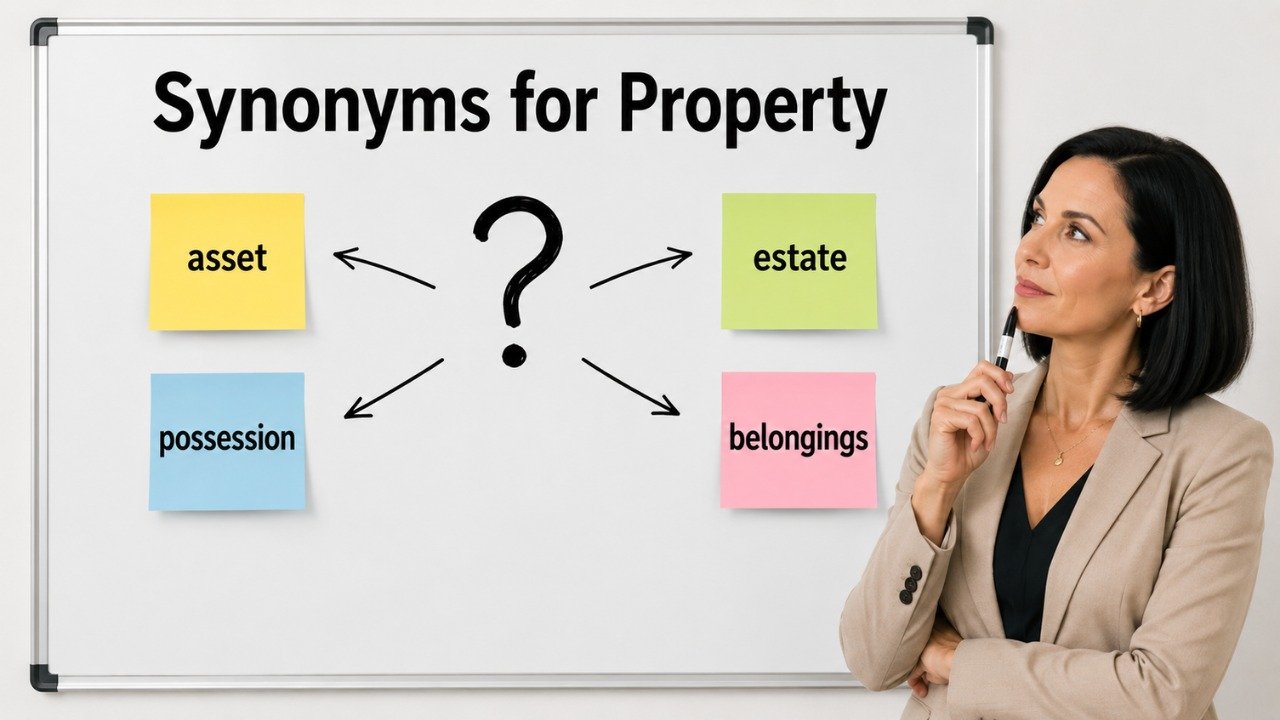
Quick Answer: The best synonyms for property include possession, asset, belongings, estate, real estate, land, premises, holding, attribute, and characteristic. Possession is the broadest alternative for something a person owns. Asset works best in business and financial writing. Estate, real estate, and land describe buildings or land ownership. Belongings suits personal items in everyday speech. Attribute and characteristic replace property when the word refers to a quality, feature, or behavior of a person, object, material, number, or substance.
Pronunciation and Word Details
Word: Property.
Pronunciation: /ˈprɒpəti/
Part of Speech: Noun.
Meaning: Something that is owned, a piece of land or a building, or a quality belonging to a person or thing.
US Pronunciation:
UK Pronunciation:
What Does “Property” Mean?
Property means something that belongs to a person, organization, group, or public authority. It can also mean land and buildings or a particular quality that something possesses.
Property is primarily used as a noun. Its exact meaning depends on the sentence and subject.
When property refers to ownership, it can include money, furniture, equipment, vehicles, personal items, land, buildings, and legal rights.
Example: All personal property must be removed before the inspection.
When property refers to land and buildings, it usually describes a house, commercial building, parcel of land, or another piece of real estate.
Example: They purchased a property near the city center.
Property can also mean a characteristic or feature of a substance, object, number, or system.
Example: Strength is an important property of this material.
In mathematics and science, property describes a rule, behavior, quality, or measurable feature.
Example: The teacher explained an important property of triangles.
The word may be countable or uncountable. It is countable when discussing individual buildings or qualities. It is often uncountable when referring generally to owned possessions.
Countable Example: The family owns three properties.
Uncountable Example: Damaging another person’s property is unacceptable.
Meaning, Tone, and Context of “Property”
Property has a neutral and often formal tone. It appears frequently in legal documents, financial reports, real estate discussions, academic writing, scientific explanations, insurance policies, contracts, and everyday conversations.
In casual speech, property commonly refers to a house, building, or piece of land.
Example: The property has a large garden.
In legal writing, property can refer to anything that can be owned or controlled under recognized rights.
Example: The agreement explains how the property will be divided.
In financial writing, property may be treated as an asset with measurable value.
Example: The property represents a major part of the family’s wealth.
In science, property is a technical but neutral word for a quality that can be observed, measured, or described.
Example: Conductivity is a physical property of the material.
In mathematics, property refers to a rule or principle that applies to numbers, shapes, or operations.
Example: The distributive property simplifies the expression.
The word is not usually emotional. However, it can become sensitive when connected to ownership disputes, inheritance, damage, theft, privacy, or personal belongings.
Property is broader than real estate. Real estate only refers to land and permanent structures, while property may also include movable objects, money, creative rights, and abstract qualities.
When and How to Use “Property”
For Personal Possessions
Use property when referring generally to objects that belong to a person.
Explanation: This use can include clothing, furniture, electronic equipment, tools, documents, and other owned items.
Example: Visitors are responsible for protecting their personal property.
For Land and Buildings
Use property when describing a house, apartment building, office, store, farm, or parcel of land.
Explanation: Property is common in real estate, legal, financial, and everyday discussions.
Example: The couple is searching for a property with additional outdoor space.
For Legal Ownership
Use property when discussing ownership rights, inheritance, contracts, transfer, possession, or control.
Explanation: This use is formal and often appears in legal or official writing.
Example: The document confirms that the property belongs to her.
For Business Assets
Use property when referring to buildings, equipment, materials, or other resources owned by a business.
Explanation: Asset may be more precise when discussing accounting or financial value.
Example: The business invested in new property and equipment.
For Intellectual Ownership
Use property when discussing legally protected ideas, designs, inventions, writing, or creative work.
Explanation: The complete expression intellectual property is normally used in this context.
Example: Employees must respect the intellectual property of others.
For Qualities and Characteristics
Use property when referring to a feature or quality of an object, substance, person, or system.
Explanation: Attribute, characteristic, quality, or feature may sometimes sound more natural.
Example: Flexibility is a useful property of the material.
For Scientific Description
Use property when identifying something that can be measured or observed.
Explanation: Common scientific properties include density, temperature, color, strength, conductivity, and solubility.
Example: Density is a measurable property of matter.
For Mathematical Rules
Use property when naming a rule that remains true within a mathematical system.
Explanation: This use is technical and precise.
Example: The associative property allows the numbers to be grouped differently.
For Damage or Loss
Use property when discussing theft, destruction, damage, protection, or insurance.
Explanation: The word may refer to personal possessions, buildings, or business assets.
Example: The storm caused extensive property damage.
Best Synonyms for Property
Possession: Something owned or controlled by a person.
Example: The watch was one of his most valuable possessions.
Asset: Something valuable that provides financial or practical benefit.
Example: The building is an important business asset.
Belongings: Personal objects that someone owns and uses.
Example: She packed her belongings into several boxes.
Estate: Land, buildings, money, and possessions owned by a person, especially after death.
Example: The lawyer was responsible for managing the estate.
Real Estate: Land and permanent buildings considered as property.
Example: They invested a large amount of money in real estate.
Land: An area of ground that can be owned, used, or developed.
Example: The farmer purchased additional land.
Premises: A building and the land connected to it.
Example: Visitors must leave the premises before closing time.
Holding: Property, land, shares, or another asset owned by a person or organization.
Example: The farm is the family’s largest holding.
Attribute: A quality or feature belonging to someone or something.
Example: Patience is a valuable attribute in a teacher.
Characteristic: A noticeable quality that helps identify or describe something.
Example: Durability is a key characteristic of the product.
50 Synonyms for Property with Short Meanings
- Possession: Something that a person owns.
- Asset: Something valuable or useful that is owned.
- Belongings: Personal objects owned by someone.
- Goods: Movable items that can be owned, sold, or exchanged.
- Effects: Personal possessions, especially when moved or stored.
- Valuables: Possessions that have considerable financial or personal value.
- Holdings: Property, investments, or land owned by someone.
- Resources: Useful possessions, materials, or sources of value.
- Wealth: Valuable property, money, and other assets.
- Capital: Money or property used to produce further value.
- Estate: A person’s land, buildings, money, and possessions.
- Realty: A formal legal term for land and permanent buildings.
- Real Estate: Land and structures permanently attached to it.
- Land: An area of ground owned or controlled by someone.
- Territory: An area of land under ownership or control.
- Acreage: An area of land measured in acres.
- Grounds: Land surrounding or connected to a building.
- Premises: A building together with the land belonging to it.
- Site: A particular area of land used for a purpose.
- Parcel: A defined section of land.
- Lot: A measured piece of land intended for ownership or development.
- Plot: A small or clearly marked piece of land.
- Home: A place where a person lives.
- Residence: A house or place used as a home.
- Dwelling: A building or space where people live.
- Building: A permanent structure with walls and a roof.
- Structure: Something built for a particular purpose.
- Chattel: Movable personal property in legal language.
- Ownership: The state or legal right of possessing something.
- Title: Legal proof of ownership.
- Proprietary Interest: A legal or financial ownership interest.
- Attribute: A quality belonging to a person or thing.
- Characteristic: A feature that helps describe or identify something.
- Quality: A particular standard, nature, or feature.
- Feature: A noticeable part or aspect of something.
- Trait: A distinguishing quality or behavior.
- Aspect: One part, quality, or side of something.
- Nature: The basic character or qualities of something.
- Element: A basic part or feature of a larger whole.
- Function: The purpose or activity of something.
- Capacity: The ability to contain, produce, or perform something.
- Capability: The ability or potential to do something.
- Behavior: The way a substance, object, or system acts.
- Tendency: A usual direction, pattern, or behavior.
- Hallmark: A quality strongly associated with something.
- Peculiarity: An unusual or distinctive characteristic.
- Parameter: A measurable factor that describes a system.
- Specification: A clearly stated feature or requirement.
- Condition: The state or quality of something at a particular time.
- State: The particular form, situation, or condition of something.
Read Also:
Synonyms for Requirement
Synonyms for Property by Context
When Property Means Something Owned
Possession is the closest general synonym when property means an object or resource that belongs to someone.
Belongings works best for everyday personal items. Goods refers to movable objects, especially items that can be purchased, sold, transported, or stored. Valuables refers to possessions with financial or emotional importance.
Example With Possession: The necklace was her most treasured possession.
Example With Belongings: He collected his belongings before leaving the room.
Example With Goods: The damaged goods were removed from the warehouse.
Example With Valuables: Guests should keep their valuables in a secure place.
When Property Means a Valuable Asset
Asset is the strongest alternative in business, finance, insurance, and accounting.
Holdings refers to property, land, shares, or investments owned by a person or organization. Wealth describes the total value of money, property, and other resources. Capital refers to property or money used to create income or business growth.
Example With Asset: The office building is a valuable asset.
Example With Holdings: The investor reviewed all of her property holdings.
Example With Wealth: Most of the family’s wealth was connected to land.
Example With Capital: The equipment was treated as business capital.
When Property Means Land or Buildings
Real estate is the most familiar alternative when discussing land and permanent buildings.
Realty is a more formal legal term. Land refers specifically to the ground rather than everything built on it. Estate may describe a large area of land, a group of properties, or everything owned by an individual.
Example With Real Estate: She works in real estate.
Example With Realty: The agreement covers the transfer of realty.
Example With Land: They bought land outside the town.
Example With Estate: The historic estate includes several buildings.
When Property Means a Specific Piece of Land
Parcel, lot, plot, site, acreage, and grounds describe particular types or areas of land.
Parcel is common in legal descriptions. Lot often refers to land intended for construction. Plot usually describes a smaller marked area. Site focuses on location and intended use. Acreage emphasizes size. Grounds refers to the land surrounding a building.
Example With Parcel: The parcel is located beside the main road.
Example With Lot: They plan to build a house on the empty lot.
Example With Plot: She purchased a small garden plot.
Example With Site: The company selected a new construction site.
When Property Means a Building or Location
Premises refers to a building and the land connected to it. Residence and dwelling describe places where people live. Building and structure are broader physical terms.
Example With Premises: Smoking is not allowed on the premises.
Example With Residence: The residence has four bedrooms.
Example With Dwelling: The old dwelling required extensive repairs.
Example With Structure: The structure was damaged during the storm.
When Property Means Legal Ownership
Ownership refers to the state of legally possessing something. Title means the legal right or document that proves ownership. Proprietary interest describes a legal or financial claim in property.
Example With Ownership: Ownership passed to the buyer after the final payment.
Example With Title: The title confirms who legally owns the land.
Example With Proprietary Interest: She maintained a proprietary interest in the invention.
When Property Means a Quality
Attribute, characteristic, quality, feature, trait, and aspect are the strongest alternatives when property refers to something that describes a person, object, material, or system.
Attribute is useful in formal and academic writing. Characteristic emphasizes a recognizable feature. Quality is broad and natural. Trait often describes people, animals, or inherited features.
Example With Attribute: Reliability is an important attribute of the system.
Example With Characteristic: High strength is a characteristic of the material.
Example With Quality: Kindness is a quality that many people admire.
Example With Trait: Curiosity is a common trait among young learners.
When Property Means Scientific Behavior
Behavior, capacity, tendency, parameter, condition, and state may replace property in scientific or technical writing.
Behavior describes how something acts under particular conditions. Capacity refers to how much something can hold or achieve. Parameter is a measurable factor. State describes the condition of matter or a system.
Example With Behavior: Researchers studied the behavior of the liquid at low temperatures.
Example With Capacity: The container’s capacity is two liters.
Example With Parameter: Temperature was the main parameter in the experiment.
Example With State: Water changes state when it freezes.
Another Word for Property
Possession is the best single general replacement for property when the word refers to something owned. However, no single synonym works in every sentence because property has several distinct meanings.
Use asset for something valuable, real estate for land and buildings, belongings for personal objects, premises for a building and its surrounding land, and characteristic for a quality or feature.
Original: The bicycle is his property.
Better Option: The bicycle is his possession.
Original: The company purchased a valuable property.
Better Option: The company purchased a valuable asset.
Original: They are looking for property near the coast.
Better Option: They are looking for real estate near the coast.
Original: Strength is an important property of steel.
Better Option: Strength is an important characteristic of steel.
When Not to Use “Property”
Property is a useful word, but it can sound unclear when the sentence does not show which meaning is intended.
When Referring to Personal Items Casually
Property may sound overly formal when talking about clothing, bags, books, or other everyday items.
Weak: Please collect your property before leaving.
Better: Please collect your belongings before leaving.
When Discussing Financial Value
Asset is usually more precise than property in business reports, accounting, and investment discussions.
Weak: The company listed the building as valuable property.
Better: The company listed the building as a valuable asset.
When Referring Only to Land and Buildings
Real estate may communicate the intended meaning more clearly.
Weak: She plans to invest in property.
Better: She plans to invest in real estate.
When Referring to a Scientific Quality
Characteristic, feature, behavior, or attribute may be clearer when the exact quality is important.
Weak: The researchers examined a property of the chemical.
Better: The researchers examined a reactive characteristic of the chemical.
When Describing a Place Where People Live
Home, residence, or dwelling may sound more natural than property when the focus is on living rather than ownership.
Weak: They returned to their property after dinner.
Better: They returned to their home after dinner.
When Referring to a Business Location
Premises may be more precise when discussing a building and the land immediately connected to it.
Weak: Visitors may not enter the property after closing.
Better: Visitors may not enter the premises after closing.
When the Meaning Is Too Broad
Property can include land, possessions, money, rights, or characteristics. Use a specific noun when readers need exact information.
Weak: The storm damaged their property.
Better: The storm damaged their roof, vehicle, and garden equipment.
When Repetition Weakens the Writing
Repeated use of property can make a paragraph sound mechanical.
Weak: The property owner inspected the property before listing the property for sale.
Better: The owner inspected the building before listing it for sale.
Words Commonly Confused With Property
Property vs Possession: Property is a broad term for anything that can be owned. A possession is usually a particular object or item owned by someone.
Property vs Asset: Property can be valuable or ordinary. An asset is something expected to provide financial, practical, or economic benefit.
Property vs Real Estate: Property includes possessions, rights, land, buildings, and qualities. Real estate only refers to land and permanent structures.
Property vs Estate: Property can mean one item, a building, or a quality. Estate may mean a large property or the complete money, land, rights, and possessions left by a person.
Property vs Belongings: Property sounds more formal and can include land or legal rights. Belongings usually means personal movable items.
Property vs Premises: Property refers to something owned. Premises specifically refers to a building and the land attached to it.
Property vs Ownership: Property is the thing that is owned. Ownership is the legal state or right of owning it.
Property vs Title: Property is the asset or land itself. Title is the legal right or evidence showing who owns it.
Property vs Attribute: Property can refer to owned items or qualities. Attribute only refers to a quality, feature, or characteristic.
Property vs Characteristic: Property is common in science and mathematics for a defined quality or rule. Characteristic is broader and often used in everyday description.
Which Synonym Should You Choose?
Choose possession when referring generally to an object or item that belongs to someone.
Choose belongings in casual conversation when discussing personal items such as clothing, bags, books, or furniture.
Choose asset in business, financial reports, accounting, insurance, and investment writing.
Choose real estate when discussing land, houses, commercial buildings, or property investment.
Choose estate when referring to a large area of land or the total assets left by a person.
Choose land when the focus is specifically on ground rather than buildings or other possessions.
Choose premises when describing a business building and the connected land.
Choose parcel in legal or official writing about a clearly defined section of land.
Choose lot when discussing a piece of land intended for construction or development.
Choose residence or dwelling when the focus is on a place where people live.
Choose ownership when discussing the legal state of possessing something.
Choose title when discussing formal proof or transfer of ownership.
Choose attribute in formal, academic, or technical writing about a quality.
Choose characteristic when describing a noticeable or identifying quality.
Choose quality in everyday speech when referring to the nature or standard of something.
Choose feature when referring to a noticeable part or function.
Choose trait when discussing a person’s behavior, personality, or inherited characteristic.
Choose behavior when explaining how a substance, object, or system reacts.
Choose parameter in technical writing when referring to a measurable factor.
Choose state or condition when describing the current form or situation of something.
Real Life Examples of “Property” in Sentences
Original: The suitcase is my property.
Better Option: The suitcase is my possession.
Original: She placed all her property in storage.
Better Option: She placed all her belongings in storage.
Original: The building is the company’s most valuable property.
Better Option: The building is the company’s most valuable asset.
Original: They want to purchase property in the countryside.
Better Option: They want to purchase real estate in the countryside.
Original: The property includes a house and several fields.
Better Option: The estate includes a house and several fields.
Original: Visitors must not leave the property without permission.
Better Option: Visitors must not leave the premises without permission.
Original: Flexibility is a useful property of this material.
Better Option: Flexibility is a useful characteristic of this material.
Original: Patience is one of her best properties.
Better Option: Patience is one of her best qualities.
Original: The scientist measured the properties of the liquid.
Better Option: The scientist measured the characteristics of the liquid.
Original: The mathematical property applies to every example.
Better Option: The mathematical rule applies to every example.
Synonym Groups and Usage Differences
Ownership Group
This group includes possession, ownership, title, proprietary interest, holdings, and chattel.
Possession focuses on having or controlling something. Ownership emphasizes the legal right to it. Title is evidence of that right. Chattel is a legal term for movable personal property.
Example: The title was transferred to the new owner after payment.
Personal Belongings Group
This group includes belongings, effects, goods, valuables, and possessions.
Belongings is natural in everyday speech. Effects often appears in formal descriptions of someone’s personal items. Valuables refers only to items with significant financial or personal value.
Example: Travelers were advised to protect their valuables.
Financial Asset Group
This group includes asset, capital, wealth, resources, holdings, and estate.
Asset refers to something useful or valuable. Capital is used to produce further income or growth. Wealth describes the total value of money and property. Holdings often refers to investments, land, or business interests.
Example: The new equipment became an important business asset.
Land and Real Estate Group
This group includes real estate, realty, land, territory, acreage, parcel, lot, and plot.
Real estate is the common general term. Realty is more formal and legal. Acreage emphasizes size. Parcel, lot, and plot describe defined pieces of land.
Example: The developer purchased a large parcel beside the highway.
Building and Location Group
This group includes premises, site, residence, dwelling, building, structure, and home.
Premises refers to a building and its connected land. Site emphasizes location. Residence and dwelling describe places where people live. Structure is the broadest physical term.
Example: The business moved to larger premises.
Quality and Characteristic Group
This group includes attribute, characteristic, quality, feature, trait, aspect, nature, hallmark, and peculiarity.
Attribute and characteristic are suitable for formal description. Quality is broad and natural. Trait commonly describes a person or living thing. Hallmark means a particularly recognizable quality.
Example: Careful attention to detail is a hallmark of her work.
Scientific and Technical Group
This group includes behavior, capacity, capability, parameter, state, condition, function, and tendency.
These words describe measurable features, abilities, reactions, and conditions. The correct choice depends on what is being observed.
Example: Temperature affects the behavior of the gas.
Antonyms of Property
Property does not have one direct antonym because it has several meanings. Its opposites depend on whether it refers to ownership, an asset, land, or a quality.
Dispossession: The loss or removal of property or ownership.
Nonownership: The condition of not owning something.
Liability: A financial obligation rather than a valuable asset.
Debt: Money owed instead of wealth or owned value.
Poverty: A serious lack of money, property, and resources.
Rental: The temporary use of something without owning it.
Public Ownership: Ownership by the public or an authority rather than a private person.
Absence: The lack of a particular quality or property.
Defect: An undesirable feature rather than a beneficial quality.
Weakness: A limitation rather than a strength or useful characteristic.
Comparison: Property vs Related Words
Property vs Possession
Property is a broad term that includes land, buildings, personal objects, rights, and characteristics. Possession usually refers to a particular object someone owns or controls.
Example With Property: The law protects private property.
Example With Possession: The ring is her most valuable possession.
Property vs Asset
Property is anything owned, regardless of value or financial usefulness. An asset has economic, practical, or strategic value.
Example With Property: The damaged chair was company property.
Example With Asset: The building is a major financial asset.
Property vs Real Estate
Property may refer to land, movable possessions, legal rights, or qualities. Real estate only refers to land and permanent buildings.
Example With Property: Employees must protect company property.
Example With Real Estate: He has invested in commercial real estate.
Property vs Estate
Property can refer to one owned item or one building. Estate can describe a large area of land or the total possessions and money belonging to a person.
Example With Property: They purchased a small property near the river.
Example With Estate: The estate includes farmland, cottages, and woodland.
Property vs Belongings
Property is formal and broad. Belongings is more conversational and usually refers to personal movable items.
Example With Property: The policy covers lost personal property.
Example With Belongings: She packed her belongings before moving.
Property vs Premises
Property emphasizes ownership. Premises emphasizes a building and the surrounding land used by a person or business.
Example With Property: The property is owned by a local family.
Example With Premises: Visitors must sign in before entering the premises.
Property vs Attribute
Property has several meanings, including something owned and a quality. Attribute only means a quality or characteristic associated with something.
Example With Property: Heat resistance is a useful property of the material.
Example With Attribute: Reliability is a valuable attribute in an employee.
Property vs Characteristic
Property is common in technical and scientific writing. Characteristic is more natural when describing a recognizable quality in general writing.
Example With Property: Conductivity is a physical property of copper.
Example With Characteristic: Confidence is a noticeable characteristic of her speaking style.
Property vs Feature
A property is an inherent quality or behavior. A feature is a noticeable part, function, or design element.
Example With Property: Elasticity is a property of rubber.
Example With Feature: The adjustable handle is a useful feature.
Common Phrases and Expressions With Property
Private Property: Land, possessions, or assets owned by a private person or organization.
Personal Property: Movable possessions belonging to an individual.
Real Property: Land and anything permanently attached to it.
Intellectual Property: Legally protected ideas, inventions, writing, designs, or creative work.
Commercial Property: Land or buildings used for business purposes.
Residential Property: Land or buildings used as homes.
Property Rights: Legal rights to own, use, control, sell, or transfer property.
Property Owner: A person or organization that legally owns property.
Property Value: The estimated financial worth of land, a building, or another asset.
Property Damage: Physical harm caused to possessions, land, buildings, or equipment.
Common Mistakes to Avoid
Assuming Property Always Means Real Estate
Property has broader meanings. It can refer to personal possessions, legal rights, intellectual work, or a characteristic.
Incorrect: Every use of property refers to land or buildings.
Better: The meaning of property depends on the sentence and subject.
Using Property When Belongings Sounds More Natural
Property may sound too formal in ordinary conversations about personal items.
Unnatural: I packed my property before the trip.
Natural: I packed my belongings before the trip.
Confusing Property With Asset
Not everything someone owns is an asset in a financial sense. Asset normally suggests usefulness, value, or economic benefit.
Incorrect: Every inexpensive personal item is a major asset.
Better: An asset is normally something with financial or practical value.
Confusing Property With Premises
Premises refers to a place, building, and connected land. It does not refer generally to movable possessions.
Incorrect: She placed her premises in a suitcase.
Better: She placed her belongings in a suitcase.
Using Real Estate for Movable Possessions
Real estate only includes land and permanent structures.
Incorrect: His phone and laptop are valuable real estate.
Better: His phone and laptop are valuable possessions.
Using the Wrong Plural Form
Property may be countable or uncountable depending on meaning.
Use properties for several buildings, pieces of land, or characteristics.
Correct: The company owns several commercial properties.
Use property without a plural ending when referring generally to possessions or ownership.
Correct: The police returned the stolen property.
Treating Belongings as Singular
Belongings is normally plural.
Incorrect: This belonging are mine.
Better: These belongings are mine.
For one object, use possession, item, or belonging.
Correct: This watch is a valuable possession.
Treating Premises as a Simple Plural
Premises ends in the letter s, but it can refer to one business location.
Incorrect: The premises are several different companies.
Better: The premises is a single location in meaning, although standard grammar usually uses a plural verb.
Correct: The premises are currently closed.
Using Attribute for Land or Buildings
Attribute only refers to a quality or characteristic.
Incorrect: They purchased an attribute near the coast.
Better: They purchased a property near the coast.
Repeating Property Too Often
Replace repeated uses with a more precise synonym.
Repetitive: The property owner repaired the property before selling the property.
Improved: The owner repaired the building before selling it.
Using a Vague Meaning in Technical Writing
When property refers to a scientific quality, name the exact feature whenever possible.
Vague: The substance has an unusual property.
Clearer: The substance has unusually high electrical conductivity.
Conclusion
The most suitable synonyms for property depend on what the word represents. Possession and belongings describe owned items, while asset fits financial and business writing. Real estate, land, estate, premises, parcel, and lot describe buildings or areas of land. Attribute, characteristic, quality, and feature work when property means a defining quality. Understanding these differences helps you select language that is precise, natural, and appropriate for legal documents, reports, essays, scientific explanations, and everyday conversation.
FAQs About Synonyms for Property
What Is the Best General Synonym for Property?
Possession is the best general synonym when property means something owned. Asset is better when the item has financial or practical value.
What Is Another Word for Property in Real Estate?
Real estate is the most common alternative. Land, estate, realty, premises, parcel, lot, and plot may also fit particular situations.
What Is Another Word for Personal Property?
Belongings, possessions, effects, goods, valuables, and chattel are useful alternatives. Chattel is mainly used in legal writing.
What Is a Formal Synonym for Property?
Asset, estate, realty, possession, holding, and proprietary interest are formal alternatives. The correct word depends on the legal or financial context.
What Is Another Word for a Property of Something?
Attribute, characteristic, quality, feature, trait, and aspect are strong alternatives when property means a defining quality.
Are Property and Real Estate the Same?
Not completely. Real estate only refers to land and permanent buildings. Property can also include personal possessions, money, rights, and characteristics.
Can Property Be Plural?
Yes. Properties can mean several buildings, pieces of land, or characteristics. Property is usually uncountable when referring generally to possessions or ownership.
