
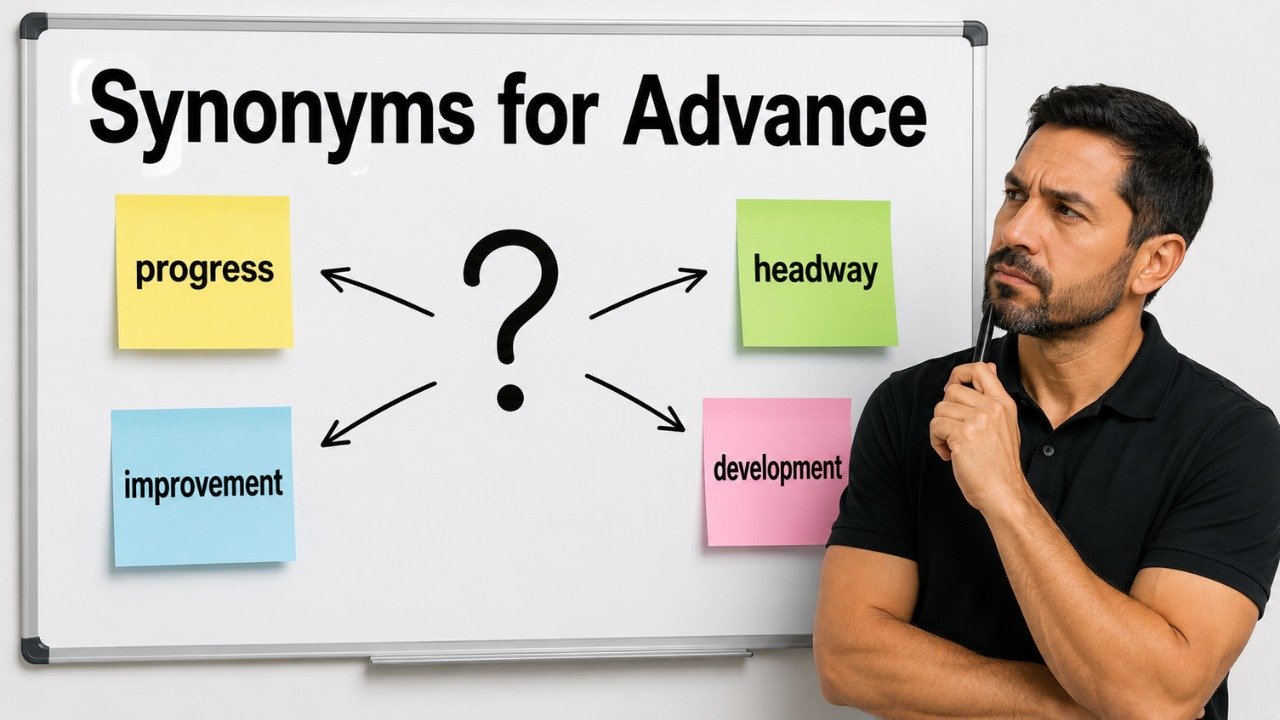
Quick Answer: The best synonyms for advance include progress, proceed, move forward, develop, improve, promote, approach, propose, prepayment, and prior. Use progress for general improvement, proceed for continuing an action, move forward in casual speech, develop for gradual growth, promote for raising someone to a higher position, approach for coming nearer, propose for presenting an idea, prepayment for money paid early, and prior for something arranged beforehand. Because advance has several meanings, the best replacement always depends on the sentence.
Pronunciation and Word Details
Word: Advance.
Pronunciation: /ədˈvæns/.
Part of Speech: Noun, verb, and adjective.
Meaning: To move forward, improve, promote, approach, present an idea, or provide something before the expected time.
US Pronunciation:
UK Pronunciation:
What Does “Advance” Mean?
Advance means to move forward, make progress, bring something forward, or help someone or something reach a higher level. It can function as a verb, noun, or adjective.
As a verb, advance commonly describes forward movement.
Example: The rescue team advanced toward the damaged building.
It can also describe improvement, growth, or development.
Example: Medical knowledge continues to advance.
Advance may mean helping a person gain a better position.
Example: The new training program could advance her career.
It can also mean presenting an idea, argument, request, or proposal for consideration.
Example: The committee advanced a new plan for improving safety.
In financial contexts, advance can mean giving money before it is normally due.
Example: The employer advanced him part of his salary.
As a noun, advance can refer to progress, forward movement, a payment made early, or an approach toward a person or place.
Example: The research represents an important advance in technology.
As an adjective, advance describes something provided, arranged, or completed before the usual time.
Example: Guests received advance notice of the schedule change.
The meaning of advance changes significantly according to context. A synonym that works in a sentence about progress may not work in a sentence about payment, promotion, or early preparation.
Meaning, Tone, and Context of “Advance”
Advance usually has a neutral to formal tone. It is common in professional, academic, technical, financial, military, and everyday contexts.
When advance means to move forward physically, it can sound direct and purposeful.
Example: The hikers advanced carefully through the narrow passage.
When it refers to progress or development, it often carries a positive meaning.
Example: The project has advanced considerably since last month.
In professional writing, advance may describe career development, organizational goals, research, or knowledge.
Example: The scholarship helps students advance their education.
In formal discussions, advance can mean presenting an argument or proposal.
Example: The writer advances a convincing explanation for the change.
In financial language, advance may refer to money provided before the normal payment date. This use is formal and should be explained clearly to avoid confusion with a gift or ordinary payment.
Example: She requested an advance on her monthly salary.
As an adjective, advance is frequently used with words such as notice, payment, warning, preparation, planning, booking, and approval.
Example: Advance preparation reduced the risk of delays.
Advance is generally not emotional. However, it can suggest ambition, urgency, confidence, or strategic movement depending on the surrounding words.
When and How to Use “Advance”
For Physical Movement
Use advance when a person, group, vehicle, or force moves forward toward a place or target.
Example: The firefighters advanced through the smoke.
For General Progress
Use advance when a project, idea, process, or field becomes more developed or successful.
Example: The investigation advanced after new evidence appeared.
For Personal Development
Use advance when someone improves their education, abilities, position, or career.
Example: Additional training may help you advance professionally.
For Promotion
Use advance when someone moves to a higher rank, level, or position.
Example: Strong performance allowed her to advance into a leadership role.
For Approaching Something
Use advance when a person or object comes closer to another person, place, or point.
Example: The storm continued to advance toward the coast.
For Presenting an Idea
Use advance when someone puts forward an opinion, claim, argument, theory, or proposal.
Example: The researcher advanced a different interpretation of the results.
For Early Payment
Use advance when money is provided before it is normally earned, received, or due.
Example: The company agreed to advance the travel expenses.
For Early Preparation
Use advance before a noun when something is arranged, provided, or completed beforehand.
Example: Advance planning made the event easier to manage.
For Supporting a Cause
Use advance when an action helps a goal, interest, organization, or field develop.
Example: The program was created to advance public education.
For Continuing an Activity
Use advance when a process moves into its next stage.
Example: The application will advance to the final review stage.
Best Synonyms for Advance
Progress
Synonym: To improve, develop, or move toward a goal.
Example: The construction work continues to progress steadily.
Proceed
Synonym: To continue with an action or move to the next stage.
Example: The team received permission to proceed with the plan.
Move Forward
Synonym: To continue making progress or go toward a destination.
Example: We are ready to move forward with the agreement.
Develop
Synonym: To grow, improve, or become more complete over time.
Example: The idea developed into a practical solution.
Improve
Synonym: To become better in quality, ability, or condition.
Example: Her writing continued to improve throughout the course.
Promote
Synonym: To move someone to a higher position or support the growth of something.
Example: The organization promoted him to department manager.
Approach
Synonym: To move closer to a person, place, time, or condition.
Example: The vehicle slowly approached the entrance.
Propose
Synonym: To present an idea or plan for consideration.
Example: The committee proposed a new attendance policy.
Prepayment
Synonym: Money paid before goods, services, or work are received.
Example: The supplier requested a prepayment before beginning production.
Prior
Synonym: Existing, happening, or arranged before a particular time.
Example: Prior approval is required for additional expenses.
50 Synonyms for Advance with Short Meanings
- Progress: Movement toward improvement or completion.
- Improvement: A change that makes something better.
- Development: Gradual growth or increased capability.
- Growth: An increase in size, quality, strength, or success.
- Headway: Noticeable progress toward a goal.
- Movement: A change in position or stage.
- Rise: An upward movement or improvement.
- Promotion: Movement to a higher position or rank.
- Elevation: A move to a higher level or status.
- Approach: Movement closer to a person, place, or point.
- Proceed: To continue with an action or process.
- Move Forward: To continue toward a goal or destination.
- Continue: To keep doing something without stopping.
- Develop: To grow or become more complete.
- Improve: To become better in quality or performance.
- Evolve: To develop gradually over time.
- Grow: To increase in size, strength, or success.
- Expand: To become larger or more extensive.
- Rise: To move upward or reach a better position.
- Ascend: To move to a higher physical or professional level.
- Approach: To move nearer to something.
- Near: To come close to a place, time, or condition.
- Draw Closer: To reduce the distance from something.
- Accelerate: To move or develop more quickly.
- Further: To help something progress or succeed.
- Promote: To raise someone or support something.
- Elevate: To move someone or something to a higher level.
- Upgrade: To improve something to a better standard.
- Enhance: To improve quality, value, or effectiveness.
- Strengthen: To make something more powerful or effective.
- Refine: To improve something through careful changes.
- Propel: To push something forward.
- Encourage: To support progress or action.
- Foster: To help something develop over time.
- Support: To assist the success or development of something.
- Push Ahead: To continue despite difficulty.
- Press Forward: To move ahead with determination.
- Forge Ahead: To make strong progress despite obstacles.
- Gain Ground: To improve a position or make progress.
- Make Headway: To achieve noticeable progress.
- Lead: To remain ahead or guide movement forward.
- Present: To bring an idea or proposal before others.
- Propose: To suggest a plan for consideration.
- Put Forward: To introduce an idea, claim, or candidate.
- Offer: To present something for acceptance.
- Submit: To formally present something for review.
- Loan: Money temporarily given with an expectation of repayment.
- Prepayment: Money provided before it is normally due.
- Prior: Existing or happening before another event.
- Early: Done before the expected or usual time.
Read Also:
Synonyms for Property

Synonyms for Advance by Context
When Advance Means Move Forward
Use proceed, move forward, press forward, push ahead, forge ahead, and continue when advance describes physical or figurative movement.
Example With Advance: The group advanced toward the exit.
Example With Proceed: The group proceeded toward the exit.
Example With Move Forward: The group moved forward toward the exit.
Proceed is slightly more formal than move forward. Press forward and forge ahead suggest determination, especially when difficulties are present.
When Advance Means Make Progress
Use progress, develop, improve, evolve, grow, gain ground, make headway, and expand when something becomes better or more complete.
Example With Advance: The research advanced rapidly during the final stage.
Example With Progress: The research progressed rapidly during the final stage.
Example With Develop: The research developed rapidly during the final stage.
Progress is the most direct replacement for general improvement. Develop emphasizes gradual change. Make headway is useful when progress has been difficult.
When Advance Means Promote Someone
Use promote, elevate, raise, upgrade, and move up when a person reaches a higher position or level.
Example With Advance: The organization advanced her to a senior position.
Example With Promote: The organization promoted her to a senior position.
Example With Elevate: The organization elevated her to a senior position.
Promote is usually the most natural word for employment. Elevate sounds more formal and can also describe increased importance or status.
When Advance Means Approach
Use approach, near, draw closer, come toward, and move closer when something reduces its distance from a place, person, or event.
Example With Advance: The storm advanced toward the city.
Example With Approach: The storm approached the city.
Example With Draw Closer: The storm drew closer to the city.
Approach is the clearest neutral replacement. Draw closer creates a stronger sense of gradual movement.
When Advance Means Present an Idea
Use propose, present, put forward, offer, submit, introduce, and suggest when someone brings an idea, claim, argument, or plan before others.
Example With Advance: The lawyer advanced a new argument.
Example With Present: The lawyer presented a new argument.
Example With Put Forward: The lawyer put forward a new argument.
Present is neutral and widely useful. Propose is best for plans. Put forward works well for arguments, opinions, and candidates.
When Advance Means Support Progress
Use further, promote, foster, encourage, support, strengthen, and develop when an action helps a cause, field, or goal succeed.
Example With Advance: The program aims to advance scientific education.
Example With Further: The program aims to further scientific education.
Example With Promote: The program aims to promote scientific education.
Further is concise and formal. Promote emphasizes active support. Foster suggests gradual development over time.
When Advance Means Provide Money Early
Use prepay, prepayment, lend, loan, provide early payment, and pay beforehand when money is given before the expected date.
Example With Advance: The employer advanced her part of her salary.
Example With Lend: The employer lent her part of the money she needed.
Example With Prepay: The employer prepaid part of the amount owed.
Prepay is best when an expected payment is made early. Lend is better when the money must later be repaid.
When Advance Means Prior or Early
Use prior, early, preliminary, previous, beforehand, and arranged earlier when advance appears before a noun.
Example With Advance: We received advance notice of the closure.
Example With Prior: We received prior notice of the closure.
Example With Early: We received early notice of the closure.
Prior is common in formal writing. Early sounds more conversational. Preliminary is best for an initial stage rather than something simply provided beforehand.
Another Word for Advance
Progress is the best broad replacement when advance refers to improvement or movement toward a goal. Move forward is often the most natural replacement when advance functions as a verb.
However, no single synonym works for every meaning. Choose promote for a higher position, approach for coming closer, propose for presenting an idea, and prepayment for money supplied early.
Original: The project continues to advance.
Better Option: The project continues to progress.
Original: She hopes to advance in her career.
Better Option: She hopes to move forward in her career.
Original: The panel advanced a new proposal.
Better Option: The panel presented a new proposal.
Original: The customer made an advance payment.
Better Option: The customer made a prepayment.
When Not to Use “Advance”
Advance can become unclear because it has several different meanings. Avoid it when a more precise synonym would help the reader immediately understand the intended action.
Do not use advance when you simply mean improve.
Weak: The new process will advance the quality of the service.
Better: The new process will improve the quality of the service.
Avoid advance when approach communicates physical movement more naturally.
Weak: The train advanced toward the platform.
Better: The train approached the platform.
Do not use advance when promote clearly describes a change in employment rank.
Weak: The company advanced her to supervisor.
Better: The company promoted her to supervisor.
Avoid advance when propose is more precise for an idea or plan.
Weak: The committee advanced a solution during the meeting.
Better: The committee proposed a solution during the meeting.
Do not use advance payment without explaining the financial arrangement when readers may confuse it with a deposit, loan, or full prepayment.
Weak: He received an advance.
Better: He received an early payment on the work he had agreed to complete.
Avoid using advance with forward when the sentence becomes repetitive.
Weak: The team advanced forward through the passage.
Better: The team advanced through the passage.
Better: The team moved forward through the passage.
Advance already contains the idea of forward movement, so adding forward is usually unnecessary.
Words Commonly Confused With Advance
Advance vs Advanced: Advance can be a verb, noun, or adjective describing something early. Advanced usually describes something modern, complex, highly developed, or at a higher level.
Advance vs Advancement: Advance can describe a single movement or improvement. Advancement usually refers to the process of development or promotion over time.
Advance vs Progress: Advance has several meanings, including movement, payment, promotion, and early preparation. Progress mainly refers to improvement or movement toward a goal.
Advance vs Proceed: Advance often suggests forward movement or improvement. Proceed means to continue with an action or begin the next step.
Advance vs Promote: Advance can mean to help someone reach a higher position. Promote specifically refers to raising rank or actively supporting something.
Advance vs Approach: Advance may describe movement toward something with a sense of direction or purpose. Approach simply means to come nearer.
Advance vs Propose: Advance can mean presenting an idea or argument. Propose specifically means suggesting a plan or action for consideration.
Advance vs Loan: An advance may be money paid before it is earned or due. A loan is money given with an expectation of repayment.
Advance vs Deposit: An advance payment may cover part or all of a future amount. A deposit is often a partial payment that secures a purchase, service, or booking.
Advance vs Prior: Advance before a noun often means arranged or given beforehand. Prior directly means earlier in time or order.
Which Synonym Should You Choose?
Choose progress when writing about improvement, achievement, or movement toward a goal.
Choose proceed when giving formal permission to continue an action or enter the next stage.
Choose move forward in casual speech, emails, and conversations about plans or decisions.
Choose develop when discussing gradual growth in skills, ideas, systems, knowledge, or relationships.
Choose improve when the main meaning is becoming better in quality, performance, condition, or ability.
Choose promote when writing about employment rank, public awareness, products, ideas, or causes.
Choose approach when describing movement closer to a person, place, date, limit, or condition.
Choose propose when introducing a plan, solution, change, or action for consideration.
Choose present when introducing an argument, claim, idea, or piece of information.
Choose further in formal essays and reports when an action supports the development of a cause or goal.
Choose gain ground when progress is measurable but gradual.
Choose make headway when progress has been difficult or delayed.
Choose accelerate when progress or movement becomes faster.
Choose prepayment when discussing money paid before goods, services, or work are received.
Choose loan when money is provided temporarily and must be repaid.
Choose prior in formal writing when something happened, existed, or was required earlier.
Choose early in casual speech when something happens before the usual time.
Real Life Examples of “Advance” in Sentences
Original: The team advanced to the next stage of the competition.
Better Option: The team progressed to the next stage of the competition.
Original: The workers advanced carefully through the tunnel.
Better Option: The workers proceeded carefully through the tunnel.
Original: Her qualifications helped her advance in the company.
Better Option: Her qualifications helped her move up in the company.
Original: The training course advanced his professional skills.
Better Option: The training course improved his professional skills.
Original: The storm advanced toward the northern coast.
Better Option: The storm approached the northern coast.
Original: The speaker advanced a different explanation.
Better Option: The speaker presented a different explanation.
Original: The committee advanced a plan for reducing waste.
Better Option: The committee proposed a plan for reducing waste.
Original: The organization works to advance literacy.
Better Option: The organization works to promote literacy.
Original: The company advanced her enough money to cover the expenses.
Better Option: The company provided her with an early payment to cover the expenses.
Original: We received advance warning about the road closure.
Better Option: We received prior warning about the road closure.
Synonym Groups and Usage Differences
Movement Group
This group includes proceed, move forward, press forward, push ahead, forge ahead, approach, and draw closer.
Proceed is neutral and formal. Move forward is conversational. Press forward and forge ahead suggest determination. Approach and draw closer focus on reducing distance.
Example: The rescue team pressed forward despite the difficult conditions.
Progress Group
This group includes progress, develop, improve, evolve, grow, expand, gain ground, and make headway.
Progress is the broadest option. Develop emphasizes gradual formation or growth. Improve focuses on becoming better. Evolve suggests continuing change over time.
Example: The research made significant headway after the new data became available.
Promotion Group
This group includes promote, elevate, raise, upgrade, and move up.
Promote is most natural for employment. Elevate sounds more formal and can refer to status or importance. Upgrade is more common for systems, equipment, services, or classifications.
Example: The company promoted her after a successful year.
Support Group
This group includes further, foster, encourage, support, strengthen, and propel.
Further means to help a goal progress. Foster emphasizes gradual support. Propel suggests a strong force causing rapid movement or development.
Example: The new funding could propel the project into its next stage.
Proposal Group
This group includes propose, present, put forward, offer, submit, introduce, and suggest.
Propose is best for plans and actions. Present works for ideas, evidence, and arguments. Submit is formal and often involves official review.
Example: The adviser put forward a practical solution.
Financial Group
This group includes prepayment, loan, early payment, prepaid amount, and money provided beforehand.
Prepayment is money paid before it is due. A loan must normally be repaid. An early payment may simply be part of an amount already owed.
Example: The contractor requested a prepayment before ordering the materials.
Early Timing Group
This group includes prior, early, previous, preliminary, beforehand, and arranged earlier.
Prior is formal and direct. Early is more conversational. Preliminary refers to an initial stage that may change later.
Example: Prior approval is necessary before making the purchase.
Antonyms of Advance
The opposite of advance depends on whether the word refers to movement, progress, promotion, timing, or financial support.
Retreat: To move backward or away from a position.
Withdraw: To move back or remove participation.
Recede: To move farther away.
Regress: To return to a less developed condition.
Decline: To become weaker, lower, or less successful.
Deteriorate: To become worse in quality or condition.
Worsen: To become less effective or more difficult.
Stagnate: To stop developing or making progress.
Remain: To stay in the same place or condition.
Lag: To fall behind others in movement or progress.
Demote: To move someone to a lower position or rank.
Delay: To make something happen later.
Postpone: To move an event or action to a later time.
Withhold: To refuse or delay giving something.
Repay: To return money that was previously received.
Follow: To come after rather than move ahead.
Comparison of Advance and Related Words
Advance vs Progress
Advance can refer to progress, movement, promotion, early payment, or prior preparation. Progress mainly refers to development toward a goal.
Example With Advance: The project advanced after the final approval.
Example With Progress: The project progressed after the final approval.
Advance vs Proceed
Advance emphasizes forward movement. Proceed emphasizes continuing an action or moving to the next stage.
Example With Advance: The soldiers advanced across the field.
Example With Proceed: The meeting proceeded after the interruption.
Advance vs Improve
Advance can describe general development or movement to a higher stage. Improve specifically means becoming better.
Example With Advance: The course helped advance her knowledge.
Example With Improve: The course helped improve her writing.
Advance vs Promote
Advance can mean moving someone upward or helping a cause develop. Promote is more specific when describing a higher position or active support.
Example With Advance: The program could advance his career.
Example With Promote: The company decided to promote him.
Advance vs Approach
Advance often suggests purposeful forward movement. Approach simply means coming closer.
Example With Advance: The group advanced toward the entrance.
Example With Approach: The group approached the entrance.
Advance vs Propose
Advance can mean introducing an argument, claim, or idea. Propose is most natural when suggesting a plan or action.
Example With Advance: The author advanced a new theory.
Example With Propose: The committee proposed a new policy.
Advance vs Prepayment
Advance is a broad financial term that may describe money given before it is earned or due. Prepayment specifically means payment made before the expected time.
Example With Advance: The writer received an advance before completing the book.
Example With Prepayment: The customer made a prepayment before receiving the order.
Advance vs Prior
Advance used before a noun means arranged or provided beforehand. Prior means earlier in time or order.
Example With Advance: Advance notice helped everyone prepare.
Example With Prior: Prior notice helped everyone prepare.
Advance vs Advanced
Advance often describes early preparation or the act of moving forward. Advanced describes something highly developed, difficult, or at a higher level.
Example With Advance: We received advance information about the change.
Example With Advanced: She enrolled in an advanced mathematics course.
Common Phrases and Expressions With “Advance”
In Advance: Before a particular event or expected time.
Advance Notice: Information provided before an event or change.
Advance Warning: A warning given early enough for preparation.
Advance Payment: Money paid before it is normally due.
Advance Booking: A reservation made before the intended date.
Advance Planning: Preparation completed before an activity begins.
Advance Preparation: Work done early to make a future task easier.
Advance Copy: A copy provided before official publication or release.
Advance Approval: Permission obtained before taking an action.
Advance Toward: To move closer to a place, goal, or position.
Advance a Proposal: To present a plan for consideration.
Advance an Argument: To introduce and support a particular claim.
Advance a Career: To improve professional position or opportunities.
Advance Knowledge: To contribute to the development of understanding.
Common Mistakes to Avoid
Using Advance Forward
Advance already means move forward, so adding forward is often repetitive.
Incorrect: The group advanced forward through the narrow passage.
Correct: The group advanced through the narrow passage.
Correct: The group moved forward through the narrow passage.
Confusing Advance and Advanced
Use advance for an action, movement, early arrangement, or payment. Use advanced for something highly developed or difficult.
Incorrect: She joined an advance language course.
Correct: She joined an advanced language course.
Correct: She paid for the language course in advance.
Using Advance for Every Type of Improvement
Advance can sound vague when improve, develop, or progress would express the exact meaning more clearly.
Vague: The new lessons will advance student performance.
Clear: The new lessons will improve student performance.
Confusing an Advance with a Gift
A financial advance may be deducted from future earnings or require repayment. It is not automatically a gift.
Unclear: The company gave him money.
Clear: The company advanced him part of his next salary.
Confusing Advance Payment and Deposit
An advance payment is money paid early. A deposit is often a partial amount used to secure a service or purchase.
Unclear: We made an advance to reserve the room.
Clear: We paid a deposit to reserve the room.
Using the Wrong Synonym for an Idea
Use propose for a plan, present for an explanation, submit for formal review, and advance for a formal argument or claim.
Awkward: She progressed a new suggestion.
Natural: She proposed a new solution.
Repeating Advance Too Often
Repeated use makes writing sound mechanical and can hide important differences in meaning.
Weak: The project advanced after the team advanced the proposal, allowing the manager to advance the schedule.
Better: The project progressed after the team presented the proposal, allowing the manager to move the schedule forward.
Using Advance as a Verb Without an Object
Advance can be used with or without an object, but the structure must match the intended meaning.
Without an Object: The team advanced slowly.
With an Object: The program advanced their understanding of science.
Using In Advance Incorrectly
In advance means before an event or expected time. It should not be used for something happening at the same time.
Incorrect: Please pay in advance when the service is completed.
Correct: Please pay in advance before the service begins.
Choosing an Unclear Financial Meaning
Explain whether the money is a loan, prepayment, salary advance, or deposit.
Unclear: She requested an advance.
Clear: She requested an advance on her next salary.
Conclusion
Synonyms for advance vary because the word can describe movement, progress, promotion, support, proposals, early timing, and money. Use progress for general development, proceed for continuing an action, improve for better quality, promote for a higher position, approach for coming closer, propose for presenting a plan, prepayment for money paid early, and prior for something arranged beforehand. Choosing a context specific synonym makes every sentence clearer, more natural, and more precise.
FAQs About Synonyms for Advance
What Is the Best Synonym for Advance?
Progress is the best broad synonym when advance means development. Move forward is often best when it describes continuing toward a goal.
Is Proceed a Synonym for Advance?
Yes. Proceed is a suitable synonym when advance means to continue an action or enter the next stage of a process.
What Is Another Word for Career Advance?
Promotion, professional growth, career progress, and advancement are useful alternatives. Promotion is best for movement to a higher position.
What Is a Synonym for Advance Payment?
Prepayment, early payment, prepaid amount, and payment beforehand are suitable alternatives depending on the financial arrangement.
What Is the Difference Between Advance and Progress?
Advance has several meanings, including forward movement, early payment, and promotion. Progress mainly refers to improvement or movement toward a goal.
Can Advance Mean Propose?
Yes. In formal writing, advance can mean to present an idea, argument, theory, or claim for consideration.
Is Prior a Synonym for Advance?
Prior can replace advance when advance describes something provided or arranged beforehand, such as prior notice or prior approval.
