
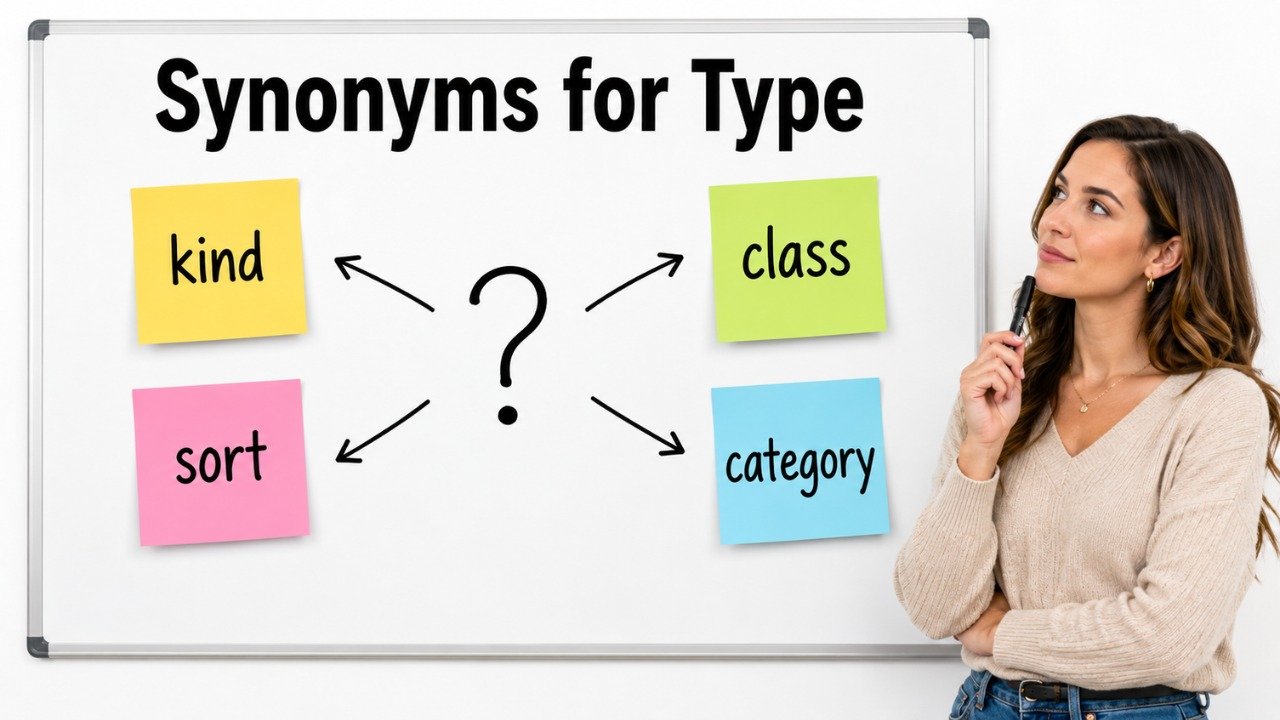
Quick Answer: Common synonyms for type include kind, sort, category, class, variety, form, style, model, version, and typeface. Use kind or sort in general conversation, category or classification in formal writing, class in academic or technical contexts, variety when describing different options, style for appearance or design, model for a particular product form, and typeface when discussing printed or digital lettering. The best synonym depends on whether type refers to a group, a person, a design, written characters, or the action of entering text.
Pronunciation and Word Details
Word: Type.
Pronunciation: /taɪp/.
Part of Speech: Noun and verb.
Meaning: A group of people or things that share similar qualities, or the act of entering words using a keyboard.
US Pronunciation:
UK Pronunciation:
What Does “Type” Mean?
Type means a category of people, objects, ideas, or products that share certain features. It is commonly used as a noun, but it can also function as a verb.
As a noun, type can describe a particular kind, class, form, or style.
Example: This type of fabric is suitable for summer clothing.
Type can also describe a person with recognizable qualities or preferences.
Example: She is the quiet and thoughtful type.
In design and printing, type refers to letters, characters, or a particular typeface.
Example: The title appears in large, clear type.
As a verb, type means to enter letters, numbers, or symbols using a keyboard or keypad.
Example: Please type your full name into the form.
The intended meaning usually becomes clear from the words surrounding type. In a product discussion, it often means model or variety. In a personality discussion, it can mean kind of person. In writing or design, it may refer to lettering. In computer use, it describes entering text.
Meaning, Tone, and Context of “Type”
Type is usually a neutral and widely understood word. It can appear naturally in casual speech, business communication, academic writing, technical instructions, product descriptions, and everyday conversation.
In casual speech, type often means kind or sort.
Example: What type of music do you enjoy?
In formal writing, category, classification, class, or form may sound more precise.
Example: The researchers examined each category of response.
In product descriptions, type may refer to a model, version, style, or variety.
Example: This model uses less energy than the previous version.
When describing people, type can sound conversational and slightly general.
Example: He is not the competitive type.
In typography, type has a technical meaning connected with letters, printed characters, and typefaces.
Example: The designer selected a readable typeface for the main text.
As a verb, type is neutral and practical. It is commonly used in instructions related to computers, forms, messages, and documents.
Example: Type the reference number in the box.
The word is not usually emotional, although phrases such as “not my type” can express personal preference or attraction.
When and How to Use “Type”
For Categories
Use type when placing something within a general group based on shared characteristics.
Example: This type of plant grows well in indirect light.
For Products
Use type when discussing different forms, models, materials, or versions of a product.
Example: Which type of paint works best in a bathroom?
For People
Use type to describe a person with a recognizable personality, appearance, habit, or preference.
Example: She is the adventurous type.
For Preferences
Use type when explaining what kind of person or thing someone prefers.
Example: Historical fiction is not usually my type of book.
For Styles
Use type when describing a particular design, appearance, or arrangement.
Example: This type of decoration suits a simple interior.
For Academic Classification
Use type when discussing groups in science, grammar, literature, mathematics, or research.
Example: The study identified three types of responses.
For Typography
Use type when referring to printed or digital letters and characters.
Example: The warning was printed in bold type.
For Keyboarding
Use type as a verb when someone enters words using a keyboard or keypad.
Example: Type your password carefully.
For Data Entry
Use type when entering information into a digital field, document, or system.
Example: Type the date in the required format.
For Written Communication
Use type when producing a message, report, letter, or document on a device.
Example: She typed a short reply to the customer.
Best Synonyms for Type
Kind: A group of things or people that share similar qualities.
Example: What kind of solution would work best?
Sort: A general category used mainly in conversation.
Example: This sort of problem requires patience.
Category: A clearly defined group within a larger system.
Example: The product belongs in the household category.
Class: A division based on quality, purpose, rank, or shared features.
Example: This class of materials can resist high temperatures.
Variety: One particular form among several available options.
Example: The store offers a wide variety of fabrics.
Form: A particular structure, shape, or version of something.
Example: Written language is one form of communication.
Style: A recognizable appearance, design, or manner.
Example: This style of furniture works well in smaller rooms.
Model: A particular design or version of a product.
Example: The newer model includes additional features.
Type of Person: A description of someone based on personality or behavior.
Example: He is the type of person who plans everything carefully.
Typeface: A complete design used for letters, numbers, and symbols.
Example: The typeface gives the page a professional appearance.
50 Synonyms for Type with Short Meanings
- Kind: A general group with shared qualities.
- Sort: A category or variety of something.
- Category: A named group within a larger system.
- Class: A division based on common features.
- Group: A collection of related people or things.
- Variety: One form among several possible forms.
- Form: A particular structure or version.
- Style: A distinctive appearance or manner.
- Model: A particular design of a product.
- Version: A specific form of something that may differ from others.
- Genre: A category of art, writing, music, or entertainment.
- Classification: The placement of something into an organized group.
- Division: A separate part or category within a system.
- Family: A related group with shared characteristics.
- Species: A biological group of similar living organisms.
- Breed: A recognized variety of animal.
- Order: A scientific or organized level of classification.
- Format: The arrangement or structure of information.
- Pattern: A repeated form, design, or recognizable arrangement.
- Design: A particular planned appearance or structure.
- Make: A particular manufacturer or product identity.
- Line: A connected range of products or designs.
- Nature: The basic character or qualities of something.
- Character: The distinguishing qualities of a person or thing.
- Description: A group identified by certain qualities.
- Designation: A name or label given to a class.
- Archetype: A typical or widely recognized example.
- Prototype: An original model used as a basis for later forms.
- Example: A person or thing representing a category.
- Specimen: An individual example used to represent a group.
- Mold: A recognizable kind of character or personality.
- Stamp: A distinctive kind, quality, or character.
- Person: An individual human being.
- Individual: One particular person.
- Personality: A recognizable set of personal qualities.
- Typeface: A complete visual design for written characters.
- Font: A specific size, weight, and style of a typeface.
- Face: A shortened term for typeface.
- Lettering: The style or appearance of written letters.
- Characters: Letters, numbers, and symbols used in text.
- Write: To create words or sentences in written form.
- Key: To enter information by pressing keyboard keys.
- Keyboard: To enter text using a keyboard.
- Enter: To place information into a digital system.
- Input: To add data to a computer or device.
- Transcribe: To produce a written copy of spoken or recorded words.
- Compose: To create a written message or document.
- Record: To place information into written or digital form.
- Typeset: To arrange written text for printing or display.
- Tap: To enter text by touching keys on a screen or device.
Read Also:
Synonyms for Prioritizing
Synonyms for Type by Context
When Type Means Kind or Category
The most useful synonyms are kind, sort, category, class, group, and classification. These words identify people or things that share common features.
Kind is the most natural general replacement. Sort is especially common in conversation. Category and classification are more organized and formal. Class is often used in academic, scientific, and technical writing.
Example With Type: This type of material absorbs water quickly.
Example With Kind: This kind of material absorbs water quickly.
Example With Category: This material belongs to an absorbent category.
When Type Means Variety or Form
Useful alternatives include variety, form, version, and variation. These words describe one possible form among several choices.
Variety is useful when multiple options are available. Form describes structure or appearance. Version often refers to something that has been changed, updated, or presented differently.
Example With Type: We tested a different type of solution.
Example With Variety: We tested a different variety of solution.
Example With Version: We tested an updated version of the solution.
When Type Means Style or Design
Style, design, pattern, format, and model are useful when type describes appearance or construction.
Style focuses on visual or personal features. Design emphasizes planning and structure. Pattern describes an arrangement that can be repeated. Format refers to organization. Model identifies a particular product design.
Example With Type: I prefer this type of chair.
Example With Style: I prefer this style of chair.
Example With Model: I prefer this model of chair.
When Type Refers to a Person
Useful alternatives include person, individual, personality, character, mold, and archetype.
Person and individual are direct and neutral. Personality focuses on personal qualities. Character can describe a recognizable nature. Archetype refers to a highly typical example of a person.
Example With Type: He is the patient type.
Example With Personality: He has a patient personality.
Example With Person: He is a patient person.
When Type Refers to Printed Letters
Typeface, font, lettering, face, and characters are useful in design, printing, and publishing.
Typeface refers to the overall design of a set of characters. Font refers to a specific variation of that typeface, such as a particular size or weight. Lettering refers more generally to the visual appearance of letters.
Example With Type: The heading uses elegant type.
Example With Typeface: The heading uses an elegant typeface.
Example With Lettering: The heading uses elegant lettering.
When Type Means Enter Text
Key, enter, input, transcribe, compose, keyboard, and tap can replace the verb type in suitable contexts.
Enter is best for forms and data fields. Input is common in technical instructions. Transcribe means to turn speech or recordings into written text. Compose emphasizes creating the message rather than pressing the keys.
Example With Type: Type the number into the box.
Example With Enter: Enter the number into the box.
Example With Input: Input the number into the box.
Another Word for Type
The best general replacement for type is kind. It works naturally when type refers to a category, variety, or group. However, the best alternative depends on the sentence. Category is stronger in formal organization, style is better for appearance, model is better for products, typeface is correct for lettering, and enter is more precise for digital instructions.
Original: What type of food do you prefer?
Better Option: What kind of food do you prefer?
Original: Select the type that matches your request.
Better Option: Select the category that matches your request.
Original: I like this type of jacket.
Better Option: I like this style of jacket.
Original: Type your account number in the box.
Better Option: Enter your account number in the box.
When Not to Use “Type”
Avoid type when a more precise word would communicate the meaning more clearly. Because type has several meanings, it can sometimes sound general or unclear.
When Referring to an Official Category
Category or classification may sound more precise in reports, studies, surveys, and organized systems.
Weak: Each type was assigned a code.
Better: Each category was assigned a code.
When Describing Visual Appearance
Style or design may be clearer when discussing clothing, furniture, art, or decoration.
Weak: I like this type of architecture.
Better: I like this style of architecture.
When Naming a Product Version
Model or version is usually more accurate when discussing a particular product.
Weak: This type has a stronger battery.
Better: This model has a stronger battery.
When Discussing Fonts
Do not use type when you specifically mean the design of letters.
Weak: The document uses a modern type.
Better: The document uses a modern typeface.
When Entering Data
Enter or input can make technical instructions clearer.
Weak: Type the requested information.
Better: Enter the requested information.
When Describing a Person
Using type can sound impersonal, judgmental, or overly general in sensitive situations.
Weak: She is a difficult type.
Better: She can be difficult to work with in stressful situations.
When Type Becomes Repetitive
Repeated use can make a paragraph sound dull.
Weak: This type of device is a type of tool used for this type of repair.
Better: This device is a specialized tool used for this kind of repair.
Words Commonly Confused With Type
Type vs Kind: Both can describe a group with shared features. Kind sounds more natural in everyday conversation, while type may sound more systematic or technical.
Type vs Sort: Sort is informal and conversational. Type is slightly more neutral and works well in both speech and writing.
Type vs Category: Type can refer to any general group. Category usually suggests a clearly defined place within an organized system.
Type vs Class: Class often refers to a formal division based on rank, quality, scientific features, or academic criteria.
Type vs Variety: Variety emphasizes differences within the same general group. Type can describe a broader category.
Type vs Style: Type identifies what something is, while style usually describes how it looks, feels, or is presented.
Type vs Model: Model refers to a specific product design or version. Type describes the broader group to which that model belongs.
Type vs Form: Form emphasizes structure, shape, or method. Type emphasizes classification.
Type vs Typeface: Type can refer generally to printed letters. Typeface is the precise term for a complete visual design of characters.
Typeface vs Font: A typeface is the overall letter design, while a font is a particular size, weight, or variation within that design.
Which Synonym Should You Choose?
Choose kind for natural everyday questions about groups, choices, preferences, and qualities.
Choose sort in relaxed conversation when the category does not need to be precisely defined.
Choose category when organizing information into clearly named groups.
Choose classification when discussing a formal system used in research, science, records, or analysis.
Choose class when referring to an academic, scientific, social, or quality based division.
Choose variety when describing different options within the same general group.
Choose form when discussing structure, method, shape, or expression.
Choose style when referring to appearance, fashion, decoration, writing, or personal manner.
Choose design when focusing on the planned structure or visual construction of something.
Choose model when discussing a particular version of a product or machine.
Choose version when something has been updated, adapted, translated, or changed.
Choose genre for categories of books, films, music, art, or other creative works.
Choose species or breed in biological and animal related contexts.
Choose typeface when referring to the overall design of letters and symbols.
Choose font when referring to a particular typeface variation, weight, or size.
Choose person or individual when type refers to a human being.
Choose enter for instructions involving forms, passwords, codes, and digital fields.
Choose input for technical writing about adding data to a system.
Choose transcribe when converting speech, recordings, or handwritten material into text.
Choose compose when the focus is on creating a message, document, or written response.
Real Life Examples of “Type” in Sentences
Original: What type of exercise do you enjoy?
Better Option: What kind of exercise do you enjoy?
Original: This type of error appears frequently in the report.
Better Option: This category of error appears frequently in the report.
Original: We need a different type of packaging.
Better Option: We need a different form of packaging.
Original: She prefers this type of dress.
Better Option: She prefers this style of dress.
Original: This type includes several useful features.
Better Option: This model includes several useful features.
Original: Mystery is my favorite type of fiction.
Better Option: Mystery is my favorite genre of fiction.
Original: He is the organized type.
Better Option: He is an organized person.
Original: The heading appears in bold type.
Better Option: The heading appears in a bold typeface.
Original: Type your answer in the space provided.
Better Option: Enter your answer in the space provided.
Original: She typed the interview notes carefully.
Better Option: She transcribed the interview notes carefully.
Synonym Groups and Usage Differences
Category Group
Kind, sort, category, class, group, and classification all place people or things into groups.
Kind and sort are broad and natural. Category and classification suggest organized systems. Class is useful when the division follows specific standards.
Example: Each category contains products with similar features.
Variety Group
Variety, form, version, and variation describe different expressions of the same general thing.
Variety emphasizes choice. Form emphasizes structure. Version suggests modification or development.
Example: The updated version contains several corrections.
Style Group
Style, design, pattern, and format describe appearance, arrangement, or presentation.
Style is often visual. Design includes planning. Pattern refers to repeated features. Format describes how information is arranged.
Example: The document uses a clear and consistent format.
Product Group
Model, make, line, and version are useful for products, devices, tools, and equipment.
Model identifies a specific design. Make can identify the producer or product identity. Line describes a related range. Version distinguishes one release from another.
Example: This model has a larger display.
Personality Group
Person, individual, personality, character, mold, and archetype can describe human qualities.
Person and individual are neutral. Personality focuses on behavior and character. Archetype describes a highly recognizable example.
Example: She has a calm and practical personality.
Typography Group
Typeface, font, face, lettering, and characters relate to written symbols and visual text.
Typeface is the complete visual design. Font is a particular variation. Lettering describes appearance. Characters are individual letters, numbers, and symbols.
Example: The typeface remains readable at a small size.
Keyboarding Group
Key, enter, input, transcribe, compose, record, and typeset relate to producing or entering written information.
Enter and input are useful for data. Transcribe involves copying spoken or recorded language. Compose means creating original text. Typeset refers to arranging text for publication.
Example: Enter the code exactly as it appears.
Antonyms of Type
Type does not have one universal opposite because it has several meanings. Its opposite depends on whether it refers to a category, a typical example, printed text, or entering information.
Individual: One particular person or thing rather than a general category.
Unique Item: Something that does not belong neatly to a common type.
Exception: A person or thing that does not follow the usual category or pattern.
Difference: A quality showing that things are not of the same type.
Irregularity: Something that does not match an expected pattern or class.
Original: Something distinct rather than a standard model or type.
Unclassified: Not placed within a recognized category.
Miscellaneous: Consisting of items from several different categories.
Handwrite: To write by hand rather than type with a keyboard.
Delete: To remove entered text rather than add it.
Erase: To remove writing, characters, or information.
Omit: To leave information out rather than enter or record it.
Comparison of Type and Related Words
Type vs Kind
Type and kind are often interchangeable. Kind sounds more natural in everyday speech, while type can sound more organized, analytical, or technical.
Example With Type: This type of fabric dries quickly.
Example With Kind: This kind of fabric dries quickly.
Type vs Sort
Sort is more conversational and sometimes less precise. Type works in both formal and casual contexts.
Example With Type: What type of support do you need?
Example With Sort: What sort of support do you need?
Type vs Category
Category suggests an official or clearly organized group. Type can describe a category without implying a formal system.
Example With Type: We studied three types of behavior.
Example With Category: We placed each behavior into a separate category.
Type vs Class
Class often suggests a division based on rank, quality, scientific rules, or shared technical properties.
Example With Type: This type of chemical reacts with water.
Example With Class: This class of chemicals reacts with water.
Type vs Variety
Type describes a category. Variety describes one option within a category or a collection of different options.
Example With Type: This is a common type of apple.
Example With Variety: This variety of apple has a sweet flavor.
Type vs Form
Type focuses on classification, while form focuses on structure, expression, or method.
Example With Type: This type of communication is effective.
Example With Form: Written communication is an effective form of communication.
Type vs Style
Type tells the reader what category something belongs to. Style describes its appearance or manner.
Example With Type: This is a traditional type of chair.
Example With Style: This chair has a traditional style.
Type vs Model
Type names a broad group, while model identifies a particular product design.
Example With Type: This type of camera is suitable for beginners.
Example With Model: This camera model is suitable for beginners.
Type vs Typeface
Type is a broad term for printed or displayed text. Typeface is the exact term for the visual design of letters.
Example With Type: The title is printed in large type.
Example With Typeface: The title uses a bold typeface.
Type vs Enter
Type describes the physical act of using keys. Enter emphasizes placing information into a field or system.
Example With Type: Type your name carefully.
Example With Enter: Enter your name in the first field.
Common Phrases and Expressions With “Type”
A Type Of: One particular kind or category.
Example: A rose is a type of flowering plant.
This Type Of: A specific category that has already been mentioned or identified.
Example: This type of material is easy to clean.
What Type Of: A question used to ask about a category or preference.
Example: What type of books do you read?
The Same Type: Belonging to an identical or similar category.
Example: Both machines use the same type of battery.
A Different Type: A category that is not the same as another.
Example: We need a different type of container.
A Certain Type: A particular category that is not fully identified.
Example: The role requires a certain type of experience.
The Right Type: The most suitable category, form, or person.
Example: This is the right type of tool for the task.
Not My Type: A person or thing that does not match someone’s preference.
Example: Loud music is not my type of entertainment.
The Creative Type: A person who is imaginative or artistic.
Example: She has always been the creative type.
Type In: To enter words, numbers, or symbols using a keyboard.
Example: Type in the security code to continue.
Common Mistakes to Avoid
Repeating Type Too Often
Using type several times in one paragraph can make the writing sound vague and repetitive. Replace some uses with kind, category, form, style, model, or variety.
Incorrect: This type of tool is the type used for this type of project.
Improved: This tool is the model commonly used for this kind of project.
Using Type When Style Is More Accurate
Type and style are not always interchangeable. Style usually refers to appearance, design, or manner.
Incorrect: I like the type of her jacket.
Improved: I like the style of her jacket.
Using Type Instead of Model
When discussing a specific product design, model is usually clearer.
Incorrect: The newest type has a larger screen.
Improved: The newest model has a larger screen.
Confusing Typeface and Font
Typeface refers to the complete design of characters. Font refers to a particular variation of that design.
Incorrect: Every typeface size is available.
Improved: Every font size is available.
Using Type for a Person in a Negative Way
Calling someone a type can sound dismissive or judgmental. Describe the specific behavior instead.
Unclear: He is an unreliable type.
Improved: He often misses deadlines and forgets important details.
Choosing a Technical Synonym in Casual Speech
Classification may sound too formal in an ordinary conversation.
Unnatural: What classification of movie do you enjoy?
Natural: What kind of movie do you enjoy?
Choosing an Informal Synonym in Formal Writing
Sort can sound too conversational in a formal report.
Informal: We identified four sorts of errors.
Formal: We identified four categories of errors.
Using Type Without a Clear Noun
Type usually needs a clear object when it refers to a category.
Unclear: I do not like that type.
Clear: I do not like that type of fabric.
Confusing Type With Write
Typing is one method of writing, but writing can also include handwriting and other forms of composition.
Incorrect: She typed the note with a pen.
Correct: She wrote the note with a pen.
Using Type Vaguely
Replace type when readers need to know the exact category, model, style, or format.
Vague: Select the correct type.
Clear: Select the correct document format.
Conclusion
Synonyms for type include kind, sort, category, class, variety, form, style, model, version, and typeface. Kind is best for general conversation, while category and classification suit formal organization. Style works for appearance, model identifies a product design, and typeface refers to lettering. When type functions as a verb, enter, input, transcribe, or compose may be more precise. Choosing the right alternative makes each sentence clearer and helps readers understand the exact category, design, person, or action being described.
FAQs About Synonyms for Type
What Is the Best Synonym for Type?
Kind is the best general synonym for type. Category is better for formal classification, while style, model, and form suit more specific contexts.
Can Kind and Type Be Used Interchangeably?
They can often be exchanged when referring to a general category. Kind sounds more conversational, while type can sound more systematic or technical.
What Is a Formal Synonym for Type?
Category, classification, class, and designation are formal alternatives. The strongest choice depends on how the group is organized.
What Is Another Word for Type of Person?
Personality, character, individual, archetype, and kind of person are useful alternatives. Person is usually the simplest and most respectful choice.
What Is Another Word for Type in Design?
Style, design, pattern, format, and model can replace type in design contexts. Typeface is the correct choice when discussing letters or text.
What Is Another Word for Type on a Keyboard?
Enter, input, key, keyboard, compose, and transcribe may replace type. Enter is especially useful for forms and digital instructions.
What Is the Difference Between a Typeface and a Font?
A typeface is the complete visual design of letters and symbols. A font is a specific size, weight, or style within that typeface.
