
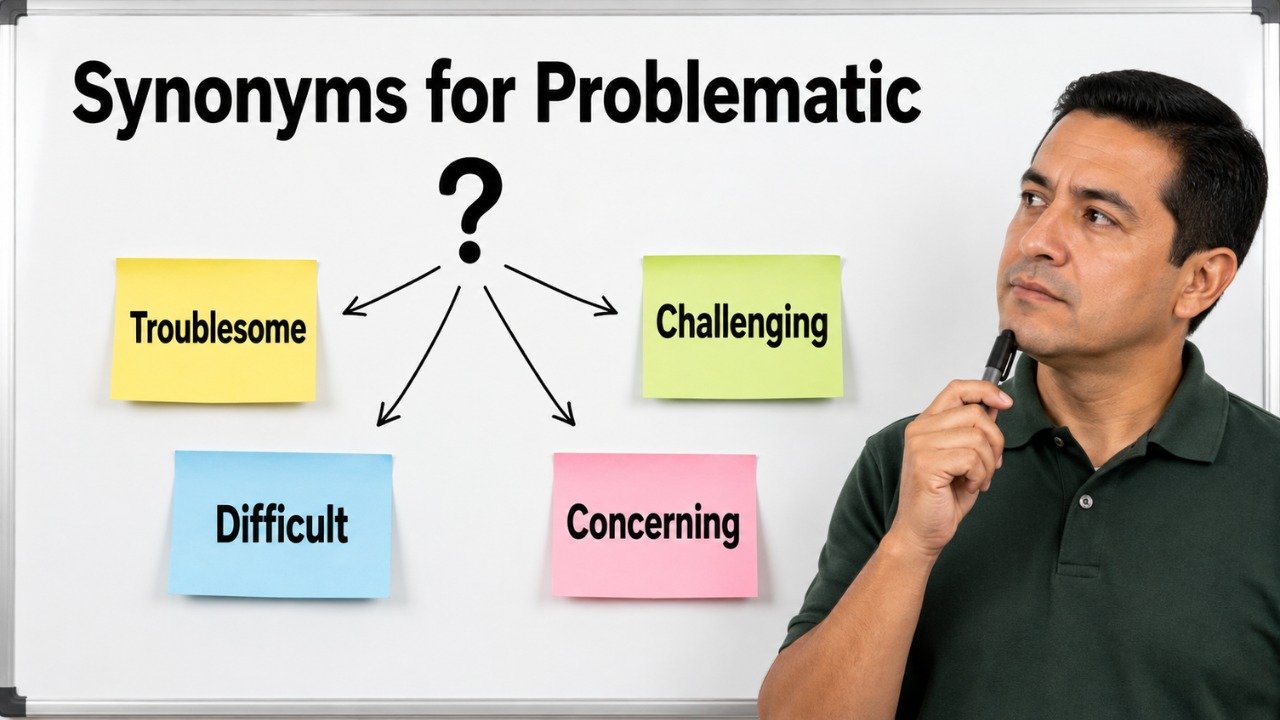
Quick Answer: For readers searching for synonyms for problematic, the best choices are troublesome, difficult, challenging, concerning, questionable, controversial, flawed, defective, complicated, and risky. Use troublesome for a situation that causes repeated difficulties, challenging for something that requires effort, concerning for something that creates worry, and questionable for something that causes doubt. Controversial fits disputed subjects, flawed describes imperfect ideas or plans, defective suits faulty products, and risky highlights possible danger or loss.
Pronunciation and Word Details
Word: Problematic.
Pronunciation: /ˌprɑː.bləˈmæt̬.ɪk/.
Part of Speech: Adjective.
Meaning: Causing difficulty, concern, doubt, disagreement, or an unwanted problem.
US Pronunciation:
UK Pronunciation:
What Does “Problematic” Mean?
Problematic means causing a problem, creating difficulty, or giving people a reason to feel concerned.
It is an adjective used to describe situations, ideas, actions, decisions, systems, behaviors, and objects that may produce negative results. The exact meaning changes according to the sentence.
A problematic situation is difficult to manage or resolve.
Example: The lack of accurate information made the situation problematic.
A problematic claim may be doubtful, misleading, or poorly supported.
Example: The report contained a problematic claim about the results.
A problematic product may be faulty, unsafe, or unreliable.
Example: The company replaced the problematic device.
A problematic subject may create disagreement or controversy.
Example: The speaker avoided the most problematic topic during the discussion.
The word does not always mean that something is completely wrong. It can simply suggest that the subject requires attention, improvement, caution, or further investigation.
Meaning, Tone, and Context of “Problematic”
Problematic usually has a neutral to critical tone. It identifies something as a source of difficulty, concern, doubt, or disagreement without always explaining the exact problem.
In formal writing, problematic can describe a weak argument, unreliable method, questionable assumption, or difficult policy.
Example: The research method is problematic because it excludes important data.
In academic writing, the word often shows that an idea, theory, definition, or conclusion needs closer examination.
Example: This interpretation is problematic when applied to earlier historical periods.
In professional communication, problematic can politely identify an issue without using highly emotional language.
Example: The current delivery schedule may become problematic during the busy season.
In casual conversation, it can describe anything inconvenient, difficult, or worrying.
Example: Losing access to the account would be problematic.
The word may sound strong when used to describe a person. Calling a person problematic can seem vague, judgmental, or personally critical. It is often clearer to name the particular behavior, statement, or decision that caused concern.
Vague: He is problematic.
Clearer: His repeated refusal to follow the safety procedure is concerning.
When and How to Use “Problematic”
For Difficult Situations
Use problematic when a situation creates obstacles or cannot be handled easily.
Example: The sudden change in the deadline was problematic for the entire team.
For Flawed Ideas or Plans
Use problematic when an idea contains weaknesses that may prevent it from succeeding.
Example: The proposal is problematic because it does not include a realistic budget.
For Concerning Behavior
Use problematic when an action or pattern creates worry or may lead to negative consequences.
Example: Her habit of ignoring important warnings became problematic.
For Questionable Claims
Use problematic when a statement appears doubtful, inaccurate, unfair, or unsupported.
Example: The conclusion is problematic because it relies on incomplete evidence.
For Controversial Subjects
Use problematic when a topic is likely to create disagreement, criticism, or debate.
Example: The policy remains problematic among residents and local officials.
For Faulty Products
Use problematic when an object, system, or feature does not work reliably.
Example: The problematic component caused the machine to stop repeatedly.
For Risky Decisions
Use problematic when a choice could produce harm, failure, loss, or another unwanted outcome.
Example: Expanding without additional funding could be problematic.
For Polite Criticism
Use problematic when you want to identify a weakness without sounding unnecessarily harsh.
Example: Some sections of the agreement may be problematic for smaller businesses.
Best Synonyms for Problematic
Troublesome
Synonym: Causing repeated difficulty, inconvenience, or annoyance.
Example: The troublesome software error delayed the project.
Difficult
Synonym: Hard to manage, understand, complete, or resolve.
Example: The team faced a difficult decision about the budget.
Challenging
Synonym: Requiring considerable effort, skill, patience, or thought.
Example: Meeting the new deadline will be challenging.
Concerning
Synonym: Creating worry or suggesting that something may be wrong.
Example: The sudden decline in attendance is concerning.
Questionable
Synonym: Open to doubt, criticism, or suspicion.
Example: The writer used evidence from a questionable source.
Controversial
Synonym: Causing strong disagreement or public debate.
Example: The council introduced a controversial new rule.
Flawed
Synonym: Containing a weakness, mistake, or imperfection.
Example: The final conclusion was based on flawed reasoning.
Defective
Synonym: Not working correctly because of a fault.
Example: The defective part was removed from the machine.
Complicated
Synonym: Difficult to understand or manage because of many connected details.
Example: The application process became unnecessarily complicated.
Risky
Synonym: Involving the possibility of danger, loss, failure, or harm.
Example: Investing all the available money in one plan would be risky.
50 Synonyms for Problematic with Short Meanings
- Troublesome: Causing difficulty, annoyance, or repeated problems.
- Difficult: Hard to manage, understand, or complete.
- Challenging: Requiring significant effort, ability, or patience.
- Concerning: Creating worry or attracting serious attention.
- Troubling: Making someone feel worried or uncomfortable.
- Questionable: Open to doubt, criticism, or suspicion.
- Controversial: Causing disagreement, debate, or strong opinions.
- Flawed: Containing an error, weakness, or imperfection.
- Defective: Faulty and unable to work as intended.
- Complicated: Difficult because of many connected details.
- Risky: Carrying a possibility of loss, danger, or failure.
- Awkward: Difficult, uncomfortable, or inconvenient to handle.
- Inconvenient: Causing extra effort, delay, or discomfort.
- Uncertain: Not clearly known, decided, or reliable.
- Doubtful: Unlikely to be true, successful, or dependable.
- Dubious: Not completely trustworthy, convincing, or acceptable.
- Debatable: Open to discussion, disagreement, or different opinions.
- Contentious: Likely to cause arguments or strong disagreement.
- Sensitive: Requiring careful treatment because of possible offense or harm.
- Delicate: Needing cautious and thoughtful handling.
- Unstable: Likely to change, fail, or become unsafe.
- Unreliable: Not consistently accurate, effective, or dependable.
- Faulty: Containing an error or failing to work correctly.
- Unsound: Based on weak reasoning or lacking reliability.
- Imperfect: Containing faults, limitations, or weaknesses.
- Deficient: Lacking an important quality, amount, or feature.
- Inadequate: Not sufficient or suitable for the intended purpose.
- Unsuitable: Not appropriate for a particular situation or use.
- Inappropriate: Not correct, suitable, or acceptable in context.
- Objectionable: Likely to cause criticism, disapproval, or offense.
- Unacceptable: Not satisfactory, suitable, or permitted.
- Disturbing: Causing discomfort, anxiety, or emotional concern.
- Worrying: Giving a reason to feel anxious or concerned.
- Alarming: Creating fear because something may be seriously wrong.
- Dangerous: Likely to cause injury, damage, or harm.
- Hazardous: Presenting a clear risk to health, safety, or success.
- Precarious: Uncertain, unstable, and likely to become worse.
- Thorny: Difficult to resolve because of complicated issues.
- Knotty: Complex and hard to understand or solve.
- Complex: Containing many related parts that make understanding difficult.
- Demanding: Requiring substantial effort, time, or attention.
- Burdensome: Creating an excessive responsibility or difficulty.
- Taxing: Requiring considerable physical or mental effort.
- Disruptive: Interrupting normal activity, progress, or order.
- Obstructive: Preventing or slowing progress.
- Adverse: Harmful or unfavorable in its effects.
- Unfavorable: Unlikely to produce a positive or successful result.
- Harmful: Causing physical, emotional, social, or practical damage.
- Detrimental: Producing a damaging or negative effect.
- Fraught: Filled with difficulty, tension, danger, or uncertainty.
Read Also:
Synonyms for Concrete
Synonyms for Problematic by Context
When Problematic Means Difficult to Manage
Troublesome, difficult, challenging, complicated, awkward, thorny, knotty, and demanding work well when something requires extra effort or careful management.
Example: Coordinating five separate schedules was problematic.
Better Option: Coordinating five separate schedules was complicated.
Troublesome emphasizes repeated inconvenience or disruption.
Example: The troublesome payment error affected several customers.
Challenging sounds more positive than problematic because it can suggest that success is still possible with effort.
Example: Completing the project in two weeks will be challenging.
Thorny and knotty are useful for complex questions that do not have easy answers.
Example: The committee must resolve a thorny legal question.
When Problematic Means Flawed or Defective
Flawed, defective, faulty, unsound, imperfect, deficient, and inadequate describe something that contains a weakness or does not work properly.
Example: The problematic reasoning weakened the entire argument.
Better Option: The flawed reasoning weakened the entire argument.
Flawed is effective for arguments, plans, methods, conclusions, and assumptions.
Example: The study was based on a flawed method.
Defective and faulty are more suitable for products, equipment, systems, and physical components.
Example: A defective switch caused the equipment failure.
Unsound is commonly used for reasoning, advice, judgment, and financial decisions.
Example: The recommendation was based on unsound assumptions.
When Problematic Means Concerning
Concerning, troubling, worrying, disturbing, and alarming describe something that causes emotional or practical concern.
Example: The decline in reading ability is problematic.
Better Option: The decline in reading ability is concerning.
Concerning is measured and professional.
Example: The report revealed a concerning pattern of delays.
Troubling expresses stronger worry.
Example: The sudden increase in complaints is troubling.
Alarming is appropriate when the situation appears urgent or serious.
Example: The rapid loss of water was alarming.
When Problematic Means Questionable
Questionable, doubtful, dubious, debatable, inappropriate, objectionable, and unacceptable fit statements, actions, or choices that may not be valid or proper.
Example: The author made a problematic comparison.
Better Option: The author made a questionable comparison.
Questionable suggests doubt about quality, truth, ethics, or judgment.
Example: The decision was based on questionable evidence.
Dubious suggests that something is difficult to believe or trust.
Example: The advertisement made several dubious claims.
Inappropriate focuses on suitability within a particular setting.
Example: His comment was inappropriate for a formal meeting.
When Problematic Means Controversial
Controversial, contentious, sensitive, delicate, and debatable describe subjects that may create disagreement or require careful discussion.
Example: The committee discussed a problematic proposal.
Better Option: The committee discussed a controversial proposal.
Controversial emphasizes strong disagreement among different groups.
Example: The law remains controversial.
Contentious is suitable for issues that frequently produce arguments.
Example: Funding became the most contentious part of the negotiation.
Sensitive and delicate suggest that the topic should be handled carefully.
Example: The manager addressed the sensitive complaint privately.
When Problematic Means Risky or Harmful
Risky, dangerous, hazardous, precarious, adverse, harmful, and detrimental describe possible or actual negative effects.
Example: Continuing without safety checks would be problematic.
Better Option: Continuing without safety checks would be dangerous.
Risky highlights uncertainty and the possibility of failure or loss.
Example: Borrowing more money would be risky.
Harmful and detrimental describe negative effects that are already known or strongly expected.
Example: Constant interruptions are detrimental to concentration.
Precarious describes an unstable situation that could quickly become worse.
Example: The business remained in a precarious financial position.
Another Word for Problematic
Troublesome is one of the best general replacements for problematic. It clearly describes something that causes difficulty, inconvenience, or repeated complications.
However, the most accurate alternative depends on the exact reason the subject is problematic. Use concerning for worry, flawed for weaknesses, controversial for disagreement, defective for faulty products, and risky for possible danger.
Original: The new procedure is problematic for smaller teams.
Better Option: The new procedure is troublesome for smaller teams.
Original: The conclusion is problematic because it ignores key evidence.
Better Option: The conclusion is flawed because it ignores key evidence.
Original: The recent change in behavior is problematic.
Better Option: The recent change in behavior is concerning.
Original: The proposal became problematic during the public meeting.
Better Option: The proposal became controversial during the public meeting.
When Not to Use “Problematic”
Problematic should not be used when a more precise word can explain the exact nature of the issue.
When the Meaning Is Too Vague
Problematic can hide useful details. Readers may not know whether something is difficult, dangerous, inaccurate, offensive, or defective.
Weak: The new system is problematic.
Better: The new system is unreliable and frequently loses customer information.
When Describing a Specific Technical Fault
Use defective, faulty, unstable, or incompatible when describing a clear technical problem.
Weak: The problematic cable stopped the device from charging.
Better: The defective cable stopped the device from charging.
When Explaining a Weak Argument
Use flawed, unsound, inaccurate, or unsupported when identifying a weakness in reasoning.
Weak: The writer presents a problematic conclusion.
Better: The writer presents an unsupported conclusion.
When Discussing Immediate Danger
Use dangerous, hazardous, or unsafe when people need to understand that a serious risk exists.
Weak: Entering the damaged building could be problematic.
Better: Entering the damaged building could be dangerous.
When Referring to a Person
Calling someone problematic may sound judgmental and unclear. Describe the behavior instead.
Weak: The employee is problematic.
Better: The employee repeatedly misses deadlines and ignores written instructions.
When the Word Becomes Repetitive
Repeatedly using problematic can make writing sound vague and monotonous.
Weak: The problematic policy created a problematic process and several problematic results.
Better: The flawed policy created a complicated process and several harmful results.
Words Commonly Confused With Problematic
Problematic vs Difficult: Problematic suggests that something causes or contains a problem. Difficult simply means that it requires effort, skill, or patience.
Example With Problematic: The missing safety information makes the instructions problematic.
Example With Difficult: The instructions are difficult to memorize.
Problematic vs Challenging: Problematic usually has a negative tone. Challenging can sound positive because it suggests an opportunity to use effort or ability.
Example With Problematic: The inaccurate data made the analysis problematic.
Example With Challenging: Analyzing the large data set was challenging.
Problematic vs Concerning: Problematic focuses on difficulty or weakness. Concerning focuses on worry.
Example With Problematic: The limited budget is problematic for the project.
Example With Concerning: The rapid decline in sales is concerning.
Problematic vs Controversial: Problematic can describe many kinds of problems. Controversial specifically describes something that causes strong disagreement.
Example With Problematic: The plan is problematic because it lacks funding.
Example With Controversial: The plan is controversial because residents strongly disagree about it.
Problematic vs Questionable: Problematic means that something creates a difficulty. Questionable suggests doubt about its truth, quality, ethics, or suitability.
Example With Problematic: The schedule is problematic for employees with long journeys.
Example With Questionable: The manager used a questionable method to calculate the results.
Problematic vs Flawed: Problematic describes the effect or overall concern. Flawed identifies a weakness or error within something.
Example With Problematic: The entire proposal may be problematic.
Example With Flawed: The proposal contains a flawed financial estimate.
Problematic vs Defective: Problematic can describe abstract and physical matters. Defective usually refers to something that fails to work because of a fault.
Example With Problematic: The new return policy is problematic.
Example With Defective: The customer received a defective product.
Which Synonym Should You Choose?
Choose troublesome when a situation creates repeated difficulty, inconvenience, or annoyance.
Choose difficult when something requires effort, skill, patience, or careful thought.
Choose challenging when you want to describe difficulty without making the situation sound entirely negative.
Choose concerning when a change, behavior, result, or pattern gives people a reason to worry.
Choose troubling when the concern is stronger or more emotionally serious.
Choose questionable when an action, claim, source, decision, or method causes doubt.
Choose controversial when a subject creates strong disagreement among groups or individuals.
Choose contentious when an issue regularly causes arguments or conflict.
Choose flawed when an argument, plan, method, theory, or conclusion contains a weakness.
Choose defective when a product, component, or piece of equipment does not work correctly.
Choose complicated when a process or situation contains many connected details.
Choose risky when a decision may lead to loss, failure, or danger.
Choose dangerous or hazardous when physical harm or serious damage is possible.
Choose inappropriate when a word, behavior, or action does not suit the situation.
Choose detrimental when describing an effect that damages progress, performance, health, or success.
For essays and reports, flawed, concerning, questionable, unsound, and controversial often provide greater precision.
For professional emails, concerning, difficult, inconvenient, and challenging usually sound measured and respectful.
For casual conversation, difficult, awkward, worrying, and troublesome feel natural.
For technical writing, defective, faulty, unstable, unreliable, and inadequate are more informative than problematic.
Real Life Examples of “Problematic” in Sentences
Original: The new attendance policy is problematic for parents.
Better Option: The new attendance policy is inconvenient for parents.
Original: The results of the experiment are problematic.
Better Option: The results of the experiment are unreliable.
Original: His explanation was problematic because it ignored the main question.
Better Option: His explanation was inadequate because it ignored the main question.
Original: The machine has a problematic component.
Better Option: The machine has a defective component.
Original: The sudden change in her performance is problematic.
Better Option: The sudden change in her performance is concerning.
Original: The company made a problematic financial decision.
Better Option: The company made a risky financial decision.
Original: The article includes several problematic assumptions.
Better Option: The article includes several flawed assumptions.
Original: The speaker introduced a problematic subject.
Better Option: The speaker introduced a controversial subject.
Original: The instructions became problematic after the second step.
Better Option: The instructions became confusing after the second step.
Original: Continuing the journey in severe weather would be problematic.
Better Option: Continuing the journey in severe weather would be dangerous.
Synonym Groups and Usage Differences
Difficulty Group
Troublesome, difficult, challenging, complicated, demanding, thorny, and knotty describe situations that require effort or careful management.
Troublesome often suggests repeated inconvenience, while challenging can suggest that the difficulty is manageable.
Example: Organizing the records manually was a demanding task.
Concern Group
Concerning, troubling, worrying, disturbing, and alarming describe different levels of worry.
Concerning is measured, troubling is stronger, and alarming suggests urgency or possible danger.
Example: The unexpected increase in errors is concerning.
Doubt Group
Questionable, doubtful, dubious, debatable, and uncertain show that something may not be reliable, correct, or settled.
Questionable is useful for actions and evidence, while dubious often suggests distrust.
Example: The report relies on questionable calculations.
Controversy Group
Controversial, contentious, sensitive, and delicate relate to disagreement or the need for careful communication.
Controversial highlights divided opinion, while sensitive emphasizes the possibility of emotional harm or offense.
Example: The committee postponed the contentious discussion.
Defect Group
Flawed, defective, faulty, unsound, deficient, and imperfect describe weaknesses or failures.
Flawed is common for ideas and methods. Defective and faulty are more appropriate for objects and systems.
Example: The conclusion resulted from a flawed assumption.
Suitability Group
Unsuitable, inappropriate, inadequate, objectionable, and unacceptable indicate that something does not meet expectations or fit the situation.
Inappropriate relates to context, while inadequate means that something is not sufficient.
Example: The proposed location is unsuitable for a large event.
Risk Group
Risky, dangerous, hazardous, precarious, harmful, and detrimental relate to danger, damage, or negative outcomes.
Risky emphasizes possibility, while harmful and detrimental describe damaging effects.
Example: Ignoring the warning could be hazardous.
Disruption Group
Disruptive, obstructive, burdensome, inconvenient, and taxing describe something that interrupts progress or creates extra strain.
Disruptive affects normal activity, while obstructive actively prevents progress.
Example: Frequent system failures became disruptive.
Antonyms of Problematic
The opposite of problematic depends on whether the word refers to difficulty, reliability, safety, suitability, or quality.
Straightforward: Easy to understand, manage, or complete.
Simple: Not complicated or difficult.
Manageable: Possible to control, organize, or resolve.
Uncomplicated: Free from unnecessary difficulty or complexity.
Reliable: Consistently accurate, effective, or dependable.
Sound: Based on strong reasoning or good judgment.
Valid: Logically or factually acceptable.
Acceptable: Satisfactory and suitable for the situation.
Appropriate: Correct or suitable for a particular context.
Suitable: Right for a particular purpose or need.
Effective: Producing the intended result.
Stable: Unlikely to change, fail, or become dangerous.
Safe: Unlikely to cause danger, injury, or damage.
Harmless: Not causing injury, loss, or negative effects.
Beneficial: Producing a useful or positive result.
Comparison: Problematic vs Related Words
Problematic vs Troublesome
Problematic is broad and may describe difficulty, doubt, disagreement, or risk. Troublesome usually emphasizes repeated difficulty or inconvenience.
Example With Problematic: The lack of evidence makes the accusation problematic.
Example With Troublesome: The recurring error has become troublesome.
Problematic vs Challenging
Problematic has a more negative tone and suggests that something contains a weakness or causes an issue. Challenging emphasizes the effort needed to succeed.
Example With Problematic: The inaccurate instructions are problematic.
Example With Challenging: Following the advanced instructions is challenging.
Problematic vs Concerning
Problematic identifies a difficulty or weakness. Concerning expresses worry about what something may indicate or cause.
Example With Problematic: The limited storage space is problematic.
Example With Concerning: The repeated loss of information is concerning.
Problematic vs Questionable
Problematic describes something that creates an issue. Questionable suggests doubt about truth, quality, ethics, or suitability.
Example With Problematic: The schedule is problematic for part time workers.
Example With Questionable: The decision was based on questionable evidence.
Problematic vs Controversial
Problematic can refer to any kind of difficulty. Controversial specifically refers to disagreement and divided opinion.
Example With Problematic: The plan is problematic because it costs too much.
Example With Controversial: The plan is controversial because the community is divided.
Problematic vs Flawed
Problematic describes the general negative effect. Flawed identifies an internal error, weakness, or limitation.
Example With Problematic: The research design is problematic.
Example With Flawed: The research design is flawed because the sample is too small.
Problematic vs Defective
Problematic works for abstract and physical subjects. Defective mainly describes objects or components that do not function correctly.
Example With Problematic: The replacement process is problematic.
Example With Defective: The replacement part is defective.
Problematic vs Risky
Problematic can describe an existing difficulty. Risky focuses on the possibility of a future negative result.
Example With Problematic: The current arrangement is problematic for the staff.
Example With Risky: Changing the arrangement without consultation would be risky.
Common Phrases and Expressions With Problematic
Problematic Situation: A situation that creates difficulty or concern.
Problematic Behavior: Conduct that causes harm, conflict, or worry.
Problematic Assumption: An idea accepted without enough evidence or careful examination.
Problematic Decision: A choice likely to create difficulty or negative consequences.
Problematic Relationship: A connection marked by conflict, instability, or unhealthy patterns.
Problematic Pattern: A repeated trend that produces unwanted results.
Problematic Claim: A statement that may be inaccurate, doubtful, or poorly supported.
Problematic Aspect: A particular part of something that causes difficulty.
Problematic Approach: A method containing weaknesses or likely to fail.
Deeply Problematic: Extremely concerning, flawed, harmful, or unacceptable.
Common Mistakes to Avoid
Using Problematic Without Explaining the Problem
The word may sound vague unless the sentence identifies the exact concern.
Unclear: The agreement is problematic.
Improved: The agreement is problematic because it gives one party complete control over payment dates.
Repeating Problematic Too Often
Use precise alternatives to improve clarity and sentence variety.
Repetitive: The problematic rule created a problematic delay and a problematic outcome.
Improved: The confusing rule created an unnecessary delay and an unfavorable outcome.
Calling a Person Problematic
Describe the person’s action or behavior instead of applying a vague label.
Weak: She is a problematic manager.
Better: She frequently changes instructions without informing the team.
Using Challenging When You Mean Harmful
Challenging can make a dangerous or damaging situation sound less serious than it is.
Weak: Driving with faulty brakes is challenging.
Better: Driving with faulty brakes is dangerous.
Using Controversial for Every Problem
Controversial should only be used when people strongly disagree.
Incorrect: The broken printer is controversial.
Correct: The broken printer is defective.
Using Defective for an Abstract Idea
Defective usually describes products or physical parts. Flawed is more natural for reasoning, arguments, and plans.
Unnatural: The theory is defective.
Natural: The theory is flawed.
Confusing Concerning With Difficult
Something may be difficult without causing worry, and it may be concerning without being difficult to manage.
Example: The puzzle is difficult, but the decline in student participation is concerning.
Writing Problematic Issue
The phrase can be repetitive because an issue is already a problem or subject of concern.
Wordy: The report identifies a problematic issue.
Better: The report identifies a serious issue.
Choosing a Synonym That Changes the Meaning
Always identify why something is problematic before selecting a replacement. A difficult task is not automatically controversial, and a questionable claim is not necessarily dangerous.
Conclusion
Problematic is a broad adjective for something that creates difficulty, doubt, concern, disagreement, or risk. Readers searching for synonyms for synonyms for problematic should select a replacement that explains the exact issue. Troublesome and difficult suit practical obstacles, concerning and troubling express worry, questionable fits doubtful claims, controversial describes disagreement, flawed identifies weaknesses, defective suits faulty objects, and risky highlights possible danger. Precise synonym choices make descriptions clearer, more informative, and more useful.
FAQs About Synonyms for Problematic
What Is the Best Synonym for Problematic?
Troublesome is the best general synonym because it describes something that causes difficulty or inconvenience. A more precise choice may be concerning, flawed, controversial, defective, or risky.
Is Difficult a Synonym for Problematic?
Yes. Difficult is suitable when something requires effort or is hard to manage. Problematic is broader because it may also suggest doubt, concern, disagreement, or harm.
What Is a Formal Synonym for Problematic?
Concerning, questionable, contentious, flawed, unsound, adverse, and detrimental are useful formal alternatives. The right choice depends on the intended meaning.
What Is a Polite Alternative to Problematic?
Challenging, concerning, complicated, or difficult can sound more measured and polite. These words are useful in professional communication.
Can Controversial Replace Problematic?
Controversial can replace problematic when the subject causes strong disagreement or public debate. It should not be used for ordinary technical faults or practical difficulties.
What Is a Synonym for a Problematic Situation?
Troublesome situation, difficult situation, complicated situation, challenging situation, precarious situation, and delicate situation are natural alternatives.
What Is the Opposite of Problematic?
Common opposites include straightforward, manageable, reliable, sound, suitable, acceptable, stable, safe, and beneficial.
