
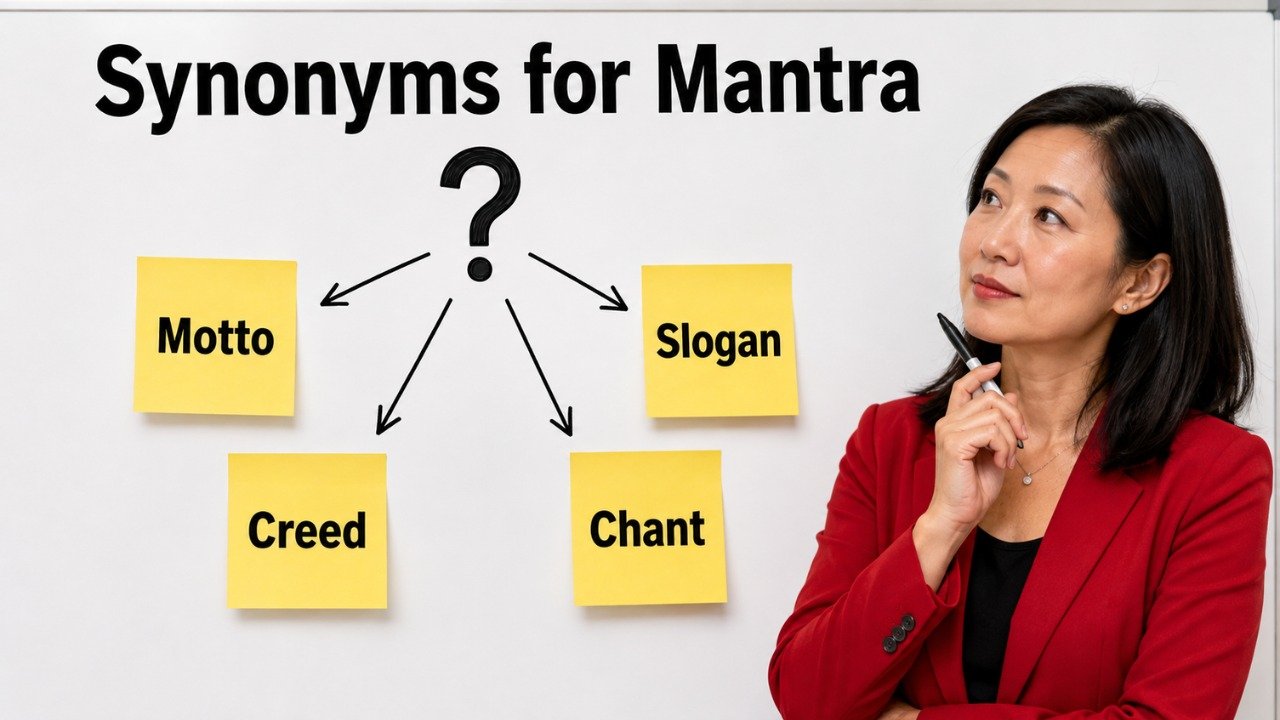
Quick Answer: The best synonyms for mantra include affirmation, motto, maxim, credo, principle, chant, invocation, watchword, guiding belief, and repeated phrase. When discussing meditation or spiritual practice, chant, invocation, prayer, or sacred phrase may be the best choices. For personal encouragement, affirmation works well. In formal writing, credo, principle, maxim, or guiding belief can express an idea that influences decisions. The most suitable synonyms for mantra depend on whether the word refers to sacred recitation, personal motivation, or a frequently repeated belief.
Pronunciation and Word Details
Word: Mantra.
Pronunciation: /ˈmæn.trə/
Part of Speech: Noun.
Meaning: A word, sound, phrase, or belief that is repeated for spiritual focus, personal encouragement, or guidance.
US Pronunciation:
UK Pronunciation:
What Does “Mantra” Mean?
A mantra is a word, sound, phrase, or belief that someone repeats for spiritual focus, emotional strength, motivation, or guidance.
As a noun, mantra has both a traditional spiritual meaning and a broader figurative meaning. In spiritual contexts, it can describe a sacred sound or phrase repeated during meditation, prayer, or contemplation. The repetition may help a person concentrate, remain calm, or direct attention toward a spiritual purpose.
In everyday language, mantra often means a guiding statement or belief that someone repeats and follows. A person might describe “stay calm and keep learning” as a personal mantra. In this use, the word is similar to motto, principle, affirmation, or guiding belief.
The word can also describe a message that an organization, group, or speaker repeats frequently. In this context, mantra sometimes suggests that an idea has been repeated so often that it has become familiar or predictable.
Meaning, Tone, and Context of “Mantra”
Mantra has a thoughtful, meaningful, and sometimes spiritual tone. Its exact tone changes according to the context.
Spiritual Tone: In meditation, prayer, and spiritual practice, mantra refers to a sacred sound, word, or phrase repeated with concentration.
Motivational Tone: In personal development, a mantra can be a positive statement repeated to encourage confidence, calmness, or determination.
Figurative Tone: In conversation and writing, mantra may describe a central belief or message that guides someone’s behavior.
Formal Tone: In reports, essays, or professional discussions, mantra may describe an often repeated principle, policy, or message.
Critical Tone: Sometimes the word suggests that a phrase has been repeated without enough thought or action.
Mantra is common in discussions about meditation, mental focus, personal values, leadership, motivation, habits, identity, emotional balance, and decision making.
When and How to Use “Mantra”
For Spiritual Practice: Use mantra for a sacred sound, phrase, or set of words repeated during meditation or prayer.
Example: She quietly repeated her mantra while focusing on her breathing.
For Personal Motivation: Use mantra for a positive statement that supports confidence, courage, or persistence.
Example: His mantra was to learn from every mistake.
For Emotional Focus: Use mantra when a repeated phrase helps someone remain calm or control anxious thoughts.
Example: “Breathe slowly and stay present” became her mantra during stressful moments.
For Guiding Principles: Use mantra for a belief that influences someone’s choices and behavior.
Example: Quality before speed was the team’s working mantra.
For Repeated Messages: Use mantra for an idea that a person or group communicates frequently.
Example: Preparation is essential became the instructor’s familiar mantra.
For Lifestyle Values: Use mantra for a short phrase that summarizes how someone wants to live.
Example: Simplicity and gratitude formed his personal mantra.
Best Synonyms for Mantra
Affirmation: A positive statement repeated to encourage confidence, focus, or emotional strength.
Example: Her morning affirmation reminded her to approach challenges calmly.
Motto: A short statement expressing the guiding belief of a person, group, or organization.
Example: “Always keep learning” became the class motto.
Maxim: A short statement expressing a general rule, principle, or truth.
Example: His favorite maxim was to prepare carefully before taking action.
Credo: A set of beliefs or a central belief that guides someone’s actions.
Example: Respect and honesty formed the foundation of her professional credo.
Principle: A basic belief or rule that influences decisions and behavior.
Example: Fairness was the main principle guiding the discussion.
Chant: A word or phrase repeated rhythmically, often during spiritual practice or group activity.
Example: The group repeated the chant in a slow and steady rhythm.
Invocation: Words spoken or repeated to request spiritual help, guidance, or inspiration.
Example: The ceremony began with a peaceful invocation.
Watchword: A word or phrase expressing an important guiding idea.
Example: Accuracy became the watchword of the research team.
Guiding Belief: An idea that directs a person’s choices, attitudes, and actions.
Example: Compassion was her guiding belief in difficult situations.
Repeated Phrase: A set of words spoken or remembered again and again.
Example: His repeated phrase helped him remain focused before every performance.
50 Synonyms for Mantra with Short Meanings
- Affirmation: A positive statement repeated for confidence or focus.
- Motto: A short phrase expressing a guiding belief.
- Maxim: A brief statement presenting a rule or general truth.
- Credo: A belief or set of beliefs that guides behavior.
- Principle: A basic rule or belief influencing decisions.
- Chant: A word or phrase repeated in a steady rhythm.
- Invocation: Words used to request spiritual help or inspiration.
- Watchword: A word or phrase representing an important ideal.
- Guiding Belief: An idea that directs choices and actions.
- Repeated Phrase: Words spoken or remembered many times.
- Prayer: Words directed toward a spiritual power.
- Incantation: A set of words recited for a spiritual or symbolic purpose.
- Sacred Phrase: Words treated as spiritually meaningful.
- Meditation Phrase: Words repeated to support concentration during meditation.
- Focus Phrase: A short statement used to direct attention.
- Spiritual Formula: A fixed set of spiritually significant words.
- Prayer Formula: A regular form of words used during prayer.
- Recitation: The spoken repetition of memorized words.
- Refrain: A phrase or idea repeated regularly.
- Litany: A series of repeated statements, prayers, or requests.
- Declaration: A clear and confident statement.
- Intention: A statement describing a desired purpose or direction.
- Reminder: Words that help someone remember an important idea.
- Resolution: A firm decision or statement of purpose.
- Pledge: A serious promise to act in a particular way.
- Vow: A strong and solemn promise.
- Promise: A commitment to do or maintain something.
- Personal Code: A set of beliefs that guides individual behavior.
- Core Belief: A deeply held idea shaping attitudes and actions.
- Doctrine: A formally accepted belief or system of ideas.
- Tenet: A central belief within a philosophy or system.
- Precept: A rule that guides moral or practical behavior.
- Rule: A principle describing expected conduct.
- Ideal: A standard or value someone tries to follow.
- Philosophy: A set of ideas that guides someone’s approach to life.
- Creed: A statement or system of beliefs.
- Axiom: A statement accepted as a basic truth.
- Dictum: A formal or authoritative statement.
- Adage: A familiar saying expressing practical wisdom.
- Proverb: A traditional saying that communicates advice or truth.
- Aphorism: A concise statement expressing an observation or principle.
- Saying: A familiar expression containing an idea or lesson.
- Catchphrase: A memorable phrase used repeatedly.
- Slogan: A short and memorable statement promoting an idea.
- Rallying Cry: A phrase used to inspire collective energy or action.
- Theme: A central idea that appears repeatedly.
- Message: An idea communicated to influence or guide others.
- Guiding Words: Words that provide direction or encouragement.
- Verbal Formula: A fixed arrangement of words repeated for a purpose.
- Personal Philosophy: A set of beliefs guiding how someone lives.
Read Also:
Synonyms for Problematic
Synonyms for Mantra by Context
When Mantra Means a Sacred Recitation
Chant, invocation, prayer, incantation, sacred phrase, spiritual formula, prayer formula, and recitation are useful alternatives when mantra refers to spiritual practice.
Example With Mantra: The practitioner repeated a mantra during meditation.
Example With Chant: The practitioner repeated a chant during meditation.
Chant emphasizes rhythmic repetition. Invocation emphasizes requesting guidance or spiritual presence. Prayer emphasizes communication with a spiritual power. Sacred phrase focuses on the spiritual importance of the words.
When Mantra Means a Positive Statement
Affirmation, focus phrase, intention, reminder, declaration, and guiding words work well when mantra refers to encouragement or emotional focus.
Example With Mantra: Her mantra helped her approach the interview confidently.
Example With Affirmation: Her affirmation helped her approach the interview confidently.
Affirmation is usually the clearest choice for a positive statement repeated to build confidence. Intention focuses more on a desired direction, while reminder emphasizes remembering an important idea.
When Mantra Means a Guiding Belief
Motto, credo, principle, maxim, tenet, personal code, core belief, and personal philosophy are strong alternatives when mantra describes a belief that guides behavior.
Example With Mantra: Patience was his mantra when working with new students.
Example With Guiding Principle: Patience was his guiding principle when working with new students.
Motto is concise and memorable. Credo sounds more formal and deeply personal. Principle works well in professional and academic writing. Personal philosophy suggests a wider system of beliefs.
When Mantra Means a Frequently Repeated Message
Catchphrase, slogan, refrain, message, theme, watchword, and repeated phrase are useful when mantra refers to an idea communicated again and again.
Example With Mantra: Efficiency became management’s repeated mantra.
Example With Watchword: Efficiency became management’s watchword.
Catchphrase often sounds casual or memorable. Slogan is associated with promotion or public messaging. Refrain may suggest repetition that has become predictable.
When Mantra Means a Commitment
Pledge, vow, promise, resolution, declaration, and intention are suitable when the repeated words express commitment.
Example With Mantra: “I will finish what I begin” became her mantra.
Example With Resolution: “I will finish what I begin” became her resolution.
Resolution emphasizes a firm decision. Pledge and vow sound more serious. Intention sounds gentler and focuses on purpose rather than obligation.
Another Word for Mantra
The best general replacement for mantra is affirmation when the word refers to a positive phrase repeated for confidence or focus. However, the best alternative depends on context. Use chant for spiritual repetition, motto for a memorable guiding phrase, and principle for a belief that directs behavior.
Original: Her mantra helped her remain calm before speaking.
Better Option: Her affirmation helped her remain calm before speaking.
Original: The group repeated a mantra during the ceremony.
Better Option: The group repeated a sacred chant during the ceremony.
Original: “Treat everyone fairly” was his mantra.
Better Option: “Treat everyone fairly” was his guiding principle.
Original: Preparation became the coach’s mantra.
Better Option: Preparation became the coach’s watchword.
When Not to Use “Mantra”
Do not use mantra when a more precise word would explain the meaning more clearly.
For Ordinary Advice: Mantra may sound too spiritual or dramatic when the sentence only describes simple advice.
Weak: My teacher’s mantra was to bring a pencil.
Better: My teacher’s reminder was to bring a pencil.
For Formal Rules: Mantra may sound too vague when describing an official requirement or policy.
Weak: Following safety procedures is the laboratory mantra.
Better: Following safety procedures is a laboratory rule.
For Specific Promises: Use pledge, vow, or promise when the speaker makes a clear commitment.
Weak: She made a mantra to support the project.
Better: She made a pledge to support the project.
For Promotional Language: Use slogan when the phrase is created to promote an idea, event, or campaign.
Weak: The event’s mantra appeared on every poster.
Better: The event’s slogan appeared on every poster.
For Excessive Repetition: Repeating mantra several times in one paragraph can make the writing sound monotonous.
Weak: His mantra shaped his work, and he repeated the mantra whenever the team forgot the mantra.
Better: His guiding principle shaped his work, and he repeated the message whenever the team lost focus.
Words Commonly Confused With Mantra
Mantra vs Affirmation: A mantra can be spiritual, motivational, or philosophical. An affirmation is usually a positive statement repeated to influence confidence or thinking.
Mantra vs Motto: A mantra is often repeated privately or during meditation. A motto is a concise phrase that publicly summarizes a guiding belief.
Mantra vs Chant: A mantra is the word, sound, or phrase being repeated. A chant emphasizes the rhythmic act or form of repetition.
Mantra vs Prayer: A prayer communicates praise, gratitude, hope, or a request to a spiritual power. A mantra may be repeated mainly for concentration, meditation, or spiritual awareness.
Mantra vs Maxim: A maxim expresses a general principle or practical truth. A mantra is usually repeated as a source of focus or guidance.
Mantra vs Slogan: A mantra expresses a personal, spiritual, or guiding belief. A slogan is usually designed to communicate or promote an idea memorably.
Mantra vs Credo: A credo describes a central belief or system of beliefs. A mantra is often a shorter phrase that represents or reinforces such beliefs.
Mantra vs Incantation: A mantra is associated with meditation, spiritual focus, or personal guidance. An incantation often suggests words recited for a mystical, ceremonial, or symbolic effect.
Which Synonym Should You Choose?
Choose affirmation when describing a positive sentence repeated to improve confidence, courage, or emotional focus.
Choose chant when describing rhythmic repetition during spiritual practice, ceremony, or group activity.
Choose sacred phrase when the spiritual importance of the words matters more than the rhythm.
Choose motto when describing a memorable statement that summarizes the values of a person or group.
Choose principle when writing formally about a belief that guides actions or decisions.
Choose credo when describing a deeply held personal or professional belief.
Choose maxim when the phrase expresses practical wisdom or a general rule.
Choose watchword when a word or short phrase represents the main priority of a group, project, or period.
Choose slogan when the words are intended to promote or communicate an idea publicly.
Choose repeated phrase when you need a neutral alternative that does not suggest spirituality, motivation, or philosophy.
Real Life Examples of “Mantra” in Sentences
Original: Her mantra was to remain curious and keep asking questions.
Better Option: Her guiding principle was to remain curious and keep asking questions.
Original: He repeated a calming mantra before the examination.
Better Option: He repeated a calming affirmation before the examination.
Original: The group began the session with a mantra.
Better Option: The group began the session with a sacred chant.
Original: “Listen before speaking” became the manager’s mantra.
Better Option: “Listen before speaking” became the manager’s motto.
Original: Accuracy was the editor’s mantra.
Better Option: Accuracy was the editor’s watchword.
Original: Her daily mantra encouraged her to focus on progress.
Better Option: Her daily affirmation encouraged her to focus on progress.
Original: The instructor repeated the mantra that preparation prevents confusion.
Better Option: The instructor repeated the maxim that preparation prevents confusion.
Original: Kindness became his mantra in every difficult conversation.
Better Option: Kindness became his guiding belief in every difficult conversation.
Original: The speaker returned to the same mantra throughout the presentation.
Better Option: The speaker returned to the same message throughout the presentation.
Original: She adopted a new mantra for the beginning of the semester.
Better Option: She adopted a new personal motto for the beginning of the semester.
Synonym Groups and Usage Differences
Spiritual Recitation Group
Chant, invocation, prayer, incantation, sacred phrase, recitation, and spiritual formula belong to the spiritual recitation group.
These words describe speech repeated or delivered for meditation, prayer, ceremony, or spiritual concentration. Chant emphasizes rhythm, while invocation emphasizes calling for guidance or inspiration.
Example: The participants began their meditation with a quiet chant.
Positive Thinking Group
Affirmation, intention, declaration, reminder, and focus phrase belong to the positive thinking group.
These words describe statements used to shape attention, confidence, motivation, or emotional balance. Affirmation is the strongest choice for a positive statement repeated regularly.
Example: Her affirmation reminded her that improvement requires patience.
Guiding Belief Group
Motto, credo, principle, tenet, core belief, personal code, and philosophy belong to the guiding belief group.
These alternatives describe beliefs that influence behavior and decisions. Motto is brief and memorable, while philosophy usually represents a broader system of ideas.
Example: Honesty remained the central principle of his leadership style.
Wisdom Statement Group
Maxim, adage, proverb, aphorism, axiom, dictum, and saying belong to the wisdom statement group.
These words describe concise statements containing advice, truth, or observation. Maxim and aphorism often sound more formal than saying.
Example: “Measure carefully before acting” became his favorite maxim.
Repeated Message Group
Catchphrase, slogan, refrain, watchword, theme, message, and repeated phrase belong to the repeated message group.
These words describe language communicated many times. Refrain can suggest repeated wording, while watchword emphasizes an important priority.
Example: Responsibility became the watchword of the entire project.
Antonyms of Mantra
Because mantra has several meanings, its opposites depend on the context.
Silence: The absence of spoken or repeated words.
Doubt: A lack of confidence in a belief or statement.
Disbelief: An inability or refusal to accept an idea as true.
Denial: A rejection of a statement, belief, or reality.
Contradiction: A statement that directly opposes another statement.
Rejection: A refusal to accept a belief, message, or principle.
Uncertainty: A lack of clear belief, confidence, or direction.
Opposition: Resistance to an idea, belief, or guiding principle.
Improvisation: Speech created without using a fixed or repeated formula.
Abandonment: The act of giving up a belief, commitment, or guiding idea.
Comparison: Mantra vs Related Words
Mantra vs Affirmation
A mantra may be spiritual, philosophical, or motivational. An affirmation is usually a positive statement repeated to strengthen confidence or encourage a healthier way of thinking.
Example With Mantra: Compassion is the mantra that guides her choices.
Example With Affirmation: “I can handle this challenge” is her daily affirmation.
Mantra vs Motto
A mantra is often repeated for personal focus or spiritual practice. A motto is a concise expression of values used by a person, family, group, or organization.
Example With Mantra: He repeated his mantra before beginning the difficult task.
Example With Motto: “Learn, improve, contribute” became the group’s motto.
Mantra vs Chant
A mantra refers to the words or sounds being repeated. A chant refers more strongly to the rhythmic manner in which words are repeated.
Example With Mantra: She selected a short mantra for meditation.
Example With Chant: The audience joined the steady chant.
Mantra vs Principle
A mantra is usually expressed as a memorable phrase and may be repeated regularly. A principle is a fundamental belief or rule that guides decisions.
Example With Mantra: “Keep moving forward” became his mantra.
Example With Principle: Fairness was the principle behind his decision.
Mantra vs Maxim
A mantra is repeated for focus, motivation, or guidance. A maxim expresses a general truth, practical rule, or piece of wisdom.
Example With Mantra: Her mantra helped her stay patient.
Example With Maxim: Her favorite maxim taught that patience brings better decisions.
Mantra vs Slogan
A mantra usually reflects a personal, spiritual, or guiding belief. A slogan is designed to be memorable and communicate an idea to an audience.
Example With Mantra: Gratitude became her personal mantra.
Example With Slogan: The event used a short slogan to communicate its main theme.
Common Phrases and Expressions With Mantra
Personal Mantra: A phrase or belief that guides an individual’s thoughts and actions.
Daily Mantra: Words repeated each day for focus, encouragement, or spiritual practice.
Positive Mantra: An encouraging phrase used to support confidence and optimism.
Sacred Mantra: A spiritually important word, sound, or phrase.
Meditation Mantra: Words or sounds repeated to support concentration during meditation.
Guiding Mantra: A belief or phrase that directs decisions and behavior.
Calming Mantra: A phrase repeated to reduce stress and restore emotional balance.
Repeat a Mantra: To say or remember the same meaningful words several times.
Adopt a Mantra: To choose a phrase or belief as personal guidance.
Live by a Mantra: To organize actions and decisions around a repeated belief.
Common Mistakes to Avoid
Using Mantra for Every Repeated Sentence: Not every repeated phrase is a mantra. Use reminder, instruction, slogan, catchphrase, or repeated phrase when those words provide a more precise meaning.
Ignoring the Spiritual Meaning: Mantra has an established spiritual use. Avoid using it carelessly when discussing sacred practices. Choose respectful and accurate language.
Confusing Mantra With Motto: A motto summarizes values, while a mantra is often repeated for focus, meditation, or encouragement.
Confusing Mantra With Chant: A mantra is the phrase or sound. A chant emphasizes rhythmic vocal repetition.
Using an Unnatural Verb: English speakers usually repeat, recite, choose, adopt, use, or practice a mantra. Expressions such as “make a mantra” may sound unnatural unless the sentence clearly means creating one.
Repeating the Word Too Often: Using mantra several times in a short paragraph can weaken the writing. Replace some uses with affirmation, principle, phrase, message, or motto.
Choosing a Synonym Without Checking Context: Prayer, slogan, affirmation, and principle are not interchangeable in every sentence. Choose the synonym that matches the spiritual, motivational, professional, or conversational meaning.
Using Mantra Vaguely: Explain what the mantra is or what purpose it serves. A specific phrase gives readers more useful information than a vague reference.
Conclusion
The best synonyms for mantra depend on its intended meaning. Use chant, invocation, prayer, or sacred phrase for spiritual recitation. Choose affirmation or focus phrase for positive thinking and emotional encouragement. Motto, credo, maxim, principle, and guiding belief work well when describing values that direct behavior. Slogan, watchword, and repeated phrase are better for frequently communicated messages. Understanding these differences will help you choose precise synonyms for mantra in essays, reports, conversations, motivational writing, and discussions about meditation.
FAQs About Synonyms for Mantra
What Is the Best Synonym for Mantra?
Affirmation is the best synonym when mantra means a positive repeated statement. Chant is better for spiritual repetition, while motto is better for a guiding phrase.
Can Motto Be Used Instead of Mantra?
Yes, motto can replace mantra when the sentence describes a short statement that expresses personal or group values. It is less suitable for meditation or sacred recitation.
Is Affirmation the Same as Mantra?
Not completely. An affirmation is usually a positive statement repeated for confidence or motivation. A mantra may also be spiritual, sacred, philosophical, or meditative.
What Is a Formal Synonym for Mantra?
Credo, principle, maxim, tenet, and guiding belief are suitable formal alternatives. The best choice depends on whether the sentence describes beliefs, rules, or practical wisdom.
What Is a Spiritual Synonym for Mantra?
Chant, invocation, prayer, sacred phrase, spiritual formula, and recitation are useful spiritual alternatives.
What Is Another Word for a Personal Mantra?
Personal motto, affirmation, guiding belief, personal code, focus phrase, and personal philosophy can describe a personal mantra.
Can Slogan Replace Mantra?
Slogan can replace mantra when the phrase promotes or communicates an idea publicly. It is usually not appropriate when mantra refers to meditation, prayer, or private encouragement.
