
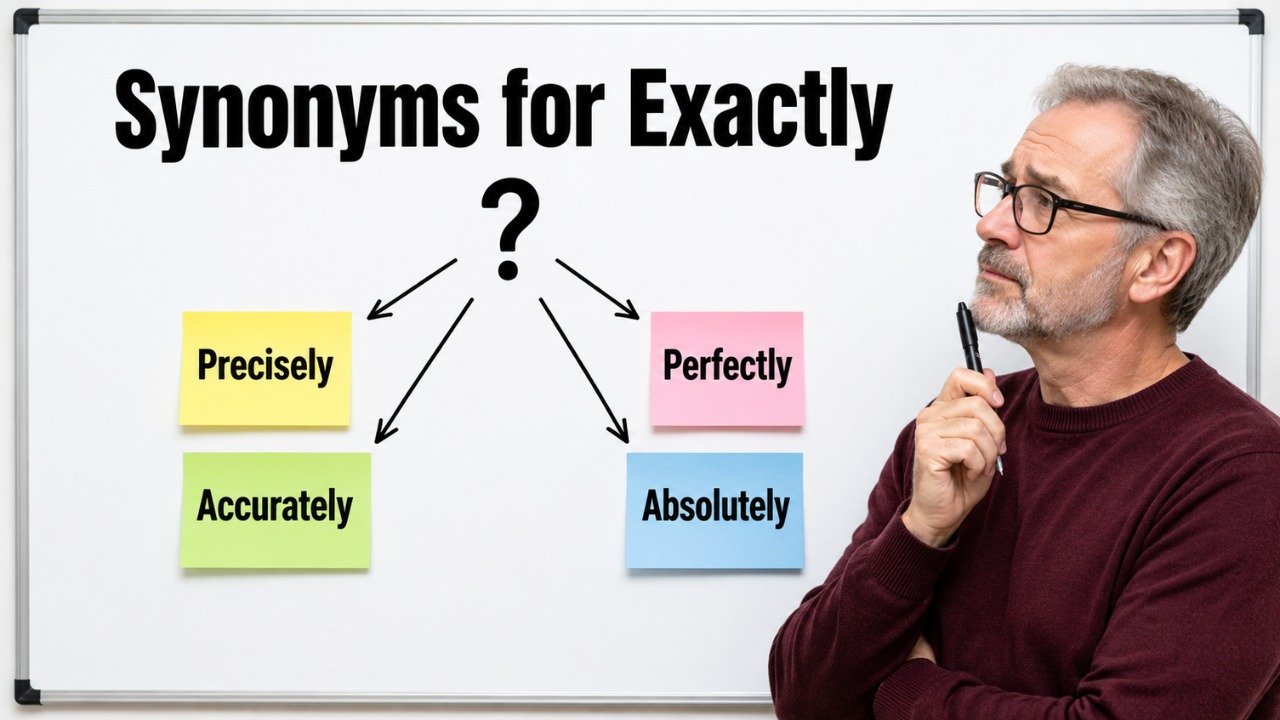
Quick Answer: The best synonyms for exactly include precisely, accurately, correctly, specifically, absolutely, completely, just, indeed, spot on, and on the dot. Use precisely for measurements, times, and detailed information. Choose accurately for facts, data, and descriptions. Correctly works for answers and actions, while specifically introduces a clear detail. Absolutely and completely add strong emphasis. Just can mean only, indeed can show agreement, spot on suits casual praise, and on the dot refers to an exact time.
Pronunciation and Word Details
Word: Exactly.
Pronunciation: /ɪɡˈzæktli/
Part of Speech: Adverb.
Meaning: In a completely correct, precise, or identical way.
US Pronunciation:
UK Pronunciation:
What Does “Exactly” Mean?
Exactly means in a completely correct, precise, or accurate way. It is an adverb that can describe numbers, locations, statements, actions, similarities, and ideas.
The word is often used to show that something has no error or difference. For example, “The meeting begins at exactly nine” means the meeting begins at nine, not before or after.
Exactly can also show complete agreement. When someone says “Exactly” as a response, they mean that another person has expressed the correct idea.
It can emphasize identity or similarity, as in “The two answers are exactly the same.” It can also mean just or only, as in “That is exactly what I needed.”
Meaning, Tone, and Context of “Exactly”
Exactly usually has a neutral tone. It is natural in formal writing, academic explanations, professional communication, technical instructions, and everyday conversation.
In reports and technical contexts, exactly emphasizes precision. It may refer to a particular quantity, measurement, time, location, or result.
In casual conversation, exactly often expresses strong agreement. A speaker may use it alone as a response when another person has made the same point.
The word can also sound emphatic. In a sentence such as “That is exactly why we changed the plan,” it highlights the main reason.
Exactly is polite and clear in most situations. However, repeating it too often can make writing sound mechanical. A more specific synonym may sometimes communicate the intended meaning more effectively.
When and How to Use “Exactly”
For Precision: Use exactly when a number, time, location, measurement, or detail must be completely specific.
Example: The package weighs exactly five kilograms.
For Agreement: Use exactly as a response when another person has expressed your opinion correctly.
Example: “The instructions need to be clearer.” “Exactly.”
For Similarity: Use exactly to show that two or more things have no meaningful difference.
Example: Her answer was exactly the same as mine.
For Emphasis: Use exactly to draw attention to an important reason, fact, or point.
Example: That is exactly why we need a written plan.
For Identification: Use exactly when identifying the particular person, place, object, or idea being discussed.
Example: This is exactly the document I was searching for.
For Limitation: Use exactly when the meaning is close to just or only.
Example: I know exactly one person who can solve this problem.
Best Synonyms for Exactly
Precisely
Synonym: Precisely means with complete exactness or careful detail.
Example: The train arrived precisely at six o’clock.
Accurately
Synonym: Accurately means in a way that is correct and free from error.
Example: The report accurately describes the final results.
Correctly
Synonym: Correctly means in the proper, true, or expected way.
Example: She correctly identified the cause of the problem.
Specifically
Synonym: Specifically means in a clear and particular way.
Example: The instructions specifically mention the final deadline.
Absolutely
Synonym: Absolutely means completely, certainly, or without any doubt.
Example: You are absolutely right about the main issue.
Completely
Synonym: Completely means fully and without any missing part.
Example: The two versions are completely identical in meaning.
Just
Synonym: Just can mean exactly, only, or precisely in a particular situation.
Example: This is just what I needed.
Indeed
Synonym: Indeed can confirm that a statement is correct or true.
Example: That is indeed the best solution available.
Spot On
Synonym: Spot on means completely correct or accurate in casual language.
Example: Your estimate was spot on.
On the Dot
Synonym: On the dot means at the exact stated time.
Example: The presentation started at ten on the dot.
50 Synonyms for Exactly with Short Meanings
- Precisely: With complete exactness.
- Accurately: Without factual or practical error.
- Correctly: In the proper or true way.
- Specifically: With attention to a particular detail.
- Explicitly: In a clear and directly stated way.
- Definitely: With certainty and no doubt.
- Absolutely: Completely or unquestionably.
- Completely: Fully and without exception.
- Entirely: In every part or respect.
- Fully: To the complete amount or degree.
- Wholly: Completely and without division.
- Totally: To an absolute degree.
- Perfectly: In a faultless or completely suitable way.
- Strictly: According to an exact rule or limit.
- Literally: According to the actual meaning of the words.
- Directly: In a straight or immediate manner.
- Just: Precisely or only.
- Only: With no additional person, thing, or amount.
- Simply: Merely or without anything more.
- Right: In the correct position, way, or moment.
- Indeed: Used to confirm truth or agreement.
- Quite: Completely in certain contexts.
- Identically: In exactly the same way.
- Equally: To the same degree or amount.
- Exactly So: Used to express complete agreement.
- To the Letter: Following every detail exactly.
- Word for Word: Using the same words without changes.
- Point for Point: Matching every separate detail.
- In Every Detail: With all parts matching precisely.
- Without Error: With no mistake or inaccuracy.
- On the Dot: At the exact stated time.
- To a Tee: Perfectly or in every detail.
- Bang On: Completely correct in informal language.
- Spot On: Precisely correct or suitable.
- Dead On: Completely accurate or correct.
- Precisely Right: Correct in every relevant detail.
- Perfectly Right: Entirely correct.
- In Full: Completely and without omission.
- In All Respects: In every relevant way.
- In Every Respect: With no meaningful difference.
- In the Same Way: Using an identical method or manner.
- In the Same Manner: Following the same process or style.
- No More and No Less: The precise amount or degree.
- Nothing But: Only the stated thing.
- Merely: Only or simply.
- Solely: Only and without anything else.
- Expressly: Clearly and specifically stated.
- Unequivocally: In a completely clear and certain way.
- Faithfully: In a way that follows the original accurately.
- Verbatim: Using exactly the same words.
Read Also:
Synonyms for Mantra

Synonyms for Exactly by Context
When Exactly Means Precisely
When exactly refers to measurements, numbers, times, locations, or detailed information, the strongest alternatives are precisely, accurately, specifically, strictly, and on the dot.
Precisely: Best for exact measurements, times, and carefully defined details.
Example: The device must be placed precisely in the center.
Accurately: Best when information, calculations, or descriptions must be correct.
Example: The chart accurately represents the monthly totals.
Specifically: Best when identifying one detail from a larger subject.
Example: The rule specifically applies to new applicants.
On the Dot: Best for an exact clock time.
Example: The interview began at two on the dot.
When Exactly Means Completely
When exactly adds emphasis or shows a total match, useful synonyms include completely, absolutely, entirely, fully, perfectly, and wholly.
Completely: Emphasizes that there is no missing part or exception.
Example: The final result was completely different from the estimate.
Absolutely: Adds confidence, certainty, or strong emphasis.
Example: Your conclusion is absolutely correct.
Perfectly: Shows a faultless match or complete suitability.
Example: The new schedule works perfectly for our team.
Entirely: Refers to the whole situation, idea, or amount.
Example: The decision was entirely reasonable.
When Exactly Means Agreement
When exactly is used as a response, the closest alternatives include indeed, precisely, exactly so, absolutely, correct, and right.
Indeed: Confirms that a statement is true.
Example: “The main problem is poor communication.” “Indeed.”
Absolutely: Expresses strong agreement.
Example: “We should check the figures again.” “Absolutely.”
Exactly So: Expresses complete agreement in a slightly formal way.
Example: “The wording changes the meaning.” “Exactly so.”
Right: Works as a brief conversational confirmation.
Example: “The final section needs more detail.” “Right.”
When Exactly Means Just or Only
When exactly means no more, no less, or the particular thing required, useful alternatives include just, only, merely, solely, simply, and nothing but.
Just: Refers to the precise thing, amount, or moment.
Example: That is just the answer I was hoping for.
Only: Limits the meaning to one person, thing, or amount.
Example: Only three participants completed the survey.
Merely: Suggests that something is nothing more than what is stated.
Example: It was merely a suggestion.
Solely: Shows that one reason, person, or factor is responsible.
Example: The decision was based solely on the available evidence.
Another Word for Exactly
Precisely is often the best single replacement for exactly because both words communicate careful accuracy and exact detail. However, the strongest alternative depends on the intended meaning.
Use accurately for correct information, absolutely for emphasis, specifically for particular details, and just when exactly means only or the precise thing needed.
Original: The session begins exactly at noon.
Better Option: The session begins precisely at noon.
Original: The summary explains exactly what happened.
Better Option: The summary accurately explains what happened.
Original: That is exactly the issue we need to address.
Better Option: That is specifically the issue we need to address.
Original: You are exactly right.
Better Option: You are absolutely right.
When Not to Use “Exactly”
Avoid exactly when a more specific word would explain the type of accuracy more clearly. In reports, calculations, and technical descriptions, precisely or accurately may provide a stronger meaning.
Do not repeat exactly several times in a short paragraph. Repetition can make otherwise clear writing sound limited or unnatural.
Exactly may also be unsuitable when the information is approximate. Do not use it for an estimated time, number, distance, or amount unless the detail is genuinely exact.
In very casual conversation, exactly can sound overly forceful when disagreement is involved. A softer expression such as “I agree” may be more polite.
Weak: The report exactly explains exactly how the error exactly occurred.
Better: The report accurately explains how the error occurred.
Weak: About exactly twenty people attended the event.
Better: About twenty people attended the event.
Weak: The temperature was exactly around thirty degrees.
Better: The temperature was approximately thirty degrees.
Weak: She repeated the statement exactly the same.
Better: She repeated the statement word for word.
Words Commonly Confused With Exactly
Exactly vs Precisely: Both words express exactness, but precisely often sounds more formal and is especially suitable for measurements, times, positions, and detailed explanations.
Exactly vs Accurately: Exactly emphasizes precision or complete sameness. Accurately emphasizes correctness and freedom from mistakes.
Exactly vs Specifically: Exactly points to a precise match, amount, or detail. Specifically introduces or identifies one particular detail.
Exactly vs Correctly: Exactly focuses on precision, while correctly focuses on whether something follows the right answer, rule, or method.
Exactly vs Literally: Exactly means precisely or completely. Literally means according to the actual or basic meaning of the words.
Exactly vs Absolutely: Exactly emphasizes precision or agreement. Absolutely emphasizes completeness, certainty, or strong approval.
Which Synonym Should You Choose?
For Formal Writing: Choose precisely when discussing exact times, measurements, positions, requirements, or definitions.
For Academic Essays: Choose specifically when introducing a particular argument, example, cause, or detail.
For Reports: Choose accurately when describing data, findings, events, calculations, or recorded information.
For Technical Instructions: Choose strictly when a rule, limit, sequence, or requirement must be followed without variation.
For Casual Speech: Choose spot on, bang on, or right when confirming that something is correct.
For Agreement: Choose absolutely, indeed, right, or exactly so, depending on the desired level of formality.
For Emphasis: Choose absolutely, completely, entirely, or perfectly when strengthening a statement.
For Specific Detail: Choose precisely, specifically, or explicitly when the reader needs clear and focused information.
For Emails: Choose specifically for requests and details, accurately for facts, and precisely for deadlines or times.
For Same Wording: Choose verbatim or word for word when no wording has been changed.
Real Life Examples of “Exactly” in Sentences
Original: The appointment begins exactly at three.
Better Option: The appointment begins precisely at three.
Original: She explained exactly what had happened.
Better Option: She accurately explained what had happened.
Original: This is exactly the information we requested.
Better Option: This is precisely the information we requested.
Original: His answer was exactly right.
Better Option: His answer was completely correct.
Original: The two designs look exactly the same.
Better Option: The two designs look identical.
Original: Follow the instructions exactly.
Better Option: Follow the instructions to the letter.
Original: He repeated my statement exactly.
Better Option: He repeated my statement verbatim.
Original: That is exactly why the plan failed.
Better Option: That is precisely why the plan failed.
Original: You described the situation exactly.
Better Option: You described the situation accurately.
Original: The speaker arrived exactly on time.
Better Option: The speaker arrived on the dot.
Synonym Groups and Usage Differences
Accuracy Group
This group includes precisely, accurately, correctly, without error, and spot on. These words show that information, calculations, answers, or actions contain no meaningful mistake.
Precisely emphasizes fine detail. Accurately emphasizes factual correctness. Correctly emphasizes following the right answer or procedure.
Example: The technician accurately recorded every measurement.
Agreement Group
This group includes indeed, absolutely, right, exactly so, and precisely. These alternatives confirm that another person’s statement is correct.
Absolutely sounds strong and enthusiastic. Indeed sounds thoughtful or formal. Right is brief and conversational.
Example: “The delay was caused by missing information.” “Absolutely.”
Emphasis Group
This group includes absolutely, completely, entirely, wholly, fully, and totally. These words strengthen a statement by showing completeness.
Absolutely often expresses certainty. Completely and entirely focus on the full degree of something. Totally is more conversational.
Example: The final version is completely different from the draft.
Specificity Group
This group includes specifically, explicitly, expressly, precisely, and directly. These words help identify a clear detail, rule, request, or instruction.
Specifically introduces a particular point. Explicitly shows that something has been stated clearly. Expressly suggests that something was stated for a definite purpose.
Example: The agreement explicitly explains the payment terms.
Same Wording Group
This group includes verbatim, word for word, faithfully, identically, and to the letter. These expressions describe language, instructions, or content that has been copied or followed without meaningful changes.
Verbatim and word for word refer mainly to wording. To the letter usually refers to rules or instructions. Faithfully means the original meaning or form has been preserved.
Example: She copied the statement word for word.
Antonyms of Exactly
The opposite of exactly depends on whether the intended meaning involves accuracy, completeness, agreement, or similarity.
Approximately: Close to the correct amount but not exact.
Roughly: In a general or estimated way.
Inaccurately: With mistakes or incorrect information.
Incorrectly: In a wrong or improper way.
Partly: Only to a limited degree.
Vaguely: Without clear or precise detail.
Differently: In a way that is not the same.
Loosely: Without strict attention to exact wording or rules.
Nearly: Almost, but not completely.
Approximately Right: Generally correct but not fully precise.
Uncertainly: Without confidence or definite knowledge.
Imprecisely: Without exact detail or accuracy.
Comparison: Exactly vs Related Words
Exactly vs Precisely
Exactly and precisely can both describe complete accuracy. Precisely often sounds more formal and is especially useful for times, measurements, locations, definitions, and technical details.
Exactly is more flexible because it can also express agreement or emphasis.
Example With Exactly: That is exactly what I was trying to explain.
Example With Precisely: Position the label precisely in the center.
Exactly vs Accurately
Exactly refers to precision, sameness, or a complete match. Accurately focuses on whether information, calculations, or descriptions are correct.
Example With Exactly: The two copies are exactly the same.
Example With Accurately: The article accurately summarizes the findings.
Exactly vs Specifically
Exactly identifies a precise match or point. Specifically introduces one particular detail, person, reason, example, or requirement.
Example With Exactly: That is exactly the document I need.
Example With Specifically: I specifically requested the signed document.
Exactly vs Correctly
Exactly emphasizes precision. Correctly emphasizes doing, understanding, or answering something in the right way.
Example With Exactly: Place the chair exactly beside the window.
Example With Correctly: Make sure you answer every question correctly.
Exactly vs Literally
Exactly means with complete precision or agreement. Literally means according to the actual meaning of a word or statement rather than a figurative meaning.
Example With Exactly: That is exactly how the process works.
Example With Literally: The phrase literally means “written by hand.”
Exactly vs Absolutely
Exactly often indicates precision or agreement. Absolutely communicates complete certainty, strong agreement, or total degree.
Example With Exactly: Your answer matches the key exactly.
Example With Absolutely: Your answer is absolutely correct.
Common Phrases and Expressions With “Exactly”
Exactly Right: Completely correct.
Exactly the Same: Not different in any way.
Exactly Alike: Identical in appearance, form, or behavior.
Exactly as Planned: Happening according to the original plan.
Exactly What I Mean: A phrase confirming that someone has understood the intended point.
Exactly on Time: Arriving or happening at the stated time.
Exactly Where: Referring to a precise location.
Exactly When: Referring to a precise time or moment.
Exactly How: Referring to the precise method or manner.
Not Exactly: Used to give a mild correction or show that something is not completely true.
Common Mistakes to Avoid
Repeating “Exactly” Too Often
Using exactly several times in the same paragraph can make the writing repetitive.
Repetitive: The guide explains exactly what to do and exactly when to do it.
Improved: The guide explains precisely what to do and when to do it.
Using “Exactly” With Approximate Information
Exactly should not normally appear beside words such as about, around, roughly, or approximately because their meanings conflict.
Incorrect: The journey took exactly about two hours.
Correct: The journey took about two hours.
Choosing the Wrong Synonym
Precisely, accurately, and correctly are related, but they are not always interchangeable.
Use precisely for exact details, accurately for error free information, and correctly for proper answers or actions.
Incorrect Choice: She precisely described the accident.
Better Choice: She accurately described the accident.
Confusing “Exactly” With “Literally”
Literally should describe the actual meaning of words or an event that truly occurred. It is not a general replacement for exactly.
Unnatural: That is literally the answer I needed.
Better: That is exactly the answer I needed.
Using Unnatural Intensifiers
Expressions such as “very exactly” and “extremely exactly” usually sound unnatural. Use precisely, very accurately, or with complete precision instead.
Unnatural: The machine measured the distance very exactly.
Better: The machine measured the distance very accurately.
Creating Redundant Phrases
Some combinations repeat the same idea unnecessarily.
Wordy: The two documents are exactly identical.
Better: The two documents are identical.
Placing “Exactly” Too Far From Its Focus
Place exactly close to the word or phrase it modifies. Poor placement can create confusion.
Unclear: She told the manager exactly after the meeting what happened.
Clear: She told the manager exactly what happened after the meeting.
Conclusion
The best synonyms for exactly depend on the intended meaning. Choose precisely for measurements and detailed information, accurately for facts and descriptions, correctly for answers and actions, and specifically for a particular point. Absolutely and completely add emphasis, while indeed and right express agreement. Just and only work when the meaning involves limitation. By matching each alternative to its context, you can avoid repetition, improve clarity, and use synonyms for exactly naturally in essays, reports, emails, instructions, and everyday conversation.
FAQs About Synonyms for Exactly
What Is the Best Synonym for Exactly?
Precisely is the most versatile synonym when exactly refers to accurate details, times, amounts, measurements, or locations.
Can “Accurately” Replace “Exactly”?
Accurately can replace exactly when the sentence refers to correct facts, descriptions, records, calculations, or results.
Is “Precisely” More Formal Than “Exactly”?
Precisely often sounds slightly more formal, especially in academic, professional, scientific, and technical writing.
What Is a Casual Synonym for Exactly?
Spot on, bang on, right, and just are useful casual alternatives, depending on the sentence.
What Can I Say Instead of “Exactly Right”?
You can say absolutely right, completely correct, perfectly right, spot on, or entirely correct.
Does “Exactly” Mean “Completely”?
Exactly can mean completely when it emphasizes a total match, strong correctness, or complete similarity. However, it can also mean precisely, accurately, or just.
What Is the Opposite of Exactly?
Common opposites include approximately, roughly, inaccurately, vaguely, loosely, nearly, and imprecisely.
