
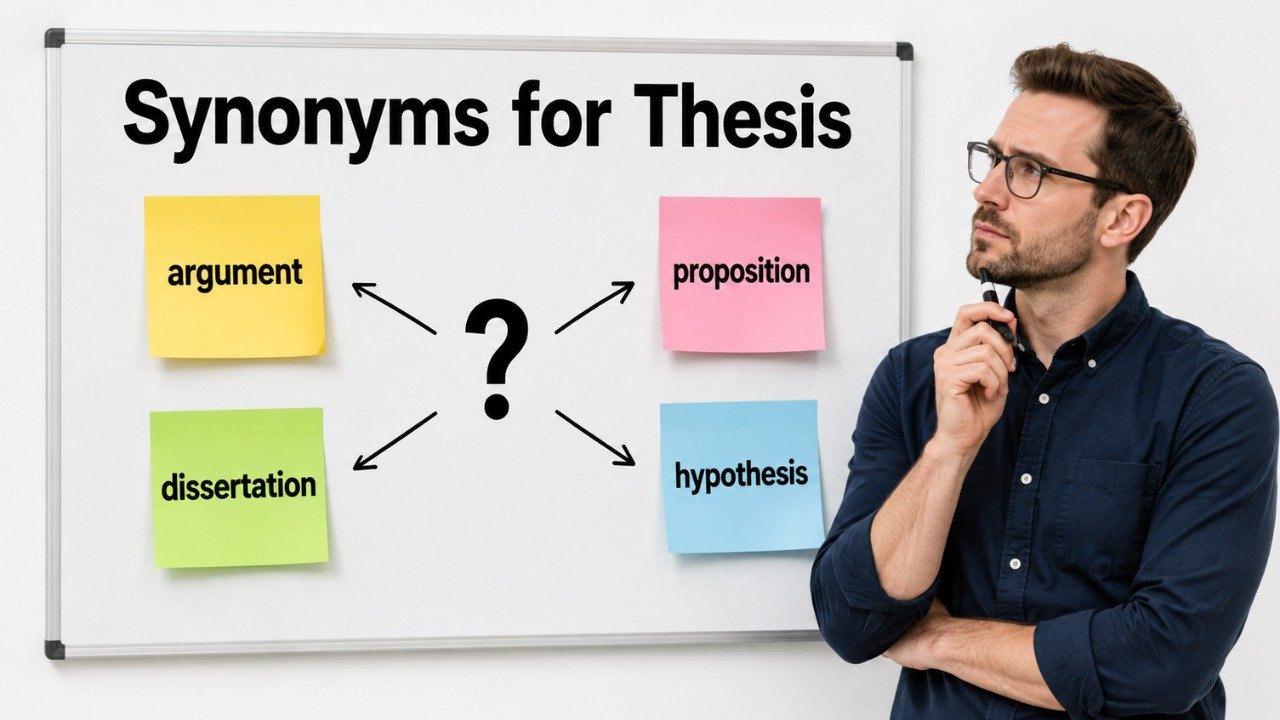
Quick Answer: The best synonyms for thesis include dissertation, argument, proposition, claim, hypothesis, theory, premise, research paper, central idea, and scholarly work. Use dissertation for a formal academic document, argument for the main point developed in an essay, proposition for a statement presented for discussion, and claim for an idea that requires support. Hypothesis works for a testable research prediction, while theory refers to a broader explanation. Research paper and scholarly work suit academic writing, and central idea is a clear option for general or conversational use.
Pronunciation and Word Details
Word: Thesis.
Pronunciation: /ˈθiː.sɪs/.
Part of Speech: Noun.
Meaning: A thesis is a central argument, proposition, or formal academic research document.
US Pronunciation:
UK Pronunciation:
What Does “Thesis” Mean?
Thesis means a central idea or argument that a writer presents, explains, and supports with evidence.
As a noun, thesis has two main meanings. The first meaning is the main claim or controlling argument of an essay, article, speech, or academic discussion.
Example: Her thesis is that access to education improves long term economic stability.
In this sentence, thesis refers to the main argument that the writer intends to prove.
The second meaning is a formal academic document based on original research. A student may write a thesis as part of a degree program.
Example: He completed a thesis on renewable energy systems.
Here, thesis refers to a substantial research document.
A thesis can also describe a proposition, interpretation, or position that someone develops through reasoning.
Example: The historian challenged the traditional thesis about the conflict.
In this context, thesis means an established explanation or point of view.
The correct synonym depends on whether thesis refers to an academic document, a central argument, a research claim, or a theoretical proposition.
Meaning, Tone, and Context of “Thesis”
Thesis has a formal, academic, analytical, and intellectual tone. It is most common in education, research, essays, reports, scholarly discussions, and structured arguments.
In academic writing, thesis often refers to the controlling argument of an essay.
Example: The introduction clearly presents the thesis of the essay.
In university contexts, thesis may refer to a long research document submitted as part of a degree.
Example: Her thesis examines the relationship between language and identity.
In formal debate, thesis can mean a proposition that is defended through logic and evidence.
Example: The speaker presented a convincing thesis about public responsibility.
In literary analysis, thesis refers to the main interpretation of a text.
Example: His thesis focuses on the role of memory in the novel.
In everyday conversation, thesis may sound too formal. Words such as main point, central idea, or argument are often more natural.
Formal: The thesis of the presentation was supported by recent findings.
Conversational: The main point of the presentation was supported by recent findings.
Thesis is generally neutral, but it can sound strong and authoritative because it suggests that an idea has been carefully developed and supported.
When and How to Use “Thesis”
For the Main Argument of an Essay
Use thesis when referring to the central claim that guides an essay or written argument.
Example: The thesis explains why urban green spaces are important for public health.
For an Academic Research Document
Use thesis when referring to a formal research project completed as part of an academic degree.
Example: She is writing her thesis on early childhood education.
For a Position That Requires Support
Use thesis when a person presents an idea that must be defended with evidence and reasoning.
Example: His thesis depends on several historical records.
For Literary Analysis
Use thesis when stating the main interpretation of a poem, novel, play, or other text.
Example: The student developed a thesis about the symbolism of the river.
For Scientific or Social Research
Use thesis when describing the central argument developed from research findings.
Example: The research supports the thesis that sleep affects concentration.
For Philosophical Discussion
Use thesis when referring to a proposition or intellectual position.
Example: The philosopher begins with a thesis about personal freedom.
For a Presentation or Speech
Use thesis when identifying the central message of a formal presentation.
Example: The thesis of her speech was that local action can create broader change.
For Comparing Competing Interpretations
Use thesis when discussing one explanation among several possible explanations.
Example: The new evidence challenges the earlier thesis about the settlement.
For a Thesis Statement
Use thesis when referring to the main claim expressed in one or two sentences near the beginning of an essay.
Example: A strong thesis gives the reader a clear sense of the writer’s position.
Best Synonyms for Thesis
Dissertation
Synonym: Dissertation means a long formal academic document based on detailed research.
Example: She completed a dissertation on language development in young children.
Argument
Synonym: Argument means a main position supported by reasons and evidence.
Example: The author develops an argument about the value of public libraries.
Proposition
Synonym: Proposition means an idea or statement presented for consideration or debate.
Example: The researcher examined the proposition that exercise improves memory.
Claim
Synonym: Claim means a statement that a writer or speaker attempts to prove.
Example: Every major claim in the essay should be supported with evidence.
Hypothesis
Synonym: Hypothesis means a testable explanation or prediction used in research.
Example: The experiment was designed to test the hypothesis.
Theory
Synonym: Theory means a structured explanation of how or why something happens.
Example: The study offers a new theory of language learning.
Premise
Synonym: Premise means a basic statement or assumption on which an argument is built.
Example: The argument begins with the premise that all citizens deserve equal treatment.
Research Paper
Synonym: Research paper means an academic document that presents investigation, evidence, and analysis.
Example: He submitted a research paper on water conservation.
Central Idea
Synonym: Central idea means the most important thought or message in a text.
Example: The central idea of the essay is personal responsibility.
Scholarly Work
Synonym: Scholarly work means a serious academic piece based on research and analysis.
Example: Her scholarly work explores changes in modern education.
50 Synonyms for Thesis with Short Meanings
- Dissertation: A long formal academic research document.
- Argument: A position supported by evidence and reasoning.
- Proposition: A statement presented for discussion or examination.
- Claim: An idea that a writer attempts to prove.
- Hypothesis: A testable prediction or proposed explanation.
- Theory: A structured explanation of facts or events.
- Premise: A basic statement supporting an argument.
- Paper: A written academic or analytical work.
- Research Paper: A document presenting research and evidence.
- Academic Paper: A formal piece of scholarly writing.
- Study: A detailed examination of a subject.
- Research Study: A systematic investigation of a question.
- Treatise: A formal and detailed written discussion.
- Monograph: A scholarly work focused on one subject.
- Essay: A structured piece presenting ideas or arguments.
- Manuscript: A written work prepared for review or publication.
- Report: A document presenting findings and analysis.
- Capstone: A major final academic project.
- Research Project: An organized investigation of a topic.
- Degree Project: A major work completed for an academic qualification.
- Scholarly Work: A serious piece of academic research or writing.
- Academic Work: Writing or research produced for educational purposes.
- Investigation: A detailed search for facts or explanations.
- Inquiry: A process of asking questions and examining evidence.
- Analysis: A detailed examination of ideas or information.
- Examination: A careful study of a subject.
- Discussion: A developed consideration of an issue.
- Exposition: A clear explanation of an idea or theory.
- Position: A particular view on a question.
- Viewpoint: A way of understanding or judging a subject.
- Contention: A strongly stated point in an argument.
- Assertion: A confident statement presented as true.
- Statement: A clear expression of an idea or position.
- Central Argument: The main claim developed in a text.
- Main Argument: The primary position supported by evidence.
- Core Claim: The essential statement a writer seeks to prove.
- Main Idea: The most important point in a piece of writing.
- Central Idea: The controlling thought of a discussion or text.
- Controlling Idea: The idea that directs and unifies a piece of writing.
- Thesis Statement: A sentence expressing the central argument.
- Proposal: An idea presented for consideration or approval.
- Postulate: A statement accepted as a basis for reasoning.
- Supposition: An idea assumed to be possible or true.
- Assumption: A belief accepted without complete proof.
- Principle: A basic idea guiding an argument or theory.
- Doctrine: A set of beliefs presented as authoritative.
- Interpretation: An explanation of the meaning of something.
- Perspective: A particular way of viewing a subject.
- Case: A set of reasons supporting a position.
- Research Claim: A statement developed and supported through research.
Read Also:
Synonyms for Exactly

Synonyms for Thesis by Context
When Thesis Means an Academic Document
When thesis refers to a formal research document, suitable alternatives include dissertation, research paper, academic paper, monograph, manuscript, capstone, degree project, and scholarly work.
Dissertation: Best for a substantial academic document based on advanced research.
Example: She defended her dissertation before an academic committee.
Research Paper: Best for a shorter academic document based on research and analysis.
Example: The student submitted a research paper on food security.
Capstone: Best for a final project that combines knowledge gained during a program.
Example: His capstone examined sustainable building design.
Monograph: Best for a detailed scholarly work focused on one narrow subject.
Example: The historian published a monograph on rural migration.
The academic requirements for a thesis or dissertation may vary. Writers should follow the terminology used by their program.
When Thesis Means a Central Argument
When thesis means the main point of an essay or discussion, useful synonyms include argument, central argument, main argument, core claim, central idea, main idea, and controlling idea.
Argument: Best when the central point is supported by reasons and evidence.
Example: The writer’s argument is that public transport benefits the entire community.
Core Claim: Best when identifying the essential statement a writer wants readers to accept.
Example: The core claim appears in the final sentence of the introduction.
Central Idea: Best for general explanations, summaries, and classroom discussions.
Example: The central idea of the passage is the importance of patience.
Controlling Idea: Best when discussing the idea that organizes an entire paragraph or essay.
Example: Every section should connect to the controlling idea.
When Thesis Means a Proposition
When thesis refers to an intellectual statement presented for debate, choose proposition, contention, assertion, position, postulate, or claim.
Proposition: Best for a formal idea submitted for consideration.
Example: The philosopher begins with a proposition about human nature.
Contention: Best for a strongly defended position, especially in a debate.
Example: Her central contention is that the policy creates unnecessary barriers.
Assertion: Best for a confident statement that may require further proof.
Example: The author’s assertion is supported by several examples.
Position: Best for a person’s established view on an issue.
Example: The article explains the writer’s position on educational reform.
When Thesis Means a Research Explanation
When thesis refers to an explanation developed through investigation, useful alternatives include hypothesis, theory, research claim, interpretation, analysis, and conclusion.
Hypothesis: Best for a prediction or explanation that can be tested.
Example: The researchers tested the hypothesis through controlled observation.
Theory: Best for a broader explanation supported by a body of evidence.
Example: The findings contribute to a theory of social development.
Research Claim: Best for a statement supported by collected information.
Example: The research claim is based on interviews and survey results.
Interpretation: Best when explaining the meaning of evidence, events, or literature.
Example: Her interpretation of the poem focuses on isolation.
When Thesis Means a Detailed Study
When thesis emphasizes the process of examining a subject, choose study, investigation, inquiry, analysis, examination, or research project.
Study: Best for a structured examination of a subject.
Example: The study explores the effects of noise on concentration.
Investigation: Best for a careful search for causes, facts, or explanations.
Example: The investigation revealed several weaknesses in the process.
Analysis: Best for breaking a subject into parts and examining their relationships.
Example: The analysis compares three approaches to language instruction.
Inquiry: Best for an open process of questioning and discovery.
Example: The inquiry focuses on how communities respond to environmental change.
Another Word for Thesis
The best general replacement for thesis is argument when the word refers to the main point of an essay, article, speech, or discussion.
When thesis refers to a formal academic document, dissertation is often the closest alternative. However, research paper, study, proposition, claim, and central idea may be better in other contexts.
Original: The thesis of the essay is clearly stated.
Better Option: The central argument of the essay is clearly stated.
Original: She is completing a thesis on workplace communication.
Better Option: She is completing a dissertation on workplace communication.
Original: The evidence supports his thesis.
Better Option: The evidence supports his claim.
Original: I did not understand the thesis of the presentation.
Better Option: I did not understand the central idea of the presentation.
When Not to Use “Thesis”
When the Context Is Casual
Thesis may sound too formal in an ordinary conversation. Main point or central idea may sound more natural.
Weak: What was the thesis of his story?
Better: What was the main point of his story?
When Referring Only to a Topic
A topic is the subject of a piece of writing. A thesis is the specific position taken about that subject.
Weak: My thesis is climate change.
Better: My topic is climate change, and my thesis is that local planning can reduce its effects.
When Referring to an Untested Prediction
Hypothesis is usually more accurate for a scientific prediction that will be tested.
Weak: The experiment tests the thesis that light affects plant growth.
Better: The experiment tests the hypothesis that light affects plant growth.
When Referring to a Short Assignment
Calling a brief class response a thesis may exaggerate its scope. Essay, paper, or assignment may be clearer.
Weak: I wrote a two paragraph thesis about the poem.
Better: I wrote a two paragraph analysis of the poem.
When the Main Claim Is Missing
Do not use thesis when a text merely introduces a subject without presenting a position.
Weak: The thesis is that this essay discusses school uniforms.
Better: The thesis is that school uniforms can reduce visible economic differences among students.
When Academic Terminology Varies
Thesis and dissertation may describe different types of academic work in different programs. Use the official term required by the relevant department or institution.
Weak: Every advanced research document is called a thesis.
Better: The program describes the final research document as a dissertation.
When Repetition Weakens the Paragraph
Repeated use of thesis can make academic writing sound mechanical.
Weak: The thesis presents a thesis that supports the researcher’s thesis.
Better: The paper presents a central argument that supports the researcher’s position.
Words Commonly Confused With Thesis
Thesis vs Dissertation: Both words can refer to formal academic research documents. Dissertation often suggests a longer and more advanced research project, but the exact distinction varies among academic programs.
Thesis vs Hypothesis: A thesis is a central argument or completed academic document. A hypothesis is a testable prediction or proposed explanation used in research.
Thesis vs Theory: A thesis is a particular position that a writer defends. A theory is a broader explanation intended to account for patterns, facts, or events.
Thesis vs Topic: A topic is the general subject of a piece of writing. A thesis states the writer’s specific position about that subject.
Thesis vs Thesis Statement: A thesis is the overall argument. A thesis statement is the sentence or group of sentences that expresses that argument.
Thesis vs Argument: Thesis and argument are close in essay writing. Thesis refers to the central claim, while argument can include the claim, reasons, evidence, and reasoning used to support it.
Thesis vs Claim: A thesis is usually the main claim of a complete text. A claim may be any statement within the text that requires support.
Thesis vs Premise: A thesis is the conclusion or position being defended. A premise is one of the foundational statements used to support that position.
Thesis vs Research Question: A research question asks what the study will investigate. A thesis provides an answer or position developed from that investigation.
Thesis vs Conclusion: A thesis presents the main position, often near the beginning. A conclusion summarizes what the discussion has established.
Which Synonym Should You Choose?
Choose dissertation when referring to a substantial academic research document.
Choose argument when referring to the main position developed throughout an essay, article, speech, or debate.
Choose central idea when explaining the main message in simple, conversational, or classroom language.
Choose claim when referring to a statement that must be supported with evidence.
Choose proposition when presenting a formal idea for discussion or debate.
Choose hypothesis when describing a testable prediction in scientific or social research.
Choose theory when discussing a broad explanation supported by a body of knowledge.
Choose premise when identifying a foundational assumption within an argument.
Choose research paper when referring to a shorter academic document that presents evidence and analysis.
Choose scholarly work when describing formal academic writing in a broad sense.
Choose interpretation when presenting an explanation of a poem, story, event, or set of findings.
Choose position when explaining a person’s view on a debated issue.
Choose contention when the writer strongly defends a disputed point.
Choose analysis when the work mainly examines parts, patterns, meanings, or relationships.
Choose report when the document primarily presents findings, observations, and conclusions.
Choose main point in casual speech when thesis would sound unnecessarily formal.
Real Life Examples of “Thesis” in Sentences
Original: The thesis of the essay appears in the introduction.
Better Option: The central argument of the essay appears in the introduction.
Original: She is writing a thesis about rural education.
Better Option: She is writing a dissertation about rural education.
Original: His thesis is supported by historical documents.
Better Option: His claim is supported by historical documents.
Original: The professor asked the student to revise the thesis.
Better Option: The professor asked the student to revise the thesis statement.
Original: The article presents a surprising thesis.
Better Option: The article presents a surprising proposition.
Original: The research did not support the original thesis.
Better Option: The research did not support the original hypothesis.
Original: Her thesis about the novel focuses on social isolation.
Better Option: Her interpretation of the novel focuses on social isolation.
Original: The presentation lacked a clear thesis.
Better Option: The presentation lacked a clear central idea.
Original: The writer develops the thesis through several examples.
Better Option: The writer develops the argument through several examples.
Original: His thesis challenges the traditional explanation.
Better Option: His position challenges the traditional explanation.
Synonym Groups and Usage Differences
Academic Document Group
Dissertation, research paper, academic paper, monograph, manuscript, capstone, degree project, and scholarly work belong to the academic document group.
These terms refer to completed pieces of formal writing. Dissertation often suggests extensive research. Research paper is broader and may describe a shorter assignment. Monograph refers to a detailed scholarly work on one focused subject.
Example: Her dissertation presents original research on community health.
Argument Group
Argument, central argument, main argument, core claim, contention, case, and position belong to the argument group.
These words describe a viewpoint supported by reasons. Argument is the most flexible choice. Contention sounds stronger and is useful when the point is disputed. Case refers to the complete set of reasons supporting a position.
Example: The author builds a strong case for improving public transport.
Main Idea Group
Central idea, main idea, controlling idea, statement, and thesis statement belong to the main idea group.
These alternatives focus on the message that organizes a text. Central idea works well in general explanations. Controlling idea is common when discussing paragraph and essay structure.
Example: Every paragraph should support the controlling idea.
Research Group
Study, research study, investigation, inquiry, analysis, examination, and research project belong to the research group.
These words emphasize the process of collecting, examining, and interpreting information. Study is broad, while investigation often focuses on discovering causes or facts.
Example: The investigation examined why the program had produced different results.
Proposition Group
Proposition, claim, assertion, postulate, supposition, assumption, and premise belong to the proposition group.
These words describe statements used in reasoning. A claim requires support. A premise helps support a conclusion. An assumption is accepted without complete proof, while a postulate is accepted as a starting point within a system of thought.
Example: The argument depends on the premise that the data is accurate.
Explanation Group
Theory, hypothesis, interpretation, perspective, exposition, and analysis belong to the explanation group.
These terms describe different ways of understanding information. A hypothesis is testable. A theory is broader. An interpretation explains meaning, while a perspective shows a particular point of view.
Example: The researcher offered a new interpretation of the findings.
Antonyms of Thesis
Thesis does not have one perfect antonym because it can refer to an argument, document, proposition, or established position. However, several words express contrasting ideas.
Antithesis: A directly opposing idea or proposition.
Counterargument: An argument presented against another position.
Rebuttal: A response intended to disprove a claim.
Refutation: Evidence or reasoning that shows a claim is false.
Denial: A statement that rejects a claim.
Objection: A reason for disagreeing with a position.
Contradiction: A statement that conflicts with another statement.
Question: An inquiry rather than a developed answer or position.
Uncertainty: A lack of a settled or clearly supported conclusion.
Doubt: A feeling that a claim may not be true.
Disproof: Evidence showing that an idea is incorrect.
Rejection: A refusal to accept a proposition.
Topic: A general subject without a specific argument.
Fragment: An incomplete part rather than a developed academic work.
Digression: Material that moves away from the central argument.
Comparison of Thesis and Related Words
Thesis vs Dissertation
Thesis and dissertation can both describe formal academic research documents. Dissertation often suggests a more extensive project containing original research, while thesis may describe a shorter research work or the central argument within it. The exact academic use varies.
Example With Thesis: Her thesis examines communication among remote teams.
Example With Dissertation: His dissertation presents an original model of language acquisition.
Thesis vs Argument
A thesis is the main claim that guides a text. An argument includes the thesis along with the reasons, evidence, and reasoning used to support it.
Example With Thesis: The thesis states that public parks improve community wellbeing.
Example With Argument: The argument supports this position with health data and community surveys.
Thesis vs Hypothesis
A thesis is a position or conclusion that a writer develops. A hypothesis is a prediction or explanation that researchers can test.
Example With Thesis: Her thesis is that flexible schedules improve employee satisfaction.
Example With Hypothesis: Her hypothesis predicts that flexible schedules will reduce employee turnover.
Thesis vs Theory
A thesis is a specific claim presented in one piece of work. A theory is a broader explanation that may connect many observations and studies.
Example With Thesis: The thesis argues that early feedback improves writing performance.
Example With Theory: The theory explains how feedback influences learning and motivation.
Thesis vs Claim
A thesis is usually the main claim of an entire essay or research document. A claim may be a smaller supporting point within that work.
Example With Thesis: The thesis argues that cities should expand cycling routes.
Example With Claim: One supporting claim is that cycling routes reduce traffic congestion.
Thesis vs Premise
A thesis is the position a writer wants to establish. A premise is a statement used as a foundation for reaching that position.
Example With Thesis: The thesis is that every student should have access to digital learning tools.
Example With Premise: One premise is that digital access has become essential for completing modern coursework.
Thesis vs Topic
A topic names the general subject. A thesis expresses a focused judgment or position about that subject.
Example With Thesis: School gardens improve student understanding of nutrition.
Example With Topic: The topic of the essay is school gardens.
Thesis vs Thesis Statement
Thesis refers to the complete central argument. Thesis statement refers to the sentence that clearly expresses that argument.
Example With Thesis: The thesis is developed throughout the entire essay.
Example With Thesis Statement: The thesis statement appears at the end of the introduction.
Thesis vs Central Idea
Thesis usually suggests an arguable position requiring support. Central idea is broader and can refer to the main message of informative or narrative writing.
Example With Thesis: The thesis argues that public art strengthens community identity.
Example With Central Idea: The central idea of the story is that honesty requires courage.
Common Phrases and Expressions With “Thesis”
Thesis Statement: A sentence expressing the main argument of a text.
Thesis Topic: The subject selected for academic research.
Thesis Proposal: A document explaining the planned research question, method, and purpose.
Thesis Defense: A formal presentation in which a student explains and answers questions about the research.
Thesis Adviser: A person who guides a student during the research and writing process.
Thesis Committee: A group that reviews and evaluates an academic thesis.
Thesis Chapter: A major section of a research document.
Thesis Argument: The central position developed through research and analysis.
Thesis Research: The investigation completed for an academic thesis.
Thesis Conclusion: The final section that summarizes findings and explains their significance.
Common Mistakes to Avoid
Confusing a Topic With a Thesis
A topic only identifies the subject. A thesis expresses a specific position about that subject.
Incorrect: My thesis is online education.
Better: My thesis is that well designed online education can improve access for working students.
Writing a Thesis That Is Too Broad
A thesis should be focused enough to support within the available space.
Weak: Technology changes society.
Better: Mobile learning tools can improve vocabulary practice by giving students frequent opportunities for review.
Writing a Statement That Is Only a Fact
A strong thesis usually presents an interpretation, position, or conclusion rather than an obvious fact.
Weak: Many schools use computers.
Better: Schools should combine computer based learning with guided classroom discussion.
Confusing Thesis With Hypothesis
Use hypothesis for a prediction that will be tested. Use thesis for the argument developed from reasoning or research.
Incorrect: The laboratory tested the thesis that temperature affects the reaction.
Better: The laboratory tested the hypothesis that temperature affects the reaction.
Using Thesis and Dissertation Without Checking Context
Academic terminology is not identical in every program. Follow the official wording used for the relevant degree.
Unclear: Every graduate student must write a dissertation.
Better: Students should check whether their program requires a thesis, dissertation, or capstone project.
Forgetting the Correct Plural
The plural of thesis is theses, not thesises.
Incorrect: The library contains several thesises on the subject.
Better: The library contains several theses on the subject.
Mispronouncing the Plural
Thesis and theses have different endings.
Singular: Thesis is pronounced /ˈθiː.sɪs/.
Plural: Theses is pronounced /ˈθiː.siːz/.
Making the Thesis Vague
Avoid broad wording that does not reveal the writer’s position.
Weak: This essay discusses exercise.
Better: Regular moderate exercise can improve concentration, sleep quality, and emotional wellbeing.
Adding Several Unrelated Claims
A thesis should present one unified position rather than a collection of disconnected ideas.
Weak: Public parks are attractive, transport is expensive, and schools need more books.
Better: Investment in shared public spaces can improve health, social connection, and neighborhood safety.
Failing to Support the Thesis
Every major section should contribute evidence, explanation, or reasoning that supports the central argument.
Weak: The essay states a thesis but never returns to it.
Better: Each paragraph develops one reason supporting the main argument.
Repeating Thesis Unnecessarily
Use central argument, claim, position, main idea, or research document when repetition becomes distracting.
Repetitive: The thesis explains the thesis through evidence that supports the thesis.
Better: The paper develops its central argument through relevant evidence.
Using an Unnatural Synonym
Not every synonym works in every sentence. Dissertation cannot replace thesis when thesis means a short statement in an essay.
Incorrect: The introduction ends with a clear dissertation.
Better: The introduction ends with a clear thesis statement.
Conclusion
The most useful synonyms for thesis include dissertation, argument, proposition, claim, hypothesis, theory, premise, research paper, and central idea. Choose dissertation for a formal academic document, argument or core claim for the main position in an essay, hypothesis for a testable prediction, and theory for a broader explanation. Central idea works well in simple explanations, while proposition and contention suit formal debate. Understanding these differences helps you use synonyms for thesis accurately in academic writing, research, reports, essays, and everyday discussion.
FAQs About Synonyms for Thesis
What Is the Best Synonym for Thesis?
Argument is the best general synonym when thesis means the central claim of an essay. Dissertation is better when thesis refers to a formal academic document.
Is Dissertation Another Word for Thesis?
Yes, dissertation can be a close alternative when referring to an academic research document. However, the official distinction varies among academic programs.
What Is Another Word for Thesis Statement?
Central claim, main argument, controlling idea, core position, and central assertion are useful alternatives to thesis statement.
Can Hypothesis Replace Thesis?
Hypothesis can replace thesis only when referring to a testable prediction or proposed explanation. It does not normally describe the main argument of an essay.
What Is the Difference Between a Thesis and a Topic?
A topic is the broad subject of a text. A thesis is the specific position or conclusion the writer presents about that subject.
What Is the Plural of Thesis?
The plural of thesis is theses. Thesis is singular, while theses refers to two or more academic arguments or documents.
What Is the Opposite of Thesis?
Antithesis is the closest direct opposite. Counterargument, rebuttal, contradiction, and refutation may also oppose a thesis in an argument.
