
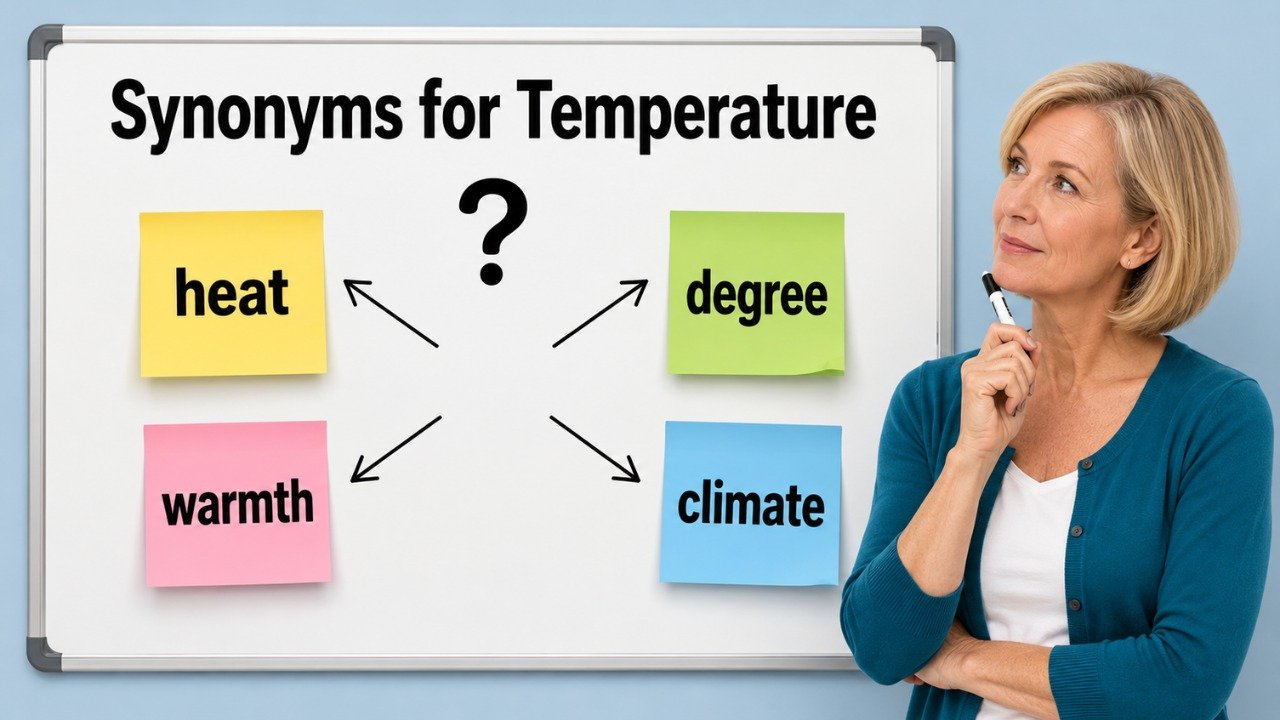
Quick Answer: The best synonyms for temperature include heat, warmth, coldness, thermal level, heat level, degree, reading, body heat, fever, and climate. Use heat or warmth in casual descriptions of how hot something feels. Use thermal level, temperature reading, or degree in scientific and technical writing. Body heat and fever work in health related contexts, while climate is useful when temperature refers figuratively to the general mood or condition of a situation. The most accurate choice always depends on what is being measured or described.
Pronunciation and Word Details
Word: Temperature.
Pronunciation: /ˈtem.prə.tʃər/
Part of Speech: Noun.
Meaning: The measured degree of how hot or cold a person, object, substance, or environment is.
US Pronunciation:
UK Pronunciation:
What Does “Temperature” Mean?
Temperature means the measured degree of hotness or coldness in a person, object, substance, or environment. It is a noun commonly used in science, weather, health, cooking, engineering, and everyday conversation.
In scientific contexts, temperature describes the thermal condition of matter.
Example: The temperature of the liquid increased during the experiment.
In weather discussions, it describes how hot or cold the surrounding air is.
Example: The temperature dropped during the evening.
In health related language, temperature may refer to a person’s body temperature.
Example: The nurse checked the patient’s temperature.
In cooking, temperature identifies the amount of heat required to prepare or store food correctly.
Example: Check the oven temperature before placing the dish inside.
The word can also be used figuratively. In this sense, it describes the emotional, social, or political intensity of a situation.
Example: The temperature of the debate rose after the announcement.
Temperature can refer to a precise numerical measurement or to a general impression of heat, warmth, coolness, or coldness.
Meaning, Tone, and Context of “Temperature”
Temperature is normally a neutral and precise word. Its tone changes slightly according to the context in which it appears.
Scientific Tone: Temperature is formal, objective, and technical when used in physics, chemistry, biology, engineering, and environmental studies.
Weather Context: It is neutral and common when discussing daily conditions, forecasts, seasonal changes, or climate patterns.
Health Context: The word is factual and clinical when referring to body temperature or signs of fever.
Cooking Context: It is practical and instructional when describing oven settings, storage conditions, or safe preparation.
Technical Context: Temperature is used in reports, manuals, experiments, equipment instructions, and performance measurements.
Conversational Context: People use temperature naturally when asking whether a place is hot, cold, warm, or comfortable.
Figurative Context: The word may sound dramatic when it describes tension, excitement, anger, or public feeling.
Temperature is generally more precise than words such as heat, warmth, or coldness because it can refer to an actual measurement.
When and How to Use “Temperature”
For Weather Conditions
Use temperature when describing how hot or cold the outdoor air is.
Example: The temperature fell sharply after sunset.
For Scientific Measurement
Use temperature when discussing a measurable physical property of matter.
Example: The scientist recorded the temperature of each sample.
For Body Health
Use temperature when referring to the measured warmth of the human body.
Example: Her temperature was checked before the examination.
For Cooking Instructions
Use temperature when describing the required heat for preparing, serving, or storing food.
Example: Keep the oven at the recommended temperature.
For Indoor Comfort
Use temperature when discussing heating, cooling, ventilation, or personal comfort.
Example: The room temperature felt comfortable during the meeting.
For Equipment Performance
Use temperature when describing the operating condition of a machine, device, or system.
Example: The engine temperature remained within the normal range.
For Environmental Conditions
Use temperature when discussing air, soil, water, or surface conditions.
Example: Water temperature affects many natural processes.
For Figurative Intensity
Use temperature figuratively to describe the emotional intensity of a discussion or situation.
Example: The temperature of the conversation increased as the disagreement continued.
Best Synonyms for Temperature
1. Heat
Synonym: The condition or sensation of being hot.
Example: The heat inside the building became uncomfortable.
2. Warmth
Synonym: A comfortable or moderate degree of heat.
Example: The warmth of the room made everyone feel relaxed.
3. Coldness
Synonym: The condition or quality of having a low temperature.
Example: The coldness of the water surprised the swimmers.
4. Thermal Level
Synonym: The measured degree of heat within a substance, object, or system.
Example: The thermal level of the equipment was carefully monitored.
5. Heat Level
Synonym: The amount or intensity of heat present.
Example: Reduce the heat level before adding the remaining ingredients.
6. Degree
Synonym: A unit or level used to express temperature.
Example: The reading increased by several degrees.
7. Reading
Synonym: A measured value shown by an instrument.
Example: The latest reading showed that the room was becoming warmer.
8. Body Heat
Synonym: The natural warmth produced by a person or animal.
Example: The blanket helped preserve body heat.
9. Fever
Synonym: An unusually high body temperature associated with illness.
Example: The child developed a mild fever during the night.
10. Climate
Synonym: The general pattern of environmental conditions in a place or the emotional character of a situation.
Example: The region has a warm and humid climate.
50 Synonyms for Temperature with Short Meanings
- Heat: The condition or sensation of being hot.
- Warmth: A comfortable or moderate amount of heat.
- Cold: A condition of low temperature.
- Coldness: The quality of being cold.
- Chill: A noticeable feeling of coldness.
- Thermal Level: The measured level of heat in something.
- Heat Level: The amount or intensity of heat present.
- Warmth Level: The degree of comfortable heat.
- Cold Level: The degree of coldness present.
- Temperature Level: A particular point on a temperature scale.
- Thermal State: The condition of an object in relation to heat.
- Thermal Condition: The current heat related condition of something.
- Degree: A unit or level used to express temperature.
- Degree of Heat: A specific measure of hotness.
- Degree of Cold: A specific measure of coldness.
- Reading: A value shown by a measuring instrument.
- Temperature Reading: A measured temperature value.
- Thermometer Reading: The value displayed by a thermometer.
- Thermal Reading: A measured value related to heat.
- Measured Temperature: The recorded degree of hotness or coldness.
- Thermal Measurement: A numerical measurement of heat conditions.
- Heat Measurement: A recorded indication of heat intensity.
- Body Temperature: The measured thermal condition of the body.
- Body Heat: The natural warmth produced by the body.
- Core Temperature: The temperature of the body’s internal organs.
- Skin Temperature: The measured warmth of the skin.
- Fever: An abnormally high body temperature.
- Fever Level: The measured severity of an elevated body temperature.
- Ambient Temperature: The temperature of the surrounding environment.
- Surrounding Temperature: The degree of heat in the nearby area.
- Environmental Temperature: The temperature within a natural or controlled environment.
- Room Temperature: The normal temperature inside an indoor space.
- Air Temperature: The measured hotness or coldness of the air.
- Atmospheric Temperature: The temperature of the surrounding atmosphere.
- Outdoor Temperature: The measured temperature outside a building.
- Indoor Temperature: The measured temperature inside a building.
- Surface Temperature: The temperature measured on an outer surface.
- Ground Temperature: The measured temperature at ground level.
- Soil Temperature: The degree of warmth or coldness within soil.
- Water Temperature: The measured warmth or coldness of water.
- Liquid Temperature: The thermal condition of a liquid.
- Cooking Temperature: The heat level required during food preparation.
- Oven Temperature: The amount of heat maintained inside an oven.
- Serving Temperature: The temperature at which food or drink is served.
- Storage Temperature: The thermal condition required for storage.
- Operating Temperature: The temperature at which equipment functions.
- Working Temperature: The heat level present while a system is operating.
- System Temperature: The measured thermal condition of a complete system.
- Engine Temperature: The heat level produced within an engine.
- Climate: The general pattern of temperature and other environmental conditions.
Read Also:
Synonyms for Vampire

Synonyms for Temperature by Context
When Temperature Means Heat
When temperature refers generally to hotness, useful alternatives include heat, heat level, degree of heat, and warmth.
Heat: The most natural casual replacement when discussing uncomfortable or intense hotness.
Example: The heat inside the kitchen became difficult to tolerate.
Heat Level: A practical choice when the intensity can be adjusted.
Example: Lower the heat level before stirring the sauce.
Degree of Heat: A more formal phrase for the measured amount of hotness.
Example: The degree of heat affected the material’s structure.
Warmth: Best for pleasant or moderate heat.
Example: The warmth of the sunlight filled the room.
When Temperature Means Coldness
When temperature refers to a low thermal condition, useful alternatives include cold, coldness, chill, and degree of cold.
Cold: A common word for a condition of low temperature.
Example: The cold entered through the open window.
Coldness: Emphasizes the quality of being cold.
Example: The coldness of the metal made it uncomfortable to touch.
Chill: Describes noticeable or slightly uncomfortable coldness.
Example: A chill remained in the air throughout the morning.
Degree of Cold: A formal phrase used when comparing levels of coldness.
Example: The degree of cold increased overnight.
When Temperature Means a Scientific Measurement
Useful alternatives include thermal measurement, thermal reading, temperature reading, measured temperature, and thermal state.
Thermal Measurement: Best for scientific reports and experiments.
Example: Each thermal measurement was entered into the results table.
Thermal Reading: Suitable when an instrument produces the value.
Example: The thermal reading remained stable for several minutes.
Temperature Reading: A clear and direct alternative in reports.
Example: The temperature reading was recorded at regular intervals.
Measured Temperature: Emphasizes that the result was obtained through observation or equipment.
Example: The measured temperature differed slightly from the expected value.
Thermal State: Describes the overall heat related condition of a substance.
Example: The thermal state of the sample changed during the process.
When Temperature Refers to Weather
Useful alternatives include air temperature, atmospheric temperature, outdoor temperature, heat, cold, and climate.
Air Temperature: Best when referring specifically to the surrounding air.
Example: The air temperature rose during the afternoon.
Atmospheric Temperature: More technical and suitable for scientific weather discussions.
Example: Atmospheric temperature changes with altitude.
Outdoor Temperature: A practical phrase for everyday reports.
Example: The outdoor temperature was lower than expected.
Heat: Useful when the weather is noticeably hot.
Example: The afternoon heat kept many people indoors.
Cold: Useful when weather conditions are noticeably cold.
Example: The early morning cold lasted until sunrise.
Climate: Refers to long term environmental patterns rather than one temporary reading.
Example: The area has a generally mild climate.
When Temperature Refers to the Human Body
Useful alternatives include body temperature, body heat, core temperature, skin temperature, fever, and fever level.
Body Temperature: The most accurate general phrase for a person’s measured temperature.
Example: The patient’s body temperature was checked again.
Body Heat: Refers to warmth naturally produced by the body.
Example: Several layers helped the hikers retain body heat.
Core Temperature: Refers to the internal temperature of the body.
Example: The medical team monitored the runner’s core temperature.
Skin Temperature: Refers specifically to warmth measured at the skin.
Example: Skin temperature can change with the surrounding environment.
Fever: Use only when the body temperature is unusually high.
Example: He stayed home because he had a fever.
When Temperature Refers to Cooking
Useful alternatives include cooking temperature, oven temperature, heat level, serving temperature, and storage temperature.
Cooking Temperature: Describes the heat required to prepare food.
Example: The cooking temperature must remain consistent.
Oven Temperature: Refers specifically to the heat inside an oven.
Example: Check the oven temperature before baking.
Heat Level: Works well for a stove or adjustable cooking surface.
Example: Keep the heat level low while the mixture thickens.
Serving Temperature: Refers to how warm or cold food should be when served.
Example: The soup reached a comfortable serving temperature.
Storage Temperature: Refers to the conditions required to keep food properly stored.
Example: The package should remain at the recommended storage temperature.
When Temperature Refers to Equipment
Useful alternatives include operating temperature, working temperature, system temperature, engine temperature, and thermal condition.
Operating Temperature: The normal temperature at which equipment functions.
Example: The machine remained within its safe operating temperature.
Working Temperature: Describes the temperature during active use.
Example: The material becomes flexible at its working temperature.
System Temperature: Refers to the heat condition of a complete technical system.
Example: The system temperature increased during heavy use.
Engine Temperature: Refers specifically to heat within an engine.
Example: The driver noticed that the engine temperature was rising.
Thermal Condition: A broad technical term for the heat related state of equipment.
Example: The technician inspected the thermal condition of the device.
When Temperature Describes a Mood or Situation
In figurative writing, useful alternatives include climate, atmosphere, mood, intensity, and tension. These are not physical measurements, but they express the social or emotional meaning of temperature.
Climate: Describes the general emotional or social condition.
Example: The political climate became more uncertain.
Atmosphere: Describes the feeling surrounding a place or event.
Example: The atmosphere in the room became tense.
Mood: Refers to the emotional character of a group or situation.
Example: The mood changed after the announcement.
Intensity: Emphasizes the strength of emotion or disagreement.
Example: The intensity of the debate increased rapidly.
Tension: Best when the figurative temperature suggests conflict or pressure.
Example: Tension grew between the two groups.
Another Word for Temperature
The best single replacement for temperature is often heat, but the most accurate alternative depends on context. Heat works well when the sentence describes hotness, while reading is better for a measured value. Body temperature is clearer in health contexts, and climate works when temperature is used figuratively.
Original: The temperature in the kitchen became uncomfortable.
Better Option: The heat in the kitchen became uncomfortable.
Original: The technician recorded the temperature.
Better Option: The technician recorded the thermal reading.
Original: The doctor checked her temperature.
Better Option: The doctor checked her body temperature.
Original: The temperature of the discussion began to rise.
Better Option: The intensity of the discussion began to rise.
When Not to Use “Temperature”
Temperature is useful and precise, but it may sound repetitive, unclear, or less natural in some sentences.
When You Mean Heat as a Physical Sensation
Use heat or warmth when you are describing what someone feels rather than a measured value.
Weak: I could feel the temperature from the fire.
Better: I could feel the heat from the fire.
When You Mean Comfortable Warmth
Temperature sounds overly technical when the sentence focuses on comfort or pleasant warmth.
Weak: The temperature of the blanket felt relaxing.
Better: The warmth of the blanket felt relaxing.
When You Mean a Specific Instrument Result
Use reading or thermal reading when discussing the value shown by a measuring device.
Weak: The temperature on the instrument changed suddenly.
Better: The reading on the instrument changed suddenly.
When You Mean General Weather
Temperature refers only to hotness or coldness. It does not include rain, wind, humidity, clouds, or other weather conditions.
Weak: The temperature was rainy and windy.
Better: The weather was rainy and windy.
When You Mean Long Term Conditions
Use climate when discussing typical environmental patterns over a long period.
Weak: The region has a dry temperature throughout the year.
Better: The region has a dry climate throughout the year.
When You Mean an Elevated Body Temperature
Use fever when the sentence specifically describes an unusually high body temperature caused by illness.
Weak: She developed a temperature during the night.
Better: She developed a fever during the night.
When Repetition Makes the Writing Awkward
Vary the wording with reading, heat level, air temperature, thermal condition, or another precise term.
Weak: The temperature increased, and the temperature remained high until the temperature was adjusted.
Better: The temperature increased, and the heat level remained high until the setting was adjusted.
When the Meaning Is Figurative
Use intensity, mood, atmosphere, climate, or tension when a direct figurative term sounds clearer.
Weak: The temperature of public opinion changed quickly.
Better: The mood of public opinion changed quickly.
Words Commonly Confused With Temperature
Temperature vs Heat: Temperature measures how hot or cold something is. Heat is thermal energy transferred between objects or the general sensation of hotness.
Temperature vs Warmth: Temperature may be high, low, or neutral. Warmth specifically suggests moderate or pleasant heat.
Temperature vs Weather: Temperature is one part of weather. Weather also includes wind, rain, humidity, clouds, and other atmospheric conditions.
Temperature vs Climate: Temperature may describe a condition at one moment. Climate describes typical environmental patterns over a long period.
Temperature vs Fever: Temperature is any measurement of body heat. Fever refers specifically to an unusually high body temperature associated with illness.
Temperature vs Degree: Temperature is the measured condition. A degree is a unit used to express that measurement.
Temperature vs Reading: Temperature is the physical property being measured. A reading is the numerical value shown by an instrument.
Temperature vs Thermal Energy: Temperature describes the average thermal condition of matter. Thermal energy refers to the total internal energy connected with particle movement.
Temperature vs Humidity: Temperature measures hotness or coldness. Humidity measures the amount of moisture in the air.
Temperature vs Heat Index: Temperature is the measured air temperature. Heat index describes how hot conditions may feel when temperature and humidity are considered together.
Which Synonym Should You Choose?
Choose heat when describing strong hotness or an uncomfortable feeling of warmth.
Choose warmth when describing pleasant, moderate, or comforting heat.
Choose coldness when emphasizing a low temperature or the quality of being cold.
Choose chill when describing a noticeable feeling of cold in the air or body.
Choose thermal level for technical writing about systems, materials, or equipment.
Choose thermal measurement when presenting scientific data or experimental results.
Choose reading when referring to the value displayed by an instrument.
Choose temperature reading when clarity is important in reports, instructions, or records.
Choose degree when referring to a unit or a change on a temperature scale.
Choose air temperature when writing about the weather in a precise way.
Choose atmospheric temperature for formal scientific discussion of the atmosphere.
Choose outdoor temperature for everyday conversations, notices, or reports.
Choose room temperature when discussing normal indoor conditions.
Choose body temperature in health reports, medical communication, or general health discussions.
Choose body heat when describing warmth naturally produced or retained by the body.
Choose fever only when referring to an unusually high body temperature linked with illness.
Choose cooking temperature for recipes and food preparation instructions.
Choose oven temperature when the sentence specifically refers to heat inside an oven.
Choose operating temperature for machinery, equipment, devices, or technical systems.
Choose climate when describing long term environmental conditions.
Choose atmosphere, mood, intensity, or tension when temperature is used figuratively.
Real Life Examples of “Temperature” in Sentences
Example One
Original: The temperature outside increased during the afternoon.
Better Option: The outdoor temperature increased during the afternoon.
Example Two
Original: The temperature from the fire warmed the room.
Better Option: The heat from the fire warmed the room.
Example Three
Original: The nurse recorded the patient’s temperature.
Better Option: The nurse recorded the patient’s body temperature.
Example Four
Original: The temperature shown on the instrument remained stable.
Better Option: The thermal reading shown on the instrument remained stable.
Example Five
Original: The temperature of the water felt pleasant.
Better Option: The warmth of the water felt pleasant.
Example Six
Original: The temperature in the air became uncomfortable.
Better Option: The heat in the air became uncomfortable.
Example Seven
Original: The temperature of the oven was too low.
Better Option: The oven temperature was too low.
Example Eight
Original: The temperature of the machine increased during operation.
Better Option: The operating temperature of the machine increased during use.
Example Nine
Original: The temperature of the meeting rose after the disagreement.
Better Option: The tension in the meeting rose after the disagreement.
Example Ten
Original: The region has a warm temperature for much of the year.
Better Option: The region has a warm climate for much of the year.
Synonym Groups and Usage Differences
Heat and Warmth Group
This group includes heat, warmth, heat level, warmth level, and degree of heat. These words describe high or moderate temperature conditions.
Heat often suggests intensity or discomfort. Warmth usually suggests comfort. Heat level is practical when the amount of heat can be adjusted.
Example: The warmth of the room made the guests comfortable.
Cold and Chill Group
This group includes cold, coldness, chill, cold level, and degree of cold. These words describe low temperature conditions.
Cold is the most general term. Coldness describes the quality of being cold. Chill often suggests a noticeable or uncomfortable feeling.
Example: A slight chill remained in the morning air.
Measurement Group
This group includes reading, temperature reading, thermometer reading, thermal reading, thermal measurement, and measured temperature.
These terms are useful when a device, instrument, experiment, or report produces a numerical value.
Example: The technician entered each thermal reading into the report.
Scientific Condition Group
This group includes thermal state, thermal condition, thermal level, temperature level, and degree.
These alternatives work well in formal, scientific, and technical writing.
Example: The thermal state of the material changed during heating.
Body Condition Group
This group includes body temperature, body heat, core temperature, skin temperature, fever, and fever level.
Body temperature is the broadest health related term. Body heat describes natural warmth. Fever refers specifically to an elevated body temperature.
Example: The nurse continued to monitor the patient’s body temperature.
Weather Group
This group includes air temperature, atmospheric temperature, outdoor temperature, heat, cold, and climate.
Air temperature is precise for daily weather. Atmospheric temperature is more technical. Climate refers to long term patterns rather than a single day.
Example: The air temperature dropped shortly after sunset.
Indoor Environment Group
This group includes room temperature, indoor temperature, ambient temperature, environmental temperature, and surrounding temperature.
These phrases describe the thermal conditions around a person, object, experiment, or system.
Example: The samples were kept at room temperature.
Cooking and Storage Group
This group includes cooking temperature, oven temperature, serving temperature, storage temperature, and heat level.
These terms are practical and specific. They should be chosen according to the stage of food preparation or storage.
Example: Keep the dish at the recommended serving temperature.
Equipment Group
This group includes operating temperature, working temperature, system temperature, engine temperature, and thermal condition.
These phrases describe how much heat is present while machinery or equipment is functioning.
Example: The engine temperature remained within the expected range.
Figurative Group
This group includes climate, atmosphere, mood, intensity, and tension. These are contextual alternatives when temperature refers to emotions, public opinion, or social conditions.
Example: The emotional climate of the discussion changed quickly.
Antonyms of Temperature
Temperature itself does not have one exact antonym because it is a measurement. The opposite depends on whether the sentence refers to heat, coldness, stability, or emotional intensity.
Coldness: The opposite of heat or a high temperature.
Coolness: A mild or comfortable absence of warmth.
Chill: A low and noticeable degree of temperature.
Freezing Cold: An extremely low temperature condition.
Heat: The opposite of coldness or a low temperature.
Warmth: The opposite of severe cold.
High Temperature: The opposite of a low temperature.
Low Temperature: The opposite of a high temperature.
Temperature Stability: The absence of significant thermal change.
Temperature Fluctuation: Repeated movement between higher and lower temperatures.
Normal Body Temperature: A body condition that contrasts with fever.
Neutrality: The opposite of emotional heat or heightened intensity.
Calmness: The opposite of a tense or heated emotional atmosphere.
Comparison: Temperature vs Related Words
Temperature vs Heat
Temperature is a measurement of how hot or cold something is. Heat is energy transferred because of a temperature difference or the sensation of hotness.
Example With Temperature: The temperature of the water reached the required level.
Example With Heat: The heat from the stove warmed the water.
Temperature vs Warmth
Temperature can describe hot, cold, or neutral conditions. Warmth refers specifically to a moderate or pleasant amount of heat.
Example With Temperature: The room temperature changed during the afternoon.
Example With Warmth: The warmth of the room felt comforting.
Temperature vs Coldness
Temperature is a neutral measurement. Coldness describes the quality or sensation of having a low temperature.
Example With Temperature: The temperature of the water was measured.
Example With Coldness: The coldness of the water made swimming difficult.
Temperature vs Degree
Temperature is the condition being measured. Degree is a unit or amount used to express the measurement.
Example With Temperature: The temperature increased during the experiment.
Example With Degree: The reading rose by one degree.
Temperature vs Reading
Temperature is the physical property. Reading is the value produced by an instrument.
Example With Temperature: The temperature of the solution changed.
Example With Reading: The latest reading confirmed the change.
Temperature vs Weather
Temperature describes hotness or coldness. Weather includes temperature, wind, rain, clouds, humidity, and other atmospheric conditions.
Example With Temperature: The temperature fell during the night.
Example With Weather: The weather became cold, windy, and rainy.
Temperature vs Climate
Temperature can describe current or temporary conditions. Climate refers to typical environmental patterns over a long period.
Example With Temperature: Today’s temperature is lower than yesterday’s.
Example With Climate: The region has a cool coastal climate.
Temperature vs Fever
Temperature can be normal, high, or low. Fever means that body temperature is unusually high because of illness or another physical response.
Example With Temperature: The nurse checked his temperature.
Example With Fever: He stayed home because he had a fever.
Temperature vs Thermal Energy
Temperature describes the average thermal condition of a substance. Thermal energy refers to the total energy associated with the movement and interaction of particles.
Example With Temperature: The small cup had a high temperature.
Example With Thermal Energy: The larger container held more thermal energy.
Temperature vs Humidity
Temperature measures hotness or coldness. Humidity measures moisture in the air.
Example With Temperature: The temperature increased in the afternoon.
Example With Humidity: High humidity made the air feel uncomfortable.
Common Phrases and Expressions With Temperature
Room Temperature: The normal or comfortable temperature inside a room.
Body Temperature: The measured thermal condition of the human body.
High Temperature: A temperature above the normal, expected, or desired level.
Low Temperature: A temperature below the normal, expected, or desired level.
Average Temperature: The mean temperature calculated from several readings.
Ambient Temperature: The temperature of the surrounding environment.
Temperature Reading: A numerical value produced by a measuring instrument.
Temperature Range: The distance between the lowest and highest temperatures.
Temperature Control: The process of maintaining or adjusting a desired temperature.
Temperature Change: An increase or decrease in thermal level.
Common Mistakes to Avoid
Treating Heat and Temperature as Identical
Heat and temperature are related, but they do not always mean the same thing. Temperature measures hotness or coldness, while heat can describe energy transfer or a sensation.
Incorrect: The thermometer measured the heat of the room.
Better: The thermometer measured the temperature of the room.
Using Climate for a Temporary Reading
Climate describes long term environmental patterns. Use temperature for a current measurement.
Incorrect: The climate reached a high point this afternoon.
Better: The temperature reached a high point this afternoon.
Using Temperature for All Weather Conditions
Temperature cannot describe rain, wind, clouds, or humidity.
Incorrect: The temperature was stormy and wet.
Better: The weather was stormy and wet.
Using Fever as a General Synonym
Fever applies only to an unusually high body temperature. It should not replace temperature in neutral situations.
Incorrect: The nurse checked his fever and found it normal.
Better: The nurse checked his temperature and found it normal.
Using Warmth for Cold Conditions
Warmth always suggests some degree of heat. It cannot describe a low temperature.
Incorrect: The warmth of the ice was below freezing.
Better: The temperature of the ice was below freezing.
Confusing Degree With Temperature
Degree is a unit or amount, while temperature is the measured condition.
Incorrect: The degree outside is rising.
Better: The temperature outside is rising.
Choosing an Overly Technical Alternative
Words such as thermal state and thermal measurement may sound unnatural in casual conversation.
Unnatural: The thermal state outside feels pleasant today.
Natural: The temperature outside feels pleasant today.
Using a Vague Synonym in Reports
Scientific and technical writing requires precise terms. Heat or warmth may be too general when an exact measurement is available.
Vague: The warmth of the machine increased.
Precise: The operating temperature of the machine increased.
Repeating Temperature Too Often
Repeated use can make a paragraph sound mechanical. Replace some instances with reading, heat level, air temperature, thermal condition, or another accurate alternative.
Repetitive: The temperature rose, but the temperature remained below the temperature limit.
Improved: The temperature rose, but the reading remained below the permitted limit.
Using Figurative Temperature Without Clear Meaning
A figurative use may sound confusing when a direct emotional word would be clearer.
Unclear: The temperature of the office changed after the meeting.
Clearer: The mood of the office changed after the meeting.
Conclusion
The best synonyms for temperature depend on whether you are describing heat, coldness, measurement, weather, body health, cooking, or equipment. Heat and warmth work well in everyday language, while thermal level, reading, and thermal measurement are better for scientific or technical writing. Use body temperature or fever in health contexts, air temperature for weather, and operating temperature for machines. Choosing among these synonyms for temperature helps make descriptions more accurate, natural, and appropriate for each situation.
FAQs About Synonyms for Temperature
What Is the Best Synonym for Temperature?
Heat is the most common general alternative, but reading, thermal level, warmth, or coldness may be more accurate in specific contexts.
Is Heat an Exact Synonym for Temperature?
No. Heat describes thermal energy or the sensation of hotness, while temperature measures how hot or cold something is.
What Is a Scientific Synonym for Temperature?
Thermal level, thermal state, thermal condition, thermal reading, and thermal measurement are useful scientific alternatives.
What Is Another Word for Body Temperature?
Body heat, core temperature, skin temperature, and body temperature reading are useful alternatives, depending on what is being measured.
What Is Another Word for High Temperature?
Heat, intense heat, high heat level, elevated temperature, and fever can work. Fever should only be used for an unusually high body temperature.
Can Climate Replace Temperature?
Climate can replace temperature only when discussing general or long term environmental conditions. It cannot replace a specific temperature reading.
What Is a Figurative Synonym for Temperature?
Climate, atmosphere, mood, intensity, and tension can replace temperature when it describes the emotional or social condition of a situation.
