
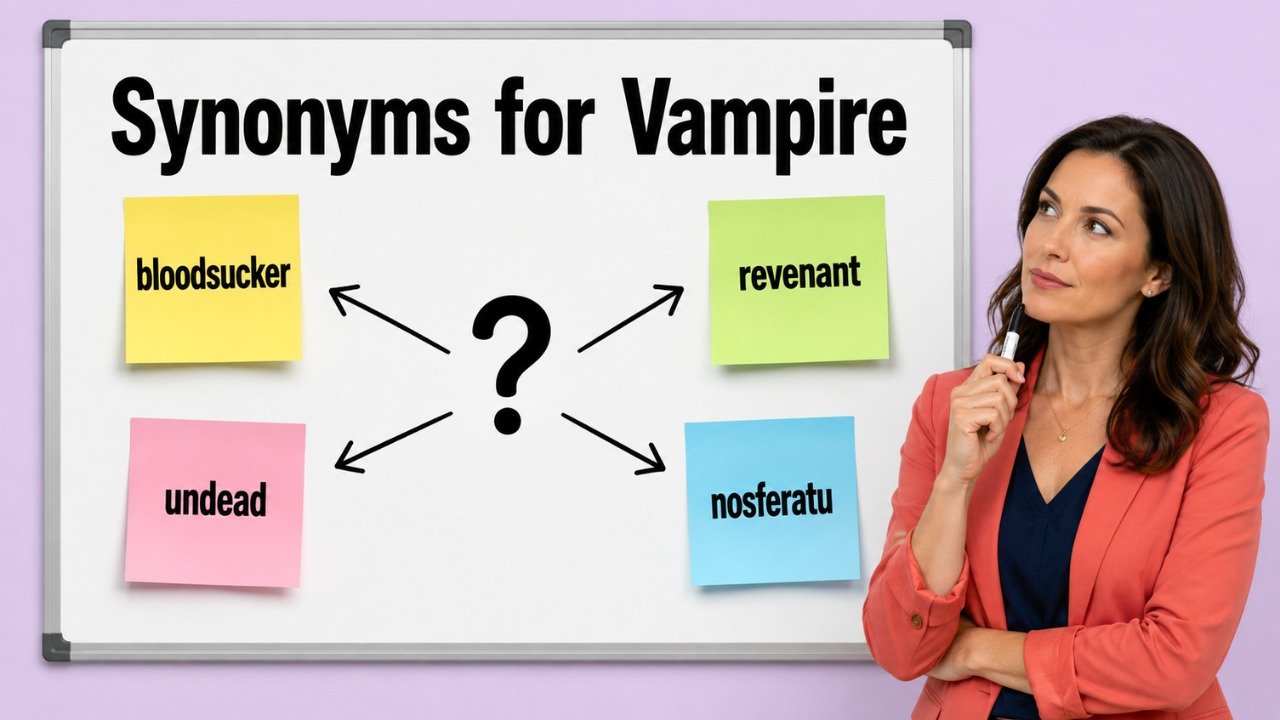
Quick Answer: The best synonyms for vampire include bloodsucker, blood drinker, nosferatu, strigoi, revenant, undead creature, night stalker, fanged predator, blood fiend, and creature of the night. Use bloodsucker or blood drinker for a direct description, nosferatu for Gothic fiction, strigoi for Romanian folklore, and revenant for a being that returns from the dead. Night stalker and fanged predator suit dramatic descriptions, while leech or emotional vampire can describe an exploitative person metaphorically.
Pronunciation and Word Details
Word: Vampire.
Pronunciation: /ˈvæmpaɪər/
Part of Speech: Noun.
Meaning: A mythical or fictional being that feeds on blood or drains life from living creatures.
US Pronunciation:
UK Pronunciation:
What Does “Vampire” Mean?
A vampire is a mythical or fictional creature believed to feed on the blood or life force of living beings. The word is primarily used as a noun.
In traditional stories, a vampire is often described as an undead being that rises at night, attacks living people, and possesses supernatural abilities. Common fictional characteristics include sharp fangs, unusual strength, immortality, and an aversion to daylight.
The word can also be used metaphorically. A person who constantly takes another person’s time, energy, money, or emotional support may be called an emotional vampire or energy vampire.
In descriptive writing, vampire may refer directly to a supernatural character or more generally to a blood feeding monster, nocturnal predator, or undead creature.
Meaning, Tone, and Context of “Vampire”
Vampire has a dark, dramatic, and supernatural tone when used literally. It commonly appears in horror stories, fantasy writing, folklore discussions, legends, games, and descriptions of fictional characters.
In academic or historical writing, vampire is generally neutral. A writer may use the term when discussing traditional beliefs, cultural legends, supernatural literature, or the development of horror fiction.
In everyday conversation, vampire can sound humorous, critical, or insulting when applied to a person. Calling someone an energy vampire suggests that being around that person feels mentally or emotionally exhausting.
Bloodsucker and leech are stronger and more negative metaphorical alternatives. They usually describe a person who selfishly benefits from others.
Some alternatives, such as strigoi, nosferatu, and revenant, carry specific cultural or literary meanings. They should be chosen carefully because they are not interchangeable in every sentence.
When and How to Use “Vampire”
For Supernatural Creatures: Use vampire when describing a fictional or mythical being that survives by consuming blood or life energy.
Example: The villagers believed that a vampire lived beneath the abandoned castle.
For Horror Writing: Use vampire when creating a threatening, mysterious, or immortal character.
Example: The vampire waited silently in the shadows until nightfall.
For Folklore Discussions: Use vampire as a broad term for blood drinking or life draining beings found in traditional legends.
Example: The lesson examined how vampire legends differ across cultures.
For Character Descriptions: Use vampire when a character has fangs, supernatural powers, immortality, or a need for blood.
Example: The mysterious stranger was eventually revealed to be a vampire.
For Metaphorical Exploitation: Use vampire to describe someone who continually drains another person’s energy, attention, or resources.
Example: His demanding behavior made him seem like an emotional vampire.
For Dramatic Emphasis: Use vampire when you want a vivid image of a secretive, dangerous, or predatory figure.
Example: The corrupt landlord was described as a vampire feeding on the hardship of others.
Best Synonyms for Vampire
Bloodsucker
Synonym: A creature that consumes blood or a selfish person who exploits others.
Example: The terrified traveler believed a bloodsucker was following him through the forest.
Blood Drinker
Synonym: A direct descriptive term for a being that drinks blood.
Example: The legend described a blood drinker that appeared only after sunset.
Nosferatu
Synonym: A literary and Gothic term for a vampire or undead blood feeding creature.
Example: The pale figure resembled a nosferatu from an ancient tale.
Strigoi
Synonym: A supernatural being from Romanian folklore that may return from death and harm the living.
Example: The villagers feared that the restless spirit had become a strigoi.
Revenant
Synonym: A person or creature believed to have returned from the dead.
Example: The revenant rose from its grave and wandered through the village.
Undead Creature
Synonym: A supernatural being that is dead but continues to move or exist.
Example: The hero discovered an undead creature hiding inside the crypt.
Night Stalker
Synonym: A threatening being that hunts or moves secretly at night.
Example: The night stalker followed its victim through the empty streets.
Fanged Predator
Synonym: A dangerous hunter identified by its sharp teeth.
Example: The fanged predator emerged from the darkness without making a sound.
Blood Fiend
Synonym: A frightening supernatural creature driven by a desire for blood.
Example: The story follows a blood fiend trapped beneath an old mansion.
Creature of the Night
Synonym: A mysterious or supernatural being associated with darkness.
Example: The creature of the night disappeared before the sun rose.
50 Synonyms for Vampire with Short Meanings
- Bloodsucker: A creature that consumes blood or an exploitative person.
- Blood Drinker: A being that survives by drinking blood.
- Nosferatu: A Gothic or literary name for a vampire.
- Strigoi: A Romanian supernatural being associated with the restless dead.
- Upir: A traditional Slavic term connected with vampire legends.
- Upyr: A spelling variation of a Slavic vampire term.
- Vrykolakas: A revenant from Greek folklore with vampire like qualities.
- Revenant: A dead person or creature believed to have returned.
- Moroi: A spirit or vampire like being in Romanian folklore.
- Mullo: An undead being found in Romani folklore.
- Nachzehrer: A corpse like revenant from Germanic folklore.
- Penanggalan: A supernatural blood feeding being from Southeast Asian folklore.
- Manananggal: A frightening night creature from Philippine folklore.
- Jiangshi: A reanimated corpse in Chinese folklore that drains life energy.
- Aswang: A broad Philippine term for a dangerous supernatural creature.
- Baobhan Sith: A supernatural female being from Scottish folklore associated with blood.
- Lamia: A mythical female creature sometimes portrayed as a blood drinking predator.
- Vetala: A spirit from South Asian folklore associated with dead bodies.
- Undead: A dead being that continues to exist or move.
- Undead Creature: A supernatural creature that exists after death.
- Undead Being: A person or entity that has returned from death.
- Immortal Monster: A monstrous being that does not age or die naturally.
- Dark Immortal: A supernatural figure with endless life and sinister qualities.
- Cursed Immortal: A being forced to live forever because of a curse.
- Night Creature: A being that becomes active after dark.
- Creature of the Night: A mysterious or dangerous nocturnal being.
- Nocturnal Predator: A hunter that searches for victims at night.
- Night Stalker: A threatening figure that secretly hunts after sunset.
- Night Prowler: A being that moves secretly through dark places.
- Blood Hunter: A creature that searches for blood or living victims.
- Fanged Predator: A dangerous hunter with long, sharp teeth.
- Fanged Fiend: A frightening supernatural creature with fangs.
- Blood Fiend: A monstrous being obsessed with consuming blood.
- Blood Demon: A demonic creature associated with blood.
- Night Demon: A supernatural threat believed to appear at night.
- Nocturnal Fiend: A cruel or frightening creature active after dark.
- Gothic Monster: A dark supernatural creature found in Gothic stories.
- Supernatural Monster: A dangerous being with powers beyond nature.
- Blood Feeding Creature: A being that obtains nourishment from blood.
- Vampiric Creature: A creature possessing qualities associated with vampires.
- Living Corpse: A dead body that continues to move or function.
- Walking Corpse: A reanimated dead body that can move among the living.
- Grave Revenant: A dead being believed to return from its grave.
- Supernatural Parasite: A being that survives by draining another creature.
- Life Drainer: A creature that removes life force from its victims.
- Soul Drainer: A fictional being that consumes spiritual energy.
- Energy Vampire: A person believed to exhaust the energy of others.
- Emotional Vampire: A person who repeatedly drains emotional attention and support.
- Exploiter: A person who selfishly takes advantage of others.
- Leech: An insulting metaphor for a person who continually takes from others.
Read Also:
Synonyms for Cooperation

Synonyms for Vampire by Context
When Vampire Means a Blood Drinking Creature
The clearest alternatives are bloodsucker, blood drinker, blood feeding creature, blood fiend, and blood hunter. These terms emphasize the creature’s need or desire for blood.
Bloodsucker: This is direct, familiar, and slightly harsh.
Example: The hunter searched the cave for the bloodsucker.
Blood Drinker: This is descriptive and suitable for fantasy or folklore writing.
Example: The blood drinker could sense a living heartbeat from across the room.
Blood Fiend: This has a dramatic and frightening tone.
Example: The villagers sealed the blood fiend inside the underground chamber.
When Vampire Means an Undead Being
Useful alternatives include revenant, undead creature, living corpse, grave revenant, strigoi, and nosferatu. These words focus on death, resurrection, or an unnatural continued existence.
Revenant: Use this for a person or creature that returns after death.
Example: The old tale describes a revenant seeking revenge on the living.
Undead Creature: Use this broad term when the exact type of monster is unknown.
Example: An undead creature guarded the entrance to the tomb.
Strigoi: Use this in a Romanian folklore context.
Example: The frightened family believed the dead man had returned as a strigoi.
When Vampire Means a Night Predator
Night stalker, night prowler, nocturnal predator, fanged predator, and creature of the night are useful descriptive alternatives.
Night Stalker: This emphasizes secret movement and hunting.
Example: The night stalker watched from the roof above the street.
Nocturnal Predator: This sounds more formal and descriptive.
Example: The creature was portrayed as a nocturnal predator with supernatural senses.
Fanged Predator: This draws attention to the creature’s teeth and hunting behavior.
Example: The fanged predator moved swiftly toward its victim.
When Vampire Means an Exploitative Person
Energy vampire, emotional vampire, exploiter, leech, and bloodsucker can describe someone who continually takes energy, money, attention, or support from others.
Energy Vampire: Use this for someone whose behavior leaves others feeling mentally exhausted.
Example: Constant complaints made him seem like an energy vampire.
Exploiter: Use this in formal writing when describing someone who takes unfair advantage of others.
Example: The dishonest official was an exploiter who benefited from public hardship.
Leech: Use this only in strongly critical or informal contexts.
Example: His former partner called him a leech because he refused to support himself.
Another Word for Vampire
Bloodsucker is often the best general replacement for vampire because it can describe both a literal blood feeding creature and a person who exploits others. However, the most accurate alternative depends on context.
Use nosferatu for Gothic fiction, revenant for a being returned from death, strigoi for Romanian folklore, and energy vampire for a draining person.
Original: A vampire followed the travelers through the forest.
Better Option: A bloodsucker followed the travelers through the forest.
Original: The vampire returned from the grave before midnight.
Better Option: The revenant returned from the grave before midnight.
Original: The novel describes a pale vampire living beneath the castle.
Better Option: The novel describes a pale nosferatu living beneath the castle.
Original: Her constant demands made her seem like a vampire.
Better Option: Her constant demands made her seem like an emotional vampire.
When Not to Use “Vampire”
Avoid vampire when a more culturally specific term is required. If you are discussing a particular traditional legend, use the correct name for the supernatural being rather than applying vampire to every blood drinking or undead creature.
Do not use vampire as a literal description of an ordinary bat. A vampire bat is a real animal, while a supernatural vampire is a mythical or fictional being.
The word may also sound overly dramatic in formal writing about exploitation. Exploiter, manipulator, or parasite may communicate the meaning more clearly.
Avoid calling a real person a vampire unless the context is clearly figurative. The expression can sound insulting, hostile, or exaggerated.
Weak: The dishonest manager was a vampire who changed the financial records.
Better: The dishonest manager was an exploiter who changed the financial records.
Weak: Every undead creature in the story is a vampire.
Better: The story includes several kinds of undead creatures.
Weak: A vampire flew from the cave and searched for insects.
Better: A bat flew from the cave and searched for insects.
Weak: The ancient spirit was definitely a vampire, although it never drank blood.
Better: The ancient spirit was a supernatural revenant.
Words Commonly Confused With Vampire
Vampire vs Vampire Bat: A vampire is a mythical or fictional blood drinking being. A vampire bat is a real animal that feeds on the blood of certain animals.
Vampire vs Zombie: A vampire is usually intelligent, supernatural, and associated with blood. A zombie is generally portrayed as a reanimated corpse with limited awareness.
Vampire vs Ghoul: A vampire commonly drinks blood or drains life. A ghoul is traditionally associated with graves, corpses, or consuming human flesh.
Vampire vs Demon: A vampire is often an undead or transformed being. A demon is usually described as an evil spirit or supernatural entity and does not necessarily drink blood.
Vampire vs Revenant: A vampire is a particular kind of supernatural predator. A revenant is any dead person or being believed to have returned, so the term is broader.
Vampire vs Cannibal: A vampire consumes blood or life force. A cannibal consumes the flesh of another member of the same species.
Vampire vs Dhampir: A vampire is a full supernatural creature. A dhampir is commonly portrayed in fiction and folklore as the child or descendant of a vampire and a human.
Vampire vs Bloodsucker: Vampire refers primarily to a supernatural being. Bloodsucker can describe a literal blood feeding creature or an exploitative person.
Which Synonym Should You Choose?
For General Writing: Choose bloodsucker when you need a familiar and direct replacement for vampire.
For Formal Folklore Writing: Choose revenant when discussing the return of the dead, or use the specific cultural name of the supernatural being.
For Gothic Fiction: Choose nosferatu, dark immortal, blood fiend, or creature of the night.
For Romanian Folklore: Choose strigoi or moroi when the traditional context supports that term.
For Horror Descriptions: Choose night stalker, fanged predator, nocturnal fiend, or grave revenant.
For Fantasy Characters: Choose blood drinker, cursed immortal, vampiric creature, or life drainer.
For Casual Conversation: Choose bloodsucker or creature of the night, depending on whether the tone is humorous or dramatic.
For Metaphorical Criticism: Choose energy vampire for a draining person, exploiter for formal criticism, and leech for a harsh informal insult.
For Essays and Reports: Choose supernatural being, undead creature, revenant, or blood feeding creature when neutral language is required.
For Character Detail: Choose fanged predator when emphasizing appearance, night stalker when emphasizing behavior, and cursed immortal when emphasizing the character’s condition.
Real Life Examples of “Vampire” in Sentences
Original: The vampire hid in the basement until the sun disappeared.
Better Option: The creature of the night hid in the basement until the sun disappeared.
Original: The villagers believed a vampire had risen from the cemetery.
Better Option: The villagers believed a revenant had risen from the cemetery.
Original: The vampire moved silently behind its victim.
Better Option: The night stalker moved silently behind its victim.
Original: A vampire guarded the entrance to the castle.
Better Option: A fanged predator guarded the entrance to the castle.
Original: The story describes a vampire that has lived for centuries.
Better Option: The story describes a cursed immortal that has lived for centuries.
Original: The vampire searched the village for fresh blood.
Better Option: The blood hunter searched the village for fresh blood.
Original: The ancient vampire appeared only after midnight.
Better Option: The ancient nosferatu appeared only after midnight.
Original: Her negative behavior made her seem like a vampire.
Better Option: Her negative behavior made her seem like an energy vampire.
Original: The corrupt leader was a vampire feeding on the wealth of the people.
Better Option: The corrupt leader was an exploiter benefiting from the wealth of the people.
Original: The vampire returned from its grave during the storm.
Better Option: The grave revenant returned during the storm.
Synonym Groups and Usage Differences
Folklore Group
This group includes strigoi, upir, upyr, vrykolakas, moroi, mullo, and nachzehrer. These terms come from different cultural traditions and should not be treated as completely identical.
Use each term only when its folklore background is relevant.
Example: The researcher compared the strigoi with other European revenant traditions.
Blood Feeding Group
This group includes bloodsucker, blood drinker, blood hunter, blood fiend, and blood feeding creature.
Bloodsucker is the most familiar. Blood drinker is neutral and descriptive. Blood fiend is dramatic and works well in horror writing.
Example: The blood drinker waited near the edge of the village.
Undead Group
This group includes revenant, undead creature, living corpse, walking corpse, and grave revenant.
These alternatives emphasize a return from death rather than blood consumption. Not every undead being is a vampire.
Example: The grave revenant wandered through the ruins in search of its former home.
Night Predator Group
This group includes night stalker, night prowler, nocturnal predator, fanged predator, and creature of the night.
These descriptions focus on hunting, darkness, secrecy, and physical danger.
Example: The nocturnal predator remained hidden until the streets became quiet.
Immortality Group
This group includes immortal monster, dark immortal, cursed immortal, and predatory immortal.
These terms work best when the character’s endless life is more important than its need for blood.
Example: The cursed immortal had watched generations rise and disappear.
Metaphorical Group
This group includes energy vampire, emotional vampire, exploiter, leech, and bloodsucker.
These words describe people who drain energy, money, support, or other resources. Energy vampire is less aggressive than leech or bloodsucker.
Example: Repeated arguments made every meeting with him feel like an encounter with an emotional vampire.
Antonyms of Vampire
The opposite of vampire changes according to whether vampire refers to an undead creature, a predator, or an exploitative person.
Mortal: A living being that will eventually die.
Living Person: A human who is alive rather than undead.
Human: An ordinary person without supernatural vampire qualities.
Donor: A person who willingly gives blood, money, time, or resources.
Giver: Someone who provides help or resources instead of taking them.
Benefactor: A person who supports or assists others.
Protector: Someone who defends people from danger.
Healer: A person or being that restores health or energy.
Nourisher: Someone who supports growth, health, or strength.
Selfless Person: Someone who puts the needs of others before personal gain.
Supporter: A person who gives encouragement, assistance, or resources.
Life Giver: A person or being associated with creating or restoring life.
Comparison: Vampire vs Related Words
Vampire vs Bloodsucker
Vampire is the standard term for a mythical or fictional being that consumes blood. Bloodsucker is more descriptive and can also insult an exploitative person.
Example With Vampire: The vampire slept beneath the ruined chapel.
Example With Bloodsucker: The bloodsucker searched the village for another victim.
Vampire vs Nosferatu
Vampire is a broad, neutral term. Nosferatu has a more Gothic, literary, and old fashioned tone.
Example With Vampire: The story introduces a vampire who hides among ordinary people.
Example With Nosferatu: The pale nosferatu waited in the darkened tower.
Vampire vs Revenant
A vampire is commonly associated with blood, fangs, and supernatural hunting. A revenant is any dead being believed to have returned.
Example With Vampire: The vampire needed blood to maintain its strength.
Example With Revenant: The revenant returned to complete an unfinished task.
Vampire vs Strigoi
Vampire is a general English term. Strigoi refers to a supernatural being associated with Romanian folklore.
Example With Vampire: The fictional vampire avoided sunlight.
Example With Strigoi: The legend warned that the restless dead could become a strigoi.
Vampire vs Zombie
Vampires are often portrayed as intelligent, fast, and capable of planning. Zombies are generally shown as reanimated bodies with limited thought.
Example With Vampire: The vampire carefully deceived the guests.
Example With Zombie: The zombie moved slowly toward the sound.
Vampire vs Ghoul
A vampire feeds on blood or life energy. A ghoul is more commonly connected with graves, corpses, and flesh.
Example With Vampire: The vampire searched for a living victim.
Example With Ghoul: The ghoul was said to haunt the cemetery.
Vampire vs Energy Vampire
Vampire usually refers to a supernatural creature. Energy vampire is a metaphor for a person whose presence or behavior leaves others exhausted.
Example With Vampire: The vampire entered the room after sunset.
Example With Energy Vampire: His constant need for attention made him an energy vampire.
Common Phrases and Expressions With “Vampire”
Vampire Fangs: Long, sharp teeth associated with vampires.
Vampire Bite: A wound caused by a vampire biting a victim.
Vampire Hunter: A character who searches for and fights vampires.
Vampire Legend: A traditional story or belief involving vampires.
Vampire Myth: A cultural belief or fictional idea about vampires.
Vampire Bat: A real bat that feeds on animal blood.
Energy Vampire: A person who leaves others feeling mentally or emotionally tired.
Emotional Vampire: A person who continually demands emotional support without giving it back.
Psychic Vampire: A fictional or spiritual term for a being that drains mental or life energy.
Modern Vampire: A contemporary version of a vampire character or legend.
Common Mistakes to Avoid
Treating Every Undead Creature as a Vampire
Vampire is one type of undead creature. Zombies, revenants, ghosts, and ghouls have different meanings.
Incorrect: Every creature that returns from death is a vampire.
Correct: A vampire is one possible type of undead creature.
Calling a Vampire Bat a Supernatural Vampire
A vampire bat is a real animal. It should not be described as an immortal or undead being.
Incorrect: The vampire bat rose from its grave at midnight.
Correct: The vampire bat left its shelter at night to search for food.
Using Cultural Terms as Perfect Synonyms
Strigoi, vrykolakas, jiangshi, and other folklore terms have distinct cultural meanings. They may share qualities with vampires, but they are not identical.
Weak: A jiangshi is simply another English word for vampire.
Better: A jiangshi is a reanimated being from Chinese folklore that shares some qualities with vampire figures.
Using “Vampire” Too Repetitively
Repeated use can make a story sound flat. Alternate it with accurate descriptions such as blood drinker, night stalker, undead creature, or fanged predator.
Repetitive: The vampire entered the room, and the vampire watched while the vampire waited.
Improved: The vampire entered the room and watched silently while the fanged predator waited for its chance.
Choosing an Overly Dramatic Synonym
Blood demon or soul drainer may be too dramatic for neutral or academic writing.
Weak: The essay examines the blood demons of European folklore.
Better: The essay examines vampire figures in European folklore.
Using Metaphorical Terms Without Context
Calling someone a vampire can be confusing unless the sentence explains what is being drained.
Vague: My coworker is a vampire.
Clear: My coworker acts like an energy vampire because every conversation becomes emotionally exhausting.
Confusing “Vampire” and “Cannibal”
A vampire consumes blood or life energy. A cannibal consumes members of its own species. The words should not be used interchangeably.
Incorrect: The cannibal drank a small amount of blood and was therefore a vampire.
Correct: Blood drinking is associated with vampires, while cannibalism involves consuming flesh from the same species.
Conclusion
The most useful synonyms for vampire depend on the meaning and setting. Bloodsucker and blood drinker work for direct descriptions, while nosferatu suits Gothic fiction. Revenant emphasizes returning from death, and strigoi belongs in Romanian folklore contexts. Night stalker and fanged predator add suspense to horror writing. For figurative language, energy vampire describes a draining person, while exploiter and leech express stronger criticism. Choosing the correct alternative makes descriptions clearer, more vivid, and culturally accurate.
FAQs About Synonyms for Vampire
What Is the Best Synonym for Vampire?
Bloodsucker is the most familiar general synonym. Blood drinker is a clearer neutral alternative, while nosferatu suits Gothic writing.
Is Nosferatu Another Word for Vampire?
Yes, nosferatu is commonly used as a literary or Gothic term for a vampire. It usually creates an old, eerie, or dramatic tone.
Is a Revenant the Same as a Vampire?
Not always. A revenant is any being believed to have returned from death, while a vampire is usually an undead predator that consumes blood or life energy.
What Is a Formal Alternative to Vampire?
Undead being, supernatural predator, blood feeding creature, and revenant are suitable formal alternatives, depending on the exact meaning.
What Is a Scary Synonym for Vampire?
Blood fiend, night stalker, fanged predator, blood demon, and nocturnal fiend create a frightening tone.
What Is a Metaphorical Synonym for Vampire?
Energy vampire, emotional vampire, exploiter, leech, and bloodsucker can describe a person who drains energy, money, time, or support.
Are Strigoi and Vampires Identical?
Not completely. Strigoi are supernatural beings from Romanian folklore. They share several qualities with vampires, but the cultural meaning is more specific.
