
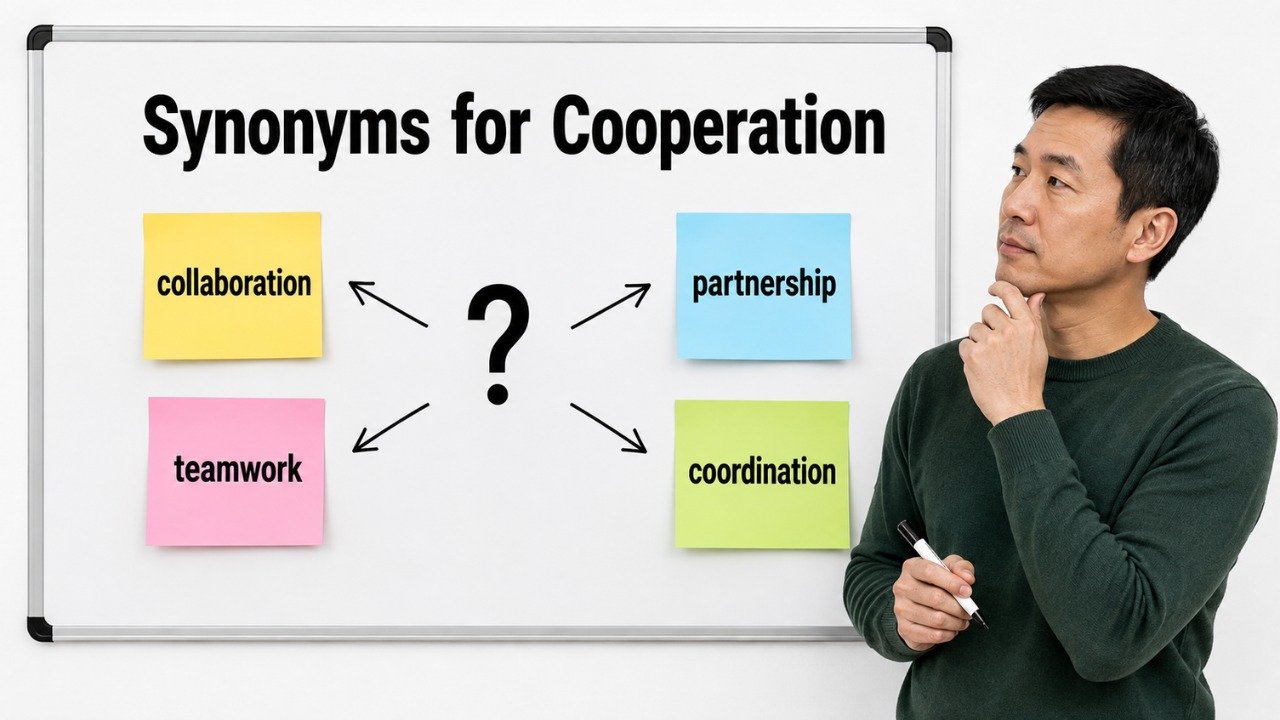
Quick Answer: The best synonyms for cooperation include collaboration, teamwork, coordination, partnership, assistance, support, unity, participation, alliance, and joint effort. Use collaboration for people creating or solving something together, teamwork for shared group performance, coordination for organized activities, and partnership for an ongoing working relationship. Assistance and support are best when one person helps another. Unity emphasizes togetherness, while participation focuses on taking part. The most suitable synonyms for cooperation depend on whether the context involves shared work, organized action, mutual help, agreement, or a formal relationship.
Pronunciation and Word Details
Word: Cooperation.
Pronunciation: /koʊˌɑː.pəˈreɪ.ʃən/
Part of Speech: Noun.
Meaning: The act of working with others toward a shared purpose or helping someone achieve a result.
US Pronunciation:
UK Pronunciation:
What Does “Cooperation” Mean?
Cooperation means working, acting, or communicating with other people to achieve a shared goal.
Cooperation is a noun. It describes a situation in which individuals, teams, groups, or organizations contribute effort, information, resources, or support for a common purpose. It often requires communication, trust, respect, willingness, and shared responsibility.
In a workplace, cooperation may involve colleagues sharing tasks and solving problems together. In education, it may describe students helping one another complete an activity. In personal relationships, cooperation can mean listening, compromising, and making decisions together.
The word also appears in formal situations. Authorities may request someone’s cooperation, meaning that they want the person to follow instructions or provide useful information. Countries, institutions, and communities may develop cooperation in areas such as education, safety, research, trade, or environmental protection.
Meaning, Tone, and Context of “Cooperation”
Cooperation usually has a positive, neutral, and respectful tone. It suggests willingness, shared effort, and constructive interaction.
Formal Tone: Cooperation is common in reports, policies, agreements, official requests, academic writing, and professional communication.
Neutral Tone: The word can describe ordinary situations without expressing strong emotion.
Positive Tone: Cooperation often implies helpfulness, respect, unity, and progress toward a common goal.
Professional Tone: In workplaces, it refers to employees, departments, or organizations working effectively together.
Academic Tone: In essays and research, cooperation may describe coordinated behavior among individuals, groups, institutions, or countries.
Conversational Tone: In everyday speech, cooperation can mean helping, working together, or being willing to do what is needed.
Instructional Tone: A teacher, manager, or official may ask for cooperation when requesting attention, compliance, patience, or assistance.
Cooperation is commonly used when discussing teamwork, communication, leadership, education, relationships, community projects, problem solving, diplomacy, agreements, and shared responsibility.
When and How to Use “Cooperation”
For Shared Work: Use cooperation when two or more people contribute toward the same task or goal.
Example: The project succeeded because of the cooperation between the design and research teams.
For Team Performance: Use cooperation when group members communicate, divide responsibilities, and support one another.
Example: Good cooperation allowed the players to respond quickly during the match.
For Mutual Help: Use cooperation when people exchange assistance or resources.
Example: The neighbors completed the cleanup through cooperation and shared effort.
For Formal Requests: Use cooperation when politely asking someone to follow instructions or provide assistance.
Example: We appreciate your cooperation during the inspection.
For Organized Action: Use cooperation when different groups coordinate their activities.
Example: Close cooperation between the departments prevented unnecessary delays.
For International Relations: Use cooperation when countries or institutions work together on shared concerns.
Example: Regional cooperation improved access to educational resources.
For Problem Solving: Use cooperation when several people combine ideas to find a solution.
Example: Solving the technical issue required cooperation from every specialist.
For Relationships: Use cooperation when people listen, compromise, and make decisions together.
Example: Cooperation helped the family create a schedule that worked for everyone.
Best Synonyms for Cooperation
Collaboration: The act of working with others to create, develop, or solve something.
Example: The report was produced through collaboration between several researchers.
Teamwork: The combined effort of people working as a team.
Example: Strong teamwork helped the group finish the assignment early.
Coordination: The organized arrangement of people, tasks, or activities.
Example: Careful coordination kept every stage of the event on schedule.
Partnership: A relationship in which people or groups work together and share responsibilities.
Example: The two organizations formed a partnership to support local education.
Assistance: Help given to someone who needs support.
Example: The volunteers provided assistance to families during the emergency.
Support: Help, encouragement, or resources provided to another person or group.
Example: Her support made it easier for the new employee to adjust.
Unity: The state of being joined by a common goal, belief, or purpose.
Example: Community unity strengthened the recovery effort.
Participation: The act of taking part in an activity or process.
Example: Active participation improved the quality of the discussion.
Alliance: A relationship formed between parties for mutual benefit or a shared objective.
Example: The groups created an alliance to protect the surrounding area.
Joint Effort: Work performed by two or more people toward the same result.
Example: The successful campaign was a joint effort involving teachers, parents, and students.
50 Synonyms for Cooperation with Short Meanings
- Collaboration: Working with others to produce or achieve something.
- Teamwork: Combined effort by members of a group.
- Coordination: Organized management of people, actions, or tasks.
- Partnership: A working relationship based on shared duties or goals.
- Assistance: Help provided to a person or group.
- Support: Help, encouragement, or resources given to others.
- Unity: Togetherness based on a common purpose.
- Participation: Active involvement in an activity or process.
- Alliance: An arrangement to work together for mutual benefit.
- Joint Effort: Shared work directed toward one result.
- Team Effort: Work completed through the contribution of a group.
- Mutual Aid: Help exchanged between people or groups.
- Mutual Support: Assistance that parties provide to one another.
- Coordination of Effort: Organized sharing of tasks and responsibilities.
- Collective Action: Action taken by a group for a shared purpose.
- Combined Effort: Effort created by joining individual contributions.
- Shared Effort: Work divided or contributed by several people.
- Working Together: Cooperating to complete a task or reach a goal.
- Joint Action: Action performed by multiple parties together.
- Concerted Action: Carefully planned action taken by several parties.
- Collaboration of Effort: A process of combining ideas and work.
- Collective Work: Work completed by people acting as a group.
- Shared Responsibility: Duties accepted by more than one person.
- Mutual Understanding: Shared awareness that supports effective interaction.
- Agreement: A shared decision, opinion, or arrangement.
- Accord: Formal agreement or harmony between parties.
- Consensus: General agreement within a group.
- Harmony: Peaceful and effective interaction between people.
- Solidarity: Unity based on shared interests, values, or challenges.
- Fellowship: Friendly association based on common interests.
- Companionship: Friendly connection and support between people.
- Association: A connection formed for a shared activity or purpose.
- Coalition: A temporary union of groups pursuing a common objective.
- Union: The state of joining together for a purpose.
- Linkage: A connection that allows parties or activities to work together.
- Integration: The process of combining parts into a coordinated whole.
- Interaction: Communication or action between people or groups.
- Engagement: Active involvement in a task, relationship, or process.
- Involvement: Participation in an activity or situation.
- Contribution: Something given to support a shared result.
- Helpfulness: A willingness to provide useful assistance.
- Compliance: Willingness to follow a request, rule, or instruction.
- Accommodation: Adjustment made to help others or reach agreement.
- Compromise: Agreement reached through mutual adjustment.
- Reciprocity: Mutual exchange of help, actions, or benefits.
- Coordination Between Parties: Organized interaction among separate participants.
- Shared Commitment: Common dedication to a purpose or result.
- Community Effort: Work carried out by members of a community.
- Synergy: A result improved by people or parts working together.
- Interdependence: Mutual reliance among people, groups, or systems.
Read Also:
Synonyms for Refreshing

Synonyms for Cooperation by Context
When Cooperation Means Working Together
Collaboration, teamwork, joint effort, team effort, shared effort, collective work, and combined effort are useful when people contribute toward the same task.
Example With Cooperation: The assignment required cooperation from every student.
Example With Teamwork: The assignment required teamwork from every student.
Collaboration works especially well when people exchange ideas, knowledge, or creative input. Teamwork focuses on group performance. Joint effort emphasizes that several people contributed to the final result.
When Cooperation Means Organized Activity
Coordination, integration, joint action, concerted action, and coordination of effort describe organized cooperation.
Example With Cooperation: Cooperation between the transport teams prevented delays.
Example With Coordination: Coordination between the transport teams prevented delays.
Coordination is best when timing, responsibilities, and resources must be arranged carefully. Integration emphasizes combining separate parts into one functioning system.
When Cooperation Means Help
Assistance, support, mutual aid, mutual support, helpfulness, and contribution are suitable when one person or group helps another.
Example With Cooperation: The family thanked the community for its cooperation.
Example With Assistance: The family thanked the community for its assistance.
Assistance usually describes practical help. Support can include emotional, financial, technical, or practical help. Mutual aid emphasizes that both sides help one another.
When Cooperation Means Agreement
Agreement, accord, consensus, harmony, accommodation, and compromise are helpful when cooperation depends on accepting a shared decision.
Example With Cooperation: Cooperation among the members made the new policy possible.
Example With Consensus: Consensus among the members made the new policy possible.
Consensus means general group agreement. Accord sounds formal. Compromise means each side adjusted its position to reach an acceptable outcome.
When Cooperation Means a Formal Relationship
Partnership, alliance, association, coalition, union, and linkage describe structured relationships between people, groups, or institutions.
Example With Cooperation: The institutions developed cooperation in scientific research.
Example With Partnership: The institutions developed a partnership in scientific research.
Partnership often suggests an ongoing relationship. Alliance may be formed to pursue a particular goal. Coalition often refers to a temporary union of separate groups.
When Cooperation Means Unity
Unity, solidarity, fellowship, harmony, and shared commitment emphasize togetherness.
Example With Cooperation: Cooperation helped the residents respond to the crisis.
Example With Solidarity: Solidarity helped the residents respond to the crisis.
Unity emphasizes being joined by one purpose. Solidarity suggests strong support based on shared values, interests, or difficulties.
When Cooperation Means Following Instructions
Compliance and accommodation can replace cooperation in certain formal requests.
Example With Cooperation: Thank you for your cooperation with the safety procedures.
Example With Compliance: Thank you for your compliance with the safety procedures.
Compliance is more precise when a person follows rules or requirements. Accommodation is more suitable when someone adjusts plans or behavior to help another person.
Another Word for Cooperation
The best general replacement for cooperation is collaboration. It clearly communicates that people are working together toward a shared result. However, the best alternative depends on the context. Teamwork suits group performance, coordination suits organized activity, assistance suits practical help, and partnership suits a continuing professional relationship.
Original: Cooperation between the writers improved the final report.
Better Option: Collaboration between the writers improved the final report.
Original: The event depended on cooperation among the volunteers.
Better Option: The event depended on teamwork among the volunteers.
Original: We appreciate your cooperation during the registration process.
Better Option: We appreciate your assistance during the registration process.
Original: Cooperation between the two departments reduced delays.
Better Option: Coordination between the two departments reduced delays.
When Not to Use “Cooperation”
Cooperation is useful, but a more precise synonym may make a sentence clearer.
When Describing Creative Work: Collaboration is often more specific when people exchange ideas or create something together.
Weak: The article was written through cooperation between two editors.
Better: The article was written through collaboration between two editors.
When Describing Team Performance: Teamwork sounds more natural when members perform coordinated roles as one group.
Weak: The players showed excellent cooperation throughout the match.
Better: The players showed excellent teamwork throughout the match.
When Describing Practical Help: Assistance or support may be clearer when one party mainly helps another.
Weak: She received cooperation from a colleague while learning the new system.
Better: She received assistance from a colleague while learning the new system.
When Describing Formal Agreement: Accord or consensus may be more accurate when the sentence focuses on agreement rather than shared work.
Weak: The committee reached cooperation on the final proposal.
Better: The committee reached consensus on the final proposal.
When Describing Rule Following: Compliance is more precise when someone follows an official instruction.
Weak: Cooperation with the regulations is required.
Better: Compliance with the regulations is required.
When Describing a Long Term Relationship: Partnership may communicate an ongoing and structured relationship more clearly.
Weak: The schools established cooperation to share teaching resources.
Better: The schools established a partnership to share teaching resources.
When the Word Becomes Repetitive: Replace repeated uses with specific alternatives.
Weak: Cooperation improved the project because cooperation encouraged communication and cooperation reduced confusion.
Better: Collaboration improved the project because teamwork encouraged communication and coordination reduced confusion.
Words Commonly Confused With Cooperation
Cooperation vs Collaboration: Cooperation means working or acting together, often by sharing effort or helping. Collaboration usually involves closer interaction, shared ideas, and joint creation.
Cooperation vs Teamwork: Cooperation is a broad term for working together. Teamwork specifically describes members functioning as a coordinated team.
Cooperation vs Coordination: Cooperation focuses on willingness to work together. Coordination focuses on organizing people, tasks, timing, and resources.
Cooperation vs Partnership: Cooperation may occur briefly or informally. Partnership usually describes a continuing relationship with shared responsibilities or benefits.
Cooperation vs Assistance: Cooperation usually involves more than one party contributing toward a goal. Assistance may flow mainly from one person to another.
Cooperation vs Compliance: Cooperation suggests willing participation or help. Compliance means following a rule, request, instruction, or requirement.
Cooperation vs Compromise: Cooperation means working together. Compromise means each side changes part of its position to reach agreement.
Cooperation vs Consensus: Cooperation involves shared action. Consensus means general agreement among the members of a group.
Cooperation vs Solidarity: Cooperation focuses on shared work or helpful behavior. Solidarity emphasizes unity and support based on common values or experiences.
Which Synonym Should You Choose?
Choose collaboration when people exchange ideas, knowledge, or skills to create something together.
Choose teamwork when discussing group performance, shared duties, or members supporting one another.
Choose coordination when writing about schedules, responsibilities, resources, or organized activities.
Choose partnership when describing a formal or continuing working relationship.
Choose assistance when one person or group provides practical help to another.
Choose support when the help may be emotional, financial, technical, or practical.
Choose consensus when the main idea is general agreement within a group.
Choose compromise when both sides make adjustments to settle a disagreement.
Choose alliance when separate parties unite for a particular objective.
Choose solidarity when emphasizing unity during a challenge or in support of a shared cause.
Choose compliance when discussing rules, instructions, standards, or formal requirements.
Choose joint effort in casual or general writing when several people contribute to the same result.
For essays and reports, collaboration, coordination, partnership, collective action, and consensus are often precise choices. For emails, assistance, support, and coordination usually sound professional and polite. In casual conversation, teamwork, help, working together, and joint effort are natural alternatives.
Real Life Examples of “Cooperation” in Sentences
Original: Cooperation among the students made the group activity successful.
Better Option: Teamwork among the students made the group activity successful.
Original: The researchers completed the study through close cooperation.
Better Option: The researchers completed the study through close collaboration.
Original: Cooperation between the departments improved the schedule.
Better Option: Coordination between the departments improved the schedule.
Original: The organization requested the cooperation of local volunteers.
Better Option: The organization requested the assistance of local volunteers.
Original: Cooperation between the two communities continued for several years.
Better Option: The partnership between the two communities continued for several years.
Original: The project required cooperation from teachers and parents.
Better Option: The project required a joint effort from teachers and parents.
Original: The manager encouraged cooperation during the difficult transition.
Better Option: The manager encouraged mutual support during the difficult transition.
Original: Cooperation helped the committee agree on a solution.
Better Option: Compromise helped the committee agree on a solution.
Original: International cooperation was necessary to address the shared concern.
Better Option: International collaboration was necessary to address the shared concern.
Original: Thank you for your cooperation with the updated procedure.
Better Option: Thank you for your compliance with the updated procedure.
Synonym Groups and Usage Differences
Shared Work Group
Collaboration, teamwork, joint effort, combined effort, shared effort, and collective work describe people contributing to the same goal.
Collaboration emphasizes exchanging ideas and creating together. Teamwork emphasizes coordinated group performance. Joint effort is broad and works well in everyday language.
Example: The new learning materials were created through collaboration among several teachers.
Organization Group
Coordination, integration, concerted action, joint action, and coordination of effort describe planned or organized cooperation.
These words are useful when timing, responsibilities, communication, and resources must be managed carefully.
Example: Careful coordination allowed all deliveries to arrive in the correct order.
Help Group
Assistance, support, mutual aid, mutual support, helpfulness, and contribution focus on giving help.
Assistance often refers to practical help. Support has a wider meaning and may include advice, encouragement, money, knowledge, or resources.
Example: Technical assistance helped the staff use the new equipment correctly.
Agreement Group
Agreement, accord, consensus, harmony, compromise, and accommodation describe cooperation based on shared decisions or peaceful relations.
Consensus means broad group agreement. Compromise involves adjustment by both sides. Harmony emphasizes a peaceful and productive relationship.
Example: The discussion ended in consensus about the main priorities.
Relationship Group
Partnership, alliance, association, coalition, union, and linkage describe connections formed for a shared purpose.
Partnership suggests ongoing cooperation. Alliance emphasizes shared interests. Coalition often involves separate groups temporarily joining around one objective.
Example: The institutions formed a partnership to improve professional training.
Unity Group
Unity, solidarity, fellowship, community effort, and shared commitment express togetherness and common purpose.
Unity is broad. Solidarity is stronger and often appears when people support one another during difficulty or conflict.
Example: Community solidarity helped residents rebuild damaged public spaces.
Participation Group
Participation, involvement, engagement, interaction, and contribution emphasize taking part.
Participation simply means joining an activity. Engagement suggests active attention and meaningful involvement.
Example: Student engagement made the discussion more thoughtful and productive.
Antonyms of Cooperation
The opposite of cooperation may involve refusal, conflict, separation, resistance, or unwillingness to help.
Conflict: Serious disagreement or opposition between people or groups.
Competition: An attempt to succeed against others rather than work with them.
Opposition: Resistance to an idea, action, or group.
Resistance: Refusal to accept, support, or follow something.
Obstruction: Behavior that blocks progress or prevents action.
Interference: Involvement that disrupts another person’s work or plans.
Disagreement: A lack of shared opinion or decision.
Division: Separation caused by different goals, views, or interests.
Disunity: A lack of agreement or togetherness.
Isolation: Separation from other people or groups.
Noncompliance: Failure or refusal to follow a rule or request.
Refusal: An unwillingness to participate, help, or agree.
Rivalry: Ongoing competition between individuals or groups.
Hostility: Unfriendly or aggressive behavior toward others.
Independence: Acting without relying on or coordinating with others.
Comparison: Cooperation vs Related Words
Cooperation vs Collaboration
Cooperation is the broad act of working together or helping one another. Collaboration usually involves closer interaction, shared ideas, and joint responsibility for creating a result.
Example With Cooperation: The departments showed cooperation by sharing important information.
Example With Collaboration: The departments collaborated to design a new training program.
Cooperation vs Teamwork
Cooperation can occur between individuals, teams, organizations, or countries. Teamwork usually refers to people performing connected roles within a group.
Example With Cooperation: Cooperation between the two teams prevented confusion.
Example With Teamwork: Strong teamwork helped the players carry out their strategy.
Cooperation vs Coordination
Cooperation emphasizes willingness and shared effort. Coordination emphasizes planning, timing, and organization.
Example With Cooperation: The volunteers showed cooperation throughout the event.
Example With Coordination: Careful coordination ensured that every volunteer knew where to go.
Cooperation vs Partnership
Cooperation can be temporary, informal, or limited to one task. Partnership usually suggests a more structured and continuing relationship.
Example With Cooperation: The schools cooperated during the educational event.
Example With Partnership: The schools formed a partnership to share resources throughout the year.
Cooperation vs Assistance
Cooperation often involves shared participation by all sides. Assistance focuses on help provided by one party to another.
Example With Cooperation: The investigation required cooperation from several departments.
Example With Assistance: The department provided assistance to the new staff members.
Cooperation vs Compliance
Cooperation suggests active willingness to help or work together. Compliance means following a rule, instruction, request, or standard.
Example With Cooperation: We appreciate your cooperation during the meeting.
Example With Compliance: Compliance with the safety rules is mandatory.
Cooperation vs Compromise
Cooperation involves working together toward a shared result. Compromise involves resolving disagreement through mutual adjustment.
Example With Cooperation: Cooperation allowed the group to complete the task.
Example With Compromise: Compromise allowed both sides to accept the final agreement.
Common Phrases and Expressions With Cooperation
Close Cooperation: Frequent and carefully coordinated work between parties.
Full Cooperation: Complete willingness to help, participate, or provide information.
International Cooperation: Countries or international institutions working together.
Mutual Cooperation: Two or more parties helping and supporting one another.
Continued Cooperation: Shared work or support that carries on over time.
Active Cooperation: Direct and willing participation in a shared effort.
Effective Cooperation: Shared work that produces the desired result.
Voluntary Cooperation: Help or participation provided willingly rather than through force.
Request Cooperation: To ask someone to help, participate, or follow instructions.
Thank You for Your Cooperation: A polite expression of appreciation for someone’s help or compliance.
Common Mistakes to Avoid
Repeating Cooperation Too Often: Frequent repetition can make a paragraph sound vague. Use collaboration, teamwork, coordination, support, or partnership when they express the exact meaning.
Choosing Collaboration for Simple Help: Collaboration usually suggests working closely together. Use assistance when one party mainly provides help to another.
Using Cooperation Instead of Compliance: When the sentence concerns obeying rules or meeting requirements, compliance may be more accurate.
Using Cooperation Instead of Consensus: Cooperation describes shared action, while consensus describes shared agreement.
Writing Reach Cooperation: This phrase is usually unnatural. Write reach an agreement, achieve cooperation, establish cooperation, or develop a partnership.
Writing Do Cooperation: This wording is unnatural in most contexts. Use cooperate, work together, provide assistance, or engage in collaboration.
Confusing the Noun and Verb: Cooperation is a noun, while cooperate is a verb.
Incorrect: The departments cooperation on the project.
Correct: The departments cooperated on the project.
Using a Vague Synonym: Words such as connection or relationship may not communicate actual shared work. Choose a synonym that clearly shows help, agreement, organization, or joint action.
Ignoring Context: Teamwork, compliance, compromise, and partnership are related to cooperation, but they are not interchangeable. Check whether the sentence describes group performance, rule following, negotiation, or a formal relationship.
Conclusion
The most useful synonyms for cooperation include collaboration, teamwork, coordination, partnership, assistance, support, unity, and joint effort. Collaboration is ideal for shared creative or professional work, while teamwork suits group performance. Coordination is best for organized tasks, and assistance describes practical help. Partnership expresses an ongoing relationship, while consensus and compromise relate to agreement. Choosing synonyms for cooperation according to the exact context makes essays, reports, emails, and everyday conversations clearer, more natural, and more precise.
FAQs About Synonyms for Cooperation
What Is the Best Synonym for Cooperation?
Collaboration is the best general synonym when people work closely toward a shared goal. Teamwork, coordination, and partnership may be more accurate in specific contexts.
Is Teamwork the Same as Cooperation?
They are closely related, but not identical. Teamwork refers to coordinated group performance, while cooperation broadly means working together or helping one another.
What Is a Formal Synonym for Cooperation?
Formal synonyms include collaboration, coordination, partnership, collective action, accord, and mutual assistance.
What Is Another Word for Cooperation in the Workplace?
Collaboration, teamwork, coordination, support, partnership, and joint effort are natural workplace alternatives.
Can Assistance Replace Cooperation?
Assistance can replace cooperation when the sentence focuses on help provided by one person or group. It is less suitable when all parties share equal responsibility.
What Is the Difference Between Cooperation and Collaboration?
Cooperation means working together or providing help. Collaboration usually involves closer interaction, shared ideas, and joint creation.
What Is the Opposite of Cooperation?
Common opposites include conflict, opposition, resistance, obstruction, disagreement, division, and noncompliance.
