
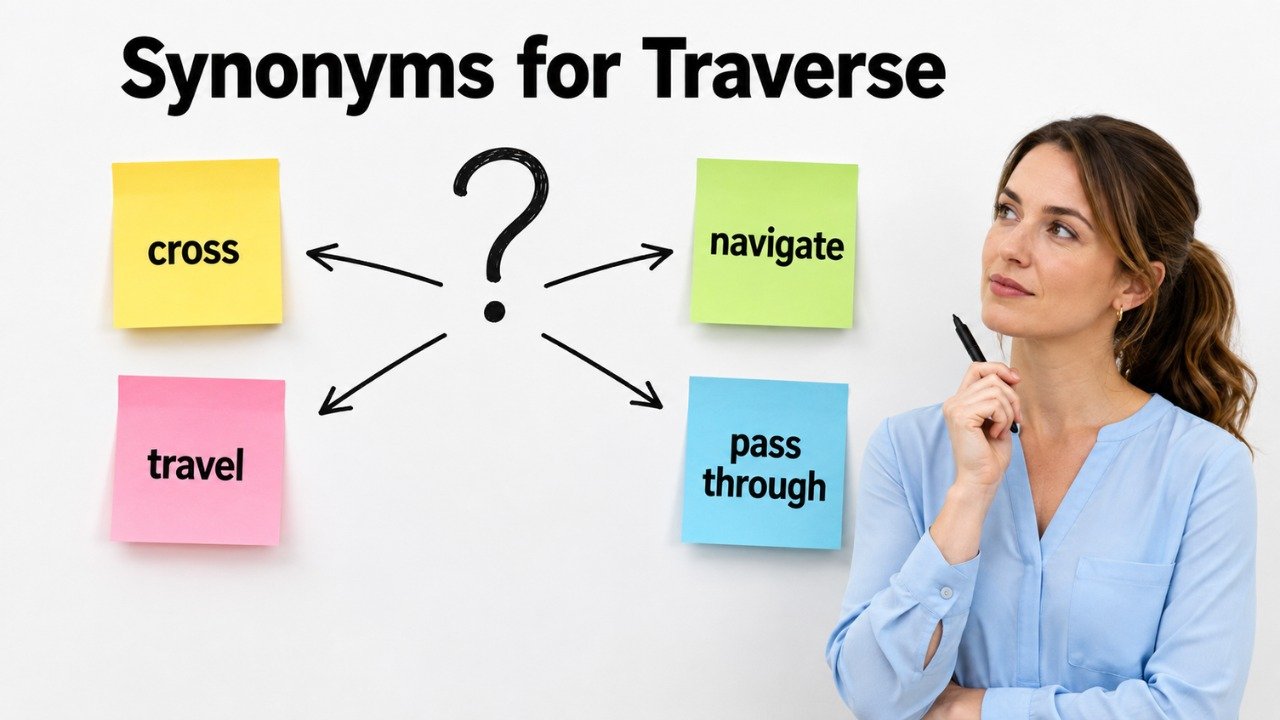
Quick Answer: The best synonyms for traverse are cross, travel across, pass through, navigate, cover, span, journey across, move through, range over, and negotiate. Use cross for simple physical movement, travel across for journeys, pass through for movement inside an area, navigate for careful movement around difficulties, span for distance or extension, and negotiate for challenging terrain. These synonyms for traverse help express movement, distance, exploration, and physical coverage more precisely.
Pronunciation and Word Details
Word: Traverse
Pronunciation: /trəˈvɜːrs/
Part of Speech: Verb and noun
Meaning: To travel, move, or extend across an area, distance, surface, or obstacle.
US Pronunciation:
UK Pronunciation:
What Does “Traverse” Mean?
Traverse means to move, travel, or pass across an area, surface, distance, or obstacle.
As a verb, traverse commonly describes crossing land, water, mountains, roads, rooms, or other physical spaces. It often suggests movement across the full width or length of something.
You can traverse a desert, traverse a mountain range, traverse a bridge, or traverse a difficult path. The word may describe movement on foot, by vehicle, or through another method of transportation.
Traverse can also describe something that extends across an area. A road may traverse a valley, while a railway line may traverse several regions.
In technical contexts, traverse can refer to movement from one side to another. As a noun, it may describe a sideways route, a crossing movement, or a route across a slope.
Meaning, Tone, and Context of “Traverse”
Traverse has a formal, neutral, and sometimes technical tone. It is more sophisticated than simple words such as cross or go across.
The word frequently appears in travel writing, geography, exploration, engineering, surveying, climbing, military descriptions, and academic writing. It is useful when a writer wants to emphasize the distance, difficulty, direction, or completeness of a crossing.
In everyday conversation, traverse can sound unnecessarily formal when cross would express the same meaning more naturally.
Formal Context: Researchers traversed the remote valley to collect samples.
Travel Context: The group traversed several countries during the expedition.
Geographical Context: The river traverses the entire region.
Technical Context: The equipment can traverse from one end of the rail to the other.
Figurative Context: She successfully traversed a difficult period in her career.
The word is generally descriptive rather than emotional. However, it can create a sense of effort, adventure, challenge, or extensive movement.
When and How to Use “Traverse”
For Crossing an Area
Use traverse when someone or something moves from one side of an area to another.
Example: The hikers traversed the open field before reaching the forest.
For Traveling Through Terrain
Use traverse when describing movement through mountains, deserts, forests, valleys, or other landscapes.
Example: The explorers traversed miles of rough terrain.
For Covering a Long Distance
Traverse can emphasize movement across a considerable distance.
Example: The train traverses the country in less than two days.
For Extending Across a Place
Use traverse when a road, river, railway, or boundary stretches across an area.
Example: A narrow road traverses the northern part of the island.
For Moving Around Difficulties
Traverse can describe careful movement through obstacles or challenging conditions.
Example: The climbers traversed the icy slope with great caution.
For Sideways Movement
In climbing and technical situations, traverse may describe movement from side to side rather than directly upward or forward.
Example: The climber traversed the rock face to reach a safer route.
For Figurative Progress
Traverse can describe passing through a difficult experience, process, period, or subject.
Example: The book traverses several complicated periods of history.
Best Synonyms for Traverse
1. Cross
Synonym: To move from one side of something to another.
Example: We crossed the river before sunset.
2. Travel Across
Synonym: To journey from one part of an area to another.
Example: They traveled across the country by train.
3. Pass Through
Synonym: To enter, move within, and leave a place.
Example: The road passes through several small towns.
4. Navigate
Synonym: To find and follow a route through an area or difficulty.
Example: The guide helped us navigate the narrow mountain trail.
5. Cover
Synonym: To travel across a particular distance or area.
Example: The team covered twenty miles before stopping.
6. Span
Synonym: To extend across the entire width, length, or distance of something.
Example: The bridge spans the wide river.
7. Journey Across
Synonym: To make an extended trip across a place.
Example: The travelers journeyed across the desert.
8. Move Through
Synonym: To progress within and across an area.
Example: The rescue team moved through the damaged building carefully.
9. Range Over
Synonym: To extend, travel, or spread across a wide area.
Example: The animals range over a large section of the grassland.
10. Negotiate
Synonym: To move successfully across or around a difficult route or obstacle.
Example: The driver negotiated the sharp mountain turns safely.
50 Synonyms for Traverse with Short Meanings
- Cross: Move from one side to another.
- Travel Across: Make a journey across an area.
- Pass Through: Move inside and beyond a place.
- Go Across: Move to the opposite side.
- Move Across: Change position from one side to another.
- Journey Across: Complete an extended trip across somewhere.
- Make One’s Way Across: Progress carefully across an area.
- Navigate: Find and follow a suitable route.
- Negotiate: Move successfully through a difficult route.
- Cover: Travel over a particular distance or area.
- Span: Extend across a complete distance.
- Extend Across: Reach from one side to another.
- Stretch Across: Continue across a wide area.
- Range Over: Move or extend across a large region.
- Cross Over: Pass from one side to another.
- Cut Across: Take a direct route across something.
- Sweep Across: Move widely and continuously across an area.
- Proceed Across: Continue moving toward the other side.
- Walk Across: Cross an area on foot.
- Trek Across: Make a long and difficult journey across.
- Hike Across: Walk across natural terrain.
- Ride Across: Cross an area using a bicycle, animal, or vehicle.
- Drive Across: Travel across an area in a vehicle.
- Sail Across: Cross water in a boat or ship.
- Fly Across: Travel across an area through the air.
- Climb Across: Move sideways or diagonally over a surface.
- Crawl Across: Move slowly across a surface.
- March Across: Walk across in a steady and organized way.
- Wade Across: Cross shallow water on foot.
- Ford: Cross a river or stream at a shallow point.
- Ferry Across: Carry people or goods across water.
- Roam Across: Travel freely across a broad area.
- Wander Across: Move across without a fixed route.
- Travel Through: Journey within and beyond an area.
- Journey Through: Pass through a place during a longer trip.
- Move Through: Progress inside an area.
- Go Through: Pass from one part to another.
- Course Through: Move continuously through an area.
- Thread Through: Move carefully through a narrow or crowded space.
- Wind Through: Follow a twisting route through something.
- Weave Through: Move around several people or obstacles.
- Crisscross: Travel repeatedly in different directions.
- Intersect: Cross another line, route, or surface.
- Bisect: Cross and divide something into two sections.
- Bridge: Extend across and connect two sides.
- Straddle: Extend across both sides of something.
- Explore: Travel through an area to learn about it.
- Tour: Travel around or through several places.
- Perambulate: Walk or travel through an area formally.
- Transit: Pass across or through a place.
Read Also:
Synonyms for Temperature
Synonyms for Traverse by Context
When Traverse Means Cross Physically
Cross, go across, move across, cross over, proceed across, and make one’s way across are useful when describing direct physical movement.
Example With Traverse: The children traversed the narrow bridge.
Example With Cross: The children crossed the narrow bridge.
Cross is usually the most natural option in everyday speech. Proceed across sounds more formal, while make one’s way across suggests careful or gradual movement.
When Traverse Means Travel Through a Region
Travel through, journey through, journey across, tour, roam across, and explore are suitable for journeys through countries, cities, landscapes, and regions.
Example With Traverse: She traversed several European regions during her journey.
Example With Travel Through: She traveled through several European regions during her journey.
Journey across emphasizes a long trip. Tour suggests visiting several locations, while explore suggests discovering or studying the area.
When Traverse Means Move Through Difficult Terrain
Navigate, negotiate, trek across, hike across, climb across, thread through, and weave through emphasize difficulty, planning, or careful movement.
Example With Traverse: The team traversed the rocky valley.
Example With Negotiate: The team negotiated the rocky valley.
Navigate emphasizes choosing the correct route. Negotiate emphasizes successfully handling obstacles. Trek across suggests a long and physically demanding journey.
When Traverse Means Extend Across
Span, extend across, stretch across, range over, bridge, and straddle describe something that reaches across a distance or area.
Example With Traverse: The railway traverses the entire province.
Example With Span: The railway spans the entire province.
Span emphasizes total distance. Extend across is neutral and clear. Stretch across often creates a stronger visual image of length.
When Traverse Means Move From Side to Side
Climb across, move laterally, sweep across, slide across, and shift across may replace traverse in technical or climbing contexts.
Example With Traverse: The climber traversed the cliff face.
Example With Climb Across: The climber climbed across the cliff face.
Climb across is clearer for general readers. Traverse is more precise in climbing contexts because it commonly describes sideways movement across a surface.
When Traverse Has a Figurative Meaning
Navigate, move through, pass through, overcome, work through, and progress through can describe experiences, processes, periods, or complicated subjects.
Example With Traverse: The novel traverses several generations of family history.
Example With Explore: The novel explores several generations of family history.
Explore works well when discussing ideas or subjects. Navigate is better for challenges, while move through suits stages or periods.
Another Word for Traverse
Cross is usually the best single replacement for traverse because it is clear, natural, and suitable for most physical movement. However, the strongest alternative depends on whether the sentence describes travel, extension, exploration, difficulty, or technical movement.
Original: We traversed the river before the storm arrived.
Better Option: We crossed the river before the storm arrived.
Original: The expedition traversed the northern desert.
Better Option: The expedition journeyed across the northern desert.
Original: A major highway traverses the region.
Better Option: A major highway extends across the region.
Original: The climbers traversed the dangerous slope.
Better Option: The climbers negotiated the dangerous slope.
When Not to Use “Traverse”
Traverse may sound too formal in simple conversations. It can also become repetitive or unclear when a more specific verb would show exactly how the movement happened.
When Simple Language Is Better
Weak: I traversed the street to reach the store.
Better: I crossed the street to reach the store.
Cross is shorter and more natural for ordinary movement.
When the Method of Travel Matters
Weak: We traversed the lake before noon.
Better: We sailed across the lake before noon.
Sailed provides more information about how the journey happened.
When Describing Difficult Movement
Weak: The driver traversed the narrow mountain road.
Better: The driver negotiated the narrow mountain road.
Negotiated more clearly communicates difficulty and careful control.
When Discussing Ideas
Weak: The article traverses several important economic issues.
Better: The article explores several important economic issues.
Explore sounds more natural when discussing ideas, themes, or subjects.
When the Sentence Becomes Redundant
Weak: The hikers traversed across the valley.
Better: The hikers traversed the valley.
Traverse already contains the idea of moving across. Adding across is often unnecessary in concise writing.
Words Commonly Confused With Traverse
Traverse vs Cross: Traverse is more formal and may suggest an extensive, difficult, or complete crossing. Cross is more common and direct.
Traverse vs Travel: Traverse focuses on movement across or through a particular area. Travel refers more generally to going from one location to another.
Traverse vs Navigate: Traverse describes the crossing itself. Navigate emphasizes finding, choosing, or following the correct route.
Traverse vs Span: Traverse usually describes movement across an area. Span describes something extending across a distance without necessarily moving.
Traverse vs Transverse: Traverse is commonly a verb or noun connected with crossing. Transverse is mainly an adjective meaning positioned or extending across something.
Traverse vs Trek: Traverse focuses on direction across an area. Trek emphasizes a long, demanding journey, usually on foot.
Traverse vs Explore: Traverse emphasizes movement across a place. Explore emphasizes learning about, examining, or discovering a place.
Traverse vs Intersect: Traverse may involve traveling across an entire area. Intersect means that two lines, roads, paths, or objects cross at a particular point.
Which Synonym Should You Choose?
Choose Cross: For clear, simple, and everyday descriptions of movement from one side to another.
Choose Travel Across: For journeys through countries, regions, or large geographical areas.
Choose Pass Through: When someone enters an area, moves inside it, and then leaves it.
Choose Navigate: When finding the correct route requires planning, direction, or skill.
Choose Negotiate: When movement involves obstacles, sharp turns, dangerous terrain, or difficult conditions.
Choose Span: When an object, structure, period, or idea extends across a complete distance.
Choose Cover: When emphasizing the amount of distance traveled.
Choose Trek Across: For long, physically demanding journeys, especially through natural terrain.
Choose Explore: When the purpose is discovery, investigation, or learning.
Choose Traverse: In formal, geographical, technical, academic, climbing, or descriptive writing where the crossing itself is important.
Real Life Examples of “Traverse” in Sentences
Example One
Original: The hikers traversed the forest before nightfall.
Better Option: The hikers traveled through the forest before nightfall.
Example Two
Original: We traversed the busy road carefully.
Better Option: We crossed the busy road carefully.
Example Three
Original: The railway traverses several rural districts.
Better Option: The railway extends across several rural districts.
Example Four
Original: The climbers traversed the steep rock face.
Better Option: The climbers moved across the steep rock face.
Example Five
Original: The expedition traversed the desert during winter.
Better Option: The expedition journeyed across the desert during winter.
Example Six
Original: The driver traversed the narrow mountain route.
Better Option: The driver negotiated the narrow mountain route.
Example Seven
Original: The river traverses the southern part of the valley.
Better Option: The river runs through the southern part of the valley.
Example Eight
Original: The rescue workers traversed the damaged building.
Better Option: The rescue workers moved through the damaged building.
Example Nine
Original: The documentary traverses many periods of human history.
Better Option: The documentary explores many periods of human history.
Example Ten
Original: The animals traverse a large area in search of food.
Better Option: The animals range over a large area in search of food.
Synonym Groups and Usage Differences
Direct Crossing Group
Cross, go across, move across, cross over, and proceed across describe direct movement from one side to another.
Cross is the most natural general choice. Proceed across is more formal and may emphasize controlled movement.
Example: The passengers crossed the platform to reach the next train.
Long Journey Group
Travel across, journey across, trek across, tour, and roam across describe movement over a broad area.
Journey across suggests an extended trip. Trek across adds difficulty, while roam across suggests freedom without a strict route.
Example: The group trekked across the remote region for several days.
Difficult Movement Group
Navigate, negotiate, thread through, weave through, and make one’s way across emphasize skill, caution, or obstacles.
Navigate focuses on route selection. Negotiate focuses on handling difficulty. Thread through and weave through describe movement around obstacles.
Example: She carefully navigated the crowded passage.
Distance and Extension Group
Span, extend across, stretch across, range over, bridge, and straddle describe something reaching from one point to another.
Span is especially useful for bridges, distances, periods, and broad subjects. Stretch across creates a visual sense of length.
Example: The bridge spans the widest section of the river.
Method of Travel Group
Walk across, drive across, sail across, fly across, ride across, wade across, and ferry across identify how the crossing happens.
These alternatives are more specific than traverse because they show the method of movement.
Example: The family drove across the country during their holiday.
Exploration Group
Explore, tour, wander across, roam across, and perambulate describe movement connected with discovery or observation.
Explore suggests purpose and curiosity. Wander suggests movement without a clear destination.
Example: They explored the ancient city on foot.
Antonyms of Traverse
The opposite of traverse depends on whether the word describes movement, crossing, progress, or extension.
Remain: Stay in the same position or place.
Stay: Continue to be in one location.
Stop: End movement or progress.
Halt: Bring movement to a complete stop.
Avoid: Keep away from a place, route, or obstacle.
Bypass: Go around something instead of crossing it.
Retreat: Move backward or away from a place.
Withdraw: Move away from an area or situation.
Return: Go back toward the starting point.
Contract: Become shorter or cover less distance.
Shorten: Reduce length, distance, or extent.
Confine: Limit movement to a smaller area.
Comparison: Traverse vs Related Words
Traverse vs Cross
Traverse is more formal and often suggests crossing a large, difficult, or important area. Cross is simpler and more common in everyday language.
Example With Traverse: The explorers traversed the frozen lake.
Example With Cross: The explorers crossed the frozen lake.
Traverse vs Travel
Traverse requires an area, surface, or distance that is crossed. Travel is a broader word for movement between places.
Example With Traverse: They traversed the northern region.
Example With Travel: They traveled to the northern region.
Traverse vs Navigate
Traverse focuses on moving across an area. Navigate focuses on selecting and following the correct route.
Example With Traverse: The team traversed the dense forest.
Example With Navigate: The team navigated the dense forest using a map.
Traverse vs Span
Traverse usually describes movement across something. Span describes extension from one side to another.
Example With Traverse: The hikers traversed the valley.
Example With Span: The bridge spans the valley.
Traverse vs Trek
Traverse describes direction and crossing. Trek emphasizes a long and tiring journey.
Example With Traverse: They traversed the open plain.
Example With Trek: They trekked across the open plain for three days.
Traverse vs Explore
Traverse focuses on passing across or through an area. Explore focuses on discovering, examining, or learning about it.
Example With Traverse: We traversed the old city in one afternoon.
Example With Explore: We explored the old city and visited its historic buildings.
Traverse vs Transverse
Traverse is normally used as a verb or noun. Transverse is usually an adjective describing something positioned across another object.
Example With Traverse: The vehicle can traverse uneven ground.
Example With Transverse: A transverse beam supports the structure.
Common Phrases and Expressions With “Traverse”
Traverse a Continent: Travel across a large landmass.
Traverse the Country: Journey across an entire nation or large part of it.
Traverse a Mountain Range: Travel across several connected mountains.
Traverse Rough Terrain: Move across difficult natural ground.
Traverse a Valley: Cross or travel through low land between hills or mountains.
Traverse a Slope: Move sideways across an inclined surface.
Traverse the Landscape: Travel across a broad natural area.
Traverse the Distance: Cover the space between two points.
Traverse From Side to Side: Move laterally across an area or surface.
Traverse a Route: Follow and complete a particular path.
Common Mistakes to Avoid
Adding an Unnecessary Preposition
Traverse usually takes a direct object. Writers often add across or through even though the meaning is already included.
Less Concise: The group traversed across the valley.
Better: The group traversed the valley.
Using Traverse for Every Type of Travel
Traverse does not simply mean visit or travel to a destination. It emphasizes movement across or through something.
Incorrect: We traversed to the city for a meeting.
Better: We traveled to the city for a meeting.
Confusing Traverse With Transverse
Traverse and transverse have related ideas, but they perform different grammatical functions.
Incorrect: The machine made a traverse movement.
Better: The machine made a transverse movement.
Choosing a Word That Hides Useful Detail
Traverse may be less informative than a verb that identifies the method of movement.
Vague: They traversed the river.
Specific: They waded across the river.
Repeating Traverse Too Often
Using traverse repeatedly can make a paragraph sound formal and monotonous. Alternate it with cross, travel through, move across, navigate, or journey across when appropriate.
Using an Overly Formal Word in Casual Speech
Traverse may sound unnatural in simple everyday statements.
Unnatural: I traversed the parking area.
Natural: I crossed the parking area.
Ignoring the Intended Direction
Cross, pass through, climb across, and span describe different relationships with an area. Choose a word that clearly shows whether the subject moves across, enters and exits, travels sideways, or simply extends over a distance.
Conclusion
The best synonyms for traverse depend on the type of movement being described. Cross is the clearest everyday alternative, while travel across and journey across suit longer trips. Navigate and negotiate work well for complicated routes or difficult terrain. Span, stretch across, and extend across describe objects or routes covering a distance. Trek, sail, drive, and hike provide useful details about the method of travel. Choosing context specific synonyms for traverse makes descriptions clearer, more natural, and more informative.
FAQs About Synonyms for Traverse
What Is the Best Synonym for Traverse?
Cross is the best general synonym for traverse. It clearly describes movement from one side of something to another.
Can Travel Replace Traverse?
Travel can replace traverse when the sentence describes a journey. However, travel does not always emphasize crossing a particular area.
Is Navigate a Synonym for Traverse?
Navigate is a close synonym when movement requires route planning, direction, or careful control. It emphasizes finding the way rather than simply crossing.
What Is a Formal Synonym for Traverse?
Journey across, proceed across, range over, and perambulate are formal alternatives. The best choice depends on the type of movement.
What Is a Simple Word for Traverse?
Cross, pass, and move across are simple alternatives. Cross is usually the most direct replacement.
What Is the Difference Between Traverse and Span?
Traverse usually describes movement across a place. Span describes something extending across a complete distance without moving.
Can Traverse Be Used Figuratively?
Yes. Traverse can describe progressing through a difficult experience, historical period, complicated subject, or lengthy process. Navigate, explore, and move through are often natural figurative alternatives.
