
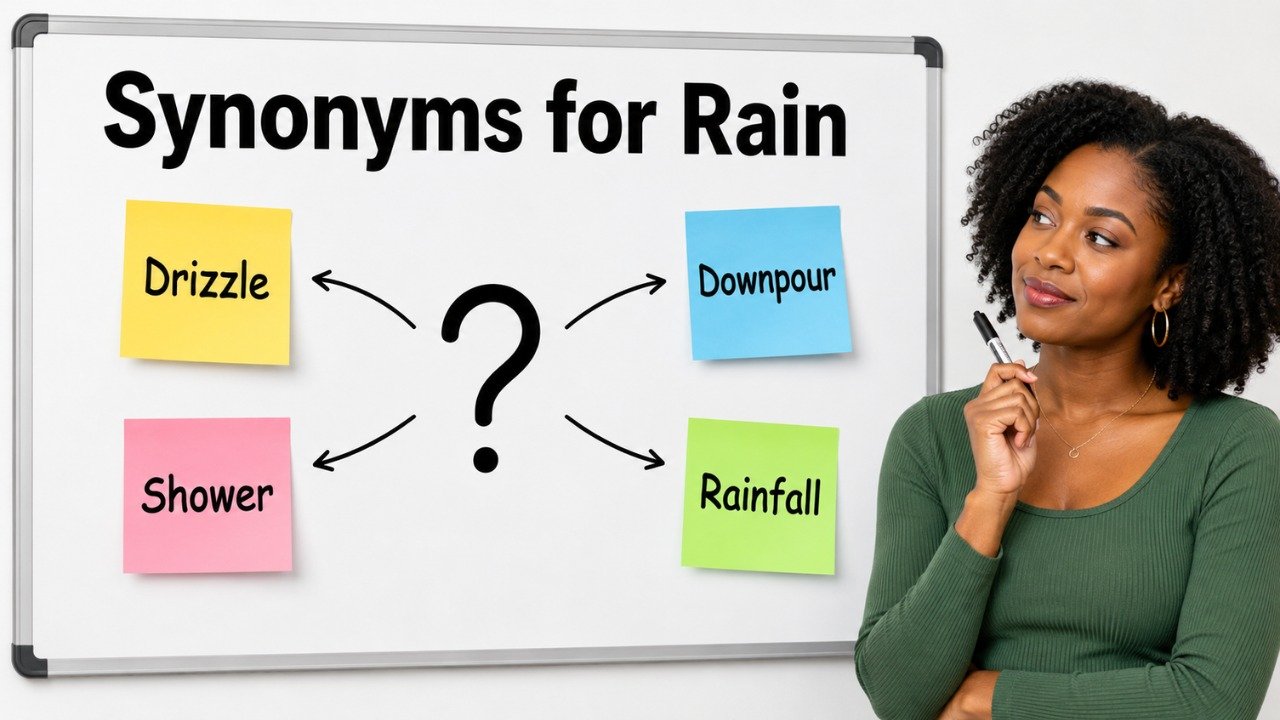
Quick Answer: The best synonyms for rain include rainfall, precipitation, shower, drizzle, downpour, deluge, cloudburst, sprinkle, mist, and torrent. Use rainfall when referring to the amount of rain received in an area, precipitation in formal, scientific, or weather related writing, shower for a short period of rain, and drizzle for very light rain. Downpour describes sudden heavy rain, while deluge and torrent suggest extremely large amounts of water. Sprinkle works for a few light drops, while mist describes extremely fine moisture in the air.
Pronunciation and Word Details
Word: Rain.
Pronunciation: /reɪn/
Part of Speech: Noun and verb.
Meaning: Water drops that fall from clouds, or the action of water falling from the sky.
US Pronunciation:
UK Pronunciation:
What Does “Rain” Mean?
Rain means water that falls from clouds in drops. As a noun, it refers to the falling water itself or to a period of wet weather. As a verb, it describes the action of water falling from the sky.
The word is common in everyday conversation, weather descriptions, literature, science, agriculture, and environmental discussions.
In the sentence “Heavy rain continued all night,” rain is a noun describing precipitation. In “It may rain this afternoon,” it functions as a verb.
Rain can also appear in figurative language. Someone might say that criticism “rained down” on a person, meaning that a large amount arrived suddenly. The exact meaning therefore depends on whether the word describes weather, quantity, movement, or a figurative flow of something.
Meaning, Tone, and Context of “Rain”
Rain is a neutral and widely understood word. It is appropriate in casual speech, formal writing, news style descriptions, academic discussions, stories, and technical explanations.
In everyday conversation, rain usually refers simply to wet weather. Words such as shower, drizzle, and downpour can make the description more specific.
In scientific and technical contexts, precipitation may be more appropriate because it includes water falling from the atmosphere and can be discussed as a measurable weather process.
In literary writing, alternatives such as deluge, torrent, mist, or cloudburst can create stronger imagery. These choices often communicate not only that rain is falling, but also how intense, gentle, sudden, or dramatic it feels.
The word itself is neither especially formal nor casual. Its flexibility makes it suitable for almost any audience.
When and How to Use “Rain”
For General Weather: Use rain when you simply want to describe water falling from clouds without emphasizing its strength.
Example: Rain is expected during the afternoon.
For Light Weather: Use rain when the exact intensity is unimportant, but choose drizzle, sprinkle, or mist when you want greater precision.
Example: Light rain covered the garden before sunrise.
For Heavy Weather: Rain works in general descriptions, while downpour, deluge, or cloudburst creates a stronger picture.
Example: Heavy rain flooded several low areas.
For Scientific Contexts: Rain can be used in environmental or weather discussions, although precipitation is often more technical.
Example: Rain provides an important source of fresh water for crops.
For Seasonal Description: Rain is useful when discussing climate patterns, farming conditions, and changes in weather.
Example: The region receives most of its rain during the warmer months.
For Figurative Meaning: Rain can describe objects, words, criticism, or other things arriving in large quantities.
Example: Questions began to rain down after the announcement.
Best Synonyms for Rain
Rainfall: Water that falls as rain, especially when its amount is measured.
Example: Annual rainfall is higher in the mountain region.
Precipitation: Water released from the atmosphere, especially in formal or scientific contexts.
Example: The forecast predicts significant precipitation overnight.
Shower: A relatively short period of rain.
Example: A brief shower cooled the streets.
Drizzle: Very light rain made of small drops.
Example: A soft drizzle continued throughout the morning.
Downpour: A sudden or intense period of heavy rain.
Example: We reached the building just before the downpour began.
Deluge: An extremely large amount of rain or water.
Example: The sudden deluge filled the drainage channels quickly.
Cloudburst: A sudden and exceptionally heavy fall of rain.
Example: A cloudburst soaked the town within minutes.
Sprinkle: A very small amount of light rain.
Example: A quick sprinkle barely wet the pavement.
Mist: Extremely fine drops of water suspended in the air.
Example: A cool mist covered the hillside.
Torrent: A powerful flow or large quantity of water, often associated with very heavy rain.
Example: Torrents of rain swept across the open field.
50 Synonyms for Rain with Short Meanings
- Rainfall: Water falling from clouds as rain.
- Precipitation: Water falling from the atmosphere.
- Shower: A short period of rain.
- Drizzle: Light rain made of tiny drops.
- Downpour: A sudden period of very heavy rain.
- Deluge: An overwhelming amount of rain.
- Cloudburst: A sudden and extremely heavy rainfall.
- Sprinkle: A few light drops of rain.
- Mist: Very fine moisture in the air.
- Torrent: A powerful rush or quantity of rainwater.
- Sprinkling: A small amount of light rain.
- Mizzle: Extremely fine rain resembling mist.
- Scotch Mist: Very fine, persistent rain.
- Rainstorm: A storm dominated by heavy rain.
- Storm: Severe weather that may include heavy rain.
- Thunderstorm: A storm with rain, thunder, and often lightning.
- Monsoon: A seasonal weather pattern often bringing intense rain.
- Wet Weather: Weather characterized by rain.
- Rainwater: Water that has fallen as rain.
- Raindrops: Individual drops of falling rain.
- Pluvial Water: Water produced by rainfall.
- Heavy Shower: A brief but strong period of rain.
- Light Shower: A short period of gentle rain.
- Passing Shower: A brief rain event that moves through quickly.
- Rain Squall: A sudden burst of rain with strong wind.
- Driving Rain: Rain blown forcefully by wind.
- Pelting Rain: Rain falling hard and rapidly.
- Pouring Rain: Very heavy continuous rain.
- Torrential Rain: Extremely heavy rainfall.
- Steady Rain: Rain falling continuously at a consistent rate.
- Persistent Rain: Rain continuing for a long period.
- Continuous Rain: Rain that does not stop for an extended time.
- Gentle Rain: Soft rain falling without great force.
- Fine Rain: Rain consisting of very small drops.
- Soft Rain: Mild and gentle rainfall.
- Light Rain: Rain falling at a low intensity.
- Heavy Rain: Rain falling at a high intensity.
- Sheeting Rain: Heavy rain appearing to fall in broad sheets.
- Lashing Rain: Heavy rain driven forcefully by wind.
- Bucketing Rain: Very heavy rain falling rapidly.
- Rain Shower: A relatively short episode of rainfall.
- Wet Spell: A period of frequently rainy weather.
- Rainy Spell: Several days or periods of rainy conditions.
- Rain Event: A period during which measurable rain occurs.
- Burst of Rain: A sudden short period of rainfall.
- Fall of Rain: An occurrence or amount of rainfall.
- Drop: A small amount of rain in certain contexts.
- Drenching: A heavy soaking caused by rain.
- Soaking: Rain heavy enough to make something thoroughly wet.
- Wetness: Moisture produced by rain in broad descriptive contexts.
Read Also:
Synonyms for Horrific

Synonyms for Rain by Context
When Rain Means General Precipitation
Rainfall and precipitation are the most useful choices when describing rain without emphasizing whether it is light or heavy.
Rainfall: Best when discussing the amount of rain an area receives.
Example: The valley receives substantial rainfall each spring.
Precipitation: Best for scientific, environmental, and weather related discussions.
Example: Precipitation increased during the second half of the month.
Rain Shower: Useful for a temporary period of rainfall.
Example: A rain shower passed over the neighborhood before noon.
When Rain Means Light Rain
Drizzle, sprinkle, mist, and mizzle describe gentle forms of wet weather.
Drizzle: Light rain consisting of small drops.
Example: A steady drizzle made the sidewalks damp.
Sprinkle: A very small amount of rain.
Example: We felt a sprinkle as we entered the park.
Mist: Extremely fine droplets floating through the air.
Example: A thin mist covered the trees.
Mizzle: Fine rain that falls somewhere between mist and drizzle.
Example: A light mizzle softened the distant view.
When Rain Means Heavy Rain
Downpour, deluge, cloudburst, and torrential rain describe strong or extreme rainfall.
Downpour: Best for intense rain that begins or falls heavily.
Example: The game stopped because of a sudden downpour.
Deluge: Suggests an overwhelming quantity of water.
Example: The overnight deluge filled the streams.
Cloudburst: Describes extremely heavy rain occurring suddenly.
Example: A cloudburst caused water to rush along the road.
Torrential Rain: Describes exceptionally strong rainfall.
Example: Torrential rain continued for several hours.
When Rain Means Wind Driven Rain
Driving rain and lashing rain describe rain made more forceful by strong winds.
Driving Rain: Rain pushed hard by the wind.
Example: The hikers struggled through driving rain.
Lashing Rain: Heavy rain striking surfaces forcefully.
Example: Lashing rain hit the windows throughout the evening.
Pelting Rain: Fast, hard falling rain.
Example: They hurried home through the pelting rain.
When Rain Means a Period of Wet Weather
Wet spell, rainy spell, and monsoon are useful when discussing rain over a longer period.
Wet Spell: A period with repeated rainy weather.
Example: The wet spell lasted most of the week.
Rainy Spell: A stretch of days with frequent rain.
Example: Garden plants grew quickly during the rainy spell.
Monsoon: A seasonal wind and weather pattern commonly associated with prolonged or intense rain in certain regions.
Example: Monsoon rains transformed the dry landscape.
Another Word for Rain
The best single alternative to rain is often rainfall when the word functions as a noun. However, the strongest replacement depends on intensity, duration, purpose, and writing style.
Precipitation works well in formal and scientific writing. Shower is better for short periods of rain. Drizzle describes gentle rain, while downpour is more accurate when the rain is very heavy.
Original: The rain continued through the night.
Better Option: The rainfall continued through the night.
Original: Some rain is expected this afternoon.
Better Option: A few showers are expected this afternoon.
Original: The rain was so light that we kept walking.
Better Option: The drizzle was so light that we kept walking.
Original: The rain suddenly became extremely heavy.
Better Option: A downpour suddenly began.
When Not to Use “Rain”
Rain is a clear general word, but it may sound vague when the intensity or type of weather is important.
Avoid relying on rain repeatedly in descriptive writing when a more precise word would help readers visualize the scene.
Weak: Rain fell lightly across the field.
Better: Drizzle fell softly across the field.
Rain can also be too general in scientific writing when the discussion concerns several forms of atmospheric water.
Weak: The study measured rain and other forms of water falling from the atmosphere.
Better: The study measured precipitation from the atmosphere.
Do not use dramatic alternatives when the weather is mild.
Weak: A deluge lightly dampened the sidewalk.
Better: A sprinkle lightly dampened the sidewalk.
Avoid calling every short period of rainfall a storm.
Weak: A storm lasted for five quiet minutes with no wind or thunder.
Better: A brief shower lasted for five minutes.
Choose a synonym that matches the amount, duration, and force of the rainfall.
Words Commonly Confused With Rain
Rain vs Rainfall: Rain can describe the weather itself or the action of water falling. Rainfall usually refers to rain as an amount or measurable occurrence.
Rain vs Precipitation: Rain is specifically liquid water falling from clouds. Precipitation is a broader term that can refer to different forms of water falling from the atmosphere.
Rain vs Drizzle: Rain can range from light to heavy. Drizzle specifically describes very fine, light rain.
Rain vs Shower: Rain is the general phenomenon. A shower is usually a shorter period of rain that may begin and end quickly.
Rain vs Downpour: Rain is neutral about intensity. A downpour specifically means very heavy rainfall.
Rain vs Mist: Rain consists of drops falling from clouds. Mist consists of extremely small water droplets suspended near the ground or in the air.
Rain vs Storm: Rain may occur without severe weather. A storm usually involves stronger atmospheric conditions and may include wind, thunder, or lightning.
Rain vs Monsoon: Rain is the actual falling water. Monsoon refers to a seasonal weather and wind pattern that can produce substantial rainfall.
Which Synonym Should You Choose?
Choose rainfall when discussing how much rain falls over a particular place or period.
Choose precipitation for formal, scientific, environmental, academic, or technical writing.
Choose shower when describing a relatively short period of rain.
Choose drizzle when the rain is light and made of small drops.
Choose sprinkle when only a few drops are falling.
Choose downpour when the rain is sudden, intense, or very heavy.
Choose deluge when you want to emphasize an overwhelming amount of water.
Choose cloudburst when extremely heavy rain begins suddenly and is concentrated within a short period.
Choose mist when the moisture consists of tiny droplets hanging in the air rather than ordinary falling rain.
Choose torrential rain when describing exceptionally intense rainfall in reports, stories, or weather descriptions.
For essays and reports, rainfall and precipitation often sound precise. For everyday conversation, rain, shower, drizzle, and downpour usually sound more natural. For creative writing, deluge, mist, driving rain, and lashing rain can provide stronger imagery.
Real Life Examples of “Rain” in Sentences
Original: The rain started just before we left home.
Better Option: The shower started just before we left home.
Original: Light rain covered the streets in the morning.
Better Option: Drizzle covered the streets in the morning.
Original: Heavy rain began during the afternoon.
Better Option: A downpour began during the afternoon.
Original: The region receives plenty of rain each year.
Better Option: The region receives plenty of rainfall each year.
Original: The report measures rain throughout the season.
Better Option: The report measures precipitation throughout the season.
Original: A little rain fell while we were outside.
Better Option: A light sprinkle fell while we were outside.
Original: Sudden rain soaked everyone at the outdoor event.
Better Option: A sudden cloudburst soaked everyone at the outdoor event.
Original: The rain was so heavy that visibility became poor.
Better Option: The torrential rain was so heavy that visibility became poor.
Original: Rain blew against the windows all evening.
Better Option: Driving rain struck the windows all evening.
Original: Several days of rain made the ground soft.
Better Option: A wet spell made the ground soft.
Synonym Groups and Usage Differences
General Rain Group
Rainfall, precipitation, rain shower, and wet weather belong to the general rain group.
Rainfall focuses on the amount of rain. Precipitation is more technical. Rain shower emphasizes duration, while wet weather describes broader conditions.
Example: Seasonal rainfall keeps the soil moist.
Light Rain Group
Drizzle, sprinkle, fine rain, gentle rain, and mizzle describe low intensity moisture.
Drizzle is the most common word for fine, light rain. Sprinkle suggests fewer drops. Gentle rain sounds softer and more descriptive.
Example: A gentle drizzle began before sunrise.
Heavy Rain Group
Downpour, deluge, cloudburst, torrential rain, pouring rain, and sheeting rain all describe strong rainfall.
Downpour is common in everyday language. Deluge is more dramatic. Cloudburst emphasizes suddenness. Torrential rain emphasizes extreme intensity.
Example: A sudden downpour sent everyone indoors.
Wind Driven Rain Group
Driving rain, lashing rain, pelting rain, and rain squall describe rainfall affected by force or wind.
These terms are useful when ordinary rain does not fully describe the harshness of the weather.
Example: Driving rain reduced visibility on the road.
Long Duration Rain Group
Persistent rain, continuous rain, steady rain, wet spell, and rainy spell emphasize duration rather than intensity.
Persistent rain may be light or heavy but continues for a long time. Steady rain suggests a consistent rate.
Example: Persistent rain continued throughout the weekend.
Dramatic Rain Group
Deluge, torrent, cloudburst, and drenching create stronger emotional or visual effects.
These words are especially useful in descriptive and creative writing when the writer wants to emphasize power, volume, or suddenness.
Example: A deluge swept across the town before sunset.
Antonyms of Rain
The opposite of rain depends on whether you are discussing weather, moisture, or environmental conditions.
Sunshine: Bright weather with direct sunlight.
Dryness: A condition with little or no moisture.
Drought: A prolonged period with unusually little rainfall.
Aridity: Extreme environmental dryness.
Clear Weather: Weather with little cloud cover and no rain.
Dry Weather: A period without rainfall.
Sun: Bright daylight associated with clear weather.
Fair Weather: Calm, pleasant weather without significant rain.
Clear Skies: Sky conditions with little cloud and no rainfall.
Dry Spell: A period during which little or no rain falls.
Comparison: Rain vs Related Words
Rain vs Rainfall
Rain describes water falling from clouds and can also function as a verb. Rainfall is mainly a noun and often focuses on the amount of rain received.
Example With Rain: The rain started early this morning.
Example With Rainfall: Annual rainfall is lower in the western part of the region.
Rain vs Precipitation
Rain refers specifically to liquid water falling from the sky. Precipitation is a broader and more technical atmospheric term.
Example With Rain: Heavy rain is expected tonight.
Example With Precipitation: The system may produce significant precipitation.
Rain vs Drizzle
Rain can describe many intensities. Drizzle refers specifically to very light rainfall made of small droplets.
Example With Rain: Rain covered the roads by noon.
Example With Drizzle: A fine drizzle dampened the pavement.
Rain vs Shower
Rain is a general term, while a shower usually refers to a relatively brief episode.
Example With Rain: Rain continued most of the day.
Example With Shower: A short shower passed through before lunch.
Rain vs Downpour
Rain does not tell the reader how strong the weather is. Downpour clearly indicates heavy rainfall.
Example With Rain: Rain began after sunset.
Example With Downpour: A downpour began after sunset and quickly flooded the road.
Rain vs Deluge
Rain is neutral, while deluge is much stronger and usually suggests an overwhelming volume of water.
Example With Rain: Rain filled the garden containers.
Example With Deluge: The deluge overwhelmed the drainage system.
Rain vs Mist
Rain falls in recognizable drops. Mist consists of extremely fine water droplets suspended in the air.
Example With Rain: Rain fell steadily on the roof.
Example With Mist: Mist hung over the valley in the early morning.
Rain vs Storm
Rain is one type of weather condition. A storm may contain rain along with strong wind, thunder, lightning, or other severe conditions.
Example With Rain: The rain lasted for an hour.
Example With Storm: The storm brought strong winds and heavy rain.
Common Phrases and Expressions With “Rain”
Heavy Rain: Rain falling with strong intensity.
Light Rain: Gentle rain falling at a low rate.
Steady Rain: Rain that continues at a consistent pace.
Pouring Rain: Extremely heavy rain.
Driving Rain: Rain pushed forcefully by strong wind.
Rain or Shine: Regardless of whether the weather is rainy or sunny.
Rain Down: To fall or arrive in large quantities.
Rain Clouds: Clouds associated with approaching or ongoing rainfall.
Rain Water: Water that comes directly from rainfall.
Chance of Rain: The possibility that rain will occur during a particular period.
Common Mistakes to Avoid
One common mistake is using every rain synonym as though it has exactly the same meaning. Drizzle, shower, downpour, and deluge all involve rain, but they describe very different intensities and conditions.
Another mistake is unnecessary repetition. A paragraph containing rain in nearly every sentence can sound dull.
Weak: The rain started early. The rain became heavier. The rain continued all afternoon.
Better: A light shower started early, developed into a downpour, and continued as steady rainfall throughout the afternoon.
Do not use precipitation as a perfect substitute in every casual sentence. It is accurate but can sound overly technical in ordinary conversation.
Weak: I forgot my umbrella because I did not expect precipitation.
Better: I forgot my umbrella because I did not expect rain.
Avoid using drizzle when the rain is clearly heavy.
Weak: A powerful drizzle flooded the road within minutes.
Better: A powerful downpour flooded the road within minutes.
Do not confuse mist with ordinary rain. Mist usually remains suspended as tiny droplets, while rain falls from clouds in larger drops.
Be careful with figurative expressions as well. Rain down is natural when something arrives in large quantities, but ordinary rain should not automatically be replaced with dramatic terms such as deluge or torrent unless the intensity supports that description.
The best word should match the amount of water, duration, force, setting, and tone of the sentence.
Conclusion
The most useful synonyms for rain include rainfall, precipitation, shower, drizzle, downpour, deluge, cloudburst, sprinkle, mist, and torrent. The right choice depends on what kind of weather you are describing. Use drizzle or sprinkle for light rain, shower for a short period, downpour or cloudburst for heavy rain, and precipitation for formal or scientific contexts. Understanding these synonyms for rain helps make descriptions more accurate, natural, expressive, and appropriate for conversation, essays, reports, weather writing, and creative work.
FAQs About Synonyms for Rain
What Is the Best Synonym for Rain?
Rainfall is one of the closest general synonyms for rain. Precipitation is better in formal or technical contexts, while shower, drizzle, and downpour describe specific types of rain.
What Is Another Word for Heavy Rain?
Downpour is one of the most natural words for heavy rain. Torrential rain, deluge, cloudburst, and pouring rain are also useful depending on intensity and context.
What Is Another Word for Light Rain?
Drizzle is the most common alternative for light rain. Sprinkle, fine rain, gentle rain, and mizzle can also describe light moisture.
What Is a Formal Synonym for Rain?
Precipitation is the most common formal and technical alternative. Rainfall is also appropriate in reports, environmental writing, agriculture, and weather discussions.
What Is a Stronger Word for Rain?
Downpour, deluge, cloudburst, and torrent are stronger choices when the rain is especially intense. Deluge is particularly dramatic because it suggests an overwhelming amount of water.
Are Rain and Rainfall the Same?
They are closely related but not always interchangeable. Rain describes the weather phenomenon or the act of water falling, while rainfall often refers to the amount of rain received.
What Is the Difference Between Rain and Drizzle?
Rain is a broad term for liquid water falling from clouds. Drizzle is a specific type of very light rain consisting of tiny droplets.
