
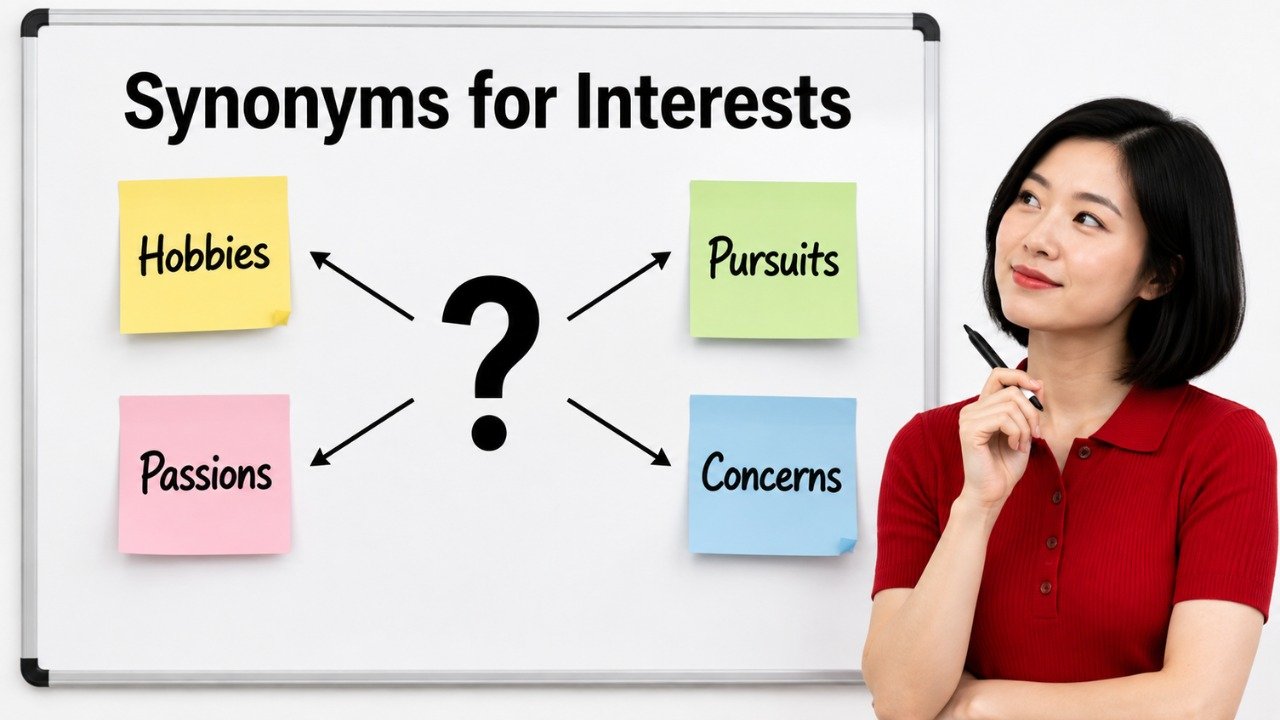
Quick Answer: The best synonyms for interests include hobbies, pursuits, passions, concerns, preferences, curiosities, activities, affairs, stakes, and benefits. Use hobbies for enjoyable activities, pursuits for activities followed seriously, passions for strong enthusiasm, concerns for matters that affect someone, and preferences for personal likes. Curiosities works when interests involve a desire to learn, while stakes and benefits are better when interests refer to financial, professional, legal, or personal advantage.
Pronunciation and Word Details
Word: Interests.
Pronunciation: /ˈɪntrəsts/
Part of Speech: Plural noun and verb.
Meaning: Things that attract attention, create enjoyment, matter to someone, or provide a personal or practical benefit.
US Pronunciation:
UK Pronunciation:
What Does “Interests” Mean?
Interests are subjects, activities, concerns, or advantages that attract a person’s attention or matter to them.
As a plural noun, interests can describe hobbies and activities someone enjoys. A person’s interests might include reading, gardening, photography, music, history, or travel.
The word can also describe subjects that create curiosity. Someone with interests in science and language may enjoy learning about those subjects even if they do not participate in them as hobbies.
In professional, financial, or legal contexts, interests can refer to benefits, rights, investments, concerns, or stakes that a person or organization wants to protect.
As a verb, interests means attracts someone’s attention or curiosity.
Example: The subject interests her because she enjoys learning how languages change.
Because interests has several meanings, the best synonym depends heavily on the sentence.
Meaning, Tone, and Context of “Interests”
Interests is generally a neutral and versatile word. It works naturally in casual conversation, professional communication, academic writing, personal descriptions, and formal discussions.
When referring to enjoyable activities, interests has a friendly and conversational tone.
Example: Her interests include painting, cooking, and local history.
When referring to subjects of study, the word can sound academic or intellectual.
Example: His research interests include language development and memory.
In business, legal, or financial contexts, interests can sound more formal because it may refer to benefits, ownership, concerns, or financial stakes.
Example: The agreement was designed to protect the interests of both parties.
The word can therefore express enjoyment, curiosity, involvement, concern, preference, or advantage depending on context.
When and How to Use “Interests”
For Hobbies: Use interests when describing activities someone enjoys during free time.
Example: Her interests include gardening, photography, and cooking.
For Personal Preferences: Use interests when referring broadly to subjects or activities someone likes.
Example: The program allows students to explore their individual interests.
For Curiosity: Use interests when describing topics that attract attention or encourage learning.
Example: His interests in astronomy began when he was a child.
For Academic Subjects: Use interests when discussing areas of study or research.
Example: Her academic interests include psychology and language development.
For Professional Concerns: Use interests when referring to matters that affect a person, group, or organization.
Example: The committee considered the interests of local residents.
For Financial Matters: Use interests when referring to financial advantages, investments, or ownership stakes.
Example: The partners disclosed their financial interests before the meeting.
For Personal Advantage: Use interests when describing what benefits someone.
Example: She made the decision based on her long term interests.
For Attention: Use interests as a verb when something attracts curiosity.
Example: Modern architecture interests him because of its unusual forms.
Best Synonyms for Interests
Hobbies: Activities regularly enjoyed for pleasure.
Example: Painting and gardening are two of her favorite hobbies.
Pursuits: Activities or goals that someone follows with continued effort or enthusiasm.
Example: Music and writing became important creative pursuits for him.
Passions: Subjects or activities that create strong enthusiasm.
Example: History and architecture are among her greatest passions.
Concerns: Matters that affect someone or deserve attention.
Example: Safety and affordability are major concerns for residents.
Preferences: Things someone likes or chooses over alternatives.
Example: The survey asked participants about their reading preferences.
Curiosities: Subjects or ideas that create a desire to know more.
Example: His scientific curiosities encouraged him to study the natural world.
Activities: Things someone does for recreation, work, learning, or participation.
Example: Outdoor activities occupy much of her free time.
Affairs: Matters or areas of activity that involve a person, organization, or community.
Example: He remained involved in community affairs.
Stakes: Financial, personal, or practical involvement in an outcome.
Example: Several investors have significant stakes in the project.
Benefits: Advantages or positive outcomes that someone receives.
Example: The decision was made with the benefits of both groups in mind.
50 Synonyms for Interests with Short Meanings
- Hobbies: Activities enjoyed during free time.
- Pursuits: Activities or goals followed with effort.
- Passions: Subjects or activities that inspire strong enthusiasm.
- Concerns: Matters that affect or matter to someone.
- Preferences: Things someone likes more than alternatives.
- Curiosities: Subjects that create a desire to learn.
- Activities: Things someone regularly does.
- Affairs: Matters involving a person or group.
- Stakes: Personal or financial involvement in an outcome.
- Benefits: Advantages received from something.
- Enthusiasms: Subjects or activities that create excitement.
- Likes: Things someone enjoys or prefers.
- Tastes: Personal preferences in style, culture, or choice.
- Inclinations: Natural tendencies toward certain choices or activities.
- Pastimes: Enjoyable activities done during free time.
- Recreations: Activities enjoyed for relaxation or pleasure.
- Avocations: Activities pursued outside a person’s main occupation.
- Diversions: Activities that provide enjoyment or distraction.
- Preoccupations: Subjects that occupy much of someone’s attention.
- Fascinations: Things that create powerful interest or attraction.
- Attractions: Things that draw attention or appeal.
- Appeals: Qualities or subjects that create interest.
- Preferences: Favored choices or personal likes.
- Leanings: Natural preferences toward particular ideas or activities.
- Predilections: Strong natural preferences for certain things.
- Penchants: Noticeable tendencies to like particular activities or ideas.
- Tendencies: Usual directions of preference or behavior.
- Concerns: Subjects that require attention or consideration.
- Priorities: Matters considered especially important.
- Needs: Things necessary or important to someone.
- Welfare: A person’s or group’s well being and benefit.
- Advantage: A favorable position or benefit.
- Advantages: Positive conditions or benefits.
- Gains: Benefits or improvements obtained from something.
- Rewards: Positive results received from an action.
- Profit: Financial or practical benefit.
- Shares: Portions of ownership or involvement.
- Holdings: Property, investments, or assets owned.
- Investments: Money, resources, or involvement committed for future benefit.
- Claims: Rights or demands connected with something.
- Rights: Legal or recognized entitlements.
- Involvements: Connections or participation in activities or matters.
- Connections: Relationships or associations with something.
- Commitments: Responsibilities or activities requiring continued involvement.
- Specialties: Subjects or activities in which someone has particular interest or skill.
- Fields: Areas of study, work, or activity.
- Subjects: Topics that attract study or attention.
- Topics: Matters discussed, studied, or explored.
- Focuses: Main areas receiving attention.
- Motivations: Reasons or desires that encourage involvement.
Read Also:
Synonyms for Rain

Synonyms for Interests by Context
When Interests Means Hobbies
When interests refers to enjoyable activities, good synonyms include hobbies, pastimes, pursuits, recreations, activities, and avocations.
Hobbies: Best for activities regularly enjoyed during free time.
Example: Photography is one of her favorite hobbies.
Pastimes: Best for pleasant activities used for relaxation.
Example: Reading became his favorite evening pastime.
Pursuits: Best for activities that involve dedication or continued effort.
Example: Writing and painting are her main creative pursuits.
Activities: A broad alternative for things someone does.
Example: The center offers activities for people with different interests.
When Interests Means Strong Enthusiasm
When interests describes subjects someone cares deeply about, passions, enthusiasms, fascinations, and pursuits are stronger alternatives.
Passions: Suggests powerful enthusiasm and emotional involvement.
Example: Music and literature are lifelong passions for her.
Enthusiasms: Emphasizes excitement about particular subjects.
Example: His many enthusiasms include history and architecture.
Fascinations: Suggests powerful curiosity or attraction.
Example: Ancient cultures became one of her greatest fascinations.
When Interests Means Preferences
When interests describes personal likes, preferences, tastes, inclinations, leanings, and penchants can be more precise.
Preferences: Best for choices someone favors.
Example: The questionnaire asks about personal preferences.
Tastes: Common when discussing style, entertainment, food, art, or culture.
Example: Their musical tastes are very different.
Inclinations: Suggests a natural tendency toward something.
Example: His artistic inclinations appeared at an early age.
When Interests Means Concerns
When interests refers to matters that affect someone, concerns, priorities, welfare, needs, and affairs are useful alternatives.
Concerns: Best when discussing issues that matter to someone.
Example: The proposal addresses the concerns of local families.
Priorities: Best for matters considered especially important.
Example: Safety remains one of the community’s main priorities.
Welfare: Best when discussing someone’s well being or protection.
Example: The decision should protect the welfare of everyone involved.
When Interests Means Financial or Personal Advantage
In financial, business, or legal contexts, interests may refer to stakes, holdings, investments, benefits, rights, or shares.
Stakes: Best when someone has something to gain or lose.
Example: Several partners have financial stakes in the company.
Holdings: Best for property, investments, or assets that someone owns.
Example: The investor reviewed her overseas holdings.
Benefits: Best when referring to positive outcomes or advantages.
Example: The policy should consider the benefits available to employees.
Rights: Best when interests involve legal entitlement or protection.
Example: The agreement protects the rights of both parties.
When Interests Is Used as a Verb
When interests means attracts attention, good alternatives include fascinates, attracts, engages, intrigues, appeals to, and captivates.
Fascinates: Suggests strong curiosity.
Example: Space exploration fascinates many young learners.
Intrigues: Suggests curiosity created by something unusual or mysterious.
Example: The unanswered question intrigues her.
Engages: Suggests successfully holding attention.
Example: The story engages readers from the opening chapter.
Another Word for Interests
Another word for interests is often hobbies when the sentence describes enjoyable activities. However, the best replacement depends on meaning. Pursuits works for serious activities, passions for strong enthusiasm, concerns for important matters, preferences for personal likes, and stakes for financial or practical involvement.
Original: Her interests include painting and gardening.
Better Option: Her hobbies include painting and gardening.
Original: His interests in music have shaped his career.
Better Option: His passions in music have shaped his career.
Original: The committee considered the interests of residents.
Better Option: The committee considered the concerns of residents.
Original: She has business interests in several industries.
Better Option: She has investments in several industries.
When Not to Use “Interests”
Interests is useful because it has several meanings, but that flexibility can sometimes make a sentence less precise.
Avoid using interests when a more specific word would explain exactly what you mean.
Weak: She has many interests outside work.
Better: She has many hobbies outside work.
Hobbies is clearer when referring specifically to recreational activities.
Weak: His interests were ignored during the negotiations.
Better: His concerns were ignored during the negotiations.
Concerns makes the meaning more specific when discussing matters that affect someone.
Weak: She has interests in three businesses.
Better: She has investments in three businesses.
Investments is more precise if money or ownership is involved.
Weak: The lesson interests the students.
Better: The lesson engages the students.
Engages may be more natural when describing attention during a lesson.
Do not repeat interests several times within a short paragraph when more precise alternatives can improve readability.
Weak: Her interests include art, and her academic interests include history, while her professional interests include education.
Better: Her hobbies include art, her academic focus includes history, and her professional pursuits involve education.
Words Commonly Confused With Interests
Interests vs Hobbies: Interests is broader. A hobby is an activity performed for enjoyment, while an interest can be any topic, activity, subject, concern, or area that attracts attention.
Interests vs Passions: Interests can be mild or strong. Passions suggests much deeper enthusiasm or emotional involvement.
Interests vs Preferences: Interests describe what attracts someone’s attention, while preferences describe what someone favors when choosing between options.
Interests vs Concerns: Interests can describe enjoyable subjects, while concerns usually describe matters that affect someone or require attention.
Interests vs Activities: Activities are things people do. Interests may include activities, but they can also include ideas and subjects that someone enjoys learning about.
Interests vs Priorities: Interests are things someone cares about or enjoys. Priorities are things considered especially important and deserving attention first.
Interests vs Stakes: Interests is broad, while stakes usually refers to something a person may gain, lose, own, or protect.
Interests vs Investments: Interests can refer broadly to financial involvement, while investments specifically involve money, assets, or resources committed for future benefit.
Which Synonym Should You Choose?
Choose hobbies when describing enjoyable activities someone does during free time.
Choose pursuits when describing activities that require continued effort, dedication, or personal development.
Choose passions when you want to express powerful enthusiasm or emotional involvement.
Choose preferences when describing choices, tastes, or things someone favors.
Choose concerns when referring to matters that affect an individual, community, or organization.
Choose priorities when certain interests are more important than others and deserve attention first.
Choose activities when you need a broad and simple word for things someone does.
Choose fascinations when a subject creates unusually strong curiosity.
Choose stakes when discussing financial, professional, personal, or practical involvement in an outcome.
Choose investments or holdings when writing specifically about financial ownership.
In reports and formal writing, concerns, priorities, stakes, holdings, and pursuits often provide greater precision than interests.
In casual conversation, hobbies, likes, passions, and activities usually sound more natural.
In essays and academic writing, pursuits, fields, subjects, focuses, and concerns can help make the intended meaning clearer.
Real Life Examples of “Interests” in Sentences
Original: Her interests include cooking, reading, and photography.
Better Option: Her hobbies include cooking, reading, and photography.
Original: His interests changed as he became older.
Better Option: His preferences changed as he became older.
Original: Science has always been one of her strongest interests.
Better Option: Science has always been one of her greatest passions.
Original: The program supports students with different interests.
Better Option: The program supports students with different pursuits.
Original: The decision should reflect the interests of the community.
Better Option: The decision should reflect the concerns of the community.
Original: The lawyer represented the interests of the client.
Better Option: The lawyer protected the rights of the client.
Original: She has financial interests in several projects.
Better Option: She has investments in several projects.
Original: Ancient history interests him greatly.
Better Option: Ancient history fascinates him greatly.
Original: The teacher selected topics that interest the class.
Better Option: The teacher selected topics that engage the class.
Original: They worked together because their interests were similar.
Better Option: They worked together because their priorities were similar.
Synonym Groups and Usage Differences
Hobby Group
Hobbies, pastimes, recreations, activities, and avocations describe activities people enjoy in their free time. Hobbies is the most common everyday choice, while avocations sounds more formal.
Example: Gardening became one of her favorite hobbies.
Enthusiasm Group
Passions, enthusiasms, fascinations, and pursuits describe subjects or activities that receive strong attention. Passions expresses the strongest emotional enthusiasm.
Example: Music has remained one of his greatest passions.
Preference Group
Preferences, tastes, inclinations, leanings, and penchants describe personal tendencies or favored choices. Preferences is the most neutral and widely useful term.
Example: The survey revealed changing consumer preferences.
Concern Group
Concerns, priorities, needs, welfare, and affairs describe matters that affect someone or require consideration.
Example: The council listened carefully to residents’ concerns.
Financial Group
Stakes, holdings, investments, shares, claims, and benefits describe financial, legal, or practical involvement.
Example: She sold several of her investment holdings.
Curiosity Group
Curiosities, fascinations, attractions, subjects, and topics describe things that capture attention or encourage learning.
Example: Astronomy was one of his earliest fascinations.
Attention Group
Fascinates, intrigues, engages, attracts, and captivates can replace interests when interests functions as a verb.
Example: The mystery intrigues readers because the answer remains uncertain.
Antonyms of Interests
Because interests has several meanings, its opposites also change according to context.
Dislikes: Things someone does not enjoy.
Aversions: Strong feelings of dislike or avoidance.
Indifference: Lack of interest, concern, or enthusiasm.
Disinterest: Absence of personal interest or involvement.
Boredom: Lack of excitement or engagement.
Apathy: Lack of enthusiasm, concern, or motivation.
Neglect: Failure to give something proper attention.
Disadvantages: Unfavorable conditions rather than benefits.
Losses: Negative results rather than gains or advantages.
Liabilities: Responsibilities or disadvantages that may create difficulty.
Opposition: A position against an idea, goal, or concern.
Detachment: Lack of emotional or personal involvement.
Comparison: Interests vs Related Words
Interests vs Hobbies
Interests is broader than hobbies. An interest can be a subject someone enjoys learning about without actively practicing it. A hobby normally involves an activity done for enjoyment.
Example With Interests: Her interests include astronomy and ancient history.
Example With Hobbies: Her hobbies include painting and gardening.
Interests vs Passions
An interest may involve mild curiosity, while a passion suggests deep enthusiasm and commitment.
Example With Interests: Photography is one of his interests.
Example With Passions: Photography is one of his greatest passions.
Interests vs Pursuits
Interests may simply attract attention, while pursuits normally involve action, effort, or continued participation.
Example With Interests: She has an interest in creative writing.
Example With Pursuits: Creative writing is one of her main artistic pursuits.
Interests vs Preferences
Interests describe subjects or activities someone likes or cares about. Preferences describe choices someone favors over alternatives.
Example With Interests: Her interests include literature and music.
Example With Preferences: Her reading preferences include historical fiction.
Interests vs Concerns
Interests can be enjoyable or beneficial, while concerns usually involve matters that affect someone or deserve attention.
Example With Interests: The students have varied academic interests.
Example With Concerns: The students expressed concerns about the new schedule.
Interests vs Priorities
Interests are things someone likes, values, or cares about. Priorities are matters considered more important than others.
Example With Interests: Travel and photography are among her interests.
Example With Priorities: Education and financial security are her main priorities.
Interests vs Stakes
Interests is a broad term, while stakes emphasizes what someone may gain, lose, own, or risk.
Example With Interests: Several groups have interests in the proposal.
Example With Stakes: Several investors have financial stakes in the project.
Interests vs Fascinations
An interest can be moderate, while a fascination usually involves stronger curiosity and sustained attention.
Example With Interests: Marine biology is one of his interests.
Example With Fascinations: Deep sea life has been a lifelong fascination for him.
Common Phrases and Expressions With “Interests”
Personal Interests: Subjects, activities, or goals that matter to an individual.
Example: The application asks candidates to describe their personal interests.
Common Interests: Activities, subjects, or concerns shared by two or more people.
Example: Their common interests helped them work well together.
Shared Interests: Interests held by multiple people or groups.
Example: The partnership developed from shared interests.
Academic Interests: Subjects or fields someone enjoys studying.
Example: Her academic interests include linguistics and psychology.
Research Interests: Areas or subjects someone studies through research.
Example: His research interests focus on language and memory.
Professional Interests: Career related subjects, goals, or areas of involvement.
Example: She attended events connected with her professional interests.
Financial Interests: Investments, ownership, benefits, or financial involvement.
Example: Participants were asked to disclose their financial interests.
Business Interests: Commercial activities, investments, or ownership connections.
Example: The family has business interests in several industries.
Best Interests: The conditions or actions most beneficial to someone.
Example: The decision was made in the child’s best interests.
Conflict of Interests: A situation in which competing personal or professional concerns may influence judgment.
Example: The organization introduced rules designed to prevent conflicts of interests.
Common Mistakes to Avoid
One common mistake is assuming interests always means hobbies. The word has several meanings, including concerns, benefits, financial involvement, preferences, and subjects of curiosity.
Choose a synonym that matches the intended meaning rather than replacing interests automatically.
Another mistake is using hobbies for subjects that someone only studies or thinks about.
Unnatural: His hobbies include economic history and political theory, although he only reads about them occasionally.
Better: His interests include economic history and political theory.
Avoid using passions when the feeling is mild. Passion suggests strong enthusiasm and can exaggerate the original meaning.
Too Strong: Filing documents is one of her passions.
Better: Filing and organization are among her professional interests.
Avoid using preferences when you actually mean hobbies.
Unclear: Her preferences include swimming and hiking.
Better: Her interests include swimming and hiking.
In financial contexts, interests may be too vague when the exact form of involvement is known. Consider investments, holdings, shares, or stakes.
Repetition is another common problem. If interests appears several times in one paragraph, use precise alternatives where appropriate.
Finally, remember that interests can function as both a plural noun and a verb. Make sure the replacement matches the grammar of the sentence.
Noun: Her interests include art and history.
Verb: Modern art interests her.
A noun synonym such as hobbies cannot directly replace the verb interests in the second sentence. A verb such as fascinates, intrigues, or engages is required.
Conclusion
The best synonyms for interests depend on what the word means in the sentence. Hobbies, pastimes, and pursuits work well for enjoyable activities, while passions and fascinations express stronger enthusiasm. Preferences and tastes describe personal choices, concerns and priorities suit important matters, and stakes, holdings, or investments fit financial contexts. When interests functions as a verb, fascinates, intrigues, attracts, and engages are useful alternatives. Understanding these distinctions helps you choose synonyms for interests that sound natural, precise, and appropriate for each context.
FAQs About Synonyms for Interests
What Is the Best Synonym for Interests?
The best synonym depends on context. Hobbies works for recreational activities, pursuits for serious activities, passions for strong enthusiasm, concerns for important matters, and stakes for financial or practical involvement.
What Is Another Word for Personal Interests?
Good alternatives include hobbies, preferences, pursuits, passions, tastes, and activities. The best choice depends on whether you mean activities, subjects, or personal preferences.
What Is a Formal Synonym for Interests?
Pursuits, concerns, priorities, affairs, holdings, and stakes can work in formal contexts. Choose the term that most accurately describes the type of interest involved.
What Is Another Word for Hobbies and Interests?
Pursuits is one of the best broad alternatives. Pastimes, activities, recreations, passions, and avocations can also work depending on the sentence.
What Is a Stronger Word Than Interests?
Passions and fascinations are stronger when describing enthusiasm. Priorities is stronger when describing importance, while stakes can be stronger when something valuable may be gained or lost.
What Are Synonyms for Interests in a Professional Context?
Useful choices include professional pursuits, concerns, priorities, specialties, fields, focuses, affairs, and areas of involvement.
Can Interests Mean Financial Ownership?
Yes. In financial or business contexts, interests can describe ownership, investment, or financial involvement. More precise alternatives include stakes, shares, holdings, investments, and claims.
