
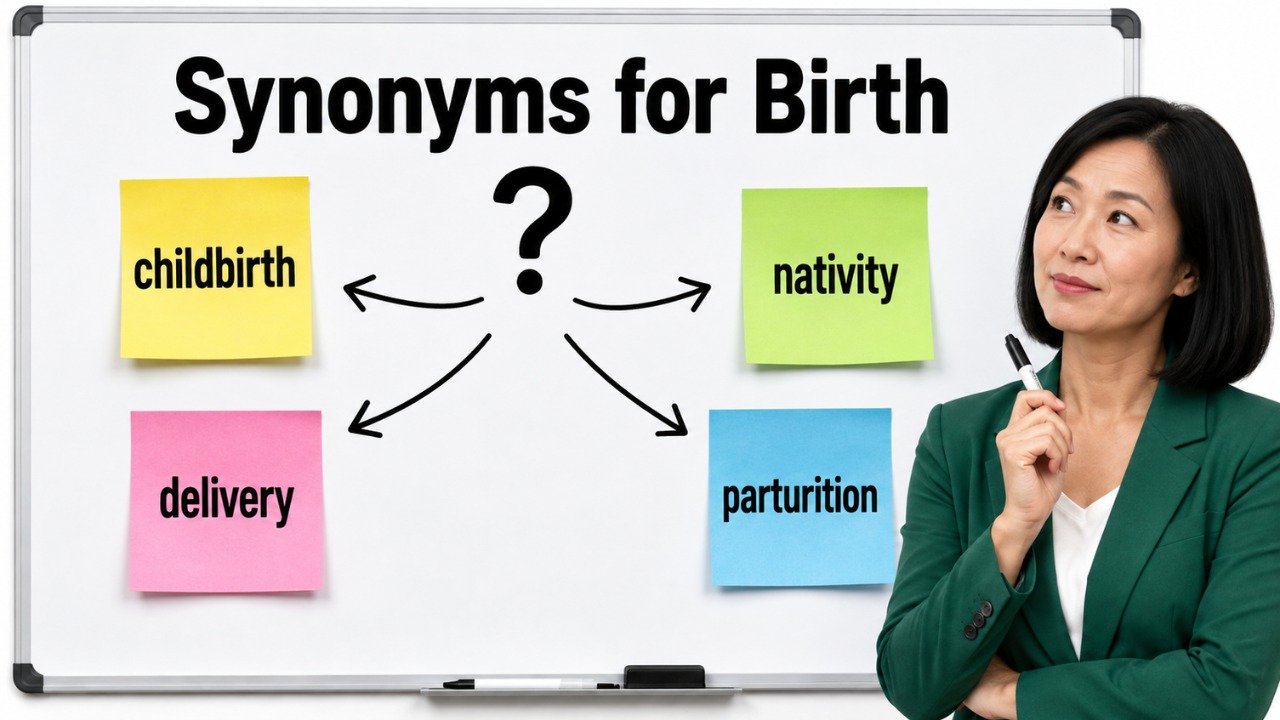
Quick Answer: The best synonyms for birth include childbirth, delivery, nativity, arrival, beginning, origin, emergence, genesis, inception, and creation. Among these synonyms for birth, childbirth and delivery are best for the physical process of having a baby, nativity works in formal or literary contexts, arrival can describe a baby’s entrance into the world, while origin, beginning, genesis, inception, and emergence are stronger when birth refers figuratively to the start of an idea, movement, organization, or new development.
Pronunciation and Word Details
Word: Birth.
Pronunciation: /bɜːrθ/
Part of Speech: Noun.
Meaning: The act of being born or the beginning, origin, or creation of something.
US Pronunciation:
UK Pronunciation:
What Does “Birth” Mean?
Birth means the act or process of a baby or young animal coming into the world. It can also mean the beginning, origin, or creation of something.
As a noun, birth is commonly connected with pregnancy, childbirth, family relationships, ancestry, and the beginning of life.
Example: The family celebrated the birth of their daughter.
Birth also has an important figurative meaning. Writers may speak about the birth of an idea, organization, movement, tradition, invention, or new period.
Example: The discovery led to the birth of a new research field.
The word can also refer to a person’s family background or social origin.
Example: The document recorded his place of birth.
Because birth has several meanings, the best synonym changes according to context. Delivery may replace birth in a medical situation, while genesis, origin, or inception may be more natural when discussing the beginning of something abstract.
Meaning, Tone, and Context of “Birth”
Birth is generally a neutral word, but its tone can become emotional, formal, medical, historical, literary, or symbolic depending on context.
In everyday conversation, birth usually refers to the arrival of a baby.
Everyday Use: They announced the birth of their first child.
In medical contexts, childbirth and delivery are often more specific because they describe the physical process.
Medical Use: The patient recovered well after delivery.
In formal records, birth appears in expressions such as date of birth, place of birth, birth certificate, and birth record.
Formal Use: Please provide your date of birth.
In historical or academic writing, birth can describe the beginning of an institution, movement, theory, or period.
Academic Use: The invention contributed to the birth of a new industry.
In literary writing, terms such as genesis, emergence, dawn, and origin may create a more expressive tone.
Literary Use: The novel explores the birth of a powerful new idea.
The word itself is usually clear and neutral. However, choosing a more specific synonym can make writing more accurate and natural.
When and How to Use “Birth”
For the Arrival of a Baby
Use birth when referring generally to a baby coming into the world.
Example: The grandparents were delighted by the birth of their grandson.
For the Process of Childbirth
Use birth when discussing the overall experience of giving birth, although childbirth or delivery may be more specific.
Example: She prepared carefully for the birth.
For Official Personal Information
Birth is appropriate when referring to identifying information about where or when someone was born.
Example: The application asks for your date of birth.
For the Beginning of an Idea
Birth can describe the moment when an idea first develops.
Example: That conversation marked the birth of their new project.
For the Creation of an Organization
Use birth figuratively to describe how an institution, movement, or organization began.
Example: The meeting led to the birth of a community initiative.
For Historical Developments
Birth is useful when describing the beginning of an era, practice, field, or cultural change.
Example: The invention helped shape the birth of modern communication.
For Literary or Symbolic Writing
Birth can represent renewal, creation, hope, or the appearance of something new.
Example: Spring was described as the birth of a new season.
Best Synonyms for Birth
Childbirth: The physical process through which a baby is born.
Example: The course helps parents prepare for childbirth.
Delivery: The process of giving birth, especially in medical contexts.
Example: The doctor discussed the safest options for delivery.
Nativity: The event or circumstances of being born, often used formally or historically.
Example: The historical record included details about his nativity.
Arrival: The coming of a baby into the world, often used warmly or informally.
Example: The family eagerly awaited the arrival of the baby.
Beginning: The point at which something starts.
Example: The meeting marked the beginning of a new partnership.
Origin: The point, place, or cause from which something begins.
Example: Researchers studied the origin of the tradition.
Genesis: The beginning or creation of something important.
Example: The book explains the genesis of the movement.
Emergence: The process of appearing or developing into existence.
Example: The decade saw the emergence of a new artistic style.
Inception: The formal beginning of an activity, organization, or process.
Example: The program has expanded considerably since its inception.
Creation: The act of bringing something new into existence.
Example: The agreement led to the creation of a new department.
50 Synonyms for Birth with Short Meanings
- Childbirth: The process of giving birth to a baby.
- Delivery: The process through which a baby is born.
- Nativity: The event or circumstances of being born.
- Arrival: The coming of a baby into the world.
- Parturition: The formal biological term for giving birth.
- Labor: The physical process leading to childbirth.
- Beginning: The point where something starts.
- Start: The first stage of something.
- Origin: The source or point where something begins.
- Genesis: The creation or earliest beginning of something.
- Inception: The point at which something formally begins.
- Commencement: The act or time of beginning.
- Outset: The earliest stage of an event or process.
- Onset: The beginning of a condition, event, or development.
- Dawn: The beginning of a new period or development.
- Emergence: The process of coming into existence or view.
- Creation: The act of bringing something into existence.
- Formation: The process of being created or developed.
- Foundation: The establishment or beginning of something.
- Establishment: The act of creating something that will continue.
- Institution: The act of beginning or establishing a system or practice.
- Origination: The act of causing something to begin.
- Initiation: The act of starting a process or activity.
- Introduction: The first appearance or beginning of something.
- Launch: The beginning of a project, product, or activity.
- Rise: The beginning or growth of something influential.
- Development: The process through which something begins to grow.
- Evolution: Gradual development from an earlier form.
- Appearance: The act of coming into existence or becoming visible.
- Advent: The arrival or beginning of an important development.
- Coming: The arrival or appearance of something new.
- Opening: The initial stage or beginning.
- Source: The place or cause from which something originates.
- Root: The fundamental origin of something.
- Rooting: The process of becoming established or originating.
- Provenance: The origin or source of something.
- Derivation: The source or process from which something develops.
- Descent: Family origin or ancestry.
- Lineage: A line of family descent.
- Ancestry: Family background or descent.
- Parentage: The identity or background of someone’s parents.
- Extraction: Family, social, or cultural origin.
- Heritage: Background inherited from earlier generations.
- Production: The act of producing or creating something.
- Generation: The act or process of bringing something into existence.
- Constitution: The act of forming or establishing something.
- Establishment point: The moment something becomes formally established.
- Starting point: The place or moment from which something begins.
- First appearance: The earliest occurrence or manifestation of something.
- Coming into being: The process of beginning to exist.
Read Also:
Synonyms for Living

Synonyms for Birth by Context
When Birth Means Childbirth
When birth refers to the physical process of having a baby, the strongest alternatives are childbirth, delivery, parturition, labor, and arrival.
Example: She remained calm throughout the birth.
Alternative: She remained calm throughout the delivery.
Childbirth is a broad and natural term for the entire physical process.
Example: The class provided practical information about childbirth.
Delivery is common when discussing medical care.
Example: The medical team prepared for the delivery.
Parturition is a technical biological term and is much less common in everyday conversation.
Example: Researchers examined the biological stages of parturition.
When Birth Means the Beginning of Something
When birth refers figuratively to a beginning, useful synonyms include beginning, start, inception, commencement, outset, onset, and dawn.
Example: The event marked the birth of a new tradition.
Alternative: The event marked the beginning of a new tradition.
Inception works particularly well in professional or formal writing.
Example: The organization has grown steadily since its inception.
Dawn is more expressive and often describes the beginning of an era.
Example: The discovery signaled the dawn of a new period in research.
When Birth Means Origin
When birth refers to where something came from, origin, source, genesis, root, provenance, and derivation may be better choices.
Example: Historians studied the birth of the custom.
Alternative: Historians studied the origin of the custom.
Genesis emphasizes the earliest creation or development of something.
Example: The article examines the genesis of the idea.
Root often identifies the deeper cause or background of something.
Example: The investigation explored the roots of the conflict.
When Birth Means Creation
When birth describes bringing something new into existence, creation, formation, establishment, origination, initiation, and foundation can be useful.
Example: The agreement led to the birth of a new organization.
Alternative: The agreement led to the creation of a new organization.
Formation is particularly natural for groups, structures, institutions, and systems.
Example: The discussion resulted in the formation of a committee.
When Birth Refers to Family Origin
When birth concerns ancestry or family background, descent, lineage, ancestry, parentage, extraction, and heritage may fit.
Example: He was noble by birth.
Alternative: He came from a noble lineage.
Descent focuses on family connection across generations.
Example: She is of mixed descent.
Heritage has a broader meaning that can include family, culture, customs, and history.
Example: He takes great interest in his family heritage.
Another Word for Birth
The best general replacement for birth is beginning when the word refers figuratively to the start of something. For the physical process of a baby being born, childbirth or delivery is usually more accurate.
The best synonym therefore depends on meaning.
Original: The agreement marked the birth of a new partnership.
Better Option: The agreement marked the beginning of a new partnership.
Original: She prepared carefully for the birth.
Better Option: She prepared carefully for childbirth.
Original: Historians discussed the birth of the movement.
Better Option: Historians discussed the genesis of the movement.
Original: The family celebrated the birth of their daughter.
Better Option: The family celebrated the arrival of their daughter.
When Not to Use “Birth”
Birth is a useful and familiar word, but another term may sometimes be clearer or more precise.
Do not use birth when the physical process is the main subject and a medical term would be more accurate.
Weak: The doctor explained how the birth would be managed medically.
Better: The doctor explained how the delivery would be managed medically.
Avoid repeating birth several times in the same paragraph when different meanings are involved.
Weak: The birth of the organization followed the birth of an idea that inspired its birth as a formal group.
Better: The organization began with an idea that eventually led to its formal establishment.
Do not use birth figuratively when the comparison sounds forced.
Weak: The new chair caused the birth of a different seating arrangement.
Better: The new chair led to a different seating arrangement.
Avoid using genesis merely as a more sophisticated replacement for every use of birth. Genesis is best for origins or beginnings, not literal childbirth.
Weak: The family celebrated the genesis of their baby.
Better: The family celebrated the birth of their baby.
Use ancestry, lineage, or descent instead of birth when family background is the main meaning.
Weak: The research focused on his birth over several generations.
Better: The research focused on his ancestry over several generations.
Words Commonly Confused With Birth
Birth vs Childbirth: Birth can mean either a baby coming into the world or the beginning of something. Childbirth refers specifically to the physical process of giving birth.
Birth vs Delivery: Birth is the broader everyday term. Delivery is often used when discussing the medical process through which a baby is born.
Birth vs Labor: Labor refers to the physical process that occurs before and during childbirth. Birth refers to the event or result of a baby coming into the world.
Birth vs Origin: Birth can describe both literal childbirth and figurative beginnings. Origin refers to the source or starting point of something.
Birth vs Genesis: Birth is common and flexible. Genesis usually refers to the earliest origin or creation of an idea, institution, movement, or development.
Birth vs Inception: Birth can be literal or figurative. Inception refers specifically to the point where an activity, system, organization, or process begins.
Birth vs Creation: Birth emphasizes coming into existence, while creation emphasizes the act of producing or making something.
Birth vs Ancestry: Birth may refer generally to someone’s family or social origin. Ancestry specifically concerns earlier generations and family descent.
Which Synonym Should You Choose?
Choose childbirth when discussing the full physical process of having a baby.
Choose delivery when discussing birth in a medical or clinical setting.
Choose arrival when describing the birth of a baby in a warm, conversational, or celebratory way.
Choose nativity in formal, historical, or literary writing about someone’s birth.
Choose beginning when you need a simple and widely understood replacement for figurative birth.
Choose origin when discussing where an idea, tradition, practice, or phenomenon came from.
Choose genesis when describing the earliest creation of an important idea, system, movement, or development.
Choose inception for formal writing about the start of an organization, project, policy, or process.
Choose emergence when something develops gradually and becomes noticeable or established.
Choose creation when emphasizing that something new was brought into existence.
Choose formation when discussing the development of a group, institution, structure, or system.
Choose descent or lineage when birth refers to family origin.
For reports and formal essays, inception, origin, formation, emergence, and genesis are often useful.
For casual conversation about a baby, birth and arrival usually sound the most natural.
For medical contexts, childbirth, labor, and delivery provide greater precision.
For historical writing, origin, genesis, emergence, and dawn can help distinguish different types of beginnings.
Real Life Examples of “Birth” in Sentences
Original: Everyone celebrated the birth of the baby.
Better Option: Everyone celebrated the arrival of the baby.
Original: She learned several relaxation techniques before the birth.
Better Option: She learned several relaxation techniques before childbirth.
Original: The hospital recorded the details of the birth.
Better Option: The hospital recorded the details of the delivery.
Original: The meeting marked the birth of a new organization.
Better Option: The meeting marked the formation of a new organization.
Original: Historians studied the birth of the movement.
Better Option: Historians studied the genesis of the movement.
Original: The invention contributed to the birth of a new industry.
Better Option: The invention contributed to the emergence of a new industry.
Original: The conversation led to the birth of an interesting idea.
Better Option: The conversation led to the creation of an interesting idea.
Original: The book examines the birth of the tradition.
Better Option: The book examines the origin of the tradition.
Original: The agreement represented the birth of a lasting partnership.
Better Option: The agreement represented the beginning of a lasting partnership.
Original: His social position was influenced by birth.
Better Option: His social position was influenced by family background and lineage.
Synonym Groups and Usage Differences
Childbirth Group
Childbirth, delivery, parturition, labor, and arrival relate to a baby being born.
Childbirth describes the overall process. Delivery is often associated with medical care. Labor describes the physical process before and during birth. Parturition is technical. Arrival is warmer and more figurative.
Example: The family was excited about the baby’s arrival.
Beginning Group
Beginning, start, inception, commencement, outset, onset, and opening describe the first point of something.
Beginning is the broadest term. Inception is more formal. Outset usually refers to the earliest stage. Onset often describes the start of an event or condition.
Example: Expectations were clear from the outset.
Origin Group
Origin, genesis, source, root, provenance, and derivation focus on where something came from.
Origin is the most general. Genesis emphasizes initial creation. Source identifies where something begins or comes from. Root often describes a deeper cause or background.
Example: Scholars continue to debate the origin of the custom.
Creation Group
Creation, formation, establishment, origination, initiation, and foundation describe bringing something into existence.
Creation is broad. Formation suits organizations and structures. Establishment emphasizes making something stable or official.
Example: The agreement allowed the formation of a new committee.
Emergence Group
Emergence, rise, advent, development, appearance, and dawn describe something becoming visible, important, or established.
Emergence often suggests gradual development. Rise emphasizes increasing influence. Advent highlights the arrival of something significant.
Example: The period witnessed the emergence of new artistic techniques.
Ancestry Group
Descent, lineage, ancestry, parentage, extraction, and heritage describe family or personal origin.
Ancestry refers broadly to earlier generations, while lineage often emphasizes a direct line of descent.
Example: Researchers traced the family’s lineage through historical records.
Antonyms of Birth
The opposite of birth changes according to whether birth means the beginning of life, the creation of something, or the start of a process.
Death: The end of life.
Demise: Death or the ending of something.
End: The point where something stops.
Ending: The final part or conclusion of something.
Conclusion: The point at which an event, process, or activity finishes.
Termination: The formal ending of something.
Cessation: The stopping of an activity or process.
Extinction: The complete disappearance of a species, practice, or phenomenon.
Destruction: The act of causing something to cease existing.
Dissolution: The ending or breaking up of an organization or group.
Closure: The act or state of bringing something to an end.
Disappearance: The process of ceasing to be visible or present.
Comparison: Birth vs Related Words
Birth vs Childbirth
Birth is broader and may refer to the event itself or to the beginning of something. Childbirth specifically refers to the physical process through which a baby is born.
Example With Birth: The family announced the birth of their son.
Example With Childbirth: She attended classes to prepare for childbirth.
Birth vs Delivery
Birth is natural in both everyday and formal language. Delivery is especially common when medical care or the procedure is being discussed.
Example With Birth: The birth took place early in the morning.
Example With Delivery: The medical team prepared carefully for the delivery.
Birth vs Beginning
Birth can be used figuratively to describe a beginning, but beginning is more direct and neutral.
Example With Birth: The agreement marked the birth of a new partnership.
Example With Beginning: The agreement marked the beginning of a new partnership.
Birth vs Origin
Birth focuses on the event of coming into existence. Origin focuses more strongly on the source, cause, or earliest point.
Example With Birth: The documentary explores the birth of the movement.
Example With Origin: The documentary explores the origin of the movement.
Birth vs Genesis
Birth is common and versatile. Genesis has a more formal or literary quality and emphasizes initial creation.
Example With Birth: The conversation led to the birth of a new concept.
Example With Genesis: The book traces the genesis of the new concept.
Birth vs Inception
Birth can describe literal or figurative beginnings. Inception usually refers to the formal beginning of a project, organization, system, or activity.
Example With Birth: The meeting led to the birth of the program.
Example With Inception: The program has expanded since its inception.
Birth vs Emergence
Birth can suggest a definite beginning. Emergence often describes something gradually appearing or developing.
Example With Birth: The period marked the birth of a new literary style.
Example With Emergence: The period saw the emergence of a new literary style.
Birth vs Creation
Birth emphasizes coming into existence, while creation focuses on the action that produces something new.
Example With Birth: The proposal resulted in the birth of a new initiative.
Example With Creation: The proposal resulted in the creation of a new initiative.
Common Phrases and Expressions With “Birth”
Give Birth: To produce a baby through childbirth.
At Birth: At the time when a person or animal is born.
Date of Birth: The calendar date on which someone was born.
Place of Birth: The location where someone was born.
Birth Certificate: An official document recording details of a person’s birth.
Birth Rate: The number of births in a population during a particular period.
Birth Weight: The weight of a baby when it is born.
From Birth: Beginning at the time a person or animal was born.
Birth of an Idea: The moment when an idea begins or is first developed.
Birth of a Nation: The beginning or establishment of a nation.
Common Mistakes to Avoid
A common mistake is assuming that every synonym for birth can replace the word in every sentence.
Childbirth and delivery work for literal human birth, but they do not normally replace birth when the word means origin.
Incorrect: The delivery of modern science began through centuries of study.
Correct: The development of modern science occurred through centuries of study.
Another mistake is using labor as a complete synonym for birth. Labor refers primarily to the physical process before and during childbirth.
Unclear: The baby’s labor occurred early in the morning.
Better: The baby’s birth occurred early in the morning.
Avoid using highly formal words such as parturition in ordinary conversation unless a technical meaning is needed.
Unnatural: We are excited about the parturition of our first child.
Natural: We are excited about the birth of our first child.
Do not use genesis for literal human childbirth.
Incorrect: The family celebrated the genesis of their daughter.
Correct: The family celebrated the birth of their daughter.
Repetition can make writing sound mechanical.
Repetitive: The birth of the group followed the birth of an idea that led to the birth of a new campaign.
Improved: The group originated from an idea that eventually developed into a new campaign.
Be careful with origin and beginning. Origin focuses on where something came from, while beginning simply identifies its starting point.
Example: The origin of the custom is uncertain, but its recorded beginning dates from a later period.
Choose synonyms according to meaning, tone, and context rather than replacing birth mechanically.
Conclusion
The best synonyms for birth depend on whether you mean childbirth, arrival, origin, creation, or the beginning of something. Childbirth and delivery are strongest for the physical process, while arrival has a warmer tone. Beginning, genesis, inception, origin, emergence, and creation work well for figurative uses. Descent, lineage, and ancestry fit family background. Understanding these differences makes it easier to choose synonyms for birth that are accurate, natural, and appropriate for conversation, essays, reports, and formal writing.
FAQs About Synonyms for Birth
What Is the Best Synonym for Birth?
Childbirth is the best synonym when referring to the physical process of having a baby. Beginning or origin is usually better when birth is used figuratively.
What Is Another Word for the Birth of a Baby?
Childbirth, delivery, and arrival are useful alternatives. Arrival often sounds warmer and more celebratory, while delivery is common in medical contexts.
What Is a Formal Synonym for Birth?
Nativity can refer formally to being born, while parturition is a technical term for the biological process of giving birth.
What Is a Synonym for Birth When It Means Beginning?
Beginning, inception, genesis, commencement, emergence, dawn, and origin are useful choices depending on the exact context.
Is Genesis a Synonym for Birth?
Yes, when birth means the origin or creation of an idea, movement, organization, or development. Genesis is not a natural replacement for the literal birth of a baby.
What Is the Difference Between Birth and Delivery?
Birth is a broad term for a baby coming into the world. Delivery often refers more specifically to the medical process involved in childbirth.
Can Origin Replace Birth?
Yes, when birth refers to the source or earliest beginning of an idea, tradition, movement, or development. Origin cannot normally replace birth when discussing a baby being born.
