
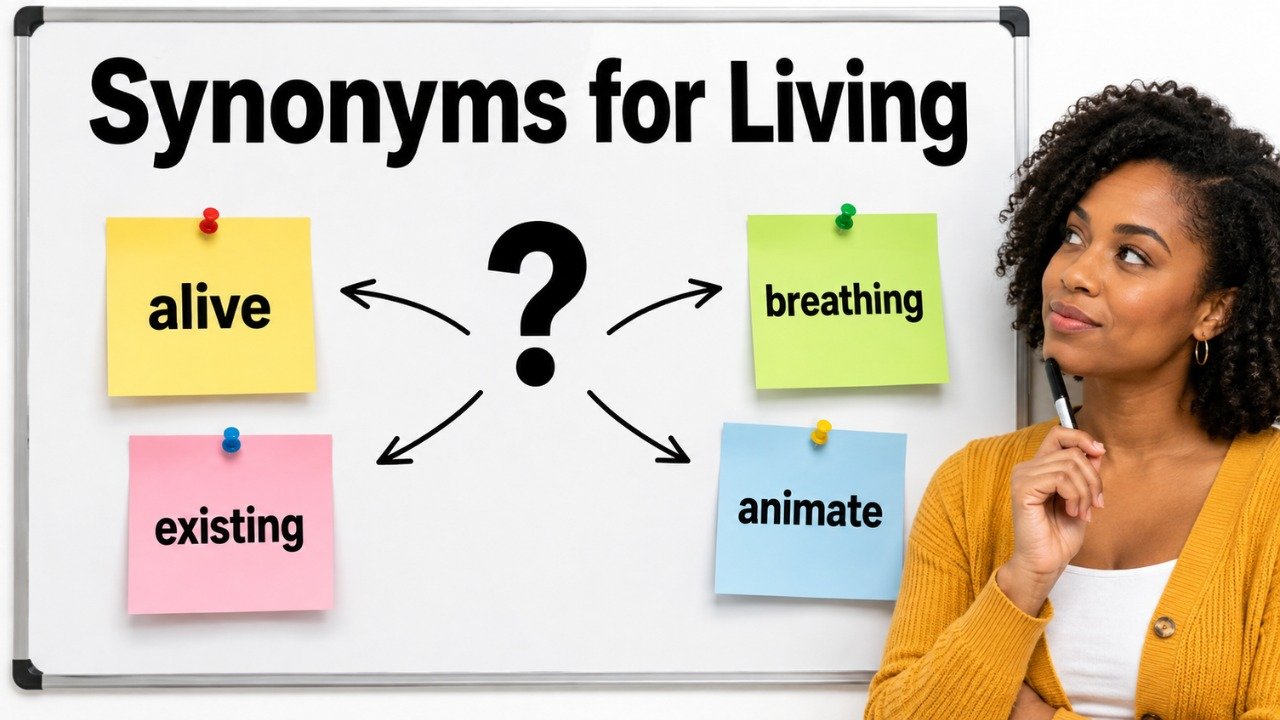
Quick Answer: The best synonyms for living include alive, existing, surviving, active, inhabited, occupied, livelihood, lifestyle, subsistence, and existence. Use alive when referring to a person, animal, or organism that has life. Use existing for something that continues to be present, inhabited for a place where people live, livelihood for the way someone earns money, and lifestyle for a person’s usual way of living. The right synonym depends on whether living describes life, survival, residence, income, or daily habits.
Pronunciation and Word Details
Word: Living.
Pronunciation: /ˈlɪvɪŋ/
Part of Speech: Adjective and noun. It is also the present participle and gerund form of the verb live.
Meaning: Having life, continuing to exist, residing somewhere, earning the necessities of life, or describing a person’s usual way of life.
US Pronunciation:
UK Pronunciation:
What Does “Living” Mean?
Living means being alive, continuing to exist, residing in a place, or having a particular way of life.
As an adjective, living commonly describes a person, animal, plant, or organism that is alive. For example, a living creature is one that currently has life.
Living can also describe something that continues to exist or remains relevant. A living tradition, for example, is a tradition that people continue to practice rather than one that exists only in history.
When connected with a place, living can refer to residence or everyday surroundings. Phrases such as living space, living conditions, and living environment describe where and how people reside.
As a noun, living can refer to someone’s livelihood or means of financial support. Someone who earns a living receives enough income through work or another activity to support everyday needs.
Living can also describe an overall lifestyle or way of life. Healthy living, simple living, and independent living all refer to particular approaches to everyday life.
Grammatically, living is also the present participle of live. In the sentence “They are living near the coast,” living describes the continuing action of residing somewhere.
Meaning, Tone, and Context of “Living”
Living is generally a neutral and widely used word. It appears naturally in everyday conversation, formal writing, academic discussion, health topics, economics, housing, biology, and descriptions of lifestyle.
When living means alive, its tone is factual and neutral. A scientist might discuss living organisms, while an ordinary speaker might refer to living relatives.
When living refers to lifestyle, it can take on a descriptive or emotional tone. Expressions such as peaceful living, comfortable living, and simple living suggest particular qualities of everyday life.
In financial contexts, living often relates to income and necessary expenses. Cost of living, living expenses, and earning a living are common expressions connected with money and basic needs.
In housing contexts, the word commonly appears in expressions such as living conditions, living arrangements, and living space.
Because living has several meanings, replacing it with a synonym requires attention to context. Alive may work perfectly in one sentence but sound completely wrong when living means livelihood or lifestyle.
When and How to Use “Living”
When Referring to Life
Use living when describing a person, animal, plant, or organism that has life.
Example: Scientists examined several living organisms from the pond.
When Describing Residence
Use living when explaining where someone currently resides.
Example: She is living with her sister while her apartment is being repaired.
When Discussing Income
Living can refer to the money or resources someone earns to support everyday needs.
Example: He makes a living by repairing musical instruments.
When Describing Lifestyle
Use living when discussing someone’s habits, routines, values, or general way of life.
Example: Simple living helped the family reduce unnecessary expenses.
When Discussing Housing Conditions
Living works naturally when referring to the quality or nature of someone’s residential environment.
Example: The building provides comfortable living conditions for its residents.
When Referring to Continued Existence
Living can describe traditions, languages, ideas, or customs that remain active and relevant.
Example: Storytelling remains a living tradition in the community.
When Talking About Current People
Living can distinguish people who are currently alive from historical figures who have died.
Example: She is one of the most respected living writers in the region.
Best Synonyms for Living
Alive
Synonym: Having life and not dead.
Example: All the passengers were found alive after the accident.
Existing
Synonym: Present or continuing to exist.
Example: The researchers examined existing forms of the tradition.
Surviving
Synonym: Continuing to live or remain after difficulty, danger, or loss.
Example: The surviving members of the family gathered for the ceremony.
Active
Synonym: Continuing to function, operate, or have influence.
Example: The custom remains active in several communities.
Inhabited
Synonym: Occupied by people or other living creatures.
Example: Only a few islands in the area are permanently inhabited.
Occupied
Synonym: Being used as a place where someone resides.
Example: The apartment remained occupied throughout the winter.
Livelihood
Synonym: A means of earning enough money to support oneself.
Example: Fishing provides a livelihood for many local families.
Lifestyle
Synonym: A person’s usual way of living.
Example: Regular exercise became an important part of her lifestyle.
Subsistence
Synonym: The basic means required to remain alive and meet essential needs.
Example: The workers earned barely enough for subsistence.
Existence
Synonym: The state of being or remaining alive.
Example: Water is essential to human existence.
50 Synonyms for Living with Short Meanings
- Alive: Having life and not dead.
- Existing: Currently present or continuing to be.
- Surviving: Remaining alive or continuing after difficulty.
- Breathing: Physically alive and taking in air.
- Animate: Possessing life or vitality.
- Vital: Full of life, energy, or essential activity.
- Active: Functioning, operating, or continuing in use.
- Extant: Still existing rather than lost or destroyed.
- Present: Existing or occurring at the current time.
- Current: Existing, happening, or relevant now.
- Survivant: Remaining alive or continuing to exist.
- Life: The state or condition of being alive.
- Existence: The state of being alive or present.
- Survival: Continued life or existence.
- Being: The state of existing.
- Inhabited: Lived in by people or animals.
- Occupied: Currently being used as a residence.
- Populated: Having people living in a particular area.
- Resident: Living in a particular place.
- Residing: Staying or having a home somewhere.
- Dwelling: Living or residing in a place.
- Staying: Temporarily or continually residing somewhere.
- Lodging: Staying in temporary accommodation.
- Settled: Established in a place of residence.
- Housed: Provided with or living in accommodation.
- Livelihood: A way of earning money for basic needs.
- Income: Money received to support one’s needs.
- Earnings: Money gained from work or activity.
- Subsistence: The means required for basic survival.
- Sustenance: Resources needed to support life.
- Support: Financial or practical means of maintaining life.
- Maintenance: Resources needed to sustain everyday needs.
- Provision: Resources supplied for someone’s needs.
- Living Wage: Income sufficient for basic everyday necessities.
- Means: Financial resources available for support.
- Lifestyle: A person’s typical way of life.
- Way of Life: The habits and conditions that shape daily existence.
- Mode of Life: A particular manner of living.
- Daily Life: Normal activities and experiences of everyday existence.
- Life Pattern: A repeated way of organizing everyday life.
- Routine: A regular pattern of daily activity.
- Existence Style: A particular manner of conducting one’s life.
- Habitation: The act or condition of living in a place.
- Residence: The state of living somewhere.
- Occupancy: The condition of residing in or using a place.
- Accommodation: A place provided for someone to live.
- Home Life: Everyday life within a household.
- Domestic Life: Life connected with the home and household.
- Living Conditions: The circumstances in which a person resides.
- Standard of Living: The level of comfort and resources available in everyday life.
Read Also:
Synonyms for Minimal
Synonyms for Living by Context
When Living Means Alive
When living refers to a person, animal, plant, or organism that has life, the strongest alternatives include alive, breathing, animate, surviving, and vital.
Example: The rescue team found a living animal beneath the debris.
Alternative: The rescue team found an alive animal beneath the debris.
Although alive is accurate, sentence structure matters. In natural English, it is usually better to write “found the animal alive” rather than “an alive animal.”
Example: No living relatives could be located.
Alternative: No surviving relatives could be located.
Surviving is especially useful when referring to people who remain alive after other members of a group have died.
When Living Means Existing
Living sometimes describes something that continues to exist, develop, or remain meaningful.
Useful alternatives include existing, active, extant, current, and continuing.
Example: The ceremony is a living tradition.
Alternative: The ceremony is an active tradition that continues today.
Existing emphasizes presence, while active suggests continued use or participation.
When Living Means Residing
When living refers to having a home or staying somewhere, useful alternatives include residing, dwelling, staying, settled, housed, and resident.
Example: They are living in a small coastal town.
Alternative: They are residing in a small coastal town.
Residing sounds slightly more formal than living and works well in official or descriptive writing.
When Living Means Livelihood
When living refers to earning enough money to support oneself, useful alternatives include livelihood, income, earnings, subsistence, support, and means.
Example: She earns a living as a photographer.
Alternative: Photography provides her livelihood.
Livelihood is one of the strongest formal replacements in this context.
When Living Means Lifestyle
When living refers to daily habits, values, routines, or personal choices, lifestyle, way of life, mode of life, daily life, and home life can be useful alternatives.
Example: Healthy living requires consistent habits.
Alternative: A healthy lifestyle requires consistent habits.
Lifestyle is usually the clearest substitute when discussing personal habits and behavior.
Another Word for Living
The best single alternative to living is often alive when the word refers to a person, animal, or organism that has life. However, no single synonym works for every meaning of living.
Use livelihood when discussing income, lifestyle when discussing habits, residing when discussing someone’s home, and existing when discussing continued presence.
Original: Only a few living members of the group remain.
Better Option: Only a few surviving members of the group remain.
Original: She is living in the city for six months.
Better Option: She is residing in the city for six months.
Original: He earns a living through carpentry.
Better Option: Carpentry provides his livelihood.
Original: Healthy living became her priority.
Better Option: A healthy lifestyle became her priority.
When Not to Use “Living”
Living is a useful word, but another term may be more precise when the exact meaning matters.
Avoid relying on living when the sentence could refer to several different ideas, such as being alive, residing somewhere, earning income, or following a lifestyle.
When You Mean Financial Income
Weak: His living comes from repairing cars.
Better: His livelihood comes from repairing cars.
Livelihood clearly communicates financial support.
When You Mean Lifestyle
Weak: Her living changed after she began exercising regularly.
Better: Her lifestyle changed after she began exercising regularly.
Lifestyle is clearer because the sentence concerns habits rather than existence.
When You Mean Residence
Weak: His living in the village is temporary.
Better: His residence in the village is temporary.
Residence sounds more precise in formal contexts.
When You Mean Alive
Weak: The missing hikers were discovered living.
Better: The missing hikers were discovered alive.
Alive is the natural complement after verbs such as found, discovered, and remained.
When Repetition Sounds Awkward
Weak: Living in the city changed her living habits and living conditions.
Better: Residing in the city changed her lifestyle and household conditions.
Using precise alternatives improves clarity and avoids repetition.
Words Commonly Confused With Living
Living vs Alive: Living can appear before a noun, as in “a living organism,” while alive usually appears after a linking verb, as in “the organism is alive.” Both can describe something that has life, but their grammatical positions often differ.
Living vs Live: Living commonly means having life or residing somewhere. Live can mean alive when used before certain nouns, as in “live animals,” and it can also function as a verb meaning to reside or remain alive.
Living vs Livelihood: Living has several meanings, while livelihood specifically refers to the means by which a person earns money or supports everyday needs.
Living vs Lifestyle: Lifestyle refers to habits, routines, preferences, and patterns of everyday life. Living is broader and may refer to existence, residence, income, or lifestyle.
Living vs Existing: Existing emphasizes being present or continuing to exist. Living usually carries a stronger association with biological life or everyday life.
Living vs Surviving: Living simply means being alive, while surviving often suggests continuing to live despite danger, difficulty, loss, or challenging circumstances.
Which Synonym Should You Choose?
Choose alive when referring directly to a person, animal, or organism that has life.
Choose surviving when someone remains alive after danger, loss, or the death of others.
Choose existing when describing something that remains present or continues to exist.
Choose active when a tradition, practice, language, or system continues to function or be used.
Choose inhabited when describing a place where people or animals live.
Choose residing in formal writing when explaining where someone currently lives.
Choose livelihood when discussing employment, income, or the way someone financially supports themselves.
Choose earnings or income when the focus is specifically on money received.
Choose lifestyle when discussing habits, routines, health choices, or everyday behavior.
Choose way of life when describing broader cultural, social, or personal patterns.
Choose subsistence when discussing the minimum resources necessary for survival.
Choose existence in formal, philosophical, or general discussions about the state of being alive.
Real Life Examples of “Living” in Sentences
Original: She is the oldest living member of the family.
Better Option: She is the oldest surviving member of the family.
Original: The scientists searched for living organisms in the water.
Better Option: The scientists searched for active organisms in the water.
Original: They have been living in the village for ten years.
Better Option: They have been residing in the village for ten years.
Original: He earns a living by teaching music.
Better Option: Teaching music provides his livelihood.
Original: Healthy living requires regular movement and balanced meals.
Better Option: A healthy lifestyle requires regular movement and balanced meals.
Original: The island has no living population during winter.
Better Option: The island has no resident population during winter.
Original: This custom remains a living part of local culture.
Better Option: This custom remains an active part of local culture.
Original: Their living conditions improved after moving.
Better Option: Their residential conditions improved after moving.
Original: She prefers quiet living in the countryside.
Better Option: She prefers a quiet way of life in the countryside.
Original: Several living examples of the ancient plant still exist.
Better Option: Several surviving examples of the ancient plant still exist.
Synonym Groups and Usage Differences
Life and Vitality Group
Alive, breathing, animate, vital, and surviving belong to the group connected with biological life.
Alive is the most direct general alternative. Breathing strongly emphasizes physical life, while animate distinguishes living beings from things without life. Surviving often implies that life has continued despite difficulty.
Example: The rescuers were relieved to find the child alive.
Continued Existence Group
Existing, extant, current, present, active, and continuing describe things that remain in existence or use.
Extant is more formal and commonly refers to something that has survived from an earlier period. Active is especially suitable for traditions, practices, organizations, or systems that continue to function.
Example: Only a few extant copies of the old document remain.
Residence Group
Residing, dwelling, staying, housed, settled, resident, and occupying relate to living in a particular location.
Residing is formal and neutral. Staying may suggest a temporary arrangement, while settled suggests a more established residence.
Example: The family is currently residing near the university.
Financial Support Group
Livelihood, income, earnings, subsistence, sustenance, support, and means relate to the resources necessary for everyday life.
Livelihood focuses on the activity or means through which someone supports themselves. Income and earnings focus more directly on money.
Example: Farming provides the family’s main livelihood.
Lifestyle Group
Lifestyle, way of life, mode of life, daily life, routine, home life, and domestic life describe how people conduct their everyday existence.
Lifestyle often focuses on individual habits and choices, while way of life can describe broader cultural or social patterns.
Example: Moving to the countryside gave them a quieter way of life.
Antonyms of Living
The opposite of living changes according to the meaning being used.
Dead: No longer alive.
Deceased: Dead, especially when referring respectfully or formally to a person.
Lifeless: Without life, movement, or vitality.
Extinct: No longer existing as a living species or group.
Inanimate: Not possessing life.
Uninhabited: Having no people living in a place.
Vacant: Not currently occupied.
Abandoned: Left empty or no longer used.
Nonexistent: Not existing or present.
Dormant: Temporarily inactive rather than functioning actively.
Historical: Belonging mainly to the past rather than continuing as an active tradition.
Unoccupied: Not currently being lived in or used.
Comparison: Living vs Related Words
Living vs Alive
Living and alive both refer to having life, but they are not always grammatically interchangeable.
Living commonly appears before nouns.
Example With Living: The forest contains thousands of living organisms.
Alive commonly appears after a linking verb or object.
Example With Alive: The injured bird was still alive.
Living vs Surviving
Living simply indicates that someone or something has life. Surviving adds the idea of continuing despite difficulty, danger, age, destruction, or loss.
Example With Living: She is one of the greatest living poets.
Example With Surviving: She is the last surviving member of the original group.
Living vs Existing
Living often relates to biological life or human experience. Existing focuses more broadly on whether something is present or continues to exist.
Example With Living: Researchers studied living cells.
Example With Existing: Researchers reviewed the existing evidence.
Living vs Residing
Living is natural in both casual and formal communication. Residing is more formal and refers specifically to having a home or staying in a particular place.
Example With Living: They are living near the university.
Example With Residing: They are currently residing near the university.
Living vs Livelihood
Living can mean the act or condition of life, while livelihood means the way a person financially supports themselves.
Example With Living: She enjoys country living.
Example With Livelihood: Farming provides her livelihood.
Living vs Lifestyle
Living can describe life in a broad sense, while lifestyle specifically refers to someone’s habits, routines, choices, and usual pattern of life.
Example With Living: Healthy living can improve daily wellbeing.
Example With Lifestyle: She adopted a healthier lifestyle.
Living vs Inhabited
Living can refer to people residing somewhere, while inhabited specifically describes a location that has residents.
Example With Living: Several families are living on the island.
Example With Inhabited: The island has been inhabited for generations.
Common Phrases and Expressions With “Living”
Living Person: A person who is currently alive.
Living Thing: Any organism that has life.
Living Organism: A biological organism that is alive.
Living Conditions: The circumstances and environment in which someone lives.
Cost of Living: The amount of money required to cover normal everyday expenses.
Standard of Living: The level of comfort, goods, services, and resources available to a person or group.
Living Expenses: Regular costs required for everyday needs such as housing, food, and utilities.
Living Space: An area designed or used for everyday residential activities.
Living Wage: Income considered sufficient to meet essential living costs.
Living Proof: A person or situation that clearly demonstrates that something is true or possible.
Common Mistakes to Avoid
One common mistake is assuming that every synonym for living can replace the word in every context. Living has several meanings, so a synonym must match the intended sense.
Do not use alive as a replacement for living when discussing income.
Incorrect: He earns an alive from writing.
Correct: He earns a living from writing.
Do not confuse livelihood with lifestyle. Livelihood concerns financial support, while lifestyle concerns habits and ways of living.
Incorrect: Exercise is an important part of his livelihood.
Correct: Exercise is an important part of his lifestyle.
Another mistake involves the position of alive. Living can naturally appear before many nouns, while alive usually cannot.
Unnatural: An alive person answered the door.
Natural: A living person answered the door.
Natural Alternative: The person who answered the door was alive.
Avoid using residing when the context is very casual unless a formal tone is intentional. “I am living with my cousin” sounds more conversational than “I am residing with my cousin.”
Writers should also avoid unnecessary repetition.
Repetitive: Living in a new city changed her living conditions and her style of living.
Better: Moving to a new city changed her living conditions and lifestyle.
Finally, choose synonyms according to meaning rather than surface similarity. Surviving, inhabited, lifestyle, and livelihood are all related to living, but they represent very different ideas.
Conclusion
Understanding synonyms for living helps you choose a more precise word for different situations. Alive and surviving work best when discussing life, while existing and active describe continued presence. Residing and inhabited are useful for places and residence. Livelihood, income, and earnings fit financial contexts, while lifestyle and way of life describe everyday habits and routines. Because living has several distinct meanings, always consider the sentence context before replacing it. The most accurate synonym is the one that preserves the intended meaning naturally.
FAQs About Synonyms for Living
What Is the Best Synonym for Living?
The best general synonym is alive when living means having life. In other contexts, lifestyle, livelihood, residing, existing, or inhabited may be more accurate.
What Is Another Word for Living When Referring to a Person?
Alive is the clearest general option. Surviving is better when emphasizing that the person remains alive after danger, loss, or the death of others.
What Is a Formal Synonym for Living?
Residing is a formal alternative when living means staying in a particular place. Existing or extant may be appropriate when referring to continued existence.
What Is a Synonym for Earning a Living?
Livelihood is one of the best alternatives. Income, earnings, means, and financial support may also work depending on the sentence.
Is Lifestyle a Synonym for Living?
Lifestyle can replace living when the word refers to someone’s everyday habits, routines, preferences, and way of life. It cannot replace living when the meaning is alive or residing somewhere.
What Is the Difference Between Living and Alive?
Both can describe something with life, but living commonly appears before a noun, while alive usually follows a linking verb or appears after an object. For example, “a living animal” and “the animal is alive” are both natural.
What Are Synonyms for Living in a Place?
Useful alternatives include residing, dwelling, staying, settled, housed, occupying, and resident. The best choice depends on whether the residence is temporary, permanent, formal, or casual.
